A clinical trial is stopped early after interim analysis shows the new treatment is superior to standard care (p = 0.001). However, only 60% of planned enrollment was completed. Analyze the implications of early trial termination.
A meta-analysis of 20 studies shows heterogeneity (I² = 85%) in results examining the effectiveness of a new treatment. The overall effect size is statistically significant (p < 0.01). Analyze the implications of this heterogeneity for clinical practice.
A randomized controlled trial of a new antidepressant shows statistically significant improvement (p = 0.02) compared to placebo. However, the effect size is small (Cohen's d = 0.2), and the confidence interval barely excludes the null. Analyze the clinical implications of these findings.
A research study on a new diabetes medication reports the following: Control group event rate = 20%, Treatment group event rate = 15%, Relative risk = 0.75, Number needed to treat = 20. Analyze these results and determine what they indicate about the treatment's clinical significance.
A clinical trial comparing two medications reports a relative risk of 0.75 (95% CI: 0.60-0.90) for the primary outcome. How should this result be interpreted?
A researcher conducts a study comparing two treatments and finds a p-value of 0.08. The study had 80% power to detect a clinically meaningful difference. How should this result be interpreted?
A diagnostic test has a likelihood ratio positive (LR+) of 10 and likelihood ratio negative (LR-) of 0.1. A patient has a pre-test probability of 20% for the disease. If the test is positive, what is the approximate post-test probability?
A research study found a statistically significant result with p = 0.03. The confidence interval for the effect size is 0.5 to 2.1. How should this result be interpreted?
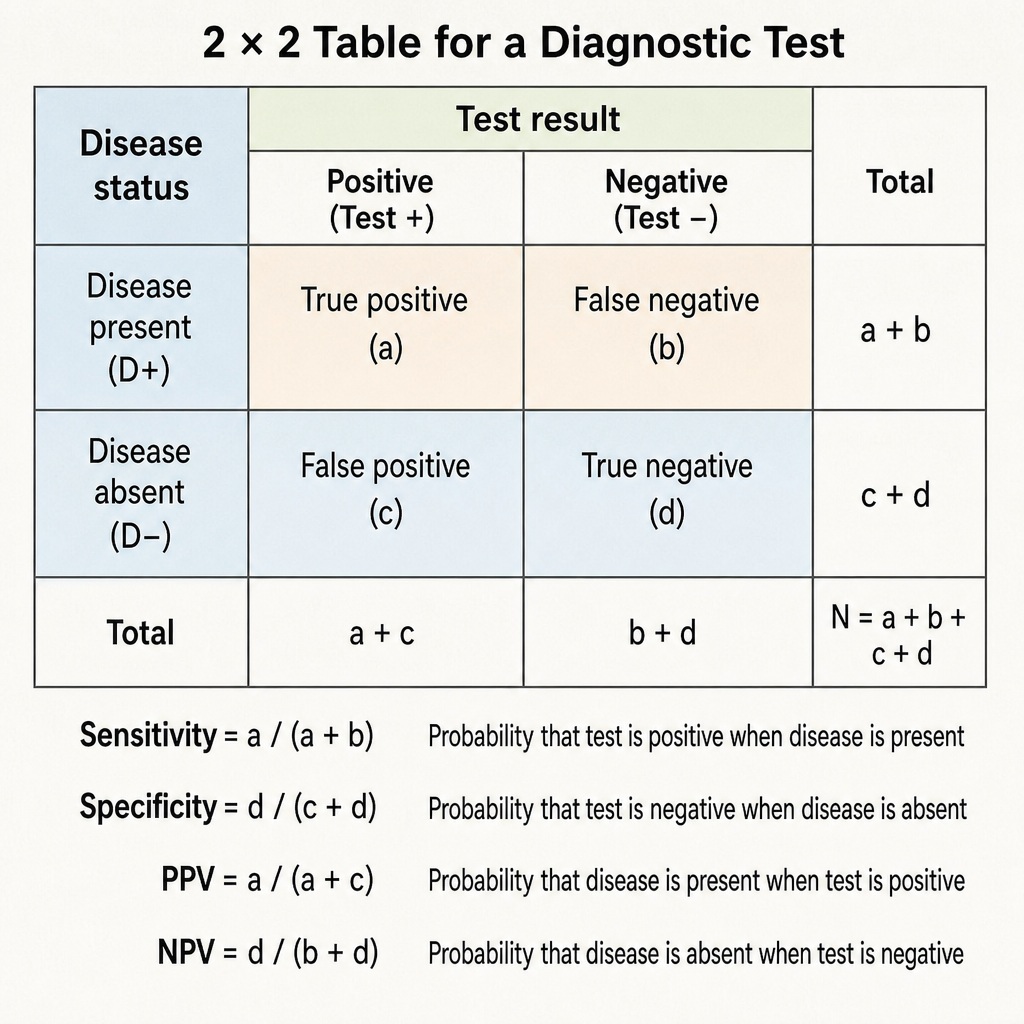
A new screening test for disease X has a sensitivity of 90% and specificity of 80%. In a population where the prevalence of disease X is 5%, what is the positive predictive value of this test?
A multivariate analysis was conducted to examine the relationship between risk of developing blindness and age. The results are shown in the table below. Which of the following is true?

Explanation: ***Early termination may lead to overestimation of treatment effect*** - Stopping a trial early due to perceived efficacy, especially with **fewer patients** than planned, can lead to an inflated estimate of the **treatment's true benefit**. - This phenomenon, known as **"winner's curse"**, occurs because early positive results could be due to random chance or statistical fluctuations, which would likely regress to the mean with a larger sample size. *The trial should continue to planned completion regardless of interim results* - While completing a trial provides the most robust estimate, ethical considerations about exposing patients to an **inferior treatment** often warrant early termination, especially when a new treatment shows significant superiority. - However, strictly adhering to the original sample size despite strong interim results can be **ethically problematic** and may unnecessarily delay access to a beneficial therapy. *The p-value is too low to be clinically meaningful* - A p-value of 0.001 indicates a **high level of statistical significance**, suggesting a very low probability that the observed effect was due to chance. - A low p-value typically implies **strong statistical evidence** against the null hypothesis, making it highly meaningful from a statistical perspective, though clinical significance requires further interpretation. *Early termination is justified by the strong statistical evidence* - While a **low p-value (p = 0.001)** indicates strong statistical evidence, early termination based solely on this can have methodological drawbacks. - Such decisions require careful consideration of the **pre-specified interim analysis plan**, the magnitude of the observed effect, and potential for overestimation, rather than just statistical significance alone.
Explanation: ***The heterogeneity suggests the treatment effect varies across populations*** - An **I² statistic of 85%** indicates a high degree of **heterogeneity**, meaning that the true effect size of the treatment likely varies considerably across the studies included in the meta-analysis. - This variation suggests that the treatment's effectiveness may differ depending on characteristics of the study populations, interventions used, or other methodological factors, implying that the overall effect might not apply uniformly to all patients. *The statistical significance overrides concerns about heterogeneity* - While the overall effect size being **statistically significant (p < 0.01)** indicates that the observed effect is unlikely due to chance, it does not negate the implications of high heterogeneity. - High heterogeneity suggests that combining all studies into one overall effect might be misleading, as the *average* effect may not accurately represent the effect in any specific subgroup. *The heterogeneity indicates poor study quality* - Poor study quality can contribute to heterogeneity, but heterogeneity itself does not solely indicate poor quality; it primarily reflects variability in results beyond what would be expected by chance. - While it's crucial to assess study quality (e.g., risk of bias), heterogeneity can also arise from genuine differences in **patient populations**, **interventions**, **comparators**, or **outcome measures**. *The meta-analysis should include more studies to reduce heterogeneity* - Including more studies does not inherently reduce heterogeneity; rather, it could potentially increase it if the new studies introduce additional variability. - Addressing heterogeneity typically involves investigating its sources through **subgroup analyses** or **meta-regression**, or using **random-effects models** rather than fixed-effect models, not simply adding more studies.
Explanation: **The treatment shows minimal clinical benefit despite statistical significance** - A **p-value of 0.02** indicates statistical significance, meaning the observed difference is unlikely due to random chance, but it does not convey the magnitude or importance of the effect. - A **small effect size (Cohen's d = 0.2)** suggests a **clinically insignificant difference**, even if statistically detectable; the treatment's impact on patient outcomes is likely very minor. *The results are contradictory and cannot be interpreted* - The results are **not contradictory** but rather highlight the distinction between **statistical significance** and **clinical significance**, which is a common scenario in research. - We can interpret these findings by understanding that a statistically significant result with a small effect size means the intervention had an effect, but that effect is of **little practical importance**. *The treatment should be immediately adopted due to statistical significance* - Immediate adoption based solely on **statistical significance** is inappropriate when the **effect size is small** and the confidence interval barely excludes the null, as the clinical utility is questionable. - **Clinical relevance** and **effect size** are crucial considerations for adoption, as a treatment with minimal benefit may not justify its cost, potential side effects, or logistical challenges. *The small effect size invalidates the statistical significance* - **Statistical significance** and **effect size** are distinct concepts; a small effect size does not invalidate a statistically significant p-value. - The p-value tells us about the **probability of observing the data** if the null hypothesis were true, while the effect size quantifies the **magnitude of the observed effect**.
Explanation: ***The treatment provides modest clinical benefit*** - The **relative risk of 0.75** indicates a 25% reduction in the event rate (1 - 0.75 = 0.25), while the **Number Needed to Treat (NNT) of 20** means that 20 patients need to be treated for one additional patient to benefit. - A NNT of 20 suggests a **modest benefit**; while not negligible, it isn't an overwhelmingly strong effect, implying that a reasonable number of patients must be treated to see one positive outcome. *The treatment provides substantial clinical benefit* - A substantial clinical benefit would typically be indicated by a much **lower NNT** (e.g., NNT < 10) and a larger relative risk reduction. - While there is a benefit, an NNT of 20 suggests it is not dramatic enough to be considered "substantial" for most clinical scenarios. *The results are contradictory and cannot be interpreted* - The provided results (control event rate, treatment event rate, relative risk, NNT) are **consistent with each other** and can be readily interpreted. - The calculations are standard epidemiological measures, and they convey a clear picture of the treatment's effect size. *The treatment has no clinically meaningful effect* - The **relative risk of 0.75** and an **NNT of 20** both clearly indicate a reduction in the event rate, meaning there is an effect. - An **effect size** that requires treating 20 patients to prevent one adverse event is generally considered meaningful, even if it's not large. *The treatment is harmful* - The **relative risk of 0.75** indicates a **reduction in events** in the treatment group compared to the control group, which signifies a beneficial effect. - If the treatment were harmful, the event rate in the treatment group would be higher, resulting in a relative risk greater than 1.
Explanation: ***The new medication reduces risk by 25%*** - A **relative risk (RR) of 0.75** means that the risk in the exposed group is 75% of the risk in the unexposed group, indicating a **25% reduction in risk** (1 - 0.75 = 0.25). - The **95% confidence interval (CI) of 0.60-0.90** does not include 1, signifying that the observed risk reduction is **statistically significant**. *The confidence interval is too wide to be meaningful* - A CI of 0.60-0.90 is **relatively narrow** in this context, providing a precise estimate of the treatment effect. - The fact that the entire CI is **below 1** indicates a meaningful and statistically significant reduction in risk. *The new medication increases risk by 25%* - This interpretation would be correct if the **relative risk were 1.25** (i.e., 25% *increase* in risk). - An RR of 0.75 indicates a **reduction**, not an increase, in risk. *The new medication reduces risk by 75%* - A 75% reduction in risk would correspond to a **relative risk of 0.25** (1 - 0.75 = 0.25). - The observed relative risk of 0.75 signifies a **25% risk reduction**.
Explanation: ***Correct: The result is statistically significant at the 0.10 level*** - A **p-value of 0.08** is less than 0.10, indicating **statistical significance** when the alpha level is set at 0.10 - While it doesn't meet the conventional **0.05 threshold** commonly used in medical research, it demonstrates that observing such a result by chance alone would occur less than 10% of the time if the null hypothesis were true - This represents a **borderline or trending result** that suggests a possible treatment difference warranting careful interpretation and potentially further investigation *Incorrect: The result suggests no difference, but the study may be underpowered* - A p-value of 0.08 does **not suggest "no difference"**; rather, it indicates a result approaching statistical significance - The study had **80% power**, which is considered **adequate** for detecting a clinically meaningful difference, so the study is **not underpowered** - Underpowered studies typically have power <80% and are more likely to miss true effects (Type II errors) *Incorrect: The study should be repeated with the same sample size* - Repeating with the **same sample size** would likely yield similar borderline results without adding clarity - If replication is desired, increasing the **sample size** would provide greater power and potentially more definitive results at the conventional α=0.05 level - A p-value of 0.08 might suggest pursuing **confirmatory studies** rather than simple repetition *Incorrect: The treatments are equivalent since p > 0.05* - A **non-significant result (p > 0.05) does not prove equivalence** or "no difference" - Demonstrating equivalence requires specific **equivalence trial designs** with predetermined equivalence margins - Failure to reject the null hypothesis simply means insufficient evidence for a difference, not proof that treatments are the same - The p-value of 0.08 actually suggests a **trend toward difference** rather than equivalence
Explanation: ***70%*** - To calculate the post-test probability, first convert the pre-test probability to **pre-test odds**: 20% probability is 20/ (100-20) = 20/80 = 0.25. - Then, multiply the pre-test odds by the **likelihood ratio positive (LR+)**: 0.25 * 10 = 2.5 (post-test odds). Convert back to percentage by using the formula: odds / (1+odds) = 2.5 / (1+2.5) = 2.5 / 3.5 ≈ 0.714, or approximately 70%. *30%* - This percentage is too low for the given LR+ of 10, which indicates a strong positive test result. - A 30% post-test probability would be more likely with a weaker test or a lower initial pre-test probability. *50%* - A 50% post-test probability would result from post-test odds of 1 (1 / (1+1) = 0.5), which is considerably lower than the calculated 2.5. - This indicates a significant underestimation of the test's impact on the probability. *90%* - While 90% is a high post-test probability, it is higher than the correct calculation. - This result might occur with a higher initial pre-test probability or a slightly higher LR+ value.
Explanation: ***The result is statistically significant but may not be clinically meaningful*** - A **p-value of 0.03** is less than the conventional alpha level of 0.05, indicating **statistical significance**, meaning the observed effect is unlikely due to chance. - However, the **clinical meaningfulness** of an effect size (0.5 to 2.1) is context-dependent and requires expert judgment; a statistically significant effect may still be too small to be practically important in patient care. *The p-value is too high to draw any conclusions* - A **p-value of 0.03** is generally considered **statistically significant** (p < 0.05), allowing conclusions to be drawn regarding the rejection of the null hypothesis. - This statement contradicts the standard interpretation of p-values in hypothesis testing. *The result is both statistically and clinically significant* - While the result is **statistically significant** (p = 0.03), its **clinical significance** is not automatically determined by a confidence interval alone. - The range of the **effect size (0.5 to 2.1)** needs to be evaluated against clinical thresholds or patient-important outcomes to determine if it is clinically meaningful. *The result is neither statistically nor clinically significant* - The **p-value of 0.03** indicates **statistical significance**, refuting the claim that it is neither. - While clinical significance is debatable, the statistical significance cannot be ignored.
Explanation: ***19.1%*** - The **positive predictive value (PPV)** is calculated using **Bayes' theorem**: `PPV = (Sensitivity × Prevalence) / [(Sensitivity × Prevalence) + ((1 - Specificity) × (1 - Prevalence))]`. - Plugging in the values: `PPV = (0.90 × 0.05) / [(0.90 × 0.05) + ((1 - 0.80) × (1 - 0.05))] = 0.045 / [0.045 + (0.20 × 0.95)] = 0.045 / (0.045 + 0.19) = 0.045 / 0.235 ≈ 0.1914`, or **19.1%**. *90%* - This value represents the **sensitivity** of the test, not the positive predictive value. - Sensitivity is the proportion of true positives among all individuals with the disease, not the probability of having the disease given a positive test result. *45%* - This incorrect value might arise from simply multiplying sensitivity and prevalence (0.90 × 0.05 = 0.045 = 4.5%), then mistakenly multiplying by 10. - It does not correspond to any standard epidemiological metric and results from miscalculation of PPV. *72%* - This incorrect value does not align with the standard PPV formula using the provided sensitivity, specificity, and prevalence. - This may result from miscalculating the denominator or incorrectly applying the formula, such as ignoring the false positive component.
Explanation: ***>80 y age group has the strongest association with blindness risk*** - The odds ratio for the **>80 years** age group is **2.1**, which is the highest among all age groups listed in the table, indicating the strongest association with blindness risk. - A higher odds ratio means a greater likelihood of the outcome (blindness) compared to the reference category. - All age groups shown have **p-values <0.001**, confirming statistical significance. *60-69 y age group shows statistically significant association with blindness* - While the 60-69 y age group has an odds ratio of **1.5** with **p<0.001**, indicating statistical significance, it does not have the strongest association compared to the **>80 y** age group (OR 2.1). - Statistical significance confirms the association is real, but effect size (OR) determines strength of association. *<50 y age group serves as the reference category* - The table shows an **Odds Ratio (OR) of 1.1** for the **<50 y** age group, indicating it is also being compared to a reference (which would have OR = 1.0). - The reference category is not explicitly shown in the table but would typically be an even younger age group or overall population baseline. *50-59 y age group has the highest odds ratio for blindness risk* - The odds ratio for the **50-59 y** age group is **1.2**, which is lower than the **>80 y** age group (OR 2.1), the **70-79 y** age group (OR 1.6), and the **60-69 y** age group (OR 1.5). - This statement is incorrect as the **>80 y** age group clearly has the highest odds ratio for blindness risk.
Collection and Presentation of Data
Practice Questions
Measures of Central Tendency
Practice Questions
Measures of Dispersion
Practice Questions
Normal Distribution
Practice Questions
Sampling Methods
Practice Questions
Sample Size Calculation
Practice Questions
Hypothesis Testing
Practice Questions
Tests of Significance
Practice Questions
Correlation and Regression
Practice Questions
Survival Analysis
Practice Questions
Multivariate Analysis
Practice Questions
Statistical Software in Research
Practice Questions
Get full access to all questions, explanations, and performance tracking.
Start For Free