A professor at AIIMS was asked to conduct a study on hazardous effects of cellphone use on health of urban Indians. He selected the study group in the fashion shown below. It indicates:

The given image shows which kind of sampling?

In the following diagram which is correct?

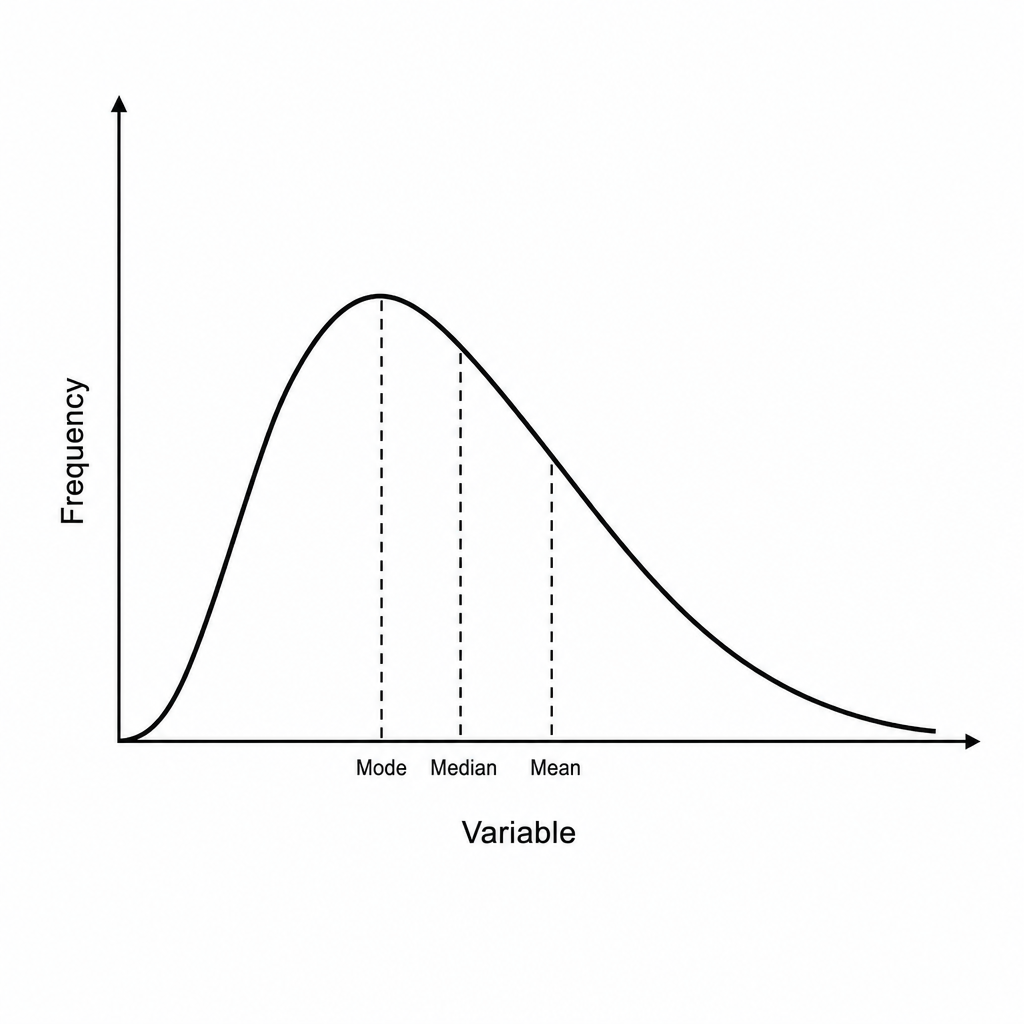
What is correct about the distribution curve shown below?

The following statistical diagram is called

The following statistical diagram is called

The following statistical diagram is called

The following statistical diagram is called

The following statistical diagram is known as

A scatter diagram is shown below between two quantitative variables. Which of the following is the correct interpretation?

Explanation: **Cluster random sampling** - The image shows distinct **groups (clusters)** like "Reliance," "Airtel," and "Vodafone," from which entire clusters or randomly selected individuals from within certain clusters are chosen for the sample. - In this method, the **population is divided into clusters**, and then a random sample of these clusters is drawn. All units within the selected clusters (or a random selection of units within selected clusters) are included in the sample. - This is the sampling method depicted in the image. *Simple random sampling* - This method involves selecting subjects from the entire population **randomly and independently**, where each member has an equal chance of being selected. - The image illustrates pre-defined groups and selection from within and between them, which isn't characteristic of a single, undifferentiated pool for simple random selection. *Systematic random sampling* - This technique involves selecting every **k-th individual** from a list, after a random start. - The visual representation does not suggest a continuous list or a patterned, interval-based selection process. *Stratified random sampling* - In this method, the population is divided into **homogeneous subgroups (strata)** based on shared characteristics, and then a simple random sample is drawn from each stratum. - While there are groups (Reliance, Airtel, Vodafone), the selection process shown (selecting some individuals from one group, some from another, and possibly an entire smaller group from a larger one) does not strictly adhere to sampling proportionally from each stratum to ensure representation.
Explanation: ***Systematic random sampling*** - The image illustrates **systematic random sampling** where participants are selected at regular intervals from a list, using a starting point chosen randomly. - For example, if we have 100 people and want to sample 10, we could pick every 10th person after a random start between 1 and 10. *Simple random sampling* - In **simple random sampling**, every individual in the population has an **equal chance** of being selected, like drawing names from a hat. - The image does not show a random selection of individuals from the entire pool without any specific pattern or interval. *Stratified random sampling* - **Stratified random sampling** involves dividing the population into **subgroups (strata)** based on shared characteristics, then taking a random sample from each stratum. - The image does not show any deliberate division of the population into distinct strata before sampling. *Cluster random sampling* - **Cluster random sampling** involves dividing the population into **clusters**, randomly selecting entire clusters, and then sampling all individuals within the chosen clusters. - The image does not depict the selection of entire pre-defined groups or clusters of individuals.
Explanation: ***Mean > median > mode*** - The diagram illustrates a **positively skewed distribution** (right-skewed), where the tail extends to the right. - In a positively skewed distribution, the correct order is always: **Mode < Median < Mean**. - The **mode** (peak) is at the highest frequency, the **median** is in the middle, and the **mean** is pulled towards the right tail by higher values. - This is the **standard relationship** for any right-skewed distribution. *Median > mode > mean* - This order describes a **negatively skewed (left-skewed) distribution**, where the tail extends to the left. - In a negatively skewed distribution: Mean < Median < Mode. - The diagram shows the opposite pattern (right skew), making this incorrect. *Mean > mode > median* - While the mean is indeed greater than the mode in a positively skewed distribution, the **median always lies between the mode and mean**. - The correct relationship for positive skew is: Mode < **Median** < Mean (not Mode < Mean < Median). - This violates the fundamental property that median is the middle value in skewed distributions. *Mean = mode = median* - This equality holds only for a **symmetrical distribution**, such as a **normal distribution** (bell curve). - In symmetrical distributions, data is evenly distributed around the center point. - The diagram clearly shows an **asymmetrical, right-skewed distribution**, making this incorrect.
Explanation: ***Positively skewed distribution*** - The curve shown is **skewed to the right** (positively skewed), meaning the tail of the distribution extends further to the right. - In a positively skewed distribution, the **mean is typically greater than the median**, which is greater than the mode. - There are more values clustered on the left side of the graph, with outliers extending to the right. - The relationship is: **Mode < Median < Mean** *Normal distribution* - A **normal distribution** (or Gaussian distribution) is symmetrical, forming a bell-shaped curve. - In such a distribution, the **mean, median, and mode are all equal** and located at the center of the curve. - There is no skewness in a normal distribution. *Negatively skewed distribution* - A **negatively skewed distribution** is skewed to the left, meaning the tail of the distribution extends further to the left. - In a negatively skewed distribution, the **mean is typically less than the median**, which is less than the mode. - There are more values clustered on the right side of the graph, with outliers extending to the left. - The relationship is: **Mean < Median < Mode** *Square wave distribution* - A **square wave distribution** is a periodic, non-sinusoidal waveform where the amplitude alternates regularly and instantaneously between two fixed values. - This type of distribution is **not represented by a continuous, curved shape** like the one shown and is not a standard probability distribution in biostatistics.
Explanation: ***Forest plot*** - A **forest plot** is a graphical display used primarily in **meta-analysis** to show the results of multiple studies comparing treatment effects. - It displays individual study effect sizes (as squares or points) with their **confidence intervals** (as horizontal lines), along with an overall pooled effect estimate (typically shown as a diamond). - The vertical line represents **no effect** (null hypothesis), and studies whose confidence intervals cross this line show non-significant results. - Forest plots allow quick visual assessment of consistency across studies and the overall effect magnitude. *Funnel plot* - A funnel plot is used to **detect publication bias** in meta-analyses by plotting study effect sizes against their precision (or sample size). - It typically shows a scatter plot with a triangular "funnel" shape, where smaller studies show more scatter and larger studies cluster at the top. - This is distinctly different from a forest plot, which displays confidence intervals horizontally. *Box and whisker plot* - A box and whisker plot represents the **distribution of numerical data** through quartiles, median, and outliers. - It shows the minimum, first quartile (Q1), median (Q2), third quartile (Q3), and maximum values in a box-and-whisker format. - It does not display multiple study results or confidence intervals. *Stem and leaf plot* - A stem and leaf plot is a **simple way to display quantitative data** by separating each data point into a "stem" (leading digit) and a "leaf" (trailing digit). - This method organizes small to moderately sized datasets and shows the actual data values while preserving their distribution shape. - It does not show comparative study results or confidence intervals.
Explanation: ***Funnel plot*** - The diagram shows a **scatter plot** of studies arranged by **trial size (number of subjects)** on the y-axis and a measure of effect (implied effect size, typically odds ratio, risk ratio, or difference in means) on the x-axis, resembling an inverted funnel. - This characteristic funnel shape is used to visually assess **publication bias** or heterogeneity among studies in a meta-analysis. *Forest plot* - A **forest plot** displays the results of individual studies and their combined effect estimate, often represented by squares and a diamond. - It does not have the "funnel" shape seen in the provided image. *Box and whisker plot* - A **box and whisker plot** graphically displays the distribution of numerical data through their quartiles, showing the median, interquartile range, and potential outliers. - It is used to summarize dataset distributions and does not resemble the shown plot. *Stem and leaf plot* - A **stem and leaf plot** is a method for displaying quantitative data in a way that preserves original data values and provides a visual representation of their distribution. - This plot organizes data by separating observed values into a stem (leading digit) and a leaf (trailing digit), which is distinctly different from the given image.
Explanation: ***Box and whisker plot*** - This diagram displays the **distribution** of a dataset through **quartiles**, with the "box" representing the interquartile range (25th to 75th percentile) and the "whiskers" extending to the minimum and maximum values (or a specified percentile range). - The horizontal line inside each box indicates the **median** of the data, providing a visual summary of central tendency and spread for different categories. *Forest plot* - A forest plot is typically used in **meta-analyses** to display the results of multiple studies measuring the same outcome. - It shows **individual study estimates** and their confidence intervals, along with an overall pooled estimate. *Funnel plot* - A funnel plot is used to assess **publication bias** in meta-analyses. - It plots the effect size against a measure of study precision, and in the absence of bias, the plot should resemble a symmetrical inverted funnel. *Stem and leaf plot* - A stem and leaf plot is a way of organizing numerical data to show its **distribution** while retaining the individual data points. - It separates each data point into a "stem" (the leading digit(s)) and a "leaf" (the trailing digit).
Explanation: ***Stem and leaf plot*** - This diagram displays quantitative data by separating each value into a "stem" (first digit(s)) and a "leaf" (last digit), arranged in order. - The provided image clearly shows digits on the left serving as stems (e.g., 1, 2, 3) and corresponding digits on the right as leaves (e.g., 80, 40, 60, 70), indicating a stem and leaf plot. *Forest plot* - A forest plot graphically presents the results of a **meta-analysis**, showing the estimated treatment effects and confidence intervals from multiple studies. - It does not organize individual data points by their numerical values in a stem-and-leaf structure. *Funnel plot* - A funnel plot is used to assess **publication bias** in a meta-analysis, plotting the effect size against a measure of study precision (e.g., standard error). - It appears as a scatter plot and does not resemble the structure of the given diagram. *Box and whisker plot* - A box and whisker plot displays the **five-number summary** of a set of data: minimum, first quartile, median, third quartile, and maximum. - It uses a rectangular "box" and "whiskers" extending from it, which is distinctly different from the digit-based organization seen in the image.
Explanation: ***Forest plot*** - This diagram, featuring a series of horizontal lines (representing **confidence intervals**) for different studies or outcomes, centered around a point estimate (often a **hazard ratio** or odds ratio), is characteristic of a forest plot. - Forest plots are commonly used in **meta-analyses** to graphically present the results of individual studies and their combined effect. *Kaplan Meier plot* - A Kaplan-Meier plot is a **survival curve** that shows the probability of a subject surviving beyond a certain time point. - It consists of a **stepwise function** decreasing over time, rather than individual point estimates with confidence intervals. *Spaghetti plot* - A spaghetti plot is used to display **multiple time series** on a single graph, where each line represents an individual's data over time. - This type of plot helps visualize **individual variability** and trends, but it does not represent hazard ratios or confidence intervals in the way shown. *Funnel plot* - A funnel plot is a scatter plot used to detect **publication bias** in meta-analyses, where the effect size is plotted against a measure of study precision. - It typically appears as a symmetrical, **funnel-shaped distribution** of points, which is visually distinct from the given diagram.
Explanation: ***There is non-linear correlation between the two variables*** - The data points in the scatter diagram clearly show a **pattern**, indicating a relationship between the variables. - However, this relationship is not a straight line; it curves upwards and then downwards, which defines a **non-linear correlation**. *There is correlation between the two variables and Pearson coefficient is 1* - While there is a **correlation**, the Pearson correlation coefficient of **1** implies a perfect positive linear relationship, meaning all points lie exactly on an upward-sloping straight line, which is not what is shown here. - The data points clearly deviate from a single straight line, showing both positive and negative trends at different stages. *There is correlation between the two variables and Pearson coefficient is -1* - The Pearson correlation coefficient of **-1** implies a perfect negative linear relationship, meaning all points lie exactly on a downward-sloping straight line. - The scatter plot shows a curved pattern, not a perfect negative linear trend. *There is no association between the two variables* - This statement is incorrect because the data points clearly show a **discernible pattern**, indicating that the variables are related. - If there were no association, the points would be scattered randomly with no clear trend or shape.
Collection and Presentation of Data
Practice Questions
Measures of Central Tendency
Practice Questions
Measures of Dispersion
Practice Questions
Normal Distribution
Practice Questions
Sampling Methods
Practice Questions
Sample Size Calculation
Practice Questions
Hypothesis Testing
Practice Questions
Tests of Significance
Practice Questions
Correlation and Regression
Practice Questions
Survival Analysis
Practice Questions
Multivariate Analysis
Practice Questions
Statistical Software in Research
Practice Questions
Get full access to all questions, explanations, and performance tracking.
Start For Free