Which scale is used for classifying data that lacks a particular structure and is presented without inherent order?
The median weight of 100 children was 16 kgs. The standard deviation was 8. Calculate the percentage coefficient of variance.
In a cohort study of 7000 smokers over ten years, 70 developed lung cancer. In a concurrent evaluation of 7000 non-smokers in the same catchment area, 7 developed lung cancer. What is the Relative Risk (RR) for developing lung cancer?
The "Crude death rate" is defined as the number of deaths (from all causes) per 1000 estimated what?
Type 1 Sampling error is classified as?
A village is divided into five relevant subgroups for the purpose of a survey. Individuals from each subgroup are then selected randomly. What is this type of sampling called?
A chi-square test would be most appropriate for testing which one of the following hypotheses?
What is true about the standard normal distribution?
What is the definition of neonatal mortality?
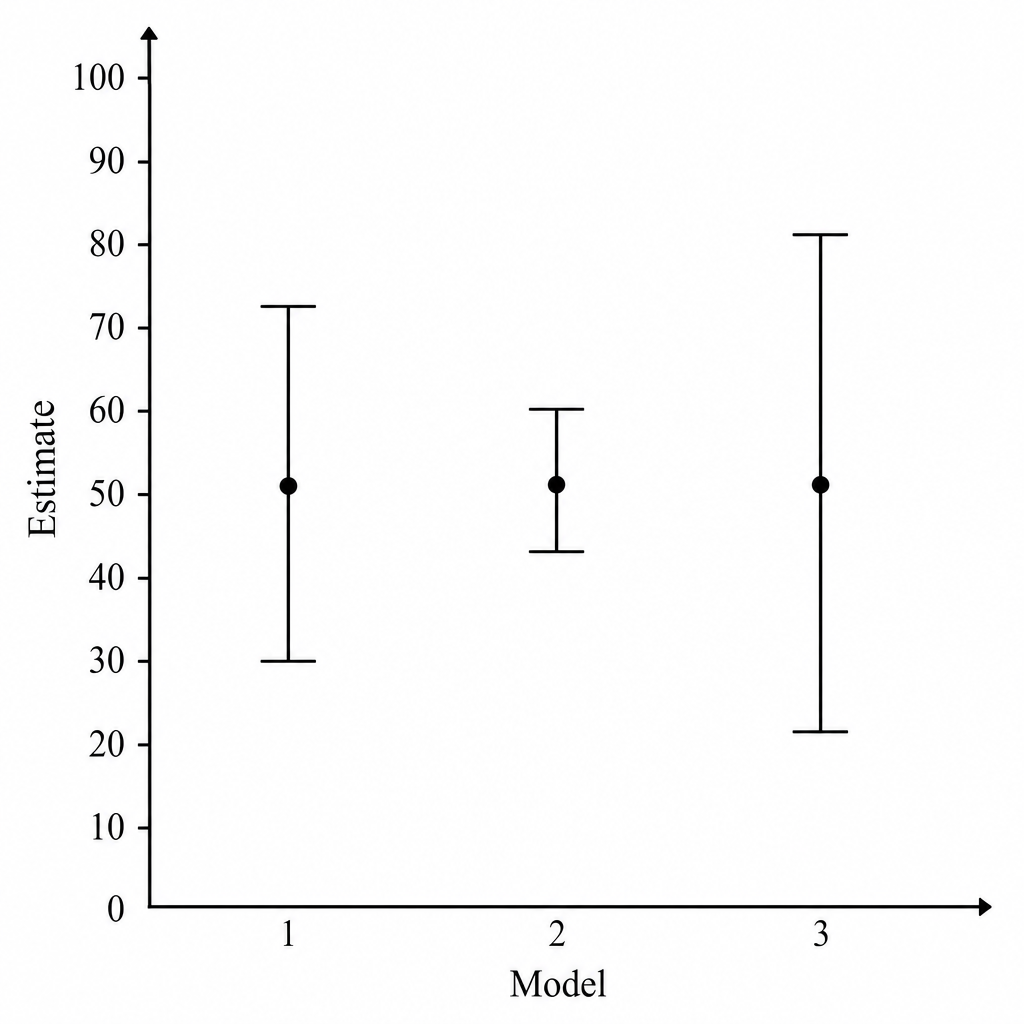
Interpret the statistical graph shown below:

Explanation: ### Explanation **Correct Answer: B. Nominal** In biostatistics, the **Nominal scale** is the simplest level of measurement. It is used for qualitative data where items are assigned to distinct categories based on a name or label. The defining characteristic of nominal data is that it **lacks an inherent order, rank, or numerical structure**. You cannot say one category is "higher" or "better" than another mathematically. * **Medical Example:** Blood groups (A, B, AB, O), Gender (Male, Female), or Site of infection. These are simply labels; Group A is not "greater" than Group B. --- ### Why the other options are incorrect: * **A. Ordinal:** While this also deals with qualitative categories, it possesses a **natural order or rank**. However, the distance between the ranks is not quantifiable. * *Example:* Stages of cancer (I, II, III, IV) or Socio-economic status (Low, Middle, High). * **C. Interval:** This is a quantitative scale where the distance between values is equal and meaningful, but there is **no absolute zero**. * *Example:* Temperature in Celsius or Fahrenheit (0°C does not mean "no temperature"). * **D. Ratio:** This is the highest level of measurement. It has all the properties of an interval scale plus a **true/absolute zero point**, allowing for the calculation of ratios. * *Example:* Height, Weight, Blood Pressure, or Pulse rate. (0 kg means no weight). --- ### High-Yield Clinical Pearls for NEET-PG: 1. **Mnemonic (NOIR):** Remember the hierarchy from simplest to most complex: **N**ominal → **O**rdinal → **I**nterval → **R**atio. 2. **Qualitative vs. Quantitative:** Nominal and Ordinal are **Qualitative** (Categorical); Interval and Ratio are **Quantitative** (Numerical). 3. **Statistical Tests:** * For **Nominal** data, the **Chi-square test** is the most commonly used test of significance. * For **Ratio/Interval** data (Normal distribution), use **Student’s t-test** or **ANOVA**.
Explanation: ### Explanation **1. Why Option A is Correct** The **Coefficient of Variation (CV)** is a measure of relative dispersion that expresses the standard deviation as a percentage of the mean. The formula is: $$\text{CV} = \left( \frac{\text{Standard Deviation}}{\text{Mean}} \right) \times 100$$ In a **Normal (Gaussian) Distribution**, the mean, median, and mode are equal. For the purpose of NEET-PG calculations, if the mean is not explicitly provided but the median is given for a large sample (n=100), we use the median as the best estimate for the mean. * **Standard Deviation (SD):** 8 * **Mean (Median):** 16 * **Calculation:** $(8 / 16) \times 100 = 0.5 \times 100 = \mathbf{50\%}$. **2. Why Other Options are Wrong** * **Options B, C, and D (35%, 45%, 55%):** These values are mathematically incorrect based on the provided data. They would only be correct if the SD was 5.6, 7.2, or 8.8 respectively, assuming a mean of 16. **3. Clinical Pearls & High-Yield Facts** * **Unitless Measure:** Unlike Standard Deviation, CV has no units. This makes it the gold standard for comparing the variability of two different datasets (e.g., comparing the variability of height in cm vs. weight in kg). * **Normal Distribution Properties:** In a perfectly normal distribution, Mean = Median = Mode. * **Standard Error vs. SD:** Do not confuse CV with Standard Error (SE). $SE = SD / \sqrt{n}$. SE measures the precision of the sample mean, while CV measures the relative spread. * **Rule of Thumb:** A higher CV indicates greater dispersion/volatility relative to the mean, while a lower CV indicates higher consistency.
Explanation: ### Explanation **1. Why Option B (10) is Correct:** Relative Risk (RR) is the ratio of the incidence of a disease among an exposed group to the incidence among a non-exposed group. It is the primary measure of association in **Cohort Studies**. * **Incidence in Exposed (Smokers):** $I_e = \frac{\text{New cases}}{\text{Total exposed}} = \frac{70}{7000} = 0.01$ (or 10 per 1000) * **Incidence in Non-exposed (Non-smokers):** $I_o = \frac{\text{New cases}}{\text{Total non-exposed}} = \frac{7}{7000} = 0.001$ (or 1 per 1000) * **Formula for Relative Risk (RR):** $\frac{I_e}{I_o} = \frac{0.01}{0.001} = \mathbf{10}$ This means smokers are 10 times more likely to develop lung cancer compared to non-smokers. **2. Why Other Options are Incorrect:** * **Option A (1):** An RR of 1 indicates "Null Hypothesis" (no association between exposure and disease). * **Option C (100):** This would imply a much higher strength of association, likely due to a calculation error in decimal placement. * **Option D (0.1):** An RR < 1 indicates a "Protective Effect" (the exposure prevents the disease), which is clinically incorrect for smoking and cancer. **3. High-Yield Clinical Pearls for NEET-PG:** * **Relative Risk (RR):** Direct measure of the **strength of association**. It is calculated only in prospective studies (Cohort). * **Odds Ratio (OR):** Used in Case-Control studies as an estimate of RR. * **Attributable Risk (AR):** $(I_e - I_o) / I_e \times 100$. It indicates the amount of disease that can be prevented if the exposure is eliminated. * **Population Attributable Risk (PAR):** Useful for public health administrators to prioritize interventions in the community.
Explanation: **Explanation:** **1. Why "Mid-year population" is correct:** The Crude Death Rate (CDR) is a fundamental measure of mortality in a population. It is calculated as the number of deaths occurring during a calendar year per 1000 of the **mid-year population**. The mid-year population (estimated as of July 1st) is used as the denominator because it represents the "average" population at risk of dying throughout that year, accounting for births, deaths, and migrations that occur during the 12-month period. **2. Why other options are incorrect:** * **Total population:** While CDR relates to the population, "Total population" is vague. In demography, the population size fluctuates daily; therefore, the specific mid-year estimate is the standardized denominator used for annual rates. * **Total births / Live births:** These are used as denominators for mortality indicators specifically related to early life, such as the **Infant Mortality Rate (IMR)** or **Maternal Mortality Ratio (MMR)**, rather than the general death rate of the entire community. **3. NEET-PG High-Yield Pearls:** * **Formula:** $CDR = \frac{\text{Number of deaths during the year}}{\text{Mid-year population}} \times 1000$. * **Limitation:** The CDR is "crude" because it does not account for the age and sex composition of the population. A population with many elderly individuals will have a higher CDR than a younger population, even if health conditions are better. * **Comparison:** To compare mortality between two different populations (e.g., Kerala vs. UP), **Age-Standardized Death Rates** are the preferred indicator to eliminate the bias of age distribution. * **Current Trend:** According to recent SRS (Sample Registration System) data, the CDR for India is approximately **6.0 per 1000** mid-year population.
Explanation: In biostatistics, hypothesis testing involves making a decision about a population based on sample data. Errors occur when this decision does not reflect the true state of the population. ### **Explanation of the Correct Answer** **A. Alpha (α) Error (Type I Error):** This occurs when a researcher **rejects a null hypothesis that is actually true**. In clinical terms, it is a "False Positive" result—concluding that a treatment works or a difference exists when, in reality, it does not. The probability of committing a Type I error is denoted by the significance level (α), commonly set at 0.05 (5%). ### **Explanation of Incorrect Options** * **B. Beta (β) Error (Type II Error):** This occurs when a researcher **fails to reject a null hypothesis that is actually false**. It is a "False Negative" result—concluding there is no difference when one actually exists. * **C & D. Gamma and Delta Errors:** These are not standard terms used to classify primary sampling errors in classical hypothesis testing. While "Gamma" is used in specific correlation coefficients and "Delta" often represents effect size, they do not describe Type I or II errors. ### **NEET-PG High-Yield Pearls** * **Confidence Level:** Calculated as **(1 – α)**. It represents the probability of correctly accepting a true null hypothesis. * **Power of a Study:** Calculated as **(1 – β)**. It is the ability of a study to detect a difference if one truly exists. To increase power, one should increase the sample size. * **P-value:** The probability of committing a Type I error. If p < 0.05, the result is statistically significant. * **Memory Aid:** * **Type I (α):** **I**nnocent person goes to jail (False Positive). * **Type II (β):** **B**ad person goes free (False Negative).
Explanation: ### Explanation **1. Why Stratified Sampling is Correct:** In **Stratified Random Sampling**, the heterogeneous population is first divided into non-overlapping, homogeneous subgroups called **"strata"** based on specific characteristics (e.g., age, gender, socio-economic status, or "relevant subgroups" as mentioned in the question). A **simple random sample** is then drawn from *each* of these strata. This ensures that every subgroup is adequately represented, reducing sampling error compared to simple random sampling. **2. Why Other Options are Incorrect:** * **Simple Random Sampling:** Every individual in the entire population has an equal chance of being selected. There is no prior division into subgroups. * **Cluster Sampling:** The population is divided into groups (clusters), usually based on geographical areas (e.g., villages, wards). Unlike stratified sampling, you randomly select a few *entire clusters* and survey everyone within them, rather than selecting individuals from every group. * **Systematic Sampling:** This involves selecting every $k^{th}$ individual (sampling interval) from a list, starting from a random point (e.g., every 5th person entering an OPD). **3. High-Yield Clinical Pearls for NEET-PG:** * **Stratified vs. Cluster:** In Stratified sampling, the groups are **homogeneous within** (similar people) but **heterogeneous between** (strata differ from each other). In Cluster sampling, groups are **heterogeneous within** but **homogeneous between** (each cluster is a mini-reflection of the population). * **Multistage Sampling:** This is the most common method used in large-scale national health surveys (like NFHS), involving a combination of sampling techniques. * **Precision:** Stratified sampling is generally more precise than simple random sampling because it accounts for variability between subgroups.
Explanation: **Explanation:** The choice of a statistical test depends primarily on the **type of data** (qualitative vs. quantitative) and the **number of groups** being compared. **Why Option B is Correct:** The Chi-square ($\chi^2$) test is a non-parametric test used to compare **proportions** or to test the **association between two categorical (qualitative) variables**. In Option B, we are comparing the proportion of people developing zoster (Yes/No) between two groups (Immunized vs. Non-immunized). Since both the independent and dependent variables are categorical, the Chi-square test is the most appropriate choice. **Analysis of Incorrect Options:** * **Option A:** Compares the **mean** scores of two groups. For comparing means between two independent groups, a **Student’s t-test** is used. * **Option C:** Compares means across multiple groups (Black/White, Male/Female, ACE inhibitors/Diuretics/Placebo). When comparing means of more than two groups, **ANOVA (Analysis of Variance)** is the test of choice. * **Option D:** Compares the **mean** cost between two treatment modalities. Similar to Option A, this requires a **Student’s t-test**. **High-Yield Clinical Pearls for NEET-PG:** * **Qualitative Data (Proportions):** Use Chi-square test or Fisher’s Exact test (if sample size is small/cell frequency <5). * **Quantitative Data (Means):** * 2 groups: **Paired t-test** (before/after) or **Unpaired t-test** (independent groups). * >2 groups: **ANOVA**. * **Correlation:** To check the strength of a linear relationship between two continuous variables (e.g., Height and Weight), use **Pearson’s Correlation Coefficient (r)**. * **Regression:** Used to predict the value of one variable based on another.
Explanation: ### Explanation **1. Why Option A is Correct:** The Standard Normal Distribution (Z-distribution) is a specific type of probability density function. In statistics, the **total area under any probability curve must equal 1 (or 100%)**, representing the sum of all possible outcomes. This property is fundamental for calculating Z-scores and p-values, as the area under specific segments of the curve represents the probability of an observation falling within that range. **2. Why the Other Options are Incorrect:** * **Option B:** In a *Standard* Normal Distribution, the **Mean is always 0** and the Standard Deviation is 1. If the mean were 1, it would simply be a "Normal Distribution," not the "Standard" version. * **Option C:** The Normal Distribution is perfectly symmetrical. Therefore, the **Mean = Median = Mode**. The relationship "Mean > Median > Mode" describes a **Positively Skewed** distribution. * **Option D:** A distribution with a tail towards the right is **Positively Skewed**. The Standard Normal Distribution is bell-shaped and symmetrical with no skew; both tails extend infinitely but are identical in shape. **3. High-Yield Clinical Pearls for NEET-PG:** * **Z-score formula:** $Z = (x - \mu) / \sigma$. It tells you how many standard deviations a value is from the mean. * **Empirical Rule (68-95-99.7 Rule):** * Mean ± 1 SD covers **68.2%** of the area. * Mean ± 2 SD covers **95.4%** of the area. * Mean ± 3 SD covers **99.7%** of the area. * **Point of Inflection:** In a normal curve, this occurs at Mean ± 1 SD (where the curve changes from convex to concave). * **Standard Error:** As sample size increases, the standard error decreases, making the distribution narrower.
Explanation: **Neonatal Mortality Rate (NMR)** is a key indicator of newborn care and maternal health. It is defined as the number of deaths of live-born infants during the **first 28 completed days of life** per **1,000 live births** in a given year. ### Why Option A is Correct: The denominator for NMR is always **live births**. This is because the indicator specifically measures the survival probability of infants who were born showing signs of life. The numerator includes all deaths occurring from birth up to (but not including) 28 days. ### Why Other Options are Incorrect: * **Option B:** Stillbirths are excluded from both the numerator and denominator of NMR. Stillbirths refer to fetal deaths after 28 weeks of gestation but before birth. * **Option C:** "Total births" (Live births + Stillbirths) is the denominator used for the **Perinatal Mortality Rate**, not the Neonatal Mortality Rate. Using total births for NMR would inaccurately dilute the rate. ### High-Yield NEET-PG Pearls: * **Early Neonatal Period:** 0–7 days. * **Late Neonatal Period:** 7–28 days. * **Most Common Cause of NMR in India:** Prematurity and low birth weight (followed by birth asphyxia and neonatal sepsis). * **Timing:** Approximately 75% of neonatal deaths occur within the first week of life (Early Neonatal period), making it the most critical window for intervention. * **Formula:** $\frac{\text{Number of deaths } < 28 \text{ days in a year}}{\text{Total number of live births in the same year}} \times 1000$
Explanation: ***Positive correlation*** - In a **positive correlation**, as one variable increases, the other variable also increases, creating an **upward trending pattern** on the scatter plot. - The data points form a **linear pattern** sloping from bottom-left to top-right, indicating a **direct relationship** between the variables. *Negative correlation* - Shows a **downward trending pattern** where one variable increases while the other decreases. - Data points slope from **top-left to bottom-right**, indicating an **inverse relationship** between variables. *Absent correlation* - Data points are **randomly scattered** with no discernible pattern or trend. - The **correlation coefficient (r)** approaches **zero**, indicating no linear relationship between variables. *Spurious correlation* - Represents a **false association** between two variables that appear correlated but lack a true causal relationship. - Often occurs due to **confounding variables** or **coincidental patterns** in the data.
Collection and Presentation of Data
Practice Questions
Measures of Central Tendency
Practice Questions
Measures of Dispersion
Practice Questions
Normal Distribution
Practice Questions
Sampling Methods
Practice Questions
Sample Size Calculation
Practice Questions
Hypothesis Testing
Practice Questions
Tests of Significance
Practice Questions
Correlation and Regression
Practice Questions
Survival Analysis
Practice Questions
Multivariate Analysis
Practice Questions
Statistical Software in Research
Practice Questions
Get full access to all questions, explanations, and performance tracking.
Start For Free