The chance of passing a genetic disease 'y' trait by affected parents to their children is 0.16. If they plan to have two children, what is the probability that both children will have the 'y' trait?
Which of the following is true regarding the mortality rate?
In a group of 100 children, the mean weight is 15 kg and the standard deviation is 1.5 kg. Which one of the following is true?
A non-symmetrical frequency distribution is known as?
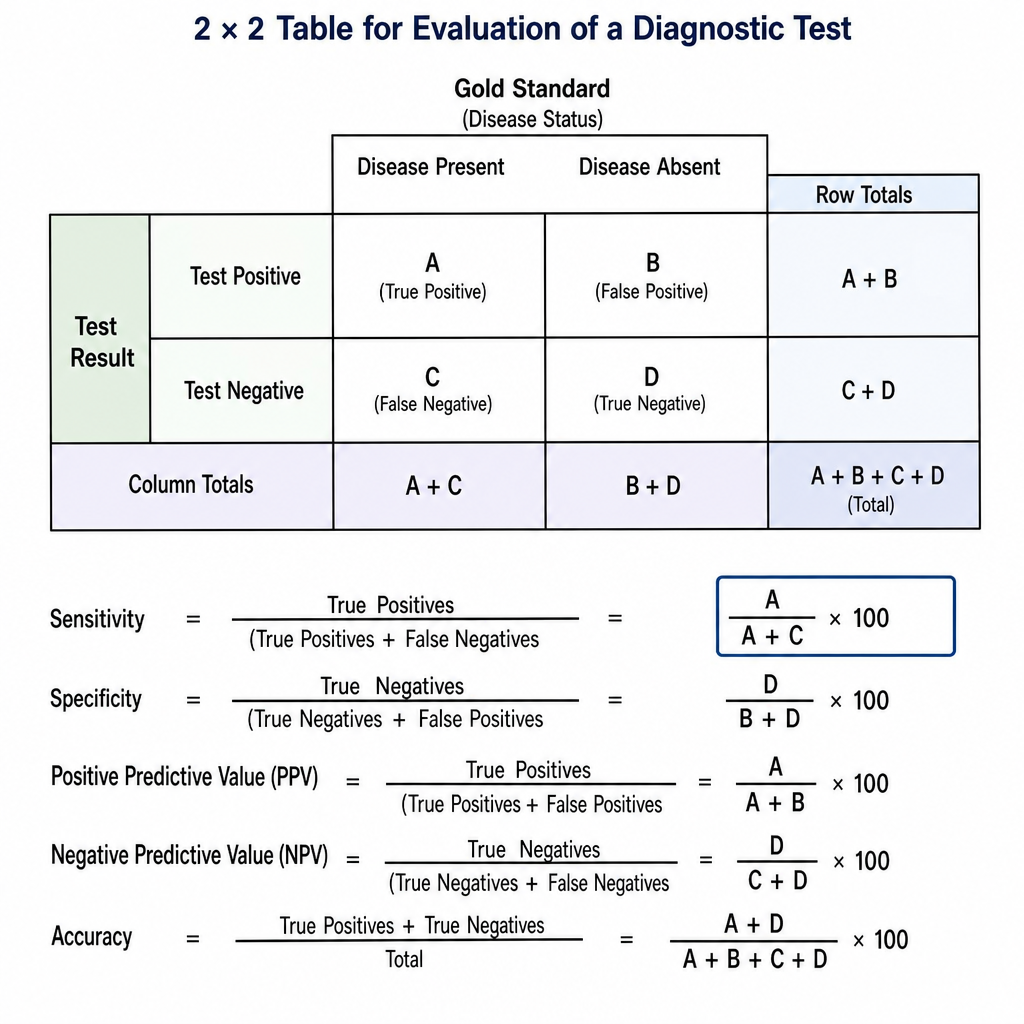
Specificity of a screening test is the ability of a test to correctly identify which of the following?
If the sample size in random sampling is increased, which of the following is true?
Two screening tests in series will increase which of the following?
If the first quartile of a dataset is 34, what percentage of observations will be greater than this value?
The 95% confidence limit typically exists within how many standard deviations of the mean?
If a researcher collects data from any member of the sampling frame that happens to be easily accessible, it is referred to as _____________ sampling?
Explanation: ### Explanation **1. Why Option D is Correct:** This question is based on the **Multiplication Rule of Probability** for **independent events**. In genetics, the inheritance of a trait by one child does not influence the inheritance of the same trait by a subsequent sibling; each birth is an independent event. * Probability of the 1st child having the trait ($P_1$) = 0.16 * Probability of the 2nd child having the trait ($P_2$) = 0.16 * To find the probability of **both** events occurring (Event A **AND** Event B), we multiply the individual probabilities: * $0.16 \times 0.16 = \mathbf{0.0256}$ **2. Why Other Options are Incorrect:** * **Option A (0):** This would imply that it is impossible for both children to inherit the trait, which contradicts genetic principles. * **Option B (0.16):** This is the probability for a single child. It ignores the requirement that *both* children must have the trait. * **Option C (0.32):** This is the result of the **Addition Rule** ($0.16 + 0.16$). Addition is used for "Either/Or" scenarios (mutually exclusive events), not "Both/And" scenarios. **3. Clinical Pearls & High-Yield Facts for NEET-PG:** * **Independent Events:** In biostatistics, remember that "Nature has no memory." The risk of a genetic disorder (e.g., Autosomal Recessive = 25%) remains the same for every pregnancy, regardless of previous outcomes. * **Multiplication Rule (AND):** Used when you want to find the joint probability of two or more independent events occurring together. * **Addition Rule (OR):** Used when you want to find the probability of at least one of two mutually exclusive events occurring. * **Complementary Probability:** The probability of a child *not* having the trait is $1 - 0.16 = 0.84$. The probability that *neither* child has the trait would be $0.84 \times 0.84 = 0.7056$.
Explanation: ### Explanation **Correct Option: A (Provides important information about the changing pattern of disease)** Mortality rates are fundamental indicators of the health status of a population. By tracking deaths over time, epidemiologists can identify shifts in disease burden (e.g., the transition from communicable to non-communicable diseases), evaluate the effectiveness of healthcare interventions, and pinpoint emerging public health threats. **Analysis of Incorrect Options:** * **Option B:** While standardization is preferred for comparisons, the **Crude Death Rate (CDR)**—the most common mortality measure—is **not** standardized for age or sex. It represents the actual number of deaths in a population without adjustments. * **Option C:** Crude death rate is calculated using the total number of deaths in a year divided by the mid-year population. It is not restricted solely to "death certificate data," as it aims to capture all-cause mortality within a geographic area, regardless of the documentation source (though registration is the ideal source). * **Option D:** The **Standardized Mortality Ratio (SMR)** is calculated as **Observed deaths / Expected deaths** (multiplied by 100). The option incorrectly flips this ratio and uses the term "unexpected." **High-Yield NEET-PG Pearls:** * **Crude Death Rate (CDR):** The simplest measure of mortality; it is highly influenced by the age structure of the population. * **Standardization:** Necessary when comparing mortality between two populations with different age structures (e.g., Sweden vs. India). * *Direct Standardization:* Uses a "Standard Population." * *Indirect Standardization:* Uses "Standard Death Rates" (results in SMR). * **SMR:** Used often in occupational epidemiology. An SMR > 100 indicates that the observed mortality is higher than expected in the general population. * **Case Fatality Rate:** Reflects the **killing power** or virulence of a specific disease, not the overall mortality of a population.
Explanation: This question tests your understanding of the **Normal Distribution (Gaussian Curve)**, a fundamental concept in biostatistics frequently tested in NEET-PG. ### **The Core Concept: Empirical Rule** In a normal distribution, data is distributed symmetrically around the mean. The relationship between the Mean and Standard Deviation (SD) determines the percentage of the population falling within specific ranges: * **Mean ± 1 SD:** Covers **68.3%** of the values. * **Mean ± 2 SD:** Covers **95.4%** (commonly rounded to 95%) of the values. * **Mean ± 3 SD:** Covers **99.7%** of the values. ### **Step-by-Step Calculation** Given: Mean = 15 kg; SD = 1.5 kg. To find the 95% confidence interval (Mean ± 2 SD): * Lower Limit: $15 - (2 \times 1.5) = 15 - 3 = \mathbf{12\text{ kg}}$ * Upper Limit: $15 + (2 \times 1.5) = 15 + 3 = \mathbf{18\text{ kg}}$ Thus, **95% of children weigh between 12 kg and 18 kg.** ### **Analysis of Incorrect Options** * **Option B & D:** The range 13.5–16.5 kg represents **Mean ± 1 SD** ($15 \pm 1.5$). This accounts for approximately **68%** of the children, not 95% or 99%. * **Option C:** The range 12–18 kg represents **Mean ± 2 SD**, which corresponds to **95%**, not 99%. For 99% (specifically 99.7%), the range would be Mean ± 3 SD (10.5–19.5 kg). ### **High-Yield Clinical Pearls for NEET-PG** 1. **Standard Normal Curve:** Has a Mean of 0 and a SD of 1. 2. **Z-score:** Indicates how many SDs a value is from the mean. A Z-score of 1.96 corresponds exactly to the 95% confidence limit. 3. **Symmetry:** In a perfectly normal distribution, **Mean = Median = Mode**. 4. **Skewness:** If Mean > Median, it is **Positively Skewed** (tail to the right); if Mean < Median, it is **Negatively Skewed** (tail to the left).
Explanation: **Explanation:** In biostatistics, the shape of a frequency distribution is defined by its symmetry. **1. Why the correct answer is right:** A **Skewed distribution** occurs when the data is not distributed evenly around the central point, resulting in a "tail" on one side. This lack of symmetry means the mean, median, and mode do not coincide. * **Positively Skewed (Right-skewed):** The tail extends towards the right (higher values). Here, **Mean > Median > Mode**. * **Negatively Skewed (Left-skewed):** The tail extends towards the left (lower values). Here, **Mean < Median < Mode**. **2. Why the incorrect options are wrong:** * **Normal distribution:** This is a perfectly **symmetrical**, bell-shaped curve where the Mean, Median, and Mode are all equal and located at the center. * **Cumulative frequency distribution:** This is a type of representation (often an Ogive curve) that shows the running total of frequencies. It describes how many observations fall below a certain value, rather than the symmetry of the data itself. **High-Yield Clinical Pearls for NEET-PG:** * **Best measure of Central Tendency:** In a **Normal** distribution, it is the **Mean**. In a **Skewed** distribution, it is the **Median** (as it is least affected by extreme values/outliers). * **The "Tail" Rule:** The direction of the skew is always determined by the direction of the **long tail**, not the peak. * **Relationship Memory Trick:** In a positive skew, the **Mean** is "pulled" most toward the tail (highest value), while the **Mode** remains at the peak (lowest value).
Explanation: **Explanation** **Specificity** is defined as the ability of a screening test to correctly identify those who **do not have the disease** (True Negatives). It measures the proportion of healthy individuals who are correctly identified as such by the test. **Analysis of Options:** * **Option A (Correct Definition):** This is the actual definition of Specificity. It represents the formula: $TN / (TN + FP)$. * **Option B (Incorrect):** This refers to **Sensitivity**, which is the ability of a test to correctly identify those who *have* the disease (True Positives). * **Option C (Incorrect):** This describes **False Positives**. High specificity aims to minimize these results. * **Option D (Incorrect):** This describes **False Negatives**. High sensitivity aims to minimize these results. *(Note: Based on standard medical definitions, Option A is the correct definition of Specificity. If the provided key marks Option D as correct, it is technically erroneous as Option D defines False Negatives.)* **High-Yield NEET-PG Pearls:** 1. **SNNIN:** A **S**pecific test, when **N**egative, helps rule **IN** the disease (minimizes False Positives). 2. **SNNOUT:** A **S**ensitive test, when **N**egative, helps rule **OUT** the disease (minimizes False Negatives). 3. **Screening vs. Diagnosis:** Screening tests require high **Sensitivity** (to catch all cases), while confirmatory/diagnostic tests require high **Specificity** (to avoid mislabeling healthy people). 4. **Relationship:** Specificity is inversely related to the False Positive Rate ($1 - \text{Specificity}$).
Explanation: ### Explanation **1. Why Option D is Correct:** The core concept here is the mathematical relationship between sample size ($n$) and the **Standard Error (SE)**. The formula for Standard Error of the Mean is: $$SE = \frac{\sigma}{\sqrt{n}}$$ (where $\sigma$ is the Standard Deviation). As the sample size ($n$) increases, the denominator becomes larger, which mathematically results in a **decrease in the Standard Error**. In biostatistics, a smaller SE indicates that the sample mean is closer to the actual population mean, making the estimate more reliable. **2. Why Other Options are Incorrect:** * **Option A:** "Approaching maximum samples" is not a standard statistical term. While a larger sample eventually approaches the total population size ($N$), it doesn't define the statistical benefit of increasing $n$. * **Option B:** Increasing sample size actually **increases** the risk of non-sampling errors (e.g., data entry errors, interviewer bias, or logistical lapses) because managing a larger volume of data is more complex. * **Option C:** While increasing sample size *does* increase precision, Option D is the **more fundamental statistical truth** derived directly from the SE formula. In NEET-PG, when two options seem correct, the one representing the direct mathematical cause (SE reduction) is preferred over the effect (Precision). **3. High-Yield Clinical Pearls for NEET-PG:** * **Precision vs. Accuracy:** Increasing sample size improves **precision** (reproducibility) and narrows the **Confidence Interval (CI)**. It does not necessarily improve accuracy (validity), which is affected by bias. * **Standard Error vs. Standard Deviation:** SD measures the dispersion of individual observations within a single sample; SE measures the dispersion of sample means around the population mean. * **Power of Study:** Increasing sample size increases the **Power** of a study ($1 - \beta$) and reduces the risk of a Type II error.
Explanation: ### Explanation In screening, the arrangement of tests (Series vs. Parallel) significantly impacts the validity and predictive value of the diagnostic process. **Why Option D is Correct:** When tests are conducted in **Series**, a patient must test positive on the first test AND the second test to be considered "positive." 1. **Specificity Increases:** This "double-check" mechanism filters out false positives. Since it is harder to pass both tests, fewer healthy people are misdiagnosed as diseased, thereby increasing specificity. 2. **Positive Predictive Value (PPV) Increases:** PPV is directly proportional to specificity. By reducing false positives, the probability that a person with a positive result actually has the disease increases. **Why Other Options are Incorrect:** * **Option A & C:** **Sensitivity decreases** in series testing because a person must test positive twice; if they miss either test, they are labeled negative (increasing false negatives). Consequently, **Negative Predictive Value (NPV)** also tends to decrease or remain less optimized compared to parallel testing. * **Option B:** While specificity does increase, it is not the *only* parameter affected. The PPV increases as a mathematical consequence of the improved specificity. **High-Yield Clinical Pearls for NEET-PG:** * **Tests in Parallel:** (e.g., ordering an EKG and Troponin simultaneously) **Increases Sensitivity** and **NPV**. It is used when you don't want to miss a single case (e.g., emergency room). * **Tests in Series:** (e.g., ELISA followed by Western Blot for HIV) **Increases Specificity** and **PPV**. It is used when the treatment is risky or expensive, and you must be certain of the diagnosis. * **Mnemonic:** **S**eries = **S**pecificity (Both start with 'S'). **P**arallel = **S**ensitivity (Think: "Parallel protects against missing cases").
Explanation: ### Explanation **Concept of Quartiles** In biostatistics, quartiles are values that divide a dataset—ordered from lowest to highest—into four equal parts, each containing 25% of the observations. * **First Quartile (Q1):** Also known as the 25th percentile. It marks the point below which 25% of the data lies. * **Second Quartile (Q2):** The Median (50th percentile). * **Third Quartile (Q3):** The 75th percentile. **Why Option B is Correct** The question states that the first quartile (Q1) is 34. By definition, Q1 separates the lowest 25% of the data from the upper 75%. Therefore, if 25% of the observations are less than 34, then **75% (100% - 25%)** of the observations must be greater than 34. **Analysis of Incorrect Options** * **Option A (25%):** This represents the percentage of observations *less than* or equal to the first quartile, not greater than it. * **Option C (37%) & Option D (66%):** These values do not correspond to standard quartile divisions (25%, 50%, or 75%) and are mathematically incorrect in this context. **Clinical Pearls & High-Yield Facts for NEET-PG** 1. **Interquartile Range (IQR):** Calculated as $Q3 - Q1$. It represents the middle 50% of the data and is the preferred measure of dispersion for skewed distributions. 2. **Box-and-Whisker Plot:** This graphical representation specifically uses quartiles. The "box" represents the IQR, and the line inside the box represents the Median (Q2). 3. **Relationship with Percentiles:** * $Q1 = 25^{th}$ percentile * $Q2 = 50^{th}$ percentile (Median) * $Q3 = 75^{th}$ percentile 4. **Robustness:** Quartiles and the Median are "resistant" measures, meaning they are not influenced by extreme outliers, unlike the Mean and Standard Deviation.
Explanation: ### Explanation This question tests the fundamental concept of the **Normal Distribution (Gaussian Curve)** and the **Empirical Rule**, which describes the spread of data in a symmetrical distribution. **Why Option B is Correct:** In a normal distribution, the relationship between the mean and standard deviation (SD) is constant. The **95% Confidence Interval (CI)** represents the range within which we are 95% certain the true population mean lies. Statistically, 95.45% of all observations fall within **± 2 SD** of the mean (more precisely ± 1.96 SD, which is rounded to 2 for exam purposes). This is the standard threshold used in medical research to determine statistical significance. **Analysis of Incorrect Options:** * **Option A (± 1 SD):** This covers approximately **68.3%** of the data points. It is too narrow for a 95% confidence limit. * **Option C (± 3 SD):** This covers approximately **99.7%** of the data points. This range is used when near-total certainty is required, leaving only 0.3% of observations as outliers. * **Option D (± 4 SD):** This covers >99.99% of the data. While mathematically possible, it is not a standard conventional limit used in biostatistics for defining confidence intervals. **High-Yield Clinical Pearls for NEET-PG:** * **The 1-2-3 Rule:** Remember 68%, 95%, and 99.7% for 1, 2, and 3 SD respectively. * **Standard Error (SE):** When calculating the Confidence Interval for a sample mean, the formula is: $Mean \pm (2 \times SE)$. Note that SE = $SD / \sqrt{n}$. * **P-value Connection:** A 95% Confidence Interval corresponds to a significance level (alpha) of **0.05**. If the 95% CI does not include the null value (e.g., 0 for difference or 1 for Odds Ratio), the result is statistically significant ($p < 0.05$).
Explanation: ### Explanation **Correct Answer: C. Convenient sampling** **Why it is correct:** Convenient sampling (also known as Accidental or Haphazard sampling) is a type of **non-probability sampling** where the researcher selects subjects based on their easy accessibility and proximity. In this method, there is no pre-defined random selection process; instead, the researcher simply recruits whoever is available and willing to participate at a specific time and place (e.g., interviewing patients standing in a hospital OPD queue). While it is the easiest and cheapest method, it carries a high risk of **selection bias**. **Why other options are incorrect:** * **A. Snowball sampling:** This is a non-probability method used for "hidden populations" (e.g., IV drug users, commercial sex workers). One participant refers the researcher to another, creating a chain-like effect. * **B. Cluster sampling:** This is a **probability sampling** method where the entire population is divided into groups (clusters), and a few clusters are selected at random. All individuals within the selected clusters are then studied. * **C. Systematic random sampling:** This is a probability method where every $k^{th}$ individual is selected from a sampling frame (e.g., selecting every 5th patient from a register) after a random start. **High-Yield Clinical Pearls for NEET-PG:** * **Probability vs. Non-Probability:** Probability sampling (Simple Random, Stratified, Systematic, Cluster, Multi-stage) allows for the calculation of sampling error, whereas Non-probability sampling (Convenient, Quota, Snowball, Purposive) does not. * **Gold Standard:** Simple Random Sampling is the most basic probability sampling where every unit has an equal and independent chance of being selected. * **Best for Large Geographical Areas:** Cluster sampling is the most feasible method for large-scale surveys (e.g., WHO's 30-cluster survey for immunization coverage).
Collection and Presentation of Data
Practice Questions
Measures of Central Tendency
Practice Questions
Measures of Dispersion
Practice Questions
Normal Distribution
Practice Questions
Sampling Methods
Practice Questions
Sample Size Calculation
Practice Questions
Hypothesis Testing
Practice Questions
Tests of Significance
Practice Questions
Correlation and Regression
Practice Questions
Survival Analysis
Practice Questions
Multivariate Analysis
Practice Questions
Statistical Software in Research
Practice Questions
Get full access to all questions, explanations, and performance tracking.
Start For Free