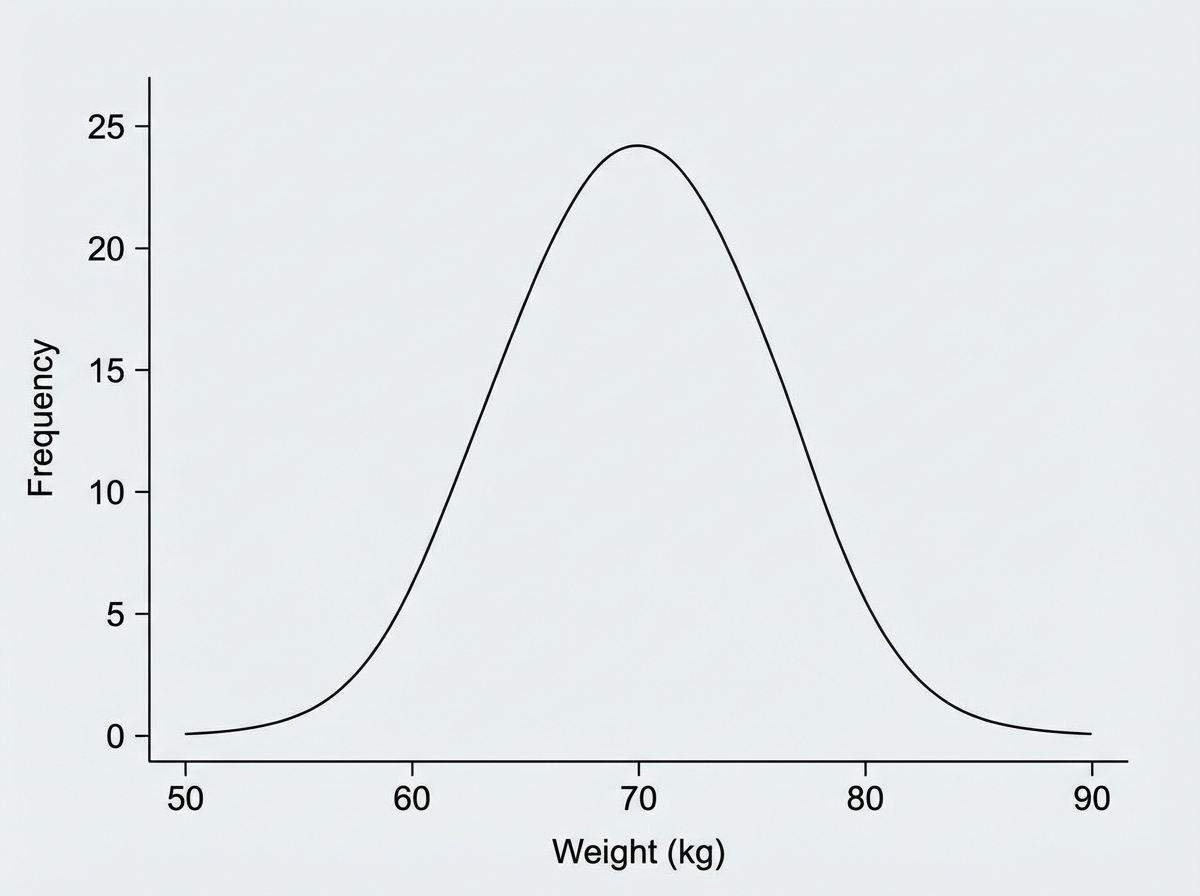
A researcher draws an unbiased sample of 100 adult individuals and finds that their mean weight is 72 kg with a standard deviation of 1.5 kg. Within what range can 95% of their weights be expected to lie?
What test is used to compare two qualitative data?
What is true about simple randomization?
What is the formula for calculating population growth rate?
Bias can be eliminated by all except?
What is the hypothesised null value for the confidence interval of relative risk?
A diagnostic test for a particular disease has a sensitivity of 0.90 and a specificity of 0.80. A single test is applied to each subject in the population in which the diseased population is 30%. What is the probability that a person, negative to this test, has no disease?
Which of the following indicators considers both fertility and mortality situations in a society?
Standardized mortality rate is standardized for what?
A test result categorized into 'very satisfied', 'satisfied', and 'dissatisfied' represents which type of scale?
Explanation: ### Explanation This question tests your understanding of the **Normal Distribution** and the **Empirical Rule** in biostatistics. **1. Why Option B is Correct:** The question asks for the range within which **95% of the weights** of the individuals in the sample lie. According to the properties of a Normal Distribution: * **Mean ± 1 SD** covers approximately **68%** of the values. * **Mean ± 2 SD** covers approximately **95%** of the values. * **Mean ± 3 SD** covers approximately **99.7%** of the values. Given: Mean ($\mu$) = 72 kg and Standard Deviation ($\sigma$) = 1.5 kg. To find the 95% range: Range = Mean ± 2 SD Range = 72 ± (2 × 1.5) Range = 72 ± 3 **Range = 69 kg to 75 kg.** **2. Why Other Options are Incorrect:** * **Option A (66 kg and 78 kg):** This represents the Mean ± 4 SD (72 ± 6), which would encompass >99.9% of the population. * **Option C (70.5 kg and 73.5 kg):** This represents the Mean ± 1 SD (72 ± 1.5), which only covers 68% of the individuals. **3. Clinical Pearls & High-Yield Facts for NEET-PG:** * **Individual vs. Population:** Always check if the question asks for the range of **individual values** (use SD) or the **Confidence Interval of the mean** (use Standard Error). If this question asked for the 95% Confidence Interval, you would use the formula: $Mean \pm 2 \times SE$ (where $SE = SD / \sqrt{n}$). * **Standard Normal Curve (Z-score):** For 95% coverage, the precise Z-value is **1.96**, but for NEET-PG calculations, it is usually rounded to **2**. * **Skewness:** In a perfectly normal distribution, Mean = Median = Mode. If the mean is greater than the median, it is a **positively skewed** distribution.
Explanation: ### Explanation The core of this question lies in distinguishing between **Qualitative (Categorical)** and **Quantitative (Numerical)** data. **1. Why Chi-square test is correct:** The **Chi-square test** is a non-parametric test used to compare the proportions or frequencies of two or more groups. It determines if there is a significant association between two **qualitative variables** (e.g., comparing the recovery rate [Yes/No] between a treatment group and a placebo group). It compares the *observed* frequencies with the *expected* frequencies. **2. Why the other options are incorrect:** * **Paired T-test (A):** Used to compare the **means** of two related groups (quantitative data) from the same sample at different times (e.g., blood pressure before and after treatment). * **Unpaired (Student’s) T-test (B):** Used to compare the **means** of two independent groups (quantitative data) (e.g., comparing the mean height of males vs. females). * **ANOVA (Analysis of Variance) (D):** Used to compare the **means** of **three or more** independent groups (quantitative data). **3. Clinical Pearls & High-Yield Facts for NEET-PG:** * **Qualitative Data = Chi-square test.** (Memory aid: "Qualitative" has a 'Q', "Chi" sounds like 'Qi'). * **Quantitative Data (2 groups) = T-test.** * **Quantitative Data (>2 groups) = ANOVA.** * **Fisher’s Exact Test:** Used instead of Chi-square when the sample size is very small (any expected cell frequency is <5). * **Standard Error of Proportion:** Used to compare proportions of a single sample with the population. * **Z-test:** Used for quantitative data when the sample size is large (n > 30).
Explanation: ### Explanation **Core Concept: Simple Randomization** Simple randomization is the most basic form of probability sampling, often compared to a "coin toss" or "lottery system." The fundamental principle of this technique is that **every individual in the sampling frame has an equal and independent chance of being selected** for the study or assigned to a specific intervention group. This eliminates selection bias and ensures that the groups are comparable, particularly regarding unknown confounding factors. **Analysis of Options:** * **Option A (Correct):** By definition, simple random sampling ensures that the probability of selection is the same for every member of the population. * **Option B (Incorrect):** Randomization does not inherently result in a smaller sample size; sample size is determined by power calculations (Alpha, Beta, and effect size) before randomization occurs. * **Option C (Incorrect):** Systematic randomization (or systematic sampling) is a different technique where every $n^{th}$ individual is selected from a list (e.g., every 5th patient). Simple randomization uses random number tables or computer-generated sequences. * **Option D (Incorrect):** While simple randomization can occasionally lead to "imbalance" in small sample sizes (e.g., 7 males and 3 females in one group), its primary goal is to distribute characteristics equally across groups to ensure internal validity. **High-Yield NEET-PG Pearls:** 1. **Gold Standard:** Randomization is the "heart" of a Randomized Controlled Trial (RCT), making it the gold standard for clinical evidence. 2. **Confounding:** Randomization is the only method that controls for both **known and unknown confounders**. 3. **Allocation Concealment:** This is a process used to prevent selection bias by hiding the assignment sequence from those recruiting participants (e.g., using opaque envelopes). 4. **Stratified Randomization:** Used when you want to ensure equal distribution of a specific prognostic factor (like age or disease severity) across groups.
Explanation: ### Explanation **1. Why the Correct Answer is Right** The **Natural Growth Rate** of a population is the difference between the number of live births and the number of deaths occurring in a year, expressed per 1,000 population. Mathematically, it is calculated as: **Growth Rate = Crude Birth Rate (CBR) – Crude Death Rate (CDR)** This formula represents the "natural increase" in a population. When expressed as a percentage, it is often referred to as the **Annual Growth Rate**. It assumes a closed population where migration (immigration and emigration) is negligible. **2. Analysis of Incorrect Options** * **Option A (CBR / CDR):** This is a ratio, not a rate of growth. It does not provide the net increase or decrease in population size. * **Option B (NRR – CDR):** Net Reproduction Rate (NRR) measures the number of daughters a newborn girl will bear during her lifetime. It is an indicator of replacement level, not a direct component used with CDR to calculate annual growth. * **Option C (TFR – CDR):** Total Fertility Rate (TFR) represents the average number of children a woman would have in her lifetime. Since TFR is a "per woman" metric and CDR is a "per 1,000 population" metric, they cannot be directly subtracted. **3. NEET-PG High-Yield Pearls** * **Demographic Equation:** To calculate the *Total* Growth Rate (including migration), the formula is: $(CBR - CDR) + (Immigration - Emigration)$. * **Vital Index:** Calculated as $(CBR / CDR) \times 100$. * **Replacement Level Fertility:** An **NRR of 1** (or TFR of 2.1) is the target for population stabilization. * **Rule of 70:** To find the doubling time of a population, divide 70 by the annual growth rate percentage.
Explanation: **Explanation:** In epidemiology, **Bias** refers to a systematic error in the design, conduct, or analysis of a study that results in a mistaken estimate of an exposure's effect on the risk of disease. The goal of study design is to eliminate bias *before* or *during* the data collection phase. **Why Multivariate Analysis is the Correct Answer:** Multivariate analysis is a **statistical technique** used during the data analysis phase to control for **confounding variables**, not bias. While confounding can be adjusted for mathematically after data is collected, most forms of bias (like selection or information bias) are inherent to the study's design. Once bias has entered the data, it generally cannot be "removed" or "eliminated" by statistical modeling; it can only be acknowledged as a limitation. **Analysis of Incorrect Options:** * **Matching (A):** This is a technique used in the design phase (especially in Case-Control studies) to eliminate **selection bias** and confounding by ensuring that the cases and controls have similar characteristics (e.g., age, sex). * **Blinding (B):** This is the primary method to eliminate **measurement/observer bias**. By keeping the participant or investigator unaware of the intervention, it prevents subjective influence on reporting or recording outcomes. * **Randomization (C):** Known as the "heart of a clinical trial," it is the best method to eliminate **selection bias**. It ensures that both known and unknown confounders are distributed equally among study groups. **High-Yield Pearls for NEET-PG:** * **Randomization** controls for both known and **unknown** confounders. * **Matching** and **Restriction** control for only **known** confounders. * **Blinding** primarily eliminates **Information/Observer Bias**. * **Recall Bias** is a common type of Information Bias specifically seen in Case-Control studies.
Explanation: ### Explanation **1. Why the Correct Answer is Right (The Concept of Ratios)** Relative Risk (RR) is a **ratio** of two probabilities (Incidence in exposed / Incidence in non-exposed). In biostatistics, the "null value" represents the point of "no difference" or "no effect." * If the risk in the exposed group is exactly the same as the risk in the non-exposed group, the ratio is **1** (e.g., 5% / 5% = 1). * Therefore, if a 95% Confidence Interval (CI) for Relative Risk includes the value **1**, the results are considered statistically non-significant (p > 0.05), as the null hypothesis cannot be rejected. **2. Why the Incorrect Options are Wrong** * **Option A (Zero):** Zero is the null value for measures based on **subtraction (differences)**, such as Mean Difference or Attributable Risk. If the difference between two groups is 0, there is no effect. For ratios, a value of 0 would imply the numerator is zero, which is not the null state. * **Options C & D (Two and Five):** These are arbitrary positive integers. They represent a doubling or quintupling of risk, respectively, indicating a strong positive association rather than a null effect. **3. Clinical Pearls & High-Yield Facts for NEET-PG** * **Null Value for Ratios:** For Relative Risk (RR), Odds Ratio (OR), and Hazard Ratio (HR), the null value is always **1**. * **Null Value for Differences:** For Mean Difference, Risk Difference, and Attributable Risk, the null value is always **0**. * **Significance Testing via CI:** * If the CI for RR is **(0.5 – 0.8)**: Significant (Protective effect, does not cross 1). * If the CI for RR is **(1.2 – 2.5)**: Significant (Risk factor, does not cross 1). * If the CI for RR is **(0.8 – 1.5)**: **Not significant** (Crosses 1).
Explanation: ### Explanation The question asks for the probability that a person who tests negative actually has no disease. In biostatistics, this is the definition of **Negative Predictive Value (NPV)**. #### 1. Why the Correct Answer (C) is Right To calculate NPV, we can use the formula or a hypothetical population grid (e.g., 1,000 people). * **Prevalence:** 30% (300 diseased, 700 healthy) * **Sensitivity:** 0.90 (True Positives = 0.90 × 300 = 270; False Negatives = 30) * **Specificity:** 0.80 (True Negatives = 0.80 × 700 = 560; False Positives = 140) **NPV Formula:** $$\text{NPV} = \frac{\text{True Negatives}}{\text{True Negatives} + \text{False Negatives}}$$ $$\text{NPV} = \frac{560}{560 + 30} = \frac{560}{590} \approx 0.949 \text{ or } \mathbf{95\%}$$ The high specificity and the relatively low prevalence contribute to a high NPV, ensuring that a negative result is highly reliable for ruling out the disease. #### 2. Why Other Options are Wrong * **A (Less than 50%):** This would occur only if the test had extremely low specificity or if the disease prevalence was near 100%. * **B (70%):** This is the percentage of healthy people in the population (1 - Prevalence), not the NPV. * **D (72%):** This is a common distractor resulting from miscalculating the denominator or confusing the formula with the Likelihood Ratio. #### 3. Clinical Pearls for NEET-PG * **NPV vs. Prevalence:** NPV is **inversely proportional** to prevalence. As prevalence decreases, NPV increases (it is easier to rule out a rare disease). * **PPV vs. Prevalence:** Positive Predictive Value (PPV) is **directly proportional** to prevalence. * **Screening vs. Diagnosis:** Sensitivity and NPV are crucial for **screening tests** (to "rule out"), while Specificity and PPV are crucial for **confirmatory tests** (to "rule in"). * **Mnemonic:** **SNOUT** (Sensitivity/Negative result/Rules OUT) and **SPIN** (Specificity/Positive result/Rules IN).
Explanation: ### Explanation The correct answer is **Net Reproduction Rate (NRR)**. **Why NRR is correct:** The Net Reproduction Rate is defined as the number of daughters a newborn girl will bear during her lifetime, assuming fixed age-specific fertility and **mortality rates**. Unlike other fertility indicators, NRR accounts for the fact that not all girls will survive to reach or complete their reproductive years. Therefore, it is a measure of **replacement-level fertility** that integrates both the reproductive potential (fertility) and the survival probability (mortality) of the female population. An NRR of 1.0 indicates that a generation of mothers is exactly replacing itself. **Why other options are incorrect:** * **A. Total Fertility Rate (TFR):** This is the average number of children a woman would have if she experiences current age-specific fertility rates throughout her life. It is a pure fertility measure and **does not** account for mortality. * **B. General Fertility Rate (GFR):** This is the number of live births per 1,000 women in the reproductive age group (15–44 or 49 years) per year. It is a better measure than the Crude Birth Rate but ignores mortality. * **D. Gross Reproduction Rate (GRR):** This is similar to NRR but assumes **zero mortality** (i.e., all girls survive until the end of their reproductive life). It considers only fertility. **High-Yield Pearls for NEET-PG:** * **NRR = 1** is the demographic goal of the National Health Policy in India (Replacement level fertility). * When NRR is 1, the **TFR is approximately 2.1**. * **NRR < 1** indicates a declining population. * **NRR vs. GRR:** NRR is always lower than GRR because it accounts for the risk of death before completing the reproductive period.
Explanation: **Explanation:** **Standardization** in biostatistics is a method used to remove the confounding effect of external variables when comparing two or more populations. **1. Why Age is the Correct Answer:** The **Standardized Mortality Ratio (SMR)** or rate is primarily used to adjust for **Age**, which is the most significant confounder in mortality data. Different populations have different age structures (e.g., a "young" developing country vs. an "aging" developed country). Since the risk of death varies significantly with age, a direct comparison of Crude Death Rates would be misleading. By standardizing for age, we calculate the number of deaths that would occur if both populations had the same age distribution, allowing for a "fair" comparison. **2. Why Other Options are Incorrect:** * **B. Disease:** While we can calculate cause-specific mortality rates, standardization refers to the adjustment of population characteristics (demographics), not the pathology itself. * **C. Region:** Region is the unit of comparison, not the variable being standardized. We standardize the data *of* a region to compare it with another. * **D. Time Period:** Mortality rates are usually calculated for a specific time (e.g., annual), but time is a constant in the formula, not a confounding variable that requires statistical standardization. **High-Yield Clinical Pearls for NEET-PG:** * **Direct Standardization:** Used when age-specific death rates of the population under study are known. It applies these rates to a "Standard Population." * **Indirect Standardization (SMR):** Used when age-specific rates are unknown or the population is small (e.g., occupational hazards). * **SMR Formula:** (Observed Deaths / Expected Deaths) × 100. * An **SMR of 100** means the mortality is the same as the standard population; **>100** means it is higher.
Explanation: **Explanation:** The correct answer is **Ordinal scale** because the data is categorized into groups that follow a specific, logical **rank or order**. In this case, 'very satisfied' represents a higher level of satisfaction than 'satisfied', which in turn is higher than 'dissatisfied'. While the order is clear, the exact mathematical distance between these categories is not quantifiable or equal. **Analysis of Options:** * **Nominal scale (Incorrect):** This scale is used for naming or labeling variables without any quantitative value or order (e.g., Gender, Blood Groups, or Yes/No). Since 'satisfied' has a higher rank than 'dissatisfied', it cannot be nominal. * **Interval scale (Incorrect):** This scale has a defined order and equal intervals between values, but **no true zero point** (e.g., Celsius scale). Satisfaction levels do not have measurable, equal intervals. * **Ratio scale (Incorrect):** This is the highest level of measurement. It has all the properties of an interval scale plus a **true zero point** (e.g., Height, Weight, Blood Pressure). Satisfaction cannot be measured on a ratio scale. **Clinical Pearls for NEET-PG:** * **Mnemonic (NOIR):** **N**ominal (Name), **O**rdinal (Order), **I**nterval (In-between distance), **R**atio (Ratio/Zero). * **Qualitative Data:** Includes Nominal and Ordinal scales. * **Quantitative Data:** Includes Interval and Ratio scales. * **High-Yield Example:** The **Likert Scale** (used in surveys) and **Cancer Staging** (Stage I, II, III) are classic examples of **Ordinal scales** frequently tested in exams.
Collection and Presentation of Data
Practice Questions
Measures of Central Tendency
Practice Questions
Measures of Dispersion
Practice Questions
Normal Distribution
Practice Questions
Sampling Methods
Practice Questions
Sample Size Calculation
Practice Questions
Hypothesis Testing
Practice Questions
Tests of Significance
Practice Questions
Correlation and Regression
Practice Questions
Survival Analysis
Practice Questions
Multivariate Analysis
Practice Questions
Statistical Software in Research
Practice Questions
Get full access to all questions, explanations, and performance tracking.
Start For Free