A study measures a patient's serum cholesterol before and after a new lipid-lowering therapy. What type of significance test should be used to analyze the data?
For a 95% confidence limit, which of the following is true?
What is true about the correlation coefficient?
Which of the following is true about the chi-square test?
The square root of the variance is called as?
The PEFR of a group of 11-year-old girls follows a normal distribution with a mean of 300 L/min and a standard deviation of 20 L/min. What can be inferred about their PEFR values?
What is signified by a correlation coefficient of 1?
What is the exact value within +-2 standard deviations (SD) in a standard normal curve?
Which of the following is a measure of location?
Registration of birth and death with a 6-monthly survey is done in which system?
Explanation: ### Explanation **Why Paired t-test is correct:** The study involves comparing the **means of quantitative data** (serum cholesterol) measured in the **same group of individuals** at two different time points (Before vs. After). In biostatistics, when observations are dependent or "paired" (e.g., pre-treatment and post-treatment values for the same patient), the **Paired t-test** is the standard parametric test used to determine if the mean difference between the two sets of observations is statistically significant. **Why the other options are incorrect:** * **Student’s t-test (Unpaired/Independent):** This is used to compare the means of two **independent** groups (e.g., comparing cholesterol levels between Group A and Group B). It cannot be used here because the data points are linked to the same individuals. * **Chi-square test:** This is a non-parametric test used for **qualitative (categorical) data** (e.g., comparing the proportion of smokers vs. non-smokers). Since cholesterol is a continuous numerical variable, this test is inappropriate. * **Pearson’s coefficient:** This measures the **strength and direction of a linear relationship** between two continuous variables (correlation), rather than testing the significance of a difference between means. **High-Yield Clinical Pearls for NEET-PG:** * **Quantitative Data + 2 Groups:** Use **t-test**. (Paired = same group; Unpaired = different groups). * **Quantitative Data + >2 Groups:** Use **ANOVA** (Analysis of Variance). * **Qualitative Data:** Use **Chi-square** or **Fisher’s Exact test** (if sample size is <30). * **Non-parametric alternative to Paired t-test:** Wilcoxon Signed-Rank test (used if data is not normally distributed).
Explanation: ### Explanation **Concept Overview** The **Confidence Interval (CI)** is a range of values that is likely to contain the true population parameter (like the mean) with a specified level of confidence. In biostatistics, the 95% Confidence Limit is calculated using the formula: **Mean ± (Z-score × Standard Error of Mean)**. **Why Option A is Correct** For a **95% Confidence Interval**, the corresponding Z-score (critical value) from the normal distribution curve is **1.96**. This means that 95% of the area under a normal distribution curve lies within ±1.96 standard deviations from the mean. Therefore, the 95% confidence limit is defined as the Mean ± 1.96 times the Standard Error of the Mean (SEM). **Analysis of Incorrect Options** * **Option B:** This describes the **Normal Distribution** (where 95% of individual observations lie within Mean ± 2 SD), not the confidence limit of the mean. * **Option C:** 2.95 is an incorrect multiplier. For a 99% confidence interval, the multiplier used is **2.58**. * **Option D:** ±2.5 SD is incorrect. According to the empirical rule, ±2 SD covers 95.4% of values, and ±3 SD covers 99.7% of values. **High-Yield NEET-PG Pearls** * **Standard Error (SE):** SE = SD / √n. It measures the precision of the sample mean compared to the population mean. * **Z-values to remember:** * 90% CI: 1.64 * **95% CI: 1.96 (Most common)** * 99% CI: 2.58 * **Interpretation:** If a 95% CI for a Relative Risk or Odds Ratio includes **1**, the result is **not statistically significant** (p > 0.05). If the CI for a difference in means includes **0**, it is not significant.
Explanation: ### Explanation **Correlation Coefficient (Pearson’s ‘r’)** is a statistical measure used to determine the strength and direction of a linear relationship between two continuous quantitative variables (e.g., height and weight). **1. Why Option D is Correct:** The value of the correlation coefficient ($r$) always ranges from **-1 to +1**. * **$r = +1$**: Perfect positive correlation (both variables increase together). * **$r = -1$**: Perfect negative correlation (one increases, the other decreases). * **$r = 0$**: No linear correlation exists. **2. Analysis of Incorrect Options:** * **Option A:** The correlation coefficient is denoted by **$r$**. The term **$r^2$** is the **Coefficient of Determination**, which explains the proportion of variance in one variable predicted by the other. * **Option B:** The value **can be zero**, indicating that there is no linear relationship between the variables. * **Option C:** This describes **Regression Analysis**. While correlation shows the strength of a relationship, regression is used to predict the value of a dependent variable ($y$) based on an independent variable ($x$) using the equation $y = a + bx$. **3. High-Yield Clinical Pearls for NEET-PG:** * **Nature of Variables:** Correlation is used for two **quantitative** variables. For qualitative/ordinal data, **Spearman’s Rank Correlation** is used. * **Unit-less:** $r$ is a pure number and is independent of the units of measurement. * **Scatter Diagram:** This is the visual method to represent correlation. A straight line rising from left to right indicates positive correlation. * **Causality:** A high correlation does **not** necessarily imply causation (Correlation $\neq$ Causation).
Explanation: ### Explanation The **Chi-square ($\chi^2$) test** is a fundamental non-parametric statistical test used primarily to analyze **categorical (nominal/ordinal) data**. **Why Option D is Correct:** The core principle of the Chi-square test is to determine if there is a significant difference between the **observed frequencies** (data collected) and the **expected frequencies** (data predicted by a null hypothesis). It assesses the "goodness of fit" or the "independence" between two categorical variables. If the difference between observed and expected values is large, the null hypothesis is rejected. **Analysis of Incorrect Options:** * **Option A:** Chi-square is a **non-parametric test**. Unlike parametric tests, it does not make assumptions about the underlying population parameters (like mean or standard deviation). * **Option B:** It does **not** require a Gaussian (Normal) distribution. It is used for skewed data or qualitative data where distribution parameters are not defined. * **Option C:** This is a common distractor. The Chi-square test determines if an association **exists** (p-value), but it does **not** measure the **strength** of that association. To measure strength, one would use tests like Cramer’s V or Odds Ratio/Relative Risk. **High-Yield Clinical Pearls for NEET-PG:** 1. **Yates’ Correction:** Applied to a $2 \times 2$ contingency table when any cell frequency is small (usually $<10$) to improve accuracy. 2. **Fisher’s Exact Test:** Used instead of Chi-square when the total sample size is small or any expected cell frequency is **$<5$**. 3. **Degrees of Freedom (df):** For a contingency table, $df = (r-1) \times (c-1)$, where $r$ is rows and $c$ is columns. 4. **Null Hypothesis:** The Chi-square test assumes there is no association between the variables being studied.
Explanation: **Explanation:** The correct answer is **Standard Deviation (SD)**. In biostatistics, **Variance** is a measure of the dispersion of data points around the mean, calculated as the average of the squared deviations from the mean. Because the units of variance are squared (e.g., $mm^2$ Hg), it is difficult to interpret clinically. To return to the original unit of measurement, we take the square root of the variance. Therefore, **Standard Deviation = $\sqrt{Variance}$**. It represents the average distance of each observation from the arithmetic mean. **Why other options are incorrect:** * **Standard Error (SE):** This measures the precision of the sample mean compared to the true population mean. It is calculated as $SD / \sqrt{n}$. It is a measure of sampling error, not the square root of variance. * **Mean Deviation:** This is the arithmetic average of the absolute deviations (ignoring plus/minus signs) of observations from the mean. It does not involve squaring or square roots. * **Range:** This is the simplest measure of dispersion, calculated as the difference between the maximum and minimum values in a dataset. **High-Yield Clinical Pearls for NEET-PG:** * **Normal Distribution:** In a Gaussian curve, Mean ± 1 SD covers **68%** of values, Mean ± 2 SD covers **95%**, and Mean ± 3 SD covers **99.7%**. * **Coefficient of Variation:** This is $(SD / Mean) \times 100$. It is used to compare the variability of two different datasets with different units (e.g., height vs. weight). * **Variance** is the only measure of dispersion that is additive, but **Standard Deviation** is the most commonly used measure in clinical research.
Explanation: This question tests your understanding of the **Normal Distribution (Gaussian Curve)** and its empirical rules, a high-yield topic in Biostatistics. ### **Explanation of the Correct Answer** In a normal distribution, the spread of data is defined by the **Mean (μ)** and **Standard Deviation (σ)**. The empirical rule states: * **Mean ± 1 SD** covers ~68% of the values. * **Mean ± 2 SD** covers ~95% of the values. * **Mean ± 3 SD** covers ~99.7% of the values. In this case: * Mean = 300 L/min; SD = 20 L/min. * Mean ± 2 SD = 300 ± (2 × 20) = 300 ± 40. * Range = **260 to 340 L/min**. Therefore, approximately **95%** of the girls fall within this range. ### **Analysis of Incorrect Options** * **Option B:** "Healthy lungs" is a clinical judgment. Normal distribution describes the statistical spread of a parameter in a population, not the clinical health status of individuals. * **Option C:** If 95% are between 260 and 340, the remaining 5% are distributed in the two tails (2.5% below 260 and 2.5% above 340). Thus, only **2.5%** are below 260 L/min. * **Option D:** In a normal distribution, the curve is asymptotic; it never touches the baseline. There is always a statistical probability of values existing beyond 3 SD (above 340 or below 260). ### **High-Yield Clinical Pearls for NEET-PG** 1. **Standard Normal Curve:** A normal distribution with a Mean of 0 and SD of 1. 2. **Z-score:** Indicates how many SDs a value is from the mean. (Z = 1.96 for the 95% confidence interval). 3. **Symmetry:** In a perfectly normal distribution, **Mean = Median = Mode**. 4. **Precision:** Increasing the sample size narrows the Standard Error, but the Standard Deviation remains a property of the population.
Explanation: **Explanation:** The **Correlation Coefficient (r)**, also known as Pearson’s product-moment correlation, is a statistical measure that quantifies the strength and direction of a linear relationship between two continuous variables (e.g., the relationship between salt intake and blood pressure). **Why Option B is Correct:** The value of 'r' always ranges from **-1 to +1**. A value of **+1** signifies a **Perfect Positive Correlation**. This means that for every unit increase in one variable, there is a proportional increase in the other, and all data points fall exactly on a straight upward-sloping line. **Analysis of Incorrect Options:** * **Option A (Zero correlation):** This occurs when **r = 0**. It indicates that there is no linear relationship between the variables (e.g., shoe size and IQ). * **Option C (Correlation less than perfect):** This refers to any value where **0 < r < 1** (positive) or **-1 < r < 0** (negative). While a relationship exists, the data points do not form a perfect straight line. * **Option D (Invalid correlation value):** Correlation values are only invalid if they fall outside the range of -1 to +1 (e.g., r = 1.5). **NEET-PG High-Yield Pearls:** 1. **Direction:** Positive (+) means variables move in the same direction; Negative (-) means they move in opposite directions. 2. **Strength:** The closer 'r' is to 1 or -1, the stronger the relationship. 3. **Coefficient of Determination (r²):** This represents the proportion of variance in one variable explained by the other. If r = 0.6, then r² = 0.36 (36% of the variation is explained). 4. **Limitation:** Correlation does **not** imply causation. 5. **Perfect Negative Correlation:** Signified by **r = -1** (one variable increases as the other decreases proportionally).
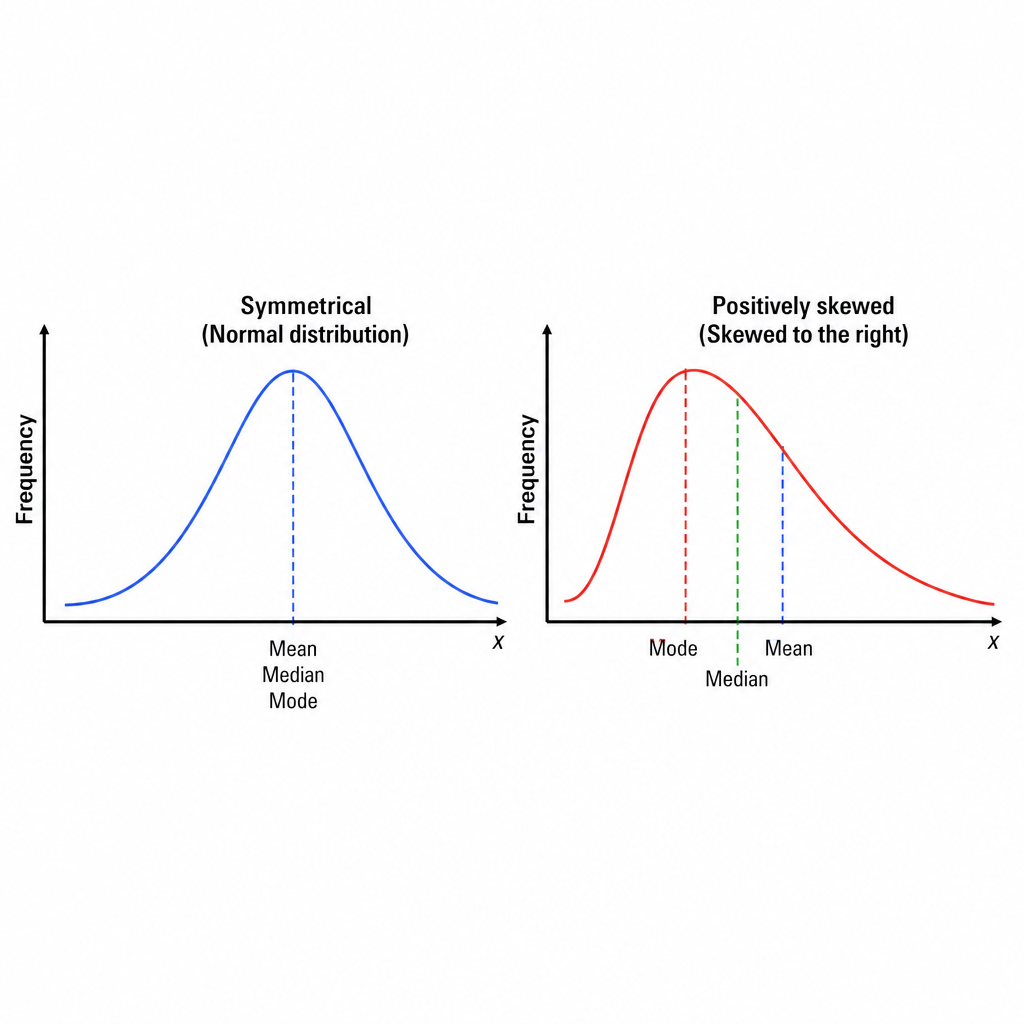
Explanation: ### Explanation In Biostatistics, the **Standard Normal Distribution (Gaussian Curve)** is a symmetrical, bell-shaped curve where the mean, median, and mode coincide at the center. The area under this curve represents the probability or percentage of observations falling within specific distances from the mean, measured in **Standard Deviations (SD)**. According to the **Empirical Rule** (also known as the 68-95-99.7 rule): * **Mean ± 1 SD** covers **68.2%** of the values. * **Mean ± 2 SD** covers **95.4%** of the values. * **Mean ± 3 SD** covers **99.7%** of the values. Therefore, **Option C (95.4%)** is the mathematically exact value for ± 2 SD. #### Analysis of Incorrect Options: * **Option A (98.8):** This does not correspond to a standard whole-number SD interval. * **Option B (97.6):** Incorrect; however, ± 2.26 SD covers approximately 97.5% of the area. * **Option D (94):** Incorrect; this is a distractor often confused with the 95% confidence interval. #### High-Yield Clinical Pearls for NEET-PG: 1. **Confidence Interval (CI) vs. SD:** While ± 2 SD covers 95.4%, the "95% Confidence Interval"—frequently used in medical research to denote statistical significance—corresponds to exactly **± 1.96 SD**. 2. **Normal Distribution Characteristics:** The total area under the curve is **1 (or 100%)**. It is asymptotic (tails never touch the baseline). 3. **Z-score:** This indicates how many standard deviations a data point is from the mean. For a standard normal curve, the mean is 0 and the SD is 1. 4. **Skewness:** If the tail is longer on the right, it is **Positively Skewed** (Mean > Median > Mode). If longer on the left, it is **Negatively Skewed** (Mode > Median > Mean).
Explanation: ### Explanation In biostatistics, measures of central tendency are also known as **measures of location**. They represent a single value that attempts to describe a set of data by identifying the central position within that data set. **Why Median is the Correct Answer:** The **Median** is the middle-most value of a distribution when observations are arranged in increasing or decreasing order. It is a measure of location because it pinpoint’s the data's center point. In medical research, the median is preferred over the mean when dealing with **skewed data** (e.g., survival time or incubation periods) because it is not influenced by extreme outliers. **Analysis of Incorrect Options:** * **A. Variance:** This is a **measure of dispersion** (variability). It quantifies how much the data points spread out from the mean. * **B. Mode:** While the Mode is technically a measure of central tendency (the most frequent value), in the context of standard NEET-PG questions, the **Median and Mean** are the primary "measures of location" used to describe the position of a distribution. *Note: If this were a multiple-select question, Mode could be included, but Median is the more robust statistical "location" parameter.* * **C. p-value:** This is a measure of **statistical significance**. It indicates the probability that the observed difference occurred by chance; it does not describe the location or spread of data. **High-Yield Clinical Pearls for NEET-PG:** * **Measures of Location (Central Tendency):** Mean, Median, Mode. * **Measures of Variation (Dispersion):** Range, Mean Deviation, Standard Deviation (most common), and Variance. * **Relationship in Skewness:** * **Positive Skew:** Mean > Median > Mode (Tail to the right). * **Negative Skew:** Mode > Median > Mean (Tail to the left). * **Ideal Measure:** For a **Normal Distribution**, Mean = Median = Mode.
Explanation: **Explanation:** The **Sample Registration System (SRS)** is a large-scale demographic survey in India designed to provide reliable annual estimates of birth rate, death rate, and other fertility/mortality indicators at the national and sub-national levels. Its unique feature is the **Dual Record System**, which consists of: 1. **Continuous enumeration:** A resident part-time enumerator (usually a teacher or Anganwadi worker) records births and deaths as they occur. 2. **Retrospective Survey:** An independent supervisor conducts a **6-monthly survey** to verify and record events. The data from both sources are matched to ensure maximum accuracy, making "6-monthly survey" the hallmark of SRS. **Why other options are incorrect:** * **National Sample Survey (NSS):** Conducted in successive "rounds" on various socio-economic subjects (e.g., morbidity, employment), but it does not involve continuous 6-monthly registration of vital events. * **Vital Statistical System (Civil Registration System):** This is the routine process of registering births, deaths, and marriages. While mandatory by law, it is a continuous process without a specific "6-monthly survey" component for verification. * **Census:** Conducted once every **10 years** (decennial). It provides a snapshot of the population at a single point in time rather than ongoing vital rates. **High-Yield Facts for NEET-PG:** * **SRS** is currently the primary source of **Infant Mortality Rate (IMR)** and **Maternal Mortality Ratio (MMR)** data in India. * It was initiated on a pilot basis in 1964-65 and became fully operational in 1969-70. * It functions under the **Registrar General of India (RGI)**, Ministry of Home Affairs.
Collection and Presentation of Data
Practice Questions
Measures of Central Tendency
Practice Questions
Measures of Dispersion
Practice Questions
Normal Distribution
Practice Questions
Sampling Methods
Practice Questions
Sample Size Calculation
Practice Questions
Hypothesis Testing
Practice Questions
Tests of Significance
Practice Questions
Correlation and Regression
Practice Questions
Survival Analysis
Practice Questions
Multivariate Analysis
Practice Questions
Statistical Software in Research
Practice Questions
Get full access to all questions, explanations, and performance tracking.
Start For Free