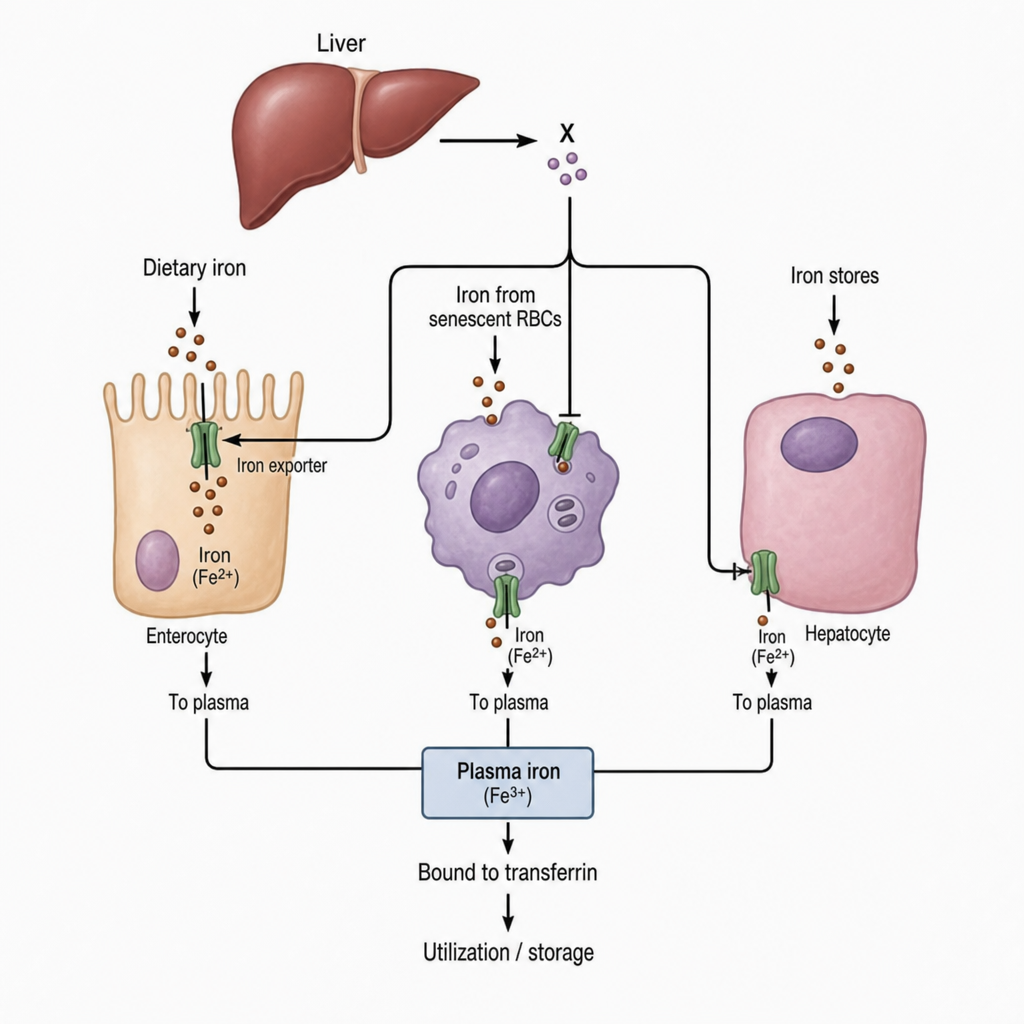
What is the pigment associated with hemochromatosis?
Kinky hair disease is due to a defect in which of the following transport mechanisms?
High affinity of HbF with O2 is due to:
Which of the following conditions is suggested by elevated serum ferritin, serum iron, and percent transferrin saturation?
Which among the following is the major hemoglobin found in the fetus?
Which one of the following amino acids in Hemoglobin accepts H+ and allows Hemoglobin to act as a buffer to acids?
Hb - Barts is?
In the human body, iron is stored in combination with which of the following?
Which of the following is NOT a site of heme synthesis?
What is the primary storage form of iron in the body?
Explanation: **Explanation:** **Hemochromatosis** is a disorder of iron overload where excessive iron is deposited in various organs (liver, pancreas, heart, and skin). When iron levels exceed the storage capacity of **ferritin**, the body stores the excess iron in the form of **Haemosiderin**. 1. **Why Haemosiderin is correct:** Haemosiderin is an insoluble iron-storage complex composed of partially digested ferritin and lysosomes. In hemochromatosis, haemosiderin accumulates in parenchymal cells, leading to tissue damage and fibrosis. It is histologically identified using the **Prussian Blue stain**, which stains the pigment deep blue. 2. **Why other options are incorrect:** * **Bilirubin:** A breakdown product of heme catabolism. Elevated levels cause jaundice, not iron overload. * **Methemoglobin:** A form of hemoglobin where iron is in the ferric ($Fe^{3+}$) state rather than the ferrous ($Fe^{2+}$) state, impairing oxygen delivery. * **Myoglobin:** An iron- and oxygen-binding protein found in muscle tissue; it is released into the blood following muscle injury (rhabdomyolysis). **High-Yield Clinical Pearls for NEET-PG:** * **Classic Triad of Hemochromatosis:** "Bronze diabetes" (Skin pigmentation, Diabetes mellitus due to pancreatic damage, and Cirrhosis). * **HFE Gene:** Most cases are hereditary, involving a mutation in the *HFE* gene (C282Y is the most common mutation). * **Diagnosis:** Elevated serum ferritin and transferrin saturation (>45%). * **Treatment:** Therapeutic phlebotomy is the gold standard; iron chelators (e.g., Deferoxamine) are used if phlebotomy is contraindicated.
Explanation: **Explanation:** **Kinky Hair Disease (Menkes Disease)** is an X-linked recessive disorder caused by a mutation in the **ATP7A gene**. This gene encodes a P-type ATPase responsible for the absorption of dietary copper from the intestinal epithelium into the bloodstream and its transport across the blood-brain barrier. In Menkes disease, copper becomes trapped within intestinal mucosal cells, leading to a severe systemic **copper deficiency**. This deficiency impairs the function of copper-dependent enzymes (cuproenzymes), most notably **Lysyl Oxidase**. This enzyme is essential for cross-linking collagen and elastin; its failure results in the characteristic "kinky," brittle, and depigmented hair (pili torti), along with connective tissue defects and neurodegeneration. **Analysis of Incorrect Options:** * **A. Iron transport:** Defects in iron transport or metabolism typically lead to Hemochromatosis (overload) or Sideroblastic anemia, not kinky hair. * **B. Calcium transport:** Abnormalities in calcium transport are associated with disorders like hypoparathyroidism or rickets, affecting bone density and neuromuscular excitability. * **D. Magnesium transport:** Defects here lead to familial hypomagnesemia, which presents with seizures and tetany, but does not affect hair structure. **High-Yield Clinical Pearls for NEET-PG:** * **Menkes vs. Wilson:** Menkes is a defect in **ATP7A** (Copper deficiency/absorption failure). Wilson Disease is a defect in **ATP7B** (Copper overload/biliary excretion failure). * **Key Enzyme:** The "kinky hair" phenotype is specifically due to **Lysyl Oxidase** failure. * **Diagnosis:** Characterized by low serum copper and low serum ceruloplasmin levels. * **Mnemonic:** "Menkes is **A**bsorption (**ATP7A**); Wilson is **B**iliary (**ATP7B**)."
Explanation: ### Explanation **Why Option A is Correct:** Fetal Hemoglobin (HbF) consists of two alpha ($\alpha$) and two gamma ($\gamma$) chains ($\alpha_2\gamma_2$), unlike adult hemoglobin (HbA), which has two alpha and two beta ($\beta$) chains ($\alpha_2\beta_2$). The central cavity of HbA contains positively charged amino acids (like Histidine) in the $\beta$-chains that bind strongly to the negatively charged **2,3-Bisphosphoglycerate (2,3-DPG)**. 2,3-DPG is an allosteric effector that stabilizes the T-state (tense/deoxygenated) of hemoglobin, promoting oxygen unloading. In HbF, the $\gamma$-chain replaces Histidine with **Serine** at position 143. Serine is neutral, which significantly **reduces the binding affinity of HbF for 2,3-DPG**. Consequently, HbF remains in the R-state (relaxed/oxygenated) more easily, resulting in a higher affinity for $O_2$ and a **leftward shift** of the oxygen dissociation curve. This allows the fetus to "pull" oxygen from maternal blood across the placenta. **Why Other Options are Incorrect:** * **B. Decrease in Hb concentration:** Hb concentration affects the total oxygen-carrying capacity of blood, not the intrinsic binding affinity of individual hemoglobin molecules. * **C. Increase in pH:** While an increase in pH (alkalosis) does increase $O_2$ affinity (Bohr effect), it is a physiological shift rather than the structural reason why HbF inherently differs from HbA. * **D. Double Bohr effect:** This describes the simultaneous shift in maternal and fetal curves in the placenta (maternal blood becomes more acidic, releasing $O_2$; fetal blood becomes more alkaline, taking up $O_2$). It facilitates transfer but is not the structural cause of HbF's high affinity. **High-Yield Clinical Pearls for NEET-PG:** * **HbF Structure:** $\alpha_2\gamma_2$. * **P50 Value:** HbF has a lower P50 (~19 mmHg) compared to HbA (~26.6 mmHg), reflecting higher affinity. * **Switching:** HbF is the primary hemoglobin from 3 months gestation until birth; it is replaced by HbA within the first 6 months of life. * **Therapeutic Note:** Hydroxyurea is used in Sickle Cell Anemia because it increases the production of HbF, which inhibits the polymerization of HbS.
Explanation: ### Explanation **1. Why Hemochromatosis is Correct:** Hemochromatosis is a disorder of **iron overload** (often due to mutations in the *HFE* gene) characterized by excessive intestinal iron absorption. This leads to an expansion of the total body iron pool. * **Serum Iron:** Increases as more iron enters the circulation. * **Serum Ferritin:** Increases because ferritin is the primary storage form of iron; its levels reflect total body stores. * **Transferrin Saturation:** Increases (often >45-50%) because the available iron-binding sites on transferrin become highly occupied. * **Total Iron Binding Capacity (TIBC):** Typically decreases as the body attempts to compensate for the iron excess. **2. Why the Other Options are Incorrect:** * **Iron Deficiency Anemia (IDA):** This is the polar opposite. It presents with **decreased** serum iron, **decreased** ferritin, and **decreased** transferrin saturation, while TIBC is increased. * **Lead Poisoning:** This affects heme synthesis by inhibiting enzymes like ALA dehydratase and Ferrochelatase. While it causes sideroblastic changes, it does not typically present with the systemic iron overload profile seen in hemochromatosis. * **Wilson’s Disease:** This is a disorder of **copper metabolism** (ATP7B mutation), not iron. It is characterized by low serum ceruloplasmin and increased urinary copper excretion. **3. NEET-PG High-Yield Pearls:** * **Classic Triad of Hemochromatosis:** "Bronze Diabetes" (Skin hyperpigmentation, Diabetes Mellitus, and Cirrhosis). * **Gold Standard Diagnosis:** Liver biopsy with **Prussian Blue staining** (Perl’s stain) to quantify the Hepatic Iron Index. * **Screening Test of Choice:** Transferrin saturation is the most sensitive initial screening test. * **Hereditary Pattern:** Most commonly Autosomal Recessive (C282Y mutation).
Explanation: **Explanation:** The correct answer is **Hb F (Fetal Hemoglobin)**. Hemoglobin synthesis undergoes a specific chronological transition during development, known as "hemoglobin switching." **1. Why Hb F is correct:** Hb F ($\alpha_2\gamma_2$) is the predominant hemoglobin from the **eighth week of gestation until birth**. It has a higher affinity for oxygen than adult hemoglobin (HbA), which is crucial for the fetus to extract oxygen from maternal blood across the placenta. By the time of birth, Hb F constitutes approximately 60–90% of total hemoglobin, eventually being replaced by HbA within the first six months of life. **2. Why the other options are incorrect:** * **Hb Gower-1 ($\zeta_2\epsilon_2$) and Hb Gower-2 ($\alpha_2\epsilon_2$):** These are **embryonic hemoglobins**. They are synthesized in the yolk sac during the first trimester (weeks 3–8) and disappear as erythropoiesis shifts to the liver and spleen. * **Hb Portland ($\zeta_2\gamma_2$):** This is also an embryonic hemoglobin. It is clinically significant in cases of $\alpha$-thalassemia major (Hb Bart’s), where it may persist as the only functional hemoglobin. **High-Yield Clinical Pearls for NEET-PG:** * **Hb F Structure:** Composed of two alpha ($\alpha$) and two gamma ($\gamma$) chains. * **Oxygen Dissociation Curve:** Hb F causes a **left shift** in the curve because it does not bind 2,3-BPG as strongly as HbA. * **Kleihauer-Betke Test:** Used to quantify fetal-maternal hemorrhage; it relies on the fact that Hb F is resistant to acid elution compared to HbA. * **Therapeutic Use:** Hydroxyurea is used in Sickle Cell Anemia to increase the levels of Hb F, which inhibits the polymerization of HbS.
Explanation: **Explanation:** The correct answer is **Histidine**. **Why Histidine is correct:** Hemoglobin (Hb) acts as a crucial physiological buffer in the blood through the **Bohr Effect**. The buffering capacity of a protein depends on the **pKa** of its amino acid side chains. Histidine is the only amino acid with an ionizable side chain (imidazole ring) that has a pKa near physiological pH (~6.0 to 7.0). In hemoglobin, specific histidine residues (notably **His-146** of the $\beta$-chain) act as proton acceptors. When the pH drops (increased $H^+$), these histidine residues become protonated, forming salt bridges that stabilize the **T-state (Deoxy-Hb)**. This reduces Hb's affinity for oxygen, facilitating oxygen delivery to tissues while simultaneously buffering the excess acid. **Why the other options are incorrect:** * **Alanine:** An aliphatic amino acid with a non-polar, hydrophobic side chain ($CH_3$). It lacks an ionizable group and cannot participate in acid-base buffering. * **Serine & Threonine:** These are polar, uncharged amino acids containing hydroxyl ($-OH$) groups. While they are important for post-translational modifications like phosphorylation, their side chains do not ionize at physiological pH and cannot act as buffers. **NEET-PG High-Yield Pearls:** * **Buffering Capacity:** Hb is responsible for the majority of the buffering action in whole blood (more than plasma proteins). * **The Imidazole Ring:** This is the specific functional group of Histidine that allows it to donate or accept protons. * **Bohr Effect:** Increased $H^+$ (decreased pH) and $CO_2$ shift the oxygen dissociation curve to the **right**, promoting $O_2$ unloading. * **Iron Binding:** In the heme pocket, the **Proximal Histidine (F8)** binds directly to the iron atom, while the **Distal Histidine (E7)** stabilizes the $O_2$ binding site.
Explanation: **Explanation:** **Hb-Barts** is a pathological hemoglobin variant associated with **Alpha-Thalassemia**. 1. **Why Option C is correct:** In Alpha-thalassemia, there is a deficiency or total absence of alpha ($\alpha$) globin chain synthesis. During fetal life, the primary hemoglobin is HbF ($\alpha_2\gamma_2$). When $\alpha$-chains are unavailable (specifically in the most severe form, **Hydrops Fetalis**, where all 4 alpha genes are deleted), the excess, unpaired gamma ($\gamma$) chains tetramerize to form **$\gamma_4$**, known as **Hb-Barts**. Because it lacks $\alpha$-chains, it is denoted as $\alpha^0\gamma_4$. 2. **Analysis of Incorrect Options:** * **Option A ($\alpha_2\beta_2$):** This represents **HbA** (Normal Adult Hemoglobin). * **Option B ($\alpha^0\beta_4$):** This represents **HbH**. It occurs when there is a deficiency of $\alpha$-chains in adults, leading to the tetramerization of excess beta ($\beta$) chains. * **Option D ($\alpha_2\gamma_2$):** This represents **HbF** (Normal Fetal Hemoglobin). **High-Yield Clinical Pearls for NEET-PG:** * **Oxygen Affinity:** Hb-Barts has an extremely high affinity for oxygen (it does not release $O_2$ to tissues), making it physiologically useless and resulting in intrauterine death (Hydrops Fetalis). * **HbH Disease:** Caused by a 3-gene deletion ($--/-\alpha$). It presents with "Golf ball-like" inclusions on Supravital staining (Brilliant Cresyl Blue). * **Electrophoresis:** On alkaline electrophoresis, Hb-Barts is the fastest-moving hemoglobin (migrates further than HbA and HbH). * **Alpha-Thalassemia Trait:** 2-gene deletion; **Silent Carrier:** 1-gene deletion.
Explanation: **Explanation:** **Why Apoferritin is the Correct Answer:** Iron is highly reactive and can generate toxic free radicals via the Fenton reaction. To prevent this, the body stores iron in a non-toxic, water-soluble form. **Apoferritin** is a shell-like protein that binds with free ferrous iron ($Fe^{2+}$), oxidizes it to ferric iron ($Fe^{3+}$), and stores it internally. Once the apoferritin shell is loaded with iron, the complex is called **Ferritin**. Ferritin is the primary intracellular storage form of iron, found predominantly in the liver, spleen, and bone marrow. **Analysis of Incorrect Options:** * **A. Albumin:** This is the most abundant plasma protein responsible for maintaining oncotic pressure and transporting various drugs, bilirubin, and calcium, but it does not play a specific role in iron storage. * **B. Globulin:** While some globulins (like Transferrin) transport iron, "globulin" is a broad category. Iron is not stored in general globulins. * **C. Transferrin:** This is the primary **transport** protein for iron in the plasma. It carries iron between the site of absorption (intestine) and the sites of utilization (bone marrow) or storage (liver). It is not a storage molecule. **High-Yield Clinical Pearls for NEET-PG:** * **Hemosiderin:** When iron stores exceed the capacity of ferritin, it forms insoluble aggregates called hemosiderin (visible with Prussian Blue stain). * **Serum Ferritin:** This is the most sensitive index for diagnosing **Iron Deficiency Anemia** (it decreases before hemoglobin levels drop). * **Ferroportin:** The only known iron exporter from cells into the blood; it is regulated by **Hepcidin** (the master regulator of iron homeostasis). * **State of Iron:** Iron is absorbed in the **Ferrous ($Fe^{2+}$)** state but transported and stored in the **Ferric ($Fe^{3+}$)** state.
Explanation: ### Explanation The synthesis of heme is a complex metabolic pathway that occurs partly in the **mitochondria** and partly in the **cytosol**. **1. Why Red Blood Cells (RBCs) are the correct answer:** Mature red blood cells lack **mitochondria** and a **nucleus**. Since the first step (catalyzed by ALA synthase) and the final steps (catalyzed by ferrochelatase) of heme synthesis must occur within the mitochondria, mature RBCs are incapable of synthesizing heme. While they are filled with hemoglobin, that hemoglobin was synthesized during the earlier erythroblast stages of development. **2. Analysis of Incorrect Options:** * **Hepatocytes (Liver):** The liver is the second most active site of heme synthesis (accounting for ~15%). Heme here is primarily used for **Cytochrome P450** enzymes involved in drug detoxification. * **Bone Marrow (Erythroid precursor cells):** This is the primary site of heme synthesis (~85%). Proerythroblasts and erythroblasts contain the necessary organelles (mitochondria) to produce heme for hemoglobin production. * **Osteocytes:** While not a primary site like the liver or marrow, almost all nucleated cells containing mitochondria (including osteocytes) possess the enzymatic machinery to produce small amounts of heme for essential hemoproteins like cytochromes in the electron transport chain. **3. NEET-PG High-Yield Pearls:** * **Rate-limiting enzyme:** ALA Synthase (ALAS-1 in liver, ALAS-2 in erythroid tissue). * **Substrates:** Glycine + Succinyl CoA. * **Lead Poisoning:** Inhibits **ALA Dehydratase** and **Ferrochelatase**, leading to anemia and stippled RBCs. * **Vitamin Link:** Pyridoxal phosphate (Vitamin B6) is a mandatory cofactor for ALA synthase; its deficiency can lead to **Sideroblastic Anemia**.
Explanation: **Explanation:** **1. Why Ferritin is Correct:** Iron is highly reactive and can generate toxic free radicals via the Fenton reaction. To prevent this, the body stores iron in a non-toxic, water-soluble protein complex called **Ferritin**. It is found in almost all cells, but primarily in the liver (hepatocytes), spleen, and bone marrow. A small amount circulates in the serum, which serves as a clinical marker for total body iron stores. While **hemosiderin** is another storage form (insoluble and found in iron overload), ferritin remains the **primary** and most readily available storage form. **2. Why Other Options are Incorrect:** * **Transferrin:** This is the primary **transport** protein for iron in the blood. It carries iron from the site of absorption or recycling to the bone marrow for erythropoiesis. * **Hepcidin:** This is the **master regulator** of iron homeostasis. It is a hormone produced by the liver that inhibits iron absorption in the gut and iron release from macrophages by degrading ferroportin. * **Ferroportin:** This is the only known **exporter** of iron from cells (enterocytes and macrophages) into the plasma. **3. High-Yield Clinical Pearls for NEET-PG:** * **Serum Ferritin:** The most sensitive and specific lab test for diagnosing **Iron Deficiency Anemia (IDA)** (levels <15 ng/mL). * **Acute Phase Reactant:** Ferritin levels rise during inflammation, infection, or malignancy, which can mask an underlying iron deficiency. * **Prussian Blue Stain:** Used to visualize iron stores (hemosiderin) in bone marrow aspirates. * **Total Iron Binding Capacity (TIBC):** An indirect measure of transferrin levels; it increases in IDA and decreases in iron overload.
Hemoglobin Structure and Function
Practice Questions
Oxygen Transport and Oxygen-Hemoglobin Dissociation Curve
Practice Questions
Hemoglobin Variants and Hemoglobinopathies
Practice Questions
Thalassemias
Practice Questions
Methemoglobin and Abnormal Hemoglobins
Practice Questions
Hemoglobin Synthesis
Practice Questions
Heme Synthesis and Porphyrias
Practice Questions
Iron Absorption and Transport
Practice Questions
Iron Storage and Recycling
Practice Questions
Disorders of Iron Metabolism
Practice Questions
Anemia: Biochemical Aspects
Practice Questions
Biochemistry of Hemostasis
Practice Questions
Get full access to all questions, explanations, and performance tracking.
Start For Free