Which of the following is a metalloporphyrin?
An Rh-negative woman delivered an Rh-positive infant. Within a few days after birth, the infant developed jaundice, ascites, hepatomegaly, and edema. What is the likely substance deposited in the skin and sclera in jaundice?
Iron in heme is linked to globin through which amino acid residue?
Pale lemon yellow color of urine is due to all except?
Which of the following are considered embryonic hemoglobins?
The Benzidine test is used to detect which of the following?
Which of the following statements characterize both hemoglobin and myoglobin?
A 10-year-old boy presented with abdominal pain, muscle weakness, and fatigue. Investigations revealed increased serum lead levels in blood. Activity of which of the following enzymes in the liver is increased in this condition?
Which vitamin enhances iron absorption?
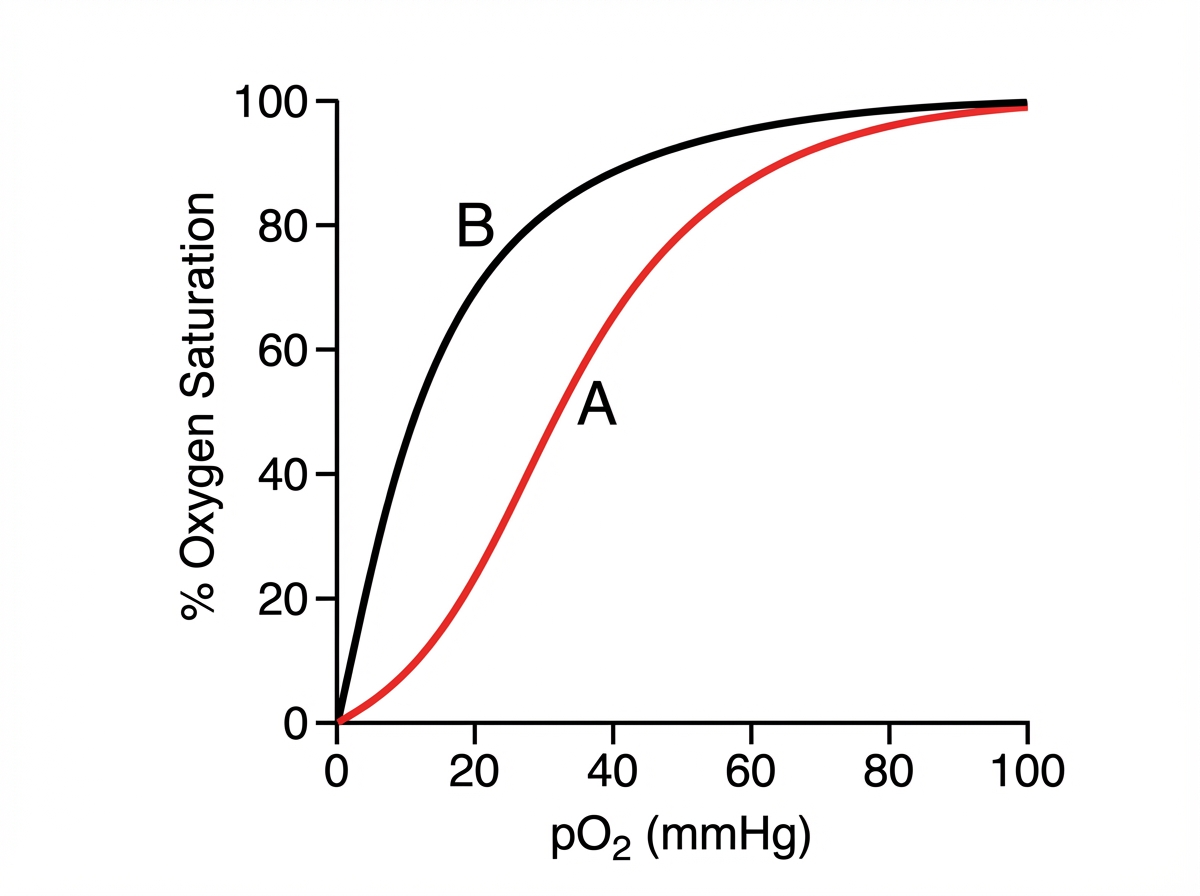
Fetal hemoglobin has a higher affinity for oxygen due to which of the following?
Explanation: **Explanation:** A **metalloporphyrin** is a complex consisting of a porphyrin ring coordinated with a central metal ion. In the human body, the most common metalloporphyrin is **Heme**, where the porphyrin ring (Protoporphyrin IX) is coordinated with an **Iron (Fe²⁺)** atom. **1. Why Hemoglobin is the Correct Answer:** Hemoglobin is a globular protein containing four heme groups. Since heme is a classic example of an iron-metalloporphyrin, hemoglobin is classified as a metalloporphyrin-containing protein. It is responsible for the transport of oxygen and carbon dioxide in the blood. **2. Analysis of Other Options:** * **B. Catalase:** While Catalase is a heme-containing enzyme (and thus contains a metalloporphyrin), in the context of standard medical examinations, **Hemoglobin** is considered the "primary" or most representative example of a metalloporphyrin. *Note: In some advanced biochemistry contexts, Catalase and Cytochromes are also metalloporphyrins, but Hemoglobin is the most definitive answer for this level.* * **C. Bilirubin:** This is a **bile pigment**. It is a linear tetrapyrrole (open chain) formed from the degradation of heme. It does **not** contain a closed porphyrin ring or a central metal ion. * **D. Cytochrome:** Like Catalase, Cytochromes contain heme. However, Hemoglobin remains the gold standard answer for basic metalloporphyrin classification in NEET-PG. **High-Yield Clinical Pearls for NEET-PG:** * **Porphyrins:** Cyclic compounds formed by four pyrrole rings linked by methenyl (=CH-) bridges. * **Heme Synthesis:** The rate-limiting step is catalyzed by **ALA Synthase**, requiring **Vitamin B6 (Pyridoxine)** as a cofactor. * **Lead Poisoning:** Inhibits ALA Dehydratase and Ferrochelatase, leading to increased protoporphyrin levels. * **Chlorophyll** is a magnesium-metalloporphyrin found in plants, whereas **Vitamin B12 (Cobalamin)** contains a corrin ring (similar to porphyrin) with Cobalt.
Explanation: ### Explanation **1. Why the Correct Answer is Right (Option B):** The clinical presentation describes **Hemolytic Disease of the Newborn (HDN)** or *Erythroblastosis Fetalis*. In an Rh-negative mother sensitized to an Rh-positive fetus, maternal IgG antibodies cross the placenta and cause massive hemolysis of fetal RBCs. * **Initial Phase:** Hemolysis leads to a surge in **unconjugated bilirubin**. * **Progression:** The massive breakdown of RBCs causes severe anemia, leading to extramedullary hematopoiesis in the liver. This results in hepatomegaly and architectural distortion of the liver. The resulting hepatic dysfunction and compression of bile canaliculi lead to a secondary "cholestatic" component, causing an increase in **conjugated bilirubin** as well. * The presence of ascites and edema (Hydrops Fetalis) indicates severe liver involvement and hypoalbuminemia, confirming that both forms of bilirubin will be elevated and deposited in tissues. **2. Why Other Options are Wrong:** * **Option A (Biliverdin):** Biliverdin is the green pigment formed by the action of heme oxygenase. It is rapidly reduced to bilirubin by biliverdin reductase and does not typically accumulate in neonatal jaundice. * **Option C (Unconjugated bilirubin):** While this is the primary pigment in physiological jaundice or mild hemolysis, it does not account for the hepatomegaly and systemic congestion seen in severe HDN, which involves a conjugated component. * **Option D (Conjugated bilirubin):** This is seen in biliary atresia or neonatal hepatitis. In HDN, the primary pathology starts with hemolysis (unconjugated), making this option incomplete. **3. NEET-PG High-Yield Pearls:** * **Bilirubin Metabolism:** Heme → Biliverdin (Heme oxygenase) → Unconjugated Bilirubin (Biliverdin reductase). * **Kernicterus:** Unconjugated bilirubin is lipid-soluble and can cross the blood-brain barrier, depositing in the **basal ganglia**. * **Direct vs. Indirect:** Conjugated bilirubin is "Direct" (water-soluble); Unconjugated is "Indirect" (lipid-soluble, albumin-bound). * **Hydrops Fetalis:** Defined by fluid accumulation in ≥2 fetal compartments (ascites, pleural effusion, pericardial effusion, or skin edema).
Explanation: **Explanation:** The correct answer is **Histidine**. In the hemoglobin molecule, iron ($Fe^{2+}$) exists in a hexacoordinated state. Four of these coordination bonds are formed with the nitrogen atoms of the **porphyrin ring**. The fifth coordination bond is formed with the imidazole ring of a specific **Histidine** residue, known as the **Proximal Histidine (F8)**. * **Proximal Histidine (F8):** Directly binds to the iron atom, anchoring the heme group to the globin chain. * **Distal Histidine (E7):** Does not bind directly to iron but stabilizes the oxygen-binding site and prevents the oxidation of $Fe^{2+}$ to $Fe^{3+}$ (methemoglobin). **Why other options are incorrect:** * **Alanine & Glycine:** These are small, non-polar/neutral amino acids. They lack the necessary side-chain functional groups (like the imidazole ring) required to coordinate with a metal ion like iron in the heme pocket. * **Cysteine:** While cysteine can coordinate with metals (as seen in Zinc-finger proteins or Cytochrome P450), it is not the residue that links heme to globin in hemoglobin or myoglobin. **High-Yield Clinical Pearls for NEET-PG:** 1. **T-state vs. R-state:** When oxygen binds to the 6th coordination site, it pulls the iron into the plane of the porphyrin ring. This movement pulls the Proximal Histidine, triggering a conformational change from the **T (Tense)** state to the **R (Relaxed)** state. 2. **Methemoglobinemia:** If the iron is oxidized to the ferric state ($Fe^{3+}$), it cannot bind oxygen. The Distal Histidine plays a crucial role in preventing this. 3. **Carbon Monoxide (CO) Binding:** CO has a much higher affinity for heme than $O_2$. The Distal Histidine creates steric hindrance that forces CO to bind at an angle, slightly reducing its affinity and allowing for life-sustaining $O_2$ transport.
Explanation: The color of normal urine is primarily determined by the concentration of specific bile pigment derivatives. **Explanation of the Correct Answer:** **C. Uroerythrin** is the correct answer because it does not contribute to the pale lemon yellow color. Instead, uroerythrin is a pink or reddish pigment. It has a high affinity for uric acid crystals; when urine is cooled, uroerythrin precipitates with urates (forming "brick dust" or *sedimentum lateritium*), giving the sediment a characteristic pinkish hue. **Explanation of Incorrect Options:** * **A. Urochrome:** This is the primary pigment responsible for the typical yellow color of urine. It is an oxidation product of urobilinogen and its excretion rate is generally constant, meaning the intensity of the yellow color depends on the urine concentration (hydration status). * **B. Urobilin:** This is the oxidized form of urobilinogen. It contributes significantly to the yellow-amber pigment of urine. * **D. Urobilinogen:** While colorless itself, urobilinogen is a precursor that readily oxidizes into urobilin upon exposure to air and light, contributing to the overall yellow spectrum of voided urine. **High-Yield Clinical Pearls for NEET-PG:** * **Urobilinogen vs. Bilirubin:** In **hemolytic jaundice**, urine urobilinogen is increased (darker yellow), but bilirubin is absent (acholuric jaundice). In **obstructive jaundice**, bilirubin is present (tea-colored urine), but urobilinogen is absent. * **Alkaptonuria:** Urine turns black on standing due to the oxidation of homogentisic acid. * **Porphyria:** Urine may turn "port-wine" red upon exposure to light due to the formation of porphobilin. * **Dietary influence:** Consumption of beets can cause **beeturia** (pink/red urine), which must be differentiated from hematuria.
Explanation: **Explanation:** Hemoglobin synthesis undergoes a sequential transition during development, shifting from embryonic to fetal and finally to adult forms. This process is governed by the switching of globin gene expression on Chromosomes 16 (alpha-like) and 11 (beta-like). **1. Why the Correct Answer is Right:** Embryonic hemoglobins are synthesized in the **yolk sac** during the first 8–10 weeks of gestation. There are three primary embryonic hemoglobins: * **Gower 1:** ($\zeta_2\epsilon_2$) * **Gower 2:** ($\alpha_2\epsilon_2$) * **Portland:** ($\zeta_2\gamma_2$) Since Option D includes both Gower and Portland, it correctly identifies the embryonic variants. **2. Analysis of Incorrect Options:** * **Options A & B:** These include **Fetal hemoglobin (HbF)**. HbF ($\alpha_2\gamma_2$) is the predominant hemoglobin from the 8th week of gestation until birth. It is produced primarily in the **liver and spleen**, not the yolk sac, and is therefore classified as fetal, not embryonic. * **Option C:** This includes **HbA2** ($\alpha_2\delta_2$). HbA2 is a minor adult hemoglobin (normal range <3.5%) that appears shortly before birth and persists throughout life. **High-Yield Clinical Pearls for NEET-PG:** * **Site of Erythropoiesis:** Yolk sac (Embryonic) $\rightarrow$ Liver/Spleen (Fetal) $\rightarrow$ Bone Marrow (Adult). * **Globin Chains:** $\zeta$ (Zeta) is the embryonic analog of the $\alpha$-chain; $\epsilon$ (Epsilon) is the embryonic analog of the $\beta$-chain. * **HbF Affinity:** HbF has a higher affinity for oxygen than HbA because it binds poorly to **2,3-BPG**, facilitating oxygen transfer across the placenta. * **Hb Barts:** A pathological hemoglobin ($\gamma_4$) seen in Alpha-thalassemia (Hydrops fetalis).
Explanation: **Explanation:** The **Benzidine test** (also known as the Adler test) is a biochemical test used to detect the presence of **heme-containing proteins**. It relies on the **peroxidase-like activity** of the heme group. In the presence of hydrogen peroxide ($H_2O_2$), the heme group catalyzes the oxidation of benzidine to a blue-colored compound. **Why Option D is correct:** Both **Hemoglobin** (found in red blood cells) and **Myoglobin** (found in muscle tissue) contain a heme prosthetic group. Therefore, both will yield a positive result in the Benzidine test. Clinically, this test is used to detect occult blood in urine or feces, but it cannot distinguish between hematuria (RBCs), hemoglobinuria, and myoglobinuria. **Why other options are incorrect:** * **Porphobilinogen (Option A):** This is a precursor in heme synthesis but does not contain the functional heme ring required for peroxidase activity. It is detected using **Ehrlich’s reagent**. * **Bilirubin (Option C):** Bilirubin is a breakdown product of heme that has lost the iron atom and the cyclic structure required for this reaction. It is typically detected using **Fouchet’s test** or the **Van den Bergh reaction**. * **Option B:** While correct for hemoglobin, it is incomplete as myoglobin also reacts positively. **Clinical Pearls for NEET-PG:** 1. **Sensitivity vs. Specificity:** The Benzidine test is highly sensitive but lacks specificity. It is no longer widely used in clinical practice due to the **carcinogenic** nature of benzidine. 2. **Confirmatory Test:** To differentiate between hemoglobinuria and myoglobinuria, the **Ammonium Sulfate precipitation test** is used (Myoglobin remains in the supernatant). 3. **False Positives:** Consumption of red meat or peroxidase-rich vegetables (like horseradish) can cause false-positive results in stool tests.
Explanation: **Explanation:** The correct answer is **D. Hema at hydrophobic pockets.** Both hemoglobin (Hb) and myoglobin (Mb) are globular hemoproteins that utilize a **heme** prosthetic group to bind oxygen. A critical structural feature shared by both is that the heme group is nestled within a **hydrophobic pocket** (crevice) formed by the folding of the polypeptide chain. This non-polar environment is essential because it prevents the permanent oxidation of the ferrous iron ($Fe^{2+}$) to ferric iron ($Fe^{3+}$), which cannot bind oxygen. **Analysis of Incorrect Options:** * **A. Non-helical:** Both proteins are highly helical. Approximately 75-80% of their polypeptide chains are composed of **alpha-helices** (labeled A through H). * **B. Subunits held by hydrogen bonds:** This applies only to **Hemoglobin**, which is a tetramer ($α_2β_2$). Myoglobin is a **monomer** and lacks quaternary structure; therefore, it does not have subunits to be held together. * **C. Binds with 2 heme:** Myoglobin binds **one** heme group (1 subunit), while Hemoglobin binds **four** heme groups (4 subunits). Neither binds exactly two. **High-Yield NEET-PG Clinical Pearls:** * **Oxygen Dissociation Curve:** Mb shows a **hyperbolic** curve (high affinity, storage function), whereas Hb shows a **sigmoidal** curve (cooperative binding, transport function). * **Proximal Histidine (F8):** Directly binds to the iron of heme in both proteins. * **Distal Histidine (E7):** Does not bind heme directly but stabilizes the $O_2$ binding and reduces the affinity for Carbon Monoxide (CO). * **P50 Values:** The $P_{50}$ of Myoglobin is ~1-2 mmHg, while for Hemoglobin, it is ~26 mmHg. A lower $P_{50}$ indicates a higher affinity for oxygen.
Explanation: ### Explanation **Correct Answer: A. ALA synthase** **Mechanism:** Lead poisoning (Plumbism) inhibits two key enzymes in the heme biosynthetic pathway: **ALA dehydratase** (which converts ALA to PBG) and **Ferrochelatase** (which incorporates iron into protoporphyrin IX). The inhibition of these enzymes leads to a significant decrease in the intracellular concentration of **Heme**. In the liver, Heme acts as a feedback inhibitor (repressor) of **ALA synthase (ALAS1)**, the rate-limiting enzyme of the pathway. When heme levels drop due to lead-induced inhibition of downstream enzymes, the feedback inhibition is lifted, leading to a compensatory **increase in the activity and synthesis of ALA synthase.** **Analysis of Incorrect Options:** * **B. Ferrochelatase:** This enzyme is directly **inhibited** by lead, not increased. Its inhibition leads to the accumulation of Protoporphyrin IX, which often complexes with zinc (Zinc Protoporphyrin). * **C. PBG deaminase:** This enzyme (also known as HMB synthase) is deficient in Acute Intermittent Porphyria. It is not significantly induced or inhibited by lead. * **D. Heme oxygenase:** This is the rate-limiting enzyme of **heme degradation** (converting heme to biliverdin). In lead poisoning, heme levels are low, so there is no substrate-driven reason for this enzyme activity to increase. **High-Yield Clinical Pearls for NEET-PG:** * **Lead Poisoning Markers:** Increased urinary **delta-aminolevulinic acid (δ-ALA)** and increased **coproporphyrin III**. * **Hematology:** Look for **Basophilic stippling** (due to inhibition of pyrimidine 5'-nucleotidase) and **Sideroblastic anemia** (ringed sideroblasts in bone marrow). * **Clinical Signs:** "ABCDEF" – **A**nemia/Abdominal colic, **B**urtonian lines (gingival), **C**onstipation, **D**rop (wrist/foot), **E**ncephalopathy, **F**ree erythrocyte protoporphyrin. * **Antidotes:** Oral Succimer (DMSA) for children; Ca-EDTA and Dimercaprol (BAL) for severe cases.
Explanation: ### Explanation **Correct Option: B (Vitamin C / Ascorbic Acid)** Vitamin C is the most potent enhancer of non-heme iron absorption. It facilitates this through two primary mechanisms: 1. **Reduction:** It reduces dietary ferric iron ($Fe^{3+}$) to the ferrous state ($Fe^{2+}$). This is crucial because iron can only be transported across the intestinal apical membrane via the **Divalent Metal Transporter 1 (DMT-1)** in its ferrous form. 2. **Chelation:** It forms a soluble iron-ascorbate complex in the acidic environment of the stomach, preventing the precipitation of iron in the alkaline environment of the duodenum, thereby maintaining its bioavailability. **Incorrect Options:** * **Vitamin A:** While Vitamin A deficiency is linked to anemia (as it helps mobilize iron from stores), it does not directly enhance the primary absorption process of iron in the gut. * **Thiamine (B1) & Riboflavin (B2):** These act as coenzymes in energy metabolism (e.g., PDH complex, TCA cycle). While Riboflavin is involved in erythropoiesis, neither has a direct role in the intestinal absorption of iron. **High-Yield Clinical Pearls for NEET-PG:** * **Inhibitors of Iron Absorption:** Phytates (cereals), Oxalates (spinach), Polyphenols/Tannins (tea/coffee), and Calcium/Phosphates. * **Hepcidin:** The "Master Regulator" of iron. It decreases iron absorption by causing the degradation of **Ferroportin** (the basolateral exporter). * **Site of Absorption:** Iron is primarily absorbed in the **Duodenum** and upper jejunum. * **Storage:** Iron is stored as **Ferritin** (water-soluble, temporary) and **Hemosiderin** (insoluble, long-term).
Explanation: ### Explanation **Correct Answer: A. Decreased 2,3-DPG concentration** The higher oxygen affinity of Fetal Hemoglobin (HbF) is fundamental to fetal survival, allowing the fetus to "pull" oxygen from maternal blood across the placenta. **The Mechanism:** Adult hemoglobin (HbA) consists of $\alpha_2\beta_2$ chains, while HbF consists of $\alpha_2\gamma_2$ chains. In the $\beta$-chains of HbA, there are positively charged histidine residues that form a pocket for **2,3-Bisphosphoglycerate (2,3-DPG)** to bind. 2,3-DPG is a negative allosteric effector that stabilizes the "T-state" (deoxygenated) and lowers oxygen affinity. In HbF, the $\gamma$-chains replace these histidine residues with neutral **serine** residues. This change reduces the positive charge in the binding pocket, significantly **decreasing the binding affinity of HbF for 2,3-DPG**. Because 2,3-DPG cannot bind effectively to HbF, the hemoglobin remains in the "R-state" (relaxed/oxygenated) more easily, resulting in a higher affinity for oxygen. --- ### Why the other options are incorrect: * **B. Reduced pH:** A decrease in pH (acidosis) triggers the **Bohr Effect**, which shifts the curve to the right and *decreases* oxygen affinity to facilitate unloading. * **C. Increased release of CO2:** High $CO_2$ levels (carbaminohemoglobin formation) also stabilize the T-state and *decrease* oxygen affinity. * **D. Oxygen dissociation curve shifted to the right:** A right shift indicates *lower* affinity (easier unloading). HbF causes a **Left Shift** in the oxygen dissociation curve. --- ### High-Yield Clinical Pearls for NEET-PG: * **P50 Value:** The P50 (partial pressure of $O_2$ at which Hb is 50% saturated) for HbF is lower (~19 mmHg) than for HbA (~27 mmHg). * **HbF Structure:** $\alpha_2\gamma_2$. * **Switching:** HbF is the primary hemoglobin from the 8th week of gestation until birth. It is replaced by HbA within the first 6 months of life. * **Therapeutic Use:** Hydroxyurea is used in Sickle Cell Anemia because it increases the production of HbF, which inhibits the polymerization of HbS.
Hemoglobin Structure and Function
Practice Questions
Oxygen Transport and Oxygen-Hemoglobin Dissociation Curve
Practice Questions
Hemoglobin Variants and Hemoglobinopathies
Practice Questions
Thalassemias
Practice Questions
Methemoglobin and Abnormal Hemoglobins
Practice Questions
Hemoglobin Synthesis
Practice Questions
Heme Synthesis and Porphyrias
Practice Questions
Iron Absorption and Transport
Practice Questions
Iron Storage and Recycling
Practice Questions
Disorders of Iron Metabolism
Practice Questions
Anemia: Biochemical Aspects
Practice Questions
Biochemistry of Hemostasis
Practice Questions
Get full access to all questions, explanations, and performance tracking.
Start For Free