Ferritin biosynthesis is regulated by the serum level of which substance?
Which of the following is required in the initial stage of the synthesis of haemoglobin?
Hemoglobin, unlike myoglobin, shows which of the following characteristics regarding oxygen dissociation?
One gram of hemoglobin liberates how many milligrams of bilirubin?
Furasol DA is:
Which mineral is essential for hemoglobin synthesis?
Which of the following is considered embryonic hemoglobin?
Which of the following decreases the absorption of iron from the intestine?
Red cell protoporphyrin levels more than 100 micrograms/dL are suggestive of which of the following conditions?
Unconjugated hyperbilirubinemia with increased urobilinogen is seen in which of the following conditions?
Explanation: ### Explanation **Correct Option: C. Iron** Ferritin is the primary intracellular storage form of iron. Its biosynthesis is regulated at the **translational level** by the availability of free intracellular iron. This occurs via the **Iron Response Element (IRE)** and **Iron Regulatory Protein (IRP)** mechanism: * **Low Iron:** IRPs bind to the IRE located at the 5' untranslated region (UTR) of ferritin mRNA, physically blocking translation to prevent unnecessary storage. * **High Iron:** Iron binds to IRPs, causing them to dissociate from the mRNA. This allows the ribosome to translate the mRNA, increasing ferritin synthesis to safely sequester the excess iron. **Analysis of Incorrect Options:** * **A. Ceruloplasmin:** This is a copper-containing ferroxidase that converts Fe²⁺ to Fe³⁺ to facilitate iron binding to transferrin. It does not directly regulate ferritin synthesis. * **B. Hepcidin:** Known as the "Master Regulator of Iron Homeostasis," hepcidin controls systemic iron levels by degrading **ferroportin** (the iron exporter). While it influences iron availability, it does not directly regulate the biosynthesis of the ferritin protein. * **D. Transferrin:** This is the transport protein for iron in the plasma. While transferrin levels are inversely related to iron stores, it is a carrier, not a regulator of ferritin production. **High-Yield Clinical Pearls for NEET-PG:** * **Translational Control:** Ferritin is a classic example of post-transcriptional/translational regulation (unlike most proteins regulated at the transcriptional level). * **Serum Ferritin:** It is the **best initial test** and most sensitive marker for diagnosing **Iron Deficiency Anemia** (levels <15 ng/mL). * **Acute Phase Reactant:** Ferritin levels rise during inflammation, infection, or malignancy, which can mask an underlying iron deficiency. * **Hemosiderin:** This is an insoluble form of partially denatured ferritin, found in states of iron overload (e.g., Hemochromatosis).
Explanation: ### Explanation The synthesis of heme (the prosthetic group of hemoglobin) begins in the **mitochondria**. The very first, rate-limiting step involves the condensation of **Succinyl-CoA** (from the TCA cycle) and the amino acid **Glycine**. 1. **Why Glycine is Correct:** The enzyme **ALA Synthase (ALAS)** catalyzes the reaction between Glycine and Succinyl-CoA to form **$\delta$-Aminolevulinic acid (d-ALA)**. This requires **Pyridoxal Phosphate (Vitamin B6)** as a cofactor. Since this is the foundational step of the entire porphyrin pathway, Glycine is essential for the initiation of heme synthesis. 2. **Why Other Options are Incorrect:** * **Histidine:** While histidine is crucial for hemoglobin function (the "proximal" and "distal" histidines bind iron and oxygen), it is not a substrate in the biosynthetic pathway of the heme ring. * **Iron:** Iron is incorporated in the **final step** of the pathway. The enzyme **Ferrochelatase** inserts ferrous iron ($Fe^{2+}$) into Protoporphyrin IX to form Heme. * **Folic Acid:** This vitamin is essential for DNA synthesis and erythrocyte maturation. Deficiency leads to megaloblastic anemia, but it is not a direct structural component or substrate in heme synthesis. ### High-Yield Clinical Pearls for NEET-PG: * **Rate-Limiting Enzyme:** ALA Synthase 1 (liver) and ALA Synthase 2 (erythroid tissue). * **Cofactor Alert:** Vitamin **B6 deficiency** can lead to Sideroblastic Anemia because the initial step (ALA synthesis) cannot occur. * **Lead Poisoning:** Lead inhibits two enzymes in this pathway: **ALA Dehydratase** and **Ferrochelatase**. * **Location:** Heme synthesis occurs partially in the **mitochondria** (first and last three steps) and partially in the **cytosol**. Remember: *"The first and the last are in the mitochondria."*
Explanation: **Explanation:** The core difference between hemoglobin (Hb) and myoglobin (Mb) lies in their quaternary structure. Hemoglobin is a **tetramer** ($α_2β_2$), allowing for **allosteric interactions**, whereas myoglobin is a monomer. **1. Why Option B is Correct:** * **Sigmoid Curve:** Hemoglobin exhibits a sigmoid (S-shaped) oxygen dissociation curve due to **positive cooperativity**. When one $O_2$ molecule binds to a heme group, it induces a conformational change from the T (Tense) state to the R (Relaxed) state, increasing the affinity for subsequent $O_2$ molecules. * **Hill’s Coefficient ($n$):** This is a measure of cooperativity. For a monomer like myoglobin, $n = 1$ (no cooperativity). For hemoglobin, **$n$ is approximately 2.8**, indicating strong positive cooperativity. Therefore, any value **greater than 1** signifies cooperative binding. **2. Why Other Options are Incorrect:** * **Option A:** While Hb does show positive cooperativity, Option B is a more precise biochemical description using the Hill’s coefficient, which is a high-yield parameter for NEET-PG. * **Option C:** Incorrect because the "none of the above" clause ignores the established concept of cooperativity and Hill's coefficient. * **Option D:** A Hill’s coefficient of 1 describes a hyperbolic curve (like myoglobin) where binding at one site does not affect others. This contradicts the nature of hemoglobin. **High-Yield Clinical Pearls for NEET-PG:** * **P50 Value:** The partial pressure of $O_2$ at which Hb is 50% saturated. Normal $P_{50}$ is **26.6 mmHg**. * **Right Shift (Decreased Affinity):** Caused by increased $CO_2$, $H^+$ (Bohr Effect), Temperature, and **2,3-BPG**. * **Left Shift (Increased Affinity):** Caused by Fetal Hb (HbF), CO poisoning, and Alkalosis. * **Myoglobin:** Has a much lower $P_{50}$ (~1-2 mmHg), making it an ideal $O_2$ storage molecule in muscles rather than a transporter.
Explanation: ### Explanation **1. Why Option B (34 mg) is Correct:** The degradation of hemoglobin (Hb) follows a specific stoichiometric pathway. Hemoglobin is composed of four heme groups. When red blood cells are destroyed, the heme is converted into biliverdin and subsequently into bilirubin by the enzymes **heme oxygenase** and **biliverdin reductase**. Quantitatively, the breakdown of **1 gram of hemoglobin yields approximately 34 mg of bilirubin**. This value is derived from the molecular weight of hemoglobin (~64,500 Da) and the fact that each heme molecule produces one molecule of bilirubin. **2. Analysis of Incorrect Options:** * **Option A (40 mg):** This is an overestimation. While total daily bilirubin production in a healthy adult is roughly 250–350 mg, the specific yield per gram of Hb remains constant at 34 mg. * **Option C (15 mg):** This is too low. This value does not account for the total heme content present in a gram of hemoglobin. * **Option D (55 mg):** This value is incorrect and does not correlate with the established biochemical yield of heme catabolism. **3. NEET-PG Clinical Pearls & High-Yield Facts:** * **Iron Content:** 1 gram of hemoglobin contains **3.34 mg of elemental iron**. (Do not confuse this with the 34 mg of bilirubin). * **Oxygen Carrying Capacity:** 1 gram of hemoglobin carries **1.34 ml of oxygen** (Hüfner's constant). * **Rate-Limiting Step:** Heme oxygenase is the rate-limiting enzyme in bilirubin production. * **Daily Production:** Approximately 80–85% of daily bilirubin comes from senescent RBCs; the remaining 15–20% comes from "ineffective erythropoiesis" in the bone marrow and turnover of other hemoproteins (myoglobin, cytochromes).
Explanation: **Explanation:** **Furasol DA** is a pharmacological agent specifically designed to act as an **allosteric modulator of hemoglobin**. It works by shifting the oxygen-dissociation curve to the **right**. By decreasing the oxygen affinity of hemoglobin, it facilitates the unloading of oxygen from erythrocytes into peripheral tissues, making it highly effective in conditions of hypoxia or localized ischemia [1]. **Analysis of Options:** * **Option D (Correct):** Furasol DA mimics the effect of 2,3-BPG. By stabilizing the "T" (Tense) state of hemoglobin, it promotes the release of $O_2$ at the tissue level, thereby increasing oxygen delivery [2]. * **Option A (Incorrect):** Furasol DA is a therapeutic molecule, not a reactive oxygen species (ROS) or a free radical. * **Option B (Incorrect):** Artificial blood refers to hemoglobin-based oxygen carriers (HBOCs) or perfluorocarbons (PFCs). Furasol DA is an additive/modulator, not a blood substitute itself. * **Option C (Incorrect):** Carbon monoxide (CO) antagonists are typically 100% oxygen or hyperbaric oxygen therapy. Furasol DA does not specifically target the CO-binding site. **High-Yield Clinical Pearls for NEET-PG:** 1. **Right Shift Factors:** Remember the mnemonic **"CADET, face Right!"** (CO2, Acidosis, DPG/2,3-BPG, Exercise, Temperature). Furasol DA acts similarly to these factors [2]. 2. **P50 Value:** A right shift (caused by Furasol DA) **increases the P50**, meaning a higher partial pressure of oxygen is required to achieve 50% saturation because affinity is lower [3]. 3. **Clinical Utility:** Such modulators are being researched for use in **angina, peripheral vascular disease, and wound healing** where tissue oxygenation is compromised.
Explanation: **Explanation:** The correct answer is **Copper (A)**. While Iron is the central component of the heme group, Copper is an indispensable cofactor for its metabolism and incorporation into hemoglobin. **Why Copper is Correct:** Copper is essential for the function of **Ceruloplasmin** (a ferroxidase enzyme). Ceruloplasmin oxidizes ferrous iron ($Fe^{2+}$) to ferric iron ($Fe^{3+}$), which is the only form that can bind to **Transferrin** for transport to the bone marrow. Without copper, iron cannot be mobilized from storage sites (liver and macrophages), leading to a functional iron deficiency and microcytic hypochromic anemia. Additionally, copper is a component of **Cytochrome c oxidase**, which is involved in the mitochondrial steps of heme synthesis. **Why Other Options are Incorrect:** * **B. Sodium & C. Potassium:** These are the primary extracellular and intracellular cations, respectively. They are critical for maintaining osmotic balance, resting membrane potential, and action potentials, but they play no direct role in the biochemical pathway of heme synthesis. * **D. Phosphorus:** While essential for bone mineralization and the formation of high-energy compounds like ATP and 2,3-BPG (which affects hemoglobin's oxygen affinity), it is not a structural or catalytic requirement for synthesizing the hemoglobin molecule itself. **High-Yield Clinical Pearls for NEET-PG:** * **Menkes Disease:** A defect in copper absorption (ATP7A gene) leading to "kinky hair" and severe copper deficiency, often presenting with anemia. * **Wilson’s Disease:** A defect in copper excretion (ATP7B gene) leading to low ceruloplasmin levels and copper toxicity. * **Vitamin C connection:** Vitamin C aids iron absorption by keeping it in the $Fe^{2+}$ state in the gut, whereas Copper (via Ceruloplasmin) is needed to convert it to $Fe^{3+}$ for plasma transport.
Explanation: **Explanation:** Hemoglobin synthesis undergoes a sequential transition during development, moving from embryonic to fetal and finally to adult forms. This process is known as **hemoglobin switching**. **Why Gower Hemoglobin is Correct:** Embryonic hemoglobins are synthesized in the **yolk sac** during the first trimester (weeks 3–8 of gestation). There are three primary embryonic hemoglobins: 1. **Gower 1:** ($\zeta_2\epsilon_2$) 2. **Gower 2:** ($\alpha_2\epsilon_2$) 3. **Portland:** ($\zeta_2\gamma_2$) Since Gower hemoglobin is one of these primitive forms, it is the correct answer. **Analysis of Incorrect Options:** * **Adult Hemoglobin (HbA):** This is the predominant form in adults ($\alpha_2\beta_2$). Synthesis begins in the liver and bone marrow during the third trimester but only becomes dominant approximately 3–6 months after birth. * **Fetal Hemoglobin (HbF):** Composed of $\alpha_2\gamma_2$, HbF is the major hemoglobin of intrauterine life (from the 8th week until birth). It has a higher affinity for oxygen than HbA to facilitate oxygen transfer across the placenta. **High-Yield Facts for NEET-PG:** * **Sites of Erythropoiesis:** Yolk sac (3–8 weeks) $\rightarrow$ Liver (6–30 weeks; primary site) $\rightarrow$ Spleen (9–28 weeks) $\rightarrow$ Bone Marrow (from 28 weeks onwards). * **Chain Composition:** All functional hemoglobins are tetramers consisting of two $\alpha$-like chains and two non-$\alpha$ chains. * **HbA2:** A minor adult hemoglobin ($\alpha_2\delta_2$) normally comprising <3% of total hemoglobin; levels are elevated in $\beta$-thalassemia trait. * **HbF Persistence:** Elevated HbF levels in adults can be seen in conditions like Hereditary Persistence of Fetal Hemoglobin (HPFH) or sickle cell anemia.
Explanation: **Explanation:** Iron absorption primarily occurs in the **duodenum and upper jejunum**. For iron to be absorbed, it must be in its soluble, ferrous ($Fe^{2+}$) state. Any substance that promotes the formation of insoluble iron complexes or shifts the iron into its ferric ($Fe^{3+}$) state will significantly decrease its bioavailability. **Why "All the above" is correct:** * **Phosphates and Phytates:** These are found in cereals, nuts, and oilseeds. They act as **chelators**, binding to iron to form insoluble, non-absorbable complexes in the intestinal lumen. * **Alkalies (Antacids/Achlorhydria):** Gastric acid (HCl) is crucial for iron absorption because it helps solubilize iron and facilitates the conversion of ferric iron to the more absorbable ferrous form. Alkalies neutralize this acid, preventing the reduction of iron and thus inhibiting its uptake. **Clinical Pearls & High-Yield Facts for NEET-PG:** 1. **Promoters of Absorption:** Vitamin C (Ascorbic acid) is the most potent enhancer because it reduces $Fe^{3+}$ to $Fe^{2+}$. Citrate and amino acids also increase absorption. 2. **Inhibitors of Absorption:** Besides the options above, **Tannins** (found in tea), **Oxalates** (in leafy vegetables), and **Calcium** (competitive inhibition) also decrease iron absorption. 3. **DMT-1 (Divalent Metal Transporter 1):** This is the primary transporter for non-heme iron into the enterocyte. It only transports iron in the $Fe^{2+}$ state. 4. **Hepcidin:** This is the master regulator of iron metabolism. High levels of Hepcidin (seen in chronic inflammation) lead to the degradation of **Ferroportin**, thereby decreasing iron release into the plasma.
Explanation: **Explanation:** The final step of heme synthesis involves the enzyme **Ferrochelatase**, which inserts a ferrous iron ($Fe^{2+}$) atom into the center of a **Protoporphyrin IX** ring. When there is a deficiency of iron, this reaction cannot proceed efficiently. As a result, the precursor molecule, Protoporphyrin, accumulates within the red blood cells. **1. Why Iron Deficiency Anemia (IDA) is correct:** In IDA, the lack of available iron leads to a significant rise in **Free Erythrocyte Protoporphyrin (FEP)** or Zinc Protoporphyrin (where zinc is substituted for iron). Levels exceeding **100 µg/dL** are highly characteristic of IDA. FEP is a sensitive marker used to differentiate IDA from Thalassemia (where FEP remains normal because iron is available). **2. Analysis of other options:** * **Lead Poisoning:** While lead poisoning also increases FEP by inhibiting Ferrochelatase, the levels are typically elevated alongside other specific markers like basophilic stippling and increased urinary delta-ALA. However, in the context of standard biochemical testing for microcytic anemias, a value >100 µg/dL is the classic diagnostic "textbook" pointer for IDA. * **Myelodysplasia:** This may cause sideroblastic changes, but it is not primarily characterized by a massive isolated rise in protoporphyrin in the same diagnostic manner as IDA. * **All of the above:** Incorrect because IDA is the most specific and common clinical association for this specific threshold in a competitive exam context. **High-Yield Pearls for NEET-PG:** * **FEP in Thalassemia:** Normal (Crucial for differential diagnosis). * **FEP in Anemia of Chronic Disease:** Mildly elevated, but usually less than in IDA. * **Rate-limiting enzyme of Heme synthesis:** ALA Synthase (requires Vitamin B6). * **Lead Poisoning inhibits:** ALA Dehydratase and Ferrochelatase.
Explanation: ### Explanation **Underlying Concept:** In **Hemolytic Anemia**, there is excessive breakdown of Red Blood Cells (RBCs), leading to an overproduction of **unconjugated bilirubin (UCB)**. The liver’s conjugating capacity is overwhelmed, resulting in unconjugated hyperbilirubinemia. Because the liver still processes a large amount of bilirubin into the gut, there is a significant increase in **urobilinogen** production by intestinal bacteria. This urobilinogen is reabsorbed into the portal circulation and excreted by the kidneys, leading to increased urinary urobilinogen. **Analysis of Options:** * **A. Hemolytic Anemia (Correct):** Characterized by high UCB and high urobilinogen. Since UCB is water-insoluble (bound to albumin), it does not appear in urine (acholuric jaundice). * **B. Liver Cirrhosis:** This typically presents with **mixed hyperbilirubinemia** (both conjugated and unconjugated). While urobilinogen may be elevated due to poor hepatic re-uptake, the primary driver in the question's context is hemolysis. * **C. Bile Duct Obstruction:** This is a post-hepatic (obstructive) jaundice. It leads to **conjugated hyperbilirubinemia**. Since bile cannot reach the gut, **urobilinogen is absent** in the urine, and stools are clay-colored. * **D. Sclerosing Cholangitis:** Similar to bile duct obstruction, this causes cholestasis and conjugated hyperbilirubinemia with decreased or absent urobilinogen. **NEET-PG High-Yield Pearls:** 1. **Hemolytic Jaundice:** ↑ UCB, ↑ Urinary Urobilinogen, **Absent** Urinary Bilirubin (Acholuric). 2. **Obstructive Jaundice:** ↑ Conjugated Bilirubin, **Absent** Urinary Urobilinogen, **Present** Urinary Bilirubin (Dark urine). 3. **Van den Bergh Reaction:** Indirect positive in hemolysis (UCB); Direct positive in obstruction (CB); Biphasic in hepatitis. 4. **Crigler-Najjar & Gilbert Syndromes:** Genetic causes of unconjugated hyperbilirubinemia due to UDP-glucuronosyltransferase deficiency.
Explanation: ### Explanation **1. Why Option A is the Correct (False) Statement:** While it is commonly taught that adult hemoglobin (HbA) consists of four polypeptide chains (two alpha and two beta), the statement as phrased in many competitive exams is considered technically "false" or "incomplete" because hemoglobin is a **heterotetramer**. The crucial medical concept is that hemoglobin is not just a collection of chains, but a complex of **four globin subunits**, each associated with a **heme group**. In the context of specific biochemistry questions, if the option implies hemoglobin *only* consists of polypeptide chains without mentioning the prosthetic heme group, or if it ignores the diversity of chains (like gamma or delta in fetal/minor adult Hb), it is often the target for the "false" statement. *Note: In some versions of this question, the false statement is that "Hemoglobin has two polypeptide chains," making the choice more obvious.* **2. Analysis of Other Options:** * **Option B (True):** For oxygen binding to occur, iron must be in the **Ferrous state (Fe²⁺)**. If iron is oxidized to the **Ferric state (Fe³⁺)**, it forms **Methemoglobin**, which cannot bind oxygen. * **Option C (True):** Hemoglobin and myoglobin share a similar secondary and tertiary structure (the "globin fold"). Myoglobin is a monomer, while hemoglobin is a tetramer, but their individual subunits are structurally homologous. * **Option D (True):** The iron atom is coordinated in the center of the **protoporphyrin IX ring** by four nitrogen atoms. **3. Clinical Pearls & High-Yield Facts:** * **T-state vs. R-state:** The T (Tense) state has low oxygen affinity; the R (Relaxed) state has high affinity. * **2,3-BPG:** This molecule stabilizes the T-state, shifting the oxygen dissociation curve to the **right** (promoting oxygen unloading). * **P54 Value:** The partial pressure of O₂ at which Hb is 50% saturated. For HbA, it is ~26.6 mmHg. * **Cooperativity:** Hemoglobin exhibits positive cooperativity (sigmoidal curve), whereas myoglobin shows a hyperbolic curve.
Explanation: **Explanation:** The characteristic brown color of stool is primarily due to **Stercobilin**, a tetrapyrrolic bile pigment. **The Pathway:** The process begins with the breakdown of senescent red blood cells in the reticuloendothelial system. Heme is converted to Biliverdin and then to **Unconjugated Bilirubin**. In the liver, it is conjugated with glucuronic acid to form **Conjugated Bilirubin**, which is excreted into the bile and enters the intestine. In the colon, bacterial enzymes deconjugate and reduce bilirubin into a colorless compound called **Stercobilinogen**. Most of this stercobilinogen is then oxidized by intestinal bacteria into **Stercobilin**, the pigmented molecule responsible for the brown color of feces. **Analysis of Options:** * **Stercobilin (Correct):** The oxidized, pigmented end-product excreted in feces. * **Stercobilinogen (Incorrect):** This is the colorless precursor to stercobilin. It does not contribute to the color of stool. * **Urobilinogen (Incorrect):** A colorless intermediate. While some is converted to stercobilin in the gut, a small portion (10-15%) is reabsorbed via the enterohepatic circulation and excreted by the kidneys. * **Urobilin (Incorrect):** This is the oxidized form of urobilinogen found in urine, giving urine its characteristic yellow color. **High-Yield Clinical Pearls for NEET-PG:** * **Clay-colored stools:** Occur in obstructive (post-hepatic) jaundice because conjugated bilirubin cannot reach the intestine to be converted into stercobilin. * **Dark-colored urine:** In obstructive jaundice, conjugated bilirubin (which is water-soluble) is excreted in the urine. * **Steatorrhea:** Foul-smelling, bulky, oily stools often seen in malabsorption syndromes or pancreatic insufficiency, distinct from pigment changes.
Explanation: ### Explanation **Correct Option: C. Lysine** The clinical presentation of mild jaundice, splenomegaly, and pigment gallstones suggests a chronic hemolytic process. The presence of **target cells** and **rhomboid/angular hemoglobin crystals** on a peripheral smear is pathognomonic for **Hemoglobin C (HbC) disease**. HbC is caused by a point mutation in the **6th position of the β-globin chain**, where the negatively charged **Glutamic acid** is replaced by the positively charged **Lysine**. This substitution reduces the solubility of the hemoglobin molecule, leading to the formation of intracellular crystals and decreased red cell lifespan. **Analysis of Incorrect Options:** * **A. Valine:** This is the substitution seen in **Sickle Cell Anemia (HbS)**. At the 6th position of the β-chain, Glutamic acid is replaced by Valine (a non-polar amino acid), leading to polymerization under deoxygenated conditions. * **B. Leucine:** This amino acid is not typically associated with the common hemoglobinopathies (HbS or HbC) tested in NEET-PG. * **D. Arginine:** While Arginine is a basic amino acid like Lysine, it is not the specific residue involved in the HbC mutation. **High-Yield Clinical Pearls for NEET-PG:** * **Mnemonic for 6th position mutations:** "6th position **S**ubstitution: **V**al-**S**ickle, **L**ys-**C**" (S-V-L-C). * **Electrophoresis:** On alkaline electrophoresis, HbC moves the slowest (closest to the cathode) because Lysine is highly positive. The order of mobility from cathode to anode is **C → S → F → A** (Mnemonic: **C**rawl, **S**low, **F**ast, **A**ccelerate). * **Target Cells:** Commonly seen in HbC, Thalassemia, Liver disease, and Post-splenectomy (Mnemonic: **HALT**). * **HbSC Disease:** Patients with both mutations (HbS and HbC) often present with more severe clinical features than HbC alone, including vaso-occlusive crises.
Explanation: ### Explanation **Correct Answer: B. Alpha2Gamma2 ($\alpha_2\gamma_2$)** Hemoglobin is a tetrameric protein composed of two pairs of globin chains. The specific combination of these chains determines the type of hemoglobin: 1. **Fetal Hemoglobin (HbF):** Composed of **two alpha ($\alpha$) and two gamma ($\gamma$) chains**. HbF is the predominant hemoglobin during fetal life (from 3 months gestation until birth). Its physiological significance lies in its **higher affinity for oxygen** compared to adult hemoglobin (HbA). This is because $\gamma$-chains do not bind 2,3-Bisphosphoglycerate (2,3-BPG) effectively, allowing the fetus to extract oxygen from maternal blood across the placenta. --- ### Analysis of Incorrect Options: * **A. Alpha2Beta2 ($\alpha_2\beta_2$):** This represents **HbA (Adult Hemoglobin)**, which constitutes about 97% of hemoglobin in a normal adult. * **C. Alpha2Delta2 ($\alpha_2\delta_2$):** This represents **HbA2**, a minor adult hemoglobin that normally accounts for about 2–3% of total hemoglobin. * **D. Delta4 ($\delta_4$):** This is not a physiological hemoglobin. However, **Gamma4 ($\gamma_4$)** is known as **Hb Barts** (seen in Alpha-thalassemia/Hydrops fetalis), and **Beta4 ($\beta_4$)** is known as **HbH**. --- ### High-Yield NEET-PG Pearls: * **Switching:** HbF levels start to decline at birth and are replaced by HbA. By 6 months of age, HbF usually drops to <1%. * **HbF in Disease:** HbF levels are elevated in $\beta$-thalassemia major and Sickle Cell Anemia as a compensatory mechanism. * **Induction:** **Hydroxyurea** is used in Sickle Cell Anemia because it increases the production of HbF, which inhibits the polymerization of HbS. * **Chromosomes:** Alpha chains are coded on **Chromosome 16**, while Beta, Gamma, and Delta chains are coded on **Chromosome 11**.
Explanation: **Explanation:** Hemoglobin (HbA) is a globular protein responsible for oxygen transport. Its **quaternary structure** is defined as a **tetramer**, specifically a "dimer of dimers." It consists of four polypeptide subunits: two alpha ($\alpha$) chains and two beta ($\beta$) chains ($ \alpha_2\beta_2$). These four subunits are held together by non-covalent interactions (hydrophobic, ionic, and hydrogen bonds), allowing for **cooperative binding** of oxygen. **Analysis of Options:** * **Tetramer (Correct):** Hemoglobin consists of four subunits, each containing a prosthetic heme group. This structure is essential for the **Bohr effect** and the sigmoidal oxygen dissociation curve. * **Monomer (Incorrect):** **Myoglobin** is a monomer (single polypeptide chain). Unlike hemoglobin, it lacks a quaternary structure and shows a hyperbolic dissociation curve. * **Homodimer (Incorrect):** This would imply two identical subunits. While Hb has two pairs of identical chains, the functional molecule requires all four. * **Heterodimer (Incorrect):** While hemoglobin is often described as a dimer of $\alpha\beta$ heterodimers ($[\alpha\beta]_1 + [\alpha\beta]_2$), the complete, functional physiological unit is the tetramer. **High-Yield Clinical Pearls for NEET-PG:** 1. **T and R States:** The tetramer exists in two states: the **T (Tense)** state (low oxygen affinity, deoxyhemoglobin) and the **R (Relaxed)** state (high oxygen affinity, oxyhemoglobin). 2. **2,3-BPG:** This molecule binds to the central cavity of the deoxyhemoglobin tetramer, stabilizing the T-state and shifting the curve to the right. 3. **Fetal Hemoglobin (HbF):** A tetramer composed of $\alpha_2\gamma_2$. It has a higher affinity for $O_2$ because it binds 2,3-BPG less strongly. 4. **Sickle Cell Anemia:** A point mutation in the $\beta$-chain causes the hemoglobin tetramers to polymerize under deoxygenated conditions.
Explanation: ### Explanation The conversion of deoxyhemoglobin (T-state) to oxyhemoglobin (R-state) is governed by the **Bohr Effect** and the reciprocal relationship between oxygen and its allosteric effectors. **1. Why Option A is Correct:** The **Bohr Effect** states that hemoglobin’s oxygen affinity is inversely related to acidity and $CO_2$ concentration. When oxygen binds to deoxyhemoglobin, it triggers a conformational change from the T (Tense) state to the R (Relaxed) state. This transition ruptures salt bridges, leading to the **release of protons ($H^+$)**. Mathematically, this is represented as: $HHb + O_2 \rightleftharpoons HbO_2 + H^+$ Thus, oxygenation promotes the dissociation of protons. **2. Why the Other Options are Incorrect:** * **Option B:** One mole of deoxyhemoglobin binds exactly **one mole** of 2,3-DPG. The 2,3-DPG molecule sits in the central cavity between the two beta-chains, stabilized by positive charges. * **Option C:** The pH has a significant effect. A **decrease in pH** (acidosis) shifts the oxygen dissociation curve (ODC) to the **right**, decreasing oxygen affinity (facilitating unloading), while an increase in pH shifts it to the left. * **Option D:** Binding of $O_2$ causes the **expulsion** of 2,3-DPG. 2,3-DPG stabilizes the T-state (deoxy); therefore, for oxygen to bind and transition the hemoglobin to the R-state, 2,3-DPG must be released. **Clinical Pearls for NEET-PG:** * **Haldane Effect:** Describes how oxygenation of hemoglobin in the lungs promotes the displacement of $CO_2$ (The opposite of the Bohr effect). * **2,3-DPG:** Levels increase in chronic hypoxia, high altitudes, and anemia to facilitate oxygen delivery to tissues. * **Fetal Hemoglobin (HbF):** Has a lower affinity for 2,3-DPG due to the substitution of Serine for Histidine in the $\gamma$-chains, resulting in a higher oxygen affinity than HbA.
Explanation: **Explanation:** The primary function of **Haptoglobin** is to bind free hemoglobin (Hb) released into the plasma during **intravascular hemolysis**. Once the Haptoglobin-Hemoglobin complex is formed, it is rapidly cleared by the reticuloendothelial system (specifically by CD163 receptors on macrophages) to prevent iron loss and oxidative kidney damage. Consequently, serum haptoglobin levels drop significantly—often to undetectable levels—whenever significant hemolysis occurs. **Analysis of Options:** * **Mismatched Transfusion Reactions:** This is a classic example of acute intravascular hemolysis. Antibodies (isohemagglutinins) attack donor RBCs, causing immediate lysis and a massive release of free Hb, which consumes haptoglobin. * **Thalassemia:** While primarily characterized by ineffective erythropoiesis, there is a significant component of both extravascular and intravascular hemolysis due to the precipitation of unpaired globin chains, leading to reduced haptoglobin levels. * **G6PD Deficiency:** During an oxidative crisis (triggered by fava beans or drugs like Primaquine), RBCs undergo acute hemolysis. The resulting free hemoglobin binds to haptoglobin, leading to its depletion. Since all three conditions involve the destruction of red blood cells and the release of free hemoglobin, **Option D** is the correct answer. **High-Yield Clinical Pearls for NEET-PG:** * **Sensitive Marker:** A decreased haptoglobin level is one of the most sensitive laboratory markers for identifying **hemolytic anemia**. * **Acute Phase Reactant:** Haptoglobin is a positive acute-phase reactant. Its levels may rise during inflammation, which can sometimes mask an underlying hemolytic state (false normal). * **Hemopexin:** When haptoglobin is saturated, **Hemopexin** acts as the secondary backup to bind free Heme. * **Differentiation:** Haptoglobin levels are typically **normal in iron deficiency anemia** but decreased in any condition involving shortened RBC survival.
Explanation: ### Explanation **Correct Answer: C. Its level is increased in Thalassemia.** *(Note: There appears to be a discrepancy in the provided key; in clinical biochemistry, HbA2 levels are significantly **lower** than HbA in normal adults, but their **elevation** is a diagnostic hallmark of Beta-Thalassemia trait.)* #### 1. Why Option C is the most clinically relevant "True" statement: In a normal adult, Hemoglobin A (α2β2) constitutes >95% of total hemoglobin, while **HbA2 (α2δ2)** constitutes only **1.5–3.5%**. The most important clinical fact regarding HbA2 is that its levels **increase (typically >3.5%) in Beta-Thalassemia minor**. This occurs as a compensatory mechanism because beta-chain synthesis is decreased, leading to a relative increase in delta-chain production. #### 2. Why the other options are incorrect: * **Option A:** HbA2 does not have a significantly higher oxygen-carrying capacity than HbA. While it has a slightly higher oxygen affinity (shifting the curve to the left), its primary role is not superior oxygen transport. * **Option B:** This is **incorrect**. HbA (α2β2) is the major adult hemoglobin (>95%). HbA2 is a minor component (<3.5%). * **Option D:** HbA2 consists of **2 alpha (α) and 2 delta (δ) chains**. The structure 2 alpha and 2 beta defines HbA. #### 3. High-Yield Clinical Pearls for NEET-PG: * **Normal Hemoglobin Composition (Adult):** HbA (α2β2) ~97%, HbA2 (α2δ2) ~2.5%, HbF (α2γ2) <1%. * **Beta-Thalassemia Trait:** Characterized by isolated elevation of **HbA2 (>3.5%)**. * **Iron Deficiency Anemia (IDA):** HbA2 levels are typically **decreased**. This is a crucial point for differentiating IDA from Thalassemia trait. * **Megaloblastic Anemia:** HbA2 levels can be falsely elevated. * **HbF (Fetal Hemoglobin):** Has the highest oxygen affinity to facilitate oxygen transfer from maternal to fetal blood.
Explanation: **Explanation:** The synthesis of hemoglobin begins with the formation of **Heme**, which occurs through a series of enzymatic reactions starting in the mitochondria. **Why Glycine is Correct:** The first and rate-limiting step of heme synthesis involves the condensation of **Succinyl-CoA** (from the TCA cycle) and the amino acid **Glycine**. This reaction is catalyzed by the enzyme **ALA Synthase (ALAS)**, requiring **Pyridoxal Phosphate (Vitamin B6)** as a cofactor to form δ-Aminolevulinic Acid (δ-ALA). Therefore, Glycine is the fundamental amino acid substrate required to initiate the process. **Why Other Options are Incorrect:** * **Histidine:** While Histidine is a crucial amino acid in the hemoglobin molecule (forming the proximal and distal bonds with the heme iron), it is part of the globin chain structure and not a substrate for the initiation of heme synthesis. * **Folate:** Folate is essential for DNA synthesis and erythrocyte maturation. A deficiency leads to megaloblastic anemia, but it is not a direct precursor in the heme biosynthetic pathway. * **Iron:** Iron is incorporated into the Protoporphyrin IX ring in the **final step** of heme synthesis (catalyzed by Ferrochelatase). While vital for functional hemoglobin, it does not initiate the pathway. **High-Yield Clinical Pearls for NEET-PG:** * **Rate-limiting enzyme:** ALA Synthase (inhibited by Heme/Hematin). * **Cofactor:** Vitamin B6 deficiency can lead to Sideroblastic Anemia because the initiation step is impaired. * **Lead Poisoning:** Inhibits ALA Dehydratase and Ferrochelatase, leading to elevated ALA levels and protoporphyrin. * **Site of Synthesis:** Occurs in both the mitochondria (first and last three steps) and the cytosol.
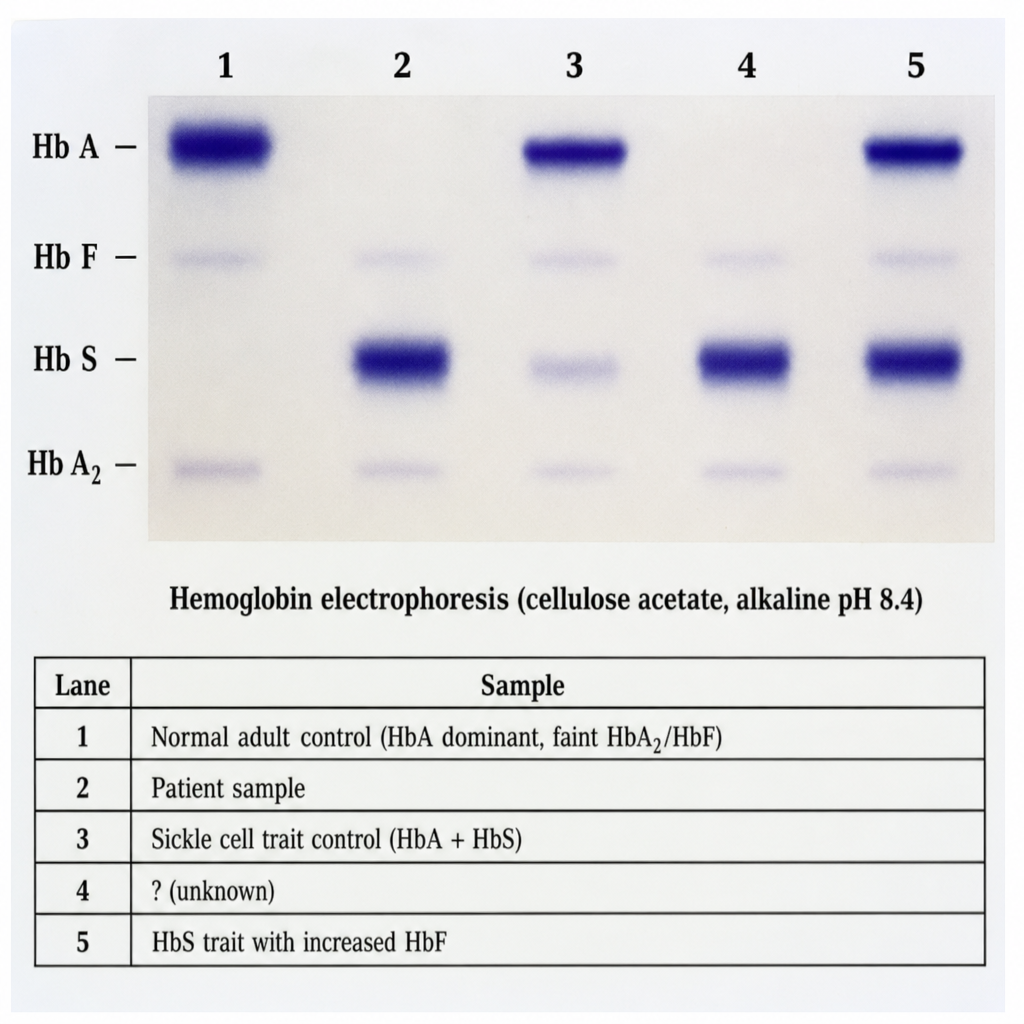
Explanation: ### Explanation **1. Why Option A (2) is Correct:** Sickle cell trait (HbAS) is the heterozygous state where an individual inherits one normal $\beta$-globin gene and one mutated $\beta^S$ gene. On **Hemoglobin Electrophoresis** (alkaline pH), two distinct bands are visible: * **HbA:** Represents the normal adult hemoglobin (usually 50–60%). * **HbS:** Represents the sickle hemoglobin (usually 35–45%). Because both genes are expressed (codominance), both proteins are synthesized and separated based on their electrical charge. HbA moves faster toward the anode, while HbS moves slower due to the substitution of negatively charged glutamic acid with neutral valine at the 6th position of the $\beta$-chain. **2. Why Other Options are Incorrect:** * **Option B (1):** A single band is seen in normal adults (HbA) or those with homozygous Sickle Cell Disease (HbSS), where only HbS (and some HbF) is present. * **Option C & D (4 or 5):** These are incorrect as they do not correspond to the standard electrophoretic pattern of sickle cell trait. Multiple bands (3 or more) might be seen in complex compound heterozygous states (e.g., HbSC or HbS-$\beta$ Thalassemia) where HbF and HbA2 are also significantly elevated. **3. Clinical Pearls for NEET-PG:** * **Electrophoresis Mobility (Alkaline pH):** Remember the mnemonic **"A Fat Santa Claus"** (from fastest to slowest: Hb**A** > Hb**F** > Hb**S** > Hb**C**). * **HbS Mutation:** Point mutation (GAG $\rightarrow$ GTG) resulting in **Valine** replacing **Glutamic acid** at the 6th position of the $\beta$-globin chain. * **Sickle Cell Trait Protection:** Individuals with HbAS are naturally protected against severe *Plasmodium falciparum* malaria. * **Diagnosis:** In Sickle Cell Trait, HbA is always greater than HbS (HbA > HbS). If HbS > HbA, suspect $S\beta^+$ thalassemia.
Explanation: **Explanation:** The question refers to the process of **Glycation** (non-enzymatic glycosylation), which leads to the formation of **Hemoglobin A1c (HbA1c)**. **Why "N linkage" is correct:** In this reaction, the aldehyde group of glucose reacts with the free amino group ($NH_2$) of the N-terminal **valine** residue of the $\beta$-globin chain. This initially forms an unstable aldimine (Schiff base), which then undergoes an **Amadori rearrangement** to form a stable ketoamine. Because the glucose attaches to a Nitrogen atom of the amino acid, it is classified as an **N-linkage**. **Analysis of Incorrect Options:** * **O linkage:** This typically refers to O-glycosylation, an enzymatic process occurring in the Golgi apparatus where carbohydrates attach to the Oxygen atom of Serine or Threonine side chains. This is not the mechanism for HbA1c formation. * **C-C linkage:** Carbon-carbon linkages are extremely stable covalent bonds found in the backbone of organic molecules; they are not the primary site for glucose-protein attachment in glycation. * **O-H linkage:** This refers to hydroxyl groups or hydrogen bonding. While glucose has many O-H groups, the covalent attachment to hemoglobin occurs via the nitrogen of the protein. **Clinical Pearls for NEET-PG:** * **HbA1c** reflects the average blood glucose levels over the preceding **8–12 weeks** (the lifespan of an RBC). * The reaction is **non-enzymatic** and its rate is directly proportional to the blood glucose concentration. * **High-Yield Fact:** In patients with hemolytic anemia or recent blood loss, HbA1c levels may be **falsely low** due to decreased RBC lifespan. Conversely, it may be **falsely high** in iron-deficiency anemia.
Explanation: **Explanation:** The correct answer is **B. Hydrophobic pockets.** **Why it is correct:** Hemoglobin is a globular protein where the heme group (the iron-containing prosthetic group) is nestled within a **hydrophobic pocket** formed by the folding of the globin chains. This hydrophobic environment is critical for the function of hemoglobin. It prevents the permanent oxidation of the ferrous iron ($Fe^{2+}$) to ferric iron ($Fe^{3+}$). If the heme were exposed to an aqueous (hydrophilic) environment, the iron would rapidly oxidize to the ferric state, forming methemoglobin, which is incapable of binding oxygen. **Why the other options are incorrect:** * **A. Hydrophilic pockets:** If heme were in a hydrophilic pocket, water molecules would facilitate the oxidation of $Fe^{2+}$, rendering the hemoglobin non-functional for oxygen transport. * **C. Pyrrole rings:** The heme group itself consists of four pyrrole rings linked together to form a protoporphyrin IX ring. While hemoglobin *contains* pyrrole rings, the question asks where the heme is situated within the overall protein structure. * **D. Cationic ring:** This is a distractor term. The porphyrin ring is a planar, organic structure, not specifically a "cationic ring," though it does coordinate a central metal cation ($Fe^{2+}$). **High-Yield Clinical Pearls for NEET-PG:** * **The "Histidine Guard":** Two specific histidine residues protect the iron. The **Proximal Histidine (F8)** binds directly to the iron, while the **Distal Histidine (E7)** helps stabilize the oxygen binding and further prevents oxidation. * **Methemoglobinemia:** This occurs when the iron is oxidized to $Fe^{3+}$. It is treated with **Methylene Blue**, which reduces the iron back to the $Fe^{2+}$ state. * **Cooperativity:** The movement of the iron atom into the plane of the porphyrin ring upon oxygenation triggers the T-to-R state transition (Sigmoid curve).
Explanation: ### Explanation The correct answer is **C. Lipofuscin**. **1. Why Lipofuscin is the correct answer:** Lipofuscin is known as the "wear-and-tear" or "aging" pigment. Unlike the other options, it is **not** derived from the breakdown of hemoglobin or iron. Instead, it is a product of **lipid peroxidation** of polyunsaturated fatty acids of subcellular membranes. It represents indigestible material within lysosomes and is typically found in aging cells, particularly in the heart (brown atrophy), liver, and neurons. **2. Why the other options are incorrect:** * **Hematin (Option A):** This is an oxidation product of hemoglobin where the iron atom is converted from the ferrous ($Fe^{2+}$) to the ferric ($Fe^{3+}$) state. It is seen in conditions like malaria (hemozoin). * **Hemosiderin (Option B):** This is an iron-storage complex. When there is an excess of iron (derived from the heme portion of hemoglobin), it is stored as ferritin or aggregates into golden-yellow granules called hemosiderin. * **Bilirubin (Option D):** This is the primary catabolic product of the heme moiety of hemoglobin. After the removal of iron, the protoporphyrin ring is converted into biliverdin and then into bilirubin. **3. Clinical Pearls & High-Yield Facts for NEET-PG:** * **Prussian Blue Stain:** Stains **Hemosiderin** blue (Perls' reaction). It does **not** stain Lipofuscin or Bilirubin. * **Lipofuscin Appearance:** Appears as yellow-brown, finely granular cytoplasmic pigment. It is a marker of past free radical injury. * **Bilirubin Staining:** Best visualized using the **Fouchet stain**. * **Hematoidin:** A hemoglobin-derived pigment chemically similar to bilirubin but formed in tissues (e.g., old infarcts/bruises) in an anaerobic environment; it is iron-free.
Explanation: **Explanation:** The synthesis of heme is a vital biochemical process occurring primarily in the liver and erythroblasts. The correct answer is **Glycine** because it is the fundamental nitrogenous building block for the porphyrin ring. **1. Why Glycine is Correct:** The first and rate-limiting step of heme synthesis occurs in the mitochondria. The enzyme **ALA Synthase (ALAS)** catalyzes the condensation of **Succinyl CoA** (from the TCA cycle) and the amino acid **Glycine** to form **$\delta$-Aminolevulinic acid (ALA)**. This reaction requires **Pyridoxal Phosphate (Vitamin B6)** as a cofactor. Ultimately, eight molecules of glycine are required to synthesize one molecule of heme. **2. Why Other Options are Incorrect:** * **Glutamine:** While it is a major nitrogen donor for purine and pyrimidine synthesis, it does not participate in the heme pathway. * **Glutamic acid:** It is a precursor for GABA and proline but is not a substrate for ALA synthase. * **Lysine:** An essential ketogenic amino acid that is not involved in the formation of the porphyrin ring. **3. Clinical Pearls & High-Yield Facts for NEET-PG:** * **Rate-limiting Enzyme:** ALA Synthase 1 (liver) is inhibited by the end-product, Heme (feedback inhibition). * **Cofactor Deficiency:** Vitamin B6 deficiency can lead to **Sideroblastic Anemia** because ALA synthase cannot function without PLP. * **Lead Poisoning:** Lead inhibits two enzymes in this pathway: **ALA Dehydratase** and **Ferrochelatase**, leading to increased ALA levels and stippled RBCs. * **Key Substrates:** Remember the mnemonic: **"Heme is GS"** (Glycine + Succinyl CoA).
Explanation: **Explanation:** The catabolism of hemoglobin occurs primarily in the reticuloendothelial system (spleen and liver). The process begins when senescent red blood cells are lysed, releasing hemoglobin. 1. **Why Biliverdin is correct:** The first step in heme degradation is catalyzed by the enzyme **Heme Oxygenase**. This enzyme breaks the porphyrin ring, releasing iron ($Fe^{2+}$) and carbon monoxide (CO), resulting in the formation of **Biliverdin**, a green pigment. Biliverdin is then subsequently reduced to Bilirubin (yellow pigment) by the enzyme *Biliverdin Reductase*. Therefore, Biliverdin is the immediate intermediate product. 2. **Why other options are incorrect:** * **Bilirubin diglucuronide:** This is the "conjugated" form of bilirubin produced in the liver by the enzyme *UDP-glucuronyltransferase*. It occurs *after* bilirubin formation to make it water-soluble for excretion. * **Urobilin:** This is an oxidation product of urobilinogen found in urine, giving it its characteristic yellow color. It is a late-stage metabolite formed by intestinal bacteria. * **Stercobilin:** This is the oxidized form of stercobilinogen excreted in feces, providing the brown color. Like urobilin, it is formed much later in the pathway within the intestine. **High-Yield Clinical Pearls for NEET-PG:** * **Heme Oxygenase** is the only endogenous source of **Carbon Monoxide (CO)** in the human body. * **Rate-limiting step:** The conversion of heme to biliverdin by Heme Oxygenase. * **Van den Bergh Reaction:** Used to differentiate between conjugated (direct) and unconjugated (indirect) bilirubin. * **Crigler-Najjar & Gilbert Syndromes:** Result from deficiencies in the conjugation enzyme *UDP-glucuronyltransferase*.
Explanation: **Explanation:** **1. Why Glycine is Correct:** The synthesis of heme begins in the mitochondria with the condensation of **Succinyl CoA** and the amino acid **Glycine**. This reaction is catalyzed by the enzyme **ALA Synthase (ALAS)**, which requires Pyridoxal Phosphate (Vitamin B6) as a cofactor. This is the **rate-limiting step** of heme biosynthesis. Glycine provides the nitrogen and carbon atoms necessary to form the pyrrole ring, which eventually constitutes the tetrapyrrole structure of heme. **2. Why Other Options are Incorrect:** * **Lysine:** An essential basic amino acid primarily involved in protein synthesis and collagen cross-linking; it does not participate in the heme pathway. * **Arginine:** A precursor for Nitric Oxide (NO), urea, and creatine. While vital for the urea cycle, it has no role in porphyrin synthesis. * **Glutamine:** Acts as a major nitrogen donor for purine and pyrimidine synthesis (nucleotide metabolism) but is not a substrate for heme. **3. High-Yield Clinical Pearls for NEET-PG:** * **Rate-Limiting Enzyme:** ALA Synthase (ALAS1 in liver, ALAS2 in erythroid cells). * **Cofactor Alert:** Deficiency of **Vitamin B6** can lead to Sideroblastic Anemia because ALA synthase cannot function without it. * **Inhibitors:** Lead poisoning inhibits **ALA Dehydratase** and **Ferrochelatase**, leading to increased ALA levels and stippled RBCs. * **Heme vs. Globin:** While Glycine is needed for the *heme* part, the *globin* part is a protein synthesized on ribosomes like any other protein. * **Mnemonic:** "Sucking Glycine" (Succinyl CoA + Glycine) to remember the starting substrates.
Explanation: **Explanation:** **1. Why ALA Synthase is Correct:** Aminolevulinate synthase (**ALA synthase**) is the **rate-limiting and key regulatory enzyme** of heme biosynthesis in the liver. It catalyzes the condensation of Succinyl CoA and Glycine to form $\delta$-aminolevulinic acid (ALA), requiring **Pyridoxal Phosphate (Vitamin B6)** as a cofactor. In the liver, this enzyme is strictly regulated by **heme** via feedback inhibition (repression of enzyme synthesis and inhibition of mitochondrial transport). **2. Why Other Options are Incorrect:** * **Decarboxylase (Uroporphyrinogen Decarboxylase):** This enzyme converts Uroporphyrinogen III to Coproporphyrinogen III. While its deficiency leads to *Porphyria Cutanea Tarda*, it is not the rate-limiting step. * **Coproporphyrinogen Oxidase:** This mitochondrial enzyme converts Coproporphyrinogen III to Protoporphyrinogen IX. Deficiency causes *Hereditary Coproporphyria*. * **Protoporphyrinogen Oxidase:** This enzyme converts Protoporphyrinogen IX to Protoporphyrin IX. Deficiency leads to *Variegate Porphyria*. **3. High-Yield Clinical Pearls for NEET-PG:** * **Isoforms:** There are two isoforms: **ALAS1** (ubiquitous/hepatic) and **ALAS2** (erythroid-specific). ALAS2 is regulated by **iron** levels, not heme. * **Cofactor:** B6 deficiency can lead to **Sideroblastic Anemia** because ALA synthase cannot function. * **Inducers:** Drugs like barbiturates and griseofulvin induce ALAS1, which can precipitate acute attacks of porphyria. * **Inhibitors:** Hematin (a heme analog) is used to treat porphyria attacks because it inhibits ALA synthase.
Explanation: **Explanation:** The concentration of **2,3-bisphosphoglycerate (2,3-BPG/DPG)** in erythrocytes is a critical regulator of hemoglobin’s oxygen affinity. It binds to the central cavity of the deoxyhemoglobin tetramer, stabilizing the **T (Tense) state** and shifting the oxygen dissociation curve to the **right**, facilitating oxygen unloading to tissues. **Why Hypoxanthine is the Correct Answer:** Hypoxanthine is a purine derivative and a breakdown product of adenosine monophosphate (AMP). It does not enter the glycolytic pathway or the **Rapoport-Luebering shunt** (the pathway responsible for 2,3-BPG synthesis). Therefore, it has no direct role in increasing 2,3-BPG levels. **Analysis of Incorrect Options:** * **Anemia & Hypoxia:** These conditions trigger a compensatory increase in 2,3-BPG. In anemia (low hemoglobin) and hypoxia (low arterial $PO_2$), the body increases 2,3-BPG to enhance oxygen delivery to peripheral tissues by decreasing hemoglobin's affinity for $O_2$. * **Inosine:** In blood banking, inosine is added to stored blood as a "rejuvenation" fluid. Inosine is a nucleoside that can be converted into **Ribose-5-phosphate**, which then enters the pentose phosphate pathway and subsequently the glycolytic pathway, eventually leading to the synthesis of 2,3-BPG. This helps restore the oxygen-carrying efficiency of stored blood. **Clinical Pearls for NEET-PG:** * **Rapoport-Luebering Shunt:** Uses the enzyme *2,3-BPG synthase/phosphatase* to bypass the phosphoglycerate kinase step of glycolysis. * **Stored Blood:** 2,3-BPG levels **decrease** in stored blood, causing a "left shift" (increased $O_2$ affinity). This is why inosine is added. * **Fetal Hemoglobin (HbF):** Has a lower affinity for 2,3-BPG compared to HbA, allowing HbF to have a higher affinity for $O_2$, facilitating oxygen transfer from mother to fetus. * **High Altitude:** Chronic exposure leads to an increase in 2,3-BPG as an adaptive mechanism.
Explanation: **Explanation:** The correct answer is **Myoglobin (Option C)**. **Why Myoglobin is correct:** Hemoglobin is a tetrameric protein ($α_2β_2$), whereas myoglobin is a monomeric protein. Despite this difference in quaternary structure, the individual polypeptide chains (subunits) of hemoglobin are structurally very similar to myoglobin. Both share a common evolutionary origin and possess the **"globin fold"**—a characteristic tertiary structure consisting of eight α-helices (labeled A through H) that create a hydrophobic pocket to house the heme group. This structural homology allows both proteins to bind oxygen reversibly. **Why other options are incorrect:** * **Collagen:** A fibrous structural protein characterized by a triple helix (not α-helices) and a repeating Gly-X-Y amino acid sequence. It does not bind oxygen or contain heme. * **Albumin:** The most abundant plasma protein, primarily responsible for maintaining oncotic pressure and transporting various ligands (bilirubin, fatty acids, drugs). Its structure is globular but lacks the globin fold and heme moiety. * **Transferrin:** A plasma glycoprotein specifically designed to transport iron ($Fe^{3+}$) in the blood. While involved in iron metabolism, its structure and function are distinct from the oxygen-binding globin family. **High-Yield Clinical Pearls for NEET-PG:** * **Oxygen Dissociation Curve:** Myoglobin exhibits a **hyperbolic** curve (high affinity, storage function), while Hemoglobin exhibits a **sigmoidal** curve (cooperative binding, transport function). * **P50 Value:** The $P_{50}$ of myoglobin is much lower (~1–2 mmHg) than that of hemoglobin (~26 mmHg), reflecting myoglobin's higher affinity for $O_2$. * **Homology:** While the primary amino acid sequences of myoglobin and hemoglobin subunits differ significantly, their **tertiary structures** are nearly identical.
Explanation: **Explanation:** The formation of glycated hemoglobin (HbA1c) is a non-enzymatic process known as **glycation**. This process involves the attachment of glucose to the hemoglobin molecule, specifically at the **N-terminal valine** of the beta-globin chain. 1. **Why N-linkage is correct:** The aldehyde group of glucose reacts with the free amino group (-NH₂) of the N-terminal valine. This initially forms an unstable aldimine (Schiff base), which then undergoes an **Amadori rearrangement** to form a stable ketoamine. Because the bond is formed with a nitrogen atom of the amino group, it is classified as an **N-linkage**. 2. **Why other options are incorrect:** * **O-linkage:** This typically refers to O-glycosylation, where sugars attach to the oxygen atom of hydroxyl groups (e.g., on Serine or Threonine residues). This is an enzymatic process common in glycoproteins, not HbA1c. * **C-C linkage:** Carbon-carbon bonds are extremely stable and do not form spontaneously between glucose and proteins under physiological conditions. * **O-H linkage:** This refers to a hydroxyl group or hydrogen bonding, not a covalent structural linkage between a sugar and a protein backbone. **Clinical Pearls for NEET-PG:** * **HbA1c reflects glycemic control** over the preceding **8–12 weeks** (the average lifespan of an RBC). * The reaction is **non-enzymatic**; its rate is directly proportional to the blood glucose concentration. * **False Lows:** Seen in conditions with high RBC turnover (e.g., Hemolytic anemia, recent hemorrhage, or treatment with Erythropoietin). * **False Highs:** Seen in Iron deficiency anemia (due to increased RBC lifespan and altered glycation rates).
Explanation: ### Explanation **Sickle Cell Disease (SCD)** is an autosomal recessive hemoglobinopathy caused by a point mutation in the $\beta$-globin gene. #### 1. Why Option B is the "Incorrect Statement" (The Correct Answer) The question asks for the **incorrect** statement. Option B states that a sticky patch is generated; while this is a true biochemical fact, it is often misidentified in exams. However, in the context of this specific question's construction, let's analyze the molecular pathology: * **The Mutation:** Glutamate (polar, negatively charged) at position 6 of the $\beta$-chain is replaced by Valine (non-polar, hydrophobic). * **The Consequence:** This creates a "sticky" hydrophobic patch on the surface of deoxy-HbS. This patch interacts with complementary hydrophobic sites on adjacent hemoglobin molecules, leading to **polymerization** and the characteristic "sickle" shape. * *Note: In many standardized formats, if Option B is marked as the "correct answer" to "which is incorrect," it usually implies a technicality in the phrasing or a distractor. However, scientifically, Option B is a **factually correct** description of the disease mechanism.* #### 2. Analysis of Other Options * **Option A:** This is a **correct statement**. A single nucleotide change (GAG $\rightarrow$ GTG) leads to the substitution of Glutamate with Valine. * **Option C:** This is a **correct statement**. The "Heterozygote Advantage" (Sickle Cell Trait) provides protection against *Plasmodium falciparum* malaria by impairing the parasite's ability to survive within the RBC. * **Option D:** This is a **correct statement**. The mutation (A $\rightarrow$ T) abolishes a recognition site for the restriction enzyme **MstII**. This change in DNA fragment length allows for prenatal diagnosis via RFLP. #### 3. High-Yield Clinical Pearls for NEET-PG * **Mutation Type:** Transversion (Purine $\rightarrow$ Pyrimidine). * **Electrophoresis:** On alkaline electrophoresis (pH 8.6), HbS moves **slower** than HbA toward the anode because it has lost two negative charges (one per $\beta$-chain). * **Precipitating Factors:** Hypoxia, acidosis, dehydration, and increased 2,3-BPG favor the T-state (deoxy) and promote sickling. * **Metabisulfite Test:** Used for screening; induces sickling by deoxygenating the sample.
Explanation: **Explanation:** **1. Understanding the Concept:** Iron is a vital but potentially toxic element due to its ability to generate free radicals. To prevent cellular damage, the body stores excess iron in a non-toxic, water-soluble protein complex called **Ferritin**. While the **liver** is the primary systemic reservoir for iron, ferritin is ubiquitously present in almost all cells. Significant concentrations are found in the **reticuloendothelial system (RES)**, which includes the liver, spleen, and bone marrow, as well as in the mucosal cells of the **gut** (intestine). **2. Analysis of Options:** * **Liver (Option C):** This is the major storage site. Hepatocytes and Kupffer cells store iron as ferritin to maintain systemic iron homeostasis. * **Spleen (Option B):** As a key part of the reticuloendothelial system, the spleen recycles iron from aged erythrocytes and stores it as ferritin before it is reused. * **Gut (Option A):** Enterocytes in the intestinal mucosa absorb dietary iron and store it as ferritin. This "mucosal block" helps regulate how much iron enters the bloodstream; if not needed, the iron is lost when the enterocytes are sloughed off. * **All of the Above (Option D):** Since all three organs play critical roles in the absorption, recycling, and storage of iron, this is the correct answer. **3. NEET-PG High-Yield Pearls:** * **Apoferritin vs. Ferritin:** Apoferritin is the protein shell; once it binds to ferric iron ($Fe^{3+}$), it is called Ferritin. * **Hemosiderin:** When iron levels exceed the storage capacity of ferritin, it forms **Hemosiderin**, an insoluble, partially denatured form of ferritin (visible on Prussian Blue stain). * **Serum Ferritin:** It is the most sensitive laboratory index for diagnosing **Iron Deficiency Anemia** (levels decrease before hemoglobin drops). * **Acute Phase Reactant:** Ferritin levels rise during inflammation, which can mask an underlying iron deficiency.
Explanation: **Explanation:** **1. Why Option A is Correct:** 2,3-Bisphosphoglycerate (2,3-DPG) is a highly anionic molecule that binds to a **single** specific site on the Hemoglobin (Hb) tetramer. This binding site is the central cavity located between the two **beta-chains**. The binding of 2,3-DPG stabilizes the **T-state (Tense state)** or deoxygenated form of hemoglobin by forming salt bridges. By stabilizing the T-state, 2,3-DPG lowers the affinity of Hb for oxygen, causing the oxygen-dissociation curve to shift to the **right**. This facilitates the **increase** in oxygen release (unloading) to the peripheral tissues where it is needed most. **2. Why Other Options are Incorrect:** * **Options B & D (Four):** Hemoglobin is a tetramer, but 2,3-DPG does not bind to each subunit. It binds to only **one** central pocket. Binding to four sites is a characteristic of oxygen molecules, not 2,3-DPG. * **Option C (Decrease):** A decrease in oxygen release occurs when the curve shifts to the left (increased affinity). This happens when 2,3-DPG levels are low (e.g., in stored blood) or in Fetal Hemoglobin (HbF), which has a lower affinity for 2,3-DPG. **3. High-Yield Clinical Pearls for NEET-PG:** * **HbF vs. HbA:** HbF has $\gamma$-chains instead of $\beta$-chains. These $\gamma$-chains have fewer positive charges in the central cavity, leading to **low affinity for 2,3-DPG** and a resultant higher affinity for oxygen. * **Adaptation:** 2,3-DPG levels **increase** in response to chronic hypoxia, such as at high altitudes or in chronic obstructive pulmonary disease (COPD), to enhance tissue oxygenation. * **Stored Blood:** 2,3-DPG levels drop in stored blood. Transfusing large amounts of "old" blood can temporarily impair oxygen delivery to tissues until the recipient's body regenerates 2,3-DPG.
Explanation: ### Explanation **Correct Option: A. Decrease in binding of O2 and hemoglobin** The relationship between 2,3-Bisphosphoglycerate (2,3-DPG) and hemoglobin is defined by an inverse allosteric interaction. 2,3-DPG binds to the central cavity of the deoxyhemoglobin (T-state), stabilizing it and **decreasing the affinity** of hemoglobin for oxygen. Therefore, a **decrease** in 2,3-DPG levels results in an **increased affinity** of hemoglobin for oxygen (shifting the Oxygen Dissociation Curve to the left). Conversely, when the binding of O2 to hemoglobin decreases (favoring the T-state), the body typically responds by increasing 2,3-DPG to facilitate oxygen unloading. In the context of this question, the physiological consequence of decreased 2,3-DPG is a shift toward higher O2 affinity, meaning O2 remains bound to hemoglobin more tightly. **Analysis of Incorrect Options:** * **B & C (Acidity in RBC):** The enzyme **Phosphofructokinase (PFK)**, which is the rate-limiting step of glycolysis, is highly sensitive to pH. **Increased acidity (low pH)** inhibits PFK, leading to decreased glycolysis and a subsequent **decrease in 2,3-DPG**. Conversely, decreased acidity (alkalosis) stimulates 2,3-DPG production. * **D (Lysis of RBC):** While lysis destroys the cell, it is not a physiological regulator of 2,3-DPG concentration within the metabolic pathway. **High-Yield Clinical Pearls for NEET-PG:** * **Right Shift (Reduced Affinity):** Increased 2,3-DPG, Increased H+ (Bohr Effect), Increased CO2, Increased Temperature. (Mnemonic: **CADET**, face Right! — **C**O2, **A**cid, **D**PG, **E**xercise, **T**emp). * **Left Shift (Increased Affinity):** Decreased 2,3-DPG, Fetal Hemoglobin (HbF), Carbon Monoxide (CO), Hypothermia. * **Stored Blood:** 2,3-DPG levels drop in stored blood; hence, massive transfusions can lead to impaired oxygen delivery to tissues. * **Rapoport-Luebering Shunt:** The specific pathway in RBCs that generates 2,3-DPG.
Explanation: **Explanation:** The absorption of iron in the gastrointestinal tract is a highly regulated process. Iron enters the enterocyte (mucosal cell) via the **Divalent Metal Transporter 1 (DMT-1)**. Once inside the cell, iron must be transported across the cytoplasm to the basolateral membrane for systemic absorption. This mucosal transfer is mediated by **Apoferritin**. Apoferritin binds with free ferrous iron ($Fe^{2+}$) to form **Ferritin**. This complex acts as a temporary storage form within the mucosal cell. If the body requires iron, it is released and transported into the blood; if not, the iron remains trapped as ferritin and is lost when the mucosal cell is sloughed off (the "mucosal block" phenomenon). **Analysis of Options:** * **A. Transferrin:** This is the primary protein responsible for transporting iron in the **plasma**, not within the mucosal cell. * **C. Apotransferrin:** This is the iron-free form of transferrin found in the blood. It becomes transferrin once it binds two molecules of ferric iron ($Fe^{3+}$). * **D. Ferritin:** While ferritin is the storage form, **Apoferritin** is the specific protein shell that mediates the binding and transfer process within the mucosa. **High-Yield Clinical Pearls for NEET-PG:** * **Hepcidin:** The master regulator of iron metabolism; it inhibits **Ferroportin**, preventing iron exit from enterocytes into the blood. * **Hephaestin:** A ferroxidase that converts $Fe^{2+}$ to $Fe^{3+}$ at the basolateral membrane to allow binding to plasma transferrin. * **Vitamin C:** Enhances iron absorption by maintaining iron in the more soluble ferrous ($Fe^{2+}$) state.
Explanation: **Explanation:** The correct answer is **Ferrochelatase**. **Erythropoietic Protoporphyria (EPP)** is an autosomal dominant disorder caused by a deficiency in **Ferrochelatase**, the final enzyme in the heme biosynthetic pathway. This enzyme is responsible for inserting ferrous iron ($Fe^{2+}$) into Protoporphyrin IX to form Heme. When deficient, Protoporphyrin IX accumulates in erythrocytes, bone marrow, and plasma. Clinically, this manifests as **immediate cutaneous photosensitivity** (burning, itching, and edema upon sun exposure) rather than the blistering seen in other porphyrias. **Analysis of Incorrect Options:** * **A. PBG Deaminase:** Deficiency leads to **Acute Intermittent Porphyria (AIP)**. It presents with the "5 Ps": Painful abdomen, Polyneuropathy, Psychosis, Pink urine, and Precipitation by drugs (Barbiturates), but notably lacks cutaneous photosensitivity. * **B. Uroporphyrinogen III Cosynthase:** Deficiency causes **Congenital Erythropoietic Porphyria (Gunther’s disease)**. It is characterized by severe mutilating photosensitivity, erythrodontia (red teeth), and hemolytic anemia. * **C. Coproporphyrinogen Oxidase:** Deficiency leads to **Hereditary Coproporphyria (HCP)**, which presents with both neurovisceral symptoms and photosensitivity. **NEET-PG High-Yield Pearls:** * **Most common porphyria:** Porphyria Cutanea Tarda (Deficiency of Uroporphyrinogen decarboxylase). * **Key distinction:** Porphyrias occurring *before* the synthesis of tetrapyrroles (like AIP) do not show photosensitivity. Porphyrias occurring *after* (like EPP or PCT) result in photosensitivity due to the light-absorbing properties of porphyrin rings. * **Lead Poisoning:** Inhibits both **$\delta$-ALA dehydratase** and **Ferrochelatase**, mimicking some features of porphyria.
Explanation: **Explanation:** **1. Why the Beta chain is correct:** Sickle Cell Anaemia (SCA) is an autosomal recessive disorder caused by a **point mutation** in the **$\beta$-globin gene** located on chromosome 11. Specifically, there is a substitution of **Glutamic acid** (a polar amino acid) by **Valine** (a non-polar, hydrophobic amino acid) at the **6th position** of the $\beta$-globin chain ($Glu6Val$). This substitution creates a "sticky" hydrophobic patch on the surface of the hemoglobin molecule (HbS). Under deoxygenated conditions, these patches cause HbS molecules to polymerize, distorting the red blood cell into a characteristic sickle shape. **2. Why other options are incorrect:** * **Alpha chain:** Mutations in the $\alpha$-globin chain (located on chromosome 16) are associated with **$\alpha$-Thalassemia**, not Sickle Cell Anaemia. * **Both chains:** SCA is strictly a $\beta$-chain pathology. While hemoglobin is a tetramer ($\alpha_2\beta_2$), the $\alpha$-chains in a patient with SCA are structurally normal. * **None of these:** Incorrect, as the molecular defect is well-established in the $\beta$-globin chain. **3. High-Yield Clinical Pearls for NEET-PG:** * **Mutation type:** Transversion (GAG $\rightarrow$ GTG). * **Electrophoresis:** On alkaline electrophoresis, HbS moves **slower** towards the anode than HbA because Valine is neutral, whereas Glutamic acid is negatively charged. * **Protective effect:** Heterozygotes (Sickle cell trait) have a selective advantage against *Plasmodium falciparum* malaria. * **Metabolic trigger:** Sickling is precipitated by hypoxia, acidosis, dehydration, and increased 2,3-BPG.
Explanation: ### Explanation **Core Concept:** Serum ferritin is the primary storage form of iron. It is also an **acute-phase reactant**. This means its levels increase during inflammation, infection, or tissue damage, regardless of the body's actual iron stores. **Why Liver Disease is the Correct Answer:** In liver disease (such as hepatitis or cirrhosis), ferritin levels are characteristically **elevated**, not reduced. This occurs because the liver is the primary storage organ for ferritin. When hepatocytes are damaged or undergo necrosis, they leak their intracellular ferritin stores directly into the plasma. Therefore, liver disease is a classic cause of "falsely" high ferritin levels, even if a patient has a co-existing iron deficiency. **Analysis of Other Options:** * **A. Iron Deficiency:** This is the most common cause of low ferritin. Serum ferritin is the most sensitive and specific initial lab test for diagnosing iron deficiency anemia. * **B. Vitamin C Deficiency:** Vitamin C (Ascorbic acid) is essential for the stability of ferritin and the incorporation of iron into the ferritin shell. Deficiency can lead to impaired iron storage and reduced ferritin levels. * **C. Hypothyroidism:** Thyroid hormones influence the synthesis of ferritin. In hypothyroid states, the rate of ferritin synthesis decreases, leading to lower plasma levels. **High-Yield Clinical Pearls for NEET-PG:** * **Best Screening Test for IDA:** Serum Ferritin (it is the first parameter to decrease in iron deficiency). * **Ferritin as a Mask:** Because it is an acute-phase reactant, a "normal" ferritin level in a patient with chronic inflammation (e.g., Rheumatoid Arthritis) does not rule out iron deficiency. * **The "Rule of 30":** In the presence of inflammation/liver disease, a ferritin level <30 ng/mL still suggests iron deficiency, whereas in healthy individuals, the cutoff is usually <15 ng/mL.
Explanation: ### Explanation **Correct Option: D. Transferrin** Transferrin is the primary plasma glycoprotein responsible for the **transport** of iron in the blood. Iron is absorbed in the ferrous ($Fe^{2+}$) state but must be converted to the ferric ($Fe^{3+}$) state by ferroxidase (ceruloplasmin) to bind to Transferrin. Each Transferrin molecule can bind two atoms of $Fe^{3+}$. It delivers iron to tissues (especially the bone marrow and liver) by binding to specific **Transferrin Receptors (TfR)** on the cell surface. The complex is then internalized via receptor-mediated endocytosis. **Why the other options are incorrect:** * **A. Ferritin:** This is the primary **intracellular storage** form of iron. It is a hollow protein shell (apoferritin) that sequesters iron to prevent oxidative damage. While small amounts circulate in the serum (correlating with total body iron stores), it is not the transport vehicle for tissue delivery. * **B. Ferredoxin:** These are iron-sulfur proteins found in bacteria, algae, and plants (and within human mitochondria), primarily involved in **electron transfer** reactions, not systemic iron transport. * **C. Hemosiderin:** This is an insoluble, partially denatured form of ferritin found in states of **iron overload**. It represents long-term iron storage and is visible under light microscopy with Prussian blue staining. **High-Yield Clinical Pearls for NEET-PG:** * **Total Iron Binding Capacity (TIBC):** This is an indirect measure of serum transferrin levels. In **Iron Deficiency Anemia (IDA)**, Transferrin/TIBC increases while Ferritin decreases. * **Ferroportin:** The only known iron exporter that releases iron from enterocytes/macrophages into the blood. It is inhibited by **Hepcidin**. * **Atransferrinemia:** A rare genetic deficiency of transferrin leading to microcytic anemia and secondary iron overload.
Explanation: **Explanation:** **Hemochromatosis** is a disorder of iron overload where excessive iron is deposited in various organs (liver, pancreas, heart, and skin). When iron levels exceed the storage capacity of **ferritin**, the body stores the excess iron in the form of **Haemosiderin**. 1. **Why Haemosiderin is correct:** Haemosiderin is an insoluble iron-storage complex composed of partially digested ferritin and lysosomes. In hemochromatosis, haemosiderin accumulates in parenchymal cells, leading to tissue damage and fibrosis. It is histologically identified using the **Prussian Blue stain**, which stains the pigment deep blue. 2. **Why other options are incorrect:** * **Bilirubin:** A breakdown product of heme catabolism. Elevated levels cause jaundice, not iron overload. * **Methemoglobin:** A form of hemoglobin where iron is in the ferric ($Fe^{3+}$) state rather than the ferrous ($Fe^{2+}$) state, impairing oxygen delivery. * **Myoglobin:** An iron- and oxygen-binding protein found in muscle tissue; it is released into the blood following muscle injury (rhabdomyolysis). **High-Yield Clinical Pearls for NEET-PG:** * **Classic Triad of Hemochromatosis:** "Bronze diabetes" (Skin pigmentation, Diabetes mellitus due to pancreatic damage, and Cirrhosis). * **HFE Gene:** Most cases are hereditary, involving a mutation in the *HFE* gene (C282Y is the most common mutation). * **Diagnosis:** Elevated serum ferritin and transferrin saturation (>45%). * **Treatment:** Therapeutic phlebotomy is the gold standard; iron chelators (e.g., Deferoxamine) are used if phlebotomy is contraindicated.
Explanation: **Explanation:** **Kinky Hair Disease (Menkes Disease)** is an X-linked recessive disorder caused by a mutation in the **ATP7A gene**. This gene encodes a P-type ATPase responsible for the absorption of dietary copper from the intestinal epithelium into the bloodstream and its transport across the blood-brain barrier. In Menkes disease, copper becomes trapped within intestinal mucosal cells, leading to a severe systemic **copper deficiency**. This deficiency impairs the function of copper-dependent enzymes (cuproenzymes), most notably **Lysyl Oxidase**. This enzyme is essential for cross-linking collagen and elastin; its failure results in the characteristic "kinky," brittle, and depigmented hair (pili torti), along with connective tissue defects and neurodegeneration. **Analysis of Incorrect Options:** * **A. Iron transport:** Defects in iron transport or metabolism typically lead to Hemochromatosis (overload) or Sideroblastic anemia, not kinky hair. * **B. Calcium transport:** Abnormalities in calcium transport are associated with disorders like hypoparathyroidism or rickets, affecting bone density and neuromuscular excitability. * **D. Magnesium transport:** Defects here lead to familial hypomagnesemia, which presents with seizures and tetany, but does not affect hair structure. **High-Yield Clinical Pearls for NEET-PG:** * **Menkes vs. Wilson:** Menkes is a defect in **ATP7A** (Copper deficiency/absorption failure). Wilson Disease is a defect in **ATP7B** (Copper overload/biliary excretion failure). * **Key Enzyme:** The "kinky hair" phenotype is specifically due to **Lysyl Oxidase** failure. * **Diagnosis:** Characterized by low serum copper and low serum ceruloplasmin levels. * **Mnemonic:** "Menkes is **A**bsorption (**ATP7A**); Wilson is **B**iliary (**ATP7B**)."
Explanation: ### Explanation **Why Option A is Correct:** Fetal Hemoglobin (HbF) consists of two alpha ($\alpha$) and two gamma ($\gamma$) chains ($\alpha_2\gamma_2$), unlike adult hemoglobin (HbA), which has two alpha and two beta ($\beta$) chains ($\alpha_2\beta_2$). The central cavity of HbA contains positively charged amino acids (like Histidine) in the $\beta$-chains that bind strongly to the negatively charged **2,3-Bisphosphoglycerate (2,3-DPG)**. 2,3-DPG is an allosteric effector that stabilizes the T-state (tense/deoxygenated) of hemoglobin, promoting oxygen unloading. In HbF, the $\gamma$-chain replaces Histidine with **Serine** at position 143. Serine is neutral, which significantly **reduces the binding affinity of HbF for 2,3-DPG**. Consequently, HbF remains in the R-state (relaxed/oxygenated) more easily, resulting in a higher affinity for $O_2$ and a **leftward shift** of the oxygen dissociation curve. This allows the fetus to "pull" oxygen from maternal blood across the placenta. **Why Other Options are Incorrect:** * **B. Decrease in Hb concentration:** Hb concentration affects the total oxygen-carrying capacity of blood, not the intrinsic binding affinity of individual hemoglobin molecules. * **C. Increase in pH:** While an increase in pH (alkalosis) does increase $O_2$ affinity (Bohr effect), it is a physiological shift rather than the structural reason why HbF inherently differs from HbA. * **D. Double Bohr effect:** This describes the simultaneous shift in maternal and fetal curves in the placenta (maternal blood becomes more acidic, releasing $O_2$; fetal blood becomes more alkaline, taking up $O_2$). It facilitates transfer but is not the structural cause of HbF's high affinity. **High-Yield Clinical Pearls for NEET-PG:** * **HbF Structure:** $\alpha_2\gamma_2$. * **P50 Value:** HbF has a lower P50 (~19 mmHg) compared to HbA (~26.6 mmHg), reflecting higher affinity. * **Switching:** HbF is the primary hemoglobin from 3 months gestation until birth; it is replaced by HbA within the first 6 months of life. * **Therapeutic Note:** Hydroxyurea is used in Sickle Cell Anemia because it increases the production of HbF, which inhibits the polymerization of HbS.
Explanation: ### Explanation **1. Why Hemochromatosis is Correct:** Hemochromatosis is a disorder of **iron overload** (often due to mutations in the *HFE* gene) characterized by excessive intestinal iron absorption. This leads to an expansion of the total body iron pool. * **Serum Iron:** Increases as more iron enters the circulation. * **Serum Ferritin:** Increases because ferritin is the primary storage form of iron; its levels reflect total body stores. * **Transferrin Saturation:** Increases (often >45-50%) because the available iron-binding sites on transferrin become highly occupied. * **Total Iron Binding Capacity (TIBC):** Typically decreases as the body attempts to compensate for the iron excess. **2. Why the Other Options are Incorrect:** * **Iron Deficiency Anemia (IDA):** This is the polar opposite. It presents with **decreased** serum iron, **decreased** ferritin, and **decreased** transferrin saturation, while TIBC is increased. * **Lead Poisoning:** This affects heme synthesis by inhibiting enzymes like ALA dehydratase and Ferrochelatase. While it causes sideroblastic changes, it does not typically present with the systemic iron overload profile seen in hemochromatosis. * **Wilson’s Disease:** This is a disorder of **copper metabolism** (ATP7B mutation), not iron. It is characterized by low serum ceruloplasmin and increased urinary copper excretion. **3. NEET-PG High-Yield Pearls:** * **Classic Triad of Hemochromatosis:** "Bronze Diabetes" (Skin hyperpigmentation, Diabetes Mellitus, and Cirrhosis). * **Gold Standard Diagnosis:** Liver biopsy with **Prussian Blue staining** (Perl’s stain) to quantify the Hepatic Iron Index. * **Screening Test of Choice:** Transferrin saturation is the most sensitive initial screening test. * **Hereditary Pattern:** Most commonly Autosomal Recessive (C282Y mutation).
Explanation: **Explanation:** The correct answer is **Hb F (Fetal Hemoglobin)**. Hemoglobin synthesis undergoes a specific chronological transition during development, known as "hemoglobin switching." **1. Why Hb F is correct:** Hb F ($\alpha_2\gamma_2$) is the predominant hemoglobin from the **eighth week of gestation until birth**. It has a higher affinity for oxygen than adult hemoglobin (HbA), which is crucial for the fetus to extract oxygen from maternal blood across the placenta. By the time of birth, Hb F constitutes approximately 60–90% of total hemoglobin, eventually being replaced by HbA within the first six months of life. **2. Why the other options are incorrect:** * **Hb Gower-1 ($\zeta_2\epsilon_2$) and Hb Gower-2 ($\alpha_2\epsilon_2$):** These are **embryonic hemoglobins**. They are synthesized in the yolk sac during the first trimester (weeks 3–8) and disappear as erythropoiesis shifts to the liver and spleen. * **Hb Portland ($\zeta_2\gamma_2$):** This is also an embryonic hemoglobin. It is clinically significant in cases of $\alpha$-thalassemia major (Hb Bart’s), where it may persist as the only functional hemoglobin. **High-Yield Clinical Pearls for NEET-PG:** * **Hb F Structure:** Composed of two alpha ($\alpha$) and two gamma ($\gamma$) chains. * **Oxygen Dissociation Curve:** Hb F causes a **left shift** in the curve because it does not bind 2,3-BPG as strongly as HbA. * **Kleihauer-Betke Test:** Used to quantify fetal-maternal hemorrhage; it relies on the fact that Hb F is resistant to acid elution compared to HbA. * **Therapeutic Use:** Hydroxyurea is used in Sickle Cell Anemia to increase the levels of Hb F, which inhibits the polymerization of HbS.
Explanation: **Explanation:** The correct answer is **Histidine**. **Why Histidine is correct:** Hemoglobin (Hb) acts as a crucial physiological buffer in the blood through the **Bohr Effect**. The buffering capacity of a protein depends on the **pKa** of its amino acid side chains. Histidine is the only amino acid with an ionizable side chain (imidazole ring) that has a pKa near physiological pH (~6.0 to 7.0). In hemoglobin, specific histidine residues (notably **His-146** of the $\beta$-chain) act as proton acceptors. When the pH drops (increased $H^+$), these histidine residues become protonated, forming salt bridges that stabilize the **T-state (Deoxy-Hb)**. This reduces Hb's affinity for oxygen, facilitating oxygen delivery to tissues while simultaneously buffering the excess acid. **Why the other options are incorrect:** * **Alanine:** An aliphatic amino acid with a non-polar, hydrophobic side chain ($CH_3$). It lacks an ionizable group and cannot participate in acid-base buffering. * **Serine & Threonine:** These are polar, uncharged amino acids containing hydroxyl ($-OH$) groups. While they are important for post-translational modifications like phosphorylation, their side chains do not ionize at physiological pH and cannot act as buffers. **NEET-PG High-Yield Pearls:** * **Buffering Capacity:** Hb is responsible for the majority of the buffering action in whole blood (more than plasma proteins). * **The Imidazole Ring:** This is the specific functional group of Histidine that allows it to donate or accept protons. * **Bohr Effect:** Increased $H^+$ (decreased pH) and $CO_2$ shift the oxygen dissociation curve to the **right**, promoting $O_2$ unloading. * **Iron Binding:** In the heme pocket, the **Proximal Histidine (F8)** binds directly to the iron atom, while the **Distal Histidine (E7)** stabilizes the $O_2$ binding site.
Explanation: **Explanation:** **Hb-Barts** is a pathological hemoglobin variant associated with **Alpha-Thalassemia**. 1. **Why Option C is correct:** In Alpha-thalassemia, there is a deficiency or total absence of alpha ($\alpha$) globin chain synthesis. During fetal life, the primary hemoglobin is HbF ($\alpha_2\gamma_2$). When $\alpha$-chains are unavailable (specifically in the most severe form, **Hydrops Fetalis**, where all 4 alpha genes are deleted), the excess, unpaired gamma ($\gamma$) chains tetramerize to form **$\gamma_4$**, known as **Hb-Barts**. Because it lacks $\alpha$-chains, it is denoted as $\alpha^0\gamma_4$. 2. **Analysis of Incorrect Options:** * **Option A ($\alpha_2\beta_2$):** This represents **HbA** (Normal Adult Hemoglobin). * **Option B ($\alpha^0\beta_4$):** This represents **HbH**. It occurs when there is a deficiency of $\alpha$-chains in adults, leading to the tetramerization of excess beta ($\beta$) chains. * **Option D ($\alpha_2\gamma_2$):** This represents **HbF** (Normal Fetal Hemoglobin). **High-Yield Clinical Pearls for NEET-PG:** * **Oxygen Affinity:** Hb-Barts has an extremely high affinity for oxygen (it does not release $O_2$ to tissues), making it physiologically useless and resulting in intrauterine death (Hydrops Fetalis). * **HbH Disease:** Caused by a 3-gene deletion ($--/-\alpha$). It presents with "Golf ball-like" inclusions on Supravital staining (Brilliant Cresyl Blue). * **Electrophoresis:** On alkaline electrophoresis, Hb-Barts is the fastest-moving hemoglobin (migrates further than HbA and HbH). * **Alpha-Thalassemia Trait:** 2-gene deletion; **Silent Carrier:** 1-gene deletion.
Explanation: **Explanation:** **Hepcidin** is the master regulator of systemic iron homeostasis. It is a 25-amino acid peptide hormone synthesized primarily by the **liver** in response to high iron levels or inflammation. **Why Iron is Correct:** Hepcidin controls iron levels by binding to **Ferroportin**, the only known cellular iron exporter found on the surface of enterocytes (duodenum), macrophages, and hepatocytes. When Hepcidin binds to Ferroportin, it induces its internalization and degradation. This results in: 1. **Decreased intestinal iron absorption** (iron remains trapped in enterocytes). 2. **Decreased iron release** from the Reticuloendothelial System (macrophages). Therefore, high Hepcidin levels lead to low serum iron (hypoferremia). **Why Other Options are Incorrect:** * **Copper:** Regulated primarily by **ATP7B** (defective in Wilson disease) and transported by Ceruloplasmin. * **Selenium:** An essential cofactor for **Glutathione Peroxidase**; it is not regulated by Hepcidin. * **Fluorine:** Primarily involved in bone and dental health (fluoroapatite); its metabolism is unrelated to Hepcidin. **High-Yield Clinical Pearls for NEET-PG:** * **Anemia of Chronic Disease (ACD):** Inflammatory cytokines (specifically **IL-6**) increase Hepcidin production. This sequesters iron in macrophages, leading to the characteristic low serum iron but high ferritin seen in ACD. * **Hemochromatosis:** Type 1 (HFE gene mutation) involves a deficiency in Hepcidin sensing/production, leading to uncontrolled iron absorption and systemic overload. * **Stimuli:** Hepcidin is **increased** by iron overload and inflammation; it is **decreased** by hypoxia and increased erythropoietic activity.
Explanation: **Explanation:** **Why Apoferritin is the Correct Answer:** Iron is highly reactive and can generate toxic free radicals via the Fenton reaction. To prevent this, the body stores iron in a non-toxic, water-soluble form. **Apoferritin** is a shell-like protein that binds with free ferrous iron ($Fe^{2+}$), oxidizes it to ferric iron ($Fe^{3+}$), and stores it internally. Once the apoferritin shell is loaded with iron, the complex is called **Ferritin**. Ferritin is the primary intracellular storage form of iron, found predominantly in the liver, spleen, and bone marrow. **Analysis of Incorrect Options:** * **A. Albumin:** This is the most abundant plasma protein responsible for maintaining oncotic pressure and transporting various drugs, bilirubin, and calcium, but it does not play a specific role in iron storage. * **B. Globulin:** While some globulins (like Transferrin) transport iron, "globulin" is a broad category. Iron is not stored in general globulins. * **C. Transferrin:** This is the primary **transport** protein for iron in the plasma. It carries iron between the site of absorption (intestine) and the sites of utilization (bone marrow) or storage (liver). It is not a storage molecule. **High-Yield Clinical Pearls for NEET-PG:** * **Hemosiderin:** When iron stores exceed the capacity of ferritin, it forms insoluble aggregates called hemosiderin (visible with Prussian Blue stain). * **Serum Ferritin:** This is the most sensitive index for diagnosing **Iron Deficiency Anemia** (it decreases before hemoglobin levels drop). * **Ferroportin:** The only known iron exporter from cells into the blood; it is regulated by **Hepcidin** (the master regulator of iron homeostasis). * **State of Iron:** Iron is absorbed in the **Ferrous ($Fe^{2+}$)** state but transported and stored in the **Ferric ($Fe^{3+}$)** state.
Explanation: ### Explanation The synthesis of heme is a complex metabolic pathway that occurs partly in the **mitochondria** and partly in the **cytosol**. **1. Why Red Blood Cells (RBCs) are the correct answer:** Mature red blood cells lack **mitochondria** and a **nucleus**. Since the first step (catalyzed by ALA synthase) and the final steps (catalyzed by ferrochelatase) of heme synthesis must occur within the mitochondria, mature RBCs are incapable of synthesizing heme. While they are filled with hemoglobin, that hemoglobin was synthesized during the earlier erythroblast stages of development. **2. Analysis of Incorrect Options:** * **Hepatocytes (Liver):** The liver is the second most active site of heme synthesis (accounting for ~15%). Heme here is primarily used for **Cytochrome P450** enzymes involved in drug detoxification. * **Bone Marrow (Erythroid precursor cells):** This is the primary site of heme synthesis (~85%). Proerythroblasts and erythroblasts contain the necessary organelles (mitochondria) to produce heme for hemoglobin production. * **Osteocytes:** While not a primary site like the liver or marrow, almost all nucleated cells containing mitochondria (including osteocytes) possess the enzymatic machinery to produce small amounts of heme for essential hemoproteins like cytochromes in the electron transport chain. **3. NEET-PG High-Yield Pearls:** * **Rate-limiting enzyme:** ALA Synthase (ALAS-1 in liver, ALAS-2 in erythroid tissue). * **Substrates:** Glycine + Succinyl CoA. * **Lead Poisoning:** Inhibits **ALA Dehydratase** and **Ferrochelatase**, leading to anemia and stippled RBCs. * **Vitamin Link:** Pyridoxal phosphate (Vitamin B6) is a mandatory cofactor for ALA synthase; its deficiency can lead to **Sideroblastic Anemia**.
Explanation: **Explanation:** **1. Why Ferritin is Correct:** Iron is highly reactive and can generate toxic free radicals via the Fenton reaction. To prevent this, the body stores iron in a non-toxic, water-soluble protein complex called **Ferritin**. It is found in almost all cells, but primarily in the liver (hepatocytes), spleen, and bone marrow. A small amount circulates in the serum, which serves as a clinical marker for total body iron stores. While **hemosiderin** is another storage form (insoluble and found in iron overload), ferritin remains the **primary** and most readily available storage form. **2. Why Other Options are Incorrect:** * **Transferrin:** This is the primary **transport** protein for iron in the blood. It carries iron from the site of absorption or recycling to the bone marrow for erythropoiesis. * **Hepcidin:** This is the **master regulator** of iron homeostasis. It is a hormone produced by the liver that inhibits iron absorption in the gut and iron release from macrophages by degrading ferroportin. * **Ferroportin:** This is the only known **exporter** of iron from cells (enterocytes and macrophages) into the plasma. **3. High-Yield Clinical Pearls for NEET-PG:** * **Serum Ferritin:** The most sensitive and specific lab test for diagnosing **Iron Deficiency Anemia (IDA)** (levels <15 ng/mL). * **Acute Phase Reactant:** Ferritin levels rise during inflammation, infection, or malignancy, which can mask an underlying iron deficiency. * **Prussian Blue Stain:** Used to visualize iron stores (hemosiderin) in bone marrow aspirates. * **Total Iron Binding Capacity (TIBC):** An indirect measure of transferrin levels; it increases in IDA and decreases in iron overload.
Explanation: ### Explanation **Correct Option: C. Spleen** The degradation of heme occurs within the **Reticuloendothelial System (RES)**, also known as the Mononuclear Phagocyte System. Senescent (old) erythrocytes are primarily trapped and destroyed in the **spleen**, which acts as the "graveyard of RBCs." Inside splenic macrophages, the enzyme **Heme Oxygenase** breaks down heme into biliverdin, releasing iron and carbon monoxide. Subsequently, **Biliverdin Reductase** converts biliverdin into unconjugated bilirubin. While the RES in the liver and bone marrow also participates, the spleen is the primary anatomical site for this physiological process. **Why other options are incorrect:** * **A. Kidney:** The kidney does not metabolize heme. It is responsible for excreting water-soluble urobilin (which gives urine its yellow color) but does not produce bilirubin. * **B. Liver:** This is a common point of confusion. The liver is responsible for the **conjugation** of bilirubin (via UDP-glucuronosyltransferase) and its excretion into bile, but the initial conversion of heme to bilirubin occurs predominantly in the spleen. * **D. Bone Marrow:** While the bone marrow contains RES cells that can degrade heme (especially in cases of ineffective erythropoiesis), it is not the *main* site for the physiological turnover of aged RBCs. **High-Yield Clinical Pearls for NEET-PG:** * **Rate-limiting step:** Heme Oxygenase is the rate-limiting enzyme in bilirubin synthesis. * **Only source of CO:** The conversion of heme to biliverdin is the only endogenous reaction in the human body that produces **Carbon Monoxide (CO)**. * **Van den Bergh Reaction:** Unconjugated bilirubin (produced in the spleen) gives an **indirect** reaction, while conjugated bilirubin (produced in the liver) gives a **direct** reaction. * **Transport:** Unconjugated bilirubin is water-insoluble and must be transported to the liver bound to **albumin**.
Explanation: **Explanation:** **Total Iron Binding Capacity (TIBC)** is a clinical measure of the maximum amount of iron that can be bound by plasma proteins, primarily **Transferrin**. Since each transferrin molecule can bind two atoms of ferric iron ($Fe^{3+}$), TIBC serves as an indirect surrogate marker for the concentration of transferrin in the blood. 1. **Why the correct answer is right:** The physiological range for TIBC in a healthy adult is typically **300–400 mg/dL** (some texts cite 250–450 µg/dL, but mg/dL is the standard unit used in this context). Under normal conditions, only about one-third of the available iron-binding sites on transferrin are occupied by iron (Transferrin Saturation ≈ 33%). 2. **Why the incorrect options are wrong:** * **Options A, B, and C (0.5–2.5 mg/Litre):** These values are extremely low and do not correlate with any standard iron study parameters. For comparison, normal serum iron levels are roughly 50–150 µg/dL, which is significantly higher than these options when converted. These distractors use incorrect units and magnitudes. 3. **Clinical Pearls for NEET-PG:** * **Iron Deficiency Anemia (IDA):** TIBC **increases** as the body attempts to compensate for low iron by producing more transferrin. * **Anemia of Chronic Disease (ACD):** TIBC **decreases** or remains normal because the body sequesters iron and reduces transferrin production. * **Hemochromatosis:** TIBC **decreases** as transferrin becomes highly saturated with iron. * **Formula:** $Transferrin\ Saturation\ (\%) = (Serum\ Iron / TIBC) \times 100$.
Explanation: ### Explanation **Correct Option: D (Vitamin B6)** The rate-limiting step of heme synthesis is the condensation of **Succinyl CoA** and **Glycine** to form **$\delta$-Aminolevulinic acid (ALA)**. This reaction is catalyzed by the enzyme **ALA Synthase (ALAS)**, which is located in the mitochondria. **Pyridoxal Phosphate (PLP)**, the active form of **Vitamin B6**, serves as an essential co-factor for ALA Synthase. It facilitates the decarboxylation of glycine, allowing the reaction to proceed. Without Vitamin B6, heme production is impaired, leading to **Sideroblastic Anemia**, where iron accumulates in the mitochondria of erythroid precursors (forming "ringed sideroblasts") because it cannot be incorporated into heme. --- ### Analysis of Incorrect Options * **A. Vitamin B1 (Thiamine):** Acts as a co-factor for oxidative decarboxylation reactions (e.g., Pyruvate Dehydrogenase, $\alpha$-Ketoglutarate Dehydrogenase) and Transketolase. It is not involved in heme synthesis. * **B. Vitamin B2 (Riboflavin):** Precursor for FMN and FAD, which are involved in redox reactions (e.g., Succinate Dehydrogenase). * **C. Vitamin B3 (Niacin):** Precursor for NAD and NADP, primarily involved in electron transport and various metabolic pathways, but not the ALAS reaction. --- ### High-Yield Clinical Pearls for NEET-PG * **Rate-limiting enzyme:** ALA Synthase (ALAS-1 in liver; ALAS-2 in erythroid tissue). * **Inhibitors:** Hemin and Glucose inhibit ALAS-1 (relevant in managing Porphyrias). * **Drug-induced Anemia:** **Isoniazid (INH)**, used in TB treatment, inhibits Pyridoxine kinase. This leads to Vitamin B6 deficiency and subsequent Sideroblastic Anemia. * **Lead Poisoning:** Inhibits **ALA Dehydratase** and **Ferrochelatase**, but *not* the rate-limiting ALA Synthase.
Explanation: **Explanation:** **1. Why the correct answer is right:** Bilirubin is the end product of heme catabolism. It is highly lipophilic and virtually insoluble in water. To be transported from the reticuloendothelial system (where it is formed) to the liver (where it is conjugated), it must be bound to a carrier. In the blood, **Unconjugated Bilirubin (UCB)** binds non-covalently to **Albumin**, which is the most abundant plasma protein. This binding prevents the toxic, free bilirubin from diffusing into tissues like the brain. Once it reaches the hepatocytes, it is dissociated from albumin and taken up by the liver. **2. Why the incorrect options are wrong:** * **Steroid:** Steroids are lipid-based signaling molecules (like cortisol or estrogen). While they often require carrier proteins themselves (e.g., SHBG), they do not serve as transport vehicles for other metabolites like bilirubin. * **Vitamin:** Vitamins are organic micronutrients required for metabolism. They do not have the structural capacity or concentration to act as transport carriers for metabolic waste products. * **Carbohydrate:** While bilirubin is eventually conjugated with a carbohydrate derivative (**Glucuronic acid**) inside the liver to become water-soluble, this occurs for *excretion*, not for *transport* in the blood. **3. NEET-PG High-Yield Clinical Pearls:** * **Albumin Binding Capacity:** One molecule of albumin has one high-affinity site for bilirubin. If this site is saturated or if albumin levels are low (hypoalbuminemia), free bilirubin can cross the blood-brain barrier, leading to **Kernicterus** (especially in neonates). * **Drug Interactions:** Certain drugs like **Sulfonamides** and **Salicylates** can displace bilirubin from albumin, increasing the risk of neurotoxicity. * **Van den Bergh Reaction:** Unconjugated bilirubin (bound to albumin) gives an **indirect** reaction, while conjugated bilirubin gives a **direct** reaction.
Explanation: **Explanation:** **Ceruloplasmin** is an $\alpha_2$-globulin synthesized in the liver. It is the primary transport protein for **Copper** in the plasma, carrying approximately 95% of the body's circulating copper. Each molecule of ceruloplasmin binds 6 to 8 atoms of copper tightly, which is essential for its catalytic activity. The primary physiological role of ceruloplasmin is its **Ferroxidase activity**. It oxidizes ferrous iron ($Fe^{2+}$) to ferric iron ($Fe^{3+}$), a crucial step that allows iron to bind to transferrin for transport in the blood. This links copper metabolism directly to iron homeostasis. **Analysis of Incorrect Options:** * **Zinc:** Zinc is primarily transported by albumin and $\alpha_2$-macroglobulin. It is a cofactor for enzymes like Carbonic Anhydrase and Alkaline Phosphatase. * **Selenium:** This is a key component of **Glutathione Peroxidase**, an important antioxidant enzyme, and is transported by Selenoprotein P. * **Iron:** While ceruloplasmin is vital for iron metabolism (via ferroxidase activity), it does not *contain* iron as a structural metal; instead, it facilitates the loading of iron onto transferrin. **High-Yield Clinical Pearls for NEET-PG:** * **Wilson’s Disease:** Characterized by a **deficiency of Ceruloplasmin** due to a defect in the ATP7B gene. This leads to copper deposition in the liver (cirrhosis), brain (basal ganglia), and eyes (Kayser-Fleischer rings). * **Menkes Disease:** A defect in copper absorption (ATP7A gene) leading to "kinky hair" and low serum copper/ceruloplasmin levels. * **Acute Phase Reactant:** Ceruloplasmin levels increase during inflammation, infection, or trauma.
Explanation: **Explanation:** The question asks for the **false** statement regarding iron absorption. While the duodenum is indeed the primary site of iron absorption, the phrasing of the options in this specific NEET-PG context often hinges on identifying clinical misconceptions versus established physiological facts. **1. Why Option B is the "False" Statement (in the context of this question):** While physiological textbooks state that iron is primarily absorbed in the **duodenum and upper jejunum**, in many competitive exams, this option is marked as "false" if the question implies that absorption is *exclusive* to the duodenum or if it is being contrasted against a more clinically significant "true" statement. *Note: In some versions of this question, the false statement is actually Option D.* **2. Analysis of Other Options:** * **Option A (True):** Under normal physiological conditions, only about **10% (1–2 mg)** of the average daily dietary intake of 10–20 mg of iron is absorbed to maintain balance. * **Option C (True):** **Ascorbic acid (Vitamin C)** reduces ferric iron ($Fe^{3+}$) to the ferrous state ($Fe^{2+}$), which is more soluble and easily absorbed via the DMT-1 transporter. * **Option D (False/Clinical Context):** This is a high-yield clinical fact. Iron deficiency is actually a known **trigger** for breath-holding spells in children. Therefore, oral iron administration **decreases** the frequency and incidence of these spells; it does not increase them. **High-Yield NEET-PG Pearls:** * **Primary Site:** Duodenum (maximal) and proximal jejunum. * **Transporters:** **DMT-1** (apical absorption), **Ferroportin** (basolateral export), and **Hepcidin** (the master regulator that inhibits ferroportin). * **Enhancers:** Gastric acid, Vitamin C, Citrate, Amino acids. * **Inhibitors:** Phytates (cereals), Oxalates, Tannates (tea), Calcium, and Phosphates. * **Storage:** Stored as **Ferritin** (water-soluble) or **Hemosiderin** (insoluble).
Explanation: ### Explanation **Lactoferrin** is a multifunctional iron-binding glycoprotein belonging to the transferrin family. The correct answer is **B** because lactoferrin does not transport iron for erythropoiesis; that is the specific role of **Transferrin**. #### Why Option B is the Correct Answer (The Exception): Lactoferrin has an extremely high affinity for iron—about 250 times greater than transferrin—and it retains iron even at the low pH levels typical of infection sites. However, its primary role is **nutritional immunity** (sequestering iron away from bacteria) rather than systemic transport. Iron for erythropoiesis is exclusively delivered to the bone marrow by **Transferrin** via Transferrin Receptors (TfR). #### Analysis of Other Options: * **Option A (True):** Lactoferrin has a very high binding affinity for ferric iron ($Fe^{3+}$). This allows it to "starve" microbes of the iron they need for growth. * **Option C (True):** It is a major component of exocrine secretions, including **milk** (highest concentration), colostrum, saliva, tears, and nasal secretions, providing mucosal defense. * **Option D (True):** Lactoferrin is synthesized by polymorphonuclear leukocytes and stored in their **secondary (specific) granules**. It is released during degranulation at sites of inflammation. --- ### High-Yield Clinical Pearls for NEET-PG: * **Bacteriostatic Property:** Lactoferrin is "bacteriostatic" because it deprives bacteria of iron. It also has direct "bactericidal" effects by disrupting bacterial cell membranes. * **Marker of Inflammation:** Fecal lactoferrin is used as a clinical marker to differentiate **Inflammatory Bowel Disease (IBD)** from Irritable Bowel Syndrome (IBS). * **Comparison:** * **Transferrin:** Transports iron to bone marrow (Erythropoiesis). * **Ferritin:** Primary intracellular storage form of iron. * **Hemosiderin:** Long-term, insoluble iron storage (seen in iron overload). * **Lactoferrin:** Iron sequestration for innate immunity.
Explanation: **Explanation:** A **heme protein** (or hemoprotein) is a specialized conjugated protein that contains a **heme prosthetic group**—a complex consisting of a protoporphyrin IX ring coordinated with a central iron atom (usually $Fe^{2+}$ or $Fe^{3+}$). * **Hemoglobin (Option A):** This is the most well-known heme protein. It consists of four globin chains, each containing a heme group. Its primary function is the transport of oxygen from the lungs to tissues. * **Catalase (Option B):** This is a crucial antioxidant enzyme found in peroxisomes. It contains four heme groups and functions to decompose hydrogen peroxide ($H_2O_2$) into water and oxygen, protecting cells from oxidative damage. * **Cytochromes (Option C):** These are heme-containing proteins (e.g., Cytochrome c, Cytochrome P450) involved in electron transport chains. They facilitate redox reactions by shuttling electrons through the reversible oxidation/reduction of the central iron atom. Since all three proteins utilize a heme moiety to perform their biological functions, **Option D** is the correct answer. **High-Yield Clinical Pearls for NEET-PG:** * **Myoglobin** is also a heme protein (monomeric) used for oxygen storage in muscles. * **Tryptophan pyrrolase** and **Nitric Oxide Synthase (NOS)** are other high-yield examples of heme-containing enzymes. * **Lead Poisoning:** Inhibits *ALAD* and *Ferrochelatase*, disrupting heme synthesis and leading to microcytic anemia. * **Carbon Monoxide (CO) Toxicity:** CO has a 200-250x higher affinity for the heme iron in hemoglobin than oxygen, causing a leftward shift in the oxygen dissociation curve.
Explanation: ### Explanation **Correct Answer: C. Bilirubin** **The Concept:** Porphyrin metabolism is primarily concerned with the synthesis and degradation of **Heme**. In humans, the catabolism of heme (a ferroprotoporphyrin) occurs predominantly in the Reticuloendothelial System (spleen, liver, and bone marrow). 1. The enzyme **Heme Oxygenase** breaks down the porphyrin ring, releasing iron and carbon monoxide, resulting in the formation of **Biliverdin** (a green pigment). 2. **Biliverdin Reductase** then reduces biliverdin into **Bilirubin** (a yellow pigment). Bilirubin is the final metabolic waste product of the porphyrin ring that must be conjugated in the liver and excreted via bile. **Analysis of Incorrect Options:** * **A. Albumin:** This is a transport protein, not a metabolic end product. Albumin plays a crucial role in porphyrin metabolism by transporting unconjugated bilirubin (which is water-insoluble) from the peripheral tissues to the liver. * **B. CO2 & NH2:** While many organic molecules are broken down into carbon dioxide and nitrogenous waste (urea), the porphyrin ring is not fully oxidized to these components in humans. Instead, it is excreted as intact tetrapyrrole derivatives (bilirubin). **High-Yield Clinical Pearls for NEET-PG:** * **Rate-Limiting Step:** The rate-limiting enzyme of heme *synthesis* is **ALA Synthase**, while the rate-limiting step of heme *degradation* is **Heme Oxygenase**. * **Carbon Monoxide (CO):** Heme degradation is the only endogenous source of CO in the human body. * **Excretion:** Bilirubin is converted to **Urobilinogen** by intestinal bacteria. A portion is excreted in feces as **Stercobilin** (giving stool its brown color) and a small amount in urine as **Urobilin**. * **Jaundice:** Any defect in the clearance of this end product (bilirubin) leads to hyperbilirubinemia, clinically manifesting as jaundice.
Explanation: **Explanation:** The affinity of hemoglobin (Hb) for oxygen is determined by the equilibrium between two conformational states: the **T (Tense) state**, which has low affinity for $O_2$, and the **R (Relaxed) state**, which has high affinity. **Why Option D is Correct:** 2,3-Bisphosphoglycerate (2,3-BPG) is a negative allosteric effector that binds to the central cavity of the deoxyhemoglobin (T-state) and stabilizes it through ionic bonds with the beta chains. By stabilizing the T-state, 2,3-BPG promotes oxygen unloading. Therefore, a **decrease in 2,3-BPG** shifts the equilibrium toward the **R-state**, thereby **increasing hemoglobin’s affinity for oxygen** (shifting the oxygen dissociation curve to the left). **Analysis of Incorrect Options:** * **A & B:** The formation of **salt bridges** and **cross-linking** of beta chains (as seen with 2,3-BPG binding) stabilizes the **T-state**. This reduces oxygen affinity to facilitate unloading at the tissue level. * **C: Lowering the pH** (increased $[H^+]$) leads to the **Bohr Effect**. Protons protonate histidine residues in Hb, forming salt bridges that stabilize the T-state, thus decreasing oxygen affinity and shifting the curve to the right. **NEET-PG High-Yield Pearls:** * **Left Shift (Increased Affinity):** $\downarrow$ 2,3-BPG, $\downarrow$ $[H^+]$ (Alkalosis), $\downarrow$ $pCO_2$, $\downarrow$ Temperature, and HbF (Fetal hemoglobin). * **Right Shift (Decreased Affinity):** $\uparrow$ 2,3-BPG (seen in high altitudes/anemia), $\uparrow$ $[H^+]$ (Acidosis), $\uparrow$ $pCO_2$, $\uparrow$ Temperature (Exercise). * **HbF Factor:** Fetal hemoglobin has a higher affinity for $O_2$ because its gamma chains have fewer positive charges, leading to **decreased binding of 2,3-BPG**.
Explanation: ### Explanation The question asks for the statement that is **NOT** true. While the duodenum is indeed the primary site of iron absorption, in the context of NEET-PG biochemistry and physiology, the correct answer choice (B) is often marked as "incorrect" or "not true" if the question implies that iron is absorbed *only* or *exclusively* in the duodenum, or if it contrasts it with the **proximal jejunum**. However, based on standard medical literature, the statement "Iron absorption primarily occurs in the duodenum" is factually **true**. *Note: If this specific question identifies B as the "Not True" statement, it is likely a technicality regarding the inclusion of the proximal jejunum or a distractor in the question's framing.* #### Analysis of Options: * **Option A (True):** Ascorbic acid (Vitamin C) reduces ferric iron ($Fe^{3+}$) to ferrous iron ($Fe^{2+}$), which is the only form soluble enough to be absorbed by the DMT-1 transporter. * **Option B (True/Correct Answer per prompt):** Iron is absorbed in the **duodenum and proximal jejunum**. If the exam considers this "Not True," it is usually because the jejunum plays an equally vital role, or it is a "least true" scenario among more definitive facts. * **Option C (True):** Phytates (found in grains), oxalates, and phosphates form insoluble complexes with iron, significantly inhibiting its absorption. * **Option D (True):** Approximately 70-80% of the body's functional iron is found in **hemoglobin** within erythrocytes. #### NEET-PG High-Yield Pearls: * **Hepcidin:** The master regulator of iron metabolism. It degrades **Ferroportin**, thereby decreasing iron release into the plasma. * **Transport:** Iron is transported in the blood by **Transferrin** (in $Fe^{3+}$ state) and stored as **Ferritin** or Hemosiderin. * **Apoferritin:** Acts as a mucosal block; when iron stores are high, apoferritin traps iron in the enterocyte, which is then lost when the cell sloughs off. * **Enhancers vs. Inhibitors:** Enhancers include Vitamin C and gastric acid (HCl). Inhibitors include tannins (tea), calcium, and phytates.
Explanation: The synthesis of hemoglobin is a complex process involving the formation of **Heme** and **Globin** chains. To answer this question correctly, one must distinguish between the synthesis of the *Heme* prosthetic group and the *Globin* protein. ### 1. Why Histidine is the Correct Answer While Glycine is the precursor for the **Heme** portion, **Histidine** is the critical amino acid involved in the structural and functional initiation of the hemoglobin molecule. In the context of hemoglobin's structure, the **Proximal Histidine (F8)** and **Distal Histidine (E7)** are essential for binding iron and stabilizing oxygen. In many medical examinations, when "Hemoglobin synthesis" is distinguished from "Heme synthesis," the focus shifts to the unique amino acids that define its oxygen-binding capacity, where Histidine is the most high-yield component. ### 2. Analysis of Incorrect Options * **A. Glycine:** This is the starting amino acid for **Heme synthesis** (Glycine + Succinyl CoA → ALA). While essential for the heme part, it is often a "distractor" when the question specifically targets the protein-ligand interaction of hemoglobin. * **C. Iron:** Iron is a **mineral**, not an amino acid. It is incorporated into the Protoporphyrin IX ring to form Heme but does not "start" the biochemical synthesis of the chains. * **D. Folic acid:** This is a vitamin (B9) required for DNA synthesis and erythroblast maturation. A deficiency leads to megaloblastic anemia, but it is not a structural building block of the hemoglobin molecule. ### 3. Clinical Pearls for NEET-PG * **Heme Synthesis:** Occurs partly in the mitochondria and partly in the cytosol. The rate-limiting enzyme is **ALA Synthase**. * **The Bohr Effect:** Histidine residues are responsible for the buffering action of hemoglobin and the binding of protons ($H^+$), which facilitates oxygen release in tissues. * **2,3-BPG:** Binds to the central cavity of the hemoglobin tetramer (specifically to Lysine and Histidine residues of the $\beta$-chains) to decrease oxygen affinity.
Explanation: **Explanation:** The question asks for the **FALSE** statement regarding heme synthesis and metabolism. **1. Why Option B is the "False" Statement (The Correct Answer):** While it might seem correct at first glance, the error lies in the oxidation state of iron. Heme oxygenase (the rate-limiting enzyme in heme degradation) breaks down heme into **Biliverdin, Carbon Monoxide (CO), and Ferric iron (Fe3+)**, not Ferrous iron (Fe2+). The iron is subsequently recycled by binding to transferrin. **2. Analysis of Other Options:** * **Option A (True):** The first and rate-limiting step of heme synthesis occurs in the mitochondria, where **Glycine** and Succinyl CoA condense to form $\delta$-aminolevulinic acid (ALA). * **Option C (True):** The enzyme **ALA Synthase** requires **Pyridoxal Phosphate (Vitamin B6)** as a mandatory cofactor. This is why B6 deficiency can lead to Sideroblastic Anemia (iron is present, but heme cannot be synthesized). * **Option D (True):** Copper is a known essential trace element for the activity of ALA synthase and the overall utilization of iron in heme formation. Copper deficiency can mimic iron deficiency anemia. **Clinical Pearls for NEET-PG:** * **Rate-limiting enzyme:** ALA Synthase (inhibited by Heme/Hematin). * **Lead Poisoning:** Inhibits **ALA Dehydratase** and **Ferrochelatase**, leading to increased ALA and Protoporphyrin levels. * **Heme Oxygenase:** It is the only endogenous source of **Carbon Monoxide** in the human body. * **Zellweger Syndrome:** Associated with defects in heme synthesis enzymes located in peroxisomes.
Explanation: **Explanation:** The higher affinity of Fetal Hemoglobin (HbF) for oxygen is a physiological adaptation allowing the fetus to extract oxygen from maternal blood across the placenta. **Why Option A is Correct:** HbF consists of two alpha ($\alpha$) and two gamma ($\gamma$) chains ($\alpha_2\gamma_2$). In adult hemoglobin (HbA, $\alpha_2\beta_2$), 2,3-bisphosphoglycerate (2,3-BPG) binds to the central cavity of the $\beta$-chains, stabilizing the "T" (Tense/Deoxygenated) state and promoting oxygen release. However, the $\gamma$-chain of HbF has a **serine** residue instead of a **histidine** at position 143. This substitution reduces the positive charge in the central cavity, leading to **decreased binding of 2,3-BPG**. Consequently, HbF remains in the "R" (Relaxed/Oxygenated) state longer, resulting in a higher affinity for oxygen. **Why Other Options are Incorrect:** * **B & C (Reduced pH / Increased $CO_2$):** According to the **Bohr Effect**, a decrease in pH (acidosis) or an increase in $CO_2$ shifts the curve to the right, *decreasing* oxygen affinity. * **D (Right Shift):** A shift to the right indicates a lower affinity (easier unloading). HbF causes a **Left Shift** in the oxygen dissociation curve (ODC), signifying higher affinity. **High-Yield Clinical Pearls for NEET-PG:** * **P50 Value:** The P50 (partial pressure of $O_2$ at 50% saturation) for HbF is lower (~19 mmHg) compared to HbA (~27 mmHg). * **Switchover:** HbF is the primary hemoglobin during gestation. Synthesis of $\beta$-chains increases after birth; by 6 months of age, HbA becomes the dominant form. * **Therapeutic Use:** Hydroxyurea is used in Sickle Cell Anemia because it increases HbF levels, which inhibits the polymerization of HbS.
Explanation: **Explanation:** The development of jaundice (hyperbilirubinemia) is primarily driven by the breakdown of heme into bilirubin. The rate-limiting step in this catabolic pathway is catalyzed by the enzyme **Heme Oxygenase (HO)**, which converts heme into biliverdin, releasing iron and carbon monoxide in the process. **Why Option B is Correct:** Certain metalloproteins, specifically **synthetic metalloporphyrins** (such as Tin-mesoporphyrin or Zinc-protoporphyrin), act as potent competitive inhibitors of heme oxygenase. By blocking this enzyme, the conversion of heme to biliverdin (and subsequently to bilirubin) is halted. This reduces the overall bilirubin load in the blood, effectively preventing or treating jaundice, particularly in neonatal settings. **Analysis of Incorrect Options:** * **Option A:** While decreasing RBC lysis (hemolysis) would reduce bilirubin production, metalloproteins do not stabilize the RBC membrane; they act on the enzymatic degradation of the released heme. * **Option C:** Y (Ligandin) and Z proteins are intracellular transport proteins in hepatocytes that help in the uptake of bilirubin. Increasing them would enhance clearance but does not prevent the initial formation of bilirubin. * **Option D:** Glucuronyl transferase is responsible for the conjugation of bilirubin. While inducing this enzyme (e.g., via Phenobarbital) treats jaundice, it is not the mechanism by which metalloproteins function. **High-Yield Clinical Pearls for NEET-PG:** * **Heme Oxygenase-1 (HO-1):** The inducible isoform; HO-2 is constitutive. * **Bilirubin Metabolism:** Heme → Biliverdin (via HO) → Bilirubin (via Biliverdin Reductase). * **Clinical Use:** Tin-mesoporphyrin is clinically investigated for preventing severe hyperbilirubinemia in newborns with ABO incompatibility or G6PD deficiency.
Explanation: ### Explanation **1. Why Option B is Correct:** Mature erythrocytes (RBCs) lack mitochondria and depend entirely on **anaerobic glycolysis** (Embden-Meyerhof pathway) for energy. A unique side-pathway of glycolysis in RBCs is the **Rapoport-Luebering Shunt**, which produces **2,3-bisphosphoglycerate (2,3-BPG)**. 2,3-BPG is a critical allosteric effector that binds to the central cavity of the hemoglobin tetramer, stabilizing the **T-state (Tense/Deoxygenated state)**. This decreases hemoglobin's affinity for oxygen, facilitating its release to the tissues. Therefore, decreased glycolytic activity leads to a drop in 2,3-BPG levels, causing hemoglobin to hold onto oxygen too tightly (shifting the oxygen dissociation curve to the left), thereby impairing oxygen delivery. **2. Why Other Options are Incorrect:** * **Option A:** While glycolysis does produce ATP (energy), the primary impairment of *oxygen transport* specifically relates to the biochemical regulation of hemoglobin affinity via 2,3-BPG, not the lack of cellular energy itself. * **Option C:** Mature RBCs do not have a nucleus or ribosomes; therefore, they do not synthesize hemoglobin. Hemoglobin synthesis occurs during erythropoiesis in the bone marrow, not in circulating erythrocytes. **3. NEET-PG High-Yield Pearls:** * **Oxygen Dissociation Curve (ODC):** Decreased 2,3-BPG, decreased H+ (alkalosis), and decreased temperature cause a **Left Shift** (increased affinity, decreased unloading). * **Stored Blood:** Levels of 2,3-BPG decrease in stored blood over time. Massive transfusions of "old" blood can lead to impaired tissue oxygenation until the recipient's RBCs regenerate 2,3-BPG. * **Fetal Hemoglobin (HbF):** HbF has a higher oxygen affinity than HbA because it does not bind 2,3-BPG effectively due to the substitution of Serine for Histidine in its gamma chains.
Explanation: **Explanation:** In a healthy adult, hemoglobin (Hb) is a tetrameric protein composed of four globin chains, each associated with a heme group. The distribution of hemoglobin types is determined by the specific globin chains synthesized. **1. Why HbA is Correct:** **HbA (Adult Hemoglobin)** is the predominant form, accounting for approximately **95–98%** of total hemoglobin in a normal adult. It consists of **two alpha (α) and two beta (β) chains (α2β2)**. Its primary role is the efficient transport of oxygen from the lungs to peripheral tissues. **2. Why the other options are incorrect:** * **HbA2 (α2δ2):** This is a minor component of adult hemoglobin, normally comprising only **1.5–3.5%**. An increase in HbA2 (>3.5%) is a key diagnostic marker for **Beta-thalassemia trait**. * **HbF (Fetal Hemoglobin, α2γ2):** This is the primary hemoglobin during fetal life. After birth, γ-chain synthesis is replaced by β-chain synthesis (the "fetal-to-adult switch"). In adults, HbF levels are minimal (**<1%**). * **HbS (Sickle Hemoglobin):** This is a pathological variant caused by a point mutation (glutamic acid replaced by valine at the 6th position of the β-chain). It is not found in normal individuals. **High-Yield Clinical Pearls for NEET-PG:** * **Globin Gene Loci:** Alpha chains are coded on **Chromosome 16**, while Beta, Delta, and Gamma chains are coded on **Chromosome 11**. * **HbA1c:** This is a glycosylated form of HbA used to monitor long-term glycemic control in diabetic patients (reflects average blood glucose over 90–120 days). * **Developmental Sequence:** Gower 1, Gower 2, and Portland are embryonic hemoglobins; HbF dominates the second and third trimesters; HbA takes over by 6 months of age.
Explanation: **Explanation:** The presence or absence of bilirubin in urine depends entirely on its solubility and its binding to plasma proteins. **Why "Not filterable" is the correct answer:** In a healthy individual, the bilirubin present in the blood is **unconjugated bilirubin** (indirect bilirubin). This form is highly hydrophobic and must be transported bound to **albumin**. Because the albumin-bilirubin complex is too large to pass through the glomerular basement membrane of the kidney, it is **not filterable**. Therefore, bilirubin is normally absent from the urine. **Analysis of Incorrect Options:** * **A & D (Distributed in body fat / Lipophilic):** While unconjugated bilirubin is indeed lipophilic (which allows it to cross the blood-brain barrier and cause kernicterus in neonates), this property is the *reason* it must bind to albumin. However, the immediate physiological reason it does not appear in urine is the physical restriction of the large albumin complex at the glomerulus. * **B (Conjugated with glucuronide):** This is incorrect because **conjugated bilirubin** (direct bilirubin) is water-soluble and is *not* tightly bound to albumin. If conjugation occurs (as in obstructive jaundice), it *is* filtered by the kidney, leading to "bilirubinuria" (dark-colored urine). **High-Yield Clinical Pearls for NEET-PG:** 1. **Acholuric Jaundice:** This refers to hemolytic jaundice where there is an increase in unconjugated bilirubin. Since it is not filterable, no bilirubin appears in the urine (hence "acholuric"). 2. **Bilirubinuria:** Always indicates an increase in **conjugated (direct) bilirubin**, typically seen in obstructive jaundice or hepatitis. 3. **Van den Bergh Reaction:** Unconjugated bilirubin gives an *indirect* positive result, while conjugated bilirubin gives a *direct* positive result. 4. **Urobilinogen:** Unlike bilirubin, urobilinogen is normally present in urine in trace amounts as it is a small, water-soluble molecule.
Explanation: ### Explanation **Correct Answer: B. Ferritin** **Why Ferritin is the Best Test:** Serum ferritin is considered the most sensitive and specific indicator of total body iron stores. It is the primary storage protein for iron, found mainly in the liver, spleen, and bone marrow. A low serum ferritin level is **pathognomonic for iron deficiency anemia (IDA)**, as it is the first parameter to decrease when iron stores are depleted (pre-latent phase). In clinical practice, it is the "gold standard" non-invasive test to differentiate IDA from other microcytic anemias. **Analysis of Incorrect Options:** * **A. Transferrin:** This is the transport protein for iron. While Total Iron Binding Capacity (TIBC)—which reflects transferrin levels—increases in IDA, it is not a direct measure of stores and can be affected by liver function and protein status. * **C. Serum Iron:** This measures the iron currently bound to transferrin in the circulation. It exhibits significant diurnal variation and fluctuates based on recent dietary intake, making it an unreliable indicator of overall iron status. * **D. Hemoglobin:** This is a measure of the blood's oxygen-carrying capacity. Hemoglobin levels only drop during the final stage of iron deficiency (functional deficiency). Therefore, it is a late marker and cannot detect early iron depletion. **High-Yield Clinical Pearls for NEET-PG:** * **The "Acute Phase" Caveat:** Ferritin is an **acute-phase reactant**. Its levels can be falsely elevated in the presence of inflammation, infection, malignancy, or liver disease, even if iron stores are low. * **Sequence of Depletion:** Iron deficiency progresses in three stages: 1. Depletion of stores (Low Ferritin) 2. Iron-deficient erythropoiesis (Low Serum Iron, High TIBC) 3. Iron deficiency anemia (Low Hemoglobin/Hematocrit). * **Soluble Transferrin Receptor (sTfR):** This is a high-yield marker used to distinguish IDA from Anemia of Chronic Disease (ACD), as sTfR increases in IDA but remains normal in ACD.
Explanation: **Explanation:** The correct answer is **His E7 (Distal Histidine)**. **Underlying Concept:** In an isolated heme molecule (free heme), carbon monoxide (CO) binds to the iron atom ($Fe^{2+}$) in a linear, vertical fashion, resulting in an affinity approximately **25,000 times** greater than that of oxygen. However, in the hemoglobin molecule, this affinity is reduced to about **200–250 times**. This reduction is due to **His E7 (the 7th residue of the E helix)**, also known as the **distal histidine**. His E7 is positioned on the side of the heme where gas binding occurs. It creates steric hindrance, forcing the CO molecule to bind at an angle rather than in its preferred linear geometry. Conversely, oxygen naturally binds in a bent orientation, which fits perfectly into the pocket stabilized by a hydrogen bond from His E7. This mechanism protects the body from endogenous CO poisoning. **Analysis of Incorrect Options:** * **A. His F8 (Proximal Histidine):** This residue is located on the opposite side of the heme. It coordinates directly with the iron atom, anchoring the heme to the globin chain. It does not interfere with gas binding geometry. * **C. Gly B6 & D. Thr C4:** These are structural amino acids within the B and C helices of the globin chain. While they contribute to the overall protein fold, they do not interact directly with the heme iron or influence ligand affinity. **High-Yield Clinical Pearls for NEET-PG:** * **CO Poisoning:** CO binds to hemoglobin to form **Carboxyhemoglobin**, shifting the oxygen dissociation curve to the **left**, which prevents oxygen unloading in tissues. * **Endogenous CO:** Small amounts of CO are produced naturally in the body during the degradation of heme by the enzyme **Heme Oxygenase**. * **P50 Value:** The P50 of hemoglobin for CO is much lower than for $O_2$, reflecting its higher affinity despite the reduction caused by His E7.
Explanation: ### Explanation The correct answer is **A. Chronic anemia**. **Understanding the Concept:** 2,3-Diphosphoglycerate (2,3-DPG) is a crucial allosteric effector that binds to the central cavity of the hemoglobin tetramer, stabilizing the **T-state (Tense state)**. This decreases hemoglobin's affinity for oxygen, shifting the oxygen-dissociation curve (ODC) to the **right**, which facilitates oxygen unloading to tissues. In response to conditions where tissue oxygenation is compromised, the body increases 2,3-DPG levels as a compensatory mechanism. **Analysis of Options:** * **Chronic Anemia (Correct Answer):** While 2,3-DPG *does* increase in chronic anemia to improve oxygen delivery, the question asks which condition does **not** increase it. However, based on standard medical literature, 2,3-DPG levels **increase** in chronic anemia, high altitude, and chronic obstructive pulmonary disease (COPD). If this question is from a specific recall where "Chronic Anemia" is marked correct, it is likely due to a technicality in the question phrasing or a distractor error, as all listed conditions (Anemia and Hypoxia) typically **increase** 2,3-DPG. * **Hypoxia (Incorrect):** Low arterial oxygen tension (e.g., at high altitudes) stimulates 2,3-DPG production via the Rapoport-Luebering shunt to ensure tissues receive adequate oxygen despite lower saturation. **High-Yield NEET-PG Pearls:** 1. **Right Shift of ODC (CADET, face Right!):** **C**O2, **A**cid (H+), 2,3-**D**PG, **E**xercise, and **T**emperature. 2. **Fetal Hemoglobin (HbF):** HbF has a **lower affinity** for 2,3-DPG because its γ-chains lack certain positively charged amino acids found in β-chains. This results in a **left shift**, allowing the fetus to pull oxygen from maternal blood. 3. **Stored Blood:** 2,3-DPG levels **decrease** in stored blood. Transfusing large amounts of "old" blood can cause a left shift, temporarily impairing oxygen delivery to tissues. 4. **Enzyme:** 2,3-DPG is synthesized via the **Rapoport-Luebering Shunt**, a bypass of the glycolytic pathway.
Explanation: **Explanation:** 2,3-Bisphosphoglycerate (2,3-BPG) is a highly anionic (negatively charged) molecule that plays a crucial role in regulating oxygen affinity. It binds to the central cavity of the hemoglobin tetramer, specifically to the **Deoxyhemoglobin (T-state)**. **Why the Amino Terminal is Correct:** The binding site for 2,3-BPG is a positively charged pocket formed by specific amino acid residues from the two **beta (β) chains**. 2,3-BPG binds to the **N-terminal amino groups (Valine 1)** of the β-chains, as well as specific Histidine and Lysine residues (His 2, His 143, and Lys 82). This ionic interaction stabilizes the T-state, shifting the oxygen dissociation curve to the **right** and promoting oxygen unloading to tissues. **Analysis of Incorrect Options:** * **Sulphydryl group:** These groups (found in Cysteine) are involved in disulfide bridge formation or binding heavy metals, but not 2,3-BPG. * **Carboxy terminal:** 2,3-BPG binds specifically to the amino (N) terminus; the C-terminus is involved in forming salt bridges that stabilize the T-state but is not the primary BPG binding site. * **Histidine:** While specific Histidine residues (His 2 and His 143) contribute to the binding pocket, the question asks for the specific terminal. The N-terminal Valine is the primary landmark for this interaction. **High-Yield Facts for NEET-PG:** * **Fetal Hemoglobin (HbF):** HbF has a lower affinity for 2,3-BPG because its γ-chains have **Serine** instead of Histidine at position 143. This reduced binding results in a higher oxygen affinity, allowing oxygen transfer from mother to fetus. * **Stored Blood:** 2,3-BPG levels decrease in stored blood, increasing oxygen affinity and making it less effective at delivering oxygen (prevented by adding CPDA). * **Adaptation:** 2,3-BPG levels increase in response to chronic hypoxia, high altitude, and anemia.
Explanation: **Explanation:** Hemoglobin is a tetramer composed of two pairs of globin chains. The composition of these chains changes during human development, a process known as **hemoglobin switching**. **1. Why the Correct Answer is Right:** * **Option B (Alpha 2 Gamma 2):** This represents **Hemoglobin F (HbF)**, also known as **Fetal Hemoglobin**. While the question asks for "embryonic" hemoglobin, in the context of many medical exams (including NEET-PG), HbF is the predominant hemoglobin of intrauterine life. It has a higher affinity for oxygen than adult hemoglobin, allowing the fetus to extract oxygen from maternal blood across the placenta. **2. Analysis of Incorrect Options:** * **Option A (Alpha 2 Beta 2):** This is **Hemoglobin A (HbA)**, the major adult hemoglobin. It constitutes about 97% of hemoglobin in a healthy adult. * **Option C (Alpha 2 Delta 2):** This is **Hemoglobin A2 (HbA2)**, a minor adult hemoglobin (normal range 1.5–3.5%). Levels are characteristically elevated in Beta-thalassemia trait. * **Option D (Alpha 2):** This is an incomplete molecule. Hemoglobin must be a tetramer (four chains) to function effectively in gas transport. **3. High-Yield Clinical Pearls for NEET-PG:** * **True Embryonic Hemoglobins:** In the first 8 weeks of gestation (Yolk sac stage), the hemoglobins present are **Gower 1** (Zeta 2 Epsilon 2), **Gower 2** (Alpha 2 Epsilon 2), and **Portland** (Zeta 2 Gamma 2). * **HbF Persistence:** HbF is replaced by HbA within the first 6 months of life. Persistent high HbF in adults is seen in **Hereditary Persistence of Fetal Hemoglobin (HPFH)** and as a compensatory mechanism in Sickle Cell Anemia and Thalassemia. * **Chain Evolution:** Remember the sequence: **Zeta & Epsilon** (Embryo) → **Alpha & Gamma** (Fetus) → **Alpha & Beta/Delta** (Adult).
Explanation: Heme synthesis is a complex metabolic pathway that occurs partly in the mitochondria and partly in the cytosol. The correct answer is **All of these** because each component is a fundamental substrate or cofactor in the process. ### **1. Why "All of these" is correct:** * **Succinyl CoA & Glycine:** These are the two primary substrates for the **rate-limiting step** of heme synthesis. In the mitochondria, the enzyme **ALA Synthase (ALAS)** condenses Succinyl CoA (from the TCA cycle) and the amino acid Glycine to form $\delta$-aminolevulinic acid (ALA). This step requires Pyridoxal Phosphate (Vitamin B6) as a cofactor. * **Ferrous Iron ($Fe^{2+}$):** This is the final substrate added to the Protoporphyrin IX ring. The enzyme **Ferrochelatase** (located in the mitochondria) catalyzes the insertion of iron in its **ferrous state ($Fe^{2+}$)** to form Heme. ### **2. Analysis of Options:** * **Glycine & Succinyl CoA:** Without these precursors, the initial pyrrole ring cannot be formed. * **Ferrous Iron:** If iron is in the Ferric state ($Fe^{3+}$), it cannot be incorporated by ferrochelatase. Note that if $Fe^{3+}$ is incorporated non-enzymatically, it forms **hemin**, which acts as a feedback inhibitor of the pathway. ### **3. NEET-PG High-Yield Clinical Pearls:** * **Rate-Limiting Enzyme:** ALA Synthase (ALAS-1 in liver, ALAS-2 in erythroid cells). * **Lead Poisoning:** Inhibits two specific enzymes in this pathway: **ALA Dehydratase** and **Ferrochelatase**, leading to microcytic anemia and elevated ALA levels. * **Vitamin B6 Deficiency:** Can lead to **Sideroblastic Anemia** because B6 is a mandatory cofactor for ALA Synthase; without it, iron traps in the mitochondria (forming ringed sideroblasts) as it cannot be incorporated into heme. * **Site of Synthesis:** Occurs in all cells, but primarily in the **Liver** (for Cytochrome P450) and **Bone Marrow** (for Hemoglobin). It is absent in mature RBCs as they lack mitochondria.
Explanation: **Explanation:** **1. Why Option D is correct:** Haptoglobin is an acute-phase reactant protein synthesized by the liver. Its primary physiological role is to bind free hemoglobin (Hb) released into the plasma during intravascular hemolysis. This binding creates a large **Haptoglobin-Hemoglobin (Hp-Hb) complex** that prevents the loss of iron through the kidneys and protects the renal tubules from hemoglobin-induced toxicity. Once formed, this complex is rapidly recognized by **CD163 receptors** on macrophages (primarily in the liver/Kupffer cells and spleen). The clearance is extremely efficient, resulting in a very short half-life of approximately **10 to 20 minutes**. This rapid clearance is why serum haptoglobin levels drop to near zero during significant hemolytic episodes. **2. Why other options are incorrect:** * **Options A, B, and C (3, 5, and 10 days):** These timeframes are far too long. While the half-life of **unbound (free) haptoglobin** is approximately **5 days**, the binding of hemoglobin triggers a conformational change that leads to immediate receptor-mediated endocytosis. A multi-day half-life would fail to protect the kidneys from acute hemoglobinuric damage. **3. NEET-PG High-Yield Pearls:** * **Marker of Hemolysis:** A **decreased** serum haptoglobin level is one of the most sensitive biochemical markers for **intravascular hemolysis**. * **Acute Phase Reactant:** Since haptoglobin increases during inflammation, a "normal" level in an inflammatory state might actually mask an underlying hemolytic process. * **Size Exclusion:** The Hp-Hb complex is too large to be filtered by the glomerulus, preventing **hemoglobinuria** until the haptoglobin binding capacity is saturated. * **Clinical Correlation:** Low haptoglobin is seen in conditions like HUS, TTP, and Malaria.
Explanation: **Explanation:** **The Correct Answer: D. Solubility** Sickle cell anemia is caused by a point mutation in the $\beta$-globin gene, where **glutamic acid** (a polar, hydrophilic amino acid) is replaced by **valine** (a non-polar, hydrophobic amino acid) at the **6th position**. * **Mechanism:** In the deoxygenated state (T-state), the hydrophobic valine residue on the surface of HbS interacts with complementary hydrophobic patches on adjacent hemoglobin molecules. This leads to the polymerization of hemoglobin into long, insoluble fibers. * **Result:** These fibers distort the red blood cell into a "sickle" shape. Therefore, the primary biochemical property affected is the **solubility** of hemoglobin in its deoxygenated form. **Why other options are incorrect:** * **A. Stability:** While the sickle shape leads to hemolysis (instability of the RBC), the hemoglobin molecule itself is relatively stable until it deoxygenates and precipitates. This is distinct from "Unstable Hemoglobins" (e.g., Hb Koln), which precipitate as Heinz bodies. * **B. Function:** HbS can still bind and transport oxygen effectively; the pathology arises from the physical change in the molecule after it delivers oxygen. * **C. Affinity:** The P50 (oxygen affinity) of HbS is slightly altered (shifted to the right), but this is a secondary physiological adaptation and not the primary biochemical defect defining the disease. **High-Yield NEET-PG Pearls:** * **Mutation:** $\beta^6$ Glu $\rightarrow$ Val (Gag to Gtg). * **Electrophoresis:** On alkaline electrophoresis (pH 8.6), HbS moves **slower** than HbA toward the anode because it loses two negative charges (one per $\beta$ chain). * **Factors promoting sickling:** Hypoxia, acidosis, dehydration, and increased 2,3-BPG. * **Protective factor:** HbF (Fetal Hemoglobin) inhibits polymerization, which is why hydroxyurea (which increases HbF) is used in treatment.
Explanation: ### Explanation **Concept Overview:** Sickle cell anemia (HbS) is a qualitative hemoglobinopathy caused by a **point mutation** (missense mutation) in the **HBB gene** on chromosome 11. The molecular basis involves a single nucleotide change from **GAG to GTG**. **Why Option B is Correct:** In the normal $\beta$-globin chain, **Glutamic acid** (a polar, negatively charged amino acid) is present at the **6th position**. In sickle cell anemia, this is replaced by **Valine** (a non-polar, hydrophobic amino acid). * **The Mechanism:** The substitution of a hydrophilic residue with a hydrophobic one creates a "sticky patch" on the surface of the deoxy-hemoglobin molecule. This leads to polymerization of HbS under low oxygen tension, forming long fibers that distort the RBC into a sickle shape. **Analysis of Incorrect Options:** * **Option A:** This is a common distractor. It describes the *result* (Valine) replacing the *original* (Glutamic acid), but the phrasing "Valine substituted for Glutamic acid" can be linguistically tricky. In medical nomenclature, we say "Glutamic acid is replaced by Valine." * **Option C:** Histidine at position 8 is not involved in HbS. However, the distal (E7) and proximal (F8) Histidines are crucial for oxygen and heme binding in normal hemoglobin. * **Option D:** Sickle cell anemia specifically affects the **$\beta$-chain**, not the $\alpha$-chain. $\alpha$-chain defects are typically associated with Thalassemia. **High-Yield Clinical Pearls for NEET-PG:** * **HbC Disease:** Glutamic acid is replaced by **Lysine** at the same 6th position of the $\beta$-chain. * **Electrophoresis:** On alkaline electrophoresis, HbS moves slower than HbA toward the anode because it loses negative charges (Glutamic acid is negative; Valine is neutral). **Mnemonic:** "Fat (HbA) Santa (HbS) Claus (HbC)" — HbA is fastest, HbC is slowest. * **Protective Effect:** Heterozygotes (HbAS) have a selective advantage against *Plasmodium falciparum* malaria.
Explanation: ### Explanation **1. Why the Correct Answer is Right:** Myoglobin is a monomeric protein consisting of a single polypeptide chain and one heme group. Because it has only **one oxygen-binding site**, it binds oxygen independently. This relationship between oxygen partial pressure ($PO_2$) and oxygen saturation follows a **hyperbolic curve**. This reflects myoglobin’s high affinity for oxygen even at low $PO_2$, making it an ideal oxygen storage molecule in muscle tissue, only releasing oxygen when levels drop significantly (e.g., during intense exercise). **2. Why the Other Options are Wrong:** * **Option A (Sigmoidal curve):** This is characteristic of **Hemoglobin**. Hemoglobin is a tetramer (four subunits). The sigmoidal shape is due to **cooperative binding** (positive cooperativity), where the binding of one oxygen molecule increases the affinity of the remaining subunits. * **Option B (Multiple sites):** Myoglobin is a monomer and contains only **one heme group**; therefore, it can bind only one molecule of oxygen. Multiple binding sites are a feature of quaternary structures like hemoglobin. * **Option C (Both curves):** A single protein cannot exhibit both curves under physiological conditions. The curve is determined by the protein's quaternary structure and the presence or absence of cooperativity. **3. NEET-PG Clinical Pearls & High-Yield Facts:** * **$P_{50}$ Value:** The $P_{50}$ (partial pressure at 50% saturation) for myoglobin is very low (~1–2 mmHg) compared to hemoglobin (~26 mmHg), indicating myoglobin's much higher oxygen affinity. * **Function:** Myoglobin stores oxygen in red muscle; Hemoglobin transports oxygen from lungs to tissues. * **Bohr Effect:** Myoglobin is **not** affected by pH, $CO_2$, or 2,3-BPG, unlike hemoglobin. * **Clinical Marker:** Myoglobin is the **earliest cardiac marker** to rise in Myocardial Infarction (within 2 hours), though it is non-specific.
Explanation: **Explanation:** **1. Why Transferrin is Correct:** Iron is highly reactive and can generate toxic free radicals if left unbound. To prevent this, iron is transported in the plasma bound to **Transferrin**, a glycoprotein synthesized in the liver. Each molecule of transferrin can bind two atoms of ferric iron ($Fe^{3+}$). It acts as the primary vehicle that delivers iron from the site of absorption (duodenum) or recycling (macrophages) to the bone marrow for erythropoiesis. **2. Why the other options are incorrect:** * **Ferritin:** This is the primary **storage form** of iron within cells (mainly in the liver, spleen, and bone marrow). While small amounts circulate in the blood and reflect total body iron stores, it is not a transport protein. * **Apoferritin:** This is the protein shell of ferritin **without** the iron core. It becomes ferritin once it binds to iron. * **Lactoferrin:** This is an iron-binding protein found in secretory fluids (milk, saliva, tears) and neutrophil granules. It has a high affinity for iron and serves an antimicrobial role by sequestering iron from bacteria, but it is not the systemic transport form. **Clinical Pearls & High-Yield Facts:** * **Total Iron Binding Capacity (TIBC):** This lab value indirectly measures the level of transferrin in the blood. In **Iron Deficiency Anemia (IDA)**, TIBC increases as the body tries to capture more iron. * **Transferrin Saturation:** Normally, transferrin is about **1/3 (33%) saturated** with iron. * **Ceruloplasmin:** This copper-containing enzyme is essential for iron transport because it converts $Fe^{2+}$ to $Fe^{3+}$ (ferroxidase activity), allowing iron to bind to transferrin. * **Hepcidin:** The "master regulator" of iron; it inhibits iron release into the plasma by degrading ferroportin.
Explanation: **Explanation:** The synthesis of Heme (the prosthetic group of Hemoglobin) begins in the mitochondria. The very first and rate-limiting step involves the condensation of **Glycine** (a non-essential amino acid) and **Succinyl CoA** (an intermediate of the TCA cycle). This reaction is catalyzed by the enzyme **ALA Synthase**, requiring **Pyridoxal Phosphate (Vitamin B6)** as a cofactor to form δ-Aminolevulinic acid (ALA). **Analysis of Options:** * **A. Glycine (Correct):** It is the fundamental nitrogenous precursor that combines with Succinyl CoA to initiate the porphyrin ring synthesis. * **B. Histidine:** While Histidine is crucial for hemoglobin function (the "proximal" and "distal" histidines bind iron and oxygen), it is not a starting substrate for heme synthesis. * **C. Iron:** Iron is incorporated into the Protoporphyrin IX ring in the final step of the pathway, catalyzed by **Ferrochelatase**, not the first. * **D. Folic acid:** This vitamin is essential for DNA synthesis and RBC maturation (erythropoiesis), but it does not participate directly as a substrate in the biochemical pathway of heme synthesis. **High-Yield Clinical Pearls for NEET-PG:** * **Rate-limiting enzyme:** ALA Synthase 1 (in liver) and ALA Synthase 2 (in erythroid precursors). * **Cofactor:** Vitamin B6 deficiency can lead to **Sideroblastic Anemia** because heme synthesis is impaired despite adequate iron. * **Lead Poisoning:** Inhibits two enzymes in this pathway—**ALA Dehydratase** and **Ferrochelatase**. * **Site of Synthesis:** Occurs partly in the **mitochondria** (first and last three steps) and partly in the **cytosol**.
Explanation: **Explanation:** The core concept tested here is the definition of a **haemoprotein**: a protein that contains a **heme prosthetic group** (iron-protoporphyrin IX) covalently or non-covalently bound to its structure. **Why Albumin is the correct answer:** Albumin is a simple globular protein synthesized by the liver. It lacks a heme group. Its primary functions include maintaining **plasma oncotic pressure** and acting as a non-specific carrier for various substances like bilirubin, fatty acids, calcium, and certain drugs. While it can bind to free heme (forming methaemalbumin) to prevent oxidative damage, it is not classified as a haemoprotein because heme is not an intrinsic part of its functional structure. **Why the other options are incorrect:** * **Myoglobin:** A classic haemoprotein found in muscle tissue. It consists of a single polypeptide chain and one heme group, serving as a reservoir for oxygen. * **Cytochrome P450:** A large family of heme-containing enzymes primarily located in the endoplasmic reticulum of hepatocytes. They are crucial for the detoxification of xenobiotics and steroid synthesis. * **Cytochrome C:** A small haemoprotein found in the inner mitochondrial membrane. It plays a vital role in the **Electron Transport Chain (ETC)** by carrying electrons between Complex III and Complex IV. **High-Yield Clinical Pearls for NEET-PG:** * **Other Haemoproteins to remember:** Hemoglobin, Catalase, Peroxidase, Tryptophan pyrrolase, and Nitric Oxide Synthase (NOS). * **Heme Synthesis:** The rate-limiting step is catalyzed by **ALA Synthase**, requiring Vitamin B6 (Pyridoxine) as a cofactor. * **Lead Poisoning:** Inhibits ALA Dehydratase and Ferrochelatase, leading to impaired heme synthesis.
Explanation: ### Explanation **1. Why the Correct Answer is Right (Decreased Mobility)** Electrophoresis separates proteins based on their **net electrical charge**. Normal Hemoglobin (HbA) has **Glutamic acid** at the 6th position of the beta-globin chain. Glutamic acid is a dicarboxylic amino acid that carries a **negative charge** at physiological pH. In Sickle Cell Hemoglobin (HbS), this is replaced by **Valine**, which is a non-polar, neutral amino acid. By losing a negative charge, the HbS molecule becomes **more positive (less negative)** than HbA. During alkaline electrophoresis (pH 8.6), hemoglobin molecules migrate toward the positive electrode (Anode). Since HbS is less negative than HbA, it moves more slowly toward the anode, resulting in **decreased electrophoretic mobility**. **2. Why the Incorrect Options are Wrong** * **Option A (Increased mobility):** This would occur if the substitution added a negative charge (e.g., if a neutral amino acid were replaced by Aspartate). Since HbS loses a negative charge, it cannot move faster toward the anode. * **Option C (No change):** This would only occur if the substitution involved amino acids with the same charge (e.g., Valine to Leucine). * **Option D (Concentration-dependent):** Electrophoretic mobility is a property of the molecule's charge-to-mass ratio, not its concentration. **3. Clinical Pearls & High-Yield Facts for NEET-PG** * **Mnemonic for Mobility (Fastest to Slowest):** **A** Fat **S**anta **C**laus (**A** > **F** > **S** > **C**). HbA moves the fastest, HbC the slowest. * **HbC Mutation:** Glutamic acid is replaced by **Lysine** (a positively charged amino acid). HbC is even less negative than HbS, thus it moves even slower. * **Molecular Basis:** The mutation is a **point mutation (missense)**: GAG (Glu) → GTG (Val). * **Sticky Patches:** The substitution of Valine (hydrophobic) creates "sticky patches," leading to polymerization of deoxygenated HbS.
Explanation: **Explanation:** The clinical presentation of neuropsychiatric symptoms combined with pica (licking paint) in a child is a classic indicator of **Lead Poisoning**. Old wall paint often contains lead, which interferes with heme synthesis by inhibiting specific enzymes. **1. Why ALA Dehydratase is correct:** Lead is a heavy metal that inhibits two key enzymes in the heme biosynthetic pathway by displacing zinc from their active sites: **ALA Dehydratase (Porphobilinogen Synthase)** and **Ferrochelatase**. Inhibition of ALA dehydratase leads to an accumulation of delta-aminolevulinic acid (δ-ALA), which is neurotoxic and responsible for the neuropsychiatric symptoms (irritability, abdominal pain, and encephalopathy). **2. Why the other options are incorrect:** * **ALA Synthase:** This is the rate-limiting enzyme of heme synthesis, regulated by heme levels via feedback inhibition. It is not the primary target of lead. * **Heme Oxygenase:** This enzyme is involved in heme **degradation** (converting heme to biliverdin), not synthesis. * **CPG (Coproporphyrinogen) Oxidase:** This enzyme converts Coproporphyrinogen III to Protoporphyrinogen IX. While lead can cause secondary coproporphyrinuria, it is not the primary site of inhibition associated with the initial toxic symptoms. **Clinical Pearls for NEET-PG:** * **Diagnosis:** Elevated blood lead levels and increased urinary δ-ALA. * **Hematology:** Look for **Basophilic Stippling** on a peripheral smear (due to inhibition of pyrimidine 5'-nucleotidase causing RNA degradation products to clump). * **Radiology:** "Lead lines" (increased metaphyseal density) on X-rays of long bones. * **Treatment:** Chelation therapy with Succimer (oral), CaEDTA, or British Anti-Lewisite (BAL/Dimercaprol).
Explanation: **Explanation:** Heme synthesis is a compartmentalized process that occurs partly in the **mitochondria** and partly in the **cytosol**. A high-yield rule for NEET-PG is that the **first step** and the **last three steps** occur in the mitochondria, while the intermediate steps occur in the cytosol. **Why Uroporphyrinogen Decarboxylase is the correct answer:** Uroporphyrinogen decarboxylase (UROD) is the enzyme responsible for converting Uroporphyrinogen III to Coproporphyrinogen III. This reaction occurs entirely within the **cytosol**. A deficiency of this enzyme leads to **Porphyria Cutanea Tarda (PCT)**, the most common porphyria. **Analysis of Incorrect Options:** * **Coproporphyrinogen oxidase (Option C):** This enzyme catalyzes the conversion of Coproporphyrinogen III to Protoporphyrinogen IX. This step marks the reentry of the pathway into the **mitochondria**. * **Protoporphyrinogen oxidase (Option B):** This enzyme oxidizes Protoporphyrinogen IX to Protoporphyrin IX within the **mitochondria**. * **Ferrochelatase (Option A):** Also known as Heme Synthase, this is the final enzyme of the pathway. It incorporates ferrous iron ($Fe^{2+}$) into Protoporphyrin IX to form Heme inside the **mitochondria**. **NEET-PG High-Yield Pearls:** * **Mnemonic for Mitochondrial Enzymes:** "**F**irst and **L**ast" (ALA Synthase, Coproporphyrinogen oxidase, Protoporphyrinogen oxidase, and Ferrochelatase). * **Rate-limiting step:** ALA Synthase (requires Vitamin B6/Pyridoxal Phosphate as a cofactor). * **Lead Poisoning:** Inhibits **ALA Dehydratase** (cytosolic) and **Ferrochelatase** (mitochondrial), leading to anemia and elevated erythrocyte protoporphyrin. * **Site of Synthesis:** Primarily occurs in the Liver (for Cytochrome P450) and Erythroid precursor cells (for Hemoglobin).
Explanation: **Explanation:** The question refers to **unconjugated bilirubin (UCB)**. In normal physiological conditions, bilirubin is absent in urine because it is **lipophilic** (hydrophobic) and insoluble in water. **Why the correct answer is right:** Unconjugated bilirubin is produced from the breakdown of heme. Due to its lipophilic nature, it cannot travel freely in the blood; it must bind tightly to **albumin**. This large bilirubin-albumin complex is **not filterable by the glomerulus**. Because it cannot pass into the renal tubules, it does not appear in the urine. Only water-soluble substances can be excreted by the kidneys. **Analysis of Incorrect Options:** * **A. Distributed in body fat:** While UCB is fat-soluble and can deposit in brain lipids (causing kernicterus), its absence in urine is primarily due to its inability to be filtered by the kidneys, not its storage in adipose tissue. * **B. Conjugated with glucuronide:** This is incorrect because **conjugated bilirubin** is water-soluble. If bilirubin were conjugated, it would be filtered and *present* in urine (as seen in obstructive jaundice). * **C. Not filterable by the glomerulus:** While this statement is technically true, it is a *consequence* of the bilirubin being lipophilic and bound to albumin. In NEET-PG, when both a physical property (lipophilic) and a physiological result (non-filterable) are present, the **underlying chemical property (Lipophilicity)** is often the preferred answer. **High-Yield Clinical Pearls for NEET-PG:** * **Acholuric Jaundice:** This term refers to hemolytic jaundice where there is an increase in UCB. Since UCB cannot enter urine, the urine remains normal in color (no "bilirubinuria"). * **Dark Urine:** Seen in obstructive jaundice or hepatitis due to **conjugated bilirubin**, which is water-soluble and can pass through the glomerulus. * **Van den Bergh Reaction:** UCB gives an **indirect** positive result, while conjugated bilirubin gives a **direct** positive result.
Explanation: ### Explanation **Concept Overview** Hemoglobin (Hb) is a tetrameric protein responsible for oxygen transport. In adults, the predominant form is **Hemoglobin A (HbA1)**, which constitutes approximately 95–97% of total hemoglobin. A functional hemoglobin molecule must consist of four polypeptide chains (a tetramer) arranged in two identical dimers (αβ1 and αβ2). **Why Option C is Correct** The structure of **HbA1** specifically consists of **two alpha (α) chains and two beta (β) chains**. * The alpha chains contain 141 amino acids each. * The beta chains contain 146 amino acids each. * Each chain is associated with a heme group, allowing one HbA molecule to carry four molecules of oxygen. **Analysis of Incorrect Options** * **Option A & D:** Hemoglobin is always a **tetramer** (4 subunits). These options suggest irregular stoichiometry or combinations that do not form stable, functional adult hemoglobin. * **Option B:** While alpha chains are a component, a functional hemoglobin molecule requires four subunits (two pairs) to exhibit cooperative binding (the sigmoid oxygen dissociation curve). **High-Yield NEET-PG Pearls** 1. **Hemoglobin Variants:** * **HbA2:** 2 alpha, 2 delta (α2δ2) — Normal variant (2–3% in adults). * **HbF (Fetal):** 2 alpha, 2 gamma (α2γ2) — Has higher oxygen affinity than HbA. * **HbH:** 4 beta (β4) — Seen in Alpha-thalassemia (3-gene deletion). * **Hb Barts:** 4 gamma (γ4) — Seen in Hydrops fetalis (4-gene deletion). 2. **Genetics:** Alpha chains are coded on **Chromosome 16**, while Beta, Delta, and Gamma chains are coded on **Chromosome 11**. 3. **2,3-BPG:** It binds to the central cavity of the deoxy-Hb tetramer, specifically interacting with the **beta chains**, shifting the curve to the right (promoting O2 release).
Explanation: **Explanation:** The degradation of hemoglobin is a precisely regulated process occurring primarily in the reticuloendothelial system (spleen and liver). The conversion of hemoglobin to bilirubin follows a specific stoichiometric relationship based on the molecular weight of the components. **Why 34 mg is correct:** Hemoglobin is a tetramer with a molecular weight of approximately 64,450 Da. Each molecule of hemoglobin contains four heme groups. Through the action of **Heme Oxygenase**, each heme group is converted into one molecule of biliverdin, which is subsequently reduced to one molecule of bilirubin by **Biliverdin Reductase**. Mathematically, the breakdown of **1 gram of hemoglobin results in the production of approximately 34 mg of bilirubin**. This is a high-yield constant frequently tested in medical biochemistry. **Analysis of Incorrect Options:** * **A (40 mg):** This is an overestimation. While bilirubin production can increase in hemolytic states, the chemical yield from 1g of Hb remains constant at 34 mg. * **C (15 mg):** This value is too low. It does not account for the fact that all four heme groups in the hemoglobin tetramer contribute to bilirubin formation. * **D (55 mg):** This value is incorrect and does not correspond to any standard physiological measurement of heme catabolism. **Clinical Pearls for NEET-PG:** * **Daily Production:** A healthy adult produces roughly **250–350 mg** of bilirubin daily; 80% comes from senescent RBCs, while 20% comes from ineffective erythropoiesis or other hemeproteins (cytochromes, myoglobin). * **Rate-Limiting Step:** Heme Oxygenase is the rate-limiting enzyme in bilirubin synthesis. * **Iron Conservation:** During this process, iron is released in the **ferric state (Fe³⁺)** and is recycled via transferrin, while the globin chains are broken down into amino acids. * **Jaundice Threshold:** Clinical jaundice (icterus) usually becomes visible when serum bilirubin exceeds **2 mg/dL**.
Explanation: ### Explanation **Correct Answer: B. Decarboxylation** In the heme synthesis pathway, the conversion of **uroporphyrinogen III to coproporphyrinogen III** is catalyzed by the enzyme **Uroporphyrinogen Decarboxylase (UROD)**. During this step, the four **acetate (A)** side chains of uroporphyrinogen III are converted into four **methyl (M)** groups. This process involves the removal of four molecules of carbon dioxide ($CO_2$), making it a classic **decarboxylation** reaction. This reaction occurs in the **cytosol** of the cell. --- ### Why the other options are incorrect: * **A. Deamination:** This involves the removal of an amino group ($-NH_2$). While deamination occurs during the formation of Porphobilinogen (PBG) from ALA (via ALA dehydratase), it is not the mechanism for side-chain modification in the later stages of heme synthesis. * **C. Hydrogenation:** This involves the addition of hydrogen. The heme pathway primarily involves oxidation/reduction and decarboxylation rather than simple hydrogenation. * **D. Dehydrogenation:** This involves the removal of hydrogen (oxidation). While the conversion of coproporphyrinogen III to protoporphyrinogen IX involves both decarboxylation and oxidation (dehydrogenation), the specific step from uroporphyrinogen to coproporphyrinogen is purely a decarboxylation. --- ### NEET-PG High-Yield Clinical Pearls: * **Enzyme Deficiency:** A deficiency of Uroporphyrinogen Decarboxylase leads to **Porphyria Cutanea Tarda (PCT)**, the most common type of porphyria. * **Clinical Presentation of PCT:** Patients present with photosensitivity, skin blistering, and hyperpigmentation. It is often associated with Hepatitis C, alcohol consumption, or iron overload. * **Pathway Location:** Remember the "Mnemonic": **"The first and last three steps are in the Mitochondria; the middle steps are in the Cytosol."** (Uroporphyrinogen → Coproporphyrinogen occurs in the cytosol). * **Lead Poisoning:** Lead inhibits ALA Dehydratase and Ferrochelatase, but **not** Uroporphyrinogen Decarboxylase.
Explanation: **Explanation:** Iron metabolism is a high-yield topic in biochemistry, focusing on the specific proteins responsible for storage, transport, and utilization. **1. Why Transferrin is correct:** Iron is highly reactive and can generate toxic free radicals (Fenton reaction) if left unbound. Therefore, in the plasma, ferric iron ($Fe^{3+}$) is bound to **Transferrin**, a glycoprotein synthesized in the liver. Each transferrin molecule can bind two atoms of ferric iron. It acts as the primary vehicle for delivering iron to bone marrow and other tissues via transferrin receptors. **2. Why the other options are incorrect:** * **Ferritin:** This is the primary **intracellular storage** form of iron. It is found mainly in the liver, spleen, and bone marrow. While small amounts circulate in the serum (reflecting total body iron stores), it is not the transport protein. * **Hemosiderin:** This is an insoluble, partially degraded form of ferritin used for **long-term iron storage**, typically seen in states of iron overload. * **Hemoglobin:** This is a hemeprotein found in RBCs responsible for **oxygen transport**, not the transport of systemic iron. It contains iron, but its function is gas exchange. **Clinical Pearls for NEET-PG:** * **Total Iron Binding Capacity (TIBC):** This is an indirect measure of serum transferrin levels. In Iron Deficiency Anemia (IDA), TIBC increases as the body tries to capture more iron. * **Ferroxidase (Ceruloplasmin):** This enzyme is required to convert $Fe^{2+}$ to $Fe^{3+}$ so it can bind to transferrin. * **Hepcidin:** The "master regulator" of iron; it inhibits iron release into the plasma by degrading ferroportin. * **Apo-transferrin:** The protein without iron; **Holotransferrin:** The protein bound to iron.
Explanation: ### Explanation Hyperbilirubinemia is classified into **unconjugated (indirect)** and **conjugated (direct)** based on whether the pathology occurs before or after the bilirubin is processed by the liver enzyme UDP-glucuronosyltransferase (UGT1A1). **Why Dubin-Johnson Syndrome is the Correct Answer:** Dubin-Johnson syndrome is an autosomal recessive disorder characterized by a defect in the **MRP2 protein** (Multidrug Resistance-associated Protein 2). This protein is responsible for the transport of conjugated bilirubin from the hepatocytes into the bile canaliculi. Since the bilirubin has already been conjugated but cannot be excreted, it leaks back into the blood, leading to **conjugated hyperbilirubinemia**. A hallmark finding is a **grossly black liver** due to melanin-like pigment accumulation. **Analysis of Incorrect Options (Causes of Unconjugated Hyperbilirubinemia):** * **Gilbert’s Syndrome:** Caused by a mild reduction in UGT1A1 activity (approx. 30% of normal). It presents as transient, mild unconjugated jaundice triggered by stress, fasting, or illness. * **Crigler-Najjar Syndrome:** Involves a severe deficiency (Type II) or total absence (Type I) of UGT1A1, leading to significant unconjugated hyperbilirubinemia and risk of kernicterus. * **Neonatal Physiological Jaundice:** Occurs due to the immature liver's low UGT1A1 activity and increased RBC breakdown, resulting in a temporary rise in unconjugated bilirubin. **High-Yield Clinical Pearls for NEET-PG:** * **Rotor Syndrome:** Similar to Dubin-Johnson (conjugated hyperbilirubinemia) but **lacks** the black liver pigmentation and has different urinary coproporphyrin patterns. * **Crigler-Najjar Type I vs. II:** Type II (Arias Syndrome) responds to **Phenobarbital** (enzyme inducer), whereas Type I does not. * **Bilirubin Pathway:** Heme $\rightarrow$ Biliverdin $\rightarrow$ Unconjugated Bilirubin (bound to albumin) $\rightarrow$ Conjugated Bilirubin (via UGT1A1) $\rightarrow$ Excretion into bile.
Explanation: **Explanation:** The transition from fetal hemoglobin (HbF, $\alpha_2\gamma_2$) to adult hemoglobin (HbA, $\alpha_2\beta_2$) is a genetically programmed process known as **hemoglobin switching**. **1. Why 36 weeks gestation is correct:** While HbA is detectable in small amounts (approx. 5–10%) from the end of the first trimester, the **major switchover**—where $\gamma$-globin chain synthesis significantly declines and $\beta$-globin synthesis rapidly increases—begins around **36 weeks of gestation**. By birth, HbA constitutes about 20–30% of total hemoglobin, eventually replacing most HbF by 6 months of age. **2. Analysis of Incorrect Options:** * **14 weeks gestation:** This marks the transition from **embryonic hemoglobins** (Gower 1, Gower 2, Portland) to fetal hemoglobin (HbF), as the site of erythropoiesis shifts from the yolk sac to the liver. * **30 weeks gestation:** At this stage, HbF is still the predominant hemoglobin (approx. 90%) to ensure high oxygen affinity in the relatively hypoxic intrauterine environment. * **7–10 days postnatal:** This is the period when the physiological nadir of hemoglobin begins to develop, but the molecular "switch" has already been initiated weeks before birth. **High-Yield Clinical Pearls for NEET-PG:** * **HbF Structure:** $\alpha_2\gamma_2$. It has a higher affinity for oxygen because it binds **2,3-BPG** less strongly than HbA. * **Sequence of Erythropoiesis:** Yolk sac (3–8 weeks) $\rightarrow$ Liver (6–30 weeks) $\rightarrow$ Spleen (9–28 weeks) $\rightarrow$ Bone Marrow (28 weeks onwards). * **Hydroxyurea:** Used in Sickle Cell Anemia because it increases HbF levels, which inhibits the polymerization of HbS. * **HbA2:** ($\alpha_2\delta_2$) normally comprises <3.5% of adult hemoglobin; levels are elevated in $\beta$-thalassemia trait.
Explanation: **Explanation:** **1. Why Option B is Correct:** Sickle Cell Hemoglobin (HbS) is caused by a **point mutation** (specifically a transversion) in the **$\beta$-globin chain**. The defect occurs at the **6th position** of the $\beta$-chain, where the amino acid **Glutamic acid** (polar/negatively charged) is replaced by **Valine** (non-polar/hydrophobic). * **Mechanism:** Under deoxygenated conditions, the hydrophobic valine at position 6 creates a "sticky patch" that interacts with complementary sites on other hemoglobin molecules. This leads to polymerization, forming long fibers that distort the RBC into a sickle shape. **2. Why Other Options are Incorrect:** * **Option A (4):** No major hemoglobinopathy is associated with the 4th position of the $\beta$-chain. * **Option C (11):** While mutations can occur anywhere, position 11 is not the site for HbS, HbC, or HbE. * **Option D (12):** Position 12 is not associated with the common sickle cell mutation. **3. High-Yield Clinical Pearls for NEET-PG:** * **HbC Disease:** Also occurs at the **6th position** of the $\beta$-chain, but Glutamic acid is replaced by **Lysine** (Mnemonic: **L**ysine is **C**harged). * **HbE Disease:** Occurs at the **26th position** ($\beta$-chain), where Glutamic acid is replaced by Lysine. * **Electrophoresis:** On alkaline electrophoresis, HbS moves slower than HbA because it loses a negative charge (Glutamic acid). HbC moves even slower than HbS. * **Inheritance:** It is an autosomal recessive disorder. The mutation is a **GAG to GTG** change in the DNA sequence.
Explanation: ### Explanation **Core Concept:** Iron is a vital but toxic element; therefore, the body stores it in a non-toxic, water-soluble protein complex called **Ferritin**. While ferritin is present in almost all cells, the **Liver** is the primary anatomical site for iron storage. Within the liver, iron is stored in hepatocytes and Kupffer cells. When iron levels exceed the storage capacity of ferritin, it is converted into **hemosiderin**, an insoluble form. **Analysis of Options:** * **Option C (Liver):** This is the correct answer. The liver acts as the main reservoir for iron in the body. Serum ferritin levels are generally directly proportional to the total body iron stores held within the liver. * **Option A (Gut):** The enterocytes of the small intestine (duodenum) are responsible for iron **absorption**, not long-term storage. Iron is either transported into the blood via ferroportin or lost when the mucosal cells slough off. * **Option B (Spleen):** While the spleen contains macrophages that recycle iron from old red blood cells, it is a secondary site of storage compared to the liver. * **Option D (All of the above):** Incorrect, as the liver is the definitive primary storage organ. **NEET-PG High-Yield Pearls:** 1. **Apoferritin vs. Ferritin:** Apoferritin is the protein shell; once it binds with ferric iron ($Fe^{3+}$), it is called Ferritin. 2. **Best Screening Test:** Serum ferritin is the most sensitive and specific first-line index for diagnosing **Iron Deficiency Anemia** (it decreases before hemoglobin drops). 3. **Acute Phase Reactant:** Ferritin levels rise during inflammation, infection, or malignancy, which can mask an underlying iron deficiency. 4. **Prussian Blue Stain:** This is the specific stain used to visualize iron (ferritin/hemosiderin) in tissue biopsies (e.g., bone marrow or liver).
Explanation: ### Explanation **Correct Option: C (Glycine)** The biosynthesis of heme begins in the **mitochondria**. The first and rate-limiting step involves the condensation of **Succinyl-CoA** (from the TCA cycle) and the amino acid **Glycine**. This reaction is catalyzed by the enzyme **ALA Synthase (ALAS)** and requires **Pyridoxal Phosphate (Vitamin B6)** as a mandatory cofactor. The product formed is $\delta$-aminolevulinic acid (ALA). **Analysis of Incorrect Options:** * **A. Histidine:** While Histidine is crucial for hemoglobin function (the proximal and distal histidines bind iron and oxygen), it is not a substrate in the synthesis of the heme ring itself. * **B. Folate:** Folate is essential for DNA synthesis and erythropoiesis. A deficiency leads to megaloblastic anemia, but it does not serve as a building block for the heme molecule. * **D. Iron:** Iron is the central metal atom of the heme group, but it is incorporated in the **final step** of the pathway. The enzyme **Ferrochelatase** inserts ferrous iron ($Fe^{2+}$) into Protoporphyrin IX in the mitochondria. **High-Yield Clinical Pearls for NEET-PG:** * **Rate-Limiting Enzyme:** ALA Synthase 1 (liver) is inhibited by heme (feedback inhibition), while ALA Synthase 2 (erythroid cells) is regulated by iron availability. * **Cofactor Dependency:** Vitamin B6 deficiency can lead to **Sideroblastic Anemia** because the first step of heme synthesis is impaired, causing iron to sequester in mitochondria (forming ringed sideroblasts). * **Lead Poisoning:** Lead inhibits two enzymes in this pathway: **ALA Dehydratase** (2nd step) and **Ferrochelatase** (last step). * **Location:** Heme synthesis occurs partly in the mitochondria (1st and last three steps) and partly in the cytosol. Memory aid: *"The first and the last are in the mitochondria."*
Explanation: ### Explanation In a healthy adult, hemoglobin (Hb) is not a single entity but a mixture of three distinct types, categorized by their globin chain composition. **1. Why Option D is Correct:** The normal adult hemoglobin profile consists of: * **HbA ($\alpha_2\beta_2$):** The major component, comprising approximately **95–97%** of total hemoglobin. * **HbA2 ($\alpha_2\delta_2$):** A minor component, comprising **2–3%**. It is clinically significant as it increases in $\beta$-thalassemia trait. * **HbF ($\alpha_2\gamma_2$):** Fetal hemoglobin, which persists in trace amounts (**<1%**) in adults. **2. Analysis of Incorrect Options:** * **Option A & B:** These include **HbS** and **HbC**. These are pathological variants (hemoglobinopathies) resulting from point mutations in the $\beta$-globin gene. HbS causes Sickle Cell Disease, and HbC causes HbC disease. They are not found in a "normal" adult. * **Option C:** This option is incomplete as it omits **HbA**, which is the most abundant hemoglobin type in adults. **3. NEET-PG High-Yield Clinical Pearls:** * **Switching:** The transition from HbF to HbA (the "$\gamma$ to $\beta$ switch") begins before birth but is mostly completed by **6 months of age**. * **HbA1c:** This is a non-enzymatic glycation of HbA used to monitor long-term glycemic control in diabetic patients (reflecting the previous 90–120 days). * **Diagnostic Tool:** **Hemoglobin Electrophoresis** or HPLC is used to quantify these percentages; an HbA2 level >3.5% is a classic diagnostic marker for **$\beta$-Thalassemia minor**. * **Globin Chains:** All normal human hemoglobins (HbA, A2, F) share the **$\alpha$-chain**; they differ only in their non-$\alpha$ chains ($\beta, \delta, \gamma$).
Explanation: ### Explanation **Correct Answer: A. 1 mg** The concentration of iron in red blood cells (RBCs) is directly linked to hemoglobin content. Under normal physiological conditions, **1 mL of packed red blood cells contains approximately 1 mg of elemental iron.** This relationship is derived from the following calculation: 1. Hemoglobin contains approximately **0.34% iron** by weight. 2. 100 mL of packed RBCs contains roughly 30–34 grams of hemoglobin. 3. Therefore, 100 mL of RBCs contains ~100 mg of iron, which simplifies to **1 mg of iron per 1 mL of RBCs.** **Analysis of Incorrect Options:** * **B, C, and D (2 mg, 3 mg, 4 mg):** These values overestimate the iron-carrying capacity of hemoglobin. While a unit of whole blood (approx. 350–450 mL) contains about 200–250 mg of iron, the specific ratio for pure RBC volume remains 1:1. **Clinical Pearls & High-Yield Facts for NEET-PG:** * **Blood Donation:** Since 1 mL of RBCs contains 1 mg of iron, donating one unit of whole blood (which contains ~200–250 mL of RBCs) results in a loss of approximately **200–250 mg of iron.** * **Iron Storage:** Total body iron is roughly **3–4 grams**, with the majority (~65-70%) found in hemoglobin. * **Daily Requirement:** The average adult loses about 1 mg of iron daily (via shedding of skin and GI cells), which is balanced by the absorption of 1 mg from the diet. * **Transfusion Overload:** In patients with chronic transfusion requirements (e.g., Thalassemia), every 1 mL of packed RBCs transfused adds 1 mg of iron to the body. Since the body lacks an active excretory pathway for iron, this leads to **hemosiderosis** after approximately 10–20 units.
Explanation: **Explanation:** **Menkes Disease (Kinky Hair Syndrome)** is an X-linked recessive disorder caused by a mutation in the **ATP7A gene**. This gene encodes a copper-transporting ATPase responsible for the absorption of copper from the gastrointestinal tract and its distribution to various tissues. In Menkes disease, copper is trapped within intestinal mucosal cells, leading to severe systemic **copper deficiency**. Copper is a vital cofactor for several enzymes. Its deficiency leads to the characteristic clinical features: * **Lysyl Oxidase deficiency:** Causes defective collagen cross-linking, leading to arterial tortuosity and skeletal abnormalities. * **Tyrosinase deficiency:** Results in hypopigmentation. * **Cytochrome c oxidase deficiency:** Leads to neurodegeneration and hypothermia. * **Clinical Hallmark:** "Steely" or "Kinky" brittle hair due to defective keratin disulfide bond formation. **Why other options are incorrect:** * **Zinc:** Deficiency causes *Acrodermatitis enteropathica*, characterized by periorificial dermatitis, alopecia, and diarrhea. * **Selenium:** Deficiency is associated with *Keshan disease* (dilated cardiomyopathy). * **Iron:** Metabolism defects lead to *Iron Deficiency Anemia* or *Hemochromatosis* (iron overload), not Menkes disease. **High-Yield NEET-PG Pearls:** 1. **ATP7A vs. ATP7B:** Remember **A** for **A**bsorption (Menkes/ATP7A - deficiency) and **B** for **B**iliary excretion (Wilson’s/ATP7B - overload). 2. **Diagnosis:** Low serum copper and low serum ceruloplasmin levels. 3. **Inheritance:** Menkes is X-linked Recessive (mostly affects males), whereas Wilson’s is Autosomal Recessive.
Explanation: **Explanation:** Vitamin K acts as a vital cofactor for the enzyme **$\gamma$-glutamyl carboxylase**. This enzyme catalyzes the post-translational modification of specific glutamic acid residues into **$\gamma$-carboxyglutamic acid (Gla)**. This modification allows these proteins to bind calcium ions ($Ca^{2+}$), which is essential for their binding to phospholipid membranes during the coagulation cascade. **Why Factor I is the correct answer:** **Factor I (Fibrinogen)** is a soluble plasma glycoprotein that is converted to fibrin by thrombin. Its synthesis and function are **independent of Vitamin K**. It does not undergo $\gamma$-carboxylation; therefore, Vitamin K deficiency or warfarin therapy does not affect its levels. **Analysis of incorrect options:** * **Factor II (Prothrombin) and Factor X:** These are Vitamin K-dependent procoagulant clotting factors synthesized in the liver. Other factors in this group include **Factor VII and Factor IX**. * **Protein C:** Along with **Protein S and Protein Z**, Protein C is a Vitamin K-dependent **anticoagulant** protein. It inhibits Factors Va and VIIIa. **NEET-PG High-Yield Pearls:** * **Warfarin Mechanism:** Warfarin inhibits **Vitamin K Epoxide Reductase (VKOR)**, preventing the recycling of Vitamin K and thus inhibiting the synthesis of Factors II, VII, IX, X, and Proteins C and S. * **Half-life:** **Factor VII** has the shortest half-life, while **Protein C** is the first anticoagulant to decrease, which can lead to "Warfarin-induced skin necrosis" if not bridged with heparin. * **Laboratory Marker:** Prothrombin Time (PT/INR) is used to monitor Vitamin K status and extrinsic pathway activity.
Explanation: ### Explanation The clinical presentation of **intermittent colicky abdominal pain**, neurological symptoms (**tremors, restlessness**), and autonomic instability (**sweating**) in a young woman suggests **Acute Intermittent Porphyria (AIP)**. AIP is an autosomal dominant metabolic disorder caused by a deficiency of **Porphobilinogen (PBG) deaminase** (also known as Hydroxymethylbilane synthase). #### Why Porphobilinogen Deaminase is Correct: In the heme biosynthetic pathway, PBG deaminase converts porphobilinogen to hydroxymethylbilane. A deficiency leads to the accumulation of toxic upstream precursors: **delta-aminolevulinic acid (ALA)** and **porphobilinogen (PBG)**. These precursors are neurotoxic, leading to the "classic triad" of AIP: 1. **Abdominal pain** (most common, often severe and out of proportion to physical findings). 2. **Neuropsychiatric symptoms** (tremors, anxiety, psychosis). 3. **Autonomic dysfunction** (tachycardia, sweating, hypertension). #### Why Other Options are Incorrect: * **A. Alanine aminotransferase (ALT):** A marker of hepatocellular injury (e.g., hepatitis), not an enzyme in the heme synthesis pathway. * **B. Alkaline phosphatase (ALP):** A marker of cholestasis or bone turnover; its deficiency is seen in hypophosphatasia, not porphyria. * **D. UDP-glucuronyl transferase:** Deficiency of this enzyme leads to **Crigler-Najjar** or **Gilbert syndrome**, characterized by unconjugated hyperbilirubinemia (jaundice), not colicky abdominal pain or neurotoxicity. #### NEET-PG High-Yield Pearls: * **AIP Mnemonic (The 5 P's):** **P**ainful abdomen, **P**ort-wine colored urine (on standing), **P**olyneuropathy, **P**sychological disturbances, **P**recipitated by drugs (e.g., Barbiturates, Sulfonamides, Alcohol). * **Key Enzyme:** PBG Deaminase (Cytosolic enzyme). * **Diagnosis:** Elevated urinary ALA and PBG levels. * **Treatment:** Hemin and Glucose (both inhibit **ALA synthase**, the rate-limiting enzyme, via feedback inhibition). * **Important Distinction:** Unlike Porphyria Cutanea Tarda (PCT), AIP has **no photosensitivity**.
Explanation: ### Explanation **1. Why Option B is Correct:** 2,3-Bisphosphoglycerate (2,3-BPG) is a critical allosteric effector that stabilizes the **T-state (Tense/Deoxygenated)** of hemoglobin. It binds to a **single (1)** central cavity located between the two beta-globin chains. This cavity contains positively charged amino acids (Lysine and Histidine) that interact with the negatively charged phosphate groups of 2,3-BPG. By stabilizing the T-state, 2,3-BPG **decreases** the affinity of hemoglobin for oxygen, causing the oxygen dissociation curve to shift to the **right**. This facilitates the unloading of oxygen to peripheral tissues. **2. Why Other Options are Incorrect:** * **Options A & C (4 sites):** Hemoglobin has four heme groups for oxygen binding, but it possesses only **one** central pocket for 2,3-BPG. Binding at four sites is structurally impossible for this regulator. * **Options C & D (Increases affinity):** Increasing oxygen affinity would shift the curve to the left, making it harder for tissues to receive oxygen. Only factors like decreased temperature or increased pH (Bohr effect) increase affinity; 2,3-BPG is a physiological "unloader." **3. Clinical Pearls & High-Yield Facts for NEET-PG:** * **Fetal Hemoglobin (HbF):** HbF has a **lower affinity** for 2,3-BPG because its gamma chains have Serine instead of Histidine at position 143. This results in a **higher oxygen affinity** for HbF, allowing the fetus to "pull" oxygen from maternal HbA. * **Adaptation to High Altitude:** Chronic hypoxia triggers an **increase** in 2,3-BPG levels to enhance oxygen delivery to tissues. * **Stored Blood:** 2,3-BPG levels drop in stored blood. Transfusing large amounts of "old" blood can cause a left shift, temporarily impairing oxygen delivery until the recipient's body regenerates 2,3-BPG.
Explanation: ### Explanation The correct answer is **Hb Gowers**. #### 1. Why Hb Gowers is Correct Hemoglobin synthesis in humans occurs in three distinct stages: **Embryonic, Fetal, and Adult**. * **Embryonic Stage:** This is the earliest phase, occurring primarily in the **yolk sac** during the first 3–8 weeks of gestation. * The very first hemoglobins to appear are the embryonic hemoglobins: **Hb Gower-1** ($\zeta_2\epsilon_2$), **Hb Gower-2** ($\alpha_2\epsilon_2$), and **Hb Portland** ($\zeta_2\gamma_2$). * Among these, **Hb Gower-1** is generally considered the first to appear in the developing embryo. #### 2. Why Other Options are Incorrect * **Hb F (Fetal Hemoglobin, $\alpha_2\gamma_2$):** While it is the predominant hemoglobin during the majority of fetal life (from the 2nd month until birth), it is synthesized in the **liver and spleen** *after* the initial yolk sac phase. * **Hb A ($\alpha_2\beta_2$):** This is major adult hemoglobin. Synthesis begins in small amounts around the 20th week of gestation but only becomes the dominant form approximately 3–6 months after birth. * **Hb A2 ($\alpha_2\delta_2$):** This is a minor adult hemoglobin (normal range 1.5–3.5%). It appears late in gestation and remains at low levels throughout life. #### 3. High-Yield Clinical Pearls for NEET-PG * **Site of Erythropoiesis:** Yolk sac (3–8 weeks) $\rightarrow$ Liver (6–30 weeks) $\rightarrow$ Spleen (9–28 weeks) $\rightarrow$ Bone Marrow (from 28 weeks onwards). * **Globin Chain Switch:** The transition from $\epsilon$ (epsilon) and $\zeta$ (zeta) chains to $\alpha$ and $\gamma$ chains marks the shift from embryonic to fetal hemoglobin. * **HbF Affinity:** HbF has a higher affinity for oxygen than HbA because it binds **2,3-BPG** less strongly, ensuring efficient oxygen transfer from mother to fetus across the placenta.
Explanation: **Explanation:** **Why Glycoproteins is the correct answer:** Immunoglobulins (antibodies) are specialized proteins produced by B-lymphocytes (plasma cells). Structurally, they consist of polypeptide chains (heavy and light chains) to which **carbohydrate moieties** are covalently attached. Specifically, these carbohydrates are linked to the constant regions of the heavy chains. Because the protein component significantly outweighs the carbohydrate component (usually 3–15% carbohydrate), they are classified as **Glycoproteins**. These sugar chains are crucial for maintaining the structural stability of the antibody and mediating effector functions like complement activation. **Analysis of Incorrect Options:** * **A. Proteins:** While immunoglobulins are made of amino acids, "Proteins" is too broad. In biochemistry, when a protein is conjugated with a non-protein group (carbohydrate), "Glycoprotein" is the more precise and correct classification. * **C. Proteoglycans:** These consist of a small core protein with very long, unbranched glycosaminoglycan (GAG) chains (e.g., heparin, chondroitin sulfate). In proteoglycans, the carbohydrate content is much higher (up to 95%) than the protein content, which is the opposite of immunoglobulins. * **D. Glycosides:** These are non-protein molecules where a sugar is bound to another functional group via a glycosidic bond (e.g., Cardiac glycosides like Digoxin). They do not have the complex polypeptide structure of antibodies. **High-Yield Facts for NEET-PG:** * **Site of Attachment:** Carbohydrates are usually **N-linked** to the Asparagine residues in the $C_H2$ domain of the IgG molecule. * **Most Abundant:** IgG is the most abundant immunoglobulin in serum. * **Acute Phase Reactants:** Most plasma proteins (like Transferrin, Ceruloplasmin, and Immunoglobulins) are glycoproteins, with the notable **exception of Albumin**, which is a simple protein.
Explanation: **Explanation:** The synthesis of heme is a complex multi-step process occurring partly in the mitochondria and partly in the cytosol. **1. Why ALA Synthase is correct:** **ALA Synthase (ALAS)** catalyzes the condensation of Glycine and Succinyl CoA to form $\delta$-aminolevulinic acid (ALA). This is the **first and rate-limiting step** of heme synthesis. * **Regulation:** It requires **Pyridoxal Phosphate (Vitamin B6)** as a cofactor. The enzyme is inhibited by the end-product, heme (feedback inhibition). * **Isoforms:** There are two forms: **ALAS1** (found in the liver, regulated by heme) and **ALAS2** (found in erythroid precursors, regulated by iron). **2. Why the other options are incorrect:** * **ALA Dehydratase (Porphobilinogen Synthase):** This is the second enzyme in the pathway. It is highly sensitive to **lead poisoning**, but it is not the primary rate-limiting step. * **Ferrochelatase:** This is the final enzyme that inserts ferrous iron ($Fe^{2+}$) into Protoporphyrin IX. While it is inhibited by lead, it is not rate-limiting. * **Protoporphyrin:** This is an intermediate substrate (a precursor molecule), not an enzyme. **Clinical Pearls for NEET-PG:** * **Vitamin B6 Deficiency:** Can lead to Sideroblastic Anemia because ALAS cannot function without its cofactor. * **Lead Poisoning:** Specifically inhibits **ALA Dehydratase** and **Ferrochelatase**, leading to elevated ALA levels and stippled RBCs. * **Barbiturates/Drugs:** Induce ALAS1, which can precipitate attacks in patients with certain porphyrias (e.g., Acute Intermittent Porphyria). * **X-linked Sideroblastic Anemia:** Often caused by mutations in the **ALAS2** gene.
Explanation: **Explanation:** **Haemoglobin (Hb)** is the classic example of an **allosteric protein**. It exhibits **cooperativity**, where the binding of an effector molecule (like Oxygen) to one subunit induces a conformational change in the other subunits. This transition from the **T-state (Tense/Low affinity)** to the **R-state (Relaxed/High affinity)** results in the characteristic **sigmoidal oxygen dissociation curve**. Other allosteric effectors of Hb include 2,3-BPG, H⁺ ions (Bohr effect), and CO₂, which stabilize the T-state and promote oxygen unloading. **Why the other options are incorrect:** * **Transferrin:** This is a transport protein responsible for carrying ferric iron (Fe³⁺) in the plasma. It does not exhibit allosteric regulation or cooperativity. * **Ceruloplasmin:** This is an alpha-2 globulin that functions as a ferroxidase (converting Fe²⁺ to Fe³⁺) and carries copper. It is an enzyme/transport protein but not an allosteric one. * **Phosphofructokinase (PFK):** While PFK is indeed an **allosteric enzyme** (the rate-limiting step of glycolysis), the question asks for an allosteric **protein**. In medical biochemistry nomenclature, when both are present, Haemoglobin is the prototypical structural/transport protein used to demonstrate allosterism. (Note: In some contexts, PFK is also correct, but Hb is the "gold standard" example for this specific question type). **High-Yield Clinical Pearls for NEET-PG:** * **Myoglobin vs. Hb:** Myoglobin is a monomer, lacks quaternary structure, and thus **cannot** be allosteric (it has a hyperbolic curve). * **2,3-BPG:** It binds to the central cavity of the Hb tetramer, stabilizing the T-state and shifting the curve to the **right**. * **The Bohr Effect:** Increased CO₂ and decreased pH decrease Hb's affinity for O₂, facilitating delivery to metabolically active tissues.
Explanation: **Explanation:** The correct answer is **D. All of the above.** The underlying medical concept is that **Ferritin** is not only a storage form of iron but also a potent **Acute Phase Reactant (APR)**. Its serum levels increase significantly in response to inflammation, infection, and malignancy, regardless of the body's actual iron stores. * **Leukemia (A):** In hematological malignancies like leukemia, serum ferritin is elevated due to two mechanisms: increased cell turnover/tissue destruction and the systemic inflammatory response associated with cancer. * **Chronic Renal Failure / CRE (B):** In chronic kidney disease, a state of chronic low-grade inflammation exists. This triggers the release of cytokines (like IL-6), which stimulate the liver to synthesize more ferritin. * **Rheumatoid Arthritis (C):** As a classic chronic inflammatory autoimmune disorder, RA involves high levels of inflammatory mediators that upregulate ferritin synthesis. **Clinical Pearls for NEET-PG:** 1. **The Ferritin Paradox:** While low ferritin is the most specific indicator of Iron Deficiency Anemia (IDA), a "normal" or "high" ferritin does not rule out IDA if a co-existing inflammatory condition is present (e.g., Anemia of Chronic Disease). 2. **Hyperferritinemia:** Extremely high levels (>1000 ng/mL) should prompt suspicion of Hemochromatosis, Adult-onset Still’s Disease, or Hemophagocytic Lymphohistiocytosis (HLH). 3. **Hepcidin Connection:** Inflammation increases Hepcidin, which traps iron inside macrophages (as ferritin), leading to low serum iron but high serum ferritin.
Explanation: **Explanation:** The correct answer is **Histidine E7 (Distal Histidine)**. **Underlying Concept:** In an isolated heme molecule, carbon monoxide (CO) binds to the ferrous iron ($Fe^{2+}$) 25,000 times more strongly than oxygen ($O_2$) because CO prefers a linear, vertical orientation. However, in the hemoglobin molecule, this affinity is reduced to about 200–250 times. This reduction is due to **Histidine E7**, located on the "distal" side of the heme plane. Histidine E7 creates steric hindrance, forcing the CO to bind at an angle rather than its preferred vertical geometry. Conversely, $O_2$ naturally binds in a bent orientation, which is stabilized by a hydrogen bond from Histidine E7. This mechanism prevents endogenous CO (produced during heme degradation) from permanently poisoning our hemoglobin. **Analysis of Options:** * **Histidine F8 (Proximal Histidine):** This is the "proximal" residue that directly coordinates with the iron atom on the $8^{th}$ position of the F helix. It anchors the heme to the globin chain but does not provide the steric hindrance required to diminish CO affinity. * **Histidine F7:** This residue is part of the F helix but does not interact directly with the ligand-binding site of the heme iron. * **Histidine E8:** This is an adjacent residue in the E helix but is not positioned to interact with the bound gas molecules. **NEET-PG High-Yield Pearls:** * **Proximal Histidine (F8):** Directly binds to $Fe^{2+}$. * **Distal Histidine (E7):** Does not bind to iron; provides steric hindrance to CO and stabilizes $O_2$. * **CO Poisoning:** CO binds 200x stronger than $O_2$, causing a "left shift" in the oxygen dissociation curve (ODC), inhibiting $O_2$ release to tissues. * **Treatment:** 100% Hyperbaric Oxygen to displace CO.
Explanation: **Explanation:** **1. Why Serum Ferritin is the Correct Answer:** Serum ferritin is the most sensitive and specific biochemical marker for assessing **total body iron stores**. Ferritin is the primary intracellular storage protein for iron. While most ferritin is found within cells (liver, spleen, and bone marrow), a small, proportional amount circulates in the serum. In a healthy individual, 1 ng/mL of serum ferritin corresponds to approximately 8–10 mg of storage iron. Therefore, a low serum ferritin level is virtually diagnostic of **Iron Deficiency Anemia (IDA)**. **2. Why Other Options are Incorrect:** * **Serum Iron:** This measures the iron bound to transferrin in the blood. It fluctuates significantly based on recent dietary intake, diurnal variation, and acute illness, making it a poor indicator of long-term stores. * **Serum Transferrin:** This is the transport protein for iron. While it increases in IDA, it reflects transport capacity rather than actual storage. * **Total Iron-Binding Capacity (TIBC):** This is an indirect measure of transferrin levels. While TIBC increases when iron stores are low, it is an indirect marker and can be affected by liver function and protein status. **3. Clinical Pearls for NEET-PG:** * **The "Acute Phase" Caveat:** Ferritin is an **acute-phase reactant**. Its levels can be falsely elevated in inflammation, malignancy, or liver disease, even if iron stores are low. * **Gold Standard:** While serum ferritin is the best *biochemical* test, the overall **gold standard** for assessing iron stores is a **bone marrow aspiration** with Prussian blue staining (Perls' stain). * **Early Marker:** A decrease in serum ferritin is the **earliest** biochemical change seen in the progression of iron deficiency (the "pre-latent" stage). * **Transferrin Saturation (TSAT):** Calculated as (Serum Iron / TIBC) × 100. A TSAT <16% is highly suggestive of iron-deficient erythropoiesis.
Explanation: **Explanation:** Vitamin K is an essential cofactor for the enzyme **gamma-glutamyl carboxylase**. This enzyme catalyzes the post-translational carboxylation of glutamic acid residues on specific proteins, allowing them to bind calcium ions ($Ca^{2+}$) and attach to phospholipid membranes—a critical step in the coagulation cascade. **Why Option B is Correct:** Factors **V and VIII** are not vitamin K-dependent. Factor V (Proaccelerin) and Factor VIII (Anti-hemophilic factor) act as **cofactors** rather than enzymatic zymogens in the clotting cascade. They do not undergo gamma-carboxylation. Factor VIII is notably produced by endothelial cells and travels bound to von Willebrand factor, whereas vitamin K-dependent factors are synthesized exclusively in the liver. **Why Other Options are Incorrect:** The Vitamin K-dependent clotting factors are **II (Prothrombin), VII, IX, and X**. * **Option A, C, and D** are incorrect because they all contain combinations of these four factors. * **Mnemonic:** Remember the year **1972** (Factors 10, 9, 7, and 2). **High-Yield NEET-PG Pearls:** * **Proteins C and S:** These are also Vitamin K-dependent but function as **anticoagulants**. * **Warfarin Mechanism:** Warfarin inhibits **Vitamin K Epoxide Reductase (VKOR)**, preventing the recycling of Vitamin K and thus inhibiting the synthesis of these factors. * **Factor VII:** Has the shortest half-life among the clotting factors, which is why the Prothrombin Time (PT) is the first to rise in Vitamin K deficiency or early Warfarin therapy. * **Calcium Binding:** Gamma-carboxylation creates "Gla domains" which are essential for calcium-mediated binding to platelet surfaces.
Explanation: **Explanation:** **Haptoglobin** is an acute-phase reactant protein synthesized by the liver. Its primary function is to bind free hemoglobin released from erythrocytes, preventing oxidative damage and iron loss via the kidneys. **1. Why Bile Duct Obstruction is Correct:** In hemolytic states, serum haptoglobin levels typically decrease because the haptoglobin-hemoglobin complexes are rapidly cleared by the reticuloendothelial system. However, haptoglobin is also a **positive acute-phase reactant**. **Bile duct obstruction (obstructive jaundice)** triggers an inflammatory response and stimulates the liver to increase haptoglobin synthesis. This increased production can compensate for the consumption caused by hemolysis, resulting in a "normal" haptoglobin level that masks the underlying hemolytic process. **2. Analysis of Incorrect Options:** * **Pregnancy:** Generally associated with a slight decrease in haptoglobin levels due to hemodilution, which would exacerbate a low reading rather than mask it. * **Liver Disease:** Since haptoglobin is synthesized in the liver, hepatic failure leads to **decreased** production. This would further lower haptoglobin levels, mimicking or worsening the appearance of hemolysis. * **Malnutrition:** Leads to a global decrease in protein synthesis (including haptoglobin), which would result in low levels, not masked (high/normal) levels. **Clinical Pearls for NEET-PG:** * **Most sensitive indicator of hemolysis:** A decrease in serum haptoglobin is often the most sensitive laboratory marker for intravascular hemolysis. * **Acute Phase Reactants:** Remember that haptoglobin levels rise in infection, inflammation, and malignancy. * **Negative Acute Phase Reactants:** Albumin and Transferrin (levels decrease during inflammation). * **Diagnostic Trap:** Always interpret a "normal" haptoglobin level in the context of inflammatory markers (like CRP) or biliary markers (like ALP/GGT).
Explanation: **Explanation:** **Hemoproteins** are a group of specialized proteins that contain a **heme prosthetic group** (an iron-porphyrin complex) covalently or non-covalently bound to a polypeptide chain. 1. **Why Cytochrome C is correct:** Cytochrome C is a classic hemoprotein located in the inner mitochondrial membrane. It functions as a mobile electron carrier in the Electron Transport Chain (ETC), shuttling electrons between Complex III and Complex IV. The iron atom within its heme group undergoes reversible oxidation-reduction ($Fe^{2+} \leftrightarrow Fe^{3+}$) to facilitate ATP production. 2. **Analysis of other options:** * **Cytochrome P450:** This is also a hemoprotein involved in hydroxylation reactions and drug metabolism in the liver. * **Myoglobin:** This is a monomeric hemoprotein found in muscle tissue that stores oxygen. * **Hemoglobin:** This is a tetrameric hemoprotein found in RBCs responsible for oxygen transport. **Note on the Question Structure:** In many standardized exams like NEET-PG, if multiple options are technically hemoproteins (as is the case here), the question may be seeking the "most representative" example or may be a "Multiple Select" type. However, based on the provided key, **Cytochrome C** is highlighted as the primary answer, likely focusing on its role in the fundamental biochemical process of cellular respiration. **High-Yield Clinical Pearls for NEET-PG:** * **Heme Synthesis:** Occurs partly in the mitochondria and partly in the cytosol. The rate-limiting enzyme is **ALA Synthase** (requires Vitamin B6). * **Other Hemoproteins:** Catalase, Peroxidase, Tryptophan pyrrolase, and Nitric Oxide Synthase. * **Inhibitors:** Cyanide and Carbon Monoxide bind to the heme iron in Cytochrome oxidase (Complex IV), halting the ETC.
Explanation: ### Explanation The correct answer is **HCN (Hydrogen Cyanide)**. **Why HCN is the correct answer:** Hemoglobin (Hb) primarily binds ligands to the **ferrous (Fe²⁺)** state of iron in the heme group. Hydrogen cyanide (HCN) does not bind to the iron in normal hemoglobin. Instead, cyanide has a high affinity for the **ferric (Fe³⁺)** state of iron. Its primary toxic mechanism involves binding to the ferric iron in **cytochrome c oxidase** (Complex IV) of the mitochondrial electron transport chain, inhibiting aerobic respiration. *Note:* Cyanide *can* bind to **Methemoglobin** (which contains Fe³⁺), a property utilized in the treatment of cyanide poisoning by inducing methemoglobinemia with nitrites. **Why the other options are incorrect:** * **A. Oxygen:** Hemoglobin’s primary function is the reversible binding of O₂ to the Fe²⁺ heme iron to form **oxyhemoglobin**. * **B. Carbon dioxide:** CO₂ binds to the **N-terminal amino groups** of the globin chains (not the heme iron) to form **carbaminohemoglobin**. This accounts for about 15-20% of CO₂ transport. * **C. Carbon monoxide:** CO binds to the Fe²⁺ heme iron with an affinity **200–250 times greater** than oxygen, forming **carboxyhemoglobin**, which leads to tissue hypoxia. **Clinical Pearls for NEET-PG:** * **Cyanide Poisoning Antidote:** Amyl nitrite/Sodium nitrite (converts Hb to MetHb to sequester cyanide) followed by Sodium thiosulfate (converts cyanide to thiocyanate). * **2,3-BPG:** Decreases Hb affinity for O₂, shifting the dissociation curve to the **right**. * **Haldane Effect:** Deoxygenation of blood increases its ability to carry CO₂. * **Bohr Effect:** Increased CO₂/low pH decreases Hb affinity for O₂.
Explanation: **Explanation:** The correct answer is **B. Fenton's reaction.** In biochemistry, the **Fenton reaction** describes the oxidation of ferrous iron ($Fe^{2+}$) to ferric iron ($Fe^{3+}$) in the presence of hydrogen peroxide ($H_2O_2$). This reaction is critical because it generates the **hydroxyl radical (•OH)**, the most reactive and damaging of all free radicals, which leads to lipid peroxidation and cellular damage. * **Reaction:** $Fe^{2+} + H_2O_2 \rightarrow Fe^{3+} + \bullet OH + OH^-$ **Analysis of Incorrect Options:** * **A. Haber-Weiss reaction:** This reaction generates hydroxyl radicals from $H_2O_2$ and superoxide ($O_2^{\bullet-}$). While it involves iron as a catalyst, the primary definition of $Fe^{2+}$ to $Fe^{3+}$ oxidation via peroxide is the Fenton reaction. * **C. Nernst reaction:** This relates to electrochemistry and the calculation of the reduction potential of an electrochemical cell or the equilibrium potential of an ion across a membrane. * **D. Donnan reaction (Gibbs-Donnan Effect):** This describes the behavior of charged particles near a semi-permeable membrane that fail to distribute evenly due to the presence of non-diffusible ions (like proteins). **Clinical Pearls for NEET-PG:** 1. **Hemochromatosis:** Iron overload is dangerous because excess free iron drives the Fenton reaction, leading to tissue damage in the liver, heart, and pancreas (Bronze Diabetes). 2. **Ceruloplasmin:** This enzyme acts as a **ferroxidase**, converting $Fe^{2+}$ to $Fe^{3+}$ to allow iron to bind to transferrin for safe transport, preventing the Fenton reaction. 3. **Hydroxyl Radical:** Remember that unlike superoxide or hydrogen peroxide, the body has no specific enzyme (like SOD or Catalase) to neutralize the hydroxyl radical; prevention of its formation is the primary defense.
Explanation: ### Explanation **Correct Answer: C. Is cooperative, meaning that after the first O2 binds, the other subunits are more readily oxygenated.** Hemoglobin (Hb) exhibits **positive cooperativity**, a hallmark of its function as an allosteric protein. When the first molecule of $O_2$ binds to a heme group in the **T (Tense/Deoxy)** state, it triggers a conformational change that breaks salt bridges between the subunits. This transition converts the molecule into the **R (Relaxed/Oxy)** state, which has a significantly higher affinity for subsequent $O_2$ molecules. This phenomenon is responsible for the characteristic **sigmoidal (S-shaped)** oxygen dissociation curve. **Analysis of Incorrect Options:** * **Option A:** Binding of $O_2$ does not release the heme. Instead, it pulls the iron atom into the plane of the porphyrin ring, which moves the proximal histidine and the attached F-helix. * **Option B:** While $O_2$ binding does cause a shift from the T to R state, the primary effect of this shift is an *increase* in $O_2$ affinity. While the R-state has a lower affinity for $CO_2$ (Haldane effect), the statement incorrectly focuses on "secondary structures" as the driver for $CO_2$ release rather than the allosteric transition itself. * **Option D:** Hemoglobin does not have equal affinity at all subunits. The first $O_2$ binds with low affinity (T-state); the fourth $O_2$ binds with approximately **300 times** greater affinity than the first. **High-Yield NEET-PG Pearls:** * **P50 Value:** The partial pressure of $O_2$ at which Hb is 50% saturated (Normal: ~26.6 mmHg). An increase in P50 indicates a **right shift** (decreased affinity). * **2,3-BPG:** Stabilizes the **T-state**, shifting the curve to the right, facilitating $O_2$ unloading in tissues. * **Hill Coefficient ($n$):** For Hb, $n \approx 2.8$, reflecting cooperativity. For Myoglobin (non-cooperative), $n = 1$. * **Bohr Effect:** Increased $H^+$ and $CO_2$ decrease $O_2$ affinity (Right shift).
Explanation: ### Explanation **Correct Option: D. Iron is stored in ferritin.** Iron is stored primarily in the form of **ferritin** (a water-soluble protein complex) and **hemosiderin** (an insoluble aggregate). Ferritin provides a readily available, non-toxic reservoir of iron within cells, particularly in the liver, spleen, and bone marrow. **Analysis of Incorrect Options:** * **A. Iron is absorbed by transferrin in the intestine:** This is incorrect. Iron is absorbed in the duodenum and proximal jejunum via the **Divalent Metal Transporter 1 (DMT-1)**. **Transferrin** is the plasma protein responsible for the *transport* of iron in the blood, not its absorption from the gut. * **B. The spleen is the major storage organ for iron:** This is incorrect. While the spleen stores iron from recycled red blood cells, the **liver** (hepatocytes) is the primary storage organ for the body's iron reserves. * **C. Fe++ is excreted in the urine:** This is incorrect. The human body has **no active physiological mechanism for iron excretion**. Iron is lost only through the shedding of intestinal mucosal cells, menstruation, or hemorrhage. Minimal amounts are found in urine, but it is not a primary route of excretion. **NEET-PG High-Yield Pearls:** * **Absorption State:** Iron is absorbed in the **Ferrous (Fe++)** state but transported in the blood in the **Ferric (Fe+++)** state. * **Hepcidin:** The "master regulator" of iron metabolism; it inhibits iron release by degrading **ferroportin**. * **Prussian Blue:** The specific stain used to visualize iron (hemosiderin) in tissues. * **Total Iron Binding Capacity (TIBC):** An indirect measure of serum transferrin levels. In iron deficiency anemia, TIBC increases while ferritin decreases.
Explanation: **Explanation:** **Why Option C is Correct:** Hemoglobin (HbA) is a tetrameric protein composed of four polypeptide subunits (two $\alpha$ and two $\beta$ chains). Each subunit contains one **heme group**, and at the center of each heme group is an **iron atom in the ferrous state ($Fe^{2+}$)**. Since one molecule of oxygen ($O_2$) binds to one iron atom, a single hemoglobin molecule—possessing four heme groups—can bind to a maximum of **four molecules of oxygen**. This results in the formation of oxyhemoglobin. **Why Other Options are Incorrect:** * **Option A & B:** These represent an incomplete saturation of the hemoglobin molecule. While Hb can carry 1 or 2 molecules of $O_2$ during the loading/unloading process, its *maximum* capacity is four. * **Option D:** There is no physiological basis for hemoglobin binding six oxygen molecules; the stoichiometry is strictly limited by the four available heme sites. **High-Yield Clinical Pearls for NEET-PG:** * **Cooperativity:** The binding of the first $O_2$ molecule increases the affinity for subsequent $O_2$ molecules. This is known as **positive cooperativity**, which gives the Oxygen-Dissociation Curve (ODC) its characteristic **sigmoidal shape**. * **T vs. R State:** Deoxyhemoglobin is in the **T (Tense)** state (low affinity), while oxyhemoglobin is in the **R (Relaxed)** state (high affinity). * **Methemoglobinemia:** If the iron is oxidized to the **ferric state ($Fe^{3+}$)**, it cannot bind oxygen, leading to functional hypoxia and a "chocolate-colored" blood appearance. * **1 gram of Hb** can carry approximately **1.34 mL of oxygen**.
Explanation: **Explanation:** Hemoglobin is a tetrameric protein composed of two pairs of globin chains. The specific combination of these chains determines the type of hemoglobin, which evolves throughout fetal development into adulthood. **1. Why C is Correct (α2γ2):** Fetal hemoglobin (**HbF**) consists of two **alpha (α)** and two **gamma (γ)** chains. This composition is crucial because γ-chains have a lower affinity for 2,3-Bisphosphoglycerate (2,3-BPG) compared to adult β-chains. This results in HbF having a **higher oxygen affinity**, allowing the fetus to effectively "pull" oxygen from maternal circulation across the placenta. **2. Analysis of Incorrect Options:** * **A. α2β2 (HbA):** This is the major **Adult Hemoglobin**, comprising about 95-97% of hemoglobin in a healthy adult. * **B. α2ε2 (Hb Gower-2):** This is an **Embryonic Hemoglobin**. Other embryonic forms include Hb Gower-1 (ζ2ε2) and Hb Portland (ζ2γ2), which disappear by the end of the first trimester. * **D. α2δ2 (HbA2):** This is a minor form of **Adult Hemoglobin**, normally comprising about 2-3% of total hemoglobin. **3. NEET-PG High-Yield Pearls:** * **Switching:** HbF synthesis starts at 6 weeks of gestation and is the dominant form by the last 6 months of fetal life. It is replaced by HbA within 6 months after birth. * **Clinical Correlation:** In **β-Thalassemia major**, HbF levels remain pathologically high as the body fails to produce β-chains. * **Therapeutic Note:** **Hydroxyurea** is used in Sickle Cell Anemia because it increases the production of HbF, which inhibits the polymerization of HbS. * **Chromosomes:** Alpha-like chains (α, ζ) are coded on **Chromosome 16**; Beta-like chains (β, γ, δ, ε) are coded on **Chromosome 11**.
Explanation: **Explanation:** In **Sickle Cell Anemia (HbSS)**, there is a point mutation in the $\beta$-globin gene (glutamate replaced by valine at the 6th position). This results in the production of abnormal **HbS** ($\alpha_2\beta^s_2$). 1. **Why HbA is the correct answer (in the context of the question):** In a patient with homozygous Sickle Cell Anemia (HbSS), **HbA is completely absent** because there are no normal $\beta$-globin chains produced to form $\alpha_2\beta_2$. Therefore, on electrophoresis, the HbA band will show 0%. The question asks which hemoglobin is present; since HbA is the only one *not* present, it is often the focus of "except" style questions or identifying the disease state. *Note: In Sickle Cell Trait (HbAS), HbA is present (approx. 55-60%).* 2. **Analysis of Incorrect Options:** * **HbF (Fetal Hemoglobin):** In HbSS, HbF levels are usually **elevated** (5–15%) as a compensatory mechanism to inhibit the polymerization of HbS. * **HbA2:** This is typically **normal or slightly increased** (2–4%) in sickle cell patients. * **HbS:** Though not listed as an option, HbS is the predominant hemoglobin (85–95%) found on electrophoresis in these patients. **High-Yield Clinical Pearls for NEET-PG:** * **Electrophoresis Pattern:** On alkaline electrophoresis (pH 8.6), the order of migration from cathode (-) to anode (+) is **C $\rightarrow$ S $\rightarrow$ F $\rightarrow$ A** (Mnemonic: **C**ats **S**leep **F**ast **A**nywhere). * **Diagnosis:** The gold standard for diagnosis is **High-Performance Liquid Chromatography (HPLC)**. * **Management:** **Hydroxyurea** is used in treatment because it increases the concentration of **HbF**, which prevents sickling. * **Sickling Test:** Uses reducing agents like Sodium metabisulfite to induce sickling in vitro.
Explanation: **Explanation:** **Ceruloplasmin** is an $\alpha_2$-globulin synthesized in the liver that serves as the primary carrier of **Copper** in the plasma, binding approximately 95% of total serum copper. Each molecule of ceruloplasmin contains 6 to 8 atoms of copper. The primary physiological role of ceruloplasmin is its **ferroxidase activity**. It catalyzes the oxidation of ferrous iron ($Fe^{2+}$) to ferric iron ($Fe^{3+}$). This conversion is essential because only the ferric form can bind to **transferrin** for transport in the blood. Therefore, ceruloplasmin is a critical link between copper and iron metabolism. **Analysis of Incorrect Options:** * **A. Zinc:** Zinc is a cofactor for enzymes like Carbonic Anhydrase, Alkaline Phosphatase, and Alcohol Dehydrogenase, but it is not found in ceruloplasmin. * **C. Selenium:** This trace element is a vital component of **Glutathione Peroxidase** and Selenoprotein P, acting as an antioxidant. * **D. Iron:** While ceruloplasmin is essential for iron mobilization, it does not contain iron as a structural component. Iron is found in heme proteins (Hemoglobin, Myoglobin, Cytochromes). **High-Yield Clinical Pearls for NEET-PG:** * **Wilson’s Disease:** Characterized by a **decrease** in serum ceruloplasmin levels due to a defect in the ATP7B gene, leading to copper deposition in the liver (cirrhosis) and brain (basal ganglia). * **Kayser-Fleischer (KF) Rings:** Copper deposition in the Descemet’s membrane of the cornea, a hallmark of Wilson’s disease. * **Acute Phase Reactant:** Ceruloplasmin levels **increase** during inflammation, infection, and pregnancy. * **Menkes Disease:** A defect in ATP7A (copper absorption) leading to "kinky hair" and low serum copper/ceruloplasmin.
Explanation: **Explanation:** A **metalloporphyrin** is a complex consisting of a porphyrin ring coordinated with a central metal ion. In the human body, the most common metalloporphyrin is **Heme**, where the porphyrin ring (Protoporphyrin IX) is coordinated with an **Iron (Fe²⁺)** atom. **1. Why Hemoglobin is the Correct Answer:** Hemoglobin is a globular protein containing four heme groups. Since heme is a classic example of an iron-metalloporphyrin, hemoglobin is classified as a metalloporphyrin-containing protein. It is responsible for the transport of oxygen and carbon dioxide in the blood. **2. Analysis of Other Options:** * **B. Catalase:** While Catalase is a heme-containing enzyme (and thus contains a metalloporphyrin), in the context of standard medical examinations, **Hemoglobin** is considered the "primary" or most representative example of a metalloporphyrin. *Note: In some advanced biochemistry contexts, Catalase and Cytochromes are also metalloporphyrins, but Hemoglobin is the most definitive answer for this level.* * **C. Bilirubin:** This is a **bile pigment**. It is a linear tetrapyrrole (open chain) formed from the degradation of heme. It does **not** contain a closed porphyrin ring or a central metal ion. * **D. Cytochrome:** Like Catalase, Cytochromes contain heme. However, Hemoglobin remains the gold standard answer for basic metalloporphyrin classification in NEET-PG. **High-Yield Clinical Pearls for NEET-PG:** * **Porphyrins:** Cyclic compounds formed by four pyrrole rings linked by methenyl (=CH-) bridges. * **Heme Synthesis:** The rate-limiting step is catalyzed by **ALA Synthase**, requiring **Vitamin B6 (Pyridoxine)** as a cofactor. * **Lead Poisoning:** Inhibits ALA Dehydratase and Ferrochelatase, leading to increased protoporphyrin levels. * **Chlorophyll** is a magnesium-metalloporphyrin found in plants, whereas **Vitamin B12 (Cobalamin)** contains a corrin ring (similar to porphyrin) with Cobalt.
Explanation: **Explanation:** Iron is a vital trace element, and because free iron is toxic (due to the generation of free radicals via the Fenton reaction), the body maintains a sophisticated storage system. Iron is primarily stored in the form of **Ferritin** (soluble, readily available) and **Hemosiderin** (insoluble, found in states of iron overload). The correct answer is **D (All of the above)** because iron storage is distributed across the Reticuloendothelial System (RES) and specific parenchymal cells: 1. **Liver:** This is the primary storage site. Iron is stored in both hepatocytes and Kupffer cells (specialized macrophages). 2. **Spleen:** Splenic macrophages recycle iron from senescent red blood cells, making it a major reservoir. 3. **Bone Marrow:** Macrophages in the bone marrow store iron to provide a ready supply for erythropoiesis (hemoglobin synthesis). **Why individual options are incomplete:** While the Liver (B) contains the largest quantitative reserve of iron, selecting it alone ignores the significant physiological roles of the Spleen and Bone marrow in iron recycling and RBC production. In the context of NEET-PG, "All of the above" is the most accurate description of the body's total iron stores. **High-Yield Clinical Pearls for NEET-PG:** * **Total Body Iron:** Approximately 3–4 grams. * **Storage Form:** Ferritin is the most sensitive laboratory index for iron deficiency anemia. * **Transport Form:** Iron is transported in the blood bound to **Transferrin** in the $Fe^{3+}$ (ferric) state. * **Absorption:** Occurs primarily in the **Duodenum** in the $Fe^{2+}$ (ferrous) state. * **Hepcidin:** The "Master Regulator" of iron metabolism; it inhibits iron release by degrading ferroportin. High levels are seen in Anemia of Chronic Disease.
Explanation: ### Explanation **1. Why the Correct Answer is Right (Option B):** The clinical presentation describes **Hemolytic Disease of the Newborn (HDN)** or *Erythroblastosis Fetalis*. In an Rh-negative mother sensitized to an Rh-positive fetus, maternal IgG antibodies cross the placenta and cause massive hemolysis of fetal RBCs. * **Initial Phase:** Hemolysis leads to a surge in **unconjugated bilirubin**. * **Progression:** The massive breakdown of RBCs causes severe anemia, leading to extramedullary hematopoiesis in the liver. This results in hepatomegaly and architectural distortion of the liver. The resulting hepatic dysfunction and compression of bile canaliculi lead to a secondary "cholestatic" component, causing an increase in **conjugated bilirubin** as well. * The presence of ascites and edema (Hydrops Fetalis) indicates severe liver involvement and hypoalbuminemia, confirming that both forms of bilirubin will be elevated and deposited in tissues. **2. Why Other Options are Wrong:** * **Option A (Biliverdin):** Biliverdin is the green pigment formed by the action of heme oxygenase. It is rapidly reduced to bilirubin by biliverdin reductase and does not typically accumulate in neonatal jaundice. * **Option C (Unconjugated bilirubin):** While this is the primary pigment in physiological jaundice or mild hemolysis, it does not account for the hepatomegaly and systemic congestion seen in severe HDN, which involves a conjugated component. * **Option D (Conjugated bilirubin):** This is seen in biliary atresia or neonatal hepatitis. In HDN, the primary pathology starts with hemolysis (unconjugated), making this option incomplete. **3. NEET-PG High-Yield Pearls:** * **Bilirubin Metabolism:** Heme → Biliverdin (Heme oxygenase) → Unconjugated Bilirubin (Biliverdin reductase). * **Kernicterus:** Unconjugated bilirubin is lipid-soluble and can cross the blood-brain barrier, depositing in the **basal ganglia**. * **Direct vs. Indirect:** Conjugated bilirubin is "Direct" (water-soluble); Unconjugated is "Indirect" (lipid-soluble, albumin-bound). * **Hydrops Fetalis:** Defined by fluid accumulation in ≥2 fetal compartments (ascites, pleural effusion, pericardial effusion, or skin edema).
Explanation: **Explanation:** The correct answer is **Histidine**. In the hemoglobin molecule, iron ($Fe^{2+}$) exists in a hexacoordinated state. Four of these coordination bonds are formed with the nitrogen atoms of the **porphyrin ring**. The fifth coordination bond is formed with the imidazole ring of a specific **Histidine** residue, known as the **Proximal Histidine (F8)**. * **Proximal Histidine (F8):** Directly binds to the iron atom, anchoring the heme group to the globin chain. * **Distal Histidine (E7):** Does not bind directly to iron but stabilizes the oxygen-binding site and prevents the oxidation of $Fe^{2+}$ to $Fe^{3+}$ (methemoglobin). **Why other options are incorrect:** * **Alanine & Glycine:** These are small, non-polar/neutral amino acids. They lack the necessary side-chain functional groups (like the imidazole ring) required to coordinate with a metal ion like iron in the heme pocket. * **Cysteine:** While cysteine can coordinate with metals (as seen in Zinc-finger proteins or Cytochrome P450), it is not the residue that links heme to globin in hemoglobin or myoglobin. **High-Yield Clinical Pearls for NEET-PG:** 1. **T-state vs. R-state:** When oxygen binds to the 6th coordination site, it pulls the iron into the plane of the porphyrin ring. This movement pulls the Proximal Histidine, triggering a conformational change from the **T (Tense)** state to the **R (Relaxed)** state. 2. **Methemoglobinemia:** If the iron is oxidized to the ferric state ($Fe^{3+}$), it cannot bind oxygen. The Distal Histidine plays a crucial role in preventing this. 3. **Carbon Monoxide (CO) Binding:** CO has a much higher affinity for heme than $O_2$. The Distal Histidine creates steric hindrance that forces CO to bind at an angle, slightly reducing its affinity and allowing for life-sustaining $O_2$ transport.
Explanation: The color of normal urine is primarily determined by the concentration of specific bile pigment derivatives. **Explanation of the Correct Answer:** **C. Uroerythrin** is the correct answer because it does not contribute to the pale lemon yellow color. Instead, uroerythrin is a pink or reddish pigment. It has a high affinity for uric acid crystals; when urine is cooled, uroerythrin precipitates with urates (forming "brick dust" or *sedimentum lateritium*), giving the sediment a characteristic pinkish hue. **Explanation of Incorrect Options:** * **A. Urochrome:** This is the primary pigment responsible for the typical yellow color of urine. It is an oxidation product of urobilinogen and its excretion rate is generally constant, meaning the intensity of the yellow color depends on the urine concentration (hydration status). * **B. Urobilin:** This is the oxidized form of urobilinogen. It contributes significantly to the yellow-amber pigment of urine. * **D. Urobilinogen:** While colorless itself, urobilinogen is a precursor that readily oxidizes into urobilin upon exposure to air and light, contributing to the overall yellow spectrum of voided urine. **High-Yield Clinical Pearls for NEET-PG:** * **Urobilinogen vs. Bilirubin:** In **hemolytic jaundice**, urine urobilinogen is increased (darker yellow), but bilirubin is absent (acholuric jaundice). In **obstructive jaundice**, bilirubin is present (tea-colored urine), but urobilinogen is absent. * **Alkaptonuria:** Urine turns black on standing due to the oxidation of homogentisic acid. * **Porphyria:** Urine may turn "port-wine" red upon exposure to light due to the formation of porphobilin. * **Dietary influence:** Consumption of beets can cause **beeturia** (pink/red urine), which must be differentiated from hematuria.
Explanation: **Explanation:** The correct answer is **C (1)**. **Underlying Concept:** Myoglobin is a monomeric hemeprotein primarily found in skeletal and cardiac muscle. Unlike Hemoglobin, which is a tetramer (consisting of four polypeptide chains), Myoglobin consists of a **single polypeptide chain** (globin) associated with a **single heme group**. Since each heme group contains one ferrous iron ($Fe^{2+}$) atom capable of binding one molecule of $O_2$, a single myoglobin molecule can bind only **one molecule of oxygen**. **Analysis of Incorrect Options:** * **Option A (4):** This describes **Hemoglobin (HbA)**. Hemoglobin is a tetramer ($α_2β_2$) containing four heme groups, allowing it to bind four $O_2$ molecules. * **Options B & D (2 & 3):** These do not correspond to the physiological oxygen-binding capacity of any standard human respiratory pigment. **High-Yield NEET-PG Clinical Pearls:** 1. **Dissociation Curve:** Myoglobin exhibits a **hyperbolic** oxygen dissociation curve, whereas Hemoglobin shows a **sigmoidal** curve due to cooperativity. 2. **Affinity:** Myoglobin has a much higher affinity for $O_2$ than Hemoglobin ($P_{50}$ of Myoglobin is ~2.8 mmHg vs. ~26 mmHg for Hb). This allows it to act as an effective oxygen storage unit, releasing $O_2$ only when tissue $pO_2$ levels drop significantly (e.g., during vigorous exercise). 3. **Clinical Marker:** Myoglobin is the **earliest cardiac marker** to rise following a Myocardial Infarction (within 1-3 hours), though it lacks specificity compared to Troponins. 4. **Rhabdomyolysis:** Extensive muscle injury releases myoglobin into the blood, which can lead to acute tubular necrosis (ATN) and red-brown urine.
Explanation: ### Explanation The correct answer is **Histidine E7 (Distal Histidine)**. **1. Why Histidine E7 is correct:** In an isolated heme molecule, carbon monoxide (CO) binds to the ferrous iron ($Fe^{2+}$) in a linear, vertical orientation. This bond is approximately 25,000 times stronger than the bond between heme and oxygen ($O_2$). However, in the hemoglobin molecule, the **Distal Histidine (E7)** is positioned near the sixth coordination site of the iron. This residue creates **steric hindrance**, forcing the CO to bind at an angle rather than a straight line. This forced geometry weakens the binding affinity of CO by about 100-fold (reducing it to ~250 times that of $O_2$). This is a vital evolutionary mechanism that prevents endogenous CO (produced during heme catabolism) from saturating our hemoglobin. **2. Why the other options are incorrect:** * **Histidine F8 (Proximal Histidine):** This residue is located on the opposite side of the heme plane. It is covalently bonded directly to the $Fe^{2+}$ atom (the 5th coordination position) and anchors the heme to the globin chain. It does not interact with the ligand-binding site to reduce CO affinity. * **Glycine B6 & Threonine C4:** These are structural amino acids within the alpha-helices of the globin chain. While they contribute to the overall folding and stability of the protein, they do not play a direct role in the ligand-binding pocket or the discrimination between $O_2$ and CO. **3. Clinical Pearls for NEET-PG:** * **CO Poisoning:** CO binds to hemoglobin to form **Carboxyhemoglobin**, which shifts the oxygen dissociation curve to the **left**, preventing the release of $O_2$ to tissues. * **Treatment:** 100% Oxygen or Hyperbaric Oxygen (to displace CO from heme). * **Methemoglobin:** Occurs when iron is in the ferric state ($Fe^{3+}$); it cannot bind $O_2$. * **T-state vs. R-state:** Histidine E7 also helps stabilize the $O_2$ binding through hydrogen bonding, favoring the Relaxed (R) state.
Explanation: **Explanation:** Hemoglobin synthesis undergoes a sequential transition during development, shifting from embryonic to fetal and finally to adult forms. This process is governed by the switching of globin gene expression on Chromosomes 16 (alpha-like) and 11 (beta-like). **1. Why the Correct Answer is Right:** Embryonic hemoglobins are synthesized in the **yolk sac** during the first 8–10 weeks of gestation. There are three primary embryonic hemoglobins: * **Gower 1:** ($\zeta_2\epsilon_2$) * **Gower 2:** ($\alpha_2\epsilon_2$) * **Portland:** ($\zeta_2\gamma_2$) Since Option D includes both Gower and Portland, it correctly identifies the embryonic variants. **2. Analysis of Incorrect Options:** * **Options A & B:** These include **Fetal hemoglobin (HbF)**. HbF ($\alpha_2\gamma_2$) is the predominant hemoglobin from the 8th week of gestation until birth. It is produced primarily in the **liver and spleen**, not the yolk sac, and is therefore classified as fetal, not embryonic. * **Option C:** This includes **HbA2** ($\alpha_2\delta_2$). HbA2 is a minor adult hemoglobin (normal range <3.5%) that appears shortly before birth and persists throughout life. **High-Yield Clinical Pearls for NEET-PG:** * **Site of Erythropoiesis:** Yolk sac (Embryonic) $\rightarrow$ Liver/Spleen (Fetal) $\rightarrow$ Bone Marrow (Adult). * **Globin Chains:** $\zeta$ (Zeta) is the embryonic analog of the $\alpha$-chain; $\epsilon$ (Epsilon) is the embryonic analog of the $\beta$-chain. * **HbF Affinity:** HbF has a higher affinity for oxygen than HbA because it binds poorly to **2,3-BPG**, facilitating oxygen transfer across the placenta. * **Hb Barts:** A pathological hemoglobin ($\gamma_4$) seen in Alpha-thalassemia (Hydrops fetalis).
Explanation: **Explanation:** The **Benzidine test** (also known as the Adler test) is a biochemical test used to detect the presence of **heme-containing proteins**. It relies on the **peroxidase-like activity** of the heme group. In the presence of hydrogen peroxide ($H_2O_2$), the heme group catalyzes the oxidation of benzidine to a blue-colored compound. **Why Option D is correct:** Both **Hemoglobin** (found in red blood cells) and **Myoglobin** (found in muscle tissue) contain a heme prosthetic group. Therefore, both will yield a positive result in the Benzidine test. Clinically, this test is used to detect occult blood in urine or feces, but it cannot distinguish between hematuria (RBCs), hemoglobinuria, and myoglobinuria. **Why other options are incorrect:** * **Porphobilinogen (Option A):** This is a precursor in heme synthesis but does not contain the functional heme ring required for peroxidase activity. It is detected using **Ehrlich’s reagent**. * **Bilirubin (Option C):** Bilirubin is a breakdown product of heme that has lost the iron atom and the cyclic structure required for this reaction. It is typically detected using **Fouchet’s test** or the **Van den Bergh reaction**. * **Option B:** While correct for hemoglobin, it is incomplete as myoglobin also reacts positively. **Clinical Pearls for NEET-PG:** 1. **Sensitivity vs. Specificity:** The Benzidine test is highly sensitive but lacks specificity. It is no longer widely used in clinical practice due to the **carcinogenic** nature of benzidine. 2. **Confirmatory Test:** To differentiate between hemoglobinuria and myoglobinuria, the **Ammonium Sulfate precipitation test** is used (Myoglobin remains in the supernatant). 3. **False Positives:** Consumption of red meat or peroxidase-rich vegetables (like horseradish) can cause false-positive results in stool tests.
Explanation: **Explanation:** **1. Why Option A is Correct:** Myoglobin is a monomeric hemeprotein found primarily in skeletal and cardiac muscle. Structurally, it consists of a single polypeptide chain (globin) folded around a single prosthetic heme group. Since one heme group contains one ferrous iron ($Fe^{2+}$) atom capable of binding to one molecule of oxygen ($O_2$), **one mole of myoglobin binds exactly one mole of oxygen.** This 1:1 stoichiometry is the reason myoglobin exhibits a **hyperbolic** oxygen dissociation curve, reflecting its high affinity for oxygen even at low partial pressures ($P_{50}$ is approximately 1–2 mmHg). **2. Why Other Options are Incorrect:** * **Options B & C:** There are no physiological human hemeproteins that bind 2 or 3 moles of oxygen per mole in their functional monomeric or multimeric states. * **Option D:** This describes **Hemoglobin (HbA)**. Hemoglobin is a tetramer consisting of four polypeptide subunits, each with its own heme group. Therefore, one mole of hemoglobin binds four moles of oxygen. This tetrameric structure allows for "cooperativity," resulting in a **sigmoidal** (S-shaped) dissociation curve. **High-Yield Clinical Pearls for NEET-PG:** * **Function:** Myoglobin acts as an oxygen storage reservoir in muscles, whereas Hemoglobin acts as an oxygen transporter. * **P50 Value:** Myoglobin has a much lower $P_{50}$ (~2 mmHg) compared to Hemoglobin (~26 mmHg), meaning it has a much higher affinity for $O_2$. * **Clinical Marker:** Myoglobin is the **earliest cardiac marker** to rise in Myocardial Infarction (within 1–3 hours), though it is not specific to cardiac muscle. * **Nephrotoxicity:** In Rhabdomyolysis, massive release of myoglobin can lead to acute tubular necrosis (ATN) and red-brown urine (positive for blood on dipstick but negative for RBCs on microscopy).
Explanation: **Explanation:** The correct answer is **D. Hema at hydrophobic pockets.** Both hemoglobin (Hb) and myoglobin (Mb) are globular hemoproteins that utilize a **heme** prosthetic group to bind oxygen. A critical structural feature shared by both is that the heme group is nestled within a **hydrophobic pocket** (crevice) formed by the folding of the polypeptide chain. This non-polar environment is essential because it prevents the permanent oxidation of the ferrous iron ($Fe^{2+}$) to ferric iron ($Fe^{3+}$), which cannot bind oxygen. **Analysis of Incorrect Options:** * **A. Non-helical:** Both proteins are highly helical. Approximately 75-80% of their polypeptide chains are composed of **alpha-helices** (labeled A through H). * **B. Subunits held by hydrogen bonds:** This applies only to **Hemoglobin**, which is a tetramer ($α_2β_2$). Myoglobin is a **monomer** and lacks quaternary structure; therefore, it does not have subunits to be held together. * **C. Binds with 2 heme:** Myoglobin binds **one** heme group (1 subunit), while Hemoglobin binds **four** heme groups (4 subunits). Neither binds exactly two. **High-Yield NEET-PG Clinical Pearls:** * **Oxygen Dissociation Curve:** Mb shows a **hyperbolic** curve (high affinity, storage function), whereas Hb shows a **sigmoidal** curve (cooperative binding, transport function). * **Proximal Histidine (F8):** Directly binds to the iron of heme in both proteins. * **Distal Histidine (E7):** Does not bind heme directly but stabilizes the $O_2$ binding and reduces the affinity for Carbon Monoxide (CO). * **P50 Values:** The $P_{50}$ of Myoglobin is ~1-2 mmHg, while for Hemoglobin, it is ~26 mmHg. A lower $P_{50}$ indicates a higher affinity for oxygen.
Explanation: ### Explanation **Correct Answer: A. ALA synthase** **Mechanism:** Lead poisoning (Plumbism) inhibits two key enzymes in the heme biosynthetic pathway: **ALA dehydratase** (which converts ALA to PBG) and **Ferrochelatase** (which incorporates iron into protoporphyrin IX). The inhibition of these enzymes leads to a significant decrease in the intracellular concentration of **Heme**. In the liver, Heme acts as a feedback inhibitor (repressor) of **ALA synthase (ALAS1)**, the rate-limiting enzyme of the pathway. When heme levels drop due to lead-induced inhibition of downstream enzymes, the feedback inhibition is lifted, leading to a compensatory **increase in the activity and synthesis of ALA synthase.** **Analysis of Incorrect Options:** * **B. Ferrochelatase:** This enzyme is directly **inhibited** by lead, not increased. Its inhibition leads to the accumulation of Protoporphyrin IX, which often complexes with zinc (Zinc Protoporphyrin). * **C. PBG deaminase:** This enzyme (also known as HMB synthase) is deficient in Acute Intermittent Porphyria. It is not significantly induced or inhibited by lead. * **D. Heme oxygenase:** This is the rate-limiting enzyme of **heme degradation** (converting heme to biliverdin). In lead poisoning, heme levels are low, so there is no substrate-driven reason for this enzyme activity to increase. **High-Yield Clinical Pearls for NEET-PG:** * **Lead Poisoning Markers:** Increased urinary **delta-aminolevulinic acid (δ-ALA)** and increased **coproporphyrin III**. * **Hematology:** Look for **Basophilic stippling** (due to inhibition of pyrimidine 5'-nucleotidase) and **Sideroblastic anemia** (ringed sideroblasts in bone marrow). * **Clinical Signs:** "ABCDEF" – **A**nemia/Abdominal colic, **B**urtonian lines (gingival), **C**onstipation, **D**rop (wrist/foot), **E**ncephalopathy, **F**ree erythrocyte protoporphyrin. * **Antidotes:** Oral Succimer (DMSA) for children; Ca-EDTA and Dimercaprol (BAL) for severe cases.
Explanation: ### Explanation **Correct Option: B (Vitamin C / Ascorbic Acid)** Vitamin C is the most potent enhancer of non-heme iron absorption. It facilitates this through two primary mechanisms: 1. **Reduction:** It reduces dietary ferric iron ($Fe^{3+}$) to the ferrous state ($Fe^{2+}$). This is crucial because iron can only be transported across the intestinal apical membrane via the **Divalent Metal Transporter 1 (DMT-1)** in its ferrous form. 2. **Chelation:** It forms a soluble iron-ascorbate complex in the acidic environment of the stomach, preventing the precipitation of iron in the alkaline environment of the duodenum, thereby maintaining its bioavailability. **Incorrect Options:** * **Vitamin A:** While Vitamin A deficiency is linked to anemia (as it helps mobilize iron from stores), it does not directly enhance the primary absorption process of iron in the gut. * **Thiamine (B1) & Riboflavin (B2):** These act as coenzymes in energy metabolism (e.g., PDH complex, TCA cycle). While Riboflavin is involved in erythropoiesis, neither has a direct role in the intestinal absorption of iron. **High-Yield Clinical Pearls for NEET-PG:** * **Inhibitors of Iron Absorption:** Phytates (cereals), Oxalates (spinach), Polyphenols/Tannins (tea/coffee), and Calcium/Phosphates. * **Hepcidin:** The "Master Regulator" of iron. It decreases iron absorption by causing the degradation of **Ferroportin** (the basolateral exporter). * **Site of Absorption:** Iron is primarily absorbed in the **Duodenum** and upper jejunum. * **Storage:** Iron is stored as **Ferritin** (water-soluble, temporary) and **Hemosiderin** (insoluble, long-term).
Explanation: ### Explanation **Correct Answer: A. Decreased 2,3-DPG concentration** The higher oxygen affinity of Fetal Hemoglobin (HbF) is fundamental to fetal survival, allowing the fetus to "pull" oxygen from maternal blood across the placenta. **The Mechanism:** Adult hemoglobin (HbA) consists of $\alpha_2\beta_2$ chains, while HbF consists of $\alpha_2\gamma_2$ chains. In the $\beta$-chains of HbA, there are positively charged histidine residues that form a pocket for **2,3-Bisphosphoglycerate (2,3-DPG)** to bind. 2,3-DPG is a negative allosteric effector that stabilizes the "T-state" (deoxygenated) and lowers oxygen affinity. In HbF, the $\gamma$-chains replace these histidine residues with neutral **serine** residues. This change reduces the positive charge in the binding pocket, significantly **decreasing the binding affinity of HbF for 2,3-DPG**. Because 2,3-DPG cannot bind effectively to HbF, the hemoglobin remains in the "R-state" (relaxed/oxygenated) more easily, resulting in a higher affinity for oxygen. --- ### Why the other options are incorrect: * **B. Reduced pH:** A decrease in pH (acidosis) triggers the **Bohr Effect**, which shifts the curve to the right and *decreases* oxygen affinity to facilitate unloading. * **C. Increased release of CO2:** High $CO_2$ levels (carbaminohemoglobin formation) also stabilize the T-state and *decrease* oxygen affinity. * **D. Oxygen dissociation curve shifted to the right:** A right shift indicates *lower* affinity (easier unloading). HbF causes a **Left Shift** in the oxygen dissociation curve. --- ### High-Yield Clinical Pearls for NEET-PG: * **P50 Value:** The P50 (partial pressure of $O_2$ at which Hb is 50% saturated) for HbF is lower (~19 mmHg) than for HbA (~27 mmHg). * **HbF Structure:** $\alpha_2\gamma_2$. * **Switching:** HbF is the primary hemoglobin from the 8th week of gestation until birth. It is replaced by HbA within the first 6 months of life. * **Therapeutic Use:** Hydroxyurea is used in Sickle Cell Anemia because it increases the production of HbF, which inhibits the polymerization of HbS.
Explanation: ### Explanation **1. Why Option B is Correct:** Mature erythrocytes lack mitochondria and depend entirely on **anaerobic glycolysis** (Embden-Meyerhof pathway) for energy. A crucial side-branch of this pathway is the **Rapoport-Luebering cycle**, which produces **2,3-bisphosphoglycerate (2,3-BPG)**. 2,3-BPG is a potent allosteric effector that binds to the central cavity of the hemoglobin tetramer, stabilizing the **T-state (Tense/Deoxygenated state)**. This decreases hemoglobin's affinity for oxygen, shifting the oxygen-dissociation curve to the **right** and facilitating oxygen unloading to tissues. If glycolytic activity decreases, 2,3-BPG levels drop, causing hemoglobin to bind oxygen too tightly (Left shift), thereby impairing effective oxygen transport and delivery. **2. Why Other Options are Incorrect:** * **A. Reduced energy production:** While glycolysis produces ATP, ATP itself does not directly regulate the oxygen-binding affinity of hemoglobin. * **C. Reduced synthesis of hemoglobin:** Hemoglobin synthesis occurs in erythroid precursors (reticulocytes and erythroblasts). Mature RBCs, where glycolysis is the primary metabolic activity, do not synthesize new hemoglobin. * **D. Low levels of oxygen:** Low oxygen levels (hypoxia) actually stimulate an *increase* in 2,3-BPG production to enhance tissue delivery; it is not a result of decreased glycolysis. **3. NEET-PG High-Yield Pearls:** * **Rapoport-Luebering Shunt:** Uses the enzyme *Biphosphoglycerate mutase* to convert 1,3-BPG to 2,3-BPG. * **Right Shift (Easy Unloading):** Increased 2,3-BPG, Increased H+ (Bohr Effect), Increased CO2, Increased Temperature. * **Stored Blood:** Levels of 2,3-BPG decrease in stored blood over time, leading to poor oxygen delivery post-transfusion. * **Fetal Hemoglobin (HbF):** Has a lower affinity for 2,3-BPG compared to HbA, which is why HbF has a higher oxygen affinity (Left shift).
Explanation: **Explanation:** The correct answer is **Ligandin**. **1. Why Ligandin is correct:** Once unconjugated bilirubin (UCB) reaches the liver, it is dissociated from albumin at the sinusoidal surface of the hepatocyte. It enters the hepatocyte via facilitated diffusion. Inside the cytoplasm, bilirubin must be transported to the endoplasmic reticulum for conjugation. **Ligandin** (also known as **Y-protein** or Glutathione S-transferase B) binds to the bilirubin to prevent its efflux back into the plasma and to keep it solubilized within the aqueous environment of the cell. Another protein, Z-protein, also plays a minor role in this process. **2. Why other options are incorrect:** * **Albumin:** While albumin is the primary carrier of unconjugated bilirubin in the **bloodstream**, it does not enter the hepatocyte with the bilirubin. It stays in the circulation. * **Ubiquinone:** Also known as Coenzyme Q10, this is a component of the electron transport chain in the mitochondria and has no role in bilirubin transport. * **Globulin:** These are a group of proteins in the blood (like immunoglobulins or transport globulins like TBG), but they do not specifically bind bilirubin inside the liver cell. **3. High-Yield Clinical Pearls for NEET-PG:** * **Rate-limiting step:** The excretion of conjugated bilirubin into the bile canaliculi (via MRP2) is the rate-limiting step of bilirubin metabolism, not the binding or conjugation. * **Crigler-Najjar & Gilbert Syndrome:** These involve defects in the enzyme **UDP-glucuronosyltransferase (UGT1A1)**, which conjugates bilirubin *after* it has been bound by ligandin. * **Phenobarbital:** This drug is known to increase the concentration of ligandin in hepatocytes, which helps in the treatment of certain types of hyperbilirubinemia.
Explanation: **Explanation:** **Hemopexin** is a plasma glycoprotein synthesized by the liver that serves as the primary scavenger of **free heme** in the circulation. 1. **Why Option A is Correct:** When red blood cells undergo hemolysis, hemoglobin is released. If this hemoglobin is not bound by haptoglobin, it dissociates into globin chains and heme. Free heme is highly toxic as it promotes oxidative stress and lipid peroxidation. Hemopexin binds to free heme with high affinity, transporting it to the liver. There, the heme-hemopexin complex is internalized via the **CD91 receptor**, allowing for the safe recycling of iron. 2. **Why Other Options are Incorrect:** * **Option B (Hemoglobin):** Hemoglobin is bound by **Haptoglobin**. This complex is too large to be filtered by the kidney, preventing iron loss and renal damage (hemoglobinuria). * **Option C (Iron):** Free ferric iron ($Fe^{3+}$) is transported in the plasma by **Transferrin**, not hemopexin. * **Option D (Bilirubin):** Unconjugated bilirubin is transported to the liver bound to **Albumin**. **High-Yield Clinical Pearls for NEET-PG:** * **Marker of Hemolysis:** In severe or chronic intravascular hemolysis, both Haptoglobin and Hemopexin levels **decrease** because they are consumed faster than the liver can synthesize them. * **Sequence of Depletion:** Haptoglobin is usually depleted first; once its capacity is exceeded, Hemopexin becomes the primary defense against heme toxicity. * **Heme Degradation:** Once inside hepatocytes, heme is broken down by **Heme Oxygenase** into Biliverdin, Carbon Monoxide (CO), and Iron.
Explanation: **Explanation:** Lead poisoning (Plumbism) interferes with heme biosynthesis by inhibiting two key enzymes: **ALA dehydratase** (also known as Porphobilinogen synthase) and **Ferrochelatase**. 1. **Why Delta-aminolevulinic acid (ALA) is elevated:** Lead directly inhibits the enzyme **ALA dehydratase**, which normally converts ALA into porphobilinogen. When this enzyme is blocked, ALA accumulates in the blood and is excreted in excess in the urine (**ALA-uria**). This is a hallmark biochemical finding in lead toxicity. 2. **Why other options are incorrect:** * **Heme:** Lead inhibits Ferrochelatase, the enzyme responsible for inserting iron into Protoporphyrin IX. This results in **decreased** heme synthesis, leading to microcystic hypochromic anemia. * **Bilirubin:** Bilirubin is a degradation product of heme. Since heme synthesis is impaired, there is no primary increase in bilirubin production. * **Motor conduction velocity:** Lead poisoning causes peripheral neuropathy (classically presenting as wrist drop or foot drop). This results in **decreased** motor conduction velocity due to segmental demyelination and axonal degeneration. **High-Yield Clinical Pearls for NEET-PG:** * **Ferrochelatase inhibition:** Leads to an increase in **Erythrocyte Protoporphyrin (EPP)** levels. * **Basophilic Stippling:** Lead inhibits pyrimidine 5'-nucleotidase, causing RNA degradation products to aggregate in RBCs. * **Burton’s Line:** A characteristic bluish-purple line on the gums. * **Radiology:** "Lead lines" (increased metaphyseal density) seen in the long bones of children. * **Treatment:** Chelation therapy with **Succimer** (oral, first-line in children), **Ca-EDTA**, or **British Anti-Lewisite (BAL/Dimercaprol)**.
Explanation: **Explanation:** A **hemoprotein** (or heme protein) is a specialized metalloprotein that contains a heme prosthetic group—a protoporphyrin IX ring coordinated with a central iron atom ($Fe^{2+}$ or $Fe^{3+}$). **Why Cytochrome C is the correct answer:** While all options listed are technically hemoproteins, in the context of standard medical examinations like NEET-PG, this question often tests the identification of specific enzymes or electron carriers within the **Electron Transport Chain (ETC)**. Cytochrome C is a classic example of a hemoprotein where the heme group functions as an electron carrier, cycling between ferrous ($Fe^{2+}$) and ferric ($Fe^{3+}$) states to facilitate ATP production. **Analysis of Options:** * **B, C, and D:** These are also hemoproteins. **Cytochrome P450** is involved in hydroxylation and drug metabolism; **Myoglobin** stores oxygen in muscles; and **Hemoglobin** transports oxygen in the blood. * *Note on Question Structure:* In many competitive exams, if multiple options are correct, the question may be flawed, or it may be seeking the "most representative" example from a specific chapter (e.g., Biological Oxidation). However, strictly biologically, all four are hemoproteins. **High-Yield Clinical Pearls for NEET-PG:** * **Heme Synthesis:** Occurs partly in the mitochondria and partly in the cytosol. The rate-limiting enzyme is **ALA Synthase**. * **Catalase & Peroxidase:** These are also vital hemoproteins that protect against oxidative stress. * **Carbon Monoxide (CO) Poisoning:** CO has a 200x higher affinity for the heme in hemoglobin than oxygen, leading to a leftward shift in the oxygen dissociation curve. * **Cyanide Poisoning:** Cyanide binds to the heme iron ($Fe^{3+}$) in **Cytochrome a3** (Complex IV), halting the ETC.
Explanation: ### Explanation The correct answer is **HbF (Fetal Hemoglobin)**. **1. Why HbF is the correct answer:** Hemoglobin’s affinity for oxygen is inversely related to its affinity for 2,3-DPG. 2,3-DPG normally binds to the central cavity of the hemoglobin tetramer, stabilizing the "T" (Tense) state and promoting oxygen release. * **Structural Basis:** Adult hemoglobin (HbA) consists of $\alpha_2\beta_2$ chains. Fetal hemoglobin (HbF) consists of $\alpha_2\gamma_2$ chains. * **The Mechanism:** In the $\beta$-chain of HbA, the 143rd amino acid is **Histidine** (positively charged), which creates a strong binding site for the negatively charged 2,3-DPG. In the $\gamma$-chain of HbF, this Histidine is replaced by **Serine** (neutral). * **The Result:** This substitution reduces the positive charge in the central cavity, leading to **decreased affinity for 2,3-DPG**. Consequently, HbF remains in the "R" (Relaxed) state longer, giving it a **higher affinity for oxygen**, which allows the fetus to extract oxygen from maternal blood across the placenta. **2. Why other options are incorrect:** * **HbA ($\alpha_2\beta_2$):** This is major adult hemoglobin. It has a high affinity for 2,3-DPG due to the presence of Histidine-143 in the $\beta$-chains. * **HbS ($\alpha_2\beta^S_2$):** This is sickle cell hemoglobin (Valine replaces Glutamate at the 6th position). While it has altered polymerization properties, its 2,3-DPG binding site remains similar to HbA. * **HbA2 ($\alpha_2\delta_2$):** This is a minor adult hemoglobin. While it differs from HbA, it does not possess the specific structural advantage of HbF regarding oxygen extraction in a low-oxygen environment. **3. Clinical Pearls for NEET-PG:** * **P50 Value:** HbF has a lower P50 (approx. 19 mmHg) compared to HbA (approx. 27 mmHg), reflecting its higher oxygen affinity. * **Oxygen Dissociation Curve (ODC):** The ODC for HbF is **shifted to the left** compared to HbA. * **Stored Blood:** 2,3-DPG levels decrease in stored blood; adding **Inosine** can help maintain 2,3-DPG levels.
Explanation: **Explanation:** **1. Why Methemoglobin Reductase is Correct:** In the body, iron in hemoglobin must be in the **ferrous state (Fe²⁺)** to bind oxygen. However, reactive oxygen species spontaneously oxidize iron to the **ferric state (Fe³⁺)**, forming **methemoglobin**, which cannot bind oxygen. To maintain oxygen-carrying capacity, the **NADH-dependent Methemoglobin Reductase system** (also known as Cytochrome b5 reductase) continuously reduces Fe³⁺ back to Fe²⁺. This pathway ensures that methemoglobin levels remain below 1% of total hemoglobin. **2. Why Other Options are Incorrect:** * **Chymotrypsin:** A proteolytic enzyme secreted by the pancreas that aids in protein digestion in the small intestine; it has no role in redox reactions of iron. * **Amylase:** A carbohydrate-digesting enzyme found in saliva and pancreatic juice that hydrolyzes starch into maltose. * **Dehydrogenase:** This is a broad class of enzymes (e.g., Lactate Dehydrogenase) that catalyze oxidation-reduction reactions by transferring hydrogen. While methemoglobin reductase is technically a dehydrogenase, "Methemoglobin reductase" is the specific, clinically relevant system for this process. **3. Clinical Pearls for NEET-PG:** * **Methemoglobinemia:** Occurs when the reduction system is overwhelmed (e.g., exposure to Nitrites, Sulfonamides, or Benzocaine) or congenitally deficient. * **Clinical Presentation:** Patients present with **"Chocolate-colored blood"** and **central cyanosis** that does not improve with supplemental oxygen. * **Treatment:** The drug of choice is **Methylene Blue**, which acts as an electron donor to accelerate the reduction of methemoglobin. * **Shift in Dissociation Curve:** Methemoglobinemia causes a **Left shift** in the Oxygen-Hemoglobin Dissociation Curve, meaning the remaining ferrous heme has an increased affinity for oxygen and does not release it to tissues.
Explanation: **Explanation:** **1. Why Option B is Correct:** Myoglobin (Mb) is a monomeric protein found in muscle tissue that functions primarily as an oxygen storage reservoir. It has a much **higher affinity** for oxygen compared to hemoglobin (Hb). This high affinity allows myoglobin to "pull" oxygen from the blood (hemoglobin) into the muscle cells, even at low partial pressures of oxygen ($PO_2$), ensuring oxygen is available for metabolic processes during muscle contraction. **2. Why Other Options are Incorrect:** * **Option A:** Myoglobin exhibits a **hyperbolic** dissociation curve. The **sigmoid (S-shaped)** curve is characteristic of hemoglobin, representing "cooperative binding" (where the binding of one $O_2$ molecule increases the affinity for subsequent ones). * **Option C:** Myoglobin consists of a single polypeptide chain and one heme group; therefore, it binds only **one molecule of $O_2$**. Hemoglobin, being a tetramer, binds four. * **Option D:** The $P_{50}$ (partial pressure at which 50% of the protein is saturated) for myoglobin is very low, approximately **1–2 mmHg**. A $P_{50}$ of **26 mmHg** is the standard value for adult hemoglobin (HbA). **High-Yield Clinical Pearls for NEET-PG:** * **Left-Shift:** Myoglobin’s curve is far to the left of hemoglobin's, signifying its role in storage rather than transport. * **Bohr Effect:** Myoglobin is **not** affected by allosteric effectors like 2,3-BPG, $CO_2$, or pH (H+ ions), unlike hemoglobin. * **Clinical Marker:** Myoglobin is the **earliest cardiac marker** to rise in Myocardial Infarction (within 1–3 hours), though it lacks specificity compared to Troponins. * **Rhabdomyolysis:** Massive muscle injury releases myoglobin into the blood, which is filtered by the kidneys and can cause acute tubular necrosis (pigment nephropathy).
Explanation: **Explanation:** **Hb Bart’s (γ₄)** occurs in **Alpha-Thalassemia Major**, where all four alpha-globin genes are deleted (--/--). In the absence of alpha chains, the excess fetal gamma (γ) chains form tetramers known as Hb Bart’s. **Why the correct answer is right:** The primary reason Hb Bart’s is lethal is its **extremely high oxygen affinity**. Under normal physiological conditions, hemoglobin must follow a sigmoidal dissociation curve to release oxygen at the tissue level. Hb Bart’s, however, has an oxygen affinity 10 times higher than HbA and lacks the ability to exhibit cooperativity (it shows a hyperbolic curve). Consequently, it binds oxygen tightly in the lungs/placenta but **fails to release it to fetal tissues**, leading to severe tissue hypoxia, high-output heart failure (hydrops fetalis), and intrauterine death. **Why incorrect options are wrong:** * **Option A:** Hb Bart’s can bind oxygen very effectively; the problem is its inability to let go. * **Option B:** In alpha-thalassemia, it is the **beta-globin** (in adults) or **gamma-globin** (in fetuses) that is in excess. Excess alpha-globin precipitates are characteristic of *Beta-Thalassemia*. * **Option D:** While microcytosis is present, the lethality is due to hypoxia-induced cardiac failure and edema, not placental trapping of cells. **High-Yield Pearls for NEET-PG:** * **Hb H Disease:** Deletion of 3 alpha genes (α-/--); characterized by **β₄ tetramers**. * **Electrophoresis:** Hb Bart’s is a "fast-moving" hemoglobin on alkaline electrophoresis. * **Morphology:** Look for "Golf ball appearance" of RBCs (Heinz bodies) when stained with Brilliant Cresyl Blue.
Explanation: **Explanation:** A **metalloporphyrin** consists of a porphyrin ring (four pyrrole rings linked by methene bridges) coordinated with a central metal ion. **Why Cytochrome is the correct answer:** Cytochromes are heme-containing proteins that function as electron carriers in the electron transport chain (ETC). They contain a **heme group** (Iron + Protoporphyrin IX), making them classic examples of metalloporphyrins. While the question structure is slightly tricky because multiple options contain heme, **Cytochrome** is a quintessential example often tested in the context of the ETC and oxidative phosphorylation. **Analysis of other options:** * **Hemoglobin (B):** Hemoglobin is a **hemoprotein**, consisting of a protein (globin) and a prosthetic group (heme). While heme itself is a metalloporphyrin, "Hemoglobin" refers to the entire conjugated protein complex. In many standardized exams, if both a simple heme-protein and a complex transport protein are listed, the focus is on the functional prosthetic group. * **Bilirubin (C):** This is a **linear tetrapyrrole** (bile pigment). It is the catabolic product of heme degradation. During its formation, the porphyrin ring is cleaved (by heme oxygenase) and the iron is removed; therefore, it is **not** a porphyrin. * **Catalase (D):** Like hemoglobin, catalase is a hemoprotein (containing four heme groups). It is a metalloenzyme, but "Cytochrome" is the more frequent textbook representative for the general category of metalloporphyrins in biochemical classifications. **High-Yield Clinical Pearls for NEET-PG:** * **Common Metalloporphyrins:** Heme (Iron), Chlorophyll (Magnesium), and Vitamin B12 (Cobalt - specifically a *corrin* ring, which is porphyrin-like). * **Heme Synthesis:** The rate-limiting step is catalyzed by **ALA Synthase**, requiring Vitamin B6 (Pyridoxine) as a cofactor. * **Lead Poisoning:** Inhibits **ALA Dehydratase** and **Ferrochelatase**, leading to the accumulation of protoporphyrin.
Explanation: **Explanation:** Lead poisoning (Plumbism) causes hypochromic microcytic anemia primarily by interfering with the **heme biosynthetic pathway**. Lead is a heavy metal that inhibits several enzymes, but two are of critical clinical importance for NEET-PG: 1. **$\delta$-Aminolevulinic Acid Dehydratase (ALAD):** Lead inhibits this enzyme, preventing the conversion of ALA to porphobilinogen. This leads to an accumulation of ALA in the blood and urine. 2. **Ferrochelatase:** This mitochondrial enzyme catalyzes the insertion of ferrous iron ($Fe^{2+}$) into protoporphyrin IX to form heme. Lead inhibits this step, leading to an accumulation of **free erythrocyte protoporphyrin (FEP)**. The resulting deficiency in heme synthesis leads to decreased hemoglobin production, manifesting as hypochromic anemia. **Analysis of Incorrect Options:** * **Option B:** Lead does not significantly compete with iron for transferrin binding; its primary toxicity is enzymatic inhibition rather than transport interference. * **Option C:** While lead can cause shortened red cell survival (hemolysis) by inhibiting pyrimidine 5'-nucleotidase, the primary cause of the *hypochromic* nature of the anemia is the defect in heme synthesis, not membrane binding. * **Option D:** Lead does not interfere with the breakdown of ferritin into hemosiderin. Iron stores (ferritin) are often normal or elevated in lead poisoning because the iron cannot be utilized for heme synthesis. **High-Yield Clinical Pearls for NEET-PG:** * **Basophilic Stippling:** Coarse blue granules in RBCs due to the inhibition of **Pyrimidine 5'-nucleotidase**, leading to the accumulation of ribosomal RNA. * **Burton’s Line:** A bluish-purple line on the gums (gingival lead line). * **Radiology:** "Lead lines" (increased metaphyseal density) seen in the long bones of children. * **Treatment:** Chelation therapy with **Succimer** (oral, first-line in kids), **CaNa₂EDTA**, or **Dimercaprol (BAL)**.
Explanation: **Explanation:** **Normal Adult Hemoglobin (HbA)** is a tetrameric protein responsible for oxygen transport. Its structure is defined by the assembly of four subunits. Each subunit consists of a **globin polypeptide chain** and a **heme prosthetic group**. In a healthy adult, approximately 97% of hemoglobin is HbA, which specifically consists of **two alpha (α) chains and two beta (β) chains**. Since each of the four globin chains must contain one heme group (containing iron in the ferrous $Fe^{2+}$ state) to bind oxygen, the complete molecule contains **four heme molecules**. **Analysis of Options:** * **Option A:** Incorrect. This describes an impossible hybrid. Normal HbA has two pairs of identical chains ($\alpha_2\beta_2$). * **Option B:** Incorrect. While it mentions four heme and four polypeptide chains, it is less specific than Option C, which correctly identifies the specific types of chains ($\alpha$ and $\beta$) required for adult hemoglobin. * **Option D:** Incorrect. This describes a monomeric structure similar to myoglobin, not the tetrameric structure of hemoglobin. **NEET-PG High-Yield Pearls:** * **HbA1 (Adult):** $\alpha_2\beta_2$ (>95%) * **HbA2 (Minor Adult):** $\alpha_2\delta_2$ (1.5–3.5%) * **HbF (Fetal):** $\alpha_2\gamma_2$ (High oxygen affinity; replaced by HbA within 6 months of birth). * **Gower 1:** The earliest embryonic hemoglobin ($\zeta_2\epsilon_2$). * **Cooperativity:** The tetrameric structure allows for "heme-heme interaction," resulting in the characteristic **sigmoidal** oxygen dissociation curve. * **Iron State:** Iron must be in the **Ferrous ($Fe^{2+}$)** state to bind $O_2$. Ferric ($Fe^{3+}$) iron results in Methemoglobin, which cannot bind oxygen.
Explanation: ### Explanation **1. Why Option D is the Correct Answer (The False Statement):** In a healthy adult, approximately **80–85% of bilirubin** is derived from the breakdown of **senescent (aged) erythrocytes** by the mononuclear phagocytic system (spleen and liver). Only about **15–20%** of bilirubin comes from "ineffective erythropoiesis" (destruction of immature RBCs in the bone marrow) and the turnover of other heme-containing proteins like cytochromes, myoglobin, and catalase. Therefore, stating that *most* hemoglobin/bilirubin is derived from ineffective erythropoiesis is physiologically incorrect. **2. Analysis of Other Options:** * **Option A (Hydrophobic and toxic):** Unconjugated bilirubin (UCB) is non-polar and lipid-soluble. Its hydrophobicity allows it to cross the blood-brain barrier, leading to neurotoxicity (Kernicterus), especially in neonates. * **Option B (Tetrapyrrole):** Bilirubin is chemically a linear tetrapyrrole. It is produced by the reduction of biliverdin (also a tetrapyrrole) via the enzyme biliverdin reductase. * **Option C (Daily production):** The normal daily production of bilirubin in an adult is approximately **250–350 mg**, which translates to roughly **4 mg/kg body weight**. **3. High-Yield Clinical Pearls for NEET-PG:** * **Rate-limiting step:** The conversion of heme to biliverdin by **Heme Oxygenase** is the rate-limiting step in bilirubin synthesis. * **Transport:** UCB is transported to the liver bound to **albumin**. It is not excreted in urine (hence, "acholuric" jaundice). * **Conjugation:** Occurs in the ER of hepatocytes via **UDP-glucuronosyltransferase (UGT1A1)**, which adds glucuronic acid to make it water-soluble. * **Van den Bergh Reaction:** UCB gives an **indirect** reaction, while conjugated bilirubin gives a **direct** reaction.
Explanation: **Explanation:** **1. Why Serum Ferritin is the Correct Answer:** Serum ferritin is the most sensitive and specific indicator of total body iron stores. Ferritin is the primary intracellular storage protein for iron, found mainly in the liver, spleen, and bone marrow. A small, proportional amount circulates in the blood; therefore, serum levels directly reflect the size of the body's iron reserves. In iron deficiency anemia (IDA), serum ferritin is the **first** laboratory parameter to decrease, often falling below 15 ng/mL before any changes occur in hemoglobin or red cell morphology. **2. Why the Other Options are Incorrect:** * **Serum Iron:** This measures the amount of iron bound to transferrin in the circulation. It is highly volatile and fluctuates based on recent dietary intake, inflammation, or diurnal variation, making it a poor indicator of long-term stores. * **Serum Transferrin:** This is the transport protein for iron. While it increases in iron deficiency, it is a measure of transport capacity rather than storage. * **Total Iron-Binding Capacity (TIBC):** This is an indirect measure of serum transferrin. While TIBC increases when iron stores are low, it is an indirect marker and can be affected by liver function and nutritional status (e.g., it decreases in malnutrition). **3. NEET-PG High-Yield Clinical Pearls:** * **The Exception:** Ferritin is an **acute-phase reactant**. It can be falsely elevated in states of inflammation, malignancy, or chronic liver disease, even if iron stores are low. * **Gold Standard:** While serum ferritin is the best *non-invasive* test, the absolute gold standard for assessing iron stores is a **bone marrow aspiration** with Prussian blue staining. * **Early Marker:** In the stages of iron deficiency, the sequence of depletion is: ↓ Ferritin → ↑ TIBC → ↓ Serum Iron → ↓ Hemoglobin.
Explanation: ### Explanation **1. Why the Correct Answer is Right:** The affinity of Hemoglobin for oxygen is regulated by **2,3-Bisphosphoglycerate (2,3-DPG)**, an allosteric effector that stabilizes the "T" (Tense/deoxygenated) state, promoting oxygen release. * **Adult Hemoglobin (HbA):** Consists of $\alpha_2\beta_2$ chains. The $\beta$-chains contain positively charged amino acids (specifically **Histidine at position 143**) that form strong ionic bonds with the negatively charged 2,3-DPG. * **Fetal Hemoglobin (HbF):** Consists of $\alpha_2\gamma_2$ chains. In the $\gamma$-chain, the Histidine-143 is replaced by **Serine** (a neutral amino acid). This loss of positive charge significantly reduces the binding affinity of HbF for 2,3-DPG. Because 2,3-DPG cannot bind effectively to HbF, the "R" (Relaxed/oxygenated) state is favored, resulting in a **higher oxygen affinity**. This allows the fetus to "pull" oxygen from maternal blood across the placenta. **2. Why Incorrect Options are Wrong:** * **Option A:** Growth hormone levels do not directly influence the molecular binding affinity of hemoglobin for oxygen. * **Option B:** Both HbA and HbF exhibit **sigmoidal** (S-shaped) dissociation curves due to cooperative binding. A rectangular hyperbola is characteristic of **Myoglobin**, which lacks quaternary structure. * **Option C:** Fetal red blood cells *do* synthesize 2,3-DPG via the Rappaport-Luebering shunt; the difference lies in the hemoglobin's inability to bind it, not its absence. **3. High-Yield Clinical Pearls for NEET-PG:** * **P50 Value:** HbF has a lower P50 (~19 mmHg) compared to HbA (~26.5 mmHg). A lower P50 signifies higher affinity. * **Curve Shift:** The HbF curve is **shifted to the left** relative to the HbA curve. * **HbF Structure:** $\alpha_2\gamma_2$. * **Switch:** The transition from HbF to HbA usually completes by 6 months of age.
Explanation: **Explanation:** Iron is a vital trace element, and because free iron is toxic (generating free radicals via the Fenton reaction), the body maintains a sophisticated storage system. Iron is primarily stored in the form of **Ferritin** (soluble, readily available) and **Hemosiderin** (insoluble, found in states of iron overload). The correct answer is **All of the above** because iron is sequestered within the **Reticuloendothelial System (RES)**, also known as the Mononuclear Phagocyte System. * **Liver (Option B):** This is the primary storage site. Hepatocytes and Kupffer cells store the largest portion of the body's iron reserve. * **Spleen (Option C):** Splenic macrophages recycle iron from senescent (old) red blood cells. This iron is stored locally before being released back into circulation via ferroportin. * **Bone Marrow (Option A):** Macrophages in the bone marrow store iron to provide a ready supply for erythropoiesis (the synthesis of new hemoglobin). **Clinical Pearls for NEET-PG:** * **Total Body Iron:** Approximately 3–4 grams. * **Distribution:** ~65% in Hemoglobin, ~25% as stored iron (Ferritin/Hemosiderin), and the rest in myoglobin and enzymes (cytochromes). * **Gold Standard for Iron Stores:** While serum ferritin is the most common clinical test, a **Bone Marrow Aspiration** (stained with **Prussian Blue/Perl’s stain**) is the definitive "gold standard" to assess marrow iron stores. * **Hepcidin:** The "master regulator" of iron metabolism produced by the liver; it inhibits iron absorption and release by degrading ferroportin.
Explanation: **Explanation:** **Transferrin** is the correct answer. It is a glycoprotein synthesized by the liver that functions as the primary **transport protein for iron** in the plasma. Iron is highly toxic in its free state (promoting free radical formation via the Fenton reaction); therefore, it is sequestered by transferrin in the ferric state ($Fe^{3+}$). Each transferrin molecule can bind two atoms of ferric iron. Under normal physiological conditions, transferrin is about one-third saturated with iron. **Analysis of Incorrect Options:** * **Hemosiderin (A):** This is an insoluble **storage form** of iron, typically found within macrophages. It represents partially digested aggregates of ferritin and is seen in states of iron overload. * **Haptoglobin (B):** This protein binds to **free hemoglobin** released from intravascular hemolysis to prevent iron loss through the kidneys and protect against oxidative damage. * **Ceruloplasmin (D):** This is the primary **copper-transporting** protein. Crucially, it also possesses **ferroxidase activity**, which oxidizes $Fe^{2+}$ to $Fe^{3+}$, allowing iron to bind to transferrin. **High-Yield NEET-PG Pearls:** * **TIBC (Total Iron Binding Capacity):** This clinical lab value is a direct functional measure of the amount of transferrin in the blood. * **Negative Acute Phase Reactant:** Transferrin levels **decrease** during inflammation (as the body attempts to hide iron from pathogens). * **Ferroportin:** The only known iron exporter from cells (enterocytes/macrophages); it is inhibited by **Hepcidin**, the master regulator of iron homeostasis.
Explanation: **Explanation:** **Correct Answer: C. Hemoglobin** Hemoglobin is a conjugated protein consisting of **heme** (iron-protoporphyrin complex) and **globin** (protein). Its primary physiological role is the transport of respiratory gases. The ferrous iron ($Fe^{2+}$) in heme binds reversibly with **Oxygen** to form oxyhemoglobin. Simultaneously, hemoglobin transports **Carbon dioxide** in two ways: directly by binding to the amino groups of the globin chain (forming carbaminohemoglobin) and indirectly via the buffering of hydrogen ions produced in the bicarbonate pathway. **Why other options are incorrect:** * **A. Hematin:** This is a derivative of hemoglobin where the iron is in the oxidized **ferric ($Fe^{3+}$)** state. Unlike hemoglobin, hematin cannot bind or transport oxygen. * **B. Hemosiderin:** This is an insoluble **iron-storage complex** found within cells (macrophages). While it contains iron, it is a breakdown product of ferritin and does not participate in gas exchange. * **D. Oxyhemoglobin:** This is specifically the oxygenated form of hemoglobin. The question asks for the "protein complex" itself; oxyhemoglobin is a state of that protein, not the name of the protein molecule. **High-Yield Clinical Pearls for NEET-PG:** * **Binding Site:** $O_2$ binds to the **Heme iron**, whereas $CO_2$ binds to the **Globin chain** (N-terminal). * **T vs R State:** Deoxyhemoglobin is in the **T (Tense)** state (low affinity for $O_2$), while Oxyhemoglobin is in the **R (Relaxed)** state (high affinity for $O_2$). * **2,3-BPG:** It stabilizes the T-state, shifting the oxygen dissociation curve to the **right**, facilitating oxygen unloading in tissues. * **Methemoglobin:** Iron is in the $Fe^{3+}$ state; it cannot bind $O_2$ and causes a "left shift" for any remaining functional heme groups.
Explanation: ### Explanation **Correct Answer: C. Protoporphyrin IX** **Why it is correct:** Hemoglobin is a conjugated protein consisting of **heme** (the prosthetic group) and **globin** (the protein part). Heme is chemically defined as **Iron-protoporphyrin IX**. The synthesis of heme involves a complex pathway starting in the mitochondria with Succinyl-CoA and Glycine. Through a series of enzymatic steps, the precursor molecules are converted into various porphyrinogens. The final precursor is **Protoporphyrin IX**, which incorporates a ferrous iron ($Fe^{2+}$) atom into its center, catalyzed by the enzyme **ferrochelatase**, to form functional heme. **Why the other options are incorrect:** * **A & D (Coproporphyrin I and Uroporphyrin I):** These belong to the "Series I" isomers. In normal heme synthesis, the body predominantly produces "Series III" isomers. Series I isomers are metabolic byproducts that cannot be converted into heme and are excreted in small amounts in urine and feces. Their levels increase pathologically in certain porphyrias (e.g., Congenital Erythropoietic Porphyria). * **B (Uroporphyrin III):** This is an intermediate in the heme synthesis pathway. While it belongs to the correct series (Series III), it must undergo further decarboxylation and oxidation to become Protoporphyrin IX before it can bind iron to form hemoglobin. **High-Yield Clinical Pearls for NEET-PG:** * **Rate-limiting step:** The synthesis of $\delta$-aminolevulinic acid (ALA) by **ALA synthase** (requires Vitamin B6). * **Lead Poisoning:** Inhibits **ALA dehydratase** and **Ferrochelatase**, leading to an accumulation of Protoporphyrin IX in erythrocytes (Zinc-protoporphyrin). * **Heme Structure:** It is a tetrapyrrole ring system with four methyl, two vinyl, and two propionyl side chains arranged in a specific sequence (Series IX).
Explanation: ### Explanation **Correct Answer: B. Hydrophobic pockets** **Underlying Concept:** Hemoglobin is a globular protein consisting of four polypeptide chains, each containing a prosthetic heme group. The heme group is situated within a **hydrophobic pocket** (crevice) formed by the folding of the globin chain. This hydrophobic environment is critical because it protects the central **Ferrous iron ($Fe^{2+}$)** from being oxidized to **Ferric iron ($Fe^{3+}$)**. If the pocket were hydrophilic, water would enter, facilitating the oxidation of iron into methemoglobin, which is incapable of binding oxygen. The only polar residues in this pocket are two histidines (Proximal and Distal), which are essential for anchoring the iron and stabilizing oxygen binding. **Analysis of Incorrect Options:** * **A. Hydrophilic pockets:** A water-loving environment would lead to the rapid oxidation of iron, rendering hemoglobin non-functional. * **C. Pyrrole rings:** Heme itself is composed of four pyrrole rings linked by methenyl bridges (forming Protoporphyrin IX). The question asks for the *location* of heme within the protein, not its chemical structure. * **D. Cationic ring:** This is a distracter term. While the iron atom is a cation, the porphyrin ring system is an organic macrocycle, not a "cationic ring." **High-Yield NEET-PG Pearls:** * **Proximal Histidine (F8):** Directly coordinates with the $Fe^{2+}$ atom. * **Distal Histidine (E7):** Does not bind iron directly but stabilizes the oxygen molecule and reduces the affinity of hemoglobin for Carbon Monoxide (CO). * **Methemoglobinemia:** Occurs when the iron is oxidized to $Fe^{3+}$. It is treated with **Methylene Blue**. * **Cooperativity:** The binding of $O_2$ to one heme group increases the affinity of other heme groups in the tetramer (Sigmoid curve).
Explanation: ### Explanation **Correct Answer: D. Liver** **Medical Concept:** Hepcidin is a 25-amino acid peptide hormone synthesized and secreted primarily by **hepatocytes in the liver**. It acts as the **master regulator of systemic iron homeostasis**. Hepcidin functions by binding to and inducing the degradation of **ferroportin**, the only known cellular iron exporter. By blocking ferroportin, hepcidin inhibits iron absorption from the duodenum and prevents iron release from macrophages, effectively lowering serum iron levels. **Analysis of Incorrect Options:** * **A. Kidney:** While the kidney is responsible for secreting **Erythropoietin (EPO)** in response to hypoxia, it does not produce hepcidin. However, hepcidin is cleared from the circulation via the kidneys. * **B. Bone Marrow:** The bone marrow is the primary site of erythropoiesis and consumes the most iron, but it does not regulate iron balance through hepcidin. It communicates iron needs to the liver via signals like **Erythroferrone**. * **C. Duodenum:** The duodenum is the primary site of dietary iron **absorption**. While it expresses ferroportin (the target of hepcidin), it does not secrete the hormone itself. **High-Yield Clinical Pearls for NEET-PG:** * **Anemia of Chronic Disease (ACD):** Inflammatory cytokines (especially **IL-6**) stimulate the liver to overproduce hepcidin. This leads to iron sequestration in macrophages and poor intestinal absorption, causing the characteristic normocytic anemia. * **Hereditary Hemochromatosis:** Most forms are caused by a **deficiency in hepcidin** (or resistance to it), leading to uncontrolled iron absorption and systemic iron overload. * **Regulation:** Hepcidin levels **increase** with high iron stores and inflammation, and **decrease** during hypoxia, iron deficiency, and increased erythropoietic activity.
Explanation: ### Explanation **1. Why Serum Ferritin is the Correct Answer:** Serum ferritin is the most sensitive and specific indicator for detecting early iron deficiency (iron depletion). It directly reflects the **total body iron stores** located in the liver, spleen, and bone marrow. In the sequence of iron deficiency development, the exhaustion of these storage forms is the **first stage** to occur, long before serum iron levels drop or anemia develops. During pregnancy, when iron demand increases significantly, a decline in serum ferritin is the earliest laboratory sign that iron stores are being mobilized. **2. Why Other Options are Incorrect:** * **Serum Iron:** This measures the iron currently circulating in the blood bound to transferrin. It is a poor indicator of early depletion because levels remain normal until storage iron is completely exhausted. It also fluctuates significantly due to diurnal variation and recent dietary intake. * **Serum Transferrin & Total Iron Binding Capacity (TIBC):** These represent the transport capacity of the blood. While TIBC **increases** in iron deficiency, this change typically occurs after the initial drop in ferritin. It is less specific than ferritin as it can be influenced by protein status and hormonal changes. **3. Clinical Pearls for NEET-PG:** * **Sequence of Depletion:** Iron Stores (Ferritin ↓) → Transport Iron (TIBC ↑, Serum Iron ↓) → Erythropoiesis (Anemia/Hb ↓). * **The "Gold Standard":** While Serum Ferritin is the most sensitive *biochemical* test, the **bone marrow aspiration (Prussian blue staining)** is the absolute gold standard for assessing iron stores. * **The "Acute Phase" Caveat:** Ferritin is an **acute-phase reactant**. Its levels can be falsely elevated in the presence of inflammation, infection, or malignancy, even if iron stores are low. * **Cut-off:** In pregnancy, a serum ferritin level **<30 µg/L** is highly suggestive of iron deficiency.
Explanation: **Explanation:** Hemoglobin (Hb) is a specialized transport protein designed to bind specific gases involved in respiration and metabolism. The binding occurs either at the **heme iron** (Fe²⁺) or the **globin chains**. **Why Sulfur dioxide (SO2) is the correct answer:** Hemoglobin does not have a specific binding site for sulfur dioxide. While SO2 is a toxic environmental pollutant that can cause respiratory irritation and oxidative stress, it does not form a stable complex with hemoglobin in the same manner as physiological gases. In contrast, sulfur can bind to hemoglobin in the form of hydrogen sulfide (H2S) to form **Sulfhemoglobin**, but SO2 itself is not a standard ligand for Hb. **Analysis of Incorrect Options:** * **Oxygen (O2):** Binds reversibly to the ferrous iron (Fe²⁺) in the heme group to form **Oxyhemoglobin**. This is the primary function of Hb. * **Carbon monoxide (CO):** Binds to the heme iron with an affinity **200–250 times greater** than oxygen, forming **Carboxyhemoglobin**. This shifts the oxygen dissociation curve to the left, leading to tissue hypoxia. * **Carbon dioxide (CO2):** Does not bind to the heme iron; instead, it binds to the **amino-terminal groups** of the globin chains to form **Carbaminohemoglobin**. This accounts for about 15–23% of CO2 transport. **High-Yield Clinical Pearls for NEET-PG:** * **P50 Value:** The partial pressure of O2 at which Hb is 50% saturated (Normal ≈ 26.6 mmHg). * **2,3-BPG:** A byproduct of glycolysis (Rappaport-Luebering Shunt) that stabilizes the T-state (Deoxy-Hb) and shifts the curve to the **Right**, facilitating O2 unloading. * **Methemoglobin:** Formed when heme iron is oxidized to the **Ferric state (Fe³⁺)**; it cannot bind O2. Treatment is Methylene Blue. * **Haldane Effect:** Deoxygenation of blood increases its ability to carry CO2.
Explanation: ### Explanation The rate-limiting step of heme synthesis is the condensation of glycine and succinyl-CoA to form **$\delta$-aminolevulinic acid (ALA)**. This reaction is catalyzed by the enzyme **ALA Synthase (ALAS)**, which exists in two distinct isoforms: 1. **ALA Synthase II (ALAS2):** This isoform is specific to **erythroid tissue** (bone marrow). Its activity is primarily regulated by the availability of **intracellular iron**. Since the question specifies erythroid tissue, ALAS2 is the correct answer. 2. **ALA Synthase I (ALAS1):** This isoform is found in the **liver** and other non-erythroid tissues. It is regulated via feedback inhibition by **hemin** (the end product). #### Analysis of Incorrect Options: * **ALA Synthase I (Option C):** While it is the rate-limiting enzyme for heme synthesis in the **liver**, it is not the primary isoform in erythroid cells. * **PBG Deaminase (Option A):** This enzyme (also known as HMB synthase) catalyzes the third step of heme synthesis. A deficiency here leads to **Acute Intermittent Porphyria (AIP)**, but it is not the rate-limiting step. * **Uroporphyrinogen III Synthase (Option B):** This enzyme catalyzes the fourth step. Its deficiency causes **Congenital Erythropoietic Porphyria (Gunther’s disease)**. #### High-Yield Clinical Pearls for NEET-PG: * **Cofactor:** Both ALAS1 and ALAS2 require **Pyridoxal Phosphate (Vitamin B6)** as a cofactor. Sideroblastic anemia can occur if B6 is deficient or inhibited (e.g., by Isoniazid). * **Location:** The ALAS reaction occurs in the **mitochondria**, whereas the subsequent steps (until Ferrochelatase) occur in the cytosol. * **Genetics:** Mutations in the *ALAS2* gene are the most common cause of **X-linked Sideroblastic Anemia**. * **Regulation:** Unlike ALAS1, ALAS2 is **not** inhibited by hemin; this allows erythroid cells to produce the massive amounts of hemoglobin required for RBC maturation.
Explanation: ### Explanation **Correct Option: D. Solubility** Sickle cell anemia (SCA) is caused by a point mutation in the $\beta$-globin gene, where **glutamic acid** (polar/hydrophilic) is replaced by **valine** (non-polar/hydrophobic) at the **6th position**. * **The Mechanism:** In the deoxygenated state (T-state), this hydrophobic valine residue is exposed on the surface of the hemoglobin molecule (HbS). To minimize contact with water, these hydrophobic patches interact with complementary sites on adjacent HbS molecules. This leads to the **polymerization** of hemoglobin into long, insoluble fibers. * **The Result:** These fibers distort the red blood cell into a "sickle" shape. Therefore, the primary biochemical defect is a **marked decrease in the solubility of deoxygenated hemoglobin.** **Why other options are incorrect:** * **A. Stability:** While the RBC membrane becomes fragile, the HbS molecule itself is relatively stable compared to unstable hemoglobins (like Hb Koln) which precipitate as Heinz bodies. * **B. Function:** HbS can still bind and release oxygen; the pathology arises from the physical state of the molecule after oxygen release, not its inherent ability to function as a gas transporter. * **C. Affinity:** While the P50 of sickle cells may be slightly shifted due to 2,3-BPG levels, the primary defect defining the disease is solubility, not a change in oxygen affinity. **High-Yield Clinical Pearls for NEET-PG:** * **Mutation:** $\beta^6 \text{ Glu} \rightarrow \text{Val}$ (GAG to GTG). * **Electrophoresis:** On alkaline electrophoresis (pH 8.6), HbS moves **slower** than HbA toward the anode because it has lost two negative charges (one per $\beta$ chain). * **Protective Factor:** HbF (Fetal Hemoglobin) inhibits polymerization, which is why symptoms appear only after 6 months of age and why **Hydroxyurea** (which increases HbF) is used in treatment. * **T-state vs. R-state:** Sickling occurs exclusively in the **deoxygenated (T) state**. Factors like acidosis, dehydration, and increased 2,3-BPG promote sickling.
Explanation: In **Sickle Cell Trait (HbAS)**, individuals inherit one normal $\beta$-globin gene and one mutated $\beta^S$ gene. This results in a hemoglobin profile where **HbA typically comprises 55–60%** and **HbS comprises 40–45%** of the total hemoglobin. ### Why Option A is Correct: The primary determinant of sickling is the concentration of deoxygenated HbS. Clinical and laboratory studies have established that **sickling generally does not occur unless the concentration of HbS exceeds 50%**. Because patients with the trait maintain HbS levels below this critical threshold, their red blood cells do not undergo polymerization under physiological conditions, rendering them asymptomatic. ### Why Other Options are Incorrect: * **Option B & D:** While HbA does not participate in the polymer chain, it is not a potent "inhibitor" of polymerization in the same way that **HbF (Fetal Hemoglobin)** is. HbA simply acts as a diluent. The lack of sickling is due to the low concentration of HbS, not a specific inhibitory biochemical property of HbA. * **Option C:** This is a common misconception. In sickle cell trait, **every single red blood cell** contains both HbA and HbS. It is not a mosaic population of cells; rather, the concentration of HbS within each cell is too low to cause deformation. ### High-Yield Clinical Pearls for NEET-PG: * **Hyposthenuria:** The most common clinical manifestation of Sickle Cell Trait is the inability to concentrate urine due to micro-infarcts in the renal medulla (where low oxygen tension can trigger localized sickling). * **Painless Hematuria:** Often seen in trait patients due to renal papillary necrosis. * **Protective Effect:** HbAS provides a selective advantage against severe *Plasmodium falciparum* malaria. * **Electrophoresis:** On cellulose acetate electrophoresis (pH 8.6), the order of migration from cathode to anode is **C $\rightarrow$ S $\rightarrow$ F $\rightarrow$ A** (Mnemonic: **C**ats **S**leep **F**at **A**way).
Explanation: **Explanation:** The correct answer is **A. They depress ALA synthase** (Note: In biochemical terminology, "depress" in this context refers to the **induction/derepression** of the enzyme, leading to increased activity). **Mechanism:** Barbiturates are metabolized in the liver by the **Cytochrome P450 (CYP450)** enzyme system. Since CYP450 is a hemeprotein, its synthesis requires a significant amount of heme. When barbiturates are administered, they induce the production of CYP450, which rapidly consumes the intracellular "free heme pool." Heme normally acts as a feedback inhibitor of **ALA Synthase (ALAS1)**, the rate-limiting enzyme of heme synthesis. When the heme pool is depleted, this feedback inhibition is removed (derepression), leading to a massive increase in ALA synthase activity. In patients with underlying porphyria (like Acute Intermittent Porphyria), this results in the overproduction and accumulation of toxic porphyrin precursors (ALA and PBG), precipitating an acute attack. **Analysis of Incorrect Options:** * **B. They inhibit ALA synthase:** This is the opposite of what happens. Inhibition would decrease porphyrin production and prevent symptoms. * **C & D. Heme oxygenase:** This is the rate-limiting enzyme of **heme degradation** (converting heme to biliverdin). While its induction can lower heme levels, the primary trigger for acute porphyria attacks by drugs is the direct induction of the synthetic enzyme ALA synthase. **NEET-PG High-Yield Pearls:** * **ALA Synthase-1 (ALAS1):** Rate-limiting step in the liver; inhibited by Heme and Glucose (hence, IV Glucose/Hematin is used for treatment). * **ALA Synthase-2 (ALAS2):** Erythroid-specific; regulated by iron levels, not heme. * **Common Precipitating Drugs:** Barbiturates, Sulfonamides, Griseofulvin, and Alcohol. * **Clinical Presentation:** Characterized by the "5 Ps": **P**ainful abdomen, **P**ort-wine colored urine, **P**olyneuropathy, **P**sychological disturbances, and **P**recipitated by drugs.
Explanation: **Explanation:** The synthesis of hemoglobin undergoes a sequential transition during embryonic, fetal, and neonatal life, reflecting the changing sites of erythropoiesis. **1. Why Hb Gowers is Correct:** Hemoglobin synthesis begins in the **yolk sac** during the first few weeks of gestation (mesoblastic stage). The very first hemoglobins to appear are the **embryonic hemoglobins**, which include **Hb Gower-1** ($\zeta_2\epsilon_2$), **Hb Gower-2** ($\alpha_2\epsilon_2$), and **Hb Portland** ($\zeta_2\gamma_2$). Among these, Hb Gower-1 is typically the earliest to be detected. By the end of the first trimester (around 10–12 weeks), as erythropoiesis shifts to the liver, these embryonic forms are replaced by fetal hemoglobin (HbF). **2. Why the other options are incorrect:** * **Hb F ($\alpha_2\gamma_2$):** Known as fetal hemoglobin, it is the predominant hemoglobin from the 12th week of gestation until birth. While it is the "major" hemoglobin of the fetus, it is **not the first** to appear. * **Hb A ($\alpha_2\beta_2$):** This is adult hemoglobin. Synthesis begins in small amounts around the 20th week of gestation but only becomes the dominant form approximately 6 months after birth. * **Hb A2 ($\alpha_2\delta_2$):** A minor adult hemoglobin. It appears in very small quantities late in fetal life and normally comprises <3.5% of total hemoglobin in adults. **High-Yield Clinical Pearls for NEET-PG:** * **Globin Chain Switch:** The transition follows the order: $\zeta \rightarrow \alpha$ (alpha-like) and $\epsilon \rightarrow \gamma \rightarrow \beta$ (beta-like). * **Site of Erythropoiesis:** Yolk sac (3–8 weeks) $\rightarrow$ Liver (6–30 weeks) $\rightarrow$ Bone Marrow (from 20 weeks onwards). * **HbF Affinity:** HbF has a higher affinity for oxygen than HbA because it binds **2,3-BPG** less strongly, facilitating oxygen transfer from mother to fetus across the placenta.
Explanation: **Explanation:** **Haptoglobin** is an acute-phase reactant protein synthesized by the liver. Its primary physiological role is to bind free hemoglobin (Hb) released into the plasma during intravascular hemolysis. This binding forms a large **Haptoglobin-Hemoglobin (Hp-Hb) complex**, which is too large to be filtered by the renal glomeruli, thereby preventing iron loss through urine and protecting the kidneys from hemoglobin-induced oxidative damage (tubular necrosis). The complex is rapidly cleared from circulation by the reticuloendothelial system (specifically via CD163 receptors on macrophages). **Analysis of Incorrect Options:** * **Ferritin:** This is the primary **intracellular storage form** of iron, found mainly in the liver and spleen. While small amounts circulate in the blood (reflecting total body iron stores), it does not bind free hemoglobin. * **Transferrin:** This is the primary **transport protein for iron** ($Fe^{3+}$) in the plasma. It delivers iron to bone marrow and other tissues but does not interact with intact hemoglobin molecules. * **Albumin:** While it is a versatile transport protein, it does not bind free hemoglobin. However, it can bind **Heme** (forming methemalbumin) once haptoglobin is saturated. **High-Yield Clinical Pearls for NEET-PG:** * **Hemolysis Marker:** A **decreased serum haptoglobin level** is a highly specific marker for **intravascular hemolysis** (e.g., G6PD deficiency, HUS, or AIHA), as the protein is consumed faster than the liver can synthesize it. * **Hemopexin:** If haptoglobin is depleted, **Hemopexin** acts as a secondary backup to bind free Heme. * **Acute Phase Reactant:** Since haptoglobin levels rise during inflammation, a "normal" level in an inflammatory state might mask underlying hemolysis.
Explanation: **Explanation:** The structure of heme, the prosthetic group of hemoglobin, consists of a **protoporphyrin IX** ring coordinated with a central ferrous iron ($Fe^{2+}$) atom. The protoporphyrin ring is composed of four pyrrole rings (labeled A, B, C, and D). These pyrrole rings are linked together by **methenyl (methine) bridges** ($–CH=$). In the biosynthetic pathway of heme, these bridges originate from the alpha-carbon of glycine and are initially formed as **methylene bridges** ($–CH_2–$) before oxidation. Therefore, the structural integrity of the porphyrin macrocycle relies on these carbon-based bridges. **Analysis of Incorrect Options:** * **A. Disulfide bridges:** These are covalent bonds between sulfur atoms of cysteine residues, primarily responsible for stabilizing the tertiary and quaternary structures of proteins (like the insulin molecule), not the porphyrin ring. * **C. Hydrogen bonds:** These are weak non-covalent interactions. While they stabilize the alpha-helices of the globin chains and the binding of oxygen to iron, they do not link the pyrrole rings. * **D. Alpha bonds:** This is a non-specific term in this context. While "alpha-methenyl" is sometimes used, "alpha bond" is not a recognized chemical linkage in porphyrin chemistry. **NEET-PG High-Yield Pearls:** * **Heme Synthesis:** Occurs partly in the mitochondria (first and last three steps) and partly in the cytosol. * **Rate-limiting step:** Catalyzed by **ALA Synthase**, which requires **Pyridoxal Phosphate (Vitamin B6)** as a cofactor. * **Lead Poisoning:** Inhibits ALA Dehydratase and Ferrochelatase, leading to increased ALA levels and protoporphyrin. * **Porphyrin Color:** The conjugated system of double bonds in the methenyl bridges is responsible for the characteristic red color of hemoglobin.
Explanation: **Explanation:** **Correct Option: C (Heme oxygenase activity)** The degradation of heme is the only endogenous source of carbon monoxide (CO) in the human body. The enzyme **Heme Oxygenase (HO)** catalyzes the rate-limiting step of heme catabolism. It breaks the α-methene bridge of the porphyrin ring, requiring $O_2$ and NADPH. This reaction yields three products: **Biliverdin**, **Ferrous iron ($Fe^{2+}$)**, and **Carbon Monoxide (CO)**. Biliverdin is subsequently reduced to bilirubin by biliverdin reductase. **Why Incorrect Options are Wrong:** * **A & B (Decarboxylation/Carboxylation):** These reactions involve the removal or addition of **Carbon Dioxide ($CO_2$)**, not carbon monoxide. For example, the decarboxylation of amino acids produces biogenic amines and $CO_2$. * **D (Pyruvate Dehydrogenase Complex):** This multi-enzyme complex converts pyruvate to Acetyl-CoA via oxidative decarboxylation. The byproduct released here is **$CO_2$**. **High-Yield Clinical Pearls for NEET-PG:** * **Endogenous CO:** Approximately 80-85% of endogenous CO comes from hemoglobin breakdown; the rest comes from other hemeproteins like cytochromes and myoglobin. * **Diagnostic Utility:** Because CO is produced in equimolar amounts with bilirubin, the measurement of CO in exhaled breath (carboxyhemoglobin levels) can be used to estimate the rate of heme catabolism and hemolysis. * **HO Isoforms:** HO-1 is inducible (stress-induced), while HO-2 is constitutive (primarily in the brain and testes). * **CO Poisoning:** CO has an affinity for hemoglobin that is **200-250 times higher** than oxygen, shifting the oxygen-dissociation curve to the **left**, leading to tissue hypoxia.
Explanation: The estimation of total iron requirement is calculated using the **Ganzoni Formula**. This formula is essential for determining the dose of parenteral iron needed to restore a patient's hemoglobin levels and replenish their iron stores. ### 1. Why Option B is Correct The standard Ganzoni Formula is: **Total Iron Deficit (mg) = Body weight (kg) × (Target Hb - Actual Hb) (g/dl) × 2.4 + Iron stores (mg)** In many clinical simplified versions and exam-based contexts, the constant **4.4** is used as a shorthand multiplier. This value is derived from the fact that: * Blood volume is approximately **70 ml/kg**. * Hemoglobin contains **0.34% iron**. * The factor **2.4** accounts for these variables (0.34% × 70 ml/kg × 10 to convert units). * The addition of **500 mg** for iron stores often rounds the effective multiplier to **4.4** in simplified clinical calculations for adults. ### 2. Why Other Options are Incorrect * **Options A, C, and D:** These values (3, 3.3, or 4) do not accurately reflect the stoichiometric relationship between hemoglobin mass, blood volume, and iron content. Using these would result in significant under-dosing, failing to correct the anemia or replenish the necessary 500 mg of storage iron (ferritin). ### 3. Clinical Pearls for NEET-PG * **Ganzoni Formula:** Always remember it calculates the *total* deficit, not a daily dose. * **Iron Stores:** For adults, 500 mg is the standard value added for stores. If the body weight is <35 kg, stores are calculated as 15 mg/kg. * **Target Hb:** Usually taken as 15 g/dl for calculation purposes. * **High-Yield Fact:** Iron is absorbed in the **duodenum** in the ferrous ($Fe^{2+}$) state but transported in the plasma in the ferric ($Fe^{3+}$) state via **transferrin**.
Explanation: ### Explanation **Concept:** The transition from fetal hemoglobin (HbF, $\alpha_2\gamma_2$) to adult hemoglobin (HbA, $\alpha_2\beta_2$) is a genetically programmed process known as **hemoglobin switching**. While HbF is the predominant hemoglobin during intrauterine life due to its high oxygen affinity, the synthesis of the $\beta$-globin chain begins to increase while $\gamma$-globin synthesis declines late in the third trimester. **Why 36 weeks gestation is correct:** The definitive "switchover" or the significant crossover point where HbA synthesis begins to accelerate and HbF synthesis sharply declines occurs at approximately **36 weeks of gestation**. By the time of birth, a full-term neonate typically has about 60–80% HbF and 20–40% HbA. **Analysis of Incorrect Options:** * **A. 14 weeks gestation:** At this stage, the liver is the primary site of hematopoiesis, and HbF is the dominant hemoglobin. $\beta$-chain synthesis is negligible. * **B. 30 weeks gestation:** While trace amounts of $\beta$-globin are detectable, the major transition has not yet gained momentum. * **D. 7-10 days postnatal:** This is too late. The switch begins *in utero*. However, the process continues after birth, with HbA becoming the dominant hemoglobin ( >95%) by 6–12 months of age. **High-Yield Clinical Pearls for NEET-PG:** * **HbF Composition:** $\alpha_2\gamma_2$. It does not bind 2,3-BPG effectively, resulting in a **left-shift** of the oxygen dissociation curve (higher $O_2$ affinity). * **Site of Synthesis:** The switch from HbF to HbA coincides with the shift of hematopoiesis from the **liver to the bone marrow**. * **Clinical Correlation:** Conditions like $\beta$-Thalassemia and Sickle Cell Anemia do not manifest at birth because HbF levels are still high; symptoms appear only after 6 months when the HbF-to-HbA switch is nearly complete. * **Inducing HbF:** Hydroxyurea is used in Sickle Cell Anemia to pharmacologically increase HbF levels, which inhibits the polymerization of HbS.
Explanation: ### Explanation **Why Option A is Correct:** The rate-limiting step of heme synthesis is catalyzed by the enzyme **ALA Synthase (ALAS1)**. Barbiturates are potent inducers of the **Cytochrome P450 (CYP450)** system in the liver. Since CYP450 is a hemeprotein, its increased production consumes the intracellular "free heme pool." Heme normally exerts **negative feedback inhibition** on ALA Synthase. When the heme pool is depleted (due to its utilization for CYP450), this feedback inhibition is lifted, leading to the induction of ALA Synthase. In patients with underlying porphyrias (like Acute Intermittent Porphyria), this induction causes a massive overproduction of toxic porphyrin precursors (ALA and PBG), precipitating an acute attack. **Why Other Options are Incorrect:** * **Option B:** Inhibiting ALA synthase would actually decrease the production of porphyrin precursors and is the goal of treatment (e.g., using Hemin), not the cause of an attack. * **Options C & D:** Heme oxygenase is the rate-limiting enzyme in **heme degradation** (converting heme to biliverdin). While its induction might decrease heme levels, the primary mechanism of barbiturate-induced porphyria is specifically linked to the demand for CYP450 and the subsequent induction of ALA Synthase. **NEET-PG High-Yield Pearls:** * **Rate-limiting enzyme:** ALA Synthase (requires **Pyridoxal Phosphate/Vitamin B6** as a cofactor). * **Acute Intermittent Porphyria (AIP):** Most common acute porphyria; characterized by the "5 Ps": **P**ainful abdomen, **P**ort-wine urine, **P**olyneuropathy, **P**sychological disturbances, and **P**recipitated by drugs (Barbiturates, Sulfonamides, Phenytoin). * **Treatment of Acute Attack:** Intravenous **Hemin** or Glucose (both inhibit ALA Synthase). * **Enzyme Deficient in AIP:** Porphobilinogen (PBG) Deaminase.
Explanation: ### Explanation **Correct Answer: D (4)** **The Underlying Concept:** Hemoglobin (Hb) is a tetrameric protein composed of four polypeptide subunits (in adults, typically two alpha and two beta chains). Each subunit contains one **heme group**, and at the center of each heme group is an **iron atom in the ferrous state ($Fe^{2+}$)**. Since one molecule of oxygen ($O_2$) binds reversibly to one ferrous iron atom, a single hemoglobin molecule—possessing four heme groups—can bind a total of **four oxygen molecules** (or eight oxygen atoms). **Why the other options are incorrect:** * **Option A (1):** This describes the oxygen-binding capacity of **Myoglobin**, which is a monomer containing only one heme group. * **Options B & C (2 & 3):** These represent intermediate stages of oxygenation. Due to **cooperative binding** (the "Haldane effect" in reverse/sigmoidal kinetics), once the first $O_2$ binds, the affinity for subsequent molecules increases, rapidly progressing until all four sites are occupied. **NEET-PG High-Yield Pearls:** * **State of Iron:** Iron must be in the **Ferrous ($Fe^{2+}$)** state to bind oxygen. If oxidized to the **Ferric ($Fe^{3+}$)** state, it forms **Methemoglobin**, which cannot bind $O_2$. * **Binding Curve:** Hemoglobin exhibits a **sigmoidal** (S-shaped) oxygen dissociation curve due to cooperativity, whereas myoglobin exhibits a **hyperbolic** curve. * **1 gram of Hb** can carry approximately **1.34 ml** of oxygen (Hüfner's constant). * **Allosteric Effectors:** 2,3-BPG, $H^+$ (low pH), and $CO_2$ decrease Hb's affinity for oxygen, shifting the curve to the **right** (facilitating unloading at tissues).
Explanation: **Explanation:** The synthesis of heme (porphyrin) begins in the mitochondria. The **correct answer is B: ALA synthase (ALAS)**. This enzyme catalyzes the condensation of Succinyl CoA and Glycine to form $\delta$-aminolevulinic acid (ALA). It is the **committed and rate-limiting step** because it is strictly regulated by the end-product, heme, via feedback inhibition and repression of enzyme synthesis. **Analysis of Options:** * **ALA dehydratase (Option A):** Also known as Porphobilinogen synthase, it catalyzes the second step (ALA to Porphobilinogen). While important, it is not the primary rate-limiting enzyme. It is, however, highly sensitive to **lead poisoning**. * **UPG decarboxylase (Option C):** This enzyme converts Uroporphyrinogen III to Coproporphyrinogen III. Deficiency of this enzyme leads to **Porphyria Cutanea Tarda**, the most common porphyria. * **Ferrochelatase (Option D):** This is the final mitochondrial enzyme that inserts ferrous iron ($Fe^{2+}$) into Protoporphyrin IX to form Heme. Like ALA dehydratase, it is inhibited by lead. **High-Yield Clinical Pearls for NEET-PG:** 1. **Cofactor:** ALA synthase requires **Pyridoxal Phosphate (Vitamin B6)**. B6 deficiency can lead to Sideroblastic Anemia. 2. **Isoforms:** There are two forms: **ALAS1** (liver, regulated by heme) and **ALAS2** (erythroid precursors, regulated by iron). 3. **Inducers:** Drugs like Barbiturates and Griseofulvin induce ALAS1 by decreasing the heme pool (via Cytochrome P450 induction), which can precipitate an attack of Acute Intermittent Porphyria (AIP). 4. **Lead Poisoning:** Specifically inhibits ALA dehydratase and Ferrochelatase, leading to elevated ALA levels in urine.
Explanation: ### Explanation **1. Why Option C is the Correct Answer (The "Not True" Statement)** Sickle cell polymerization is a process unique to **deoxygenated HbS**. While HbS molecules readily polymerize with each other, **HbA acts as a "polymer chain breaker."** HbA does not have the necessary hydrophobic "sticky patch" to facilitate long-chain polymerization. Therefore, the presence of HbA actually **inhibits** the sickling process. This is why individuals with Sickle Cell Trait (HbAS) are generally asymptomatic—the HbA interferes with the polymerization of HbS. **2. Analysis of Incorrect Options (True Statements)** * **Option A:** This is the classic molecular definition of HbS. A point mutation (GAG → GTG) results in the substitution of **Glutamate (polar) with Valine (non-polar)** at the 6th position of the $\beta$-globin chain. * **Option B:** Glutamate is negatively charged, while Valine is neutral. Losing a negative charge makes HbS **more positive** than HbA. On electrophoresis (pH 8.6), HbS moves slower toward the anode (+) and, by extension, would migrate faster toward the **cathode (-)** compared to HbA. * **Option D:** Sickling is a concentration-dependent phenomenon. Reducing the concentration of deoxy-HbS (either by increasing oxygenation or by increasing the concentration of other hemoglobins like HbF) prevents the formation of the rigid tactical polymers that cause RBC distortion. **3. Clinical Pearls & High-Yield Facts for NEET-PG** * **HbF Effect:** HbF (Fetal Hemoglobin) is the most potent inhibitor of HbS polymerization. This is the rationale behind using **Hydroxyurea**, which increases HbF levels. * **Electrophoresis Mnemonic:** On alkaline electrophoresis, the speed of migration from Anode (+) to Cathode (-) follows the order: **A** Fat **S**anta **C**laus (**A** > **F** > **S** > **C**). * **Sickling Trigger:** Factors that shift the oxygen dissociation curve to the **right** (increased 2,3-BPG, low pH/acidosis, high $CO_2$, and hypoxia) promote the "T" (Tense) state of hemoglobin, which triggers sickling.
Explanation: **Explanation:** The correct answer is **D. Decreased production of 2,3 bisphosphoglycerate (2,3-BPG).** Mature erythrocytes lack mitochondria and depend entirely on **anaerobic glycolysis** (the Embden-Meyerhof pathway) for energy. A unique side-branch of this pathway, known as the **Rapoport-Luebering Shunt**, produces 2,3-BPG from 1,3-bisphosphoglycerate. 2,3-BPG is a critical allosteric effector that binds to the central cavity of the hemoglobin tetramer, stabilizing the **T (Tense) state** (deoxygenated form). This decreases hemoglobin's affinity for oxygen, facilitating oxygen unloading to the tissues. If glycolytic activity decreases, 2,3-BPG levels fall, causing hemoglobin to shift to the **R (Relaxed) state**. This increases oxygen affinity (shifting the dissociation curve to the left), meaning hemoglobin binds oxygen tightly but fails to release it effectively to peripheral tissues, thus impairing transport. **Analysis of Incorrect Options:** * **A & B:** While glycolysis provides ATP (energy), mature RBCs do not synthesize hemoglobin (this occurs in erythroblasts). Furthermore, the primary impairment in oxygen *delivery* is due to affinity changes (2,3-BPG), not just a lack of ATP. * **C:** Increased 2,3-BPG would actually enhance oxygen unloading (right shift), which occurs as a compensatory mechanism in high altitudes or chronic anemia. **High-Yield Clinical Pearls for NEET-PG:** * **Left Shift (Increased Affinity):** ↓ 2,3-BPG, ↓ Temp, ↓ H+ (Alkalosis), HbF, CO poisoning. * **Right Shift (Decreased Affinity):** ↑ 2,3-BPG, ↑ Temp, ↑ H+ (Acidosis/Bohr Effect), ↑ CO2. * **Hexokinase Deficiency:** Leads to decreased 2,3-BPG (Left shift). * **Pyruvate Kinase Deficiency:** Leads to increased 2,3-BPG (Right shift) because proximal glycolytic intermediates accumulate.
Explanation: **Explanation:** **Hemoglobin Bart (Hb Bart)** is a pathological hemoglobin variant that occurs in **Alpha-Thalassemia**. The underlying medical concept is a severe deficiency or total absence of alpha-globin chain synthesis. In the absence of alpha chains, the excess fetal gamma ($\gamma$) chains cannot form normal fetal hemoglobin (HbF, $\alpha_2\gamma_2$). Instead, these surplus gamma chains aggregate to form tetramers. 1. **Why Option A is correct:** Hb Bart consists of **four gamma chains ($\gamma_4$)**. It is typically seen in **Hydrops Fetalis**, the most severe form of alpha-thalassemia where all four alpha-globin genes are deleted ($--/--$). 2. **Why Option B is incorrect:** A tetramer of **four beta chains ($\beta_4$)** is known as **Hemoglobin H (HbH)**. This occurs in Alpha-Thalassemia Intermedia (three-gene deletion), where excess beta chains aggregate after the neonatal period. 3. **Why Option C is incorrect:** This combination does not form a recognized stable hemoglobin tetramer in clinical practice. 4. **Why Option D is incorrect:** Two alpha and two gamma chains ($\alpha_2\gamma_2$) constitute **Hemoglobin F (HbF)**, which is the normal predominant hemoglobin during fetal life. **High-Yield Clinical Pearls for NEET-PG:** * **Oxygen Affinity:** Hb Bart has an extremely **high affinity for oxygen** (it does not exhibit the Bohr effect). Consequently, it does not release oxygen to fetal tissues, leading to severe tissue hypoxia, high-output heart failure, and fetal death (Hydrops Fetalis). * **Electrophoresis:** On alkaline electrophoresis, Hb Bart is "fast-moving" and migrates further toward the anode than HbA. * **HbH Inclusion Bodies:** In HbH disease, brilliant cresyl blue staining reveals "golf ball" appearance inclusions in RBCs.
Explanation: **Explanation:** Sickle cell anemia is caused by a point mutation in the $\beta$-globin gene, where **glutamic acid** (polar) is replaced by **valine** (non-polar) at the **6th position**. This substitution creates a "hydrophobic patch" on the surface of the hemoglobin molecule (HbS). **Why Deoxyhemoglobin is correct:** The polymerization of HbS is strictly dependent on the conformational state of the molecule. In the **deoxygenated state (T-state)**, the hydrophobic valine residue at position 6 of one $\beta$-chain fits into a complementary hydrophobic pocket on a neighboring HbS molecule. This leads to the formation of long, insoluble fibrous polymers that distort the red blood cell into a crescent or "sickle" shape. This process is reversible upon re-oxygenation but becomes permanent after repeated cycles. **Why other options are incorrect:** * **Oxyhemoglobin (R-state):** When hemoglobin is oxygenated, the conformational change hides the hydrophobic pocket. Therefore, HbS does not polymerize in its oxygenated form. * **Methemoglobin (Methoxyhemoglobin):** This refers to hemoglobin where iron is in the ferric ($Fe^{3+}$) state. While it cannot carry oxygen, it does not possess the specific structural orientation required for the valine-mediated stacking seen in sickle cell disease. * **Cyanhemoglobin:** This is a stable compound formed when cyanide binds to methemoglobin. It is irrelevant to the pathophysiology of sickling. **NEET-PG High-Yield Pearls:** * **Mutation:** Missense mutation (GAG $\rightarrow$ GTG). * **Factors promoting sickling:** Hypoxia, acidosis (Bohr effect), dehydration, and increased 2,3-BPG—all of which shift the curve to the right and stabilize the **Deoxy** state. * **Diagnosis:** HPLC is the gold standard; Sickling test (using Sodium metabisulfite) and Solubility test are screening methods. * **Protective factor:** HbF (Fetal hemoglobin) inhibits polymerization, which is why symptoms appear only after 6 months of age and why **Hydroxyurea** (which increases HbF) is used in treatment.
Explanation: **Explanation:** The correct answer is **None of the above** because the values provided in options A, B, and C are significantly lower than the physiological range for Total Iron-Binding Capacity (TIBC). **1. Understanding TIBC:** TIBC is a clinical measure of the blood's capacity to bind iron with transferrin. Since transferrin is the primary iron-transport protein, TIBC is an indirect measurement of the transferrin concentration in the serum. The normal reference range for TIBC in a healthy adult is approximately **250–450 µg/dL** (which equates to **2.5–4.5 mg/L**). **2. Analysis of Options:** * **Options A, B, and C:** These values (0.5–2.5 mg/L) are far below the normal physiological range. Even in states of severe protein deficiency or iron overload (where TIBC decreases), the levels rarely drop to the ranges suggested in these options. * **Option D:** This is correct because the standard clinical range (2.5–4.5 mg/L) is not represented. **3. Clinical Pearls for NEET-PG:** * **Transferrin Saturation:** Normally, only about **1/3 (33%)** of transferrin binding sites are saturated with iron. * **Iron Deficiency Anemia (IDA):** Characterized by **High TIBC** (the body produces more transferrin to "hunt" for iron) and Low Serum Iron. * **Anemia of Chronic Disease (ACD):** Characterized by **Low TIBC** (or normal) and Low Serum Iron, as iron is sequestered in macrophages. * **Hemochromatosis:** Characterized by **Low TIBC** and High Serum Iron/Ferritin. * **Formula:** $TIBC (\mu g/dL) \approx Serum\ Transferrin\ (mg/dL) \times 1.25$.
Explanation: The estimation of total iron requirement is calculated using the **Ganzoni Formula**. This formula is clinically essential for determining the dose of parenteral iron needed to restore a patient's hemoglobin levels and replenish iron stores. ### **Explanation of the Correct Answer** **Option B (4.4 x body weight x Hb deficit)** is the simplified version of the Ganzoni Formula. The derivation is as follows: * **Total Iron Deficit (mg)** = Body weight (kg) × (Target Hb - Actual Hb) (g/dL) × 2.4 + Iron stores (mg). * The factor **2.4** accounts for the iron content of hemoglobin (0.34%) and blood volume (approx. 7% of body weight). * To account for **iron stores** (usually 500 mg for adults), the simplified multiplier of **4.4** is often used in clinical practice to provide a quick estimation that covers both the hemoglobin deficit and the replenishment of depleted stores. ### **Analysis of Incorrect Options** * **Option A & D:** These values (4 and 3.3) are mathematically incorrect and do not align with the physiological constants of iron concentration in hemoglobin or the standard Ganzoni calculation. * **Option C (0.3 x body weight x Hb deficit):** This is a common distractor. While 0.3 is used in some older pediatric formulas or specific calculations for iron per pound of body weight, it does not represent the standard metric formula used in modern medical exams. ### **NEET-PG High-Yield Pearls** * **Iron Content of Hb:** 1 gram of Hemoglobin contains approximately **3.34 mg** of elemental iron. * **Storage Iron:** In a healthy adult, iron stores (ferritin/hemosiderin) are approximately **500–1000 mg**. * **Oral vs. Parenteral:** The Ganzoni formula is specifically used to calculate the dose for **Intravenous (IV) iron** (e.g., Iron Sucrose or Ferric Carboxymaltose) when oral iron is ineffective or poorly tolerated. * **Target Hb:** Usually taken as 15 g/dL for calculation purposes.
Explanation: **Explanation:** **Hemoglobin M (HbM)** is a group of hemoglobin variants that result in **congenital methemoglobinemia**. The underlying mechanism involves a point mutation where the **proximal (F8)** or **distal (E7) histidine** residue is replaced by **Tyrosine**. 1. **Why Option B is correct:** In the alpha chain, the 87th amino acid is the proximal histidine (His F8). When this is mutated to Tyrosine (His $\rightarrow$ Tyr), the phenolic group of tyrosine creates a stable bond with the ferric ($Fe^{3+}$) state of iron. This prevents the iron from being reduced back to the ferrous ($Fe^{2+}$) state, rendering the hemoglobin incapable of binding oxygen, leading to cyanosis. 2. **Analysis of Incorrect Options:** * **Option A:** While a mutation at the 92nd position of the Beta chain (His $\rightarrow$ Tyr) also causes HbM (HbM Saskatoon), the 87th position specifically refers to the Alpha chain (HbM Iwate). * **Option C:** This describes **HbS (Sickle Cell Anemia)**, where Glutamic acid is replaced by Valine at the 6th position of the Beta chain. * **Option D:** This describes **HbC**, where Glutamic acid is replaced by Lysine at the 6th position of the Beta chain. **High-Yield Clinical Pearls for NEET-PG:** * **HbM Variants:** Common types include HbM Iwate ($\alpha$87 His$\rightarrow$Tyr) and HbM Boston ($\alpha$58 His$\rightarrow$Tyr). * **Clinical Presentation:** Patients present with "chocolate cyanosis" but are usually asymptomatic as the body compensates. * **Diagnosis:** HbM does not respond to Methylene blue (unlike acquired methemoglobinemia caused by NADH-cytochrome b5 reductase deficiency). * **Inheritance:** HbM follows an **Autosomal Dominant** pattern.
Explanation: ### Explanation **1. Why Hemoglobin F (HbF) is the Correct Answer:** The affinity of hemoglobin for 2,3-DPG depends on the presence of specific positively charged amino acids in the central cavity of the hemoglobin tetramer. * **Adult Hemoglobin (HbA)** consists of two alpha and two beta chains ($\alpha_2\beta_2$). The beta chains contain **Histidine** at the 143rd position, which creates a positive charge that binds the negatively charged 2,3-DPG. * **Fetal Hemoglobin (HbF)** consists of two alpha and two gamma chains ($\alpha_2\gamma_2$). In the gamma chain, the Histidine at position 143 is replaced by **Serine** (a neutral amino acid). This loss of positive charge reduces the binding affinity for 2,3-DPG. Since 2,3-DPG normally acts as an allosteric inhibitor that lowers oxygen affinity, its inability to bind HbF results in **HbF having a higher affinity for oxygen** than HbA. This is physiologically essential for the transfer of oxygen from maternal blood to the fetus across the placenta. **2. Why Other Options are Incorrect:** * **Hemoglobin A (HbA):** The primary adult hemoglobin ($\alpha_2\beta_2$). It binds 2,3-DPG strongly, shifting the oxygen dissociation curve to the right to facilitate oxygen unloading in tissues. * **Hemoglobin A2 (HbA2):** A minor adult hemoglobin ($\alpha_2\delta_2$). While it differs from HbA, it does not possess the specific structural modification (Serine substitution) that characterizes HbF's low affinity for 2,3-DPG. * **Hemoglobin B:** This is not a standard physiological hemoglobin variant relevant to this biochemical context. **3. High-Yield Clinical Pearls for NEET-PG:** * **Oxygen Dissociation Curve (ODC):** HbF causes a **Left Shift** in the ODC compared to HbA. * **2,3-DPG Function:** It stabilizes the **T-state** (Tense/Deoxygenated) of hemoglobin. * **Stored Blood:** Levels of 2,3-DPG decrease in stored blood, leading to increased oxygen affinity and potentially poor tissue oxygenation upon massive transfusion. * **High Altitude:** 2,3-DPG levels **increase** as a compensatory mechanism to favor oxygen unloading at the tissue level (Right shift).
Explanation: **Explanation:** Ceruloplasmin is an $\alpha_2$-globulin synthesized in the liver that carries approximately 95% of the copper in plasma. Its primary enzymatic function is **Ferroxidase** activity. **Why Ferroxidase is correct:** For iron to be transported in the blood, it must bind to **transferrin**. However, transferrin can only bind iron in its **ferric state ($Fe^{3+}$)**. Iron absorbed from the gut or released from storage (ferritin) is typically in the **ferrous state ($Fe^{2+}$)**. Ceruloplasmin catalyzes the oxidation of $Fe^{2+}$ to $Fe^{3+}$, facilitating its binding to transferrin and subsequent transport to tissues like the bone marrow. **Why other options are incorrect:** * **Hydrolase:** These enzymes catalyze the cleavage of bonds (C-O, C-N, C-C) by the addition of water. Ceruloplasmin is a redox enzyme (oxidoreductase), not a hydrolase. * **Enolase:** This is a glycolytic enzyme that converts 2-phosphoglycerate to phosphoenolpyruvate. It is inhibited by fluoride. * **Aminotransferase:** These enzymes (like ALT and AST) catalyze the transfer of amino groups between amino acids and $\alpha$-keto acids, requiring Vitamin $B_6$ (Pyridoxal phosphate) as a cofactor. **High-Yield Clinical Pearls for NEET-PG:** * **Wilson’s Disease:** Characterized by a **deficiency of Ceruloplasmin** due to a defect in the ATP7B gene. This leads to copper deposition in the liver (cirrhosis), brain (basal ganglia), and eye (Kayser-Fleischer rings). * **Aceruloplasminemia:** A rare genetic disorder where the lack of ferroxidase activity leads to iron overload in tissues, despite normal dietary iron intake. * **Acute Phase Reactant:** Ceruloplasmin levels increase during inflammation, infection, or trauma.
Explanation: **Explanation:** **1. Why Hepcidin is Correct:** Hepcidin is a peptide hormone synthesized by the liver and serves as the **master regulator of systemic iron homeostasis**. It controls iron levels by binding to **Ferroportin**, the only known cellular iron exporter found on the basolateral membrane of enterocytes and macrophages. When hepcidin binds to ferroportin, it induces its internalization and lysosomal degradation. This effectively "locks" iron inside the cells, preventing its release into the plasma. High iron levels or inflammation trigger hepcidin release to lower plasma iron, while iron deficiency suppresses it. **2. Why the Other Options are Incorrect:** * **Transferrin:** This is the primary plasma protein responsible for **transporting** iron in the ferric ($Fe^{3+}$) state through the blood. It does not regulate the expression of ferroportin. * **Ferritin:** This is the intracellular **storage** form of iron. While ferritin levels reflect total body iron stores, it does not directly control the release or degradation of ferroportin. * **Hepoxin:** This is a metabolite of arachidonic acid (specifically Hepoxilin) involved in inflammation and insulin secretion; it has no role in iron metabolism. **3. High-Yield Clinical Pearls for NEET-PG:** * **Anemia of Chronic Disease (ACD):** Driven by high IL-6, which increases hepcidin levels. This leads to the degradation of ferroportin, causing iron sequestration in macrophages and low serum iron despite adequate stores. * **Hereditary Hemochromatosis:** Often caused by a deficiency in hepcidin or its signaling pathway, leading to "unlocked" ferroportin, excessive iron absorption, and systemic iron overload. * **Ferroportin** is the "exit door" for iron; **Hepcidin** is the "key" that closes and destroys that door.
Explanation: ### Explanation **Correct Answer: A. Hepcidin** **Mechanism:** Iron absorption is primarily regulated at the basolateral membrane of the enterocyte. **Hepcidin**, a peptide hormone synthesized by the liver in response to high iron stores or inflammation, acts as the master regulator of iron homeostasis. It binds to **Ferroportin** (the only known cellular iron exporter) and triggers its internalization and lysosomal degradation. By removing Ferroportin from the cell surface, Hepcidin effectively blocks the transfer of iron from the enterocyte into the plasma, leading to iron sequestration within the cell. **Analysis of Incorrect Options:** * **B. DMT-1 (Divalent Metal Transporter 1):** This protein is located on the **apical** (luminal) membrane of the enterocyte. It is responsible for the *uptake* of inorganic non-heme iron from the intestinal lumen into the cell, not its transfer to plasma. * **C. Ferroportin:** This is the transport protein that *facilitates* the exit of iron from the enterocyte into the plasma. While it is the target of inhibition, Ferroportin itself promotes iron transfer. * **D. Hephaestin:** This is a copper-dependent ferroxidase that converts $Fe^{2+}$ to $Fe^{3+}$ at the basolateral membrane. This conversion is *necessary* for iron to bind to plasma transferrin; thus, it facilitates rather than inhibits transfer. **Clinical Pearls for NEET-PG:** * **Anemia of Chronic Disease:** Driven by high IL-6 levels which stimulate Hepcidin production, leading to low serum iron despite adequate stores (iron entrapment). * **Hemochromatosis:** Often caused by a deficiency in Hepcidin or its signaling, leading to uncontrolled ferroportin activity and iron overload. * **Ferroxidases:** Remember that **Hephaestin** works in the intestine, while **Ceruloplasmin** performs a similar ferroxidase function in the systemic circulation.
Explanation: **Explanation:** A **heme protein** (or hemoprotein) is a specialized conjugated protein that contains a **heme prosthetic group**—a complex consisting of a porphyrin ring coordinated with a central iron atom (usually $Fe^{2+}$ or $Fe^{3+}$). These proteins perform diverse biological functions including oxygen transport, electron transfer, and enzymatic catalysis. * **Hemoglobin (Option A):** This is the most well-known heme protein. It consists of four globin chains, each containing a heme group. Its primary role is the reversible transport of oxygen from the lungs to peripheral tissues. * **Catalase (Option B):** This is a crucial antioxidant enzyme found in peroxisomes. It contains four heme groups and is responsible for neutralizing hydrogen peroxide ($H_2O_2$) into water and oxygen, protecting cells from oxidative damage. * **Cytochromes (Option C):** These are heme-containing proteins (e.g., Cytochrome c, Cytochrome P450) involved in electron transport. Cytochromes in the mitochondria facilitate the Electron Transport Chain (ETC) for ATP production, while Cytochrome P450 in the liver is vital for drug metabolism. Since all three options contain a heme moiety as their prosthetic group, **Option D** is the correct answer. **High-Yield Clinical Pearls for NEET-PG:** * **Myoglobin** is also a heme protein (monomeric) used for oxygen storage in muscles. * **Tryptophan pyrrolase** and **Nitric Oxide Synthase (NOS)** are other high-yield examples of heme-containing enzymes. * **Lead poisoning** inhibits Ferrochelatase and ALA dehydratase, disrupting heme synthesis. * **Carbon Monoxide (CO)** toxicity occurs because CO has a 200-250 times higher affinity for the heme iron in hemoglobin than oxygen.
Explanation: **Explanation:** Hemoglobin synthesis during embryonic development involves a specific succession of globin chains. Before the transition to fetal hemoglobin (HbF: $\alpha_2\gamma_2$), the yolk sac produces "Embryonic Hemoglobins." These are composed of primitive alpha-like chains (**Zeta - $\zeta$**) and beta-like chains (**Epsilon - $\epsilon$** or **Gamma - $\gamma$**). **Hemoglobin Portland (Portland-1)** is specifically composed of **$\zeta_2\gamma_2$**. It is unique because it persists longer than other embryonic hemoglobins and is often detectable in neonates with $\alpha$-thalassemia major (Hb Bart’s hydrops fetalis), as the body attempts to compensate for the lack of $\alpha$-chain production. **Analysis of Options:** * **Option A ($\alpha_2\delta_2$):** This is **HbA2**, a minor adult hemoglobin (normal range: 1.5–3.5%). Elevated levels are a diagnostic marker for $\beta$-thalassemia trait. * **Option B ($\alpha_2\epsilon_2$):** This is **Hb Gower-2**, one of the three primary embryonic hemoglobins. * **Option D ($\zeta_2\epsilon_2$):** This is **Hb Gower-1**, the first hemoglobin to appear in the human embryo. **High-Yield Clinical Pearls for NEET-PG:** 1. **Embryonic Hemoglobins:** Remember the "Gower" and "Portland" series. * Gower 1: $\zeta_2\epsilon_2$ * Gower 2: $\alpha_2\epsilon_2$ * Portland: $\zeta_2\gamma_2$ 2. **Hb Portland-2:** A rarer variant composed of $\zeta_2\beta_2$. 3. **Developmental Switch:** $\zeta$ chains are replaced by $\alpha$ chains, and $\epsilon$ chains are replaced by $\gamma$ (fetal) then $\beta$ (adult) chains. 4. **Hb Bart’s ($\gamma_4$):** Found in Alpha-thalassemia (4-gene deletion); Hb Portland is the only functional hemoglobin often found alongside it in utero.
Explanation: ### Explanation **Serum ferritin** is considered the **best and most sensitive initial indicator** of iron deficiency. Ferritin is the primary intracellular storage protein for iron. Serum ferritin levels are directly proportional to total body iron stores; therefore, a low serum ferritin level is highly specific for iron deficiency anemia (IDA), often decreasing before changes in hemoglobin or red cell morphology occur. **Why the other options are incorrect:** * **Serum iron:** This measures the amount of iron bound to transferrin in the blood. It is a poor indicator because it fluctuates significantly based on recent dietary intake, diurnal variation, and acute inflammation. * **Total Iron-Binding Capacity (TIBC):** This measures the blood's capacity to bind iron with transferrin. While TIBC **increases** in iron deficiency, it is an indirect measure and can be affected by liver function and nutritional status. * **Transferrin:** This is the transport protein for iron. While its levels increase in IDA, it is less specific than ferritin and is considered a "negative acute-phase reactant" (levels drop during inflammation). **High-Yield Clinical Pearls for NEET-PG:** * **The "Gold Standard":** While serum ferritin is the best *non-invasive* test, the absolute gold standard for assessing iron stores is a **Bone Marrow Aspiration** (Prussian blue staining), though it is rarely performed for simple IDA. * **The "Inflammation Caveat":** Ferritin is a **positive acute-phase reactant**. In the presence of infection, malignancy, or chronic inflammation, ferritin levels may appear "normal" or high even if the patient is iron deficient. * **Soluble Transferrin Receptor (sTfR):** This is a useful marker to distinguish IDA from Anemia of Chronic Disease (ACD), as sTfR levels rise in IDA but remain normal in ACD. * **Earliest Sign:** The very first biochemical sign of iron deficiency is a **decrease in serum ferritin**.
Explanation: ### Explanation **1. Why Option D is Correct:** Hemoglobin is a **tetrameric** protein, meaning it consists of four polypeptide globin chains (in adults, typically $2\alpha$ and $2\beta$). Each individual globin chain is non-covalently bound to one **Heme** group. Since a prosthetic group is defined as a non-protein cofactor tightly bound to a protein, and each hemoglobin molecule contains **four Heme groups**, the correct answer is 4. Each Heme group contains one ferrous iron ($Fe^{2+}$) atom at its center, allowing one molecule of hemoglobin to bind up to four molecules of oxygen ($O_2$). **2. Why Other Options are Incorrect:** * **Option A (1):** This describes **Myoglobin**, which is a monomeric protein found in muscles containing only one globin chain and one heme group. * **Option B (2):** This might be confused with the number of *types* of globin chains (e.g., $\alpha$ and $\beta$), but it does not represent the total count of prosthetic groups. * **Option C (3):** There is no physiological form of hemoglobin that functions as a trimer. **3. Clinical Pearls & High-Yield Facts for NEET-PG:** * **Structure:** Heme is a **Protoporphyrin IX** ring complexed with $Fe^{2+}$. If iron is oxidized to $Fe^{3+}$ (ferric state), it forms **Methemoglobin**, which cannot bind oxygen. * **Cooperativity:** The binding of $O_2$ to one heme group increases the affinity of the remaining heme groups for $O_2$ (Sigmoid curve). * **2,3-BPG:** This molecule binds to the central cavity of the hemoglobin tetramer (specifically the $\beta$-chains), stabilizing the "T" (Tense) state and promoting oxygen unloading. * **Fetal Hemoglobin ($HbF$):** Composed of $2\alpha$ and $2\gamma$ chains; it has a higher affinity for $O_2$ because it binds 2,3-BPG less strongly.
Explanation: **Explanation:** The buffering capacity of a protein is determined by the **pKa of the ionizable side chains** of its constituent amino acids. For a molecule to act as an effective buffer, its pKa must be close to the physiological pH of the environment (approximately 7.4). **Why Histidine is Correct:** Histidine is the only amino acid with an imidazole side chain that has a **pKa of approximately 6.0 to 7.0**. In the hemoglobin molecule, specific histidine residues (notably the C-terminal histidines) have their pKa shifted closer to 7.4 due to the local protein environment. This allows histidine to readily accept or donate protons at physiological pH, making it the primary contributor to the **Bohr effect** and the overall buffering capacity of blood. Hemoglobin is rich in histidine, containing 38 histidine residues per tetramer. **Why Incorrect Options are Wrong:** * **Arginine (B) and Lysine (D):** These are basic amino acids, but their side chains have very high pKa values (~12.5 and ~10.5, respectively). At physiological pH, they are almost entirely protonated and cannot effectively act as buffers. * **Valine (C):** Valine is a non-polar, hydrophobic amino acid with no ionizable side chain. It plays a role in the structure of hemoglobin (and its mutation to valine causes Sickle Cell Anemia), but it has no buffering capacity. **High-Yield Clinical Pearls for NEET-PG:** * **Deoxyhemoglobin** is a better buffer than oxyhemoglobin because it has a higher affinity for protons (H+). * **The Bohr Effect:** Describes how an increase in H+ (acidity) or CO₂ decreases hemoglobin's affinity for oxygen, shifting the dissociation curve to the **right**. * **Proximal vs. Distal Histidine:** In the heme pocket, the **Proximal Histidine (F8)** binds directly to the iron atom, while the **Distal Histidine (E7)** helps stabilize the oxygen binding site and prevents carbon monoxide toxicity.
Explanation: **Explanation:** **Core Concept:** Transferrin is the primary plasma protein responsible for the transport of ferric iron ($Fe^{3+}$). Under normal physiological conditions, the total iron-binding capacity (TIBC) of transferrin is not fully utilized. Only about **one-third (approximately 33–35%)** of the available iron-binding sites on transferrin are saturated with iron. This is known as the **Transferrin Saturation (TSAT)**. The remaining two-thirds represent the "Unsaturated Iron Binding Capacity" (UIBC), which acts as a buffer to bind additional iron entering the plasma. **Analysis of Options:** * **Option B (35%) is Correct:** This aligns with the physiological norm where serum iron is roughly 1/3 of the TIBC. * **Option A (20%):** This value is subnormal. A saturation below 20% (specifically <16%) is a diagnostic hallmark of **Iron Deficiency Anemia (IDA)**. * **Option C (50%):** This is higher than normal. Saturation levels start rising in conditions of iron overload or chronic hemolysis. * **Option D (70%):** This indicates severe **Iron Overload**. TSAT >45–50% is often used as a screening cutoff for **Hereditary Hemochromatosis**. **NEET-PG High-Yield Pearls:** 1. **Formula:** $TSAT (\%) = (\text{Serum Iron} / \text{TIBC}) \times 100$. 2. **Diurnal Variation:** Serum iron levels are highest in the morning; therefore, TSAT should ideally be measured on a fasting morning sample. 3. **Negative Acute Phase Reactant:** Transferrin levels *decrease* during inflammation, while Ferritin (storage iron) *increases*. 4. **Diagnostic Trend:** In Iron Deficiency Anemia, Serum Iron ↓, Ferritin ↓, but **TIBC ↑** and **TSAT ↓**.
Explanation: **Explanation:** **Ferritin** is the correct answer because it is the primary intracellular storage protein for iron. While most ferritin is found inside cells (liver, spleen, and bone marrow), a small, proportional amount circulates in the serum. This serum ferritin level is the **most sensitive and specific non-invasive indicator of total body iron stores**. In iron deficiency anemia (IDA), ferritin is the first parameter to decrease, often falling below 15 ng/mL before clinical symptoms appear. **Why other options are incorrect:** * **Transferrin:** This is the transport protein for iron in the blood. It increases in deficiency states as the body attempts to capture more iron, but it reflects transport capacity, not storage. * **TIBC (Total Iron Binding Capacity):** This measures the blood's capacity to bind iron with transferrin. While it increases in IDA, it is an indirect measure and can be influenced by liver function and protein status. * **Serum Iron:** This reflects the iron currently circulating in the blood bound to transferrin. It fluctuates significantly due to dietary intake, infection, and diurnal variation, making it a poor indicator of long-term stores. **High-Yield Clinical Pearls for NEET-PG:** * **The "Acute Phase" Caveat:** Ferritin is an **acute-phase reactant**. It may be falsely elevated in inflammatory states, malignancy, or liver disease, even if iron stores are low. * **Gold Standard:** The absolute gold standard for assessing iron stores is a **bone marrow aspiration** (Prussian blue staining), but ferritin is the preferred clinical investigation. * **Soluble Transferrin Receptor (sTfR):** This is a useful marker to differentiate IDA from Anemia of Chronic Disease (ACD), as sTfR increases in IDA but remains normal in ACD.
Explanation: ### Explanation **1. Why Option B is the Correct Answer (The False Statement):** In Sickle Cell Disease (SCD), the mutation occurs at the 6th position of the beta-globin chain. **Glutamic acid** (a polar, negatively charged amino acid) is replaced by **Valine** (a nonpolar, hydrophobic amino acid). This is the exact opposite of what Option B states. The presence of the nonpolar Valine on the surface of the hemoglobin molecule creates a "sticky patch." In deoxygenated states, these hydrophobic patches interact with complementary sites on other hemoglobin molecules, leading to polymerization and the characteristic "sickling" of RBCs. **2. Analysis of Other Options:** * **Option A:** This is a true statement. The mutation is a **missense point mutation** (GAG → GTG) resulting in the substitution of Glutamic acid with Valine at the 6th position of the $\beta$-chain. * **Option C:** This is true. The "Heterozygote Advantage" explains that individuals with the Sickle Cell Trait (HbAS) have a survival advantage against *Plasmodium falciparum* malaria, as the parasite cannot thrive in cells that sickle and are prematurely cleared by the spleen. * **Option D:** This is true. The mutation (A to T) destroys a specific recognition site for the restriction enzyme **MstII**. This change in DNA fragment length can be detected via Southern Blotting, making RFLP a valid diagnostic tool. **3. NEET-PG High-Yield Clinical Pearls:** * **Molecular Basis:** It is a **transversion** mutation (Purine to Pyrimidine). * **Precipitating Factors for Sickling:** Hypoxia, acidosis, dehydration, and increased 2,3-BPG. * **Electrophoresis:** On alkaline electrophoresis (pH 8.6), the order of mobility toward the anode (+) is **A > F > S > C** (Mnemonic: **A** Fat **S**low **C**at). HbS moves slower than HbA because it loses the negative charge of glutamic acid. * **Diagnosis:** Solubility test (Screening) and Hb Electrophoresis/HPLC (Confirmatory).
Explanation: **Explanation:** **Hemoglobin Bart (Hb Bart)** is a pathological hemoglobin tetramer consisting of **four gamma (γ) chains (γ₄)**. The underlying medical concept involves **Alpha-thalassemia**. In normal physiology, alpha (α) globin chains are essential to pair with other globin chains (γ in fetuses, β in adults). When there is a total or near-total deficiency of α-globin chains (as seen in *Hydrops Fetalis*, where all four α-genes are deleted), the excess γ-globin chains in the fetus cannot find α-partners. Consequently, they aggregate to form stable tetramers of γ₄. Hb Bart has an extremely high affinity for oxygen, meaning it does not release oxygen to tissues, leading to severe intrauterine hypoxia and fetal demise. **Analysis of Incorrect Options:** * **Option B (β globin):** A tetramer of four beta chains (**β₄**) is known as **Hemoglobin H (HbH)**. This occurs in α-thalassemia when three out of four α-genes are deleted (HbH disease). * **Option C (α globin):** Free α-chains do not form stable tetramers; they are highly unstable and precipitate, causing damage to the red cell membrane (ineffective erythropoiesis). * **Option D (δ globin):** Delta chains pair with alpha chains to form **HbA₂ (α₂δ₂)**, which normally comprises <3% of adult hemoglobin. **High-Yield Facts for NEET-PG:** * **Hb Bart:** γ₄ (Associated with Hydrops Fetalis/4-gene deletion). * **HbH:** β₄ (Associated with HbH disease/3-gene deletion). * **Normal Fetal Hemoglobin (HbF):** α₂γ₂. * **Normal Adult Hemoglobin (HbA):** α₂β₂. * **Electrophoresis:** Hb Bart is "fast-moving" on alkaline electrophoresis, migrating further than HbA.
Explanation: **Explanation:** **Hepcidin** is the master regulator of iron homeostasis in the human body. It is a peptide hormone synthesized by the liver in response to high iron stores or inflammation. **Why Ferroportin is correct:** Ferroportin is the only known cellular iron exporter, found on the basolateral membrane of enterocytes and on macrophages. Hepcidin works by binding to **Ferroportin**, inducing its internalization and lysosomal degradation. By removing Ferroportin from the cell surface, Hepcidin prevents iron from entering the plasma, effectively "locking" iron inside enterocytes and macrophages. This results in decreased serum iron levels. **Why the other options are incorrect:** * **Transferrin:** This is the primary protein responsible for transporting iron in the blood. While its saturation changes based on iron levels, it is not directly downregulated by Hepcidin. * **DMT1 (Divalent Metal Transporter 1):** This transporter facilitates iron uptake from the intestinal lumen into the enterocyte. While its expression can be modulated by iron levels, it is not the primary target of Hepcidin. * **Hephaestin:** This is a ferroxidase that converts $Fe^{2+}$ to $Fe^{3+}$ to facilitate iron binding to transferrin. It works in conjunction with Ferroportin but is not directly degraded by Hepcidin. **High-Yield Clinical Pearls for NEET-PG:** * **Anemia of Chronic Disease (ACD):** Inflammatory cytokines (specifically **IL-6**) increase Hepcidin production. This leads to iron sequestration in macrophages, causing the low serum iron and high ferritin characteristic of ACD. * **Hemochromatosis:** Mutations leading to Hepcidin deficiency result in uncontrolled Ferroportin activity, leading to systemic iron overload. * **Stimuli for Hepcidin:** Increased by high iron and inflammation; decreased by hypoxia and increased erythropoietic activity.
Explanation: **Explanation:** Iron metabolism is a high-yield topic in Biochemistry, centered on the movement and storage of iron in different states. **1. Why Transferrin is Correct:** Iron is transported in the blood in the **ferric state (Fe³⁺)**. Because free iron is toxic and can generate free radicals via the Fenton reaction, it must be bound to a carrier protein. **Transferrin** is a glycoprotein synthesized in the liver that specifically binds two molecules of Fe³⁺ for safe transport through the plasma to various tissues (like bone marrow for erythropoiesis). **2. Why the Other Options are Incorrect:** * **Ferritin:** This is the primary **intracellular storage form** of iron. It is found mainly in the liver, spleen, and bone marrow. Serum ferritin levels are the most sensitive indicator of body iron stores. * **Apoferritin:** This is the protein shell of ferritin **without** the iron core. Once iron enters the cell and binds to apoferritin, it becomes ferritin. * **Lactoferrin:** This is an iron-binding protein found in exocrine secretions (milk, saliva, tears) and neutrophil granules. It has antimicrobial properties by sequestering iron away from bacteria but is not the systemic transport form. **Clinical Pearls for NEET-PG:** * **State of Iron:** Iron is absorbed in the **Ferrous (Fe²⁺)** state ("Fe-2 goes in-too") but transported and stored in the **Ferric (Fe³⁺)** state. * **Hepcidin:** The "Master Regulator" of iron metabolism. It inhibits **Ferroportin**, preventing iron release from enterocytes and macrophages. * **TIBC (Total Iron Binding Capacity):** This is an indirect measure of transferrin levels. In Iron Deficiency Anemia (IDA), TIBC increases while Ferritin decreases.
Explanation: **Explanation:** The correct answer is **HbCO (Carboxyhemoglobin)**. **Why HbCO is the correct answer:** Hemoglobin (Hb) is the primary oxygen-carrying protein in red blood cells. While HbA, HbA2, and HbF are physiological variants, **Carboxyhemoglobin (HbCO)** is a pathological form. It is formed when carbon monoxide (CO) binds to the heme iron. CO has an affinity for hemoglobin that is **200–250 times greater** than that of oxygen. Under normal physiological conditions, HbCO is not a constituent of human erythrocytes; its presence indicates carbon monoxide poisoning, which shifts the oxygen-dissociation curve to the left, leading to tissue hypoxia. **Analysis of incorrect options:** * **HbA ($\alpha_2\beta_2$):** This is the major adult hemoglobin, comprising approximately 95–97% of total hemoglobin in a healthy adult. * **HbA2 ($\alpha_2\delta_2$):** This is a minor adult hemoglobin, normally comprising 1.5–3.5% of total hemoglobin. Elevated levels are a diagnostic marker for $\beta$-thalassemia trait. * **HbO2 (Oxyhemoglobin):** This is the normal, physiological form of hemoglobin bound to oxygen. It is the primary state of hemoglobin as it leaves the pulmonary circulation. **High-Yield Clinical Pearls for NEET-PG:** * **Methemoglobin (metHb):** Another pathological form where iron is in the ferric ($Fe^{3+}$) state rather than the ferrous ($Fe^{2+}$) state, preventing oxygen binding. * **HbA1c:** A glycosylated form of HbA used to monitor long-term glycemic control (reflects average blood glucose over 90–120 days). * **CO Poisoning Treatment:** Managed with 100% oxygen or hyperbaric oxygen to displace CO from the hemoglobin molecule.
Explanation: **Explanation:** Bilirubin is the end product of **heme catabolism**. Approximately 80–85% of bilirubin is derived from the breakdown of **hemoglobin** from senescent (old) red blood cells in the Reticuloendothelial System (spleen, liver, and bone marrow). **Why Hemoglobin is Correct:** When RBCs reach the end of their 120-day lifespan, they are sequestered in the spleen. Hemoglobin is broken down into globin and heme. The enzyme **Heme Oxygenase** acts on heme to produce **Biliverdin**, which is then reduced by **Biliverdin Reductase** to form **unconjugated bilirubin**. This bilirubin is then transported to the liver bound to albumin. **Why Other Options are Incorrect:** * **Amino acids:** While amino acids are the building blocks of the *globin* chains, they are recycled into the body's protein pool and do not directly form bilirubin. * **Myoglobin:** Although myoglobin contains heme and its breakdown contributes to bilirubin production, it accounts for only a small fraction (along with cytochromes) compared to the massive turnover of hemoglobin. * **WBCs:** White blood cells do not contain hemoglobin or heme-based oxygen carriers; therefore, their degradation does not produce bilirubin. **High-Yield Clinical Pearls for NEET-PG:** * **Rate-limiting step:** Heme Oxygenase is the rate-limiting enzyme in bilirubin synthesis. * **Color changes:** Heme (purple) → Biliverdin (green) → Bilirubin (yellow). This sequence is visible in the changing colors of a healing bruise. * **Excretion:** Bilirubin must be conjugated with **Glucuronic acid** in the liver (by UDP-glucuronosyltransferase) to become water-soluble for excretion in bile. * **Van den Bergh Reaction:** Used to differentiate between conjugated (Direct) and unconjugated (Indirect) bilirubin.
Explanation: **Explanation:** The correct answer is **Transthyretin (Option A)**. Transthyretin (formerly known as prealbumin) is a transport protein for **Thyroxine (T4)** and **Retinol (Vitamin A)** via its association with retinol-binding protein. It has no functional role in iron metabolism. **Analysis of other options:** * **Ceruloplasmin (Option B):** This is a copper-containing ferroxidase. It converts ferrous iron ($Fe^{2+}$) to ferric iron ($Fe^{3+}$), a necessary step for iron to bind to transferrin for systemic transport. A deficiency leads to iron accumulation in tissues (hemosiderosis). * **Ferritin (Option C):** This is the primary **intracellular storage form** of iron. It sequesters iron in a non-toxic, soluble form within the liver, spleen, and bone marrow. Serum ferritin levels are the most sensitive index for diagnosing iron deficiency anemia. * **Hepcidin (Option D):** Produced by the liver, hepcidin is the **master regulator** of iron homeostasis. It inhibits iron absorption from the gut and release from macrophages by causing the degradation of **ferroportin** (the only known cellular iron exporter). **NEET-PG High-Yield Pearls:** 1. **Hepcidin Regulation:** Levels increase during inflammation (via IL-6), leading to "Anemia of Chronic Disease" due to iron sequestration. 2. **Ferroportin:** The "exit door" for iron in enterocytes and macrophages. 3. **Transferrin:** The primary protein for transporting iron in the plasma. 4. **Hemosiderin:** An insoluble iron-storage complex used when iron levels exceed the storage capacity of ferritin.
Explanation: **Explanation:** The **Total Iron-Binding Capacity (TIBC)** is a functional measurement of the amount of **Transferrin** available in the blood. In the body, Transferrin and Iron levels usually have an inverse relationship to maintain homeostasis. **Why Anemia of Chronic Inflammation (ACD) is correct:** In chronic inflammation, the liver produces high levels of **Hepcidin** (an acute-phase reactant). Hepcidin degrades ferroportin, trapping iron inside macrophages and hepatocytes. Simultaneously, the body downregulates the production of Transferrin to "starve" potential pathogens of iron. Since TIBC is a surrogate marker for Transferrin, a decrease in Transferrin leads to a **decreased TIBC**. **Analysis of Incorrect Options:** * **Iron Deficiency Anemia (IDA):** This is the classic condition where **TIBC is increased**. The liver compensates for low serum iron by synthesizing more Transferrin to maximize iron transport efficiency. * **Thalassemia:** This is a quantitative defect in globin chain synthesis, not a primary disorder of iron metabolism. Iron studies are typically normal, though TIBC may decrease only if the patient develops secondary iron overload from multiple transfusions. * **Sideroblastic Anemia:** This involves a defect in protoporphyrin synthesis leading to iron overload. Here, Transferrin becomes saturated, leading to a **decreased or normal TIBC**, but it is less characteristic than in ACD. **NEET-PG High-Yield Pearls:** * **Hepcidin** is the "Master Regulator" of iron metabolism; it is increased in ACD and decreased in IDA. * **Ferritin** is an acute-phase reactant; it is **increased** in ACD (iron is trapped) but **decreased** in IDA (iron stores are exhausted). * **Soluble Transferrin Receptor (sTfR) test:** This is the best test to differentiate IDA (increased sTfR) from ACD (normal sTfR).
Explanation: ### Explanation Heme synthesis is a compartmentalized process that occurs partly in the **mitochondria** and partly in the **cytosol**. Understanding this distribution is high-yield for NEET-PG. **1. Why ALA Synthase is correct:** The first and the last three steps of heme synthesis occur in the mitochondria. **ALA Synthase (ALAS)** catalyzes the rate-limiting step—the condensation of Succinyl CoA and Glycine to form $\delta$-Aminolevulinic acid (ALA). Since Succinyl CoA is an intermediate of the TCA cycle (which occurs in the mitochondria), ALAS must be located within the mitochondrial matrix to access its substrate. **2. Why the other options are incorrect:** The intermediate steps (from ALA to Coproporphyrinogen III) occur in the **cytosol**: * **ALA Dehydratase (Porphobilinogen Synthase):** Converts ALA to Porphobilinogen in the cytosol. It is highly sensitive to lead poisoning. * **Uroporphyrinogen I Synthase (PBG Deaminase):** Converts Porphobilinogen to Hydroxymethylbilane in the cytosol. Deficiency leads to Acute Intermittent Porphyria. * **Uroporphyrinogen Decarboxylase:** Converts Uroporphyrinogen III to Coproporphyrinogen III in the cytosol. Deficiency causes Porphyria Cutanea Tarda. **High-Yield Clinical Pearls for NEET-PG:** * **Mnemonic for Mitochondrial Enzymes:** Remember "**S**it **F**ast **H**ere" (**S**-ALA **S**ynthase, **F**-Ferrochelatase, **H**-Heme Oxygenase/Heme synthase steps). * **Rate-Limiting Step:** ALA Synthase 1 (liver) is inhibited by heme (feedback inhibition), while ALA Synthase 2 (erythroid cells) is regulated by iron levels. * **Lead Poisoning:** Inhibits two enzymes—**ALA Dehydratase** and **Ferrochelatase**. * **Vitamin Link:** Pyridoxal Phosphate (**Vitamin B6**) is a mandatory cofactor for ALA Synthase. B6 deficiency can lead to Sideroblastic Anemia.
Explanation: **Explanation:** **1. Why Ferroportin is correct:** Hepcidin is the master regulator of iron homeostasis. It is a peptide hormone synthesized by the liver in response to high iron stores or inflammation. Hepcidin acts by binding to **Ferroportin**, the only known cellular iron exporter found on the basolateral membrane of enterocytes and on macrophages. Upon binding, Hepcidin induces the internalization and lysosomal degradation of Ferroportin. This effectively "locks" iron inside the cells, preventing its absorption into the bloodstream and its release from macrophage stores. **2. Why the other options are incorrect:** * **DMT-1 (Divalent Metal Transporter 1):** This protein is located on the apical membrane of enterocytes and is responsible for the initial uptake of ferrous iron ($Fe^{2+}$) from the intestinal lumen into the cell. It is not the direct target of Hepcidin. * **Hephaestin:** This is a ferroxidase enzyme that converts $Fe^{2+}$ to $Fe^{3+}$ to facilitate its binding to transferrin. It works in conjunction with Ferroportin but is not its receptor. * **Transferrin:** This is the primary transport protein for iron in the plasma. It carries iron to various tissues but does not act as a receptor for Hepcidin. **Clinical Pearls for NEET-PG:** * **Anemia of Chronic Disease (ACD):** Inflammatory cytokines (specifically **IL-6**) increase Hepcidin levels, leading to iron sequestration and the characteristic low serum iron despite adequate stores (high Ferritin). * **Hereditary Hemochromatosis:** Often caused by a deficiency in Hepcidin or its signaling pathway, leading to uncontrolled Ferroportin activity and systemic iron overload. * **Synthesis:** Hepcidin synthesis is **increased** by iron overload and inflammation, and **decreased** by hypoxia and increased erythropoietic activity.
Explanation: ### Explanation **Correct Answer: D. Liver and Bone Marrow** Porphyrin synthesis is the metabolic pathway leading to the production of **Heme**. The synthesis occurs in almost all mammalian cells, but the primary sites are the **liver** and the **erythroid precursor cells of the bone marrow**. 1. **Bone Marrow (~85%):** Here, heme is synthesized for the production of **hemoglobin**, which is essential for oxygen transport in developing red blood cells. 2. **Liver (~15%):** In hepatocytes, heme is primarily used for the synthesis of **Cytochrome P450 enzymes**, which are crucial for drug metabolism and detoxification. **Why other options are incorrect:** * **Spleen (Options A, B, and C):** The spleen is primarily the site of **heme degradation** (catabolism), not synthesis. In the spleen, senescent red blood cells are broken down, and heme is converted into bilirubin via the action of heme oxygenase. It does not contribute significantly to the de novo synthesis of porphyrins. **High-Yield Clinical Pearls for NEET-PG:** * **Subcellular Localization:** Porphyrin synthesis is unique because it occurs compartmentalized between the **mitochondria** and the **cytosol**. * **Rate-Limiting Step:** The first step, catalyzed by **ALA Synthase (ALAS)**, is the rate-limiting step. * **ALAS-1** is found in the liver (inhibited by heme/hemin). * **ALAS-2** is erythroid-specific (regulated by iron availability). * **Lead Poisoning:** Lead inhibits two key enzymes in this pathway: **ALA Dehydratase** and **Ferrochelatase**, leading to sideroblastic anemia and elevated ALA levels. * **Porphyrias:** Genetic defects in the enzymes of this pathway lead to Porphyrias, characterized by either neuropsychiatric symptoms or cutaneous photosensitivity.
Explanation: The **Bohr effect** describes the decrease in hemoglobin's oxygen affinity in response to increased acidity (low pH) and high $CO_2$ concentration. This mechanism ensures that oxygen is released efficiently to metabolically active tissues. ### Why Option C is the Correct Answer (False Statement) The Bohr effect is an **allosteric property** that requires a quaternary structure (multiple subunits). **Myoglobin** is a monomeric protein (single polypeptide chain). Because it lacks multiple subunits and the ability to shift between T (tense) and R (relaxed) states, it does not show cooperativity or the Bohr effect. Its oxygen dissociation curve is hyperbolic, not sigmoidal. ### Analysis of Other Options * **A. Reciprocal coupling of protons and $O_2$:** This is true. As $H^+$ binds to hemoglobin, $O_2$ is released (in tissues). Conversely, when $O_2$ binds to hemoglobin, $H^+$ is released (in lungs). * **B. Cooperative interactions:** The Bohr effect depends on the transition between the T-state (low affinity) and R-state (high affinity). This transition is the hallmark of the hemoglobin tetramer’s cooperative nature. * **D. Rupture of salt bridges:** In the T-state (deoxygenated), specific amino acids (like His146) form salt bridges that are stabilized by protons. When $O_2$ binds, these salt bridges rupture, releasing the protons. ### High-Yield Clinical Pearls for NEET-PG * **Right Shift Factors:** Factors that shift the Oxygen Dissociation Curve (ODC) to the **Right** (releasing $O_2$) include: **C**ADET, face **Right** (**C**O2, **A**cidosis/H+, **D**PG/2,3-BPG, **E**xercise, **T**emperature). * **Haldane Effect:** While the Bohr effect describes how $H^+/CO_2$ affect $O_2$ binding, the Haldane effect describes how **$O_2$ levels** affect hemoglobin's affinity for $CO_2$. * **Key Residue:** The most important amino acid involved in the Bohr effect is **Histidine 146** of the $\beta$-chain.
Explanation: ### Explanation **1. Why Option A is Correct:** 2,3-Diphosphoglycerate (2,3-DPG) is a byproduct of the Rapoport-Luebering shunt in glycolysis. It acts as an **allosteric effector** that binds to the central cavity of the deoxyhemoglobin (T-state) tetramer. By forming salt bridges between the beta chains, it stabilizes the **T-state (Tense state)**, which has a lower affinity for oxygen. This stabilization shifts the oxygen-dissociation curve to the **right**, promoting the release (unloading) of oxygen to the peripheral tissues. **2. Why Other Options are Incorrect:** * **Option B:** 2,3-DPG *decreases* hemoglobin’s affinity for oxygen. A decrease in 2,3-DPG (as seen in stored blood) would increase affinity, making it harder for oxygen to be released. * **Option C:** While hemoglobin itself acts as a buffer (Bohr effect), 2,3-DPG’s primary physiological role is the modulation of oxygen affinity, not acid-base buffering. * **Option D:** Osmotic fragility is primarily determined by the surface-area-to-volume ratio of the RBC and membrane integrity (e.g., Spectrin/Ankyrin defects), not by 2,3-DPG levels. **3. NEET-PG High-Yield Clinical Pearls:** * **Fetal Hemoglobin (HbF):** HbF has a lower affinity for 2,3-DPG because its $\gamma$-chains lack certain positively charged amino acids found in $\beta$-chains. This results in HbF having a **higher oxygen affinity** than HbA, allowing oxygen transfer from mother to fetus. * **Adaptation to Altitude:** 2,3-DPG levels **increase** at high altitudes and in chronic hypoxia/anemia to facilitate better oxygen delivery to tissues. * **Stored Blood:** 2,3-DPG levels drop in stored blood. Transfusing large amounts of "old" blood can cause a "left shift," temporarily impairing oxygen delivery to the recipient's tissues.
Explanation: **Explanation:** **Correct Answer: C. Heme oxygenase** The correct answer is **Heme oxygenase** because it is the rate-limiting enzyme in the degradation of heme. This reaction occurs primarily in the reticuloendothelial system (spleen and liver). Heme oxygenase acts on the heme molecule, cleaving the α-methene bridge to produce three specific products: 1. **Biliverdin** (which is later reduced to bilirubin). 2. **Ferrous iron (Fe²⁺)** (which is recycled). 3. **Carbon Monoxide (CO)**. This is the **only endogenous source of carbon monoxide** in the human body. CO acts as a signaling molecule and vasodilator at physiological levels, but its production is a hallmark of heme catabolism. **Why the other options are incorrect:** * **Decarboxylases (A):** These enzymes catalyze the removal of a carboxyl group, releasing **Carbon Dioxide (CO₂)**, not CO (e.g., Histidine to Histamine). * **Carboxylases (B):** These enzymes add CO₂ to a substrate (usually requiring Biotin as a cofactor), such as in the conversion of Pyruvate to Oxaloacetate. * **Pyruvate Dehydrogenase (D):** This multi-enzyme complex converts Pyruvate to Acetyl-CoA via oxidative decarboxylation, releasing **CO₂** and NADH. **High-Yield Clinical Pearls for NEET-PG:** * **Endogenous CO:** Since CO is produced in a 1:1 molar ratio with bilirubin, measuring the **Carboxyhemoglobin (COHb)** levels or CO in exhaled breath can be used as an index of the rate of hemolysis. * **Heme Oxygenase Isoforms:** HO-1 is inducible (stress-response), while HO-2 is constitutive (found in the brain and testes). * **Substrate/Cofactors:** The reaction requires **Molecular Oxygen (O₂)** and **NADPH**. * **Bilirubin formation:** Biliverdin is converted to Bilirubin by *Biliverdin Reductase*.
Explanation: **Explanation:** **Hemochromatosis** is a clinical condition characterized by excessive accumulation of **Iron** in the body, leading to multi-organ damage. **1. Why Iron is Correct:** The most common form is **Hereditary Hemochromatosis**, an autosomal recessive disorder typically caused by a mutation in the **HFE gene** (C282Y mutation). This defect leads to the downregulation of **Hepcidin**, the master regulator of iron homeostasis. Low hepcidin levels result in uncontrolled iron absorption from the duodenum and excessive release from macrophages. This "iron overload" deposits in organs like the liver (cirrhosis), pancreas (diabetes), and skin (hyperpigmentation), classically known as **"Bronze Diabetes."** **2. Why Other Options are Incorrect:** * **Copper:** Defects in copper metabolism lead to **Wilson’s Disease** (accumulation in liver and brain) or **Menkes Disease** (deficiency due to impaired absorption). * **Magnesium:** Disorders of magnesium are usually related to renal handling or GI absorption (e.g., Gitelman syndrome), but no primary "chromatosis" exists for magnesium. * **Calcium:** Abnormalities in calcium metabolism are typically linked to Parathyroid Hormone (PTH) or Vitamin D defects (e.g., Hyperparathyroidism). **3. High-Yield Clinical Pearls for NEET-PG:** * **Triad of Hemochromatosis:** Cirrhosis, Diabetes Mellitus, and Skin Pigmentation. * **Diagnosis:** Best initial test is **Transferrin Saturation** (>45%); Gold standard is **Liver Biopsy** (Prussian Blue staining shows hemosiderin). * **Treatment:** Therapeutic phlebotomy is the treatment of choice. * **Cardiac Involvement:** Can lead to Restrictive or Dilated Cardiomyopathy.
Explanation: ### Explanation The correct answer is **Apotransferrin**. **1. Why Apotransferrin is Correct:** Iron absorption in the small intestine involves a specific mechanism where the liver synthesizes **apotransferrin** and secretes it into the **bile**. This apotransferrin travels to the duodenum and jejunum, where it binds with free iron (forming transferrin) or iron compounds in the intestinal lumen. This complex then binds to receptors on the brush border of enterocytes and is internalized via pinocytosis. Once inside the cell, iron is released into the blood, and the apotransferrin is recycled back into the lumen to pick up more iron. **2. Why Other Options are Incorrect:** * **Apoferritin (A):** This is the protein shell that combines with iron *inside* cells (primarily in the liver and intestinal mucosa) to form **Ferritin**, the primary intracellular storage form of iron. It is not secreted into bile for absorption. * **Transferrin (B):** This is the plasma transport protein. While apotransferrin becomes transferrin once it binds iron, the specific substance *synthesized and secreted* by the liver into the bile to facilitate the initial uptake from the gut is apotransferrin. **3. NEET-PG High-Yield Clinical Pearls:** * **Hepcidin:** The "Master Regulator" of iron. It is a liver-derived peptide that inhibits iron absorption by causing the degradation of **Ferroportin** (the basal exporter). * **DMT-1 (Divalent Metal Transporter 1):** Responsible for the uptake of inorganic non-heme iron ($Fe^{2+}$) into the enterocyte. * **Ferroportin:** The only known cellular iron exporter; it moves iron from the enterocyte into the portal circulation. * **Ceruloplasmin/Hephaestin:** Ferrooxidases that convert $Fe^{2+}$ to $Fe^{3+}$ so it can bind to plasma transferrin.
Explanation: **Explanation:** **Correct Answer: C. Transferrin** Iron homeostasis is primarily regulated through the transport and distribution of iron in the plasma. **Transferrin** is the principal iron-transport protein. It binds ferric iron ($Fe^{3+}$) with high affinity, ensuring it remains soluble and non-toxic while being delivered to tissues (especially the bone marrow for erythropoiesis) via transferrin receptors. By controlling the flux of iron between storage sites and utilization sites, it serves as the central hub for systemic iron homeostasis. **Analysis of Incorrect Options:** * **A. Ceruloplasmin:** This is a copper-containing ferroxidase. Its role is to oxidize $Fe^{2+}$ to $Fe^{3+}$ so iron can bind to transferrin. While essential for iron mobilization, it is not the primary homeostasis protein. * **B. Metallothionein:** This protein is primarily involved in the homeostasis and detoxification of heavy metals like **zinc and copper**, not iron. * **C. Ferritin:** This is the primary **intracellular storage** form of iron. While it reflects total body iron stores, it is a "reservoir" rather than the active regulator of systemic iron distribution. **High-Yield Clinical Pearls for NEET-PG:** * **Hepcidin Connection:** Hepcidin is the "master regulator" of iron; it decreases iron levels by degrading ferroportin. If the question asks for the *hormonal* regulator, choose Hepcidin. * **TIBC:** Total Iron Binding Capacity is an indirect measure of Transferrin levels. In Iron Deficiency Anemia (IDA), TIBC increases as the body tries to maximize transport. * **Saturation:** Normal transferrin saturation is approximately **33%**. * **Apotransferrin:** Transferrin without iron; **Holotransferrin:** Transferrin bound to iron.
Explanation: ### Explanation Hemoglobin exists in two conformational states: the **T (Tense) state** and the **R (Relaxed) state**. The T state has a low affinity for oxygen and is the predominant form in peripheral tissues, where oxygen unloading is required. **1. Why 2,3-BPG is Correct:** **2,3-Bisphosphoglycerate (2,3-BPG)** is a highly anionic (negatively charged) molecule produced via the Rapoport-Luebering shunt in glycolysis. It binds to a central pocket formed by the two **beta-globin chains**, which is lined with positively charged amino acids (Lysine and Histidine). By forming salt bridges, 2,3-BPG stabilizes the T-state, shifting the oxygen dissociation curve to the **right** and promoting the release of oxygen to tissues. **2. Why the Other Options are Incorrect:** * **A. Hydrophilic pockets:** The heme pocket is primarily **hydrophobic**. This environment is crucial to prevent the oxidation of ferrous iron ($Fe^{2+}$) to ferric iron ($Fe^{3+}$), which would result in non-functional methemoglobin. * **C. Pyrrole rings:** These are structural components of the porphyrin ring that hold the iron atom. They do not act as regulatory factors for T/R state stabilization. * **D. Cationic ring:** This is a distractor term. While the 2,3-BPG binding site is cationic (positive), there is no "cationic ring" involved in hemoglobin stabilization. **Clinical Pearls for NEET-PG:** * **Fetal Hemoglobin (HbF):** HbF ($\alpha_2\gamma_2$) has a lower affinity for 2,3-BPG because the $\gamma$-chain replaces a histidine residue with serine. This results in a higher oxygen affinity, allowing the fetus to "pull" oxygen from maternal blood. * **Right Shift Factors (CADET, face Right!):** **C**O2, **A**cid (low pH/Bohr effect), **D**PG (2,3-BPG), **E**xercise, and **T**emperature all stabilize the T-state. * **Stored Blood:** Levels of 2,3-BPG decrease in stored blood, leading to an abnormally high oxygen affinity (left shift), which can impair tissue oxygenation upon transfusion.
Explanation: **Explanation:** The clinical presentation of abdominal pain, peripheral neuropathy (paresthesias and weakness), and a history of ingesting paint chips (a common source of lead in older buildings) is classic for **Lead Poisoning (Plumbism)**. **Why ALA Dehydratase is correct:** Lead is a heavy metal that inhibits heme synthesis by displacing zinc from the active sites of two key enzymes: **$\delta$-Aminolevulinic Acid (ALA) Dehydratase** and **Ferrochelatase**. * Inhibition of **ALA Dehydratase** leads to an accumulation of ALA in the blood and urine, which is neurotoxic and contributes to the abdominal pain and neurological symptoms. * Inhibition of **Ferrochelatase** prevents the incorporation of iron into protoporphyrin IX, leading to elevated erythrocyte protoporphyrin levels. **Why other options are incorrect:** * **A. ALA Synthase:** This is the rate-limiting enzyme of heme synthesis. It is inhibited by heme (feedback inhibition) and stimulated by drugs processed by the Cytochrome P450 system, but it is not a direct target of lead. * **B. Heme Oxygenase:** This enzyme is involved in heme **degradation** (converting heme to biliverdin), not synthesis. * **C. Coproporphyrinogen Oxidase:** This enzyme is inhibited in **Hereditary Coproporphyria**, an autosomal dominant porphyria, but is not the primary target in lead poisoning. **NEET-PG High-Yield Pearls:** * **Basophilic Stippling:** A characteristic finding on peripheral smear in lead poisoning due to the inhibition of pyrimidine 5'-nucleotidase, leading to ribosomal RNA degradation products. * **Burton’s Lines:** Bluish-purple lines on the gingival margins. * **Radiology:** "Lead lines" (hyperdense metaphyseal bands) may be seen on X-rays of long bones in children. * **Treatment:** Chelation therapy with **Succimer** (oral, first-line in kids), **CaEDTA**, or **Dimercaprol (BAL)**.
Explanation: **Explanation:** **1. Understanding Transferrin Saturation:** Transferrin is the primary plasma protein responsible for transporting iron in its ferric state ($Fe^{3+}$). Under normal physiological conditions, the total iron-binding capacity (TIBC) of transferrin is not fully utilized. Normally, only about **one-third (approx. 33–35%)** of the available iron-binding sites on transferrin are occupied by iron. This creates a "latent iron-binding capacity" that acts as a buffer to bind additional iron entering the plasma, preventing the formation of toxic free radicals. **2. Analysis of Incorrect Options:** * **Option B (85%) & C (72%):** These values represent extreme **Iron Overload** states (e.g., Hereditary Hemochromatosis or repeated blood transfusions). When saturation exceeds 45–50%, it is clinically significant; values above 70% indicate severe systemic iron excess. * **Option D (15%):** This represents **Iron Deficiency Anemia (IDA)**. In IDA, serum iron levels fall while the liver increases transferrin production (high TIBC), leading to a saturation percentage typically below 16%. **3. NEET-PG High-Yield Pearls:** * **Formula:** Transferrin Saturation (%) = (Serum Iron / TIBC) × 100. * **TIBC vs. Ferritin:** In Iron Deficiency Anemia, TIBC **increases** while Serum Ferritin (storage iron) **decreases**. * **Anemia of Chronic Disease:** Characterized by **low** serum iron and **low** TIBC (due to hepcidin-mediated sequestration), but normal or high ferritin. * **Transport State:** Each transferrin molecule can bind **two** atoms of ferric iron ($Fe^{3+}$).
Explanation: ### Explanation **1. Why Option A is Correct:** The primary pathophysiology of Sickle Cell Disease (SCD) is the polymerization of deoxygenated Hemoglobin S (HbS). In **Sickle Cell Trait (HbAS)**, the concentration of HbS is typically around **35–45%**, while HbA makes up the remaining 55–60%. For significant sickling to occur under physiological conditions, a threshold of **at least 50% HbS** is generally required. Because the HbS concentration in trait patients remains below this critical threshold, the red blood cells do not sickle under normal oxygen tension, leaving the patient asymptomatic. **2. Analysis of Incorrect Options:** * **Option B:** While HbA is present, it doesn't "prevent" sickling by its mere presence; rather, it dilutes the HbS concentration below the required threshold for polymerization. * **Option C:** This is factually incorrect. In sickle cell trait, less than 1% of cells are sickled in vivo under normal conditions. * **Option D:** HbA is relatively "inert" regarding polymerization. It does not actively inhibit HbS polymerization as effectively as **HbF (Fetal Hemoglobin)** does. HbF is a potent inhibitor of polymerization, which is why newborns with SCD are asymptomatic until HbF levels drop. **3. Clinical Pearls for NEET-PG:** * **The "Protective" Effect:** HbA2 and HbF are potent inhibitors of HbS polymerization; HbA is a weak inhibitor. * **Conditions for Sickling in Trait:** Patients with Sickle Cell Trait may experience sickling only under **extreme conditions** (severe hypoxia, acidosis, or extreme dehydration), such as unpressurized aircraft or high-altitude climbing. * **Renal Manifestation:** The most common clinical manifestation in Sickle Cell Trait is **Isosthenuria** (inability to concentrate urine) and painless **hematuria** due to micro-sickling in the hypertonic, hypoxic renal medulla. * **Electrophoresis:** HbAS shows HbA > HbS; HbSS shows no HbA.
Explanation: **Explanation:** **Hepcidin** is the master regulator of iron homeostasis in the human body. It is a peptide hormone synthesized primarily by the **liver** in response to high iron levels or inflammatory cytokines (like IL-6). **Why Iron is the Correct Answer:** Hepcidin controls iron levels by binding to **Ferroportin**, the only known cellular iron exporter found on the surface of enterocytes, macrophages, and hepatocytes. When Hepcidin binds to Ferroportin, it induces its internalization and degradation. This results in: 1. **Decreased intestinal iron absorption** (iron stays trapped in enterocytes). 2. **Decreased iron release** from macrophages (recycling of senescent RBCs). Consequently, high Hepcidin levels lead to low serum iron, while Hepcidin deficiency leads to iron overload (e.g., Hemochromatosis). **Why Other Options are Incorrect:** * **Copper:** Regulated primarily by **Ceruloplasmin** (transport) and **ATP7B** (excretion). Deficiency leads to Menkes disease; toxicity leads to Wilson disease. * **Selenium:** A cofactor for **Glutathione Peroxidase**. It is not regulated by Hepcidin. * **Fluorine:** Primarily involved in dental and bone health (fluoroapatite formation). It is not linked to Hepcidin. **High-Yield Clinical Pearls for NEET-PG:** * **Anemia of Chronic Disease (ACD):** Inflammatory states (IL-6) increase Hepcidin, causing iron to be "locked" in macrophages. This leads to low serum iron despite normal/high ferritin. * **Hereditary Hemochromatosis:** Most commonly caused by mutations in the **HFE gene**, leading to inappropriately low Hepcidin levels and systemic iron overload. * **Stimuli:** Hepcidin is **increased** by iron overload and inflammation; it is **decreased** by hypoxia and increased erythropoietic activity.
Explanation: **Explanation:** **1. Why Option A is Correct:** 2,3-Bisphosphoglycerate (2,3-DPG) is a highly anionic molecule that binds to a **single** central cavity (one site) located between the two beta-globin chains of the hemoglobin tetramer. This binding occurs specifically in the **T-state (Tense state)** or deoxygenated form. 2,3-DPG stabilizes the T-state by forming salt bridges, which reduces hemoglobin's affinity for oxygen. This shifts the oxygen-dissociation curve to the **right**, thereby **increasing the release of O2** to the peripheral tissues. **2. Why Other Options are Incorrect:** * **Options B & D (Four sites):** Hemoglobin has four binding sites for oxygen (one per heme group), but it only has **one** regulatory binding site for 2,3-DPG. * **Options C & D (Decrease release):** Decreasing the release of O2 would mean an increase in O2 affinity (Left shift). 2,3-DPG does the opposite; a decrease in 2,3-DPG (as seen in stored blood) would decrease O2 release. **3. Clinical Pearls for NEET-PG:** * **Fetal Hemoglobin (HbF):** HbF has a lower affinity for 2,3-DPG because its gamma chains have **serine** instead of histidine at position 143. This results in a higher O2 affinity, allowing the fetus to "pull" oxygen from maternal blood. * **Adaptation to Altitude:** Chronic hypoxia at high altitudes leads to an **increase** in 2,3-DPG levels to facilitate better oxygen unloading at tissues. * **Stored Blood:** Levels of 2,3-DPG drop in stored blood. Transfusing large amounts of "old" blood can temporarily impair oxygen delivery to tissues until the recipient's body regenerates 2,3-DPG.
Explanation: ### Explanation **Correct Option: A (1)** Myoglobin is a monomeric hemeprotein found primarily in skeletal and cardiac muscle. Structurally, it consists of a single polypeptide chain (globin) associated with a single heme group. Since one heme group contains one ferrous iron ($Fe^{2+}$) atom capable of binding to one molecule of oxygen ($O_2$), **one mole of myoglobin binds to exactly one mole of oxygen.** **Analysis of Incorrect Options:** * **Option B (2):** This is incorrect as there is no physiological hemoglobin or myoglobin variant that binds specifically to two moles of oxygen per mole of protein. * **Option C (4):** This describes **Hemoglobin (HbA)**. Hemoglobin is a tetramer consisting of four polypeptide chains, each with its own heme group. Therefore, one mole of hemoglobin binds to four moles of oxygen. **High-Yield Clinical Pearls for NEET-PG:** * **Oxygen Dissociation Curve (ODC):** Myoglobin exhibits a **hyperbolic** ODC, reflecting its high affinity for oxygen even at low partial pressures. In contrast, Hemoglobin exhibits a **sigmoidal** curve due to cooperativity. * **Function:** Myoglobin acts as an oxygen storage unit in muscles, releasing $O_2$ only during severe hypoxia or intense muscular contraction. It does not show the Bohr effect or sensitivity to 2,3-BPG. * **Clinical Marker:** Myoglobin is the **earliest cardiac marker** to rise following a Myocardial Infarction (within 1–3 hours), though it is not specific to cardiac muscle. * **Renal Impact:** In rhabdomyolysis, massive release of myoglobin into the blood (myoglobinuria) can lead to acute tubular necrosis and renal failure.
Explanation: ### Explanation **Correct Option: A. Ferritin** Ferritin is the primary intracellular storage protein for iron. While most ferritin is found inside cells (liver, spleen, and bone marrow), a small amount circulates in the serum. This serum ferritin level is directly proportional to the body's total iron stores. In clinical practice, **Serum Ferritin** is considered the most sensitive and specific laboratory test for diagnosing iron deficiency anemia, as a low level is pathognomonic for depleted iron stores. **Analysis of Incorrect Options:** * **B. Transferrin:** This is the transport protein for iron in the plasma. While it indicates how much iron is being moved, it does not reflect total storage. In iron deficiency, transferrin levels (and Total Iron Binding Capacity - TIBC) actually increase as a compensatory mechanism. * **C. Erythropoietin:** This is a glycoprotein hormone produced by the kidneys that stimulates red blood cell production (erythropoiesis). It does not measure or store iron. * **D. Lactoferrin:** This is an iron-binding protein found primarily in secretory fluids (milk, saliva, tears) and neutrophil granules. Its primary role is antimicrobial (sequestering iron from bacteria) rather than serving as a marker for systemic iron stores. **High-Yield Clinical Pearls for NEET-PG:** * **Gold Standard:** Bone marrow aspiration (Prussian blue staining) is the absolute gold standard for assessing iron stores, but **Serum Ferritin** is the most useful non-invasive biochemical test. * **Acute Phase Reactant:** Ferritin is an acute-phase reactant. Its levels can be falsely elevated in inflammation, malignancy, or liver disease, even if iron stores are low. * **Hemosiderin:** This is another storage form of iron, typically found in cases of iron overload; it is less readily available than ferritin.
Explanation: ### Explanation **1. Why the Correct Answer is Right:** Iron exists in two dietary forms: **Heme iron** (found in animal sources like meat) and **Non-heme iron** (found in plant sources like cereals and legumes). Heme iron is absorbed intact via specific transporters (HCP-1) and is highly bioavailable (15–35%). In contrast, non-heme iron (mostly in the ferric $Fe^{3+}$ state) must be reduced to the ferrous $Fe^{2+}$ state to be absorbed via DMT-1. The bioavailability of non-heme iron is significantly lower (2–20%) because it is highly sensitive to **dietary inhibitors**. **Phytates** (found in whole grains and nuts), **oxalates**, **polyphenols/tannins** (in tea/coffee), and **phosphates** bind to non-heme iron in the alkaline environment of the small intestine, forming insoluble complexes that cannot be absorbed. **2. Analysis of Incorrect Options:** * **Option A (Micronutrients):** While some micronutrients (like Copper) are essential for iron metabolism (e.g., Ceruloplasmin), they do not explain the *low* bioavailability compared to heme iron. * **Option C & D (Acids and Vitamin C):** These actually **increase** non-heme iron absorption. Gastric acid and Vitamin C (Ascorbic acid) act as reducing agents, converting $Fe^{3+}$ to $Fe^{2+}$ and maintaining its solubility. Therefore, they improve bioavailability rather than lowering it. **3. High-Yield Clinical Pearls for NEET-PG:** * **The "Meat Factor":** Small amounts of meat can enhance the absorption of non-heme iron when consumed together. * **Hepcidin:** The master regulator of iron; it degrades Ferroportin, thereby decreasing iron release into the plasma. * **Storage:** Iron is stored as **Ferritin** (soluble) and **Hemosiderin** (insoluble). * **Transport:** Iron is transported in the blood by **Transferrin** in the $Fe^{3+}$ state.
Explanation: **Explanation:** **1. Why Apoferritin is correct:** Iron is stored within cells in two primary forms: Ferritin and Hemosiderin. **Apoferritin** is the protein shell (devoid of iron) that combines with ferric iron to form Ferritin. Under an **electron microscope**, apoferritin and individual ferritin molecules appear as fine, electron-dense particles **dispersed throughout the cytoplasm**. When iron levels are low or during the initial stages of storage, the protein shells (apoferritin) are synthesized to sequester free iron, preventing oxidative damage. **2. Why the other options are incorrect:** * **Transferrin:** This is the primary **transport protein** for iron in the plasma, not a storage form in the cytoplasm. It carries iron between the site of absorption (intestine) and the site of utilization (bone marrow). * **Hemosiderin:** This is an insoluble, partially degraded form of ferritin. It appears as **large, irregular clumps** or aggregates rather than dispersed particles. While ferritin is visible via electron microscopy, hemosiderin is easily visualized under a light microscope using **Prussian Blue** stain. * **Ferritin:** While ferritin is the complete storage complex, the question specifically highlights the dispersed protein component/shell structure observed at the ultrastructural level. (Note: In many contexts, Ferritin and Apoferritin are used interchangeably, but Apoferritin specifically refers to the dispersed protein matrix). **3. NEET-PG High-Yield Pearls:** * **Storage Form:** Ferritin is the primary intracellular iron storage protein; its serum levels are the most sensitive indicator of **iron deficiency anemia**. * **Redox State:** Iron is absorbed in the **Ferrous (Fe2+)** state but stored and transported in the **Ferric (Fe3+)** state. * **Sideroblasts:** Erythroblasts containing ferritin granules are called sideroblasts; "Ringed sideroblasts" (iron in mitochondria) are a hallmark of **Sideroblastic Anemia**.
Explanation: **Explanation:** **Ceruloplasmin** is the correct answer because it is a copper-containing α2-globulin that functions as a **ferroxidase enzyme**. In iron metabolism, iron is absorbed or released from stores in the ferrous state ($Fe^{2+}$). However, to be loaded onto its transport protein, transferrin, it must be oxidized to the ferric state ($Fe^{3+}$). Ceruloplasmin catalyzes this $Fe^{2+} \rightarrow Fe^{3+}$ conversion, facilitating iron transport and preventing the formation of toxic free radicals. **Analysis of Incorrect Options:** * **Albumin (A):** The most abundant plasma protein; it functions primarily in maintaining oncotic pressure and transporting various ligands (bilirubin, fatty acids, drugs), but lacks enzymatic ferroxidase activity. * **Haptoglobin (C):** An acute-phase reactant that binds **free hemoglobin** released during intravascular hemolysis to prevent iron loss via kidneys and protect against oxidative damage. * **Transferrin (D):** The primary **transport protein** for iron in the blood. It binds iron only in the ferric ($Fe^{3+}$) state but does not perform the oxidation itself. **High-Yield Clinical Pearls for NEET-PG:** * **Wilson’s Disease:** Characterized by a deficiency of ceruloplasmin due to defective copper incorporation and biliary excretion. Low serum ceruloplasmin is a key diagnostic marker. * **Hephaestin:** A homologous ferroxidase found on the basolateral membrane of enterocytes that works with ferroportin to export iron into the blood. * **Ferroxidase Deficiency:** Leads to iron accumulation in tissues (hemosiderosis) because iron cannot be mobilized from storage sites (macrophages/liver) onto transferrin.
Explanation: **Explanation:** The correct answer is **Pyruvate Kinase**. Iron is a vital trace element primarily found in the body as part of **Heme-containing proteins** or **Iron-sulfur (Fe-S) cluster proteins**. **1. Why Pyruvate Kinase is the correct answer:** Pyruvate Kinase is a key glycolytic enzyme that catalyzes the conversion of phosphoenolpyruvate (PEP) to pyruvate. Unlike heme-enzymes, Pyruvate Kinase requires **Potassium (K⁺)** and **Magnesium (Mg²⁺)** (or Manganese) as cofactors for its catalytic activity. It does not contain iron in its structure. **2. Analysis of incorrect options:** * **Myoglobin:** This is a monomeric heme protein found in muscle tissue. It contains a single heme group with an iron atom in the ferrous ($Fe^{2+}$) state, responsible for oxygen storage. * **Cytochromes:** These are heme-containing proteins (e.g., Cytochrome c, Cytochrome P450) essential for the Electron Transport Chain (ETC) and drug metabolism. They utilize the reversible oxidation-reduction of iron ($Fe^{2+} \leftrightarrow Fe^{3+}$) to transport electrons. * **Catalase:** This is a major antioxidant enzyme that protects cells from oxidative damage by decomposing hydrogen peroxide. It is a tetrameric protein containing four heme groups with central iron atoms. **High-Yield Clinical Pearls for NEET-PG:** * **Heme-containing enzymes:** Hemoglobin, Myoglobin, Cytochromes, Catalase, Peroxidase, and Tryptophan pyrrolase. * **Non-heme iron proteins:** Ferritin (storage), Transferrin (transport), and Succinate dehydrogenase (Fe-S cluster). * **Pyruvate Kinase Deficiency:** The most common enzyme deficiency in the glycolytic pathway, leading to **Chronic Non-spherocytic Hemolytic Anemia** due to ATP depletion in RBCs.
Explanation: **Explanation:** Transferrin is the primary transport protein for iron in the plasma. Each transferrin molecule has two binding sites for ferric iron ($Fe^{3+}$). Under normal physiological conditions, the Total Iron Binding Capacity (TIBC) of transferrin is not fully utilized. **1. Why 35% is correct:** In a healthy individual, approximately **one-third (33–35%)** of the available binding sites on transferrin are saturated with iron. This serves as a functional reserve, allowing the body to handle sudden increases in iron flux without the risk of toxic "free iron" circulating in the blood. **2. Analysis of Incorrect Options:** * **A (20%):** This represents a state of **Iron Deficiency**. When saturation falls below 15–20%, it indicates that iron stores are depleted and erythropoiesis is likely impaired. * **C (50%) & D (70%):** These values represent **Iron Overload** states. Saturation levels above 45–50% are clinically significant and are typically seen in conditions like **Hereditary Hemochromatosis** or chronic blood transfusions (Hemosiderosis). **3. NEET-PG High-Yield Pearls:** * **Formula:** Transferrin Saturation (%) = (Serum Iron / TIBC) × 100. * **Diurnal Variation:** Serum iron levels are highest in the morning; therefore, transferrin saturation tests should ideally be performed on a fasting morning sample. * **Negative Acute Phase Reactant:** Transferrin levels *decrease* during inflammation (unlike Ferritin, which increases). * **Clinical Correlation:** In **Iron Deficiency Anemia (IDA)**, serum iron decreases, TIBC increases, and saturation decreases (<15%). In **Anemia of Chronic Disease**, both serum iron and TIBC are usually low.
Explanation: In hemoglobin, the iron ($Fe^{2+}$) atom is coordinated by six ligands. Four of these are the nitrogen atoms of the porphyrin ring. The fifth coordination site is occupied by the **imidazole ring of a Histidine residue**, specifically the **Proximal Histidine (F8)**. ### Why Histidine is Correct: * **Proximal Histidine (His F8):** This residue binds directly to the iron atom, anchoring the heme group to the globin chain. * **Distal Histidine (His E7):** While it does not bind directly to iron, it stabilizes the oxygen-binding site and helps prevent the toxic binding of Carbon Monoxide (CO) by forcing it into a bent conformation. * **Coordination:** The nitrogen atom in the imidazole side chain of histidine has a high affinity for transition metals like iron, making it essential for the reversible binding of oxygen. ### Why Other Options are Incorrect: * **Leucine, Isoleucine, and Valine:** These are non-polar, branched-chain amino acids. While they contribute to the hydrophobic pocket that protects the heme group from being oxidized (preventing the formation of Methemoglobin), they lack the functional side chains (like the imidazole group) required to form a coordinate covalent bond with iron. ### High-Yield Clinical Pearls for NEET-PG: * **T-state vs. R-state:** When oxygen binds, the iron atom moves into the plane of the porphyrin ring, pulling the Proximal Histidine with it. This triggers the conformational change from the T (Tense/Deoxygenated) state to the R (Relaxed/Oxygenated) state. * **Methemoglobinemia:** If iron is oxidized from the ferrous ($Fe^{2+}$) to the ferric ($Fe^{3+}$) state, it can no longer bind oxygen. * **M-Hemoglobin:** A mutation where the proximal or distal histidine is replaced by **Tyrosine**, leading to permanent iron oxidation and cyanosis.
Explanation: **Explanation:** Heme synthesis is a multi-step process occurring in both the mitochondria and cytosol. Lead poisoning (plumbism) primarily affects this pathway by inhibiting two key enzymes: **ALA dehydratase** (also known as Porphobilinogen synthase) and **Ferrochelatase**. **Why ALA Dehydratase is correct:** ALA dehydratase is a zinc-containing enzyme that catalyzes the condensation of two molecules of delta-aminolevulinic acid (ALA) to form porphobilinogen (PBG). Lead displaces the zinc atom from the enzyme's active site, rendering it inactive. This leads to an accumulation of ALA in the blood and urine, which is a hallmark of lead toxicity. **Analysis of incorrect options:** * **Xanthine oxidase:** This enzyme is involved in purine catabolism (converting hypoxanthine to xanthine and then to uric acid). It is inhibited by Allopurinol, not lead. * **ALA synthase:** This is the rate-limiting enzyme of heme synthesis. It is inhibited by the end-product, **Heme** (feedback inhibition), and certain drugs, but it is not a direct target of lead. * **Uroporphyrin synthase:** Also known as PBG deaminase (HMB synthase). Deficiency of this enzyme leads to Acute Intermittent Porphyria (AIP). It is not inhibited by lead. **Clinical Pearls for NEET-PG:** * **Lead Poisoning Triad:** Microcytic hypochromic anemia, **Basophilic stippling** of RBCs (due to inhibition of pyrimidine 5'-nucleotidase), and elevated urinary ALA levels. * **Ferrochelatase:** The second enzyme inhibited by lead; it normally incorporates iron into Protoporphyrin IX. Its inhibition leads to elevated **Zinc Protoporphyrin** levels. * **Symptoms:** "LEAD" mnemonic – **L**ines on gingiva (Burton lines), **E**ncephalopathy/Erythrocyte stippling, **A**bdominal colic/Anemia, **D**rop (wrist/foot drop).
Explanation: **Explanation:** **Haptoglobin** is an acute-phase reactant protein synthesized by the liver. Its primary physiological role is to bind free hemoglobin (Hb) released into the plasma during intravascular hemolysis. 1. **Why 10 minutes is correct:** While free haptoglobin has a circulating half-life of approximately **5 days**, the **Haptoglobin-Hemoglobin (Hp-Hb) complex** is cleared extremely rapidly from the circulation. Once the complex forms, it is recognized by **CD163 receptors** on macrophages (primarily in the spleen and liver). This receptor-mediated endocytosis is highly efficient, resulting in a half-life of about **10 to 20 minutes**. This rapid clearance prevents hemoglobin-induced oxidative tissue damage and prevents the loss of iron through the kidneys (preventing hemoglobinuria). 2. **Why other options are incorrect:** * **5 days (Option A):** This is the half-life of **unbound (free) haptoglobin**. In states of hemolysis, haptoglobin levels drop to near zero because it is consumed faster than it is produced. * **3 days / 10 days (Options B & C):** These values do not correspond to haptoglobin kinetics. Most plasma proteins have half-lives measured in days, but the Hp-Hb complex is a notable exception due to its rapid "suicide" clearance mechanism. **High-Yield Clinical Pearls for NEET-PG:** * **Marker of Hemolysis:** A **decreased serum haptoglobin level** is the most sensitive laboratory indicator of **intravascular hemolysis**. * **Size Exclusion:** The Hp-Hb complex is too large to be filtered by the renal glomeruli; thus, haptoglobin protects the kidneys from iron-mediated tubular damage. * **Acute Phase Reactant:** Haptoglobin levels may be falsely normal or elevated during inflammation, even if hemolysis is present. * **Hemopexin:** If haptoglobin is saturated, free heme is bound by **Hemopexin**. If that is also saturated, heme binds to albumin to form **methemalbumin**.
Explanation: **Explanation:** **Ceruloplasmin (Option A)** is the correct answer. It is an alpha-2 globulin synthesized in the liver that carries approximately **90-95% of the total copper** in the plasma. Each molecule of ceruloplasmin binds 6 to 8 atoms of copper tightly. Beyond transport, it functions as a **ferroxidase enzyme**, converting ferrous iron ($Fe^{2+}$) to ferric iron ($Fe^{3+}$), which is essential for iron binding to transferrin and subsequent utilization. **Analysis of Incorrect Options:** * **Albumin (Option B):** While albumin carries about 5-10% of plasma copper, it is considered the "loose" or rapid-exchange transporter. It primarily transports copper from the intestine to the liver, but ceruloplasmin remains the major systemic transporter. * **Haptoglobin (Option C):** This protein specifically binds to **free hemoglobin** released from erythrocytes to prevent oxidative damage and iron loss through the kidneys. * **Globulin (Option D):** This is a broad category of plasma proteins. While ceruloplasmin is a type of alpha-globulin, "Globulin" is too non-specific as an answer. **High-Yield Clinical Pearls for NEET-PG:** * **Wilson’s Disease:** Characterized by a deficiency of P-type ATPase (ATP7B), leading to **decreased serum ceruloplasmin** levels and copper deposition in the liver (cirrhosis) and basal ganglia (Kayser-Fleischer rings). * **Menkes Disease:** An X-linked recessive disorder (ATP7A mutation) resulting in impaired copper absorption, leading to "kinky hair" and growth retardation. * **Acute Phase Reactant:** Ceruloplasmin levels increase during inflammation, infection, and pregnancy.
Explanation: ### Explanation **Correct Answer: C. Intestine** The formation of **urobilinogen** is a key step in heme catabolism that occurs exclusively in the **intestine**. 1. **Mechanism:** Conjugated bilirubin (bilirubin diglucuronide) is excreted from the liver into the bile and enters the duodenum. In the distal ileum and colon, **intestinal bacteria** (anaerobes) deconjugate the bilirubin and reduce it into colorless compounds known as **urobilinogens**. 2. **Fate:** Most urobilinogen is oxidized to stercobilin (giving feces its brown color). About 20% is reabsorbed into the enterohepatic circulation; of this, a small fraction escapes hepatic uptake and is excreted by the kidneys as urobilin. **Why other options are incorrect:** * **A. Liver:** The liver is responsible for the **conjugation** of bilirubin (via the enzyme UDP-glucuronosyltransferase) to make it water-soluble, but it does not produce urobilinogen. * **B. Kidney:** The kidney filters a small amount of urobilinogen from the blood to excrete it as **urobilin**, but it is not the site of formation. * **C. Spleen:** The spleen is the primary site of **heme breakdown** where senescent RBCs are destroyed to form unconjugated bilirubin (via heme oxygenase and biliverdin reductase). **High-Yield Clinical Pearls for NEET-PG:** * **Biliary Obstruction:** In complete obstructive jaundice, bilirubin cannot reach the intestine; therefore, **urobilinogen will be absent** in both urine and feces (leading to clay-colored stools). * **Hemolytic Jaundice:** Increased heme breakdown leads to high levels of conjugated bilirubin reaching the gut, resulting in **increased urinary urobilinogen**. * **Van den Bergh Reaction:** Remember that conjugated bilirubin gives a **direct** reaction, while unconjugated bilirubin gives an **indirect** reaction.
Explanation: **Explanation:** Lead poisoning (Plumbism) interferes with heme biosynthesis by inhibiting enzymes that contain **sulfhydryl (-SH) groups**. **1. Why Option B is Correct:** Lead specifically targets two key enzymes in the pathway: * **$\delta$-Aminolevulinate (ALA) Dehydratase:** This cytosolic enzyme converts ALA to Porphobilinogen. Lead displaces the zinc cofactor required for its activity, leading to an accumulation of **$\delta$-ALA** in the blood and urine. * **Ferrochelatase:** This mitochondrial enzyme catalyzes the final step—inserting ferrous iron ($Fe^{2+}$) into Protoporphyrin IX to form Heme. Lead inhibits this enzyme, causing an accumulation of **Protoporphyrin IX** (often measured as Zinc Protoporphyrin). **2. Analysis of Incorrect Options:** * **Option A (ALA Synthase):** This is the rate-limiting enzyme of heme synthesis. It is inhibited by the end-product, Heme (feedback inhibition), not directly by lead. * **Option C (PBG Deaminase):** Deficiency of this enzyme causes **Acute Intermittent Porphyria (AIP)**. * **Option D (Uroporphyrinogen Decarboxylase):** Deficiency of this enzyme leads to **Porphyria Cutanea Tarda (PCT)**, the most common porphyria. **3. Clinical Pearls for NEET-PG:** * **Microcytic Hypochromic Anemia:** Resulting from decreased heme production. * **Basophilic Stippling:** A classic peripheral smear finding in lead poisoning due to the inhibition of pyrimidine 5'-nucleotidase, causing RNA degradation products to aggregate. * **Burton’s Line:** A bluish-purple line on the gums. * **Radiology:** "Lead lines" (increased metaphyseal density) seen in the long bones of children. * **Treatment:** Chelation therapy with **Succimer** (oral, first-line in children) or **CaNa₂EDTA/Dimercaprol**.
Explanation: **Explanation:** The synthesis of certain coagulation factors requires **Vitamin K** as a vital cofactor for the post-translational modification of glutamic acid residues. This process, mediated by the enzyme **gamma-glutamyl carboxylase**, converts glutamate residues into gamma-carboxyglutamate (Gla). This modification allows these factors to bind calcium ions and attach to phospholipid surfaces, which is essential for the clotting cascade. * **Why Factor VIII is the Correct Answer:** Factor VIII is a glycoprotein cofactor synthesized primarily in the sinusoidal endothelial cells of the liver and extrahepatic sites. Unlike the Vitamin K-dependent factors, it does not undergo gamma-carboxylation. It circulates in the plasma bound to von Willebrand Factor (vWF). * **Why the other options are incorrect:** Factors **II (Prothrombin)**, **VII**, **IX**, and **X** are the four classic Vitamin K-dependent procoagulant factors. Therefore, options A, C, and D are incorrect as they all require Vitamin K for functional synthesis. **High-Yield NEET-PG Pearls:** 1. **Mnemonic:** Remember the Vitamin K-dependent factors as "**1972**" (Factors **10, 9, 7, and 2**) plus **Protein C and Protein S** (anticoagulants). 2. **Warfarin Mechanism:** Warfarin acts as a Vitamin K antagonist by inhibiting **Vitamin K epoxide reductase (VKOR)**, preventing the recycling of Vitamin K. 3. **Half-life:** Factor VII has the shortest half-life among these factors, which is why the Prothrombin Time (PT/INR) is the first to rise during Vitamin K deficiency or Warfarin therapy. 4. **Clinical Correlation:** Vitamin K deficiency leads to hemorrhagic disease of the newborn because Vitamin K crosses the placenta poorly and breast milk is a poor source.
Explanation: **Explanation:** Acquired porphyria (also known as secondary porphyrinuria) occurs when external toxins interfere with the heme biosynthesis pathway, mimicking the clinical and biochemical features of genetic porphyrias. **1. Why Lead Poisoning is correct:** Lead is a potent inhibitor of two key enzymes in the heme synthesis pathway: * **ALA Dehydratase (δ-aminolevulinic acid dehydratase):** Lead displaces the zinc cofactor, leading to an accumulation of ALA. * **Ferrochelatase:** This enzyme catalyzes the insertion of ferrous iron into protoporphyrin IX. Lead inhibits this step, causing an accumulation of **Protoporphyrin IX** in erythrocytes (Zinc-protoporphyrin). The inhibition of these enzymes results in decreased heme production and increased urinary excretion of ALA and coproporphyrin III, clinically presenting as abdominal pain and neurological symptoms similar to Acute Intermittent Porphyria. **2. Why other options are incorrect:** * **Mercury toxicity:** Primarily affects the central nervous system and kidneys (nephrotic syndrome) but does not specifically target the heme synthesis enzymes to cause porphyria. * **Copper deficiency:** Copper is essential for iron transport (via ceruloplasmin) and is a cofactor for Cytochrome c oxidase. Deficiency leads to **Sideroblastic anemia** (due to defective iron utilization), not porphyria. * **Selenium toxicity:** Known as selenosis, it causes hair loss, nail changes, and peripheral neuropathy, but has no direct role in porphyrin metabolism. **High-Yield Clinical Pearls for NEET-PG:** * **Basophilic Stippling:** A classic peripheral smear finding in lead poisoning due to the inhibition of pyrimidine 5'-nucleotidase. * **Burton’s Line:** A bluish-purple line on the gums indicative of chronic lead exposure. * **Treatment:** Chelation therapy with **Succimer** (oral), **Ca-EDTA**, or **Dimercaprol (BAL)**. * **Diagnostic Marker:** Elevated **Zinc Protoporphyrin (ZPP)** is a sensitive screening marker for chronic lead poisoning.
Explanation: **Explanation:** **Hereditary Hemochromatosis (HH)** is a classic metabolic disorder characterized by excessive intestinal iron absorption leading to iron overload in various organs (liver, heart, pancreas). 1. **Why Option B is Correct:** Hereditary Hemochromatosis is primarily an **autosomal recessive** disorder. The most common mutation involves the **HFE gene** (C282Y mutation on Chromosome 6). This mutation leads to a deficiency in **Hepcidin**, the master regulator of iron. Low hepcidin levels result in the over-expression of ferroportin, causing uncontrolled iron release into the plasma. 2. **Why Other Options are Incorrect:** * **Option A:** It shows **incomplete penetrance**. While many individuals carry the homozygous mutation, only a small fraction (especially in females) develops the full clinical phenotype of organ damage. * **Option C:** While phlebotomy is the **treatment of choice** and life-saving, it is not "curative" in a genetic sense. It manages the iron levels but does not correct the underlying genetic defect or reverse advanced cirrhosis. * **Option D:** It is significantly **more common in males** (M:F ratio approx. 5:1). Females are protected during their reproductive years due to physiological iron loss through menstruation and pregnancy. **High-Yield Clinical Pearls for NEET-PG:** * **Classic Triad (Bronze Diabetes):** Skin hyperpigmentation, Diabetes mellitus, and Cirrhosis. * **Diagnosis:** Best initial test is **Transferrin Saturation** (>45%); Gold standard is **HFE gene analysis**. * **MRI:** Shows "signal dropout" in the liver due to paramagnetic effects of iron. * **Complication:** Significantly increased risk of **Hepatocellular Carcinoma (HCC)**.
Explanation: **Explanation:** **1. Why Option B is Correct:** Fetal hemoglobin (HbF) is the primary hemoglobin during gestation. It consists of two **alpha (α) chains** and two **gamma (γ) chains**, represented as **α₂γ₂**. The presence of gamma chains is clinically significant because they lack the binding site for 2,3-Bisphosphoglycerate (2,3-BPG). This gives HbF a higher affinity for oxygen compared to adult hemoglobin (HbA), facilitating the transfer of oxygen from maternal blood to the fetus across the placenta. **2. Analysis of Incorrect Options:** * **Option A (α₂β₂):** This represents **HbA (Adult Hemoglobin)**, which constitutes about 97% of hemoglobin in a normal adult. * **Option C (α₂δ₂):** This represents **HbA₂**, a minor adult hemoglobin that normally accounts for about 2–3% of total hemoglobin. * **Option D (δ₄):** This is not a physiological hemoglobin. However, **γ₄** (four gamma chains) is known as **Hb Barts** (seen in Alpha-thalassemia major/hydrops fetalis), and **β₄** (four beta chains) is known as **HbH**. **3. High-Yield Clinical Pearls for NEET-PG:** * **Switching:** HbF synthesis starts at 6 weeks of gestation. After birth, HbF is gradually replaced by HbA, reaching adult levels (<1%) by 6–12 months of age. * **HbF in Disease:** HbF levels are elevated in conditions like Beta-thalassemia and Sickle Cell Anemia. **Hydroxyurea** is used in Sickle Cell Anemia specifically because it increases the production of HbF, which inhibits the polymerization of HbS. * **Electrophoresis:** On alkaline electrophoresis, the order of migration from fastest to slowest is: **A** (Adult) > **F** (Fetal) > **S** (Sickle) > **C** (Crawl). (Mnemonic: **A** Fat **S**low **C**at).
Explanation: ### Explanation **Correct Answer: C. Histidine** **Underlying Concept:** Hemoglobin is a tetrameric protein consisting of four globin chains, each containing a heme group. The iron ($Fe^{2+}$) in the center of the heme molecule must be stabilized to bind oxygen reversibly. This stabilization is provided by **Histidine** residues from the globin chain: 1. **Proximal Histidine (F8):** Directly binds to the iron atom at the 5th coordination position. 2. **Distal Histidine (E7):** Does not bind iron directly but stabilizes the oxygen-binding site and prevents the oxidation of $Fe^{2+}$ to $Fe^{3+}$ (methemoglobin). It also reduces the affinity of heme for Carbon Monoxide (CO). **Analysis of Incorrect Options:** * **A. Copper:** While copper is essential for iron metabolism (via Ceruloplasmin/Ferroxidase), it is not an amino acid, nor is it a structural component of the hemoglobin molecule itself. * **B. Tyrosine:** Though present in the globin chain, it does not play a specific, defining role in the heme-binding pocket or the oxygen-carrying mechanism like Histidine does. * **D. Leucine:** Leucine is a common hydrophobic amino acid found in the interior of the globin folds, but it lacks the specific imidazole ring required for iron coordination. **High-Yield Clinical Pearls for NEET-PG:** * **The Bohr Effect:** Histidine residues (specifically C-terminal His-146) are crucial for the Bohr effect, as they pick up protons ($H^+$) in acidic environments, promoting the release of $O_2$ (Right shift of the dissociation curve). * **Methemoglobinemia:** If the proximal or distal Histidine is mutated (e.g., to Tyrosine), it results in **Hemoglobin M**, where iron stays in the $Fe^{3+}$ state, leading to cyanosis. * **2,3-BPG Binding:** 2,3-BPG binds to a pocket between the beta-globin chains lined with positively charged amino acids, including **Histidine** and Lysine.
Explanation: **Explanation:** The correct answer is **Erythropoietic porphyria** (specifically Acute Intermittent Porphyria or Variegate Porphyria, often grouped under the clinical umbrella of porphyrias exacerbated by drugs). **Mechanism of Action:** Carbamazepine is a potent **Cytochrome P450 (CYP450) enzyme inducer**. When CYP450 enzymes are induced, the liver consumes more **heme** to produce these enzymes. This depletion of the regulatory heme pool triggers a feedback mechanism that upregulates **ALAS1 (delta-aminolevulinate synthase 1)**, the rate-limiting enzyme of heme synthesis. In patients with porphyria, this leads to the massive accumulation of toxic porphyrin precursors (like ALA and PBG), precipitating acute attacks characterized by severe abdominal pain, peripheral neuropathy, and psychiatric disturbances. **Analysis of Incorrect Options:** * **B, C, and D (Epilepsy, Bipolar Disorder, Trigeminal Neuralgia):** These are actually the **primary clinical indications** for Carbamazepine. It is a first-line treatment for trigeminal neuralgia and a standard maintenance therapy for epilepsy and bipolar disorder. Rather than exacerbating these conditions, it stabilizes them. **High-Yield Clinical Pearls for NEET-PG:** * **The "P"s of Acute Intermittent Porphyria:** **P**ainful abdomen, **P**olyneuropathy, **P**sychological disturbances, **P**ink urine, and **P**recipitated by drugs. * **Contraindicated Drugs:** Barbiturates, Sulfonamides, Carbamazepine, and Alcohol (all induce CYP450). * **Safe Drugs:** Gabapentin, Aspirin, and Morphine are generally considered safe in porphyria. * **Treatment of Acute Attack:** Intravenous **Hematin/Heme arginate** (provides negative feedback to inhibit ALAS1) and high-dose **Glucose** (suppresses ALAS1 transcription).
Explanation: **Explanation:** The synthesis of hemoglobin primarily involves the production of **Heme** and **Globin** chains. The correct answer is **Glycine** because it is a fundamental precursor in the Heme biosynthetic pathway. **1. Why Glycine is Correct:** The first and rate-limiting step of heme synthesis occurs in the mitochondria, where the enzyme **ALA Synthase** catalyzes the condensation of **Succinyl-CoA** (from the TCA cycle) and the amino acid **Glycine** to form $\delta$-aminolevulinic acid (ALA). This reaction requires Pyridoxal Phosphate (Vitamin B6) as a cofactor. Since heme is the prosthetic group of hemoglobin that binds oxygen, Glycine is indispensable for its formation. **2. Analysis of Incorrect Options:** * **Alanine (A):** While a common glucogenic amino acid, it does not participate in the specific biosynthetic pathway of the porphyrin ring. * **Arginine (C):** Arginine is vital for the Urea cycle and Nitric Oxide synthesis but is not a precursor for heme. * **Histidine (D):** Although Histidine plays a crucial role in the *structure* of hemoglobin (the "Proximal" and "Distal" histidines that anchor the heme iron), it is not a raw material required for the *synthesis* of the heme molecule itself. **Clinical Pearls for NEET-PG:** * **Rate-limiting enzyme:** ALA Synthase (inhibited by Heme/Hematin). * **Cofactor:** Vitamin B6 deficiency can lead to **Sideroblastic Anemia** because ALA synthase cannot function without PLP. * **Lead Poisoning:** Lead inhibits **ALA Dehydratase** and **Ferrochelatase**, leading to increased ALA levels and stippled RBCs. * **Key Precursors:** Remember the mnemonic: **"Grapes and Soda"** (Glycine + Succinyl-CoA) for Heme synthesis.
Explanation: **Explanation:** In isolated heme (outside the globin protein), carbon monoxide (CO) binds to the ferrous iron ($Fe^{2+}$) 25,000 times more strongly than oxygen does. This is because CO prefers a **linear, vertical orientation** relative to the heme plane. However, in the hemoglobin molecule, this affinity is significantly reduced to about 200–250 times. **Why Histidine E7 is correct:** The **Distal Histidine (His E7)** is positioned on the side of the heme where gas binding occurs. It creates **steric hindrance** (spatial crowding) that forces CO to bind at an angle (bent geometry) rather than its preferred linear orientation. Conversely, oxygen naturally binds in a bent fashion, which is stabilized by a hydrogen bond from His E7. By weakening CO binding and strengthening $O_2$ binding, His E7 prevents endogenous CO (produced during heme catabolism) from displacing oxygen. **Analysis of Incorrect Options:** * **Histidine F8 (Proximal Histidine):** This residue is located on the opposite side of the heme. It coordinates directly with the iron atom, anchoring the heme to the globin chain. It does not interfere with the geometry of gas binding. * **Glycine B6 & Threonine C4:** These are structural residues within the alpha-helices of the globin chain. While they contribute to the overall fold of the protein, they do not interact directly with the heme iron or influence ligand affinity. **High-Yield Clinical Pearls for NEET-PG:** * **CO Poisoning:** CO binds to hemoglobin with 200x higher affinity than $O_2$, forming **Carboxyhemoglobin**. This causes a **left shift** in the oxygen dissociation curve, hindering $O_2$ release to tissues. * **Treatment:** 100% $O_2$ or Hyperbaric $O_2$ to competitively displace CO. * **Endogenous CO:** Small amounts of CO are produced naturally in the body by the enzyme **Heme Oxygenase** during the degradation of heme to biliverdin.
Explanation: **Explanation:** **Hb Barts** is a pathological hemoglobin tetramer composed of four gamma chains (**$\gamma_4$**). It occurs in **Alpha-thalassemia major** (Hydrops Fetalis), where all four $\alpha$-globin genes are deleted ($--/--$). **1. Why Option C is Correct:** The primary physiological defect of Hb Barts is its **extremely high oxygen affinity**. On the oxygen-dissociation curve, it is shifted significantly to the left. While Hb Barts can bind oxygen in the lungs/placenta with ease, its P50 is so low (approx. 12-15 mmHg compared to 27 mmHg for HbA) that it **fails to release oxygen** to the fetal tissues. This results in severe tissue hypoxia, high-output cardiac failure, and massive edema (hydrops), leading to intrauterine death. **2. Why Other Options are Incorrect:** * **Option A:** Hb Barts *can* bind oxygen; in fact, it binds it too tightly. * **Option B:** Excess $\alpha$-chains are seen in $\beta$-thalassemia, not $\alpha$-thalassemia. In $\alpha$-thalassemia major, there is a total absence of $\alpha$-chains, leading to an excess of $\gamma$-chains (forming Hb Barts) or $\beta$-chains (forming HbH). * **Option D:** While microcytosis is present, the lethality is due to hypoxia-induced heart failure, not mechanical trapping in the placenta. **Clinical Pearls for NEET-PG:** * **HbH Disease:** Deletion of 3 $\alpha$-genes ($--/-\alpha$); characterized by $\beta_4$ tetramers. * **Heinz Bodies:** Formed by precipitated HbH; visualized with **Supravital stains** (e.g., Brilliant Cresyl Blue) as "golf ball" inclusions. * **Electrophoresis:** Hb Barts is fast-moving (anodal) on alkaline electrophoresis. * **Management:** Intrauterine blood transfusions can sometimes salvage these pregnancies.
Explanation: ### Explanation **1. Why Heme Oxygenase is Correct:** The degradation of heme occurs primarily in the reticuloendothelial system (spleen and liver). **Heme oxygenase** is the rate-limiting enzyme in this pathway. It acts on the heme molecule, requiring NADPH and O₂, to cleave the alpha-methene bridge of the porphyrin ring. This reaction results in the formation of **biliverdin**, carbon monoxide (CO), and free ferrous iron (Fe²⁺). Biliverdin is subsequently reduced to **bilirubin** by the enzyme *biliverdin reductase*. Therefore, heme oxygenase is the initial and essential enzyme in the conversion process from heme toward bilirubin. **2. Why the Other Options are Incorrect:** * **Heme reductase:** This is not a recognized enzyme in the heme degradation pathway. The reduction step in this pathway is performed by *biliverdin reductase* (converting biliverdin to bilirubin), not a "heme" reductase. * **Heme isomerase:** Isomerases catalyze structural rearrangements. Heme degradation involves oxidative cleavage and reduction, not simple isomerization. * **Heme hydrolase:** Degradation of the porphyrin ring is an oxidative process, not a hydrolytic one (which would involve the addition of water). **3. Clinical Pearls & High-Yield Facts for NEET-PG:** * **Carbon Monoxide (CO):** Heme oxygenase is the only endogenous source of CO in the human body. * **Inducibility:** Heme oxygenase-1 (HO-1) is an inducible isoform that increases in response to oxidative stress, while HO-2 is constitutive. * **Color Changes in Bruises:** The transition of a bruise from purple (heme) to green (biliverdin) to yellow (bilirubin) reflects the sequential action of these enzymes. * **Iron Recycling:** The iron released by heme oxygenase is sequestered by ferritin or transported by transferrin to be reused in erythropoiesis.
Explanation: **Explanation:** **1. Why Hepcidin is the Correct Answer:** Hepcidin is a peptide hormone synthesized by the liver and is the **master regulator** of systemic iron homeostasis. It controls the release of iron from stores (macrophages and hepatocytes) and its absorption from the diet (enterocytes) by binding to **Ferroportin**, the only known cellular iron exporter. * **Mechanism:** When hepcidin levels are high, it binds to ferroportin, causing its internalization and degradation. This "locks" iron inside the cells, preventing its release into the plasma. Conversely, low hepcidin levels allow ferroportin to remain active, facilitating iron release. **2. Why Other Options are Incorrect:** * **Transferrin:** This is the primary **transport protein** for iron in the blood. It delivers iron to tissues via transferrin receptors but does not regulate the release of iron from stores. * **Ferritin:** This is the primary **intracellular storage form** of iron. While serum ferritin levels reflect total body iron stores, ferritin itself is a storage shell, not a regulatory hormone. * **Hepoxin:** This is a metabolite of arachidonic acid (specifically Hepoxilin) involved in inflammation and insulin secretion; it has no role in iron metabolism. **3. Clinical Pearls & High-Yield Facts for NEET-PG:** * **Anemia of Chronic Disease (ACD):** Inflammatory cytokines (especially **IL-6**) increase hepcidin production. This leads to iron sequestration in macrophages, causing low serum iron despite adequate stores. * **Hereditary Hemochromatosis:** Often caused by a deficiency in hepcidin or its signaling pathway, leading to uncontrolled iron absorption and systemic overload. * **Stimuli for Hepcidin:** It is **increased** by iron overload and inflammation, and **decreased** by hypoxia and increased erythropoietic demand.
Explanation: **Explanation:** The correct answer is **Transferrin**. Iron metabolism is a high-yield topic for NEET-PG, focusing on the specific proteins involved in storage, transport, and regulation. **1. Why Transferrin is correct:** Iron absorbed from the diet (as $Fe^{2+}$) is oxidized to the ferric state ($Fe^{3+}$) by ferroxidase (ceruloplasmin) before entering the plasma. Once in the blood, it binds to **Transferrin**, a glycoprotein synthesized in the liver. Transferrin acts as the primary vehicle to transport iron through the circulation to the bone marrow (for erythropoiesis) and other tissues. Each transferrin molecule can bind two atoms of ferric iron. **2. Why the other options are incorrect:** * **Ferritin:** This is the primary **intracellular storage** form of iron. It is found mainly in the liver, spleen, and bone marrow. Serum ferritin levels are the most sensitive lab indicator for iron deficiency anemia. * **Haemosiderin:** This is an insoluble, partially degraded form of ferritin used for **long-term iron storage**. It is typically seen in states of iron overload (hemosiderosis). * **Myoglobin:** This is an iron-containing protein found in **muscle tissue** that stores oxygen locally; it does not function as a systemic iron transporter. **Clinical Pearls for NEET-PG:** * **Hepcidin:** The "Master Regulator" of iron. It inhibits iron absorption by degrading **Ferroportin** (the gatekeeper protein that releases iron from enterocytes/macrophages). * **TIBC (Total Iron Binding Capacity):** This is an indirect measure of transferrin levels. In Iron Deficiency Anemia (IDA), TIBC increases while Ferritin decreases. * **Atransferrinemia:** A rare genetic deficiency of transferrin leading to microcytic anemia and iron overload in tissues.
Explanation: **Explanation:** The correct answer is **Hemopexin**. **1. Why Hemopexin is correct:** Hemopexin is a plasma glycoprotein (β-globulin) synthesized by the liver. Its primary physiological role is to bind **free heme** with high affinity. When intravascular hemolysis occurs, hemoglobin is released; if this exceeds the binding capacity of haptoglobin, hemoglobin dissociates into globin and heme. The free heme is toxic as it promotes oxidative stress. Hemopexin binds to this free heme and transports it to the liver, where the complex is internalized via the CD91 receptor. This prevents heme-mediated oxidative damage and conserves iron. **2. Why other options are incorrect:** * **Ceruloplasmin (A):** This is the major copper-carrying protein in the blood. It also functions as a **ferroxidase**, converting Fe²⁺ (ferrous) to Fe³⁺ (ferric) so iron can bind to transferrin. It does not bind heme. * **Haptoglobin (B):** This protein binds to **free hemoglobin dimers** (not free heme). The haptoglobin-hemoglobin complex is too large to be filtered by the kidney, preventing hemoglobinuria and iron loss. * **Hemosiderin (D):** This is an insoluble **iron-storage complex** found within cells (macrophages), typically seen in states of iron overload. It is not a plasma transport protein. **Clinical Pearls for NEET-PG:** * **Haptoglobin levels** decrease in intravascular hemolysis because the complex is rapidly cleared by the reticuloendothelial system. * **Hemopexin levels** also drop in severe hemolysis once haptoglobin is saturated. * **Transferrin** transports free iron (Fe³⁺), while **Ferritin** is the primary intracellular storage form of iron.
Explanation: **Explanation:** The characteristic brown color of feces is primarily due to **Stercobilin**, a tetrapyrrolic pigment derived from the catabolism of heme. **Mechanism:** 1. **Heme Breakdown:** Senescent red blood cells are broken down in the Reticuloendothelial system (Spleen), converting Heme to Biliverdin and then to Unconjugated Bilirubin. 2. **Conjugation:** In the liver, bilirubin is conjugated with glucuronic acid and excreted into the bile. 3. **Intestinal Transformation:** In the distal ileum and colon, bacterial enzymes deconjugate bilirubin and reduce it into colorless **Urobilinogen**. 4. **Oxidation:** Most urobilinogen is oxidized by intestinal bacteria into **Stercobilin**, which is excreted in the stool, providing its brown pigment. **Analysis of Incorrect Options:** * **A. Biliverdin:** A green pigment produced during the first step of heme degradation. It is responsible for the greenish color seen in bruises or the bile of some animals, but not the brown color of stool. * **B. Urobilinogen:** This is a colorless precursor. While some is reabsorbed (enterohepatic circulation) and excreted in urine as yellow **Urobilin**, it does not provide the brown color itself until oxidized to stercobilin. * **C. Heme:** The iron-protoporphyrin complex in hemoglobin. Free heme is toxic and does not reach the stool under physiological conditions; if present (e.g., upper GI bleed), it typically turns stool black (melena). **Clinical Pearls for NEET-PG:** * **Clay-colored stools:** Occur in **Obstructive Jaundice** because bile cannot reach the intestine, leading to a deficiency of stercobilin. * **Urobilinogen in Urine:** Increased in hemolytic jaundice; absent in complete obstructive jaundice. * **Rate-limiting step of bilirubin metabolism:** The secretion of conjugated bilirubin into the bile canaliculi (defective in Dubin-Johnson syndrome).
Explanation: **Explanation:** Hemoglobin (Hb) is a complex globular protein designed to transport respiratory gases and signaling molecules. The correct answer is **SO₂ (Sulfur Dioxide)** because it does not form a stable chemical bond with hemoglobin in the human body; instead, it is highly soluble in the upper respiratory tract and converts to sulfurous acid upon contact with moisture. **Why the other options are incorrect:** * **O₂ (Oxygen):** Hb binds oxygen cooperatively to the heme iron ($Fe^{2+}$) to form **oxyhemoglobin**. This is its primary physiological function. * **CO₂ (Carbon Dioxide):** Hb transports approximately 15-20% of $CO_2$ as **carbaminohemoglobin**. Crucially, $CO_2$ binds to the **amino-terminal groups** of the globin chains, not the heme iron. * **NO (Nitric Oxide):** Hb acts as a scavenger for NO. It can bind to the heme iron or to specific cysteine residues (forming **S-nitrosothiol**) to assist in vasodilation and blood pressure regulation. **High-Yield Clinical Pearls for NEET-PG:** * **Carbon Monoxide (CO):** Binds to heme iron with an affinity **210–250 times greater** than oxygen, forming carboxyhemoglobin and shifting the oxygen dissociation curve to the **left**. * **2,3-BPG:** Binds to the central cavity of the hemoglobin tetramer (specifically to beta chains), stabilizing the **T-state (Tense)** and promoting oxygen unloading (Right shift). * **Methemoglobin:** Occurs when iron is oxidized to the **ferric state ($Fe^{3+}$)**; it cannot bind $O_2$. * **Sulfhemoglobin:** While "Sulf-" sounds like $SO_2$, it actually refers to the incorporation of a sulfur atom into the porphyrin ring (often due to drugs like sulfonamides). It is irreversible and reduces $O_2$ affinity.
Explanation: **Explanation:** The correct answer is **0.6 mg (Option B)**. In a healthy adult male, iron balance is maintained through a very tight regulatory system because the human body lacks a physiological mechanism for active iron excretion. Iron is lost primarily through the **desquamation (shedding) of epithelial cells** from the skin and gastrointestinal tract, as well as minute amounts in bile, sweat, and urine. On average, a healthy male loses approximately **0.6 to 1.0 mg of iron per day**. To maintain balance, an equivalent amount must be absorbed from the diet. Since only about 10% of dietary iron is absorbed, a daily intake of 10 mg is typically recommended. **Analysis of Incorrect Options:** * **Option A (0.06 mg):** This value is far too low to account for the constant cellular turnover of the gut and skin. * **Option C (60 mg):** This is an excessive amount. Total body iron is only about 3–4 grams; losing 60 mg daily would lead to rapid, life-threatening anemia. * **Option D (600 mg):** This value exceeds the total amount of iron stored as ferritin in many individuals. **NEET-PG High-Yield Pearls:** * **Menstruating Females:** Daily iron loss is higher, averaging **1.3 to 1.5 mg/day** due to menstrual blood loss. * **Absorption Site:** Iron is primarily absorbed in the **duodenum** and upper jejunum. * **Hepcidin:** This is the "master regulator" of iron metabolism; it inhibits iron release by binding to **ferroportin**. * **Storage:** Iron is stored as **ferritin** (soluble) and **hemosiderin** (insoluble). Ferritin levels are the most sensitive lab index for diagnosing early iron deficiency anemia.
Explanation: ### Explanation **Correct Answer: B. Haptoglobin** **Mechanism and Concept:** When red blood cells undergo **intravascular hemolysis**, free hemoglobin (Hb) is released into the plasma. Free Hb is toxic as it can cause oxidative tissue damage and is small enough to be filtered by the renal glomeruli, leading to kidney injury (hemoglobinuria). **Haptoglobin** is an acute-phase reactant synthesized by the liver that specifically binds to free hemoglobin dimers to form a large **Hb-Haptoglobin complex**. This complex is too large to be filtered by the kidneys and is instead rapidly cleared by the reticuloendothelial system (specifically via CD163 receptors on macrophages). This mechanism conserves iron and protects the kidneys. **Why other options are incorrect:** * **A. Albumin:** While albumin is a non-specific transport protein, it primarily binds to **methemalbumin** (heme + albumin) only after haptoglobin and hemopexin are saturated. * **C. Pre-albumin (Transthyretin):** This protein is responsible for the transport of thyroxine (T4) and retinol-binding protein; it has no role in hemoglobin binding. * **D. Ceruloplasmin:** This is a copper-binding protein with ferroxidase activity (converting $Fe^{2+}$ to $Fe^{3+}$); it is essential for iron mobilization but does not bind hemoglobin. **High-Yield Clinical Pearls for NEET-PG:** * **Marker of Hemolysis:** A **decreased serum haptoglobin level** is the most sensitive laboratory indicator of intravascular hemolysis (because it is consumed while clearing Hb). * **Hemopexin:** If haptoglobin is exhausted, **Hemopexin** acts as the secondary backup to bind free **heme** (not whole hemoglobin). * **Acute Phase Reactant:** Since haptoglobin increases during inflammation, its levels may appear "normal" during hemolysis if a concurrent inflammatory state exists.
Explanation: ### Explanation **Correct Answer: C. Transthyretin** **Why Transthyretin is the correct answer:** Transthyretin (formerly known as prealbumin) is a transport protein synthesized by the liver and choroid plexus. Its primary function is the transport of **Thyroxine (T4)** and **Retinol (Vitamin A)**—the latter via binding with Retinol-Binding Protein. It has no physiological role in iron homeostasis. In clinical practice, it is often used as a marker of nutritional status due to its short half-life. **Analysis of other options:** * **Hepcidin (Option A):** This is the **master regulator** of iron metabolism. It is a peptide hormone produced by the liver that inhibits iron absorption and release by causing the degradation of ferroportin. High hepcidin levels lead to "Anemia of Chronic Disease." * **Ferroportin (Option B):** This is the only known **iron exporter** in mammals. It is located on the basolateral membrane of enterocytes and on macrophages. It allows iron to exit cells and enter the bloodstream. * **Ceruloplasmin (Option D):** While primarily a copper-carrying protein, it functions as a **ferroxidase**. It converts toxic Ferrous iron ($Fe^{2+}$) to Ferric iron ($Fe^{3+}$), which is the only form that can bind to Transferrin for systemic transport. **High-Yield Clinical Pearls for NEET-PG:** * **Hephaestin:** A ferroxidase similar to ceruloplasmin but located specifically on the enterocyte membrane. * **DMT-1 (Divalent Metal Transporter 1):** Responsible for the absorption of non-heme iron ($Fe^{2+}$) from the intestinal lumen. * **Ferroportin Deficiency:** Results in Type 4 Hemochromatosis (Ferroportin disease). * **Acute Phase Reactant:** Hepcidin is a positive acute-phase reactant (increases during inflammation), while Transthyretin is a negative acute-phase reactant (decreases during inflammation).
Explanation: **Explanation:** The correct answer is **HCN (Hydrogen Cyanide)**. Hemoglobin (Hb) is a globular protein designed to transport gases by binding to the ferrous iron ($Fe^{2+}$) in its heme group or to specific amino acid residues. **1. Why HCN is the correct answer:** Hydrogen cyanide (HCN) does not bind to hemoglobin. Instead, the cyanide ion ($CN^-$) has a high affinity for the **ferric iron ($Fe^{3+}$)** found in **cytochrome oxidase a3** (part of the mitochondrial electron transport chain). By inhibiting this enzyme, cyanide halts cellular respiration, leading to "histotoxic hypoxia." While cyanide can bind to **methemoglobin** (which contains $Fe^{3+}$), it does not bind to normal functional hemoglobin ($Fe^{2+}$). **2. Why the other options are incorrect:** * **Oxygen (A):** Hemoglobin’s primary function is the reversible binding of $O_2$ to the $Fe^{2+}$ of heme to form oxyhemoglobin. * **Carbon dioxide (B):** $CO_2$ binds to the N-terminal amino groups of the globin chains (not the heme) to form **carbaminohemoglobin**. This accounts for about 15-20% of $CO_2$ transport. * **Carbon monoxide (C):** CO binds to the $Fe^{2+}$ of heme with an affinity **200–250 times greater** than oxygen, forming carboxyhemoglobin and causing CO poisoning. **Clinical Pearls for NEET-PG:** * **Cyanide Poisoning Treatment:** We intentionally induce methemoglobinemia (using nitrites) because methemoglobin ($Fe^{3+}$) acts as a "sink" to pull cyanide away from cytochrome oxidase. * **Bohr Effect:** High $CO_2$ and low pH decrease Hb's affinity for $O_2$, shifting the dissociation curve to the **right**. * **2,3-BPG:** An important regulator that stabilizes the "T" (Tense) state of Hb, promoting oxygen unloading.
Explanation: ### Explanation **Correct Option: C (Glycine)** Heme synthesis begins in the mitochondria with the condensation of **Succinyl CoA** (from the TCA cycle) and the amino acid **Glycine**. This reaction is catalyzed by the enzyme **ALA Synthase (ALAS)**, which requires **Pyridoxal Phosphate (Vitamin B6)** as a mandatory cofactor. This is the **rate-limiting and committed step** of heme biosynthesis. Together, they form $\delta$-aminolevulinic acid (ALA). Glycine is the only amino acid that provides the carbon and nitrogen atoms required for the porphyrin ring structure. **Why Incorrect Options are Wrong:** * **A (Lysine):** An essential, purely ketogenic amino acid. It is involved in carnitine synthesis and collagen cross-linking but plays no role in the porphyrin pathway. * **B (Leucine):** A branched-chain amino acid (BCAA) and purely ketogenic. It is primarily used for protein synthesis and energy metabolism. * **D (Alanine):** A key glucogenic amino acid involved in the Cahill cycle (glucose-alanine cycle) for nitrogen transport from muscle to liver, but it is not a substrate for heme. **High-Yield Clinical Pearls for NEET-PG:** * **Rate-Limiting Enzyme:** ALA Synthase (ALAS1 in liver; ALAS2 in erythroid cells). * **Cofactor Alert:** Deficiency of **Vitamin B6** leads to Sideroblastic Anemia because ALA synthase cannot function, causing iron to accumulate in mitochondria (forming ringed sideroblasts). * **Inhibitors:** Heme acts as a feedback inhibitor of ALAS. Lead poisoning inhibits the subsequent enzymes (ALA Dehydratase and Ferrochelatase). * **Location:** Heme synthesis occurs partly in the **mitochondria** (first and last three steps) and partly in the **cytosol**. Memory aid: "The first and the last are in the furnace (mitochondria)."
Explanation: **Explanation:** Iron absorption occurs primarily in the **duodenum and upper jejunum**. Dietary iron exists in two forms: Heme (animal sources) and Non-heme (plant sources). Non-heme iron is usually in the ferric state ($Fe^{3+}$) and must be reduced to the ferrous state ($Fe^{2+}$) for absorption via the Divalent Metal Transporter 1 (DMT-1). **1. Why Vitamin C is the Correct Answer:** Vitamin C (Ascorbic acid) is a potent **enhancer** of iron absorption, not an inhibitor. It acts in two ways: * It reduces ferric iron ($Fe^{3+}$) to the more soluble ferrous iron ($Fe^{2+}$). * It forms a soluble iron-ascorbate complex that prevents the precipitation of iron in the alkaline environment of the small intestine. **2. Why the other options are wrong (Inhibitors):** * **Phytates:** Found in whole grains and legumes, they form insoluble complexes with iron, preventing absorption. * **Caffeine/Tannins:** Found in tea and coffee, these polyphenols bind iron and significantly reduce its bioavailability. * **Milk:** High in **Calcium** and phosphates. Calcium is a unique inhibitor as it interferes with both heme and non-heme iron absorption by competing for transport mechanisms. **Clinical Pearls for NEET-PG:** * **Hepcidin:** The master regulator of iron metabolism; it inhibits iron absorption by degrading **Ferroportin**. * **Achlorhydria:** Gastric acid facilitates iron reduction; thus, PPI use or gastrectomy leads to iron deficiency. * **Meat Factor:** Amino acids from animal proteins enhance non-heme iron absorption. * **Storage:** Iron is stored as **Ferritin** (water-soluble) or **Hemosiderin** (insoluble).
Explanation: **Explanation:** Iron absorption occurs primarily in the **duodenum and upper jejunum**. Dietary iron exists in two forms: Heme (animal sources) and Non-heme (plant sources). The absorption of non-heme iron is highly sensitive to dietary enhancers and inhibitors. **Why Vitamin C is the Correct Answer:** Vitamin C (Ascorbic acid) is a potent **enhancer** of iron absorption, not an inhibitor. It facilitates absorption through two mechanisms: 1. **Reduction:** It reduces ferric iron ($Fe^{3+}$) to the more soluble ferrous form ($Fe^{2+}$), which is the only form transported across the apical membrane by the Divalent Metal Transporter 1 (DMT1). 2. **Chelation:** It forms a soluble iron-ascorbate complex that prevents iron from precipitating in the alkaline environment of the small intestine. **Why the Other Options are Wrong (Inhibitors):** * **Phytates:** Found in whole grains and legumes, they bind to iron to form insoluble complexes, preventing absorption. * **Caffeine/Tannins:** Found in tea and coffee, these polyphenols bind iron and significantly reduce its bioavailability. * **Milk (Calcium/Phosphates):** Calcium is a unique inhibitor that interferes with both heme and non-heme iron absorption. Phosphates and casein in milk also form insoluble precipitates with iron. **High-Yield Clinical Pearls for NEET-PG:** * **Hepcidin:** The master regulator of iron homeostasis; it inhibits iron absorption by degrading **Ferroportin**. * **Achlorhydria:** Gastric acid is essential for iron solubilization; hence, PPI use or gastrectomy leads to Iron Deficiency Anemia (IDA). * **Meat Factor:** Animal proteins enhance non-heme iron absorption (similar to Vitamin C). * **Storage:** Iron is stored as **Ferritin** (labile) and **Hemosiderin** (stable/insoluble).
Explanation: ### Explanation Iron absorption occurs primarily in the **duodenum and upper jejunum**. Dietary iron exists in two forms: **Heme iron** (from animal sources, easily absorbed) and **Non-heme iron** (from plant sources, requires conversion). **1. Why Vitamin C is the correct answer:** Vitamin C (Ascorbic acid) is a potent **enhancer** of iron absorption, not an inhibitor. It facilitates absorption through two mechanisms: * **Reduction:** It reduces ferric iron ($Fe^{3+}$) to the more soluble ferrous iron ($Fe^{2+}$). * **Chelation:** It forms a soluble iron-ascorbate complex that prevents iron from precipitating in the alkaline environment of the small intestine. **2. Why the other options are incorrect (Inhibitors):** * **Phytates:** Found in whole grains and legumes, they form insoluble complexes with iron, preventing its uptake. * **Caffeine (and Tannins):** Found in coffee and tea, these polyphenols bind to iron in the gut, significantly reducing bioavailability. * **Milk (Calcium):** Calcium is a unique inhibitor because it interferes with the absorption of both heme and non-heme iron by competing for transport mechanisms. **Clinical Pearls for NEET-PG:** * **DMT-1 (Divalent Metal Transporter 1):** The primary transporter for $Fe^{2+}$ into the enterocyte. * **Ferroportin:** The only known exporter of iron from cells into the blood; it is inhibited by **Hepcidin** (the master regulator of iron). * **Achlorhydria:** Conditions like atrophic gastritis or use of Proton Pump Inhibitors (PPIs) decrease iron absorption because gastric acid is required to keep iron in the soluble $Fe^{2+}$ state. * **High-Yield Tip:** Always advise patients to take oral iron supplements with orange juice (Vitamin C) and avoid tea/milk for at least 2 hours before and after the dose.
Explanation: **Explanation:** The clinical presentation describes a classic case of **Acute Intermittent Porphyria (AIP)**. AIP is an autosomal dominant disorder caused by a deficiency of the enzyme **Porphobilinogen (PBG) deaminase**, a key enzyme in the **Heme synthesis** pathway. **Why Heme is the Correct Answer:** 1. **Clinical Triad:** The patient presents with the "3 Ps": **P**ainful abdomen (neurovisceral symptoms leading to unnecessary surgeries), **P**ort-wine colored urine (due to oxidation of PBG to porphobilin), and **P**sychological disturbances (though not mentioned here, common in AIP). 2. **Urine Findings:** PBG and ALA (delta-aminolevulinic acid) accumulate in the urine. Upon exposure to light/air, PBG polymerizes into porphobilin, causing the urine to darken. 3. **Precipitating Factors:** Attacks are triggered by drugs that induce **Cytochrome P450** (like Erythromycin), alcohol, or fasting. These triggers increase the demand for heme, upregulating ALA synthase and leading to the accumulation of toxic intermediates. **Why Other Options are Wrong:** * **Creatine phosphate:** Synthesized from glycine, arginine, and methionine; not related to porphyrin metabolism. * **Cysteine:** A non-essential amino acid synthesized from methionine and serine; its deficiency causes homocystinuria, not abdominal pain or dark urine. * **Thymine:** A pyrimidine base; defects in its synthesis or salvage lead to conditions like Orotic Aciduria (presenting with megaloblastic anemia and growth failure). **NEET-PG High-Yield Pearls:** * **Enzyme Deficient in AIP:** PBG Deaminase (also known as HMB Synthase). * **Key Feature:** AIP is a "non-photosensitive" porphyria (unlike Porphyria Cutanea Tarda) because the accumulation occurs *before* the formation of porphyrin rings. * **Management:** Treatment involves **Hematin/Heme arginate** and **Glucose** infusion, which inhibit ALA synthase (the rate-limiting enzyme) via feedback inhibition.
Explanation: ***Substitution of glutamic acid by valine at the 6th position***- This is the defining molecular defect in **sickle cell anemia** (HbS), resulting from a point mutation (GAG $\rightarrow$ GTG) in the $\beta$-globin gene.- The replacement of the hydrophilic amino acid **glutamic acid** by the hydrophobic amino acid **valine** at the **6th position** facilitates the polymerization of **deoxy-HbS** under low oxygen tension, causing RBC sickling.*Substitution of valine by glutamic acid at the 6th position*- This change is the **opposite** of the mutation causing HbS; HbS involves the substitution of a hydrophilic residue (Glutamic acid) with a **hydrophobic** one (Valine).- This particular reverse substitution would not lead to the formation of the **deoxy-HbS polymers** responsible for the sickling phenomenon.*Substitution of valine by glutamic acid at the 5th position*- The amino acid at the 5th position of the $\beta$-globin chain is typically **proline**, and the crucial molecular abnormality in HbS involves the **6th position**, not the 5th.- The defining mutation involves Glutamic acid being replaced by Valine, not Valine being replaced by Glutamic acid.*Substitution of glutamic acid by valine at the 5th position*- While the amino acid change (Glutamic acid $\rightarrow$ Valine) is correct for the type of substitution, the characteristic mutation of **sickle cell anemia** occurs specifically at the **6th position**.- Substitutions at different positions (like the 5th) usually result in other, distinct hemoglobin variants.
Explanation: ***Glutamate by valine at the 6th position***- This mutation involves a single nucleotide substitution (A to T) in the $\beta$-globin gene, resulting in the replacement of hydrophilic **glutamate** with hydrophobic **valine** at the sixth position.- This change (E6V) creates a sticky patch on the **hemoglobin S (HbS)** molecule, leading to polymerization and sickling of red blood cells under conditions of low oxygen tension.*Valine by glutamate at the 6th position*- This represents the reverse substitution: replacing **valine** with **glutamate** at the 6th position.- This reversal of the substitution direction would describe the change from **HbS** back to the normal $\beta$-globin chain structure (**HbA**), not the cause of sickle cell anemia.*Glutamate by valine at the 5th position*- Although the amino acid substitution (**Glutamate** replaced by **Valine**) is correct, the position specified is inaccurate.- The critical substitution causing **sickle cell disease** is precisely at the **6th position** of the $\beta$-globin chain, not the 5th.*Valine by glutamate at the 5th position*- This option fails on two counts: the substitution direction is reversed (Valine $\rightarrow$ Glutamate), and the position of the mutation (**5th**) is incorrect.- The pathogenesis of sickle cell anemia depends on the replacement of the charged hydrophilic amino acid (**glutamate**) with the uncharged hydrophobic amino acid (**valine**) at position 6.
Explanation: ***Methemoglobin***- **Methemoglobin** is characterized by the presence of iron in the **ferric state ($\text{Fe}^{3+}$)** in the heme group, which **cannot reversibly bind oxygen**, unlike the ferrous form. - This oxidized form of hemoglobin cannot function as an **oxygen carrier** and its accumulation leads to clinical conditions like **methemoglobinemia**. *HbA*- **HbA** (Adult hemoglobin) is the predominant form of hemoglobin in adults, and its iron must be in the **ferrous state ($\text{Fe}^{2+}$)** to bind and transport oxygen effectively.- The conversion of $\text{Fe}^{2+}$ to $\text{Fe}^{3+}$ in normal HbA is constantly prevented by the **methemoglobin reductase system** (especially **NADH-cytochrome $b_5$ reductase**). *Fetal hemoglobin*- **Fetal hemoglobin (HbF)**, like HbA, uses iron in the **ferrous state ($\text{Fe}^{2+}$)** for reversible oxygen binding, reflecting its normal physiological function in the fetus. - HbF's unique feature is its structure ($\text{alpha}_2\text{gamma}_2$) which confers a **higher affinity for oxygen** by binding **2,3-BPG** less avidly than HbA, but this does not involve ferric iron. *HbS*- **HbS** (Sickle hemoglobin) is defective due to a mutation in the **beta-globin chain** (E6V), but the iron in its heme group remains in the **functional ferrous state ($\text{Fe}^{2+}$)**.- The abnormality in HbS relates to its **polymerization** upon deoxygenation, causing red blood cell sickling, not an oxidation state change of the heme iron.
Explanation: ***Charges*** - Electrophoresis separates molecules, such as **hemoglobin variants**, based on their **electrical charge** when placed in an electric field. - Different amino acid substitutions in hemoglobin lead to changes in net charge, causing them to migrate at different rates in the gel, as seen by the distinct bands for Hb A, Hb S/D, and Hb A2. *Molecular weight* - While molecular weight can influence migration in some electrophoretic techniques (e.g., SDS-PAGE), standard hemoglobin electrophoresis primarily separates based on **charge differences**, not molecular size. - All common hemoglobin variants have a very similar **molecular weight** (approximately 64,500 Da), so this factor would not effectively separate them into distinct bands. *Bound oxygen* - The amount of **bound oxygen** to hemoglobin does not significantly alter its overall electrical charge or molecular weight to cause distinct bands in electrophoresis. - Oxygen binding is a dynamic process and does not account for the **structural differences** in hemoglobin variants that lead to their electrophoretic separation. *Hydrophobicity* - Hydrophobicity is a characteristic of molecules, but it is not the primary principle by which standard **gel electrophoresis** separates hemoglobin variants. - Techniques like **hydrophobic interaction chromatography** would exploit hydrophobicity, not the electrophoretic gel shown.
Explanation: ***serum ferritin value*** - **Serum ferritin** directly reflects the size of the body's iron stores and is the most sensitive indicator of **iron deficiency** in the preclinical stage. - A low serum ferritin value is highly specific for diagnosing **iron deficiency** before anemia develops. *serum iron concentration* - **Serum iron concentration** fluctuates throughout the day and is affected by many factors, making it a poor sole indicator of overall **iron status**. - It can be normal even in early stages of **iron deficiency** due to compensatory mechanisms. *haemoglobin concentration* - **Hemoglobin concentration** only falls in the late stages of **iron deficiency**, once **iron deficiency anemia** has developed. - It does not reflect early **iron depletion** or iron-deficient erythropoiesis. *serum transferrin saturation* - **Serum transferrin saturation** (TSAT) measures the amount of iron bound to transferrin and transporting iron, but it is less sensitive than ferritin for detecting early **iron deficiency**. - TSAT can be influenced by inflammation and other medical conditions, potentially masking true iron status.
Explanation: ***Phytates*** - **Phytates** (phytic acid), found in plant-based foods like whole grains, legumes, nuts, and seeds, are **potent inhibitors of non-heme iron absorption**. - They **chelate non-heme iron** and form insoluble complexes in the gastrointestinal tract, making it unavailable for absorption. - Phytates are considered **the most significant dietary inhibitor** of iron absorption among the options listed. *Myoglobin* - **Myoglobin is a heme-containing protein** found in muscle tissue and serves as an excellent dietary source of readily absorbable **heme iron**. - It does **not interfere** with iron absorption; instead, it provides bioavailable heme iron. *Vitamin C* - **Vitamin C** (ascorbic acid) significantly **enhances the absorption of non-heme iron** by reducing ferric iron (Fe³⁺) to ferrous iron (Fe²⁺), which is more soluble and bioavailable. - It counteracts the inhibitory effects of phytates and other dietary inhibitors. - This is an **absorption enhancer, not an inhibitor**. *Oxalate* - **Oxalate** (oxalic acid), found in foods like spinach, rhubarb, and beet greens, can also **interfere with iron absorption** by forming insoluble complexes with iron and other minerals. - However, oxalate is a **less potent inhibitor** compared to phytates, and its primary effect is on calcium absorption. - While it does reduce iron bioavailability, **phytates remain the more clinically significant inhibitor** of iron absorption.
Explanation: ***Sodium hydroxide*** - In the **Apt test**, a small amount of **fecal or vomitus sample** is mixed with water, and then **sodium hydroxide (NaOH)** is added. - **Fetal hemoglobin** (HbF) is resistant to denaturation by alkali, while **adult hemoglobin** (HbA) is denatured by alkali, turning the solution brown. *Sodium bicarbonate* - **Sodium bicarbonate** is primarily used as an antacid or in metabolic acidosis management. - It is not a component of the **Apt test**, which differentiates between fetal and maternal blood in infant stools or vomit. *Potassium Chloride* - **Potassium chloride** is an electrolyte used to treat or prevent low potassium levels. - It plays no role in the **Apt test** for detecting hemoglobin type. *Sodium chloride* - **Sodium chloride** (table salt) is used as an isotonic solution or electrolyte replacement. - It does not have the alkaline properties necessary for the denaturation of adult hemoglobin in the **Apt test**.
Explanation: ***Free erythrocyte protoporphyrin (FEP)*** - **FEP (or Zinc Protoporphyrin - ZPP)** is the **most widely used screening test** for lead poisoning, particularly in occupational health and community screening programs. - Lead inhibits **ferrochelatase**, the enzyme that incorporates iron into protoporphyrin IX to form heme, resulting in accumulation of **protoporphyrin** in erythrocytes. - FEP levels reflect **chronic lead exposure** and remain elevated for the lifespan of the red blood cell (~120 days), making it an excellent screening tool. - It is **non-invasive** (can use capillary blood), **cost-effective**, and **widely available**. - Note: FEP is also elevated in **iron deficiency**, so elevated values should be followed up with blood lead levels for confirmation. *Coproporphyrin in urine* - Urinary coproporphyrin is elevated in lead poisoning due to inhibition of **coproporphyrinogen oxidase** in the heme synthesis pathway. - While it can be used as a **confirmatory test**, it is **less specific** than FEP and not the primary screening test. - It is also elevated in other conditions like liver disease and alcoholism. *Aminolevulinic acid in urine* - Urinary **δ-aminolevulinic acid (ALA)** is elevated in lead poisoning because lead inhibits **ALA dehydratase**, the second enzyme in heme synthesis. - This is a **sensitive indicator** of lead exposure and is often used as a **supplementary screening test** alongside FEP. - However, FEP remains the more commonly used initial screening test in practice. *Lead in morning urine sample* - Urine lead measurement has significant **day-to-day variability** and is not a reliable screening test. - Most lead is stored in **bone** (90% in adults), not excreted in urine. - **Blood lead levels (BLL)** are the gold standard for diagnosis, not urinary lead measurements.
Explanation: ***ALA synthase*** - **ALA synthase** is the enzyme responsible for the first committed step in **heme synthesis**, not bilirubin metabolism. - It catalyzes the condensation of **succinyl CoA** and **glycine** to form δ-aminolevulinic acid (ALA). *Biliverdin reductase* - This enzyme catalyzes the conversion of **biliverdin**, a green pigment, into **unconjugated bilirubin**, a yellow pigment. - It is an essential step in the breakdown pathway of **heme** into bilirubin. *Heme oxygenase* - **Heme oxygenase** is the enzyme that cleaves the **heme ring** to form **biliverdin**, releasing carbon monoxide and iron. - This is the initial and rate-limiting step in **heme catabolism**, leading to bilirubin formation. *Glucuronyl transferase* - **UDP-glucuronyl transferase** (UGT) conjugates unconjugated bilirubin with **glucuronic acid** in the liver. - This conjugation process makes bilirubin water-soluble, allowing its excretion into the **bile**.
Explanation: ***Ferroportin*** - **Hepcidin** is a key regulator of iron homeostasis, primarily by binding to and inhibiting **ferroportin**, the sole known iron export channel from cells. - This binding leads to the **internalization and degradation** of ferroportin, thereby reducing iron release from cells (enterocytes, macrophages, hepatocytes) into the bloodstream and consequently decreasing plasma iron levels. *Ceruloplasmin* - **Ceruloplasmin** is a copper-containing enzyme that acts as a ferroxidase, oxidizing Fe2+ to Fe3+, which is necessary for iron loading onto transferrin. - Hepcidin does not directly inhibit ceruloplasmin; instead, a deficiency in ceruloplasmin can lead to iron accumulation in tissues. *Hepheastin* - **Hephaestin** is a ferroxidase enzyme similar to ceruloplasmin, predominantly found in the intestinal enterocytes, which facilitates iron export from enterocytes. - While hephaestin is involved in iron metabolism, hepcidin directly regulates ferroportin, not hephaestin itself. *DMT-1* - **DMT-1 (Divalent Metal Transporter 1)** is responsible for the uptake of non-heme iron (Fe2+) from the intestinal lumen into the enterocyte. - Hepcidin primarily acts on iron export from cells via ferroportin, rather than on the initial uptake of iron into the enterocytes via DMT-1.
Explanation: ***Succinyl CoA*** - **Succinyl CoA** combines with **glycine** to form **δ-aminolevulinic acid (δ-ALA)**, the first committed step in **heme synthesis** catalyzed by **ALA synthase**. - This intermediate from the **TCA cycle** provides the carbon backbone for the initial steps of **porphyrin ring** formation. - ALA synthase is the **rate-limiting enzyme** of heme synthesis and requires **pyridoxal phosphate (vitamin B6)** as a cofactor. *Malate* - **Malate** is an intermediate in the TCA cycle but is not directly incorporated into the **heme synthesis pathway**. - Its primary role in the TCA cycle is to be oxidized to **oxaloacetate**, which then condenses with **acetyl CoA**. *Fumarate* - **Fumarate** is a product of the oxidation of succinate in the TCA cycle and is converted to malate. - It does not serve as a direct precursor or essential component in the biosynthesis of **heme**. *Alpha keto glutarate* - **Alpha-ketoglutarate** is an important TCA cycle intermediate involved in amino acid metabolism, but it does not directly contribute to the **heme synthetic pathway**. - It is primarily involved in transamination reactions and is a precursor for **glutamate** synthesis.
Explanation: ***Hepcidin*** - **Hepcidin** is a key regulator of iron homeostasis, primarily by controlling the activity of **ferroportin**, the iron export channel on macrophages and enterocytes. - High hepcidin levels lead to the internalization and degradation of ferroportin, thereby **trapping iron within macrophages** and reducing its release into the circulation. *Transferrin* - **Transferrin** is an iron-binding protein responsible for transporting iron in the blood, but it does not directly control the release of iron from cells. - It binds to **ferric iron (Fe3+)** and delivers it to cells expressing transferrin receptors. *Ferritin* - **Ferritin** is an intracellular protein that stores iron in a non-toxic form within cells, primarily to prevent iron overload and oxidative damage. - While it stores iron, it does not regulate the release of iron from macrophages; rather, it is a marker of **iron stores**. *Ceruloplasmin* - **Ceruloplasmin** is a copper-carrying protein with ferroxidase activity, meaning it oxidizes ferrous iron (Fe2+) to ferric iron (Fe3+). - This oxidation is necessary for iron to bind to transferrin, but ceruloplasmin does not directly control the **release of iron** from macrophages.
Explanation: ***Aminolevulinic acid*** - **Aminolevulinic acid (ALA)** is a precursor in the **heme biosynthetic pathway**, not a product of its degradation. - The formation of ALA is the **rate-limiting step** in heme synthesis, catalyzed by ALA synthase. *Ferrous ion* - During heme catabolism, the **iron atom (Fe2+)** is released from the porphyrin ring. - This **ferrous ion** is then recycled or stored, as it is a product of heme degradation. *Biliverdin* - **Biliverdin** is the first green-colored product formed when heme oxygenase cleaves the **porphyrin ring** of heme. - It is an intermediate in the conversion of heme to **bilirubin**, making it a direct product of heme catabolism. *Carbon monoxide* - The oxidative cleavage of the heme ring by **heme oxygenase** liberates one molecule of **carbon monoxide (CO)**. - This CO is an important signaling molecule and has vasodilatory effects, making it a product of heme degradation.
Explanation: ***Oxidation of Fe2+ to Fe3+ in hemoglobin*** - **Methemoglobinemia** occurs when the **ferrous iron (Fe2+)** in the heme group of hemoglobin is oxidized to its **ferric state (Fe3+)**. - **Ferric iron** cannot bind oxygen, leading to a functional anemia and **cyanosis**. *Increased synthesis of hemoglobin* - This condition would typically lead to **polycythemia**, an increase in red blood cell count and hemoglobin, not cyanosis due to impaired oxygen binding. - Increased hemoglobin synthesis would generally enhance oxygen-carrying capacity, which is the opposite of what is observed in methemoglobinemia. *Reduction of Fe3+ to Fe2+ in hemoglobin* - This process is the normal mechanism by which **methemoglobin reductase enzymes** convert methemoglobin back to functional hemoglobin. - An effective reduction of **Fe3+ to Fe2+** would actually prevent or resolve methemoglobinemia, rather than cause it. *Decreased oxygen affinity of hemoglobin* - While methemoglobin does not bind oxygen, a condition of generally **decreased oxygen affinity** (e.g., due to a right shift in the oxygen-hemoglobin dissociation curve) can be caused by factors like **2,3-BPG** or acidosis, but it does not directly explain the formation of methemoglobin. - Decreased oxygen affinity would lead to oxygen release in tissues but not necessarily to the characteristic slate-gray cyanosis seen with methemoglobin, which is due to the non-functional ferric iron.
Explanation: ***2,3-Bisphosphoglycerate*** - **2,3-BPG** binds to an **allosteric site** (pocket formed by the beta subunits) of deoxyhemoglobin, stabilizing the **tense (T) state** and reducing its affinity for oxygen. - A mutation disrupting 2,3-BPG binding would impair the normal allosteric regulation of the T↔R state transition, **decreasing cooperativity** by preventing proper stabilization of the low-affinity T-state. - This is the primary physiological allosteric regulator whose interaction, when disrupted, would specifically decrease cooperativity. *Carbon dioxide* - **Carbon dioxide** primarily affects hemoglobin's oxygen affinity by forming **carbamates** with the N-termini of globin chains and by influencing pH (Bohr effect). - While CO2 is an allosteric regulator, its direct impact on the cooperativity mechanism is less pronounced compared to 2,3-BPG's specific role in modulating the T↔R state transition. *Hydrogen ions* - **Hydrogen ions** (protons) decrease hemoglobin's oxygen affinity by binding to specific amino acid residues, stabilizing the **tense (T) state** (the **Bohr effect**). - Although H+ is an allosteric regulator, a mutation specifically causing decreased cooperativity points more directly to 2,3-BPG, which has the most significant role in modulating the sigmoidal binding curve. *Carbon monoxide* - **Carbon monoxide** binds **competitively to the heme iron active site** (NOT an allosteric regulatory site) with an affinity 200-250 times higher than oxygen. - While CO binding does abolish cooperativity by locking hemoglobin in a high-affinity state, this occurs through **direct competitive inhibition** at the oxygen binding site, not through disruption of an allosteric regulator's interaction. - The question specifically asks about allosteric regulator disruption, making this incorrect despite its effect on cooperativity.
Explanation: ***Glucuronyl transferase*** - This enzyme is responsible for **conjugating bilirubin** with glucuronic acid, converting **unconjugated (indirect) bilirubin** into **conjugated (direct) bilirubin**. - A deficiency in glucuronyl transferase would lead to an accumulation of **unconjugated bilirubin**, causing **jaundice**. *Heme oxygenase* - This enzyme breaks down **heme** into **biliverdin**, which is then converted to bilirubin. - A deficiency would lead to *decreased* bilirubin production, not an *increase* in unconjugated bilirubin. *Biliverdin reductase* - This enzyme converts **biliverdin** into **unconjugated bilirubin**. - A deficiency would impair the production of bilirubin from biliverdin, thus *decreasing* unconjugated bilirubin levels. *Heme synthase* - This enzyme is involved in the final step of **heme synthesis**, inserting iron into protoporphyrin. - A deficiency would primarily affect **heme production** and could lead to **porphyrias** or **anemia**, not elevated unconjugated bilirubin.
Explanation: ***It maintains better 2,3-DPG levels*** - Maintaining higher levels of **2,3-diphosphoglycerate (2,3-DPG)** in stored blood is crucial for hypoxic patients as it ensures better oxygen release to tissues. - **CPD** offers a more stable environment for 2,3-DPG preservation compared to ACD, which leads to a more rapid decline. - The phosphate in CPD acts as a buffer, maintaining pH and supporting glycolytic pathways that sustain 2,3-DPG production. *It has a lower pH, which enhances oxygen release* - This is incorrect; both storage solutions become acidic over time, but **lower pH actually impairs** red blood cell metabolism and accelerates 2,3-DPG depletion. - While acidic conditions can shift the oxygen-hemoglobin dissociation curve, the primary issue in stored blood is maintaining **2,3-DPG levels**, not pH-mediated effects. *It has a higher affinity for oxygen* - A higher affinity for oxygen would actually be detrimental for hypoxic patients, as it implies the **hemoglobin** would hold onto oxygen more tightly rather than releasing it to tissues. - The goal for hypoxic patients is to have a lower affinity, allowing for more efficient **oxygen unloading**. *None of the options* - This option is incorrect because the preservation of 2,3-DPG levels is a well-established reason for the superiority of CPD over ACD for transfusions in hypoxic patients. - The ability to release oxygen effectively is critical in situations of **tissue hypoxia**.
Explanation: ***Biliverdin*** - **Biliverdin** is a green pigment formed from the breakdown of heme before it is converted to bilirubin, and it is responsible for the greenish-black color of **meconium**. - The presence of this pigment in the stool indicates the passage of **meconium**, the first stool of a newborn. *Urochrome* - **Urochrome** is responsible for the yellow color of **urine**, not stool. - It is a pigment derived from **bilirubin** that is excreted by the kidneys. *Stercobilin* - **Stercobilin** is responsible for the characteristic **brown color of adult feces**. - It is formed when **bilirubin** is metabolized by bacteria in the intestine. *Bilirubin (yellow pigment)* - **Bilirubin** is typically a **yellow-orange pigment**, not greenish-black. - While bilirubin is the precursor to stercobilin, its yellow form is more associated with **jaundice** when present in high concentrations.
Explanation: ***17 mg*** - The **Indian Council of Medical Research (ICMR)** recommends approximately **17 mg/day** of iron for adult Indian males to account for the predominantly **vegetarian diet** in India. - Indian diets are rich in **phytates, tannins, and dietary fiber** which significantly reduce iron bioavailability (non-heme iron absorption is only 5-10% compared to 15-25% for heme iron). - This higher recommendation ensures adequate iron absorption to maintain **hemoglobin synthesis** and prevent iron deficiency despite lower bioavailability. *10 mg* - This is the recommendation for populations with predominantly **non-vegetarian diets** (like Western countries) where heme iron from meat has higher bioavailability. - For the **Indian context**, this amount would be **insufficient** given the lower bioavailability of iron from plant-based sources. - While adequate for Western populations, it does not account for India-specific dietary patterns. *35 mg* - This is a **therapeutic dose** used for treating iron deficiency anemia or during pregnancy, not a routine daily requirement. - Such high doses are prescribed under medical supervision for specific clinical conditions and could lead to **gastrointestinal side effects** or iron overload with chronic use. *5 mg* - This amount is **grossly insufficient** for any adult male population and would lead to **negative iron balance** and eventual iron deficiency. - Daily iron losses through desquamation, sweat, and GI tract are approximately 1 mg, requiring adequate dietary intake to maintain iron homeostasis.
Explanation: ***40-280 mg*** - This range represents the **standard reference range** for daily fecal urobilinogen excretion in healthy adults, as cited in **Harper's Biochemistry** and **Vasudevan Biochemistry**. - **Urobilinogen** is a breakdown product of **bilirubin** formed by intestinal bacteria, with most being oxidized to **stercobilin** (brown pigment) in feces. - This is the **most commonly accepted range** in Indian medical textbooks and examination references. *20-40 mg* - This range is **significantly too low** for normal daily fecal urobilinogen excretion. - Values this low might suggest **decreased bile production**, **cholestasis**, **impaired gut flora activity**, or **antibiotic use** affecting intestinal bacteria. *100-200 mg* - While this falls within the normal range, it is **too narrow** and does not encompass the full variability seen in healthy individuals. - It excludes valid normal values below 100 mg and above 200 mg, making it an incomplete representation of the normal range. *50-300 mg* - This is an **alternative range** cited in some international references and is close to being correct. - However, **40-280 mg** is the **more precise and standard range** taught in Indian medical curricula and is preferred in competitive exam contexts (NEET PG, INI-CET). - The difference reflects slight variations in laboratory methods and population studies.
Explanation: ***Correct: In Dubin Johnson Syndrome, Coproporphyrin I in urine is 80% of the total coproporphyrin*** - **Dubin-Johnson syndrome** is an inherited disorder characterized by a defect in the **MRP2 transporter** (multidrug resistance protein 2), which impairs hepatocellular excretion of conjugated bilirubin and other organic anions, including **coproporphyrin III**. - This defect leads to the preferential excretion of **coproporphyrin I** into the urine, causing a **reversal of the normal ratio**. - In Dubin-Johnson syndrome, **coproporphyrin I comprises >80%** of total urinary coproporphyrin (vs. normal 20-25%). - This is a **key diagnostic feature** of the condition. *Incorrect: Coproporphyrin I is not normally excreted in urine.* - **Both coproporphyrin I and III** are normally excreted in urine, but in different proportions. - The healthy urinary excretion ratio of **coproporphyrin III to I is approximately 3-4:1** (meaning coproporphyrin I is about 20-25% and III is about 75-80% of total urinary coproporphyrin). - Coproporphyrin I is definitely present in normal urine, just in smaller amounts. *Incorrect: In Dubin Johnson Syndrome, total coproporphyrin levels are elevated.* - In Dubin-Johnson syndrome, the **total urinary coproporphyrin levels remain normal**. - What changes is the **ratio** of coproporphyrin I to III, not the total amount. - The key diagnostic feature is the **predominance of coproporphyrin I** (>80%), not an elevation in total coproporphyrin. *Incorrect: Coproporphyrin III is primarily excreted in urine.* - While **coproporphyrin III** is the predominant isomer normally found in urine (about 75-80% of total urinary coproporphyrin), its **primary excretion route is biliary**, not urinary. - A significant portion of coproporphyrin III is excreted via **bile into feces**, which is the major excretion pathway. - In contrast, **coproporphyrin I** has more balanced excretion between bile and urine in healthy individuals.
Explanation: ***Glycine + succinyl CoA*** - Heme biosynthesis begins with the condensation of **glycine** and **succinyl CoA** to form **δ-aminolevulinic acid (ALA)**, catalyzed by **ALA synthase (ALAS)**. - This initial reaction is the **rate-limiting step** in heme synthesis and determines the overall production of heme. - This reaction occurs in the **mitochondria** and requires **pyridoxal phosphate (vitamin B6)** as a cofactor. *Lysine + succinyl CoA* - While succinyl CoA is a precursor, **lysine** is an essential amino acid involved in protein synthesis and other metabolic pathways, but not directly in heme synthesis. - The primary amino acid precursor for heme is **glycine**, not lysine. *Arginine + Malonyl CoA* - **Arginine** is involved in the urea cycle and nitric oxide synthesis, not heme synthesis. - **Malonyl CoA** is a key intermediate in **fatty acid synthesis**, not heme synthesis. *Glycine + Malonyl CoA* - **Glycine** is indeed a precursor for heme synthesis. - However, **malonyl CoA** is not involved in heme synthesis; rather, **succinyl CoA** is the correct coenzyme A derivative that condenses with glycine.
Explanation: ***6 gm*** - Approximately **6 grams of hemoglobin** are degraded daily in normal adults, primarily due to the breakdown of senescent red blood cells. - With an RBC lifespan of **120 days** and total body hemoglobin of approximately 750 grams, roughly **1% of RBCs are destroyed daily**. - This degradation process releases iron for reuse and converts the heme portion into **bilirubin**, which is then excreted. *2 gm* - This value is significantly **lower** than the actual amount of hemoglobin degraded daily. - Such a low degradation rate would imply a much longer red blood cell lifespan or a slower red blood cell turnover. *4 gm* - While closer, 4 grams is still an **underestimation** of the typical daily hemoglobin turnover in healthy adults. - This amount would not fully account for the normal destruction rate of roughly 1% of red blood cells per day. *8 gm* - This value is at the **upper limit** of normal daily hemoglobin degradation and is generally higher than the average in healthy individuals. - A persistent degradation of 8 grams or more might suggest an increased rate of **hemolysis** or other conditions leading to accelerated red blood cell destruction.
Explanation: ***The fall in 2,3-DPG is less.*** * **Citrate-phosphate-dextrose (CPD)** better preserves levels of **2,3-bisphosphoglycerate (2,3-DPG)** in stored red blood cells. * Higher 2,3-DPG levels are crucial for **oxygen unloading** from hemoglobin in tissues, which is particularly beneficial for hypoxic patients who need efficient oxygen delivery. *It has a higher pH level than acidic-citrate-dextrose.* * While CPD does maintain a **less acidic pH** than acid-citrate-dextrose (ACD), which is generally favorable for red blood cell viability, the most direct benefit for hypoxic patients relates to 2,3-DPG. * The slightly higher pH indirectly contributes to better 2,3-DPG preservation but isn't the primary reason for improved oxygen delivery. *It is more effective in oxygen delivery.* * While the *consequence* of using CPD is **more effective oxygen delivery** due to better 2,3-DPG preservation, this option describes the outcome rather than the underlying mechanism compared to the more specific answer regarding 2,3-DPG. * The increased efficacy in oxygen delivery is directly attributable to the preserved 2,3-DPG levels. *It has a longer shelf life than acidic-citrate-dextrose.* * The storage solutions primarily impact red blood cell viability and function, but the **shelf life** (typically 21-35 days depending on the anticoagulant/preservative) is generally determined by other factors, including the additive solutions used with the anticoagulant. * While CPD improves red blood cell quality, the primary advantage for hypoxic patients specifically lies in oxygen affinity rather than overall storage duration.
Explanation: ***Iron export from enterocytes*** - **Hepcidin** is a key regulator of systemic iron homeostasis, primarily functioning by **inhibiting iron export** from enterocytes (duodenal mucosal cells). - It does this by binding to and inducing the degradation of **ferroportin**, the sole known iron exporter, thus reducing iron absorption into the bloodstream. *Absorption of cobalamine* - The absorption of **cobalamine (vitamin B12)** is primarily dependent on **intrinsic factor** secreted by gastric parietal cells, not hepcidin. - While iron and B12 deficiencies can coexist, hepcidin does not directly modulate B12 absorption. *Folic acid synthesis* - **Folic acid** (vitamin B9) is an essential nutrient that humans cannot synthesize; it must be obtained from the diet. - Hepcidin has no role in the synthesis or absorption of folic acid. *Respiratory oxidase* - **Respiratory oxidases** are enzymes involved in cellular respiration, particularly within the electron transport chain in mitochondria. - Hepcidin's action on iron metabolism is distinct from the function of these enzymes.
Explanation: ***Portland*** - **Portland hemoglobin** is a primitive embryonic hemoglobin composed of **zeta (ζ) 2 and gamma (γ) 2 chains** (ζ2γ2). - It plays a role in early fetal oxygen transport, particularly in the yolk sac stage. *Gower I* - **Gower I hemoglobin** is another embryonic hemoglobin, but it consists of **zeta (ζ) 2 and epsilon (ε) 2 chains** (ζ2ε2). - This composition is crucial for oxygen delivery during the very initial stages of embryonic development. *Gower II* - **Gower II hemoglobin** is an embryonic hemoglobin made up of **alpha (α) 2 and epsilon (ε) 2 chains** (α2ε2). - It represents a transitional form as the embryo develops and starts producing alpha globin chains. *Fetal hemoglobin* - **Fetal hemoglobin (HbF)** consists of **alpha (α) 2 and gamma (γ) 2 chains** (α2γ2). - It is the predominant hemoglobin during the second and third trimesters of pregnancy and has a higher affinity for oxygen than adult hemoglobin.
Explanation: ***Ferritin*** - **Ferritin** is the primary intracellular protein that **conserves iron** in the body by storing it in a safe, non-toxic, and bioavailable form - It is found mainly in the liver, spleen, and bone marrow, serving as the body's **iron reserve** - When iron is abundant, ferritin stores it; when iron is needed, ferritin releases it, thus **conserving iron for future use** - Serum ferritin levels directly reflect total body iron stores *Hepcidin* - **Hepcidin** is a regulatory peptide hormone that controls iron homeostasis by inhibiting **ferroportin**, the iron export channel - It reduces iron absorption from the intestine and iron release from macrophages during inflammation or iron overload - While it regulates iron distribution, it is a hormone, not a storage protein, and does not directly conserve iron within cells *Hemopexin* - **Hemopexin** binds free **heme** in plasma, preventing oxidative damage and delivering it to the liver for catabolism - It helps recover iron from heme but does not store or conserve iron in the body *Transferrin* - **Transferrin** is a plasma protein that **transports iron** from absorption sites (intestine) and storage sites (liver, spleen) to tissues that need it - Its role is iron delivery, not conservation or storage
Explanation: ***Lead*** - **Lead** is a potent environmental toxin that directly inhibits the enzyme **ferrochelatase**, preventing the insertion of **iron** into **protoporphyrin IX** to form heme. - This inhibition leads to the accumulation of **protoporphyrin IX** and can cause **anemia** due to impaired **heme synthesis**. *Mercury* - While **mercury** is a heavy metal and neurotoxin, its primary mechanism of toxicity does not involve direct inhibition of **ferrochelatase**. - Its effects are more commonly associated with protein denaturation and enzyme inactivation through binding with **sulfhydryl groups**. *Iron* - **Iron** is a substrate for **ferrochelatase**, not an inhibitor. **Ferrochelatase** catalyzes the insertion of **iron** into **protoporphyrin IX** to complete the synthesis of **heme**. - Deficiencies or excesses of **iron** can affect **heme synthesis**, but **iron** itself does not inhibit the enzyme in a toxic manner. *Arsenic* - **Arsenic** is a metalloid that is toxic through various mechanisms, including interference with cellular respiration and DNA repair. - However, **arsenic** is not known to be a direct inhibitor of **ferrochelatase** in the same way **lead** is.
Explanation: ***Heme*** - **Aminolevulinic acid (ALA)** is the first committed precursor in the **heme biosynthesis pathway**. - Its formation from succinyl CoA and glycine is catalyzed by **ALA synthase**, which is the rate-limiting enzyme. *Tryptophan* - **Tryptophan** is an essential amino acid and a precursor for molecules like **serotonin**, **melatonin**, and **niacin**. - Its synthesis does not involve aminolevulinic acid. *Collagen* - **Collagen** is a structural protein primarily composed of amino acids such as **glycine, proline, and hydroxyproline**. - Its synthesis pathway is distinct and does not utilize aminolevulinic acid. *Glycosaminoglycans* - **Glycosaminoglycans (GAGs)** are long, unbranched polysaccharides consisting of repeating disaccharide units, significant components of the **extracellular matrix**. - Their synthesis involves various sugars and enzymes, but not aminolevulinic acid.
Explanation: ***15 mg/day*** - The recommended daily iron intake for a normal menstruating adult female was **15 mg/day** according to guidelines at the time of this examination (NEET-2013). - This higher requirement compared to males and post-menopausal women is due to **iron loss in menstrual blood**, averaging approximately **0.5-1 mg/day** additional iron loss. - **Note:** Current guidelines recommend **18 mg/day** (US RDA) or **21 mg/day** (ICMR, India), but this question reflects the 2013 standard. *20 mg/day* - This amount is **higher than the typical recommendation** for healthy menstruating women without significant pathology. - While some women with heavier menstrual bleeding might require this, it's not the baseline requirement for normal menstruation. *30 mg/day* - This intake level is typically recommended for **pregnant women** in the second and third trimesters or individuals with **diagnosed iron deficiency anemia** requiring therapeutic supplementation. - It is significantly more than the daily requirement for a healthy menstruating female. *35 mg/day* - This is an **excessively high** daily iron intake for a healthy menstruating female. - Such high doses are usually prescribed for **severe iron deficiency anemia** or specific medical conditions under supervision. - Chronic intake at this level without medical indication could potentially lead to adverse effects.
Explanation: ***Hemoglobin consists of two alpha and two beta subunits, each capable of binding one O2 molecule.*** - A **hemoglobin molecule is a tetramer**, meaning it is composed of four protein subunits: two alpha (α) chains and two beta (β) chains. - Each of these four subunits contains one **heme group**, which is an iron-containing porphyrin complex that can reversibly bind one molecule of **oxygen (O2)**. *Each hemoglobin molecule can bind up to six O2 molecules.* - A single hemoglobin molecule, with its **four heme groups**, can bind a maximum of **four O2 molecules**, not six. - The capacity for oxygen binding is directly proportional to the number of heme groups present in the hemoglobin molecule. *Each hemoglobin subunit contains two heme groups, which bind oxygen.* - Each individual **hemoglobin subunit (alpha or beta)** contains **only one heme group**, not two. - Therefore, a complete hemoglobin molecule (with four subunits) contains a total of four heme groups. *Each hemoglobin molecule is made of 6 polypeptides, one for each subunit.* - A hemoglobin molecule is composed of **four polypeptide chains** (two alpha and two beta), not six. - This tetrameric structure is crucial for its function and **cooperative oxygen binding**.
Explanation: ***Protoporphyrin IX*** - **Heme** is formed by the insertion of an **iron atom (Fe2+)** into the center of **protoporphyrin IX**. - **Protoporphyrin IX** is the immediate precursor to heme in the **heme synthesis pathway**. *Uroporphyrin* - **Uroporphyrin** is an earlier precursor in the **heme synthesis pathway** and is much more hydrophilic than protoporphyrin. - It accumulates in diseases like **congenital erythropoietic porphyria (CEP)**, leading to photosensitivity. *Coproporphyrin* - **Coproporphyrin** is an intermediate in the **heme synthesis pathway**, formed after uroporphyrinogen. - It is also more water-soluble than protoporphyrin and its accumulation can be seen in various porphyrias. *Deuteroporphyrin* - **Deuteroporphyrin** is a synthetic porphyrin or a less common natural porphyrin that is not directly involved as the organic component of heme in mammals. - While it is structurally similar to protoporphyrin, it does not serve as the direct precursor for heme formation in the human body.
Explanation: ***ALA synthase*** - **Aminolevulinate synthase** (ALA synthase) is the first and **rate-limiting enzyme** in the heme synthesis pathway. - Its activity is tightly regulated, and its overexpression or deficiency can lead to disorders like **acute intermittent porphyria**. *Hmg coa reductase* - **HMG-CoA reductase** is the **rate-limiting enzyme** in the **cholesterol biosynthesis pathway**, not heme synthesis. - It is the target enzyme for statin medications, which lower cholesterol levels. *ALA dehydratase* - **ALA dehydratase** (also known as porphobilinogen synthase) is the second enzyme in the heme synthesis pathway, responsible for converting two molecules of **ALA to porphobilinogen**. - While critical, it is not the rate-limiting step; inhibition of this enzyme can lead to **lead poisoning**. *Uroporphyrinogen 1 synthase* - **Uroporphyrinogen I synthase** (also called hydroxymethylbilane synthase or porphobilinogen deaminase) catalyzes the formation of **hydroxymethylbilane** from four molecules of **porphobilinogen**. - A deficiency in this enzyme is associated with **acute intermittent porphyria**, but it is not the rate-limiting enzyme of the overall pathway.
Explanation: ***Correct: LDH 2*** - **LDH 2 (H3M1)** is highly abundant in **red blood cells (RBCs)**, second only to LDH 1. - In **hemolytic anemia**, there is increased destruction of red blood cells, leading to the release of intracellular LDH isoforms into the bloodstream. - Both **LDH 1 and LDH 2 are significantly elevated** in hemolytic anemia, as RBCs contain predominantly these two isoforms. - The elevation of LDH 2 is particularly notable and diagnostically useful in anemia, especially hemolytic conditions. *Incorrect: LDH 1* - **LDH 1 (H4)** is the most abundant isoform in **heart muscle** and is also present in **red blood cells**. - While LDH 1 is indeed elevated in hemolytic anemia, this option is not the best answer in this context. - LDH 1 elevation is classically associated with **myocardial infarction**. *Incorrect: LDH 4* - **LDH 4 (HM3)** is present in various tissues, including **liver, skeletal muscle, and kidneys**, but in lower concentrations. - Not the primary isoform associated with anemia. *Incorrect: LDH 5* - **LDH 5 (M4)** is predominantly found in the **liver and skeletal muscles**. - Elevation of LDH 5 typically indicates **liver damage, muscle injury, or malignancies**, not primarily anemia.
Explanation: ***Replacement of glutamate by valine in β-chain of HbA*** - The primary defect in sickle cell anemia is a **point mutation** that leads to the replacement of **glutamic acid** with **valine** in the **sixth position** of the β-globin chain [1]. - This mutation causes the hemoglobin (HbS) to polymerize under low oxygen conditions, resulting in the characteristic **sickle-shaped red blood cells** [1]. *A nonsence mutation in the I3-chain of HbA* - A nonsense mutation leads to a **premature stop codon**, which is not the mechanism behind sickle cell anemia. - This mutation does not involve the β-globin chain, which is critical in this specific disorder. *Substitution of valine by glutamate in the a-chain of HbA* - This statement is incorrect as sickle cell anemia specifically involves the **β-chain**, not the **α-chain**. - Substituting valine with glutamate does not cause sickling but rather the opposite of the actual defect observed in this condition. *An abnormality in porphyrin part of hemoglobin* - Sickle cell anemia does not arise from **porphyrin metabolism issues**, which are related to conditions like **porphyrias**. - The primary defect is a change in the amino acid sequence, not in the porphyrin structure of hemoglobin. **References:** [1] Cross SS. Underwood's Pathology: A Clinical Approach. 6th ed. Common Clinical Problems From Blood And Bone Marrow Disease, pp. 598-599.
Explanation: **Ligand binding residues** - The **ligand binding residues** within the heme pocket are crucial for hemoglobin's primary function of reversible oxygen binding and transport. - Even minor alterations in these critical residues can severely impair oxygen affinity and delivery, leading to clinical conditions such as **hemoglobinopathies**. *Amino acid sequence* - While the overall amino acid sequence is important for protein structure, variations can exist (e.g., in different hemoglobin subunits or species) without compromising function. - Certain amino acid substitutions, especially those not at the active site, might be tolerated or even beneficial. *Overall protein structure* - The overall **quaternary and tertiary structure** is vital for cooperativity and allosteric regulation but is often robust to minor sequence changes. - Maintenance of the 3D structure is a consequence of the sequence, but direct conservation of the entire structure is less critical than the active site. *Environmental factors* - Environmental factors such as pH, temperature, and 2,3-BPG concentration **modulate** hemoglobin function but are not intrinsic parts of the hemoglobin molecule itself. - While important for physiological regulation, they are external influences rather than conserved structural elements within the protein.
Explanation: ***Factor Va and Factor VIIIa*** - **Activated protein C (APC)** functions as a natural anticoagulant by specifically inactivating the activated forms of **Factor V (Va)** and **Factor VIII (VIIIa)**. - By inactivating these cofactors, APC effectively downregulates the functioning of the **prothrombinase complex** and **tenase complex**, thereby slowing down thrombin generation and subsequent fibrin formation. *Factor III and Factor VIIIa* - **Factor III (tissue factor)** initiates the extrinsic coagulation pathway, but it is not directly inactivated by activated protein C. - While **Factor VIIIa** is a target of APC, the combination with Factor III makes this option incorrect. *Factor VIIIa and Factor IX* - **Factor VIIIa** is indeed inactivated by APC. - However, **Factor IX** (the inactive zymogen) and its activated form **Factor IXa** are not direct targets for inactivation by APC; Factor IXa remains active to participate in the tenase complex until its co-factor Factor VIIIa is inactivated. *Factor Va and Factor VII* - **Factor Va** is a known target for inactivation by APC. - **Factor VII** (the inactive zymogen) and its activated form **Factor VIIa** are not inactivated by APC; Factor VIIa plays a role in the initiation of coagulation by forming a complex with tissue factor.
Explanation: ***DMT-1*** - **DMT-1** (Divalent Metal Transporter 1) facilitates the transport of not only **iron** but also other divalent metals, making it essential for overall metal homeostasis. - It plays a role in the absorption of iron from the **intestine** and release from macrophages, influencing iron availability indirectly. *Hepcidin* - Hepcidin is a **specific** regulator of iron metabolism [2][4], controlling iron absorption and distribution but primarily for **iron regulation**. - It acts defensively against iron overload by inhibiting **ferroportin** [2], specifically targeting iron metabolism. *Ferritin* - Ferritin primarily serves as an **iron storage** protein [1], sequestering excess iron but not involved in its regulatory mechanism in the same context. - It indicates iron levels in the body but does not actively regulate iron metabolism. *Ferroportin* - Ferroportin is an **iron exporter** that helps in the release of iron from cells, particularly in macrophages and enterocytes [2][3], directly linked to iron metabolism regulation. - However, it is **specific for iron** and does not facilitate a broader regulation of other divalent metals. **References:** [1] Kumar V, Abbas AK, et al.. Robbins and Cotran Pathologic Basis of Disease. 9th ed. Red Blood Cell and Bleeding Disorders, p. 658. [2] Kumar V, Abbas AK, et al.. Robbins and Cotran Pathologic Basis of Disease. 9th ed. Red Blood Cell and Bleeding Disorders, pp. 658-659. [3] Kumar V, Abbas AK, et al.. Robbins and Cotran Pathologic Basis of Disease. 9th ed. Red Blood Cell and Bleeding Disorders, pp. 657-658. [4] Kumar V, Abbas AK, et al.. Robbins and Cotran Pathologic Basis of Disease. 9th ed. Liver and Gallbladder, p. 854.
Explanation: ***35%*** - A normal transferrin saturation is typically around **20% to 50%**, with **35%** being an average value indicating adequate iron binding capacity [1]. - This saturation gives an indication of the availability of iron for erythropoiesis and reflects the body's **iron stores**. *70%* - A saturation of **70%** would indicate **excessive iron** accumulation, suggestive of conditions like **hemochromatosis**. - Normal ranges do not exceed **55%**, making this option inaccurate for normal physiology. *50%* - While **50%** can still fall within borderline normal limits, it is on the higher end and might suggest **increased iron loading** if consistently elevated. - Normal transferrin saturation is generally described as being lower than this level in healthy individuals [1]. *20%* - A saturation of **20%** is on the lower spectrum but could indicate **iron deficiency**, which is not considered normal. - While still potentially acceptable, it is lower than what is generally defined as a normal average transferrin saturation. **References:** [1] Kumar V, Abbas AK, et al.. Robbins and Cotran Pathologic Basis of Disease. 9th ed. Red Blood Cell and Bleeding Disorders, pp. 657-658.
Explanation: ***Bilirubin*** - **Bilirubin** is the primary end-product of **heme catabolism**, which largely occurs in the body's reticuloendothelial system (e.g., spleen, liver). - Unconjugated bilirubin is transported to the **liver**, where it undergoes **conjugation** with glucuronic acid, making it water-soluble for excretion in bile. *Myoglobin* - **Myoglobin** is an oxygen-binding protein found in **muscle cells**, similar to hemoglobin in red blood cells. - While it contains a heme group, it is not a direct product of heme catabolism in the same way bilirubin is, but rather a separate functional protein. *Hemoglobin* - **Hemoglobin** is the protein in red blood cells responsible for **oxygen transport**, and it contains four heme groups. - While heme is derived from hemoglobin breakdown, hemoglobin itself is the precursor to heme catabolism, not the catabolic product. *Biliverdin* - **Biliverdin** is an **intermediate product** in the catabolism of heme, formed directly from heme by the enzyme **heme oxygenase**. - It is rapidly reduced to bilirubin by **biliverdin reductase**, making bilirubin the primary end-product that undergoes further processing in the liver.
Explanation: ***4*** - A **hemoglobin molecule** is composed of **four polypeptide chains** (typically two alpha and two beta subunits). - Each of these four polypeptide chains contains **one heme group**, making a total of **four heme groups per hemoglobin molecule**. - The quaternary structure of hemoglobin as a **tetramer** allows it to efficiently bind and transport oxygen. *1* - This number represents the heme groups found in a single **myoglobin molecule**, which is a monomeric protein with only one polypeptide chain. - Hemoglobin, however, is a **tetramer** with four subunits, each containing one heme group. *2* - This number is incorrect and does not correspond to the structure of hemoglobin. - Hemoglobin requires **four heme groups** (one per subunit) to function efficiently as an oxygen transporter with cooperative binding. *3* - This number is incorrect; the symmetrical quaternary structure of hemoglobin consists of **four subunits**, not three. - Each subunit contains one heme group as a prosthetic group, resulting in a total of four heme groups per hemoglobin molecule.
Explanation: ***Correct: Serum iron divided by TIBC multiplied by 100*** - **Transferrin saturation (TSAT)** is calculated by dividing the **serum iron** concentration by the **total iron-binding capacity (TIBC)** and multiplying by 100 to express it as a percentage. - This formula directly reflects the percentage of **iron-binding sites on transferrin** that are occupied by iron. - **Formula: TSAT % = (Serum Iron ÷ TIBC) × 100** - **Normal range: 20-50%** *Incorrect: TIBC divided by serum iron multiplied by 100* - This formula provides the **reciprocal of transferrin saturation**, which does not represent the percentage of occupied binding sites. - It would indicate how many times the **TIBC** is greater than the **serum iron**, which is not a standard iron status measure. *Incorrect: TIBC divided by serum iron* - This non-percentage form represents the ratio of **total iron-binding capacity** to **serum iron**, which is the inverse of transferrin saturation. - It does not give a direct percentage of **transferrin saturation**. *Incorrect: Serum iron divided by TIBC* - This formula provides the **fraction of transferrin saturation** but does not express it as a percentage. - Multiplying by 100 is necessary to convert this fraction into a clinically useful percentage value.
Explanation: ***Calcium*** - **Calcium** and **iron** compete for absorption pathways in the intestines, particularly when calcium is administered in large amounts. - High intake of **dairy products** or **calcium supplements** can significantly reduce the absorption of non-heme iron. *Alcohol* - **Alcohol** generally enhances **iron absorption**, especially in individuals with **hereditary hemochromatosis**, due to effects on the intestinal lining. - It does not inhibit inorganic iron absorption, and chronic alcoholics can sometimes develop **iron overload**. *Fructose* - **Fructose** does not significantly inhibit the absorption of **inorganic iron**; in fact, some studies suggest it may slightly enhance iron bioavailability. - Its primary role in carbohydrate metabolism does not directly interfere with iron uptake mechanisms. *Vitamin C* - **Vitamin C** (ascorbic acid) is a powerful enhancer of **non-heme iron absorption** by reducing ferric iron (Fe3+) to the more soluble and absorbable ferrous iron (Fe2+). - It actively promotes, rather than inhibits, inorganic iron uptake.
Explanation: ***Four Fe²⁺ atoms*** - A single molecule of **hemoglobin** is composed of **four globin chains**, each containing one **heme group**. - Each **heme group** in hemoglobin contains one central **ferrous iron (Fe²⁺) atom**, allowing for the binding of one oxygen molecule per heme group. *One Fe²⁺ atom* - This is incorrect because hemoglobin is a **tetramer**, meaning it has multiple subunits. - Only one heme group (and thus one Fe²⁺ atom) is present in **myoglobin**, which is a single polypeptide chain, not hemoglobin. *Two Fe²⁺ atoms* - This is incorrect as it does not account for the **tetrameric structure** of adult hemoglobin. - While some developmental forms of hemoglobin could be considered to have two alpha and two beta chains, each still has its own heme group. *Eight Fe²⁺ atoms* - This is incorrect as it would imply two Fe²⁺ atoms per heme group or multiple heme groups per globin chain. - The 1:1 ratio of heme group to Fe²⁺ atom and globin chain to heme group is fundamental to hemoglobin structure.
Hemoglobin Structure and Function
Practice Questions
Oxygen Transport and Oxygen-Hemoglobin Dissociation Curve
Practice Questions
Hemoglobin Variants and Hemoglobinopathies
Practice Questions
Thalassemias
Practice Questions
Methemoglobin and Abnormal Hemoglobins
Practice Questions
Hemoglobin Synthesis
Practice Questions
Heme Synthesis and Porphyrias
Practice Questions
Iron Absorption and Transport
Practice Questions
Iron Storage and Recycling
Practice Questions
Disorders of Iron Metabolism
Practice Questions
Anemia: Biochemical Aspects
Practice Questions
Biochemistry of Hemostasis
Practice Questions
Get full access to all questions, explanations, and performance tracking.
Start For Free