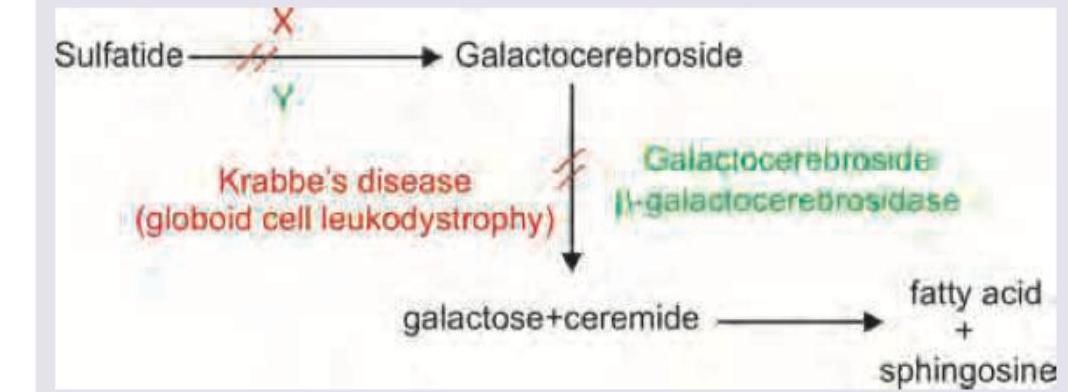
Which of the following is correct about the disease and its missing enzyme mentioned below?
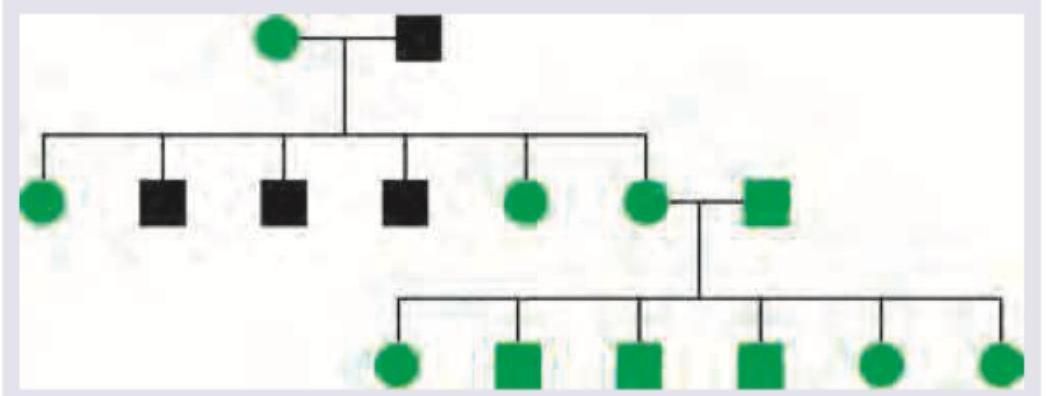
Identify the pattern of inheritance shown below.
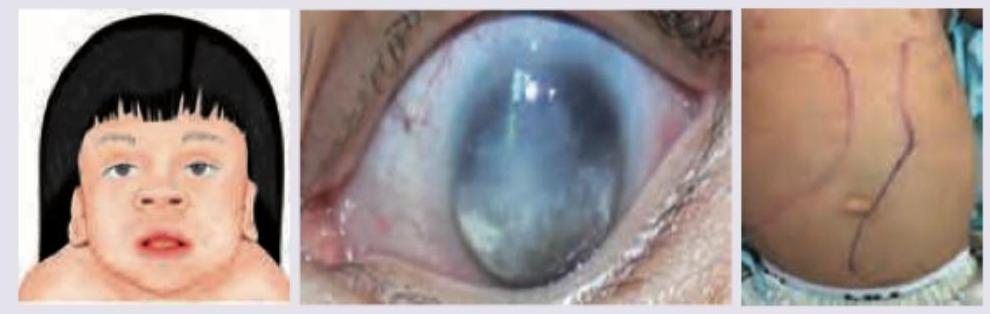
During evaluation of a child with intellectual disability following findings were noted. These point to deficiency of?
A floppy infant was brought with difficulty in breathing. CXR was performed. Family history was positive for death of sibling at 1-year of age. Which of the following enzyme deficiency will lead to this presentation?
A patient reports a change in colour of urine on air exposure. All are true about the condition shown below except:
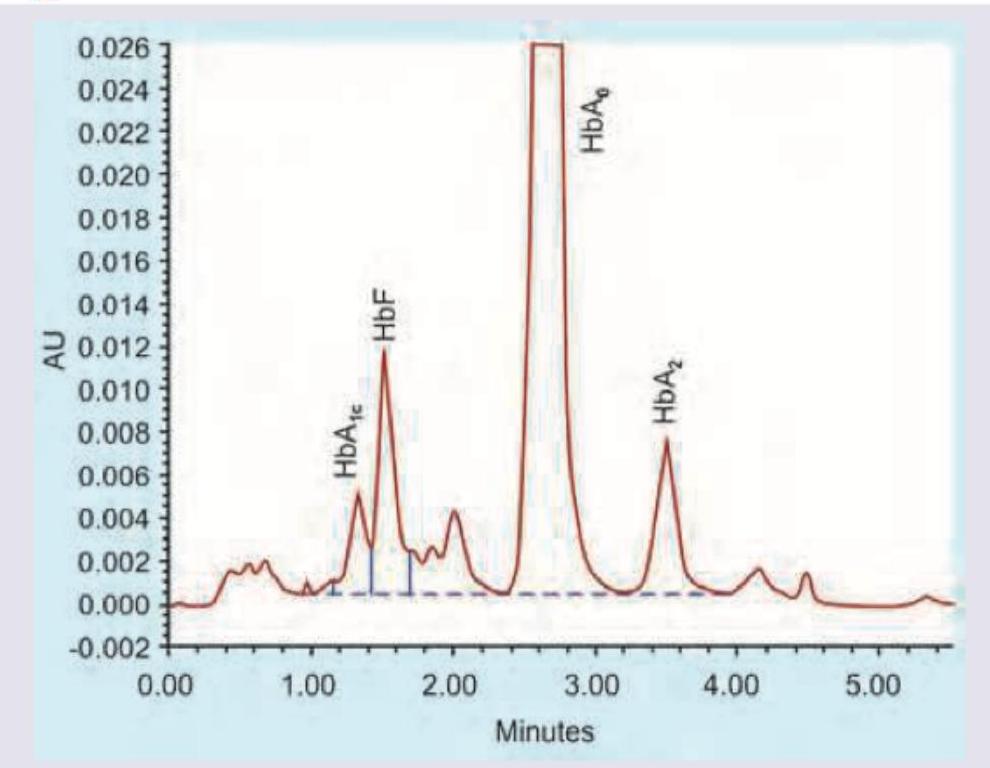
The technique shown in the image is:
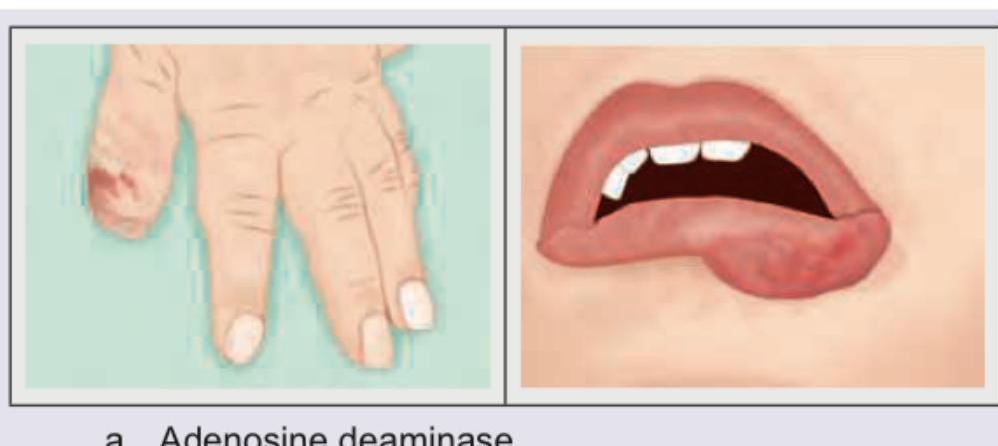
The patient shown here is suffering from deficiency of which enzyme?
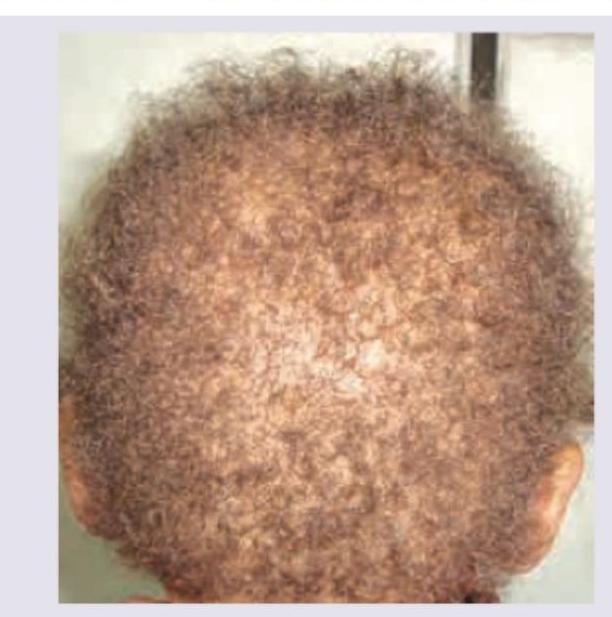
The patient shown below has curly easily breakable hair. Which is correct about the condition?
Biochemical screening of newborn infants by heel-prick blood samples is performed by using the
Which one of the following conditions is NOT inborn error of metabolism?
Explanation: ***Metachromatic leukodystrophy, Y= Arylsulfatase-A*** - **Metachromatic leukodystrophy (MLD)** is an autosomal recessive **leukodystrophy** caused by deficiency of **arylsulfatase A (cerebroside sulfatase)**. - This enzyme deficiency leads to accumulation of **sulfatides** (cerebroside sulfate) in the nervous system, particularly in **oligodendrocytes and Schwann cells**. - The pathway in the image shows the conversion of **sulfatide to galactocerebroside**, where enzyme Y represents arylsulfatase-A. - Clinical features include **progressive demyelination**, developmental regression, peripheral neuropathy, and metachromatic granules on nerve biopsy. - This is the correct answer as it accurately matches the **enzyme-disease relationship** and correlates with the biochemical pathway shown. *Canavan disease, Y= Aminoacylase* - While **Canavan disease** is a leukodystrophy, it is caused by deficiency of **aspartoacylase** (not simply "aminoacylase"), which metabolizes N-acetylaspartate (NAA). - This disease involves **spongy degeneration of white matter** and elevated NAA in urine and brain. - This enzyme and pathway are **not related to the sulfatide-galactocerebroside conversion** shown in the image. - The terminology "aminoacylase" is imprecise for this enzyme. *Gaucher disease, Y= Glucocerebrosidase* - **Gaucher disease** is caused by deficiency of **glucocerebrosidase (β-glucosidase)**. - This leads to accumulation of **glucocerebroside** in macrophages (Gaucher cells). - This enzyme acts on glucocerebroside, not on the **sulfatide pathway** shown in the image. *Niemann-Pick disease, Y= Sphingomyelinase* - **Niemann-Pick disease** (Types A and B) is caused by deficiency of **acid sphingomyelinase**. - This leads to accumulation of **sphingomyelin** in reticuloendothelial cells. - The pathway shown deals with **sulfatides and galactocerebrosides**, not sphingomyelin metabolism.
Explanation: ***Mitochondrial inheritance*** - This pedigree shows **maternal inheritance**, where all children of an affected mother are affected, but none of the children of an affected father are affected. This is characteristic of mitochondrial inheritance as mitochondrial DNA is exclusively inherited from the mother. - The trait is passed from the **affected mother** to all her offspring regardless of sex. *X linked Dominant inheritance* - In X-linked dominant inheritance, affected fathers pass the trait to **all their daughters**, and no sons. This pattern is not observed here, as affected fathers do not pass the trait to any of their children. - Affected mothers can pass the trait to both sons and daughters, but affected males also pass to all daughters, which is absent. *Y linked Inheritance* - Y-linked inheritance would show transmission only from **father to son**. This pedigree shows affected females as well, and affected fathers do not pass the trait to their sons in the observed pattern. - No instances of father-to-son transmission are observed in the parts of the pedigree where the father is affected. *X linked Recessive inheritance* - X-linked recessive inheritance typically shows more affected **males than females**, and affected fathers cannot pass the trait to their sons. Daughters of affected fathers are carriers if the mother is not affected. - There is no transmission from affected fathers to any of their offspring in the observed pedigree.
Explanation: ***Alpha-L-Iduronidase*** - The image shows **coarse facial features**, **corneal clouding**, and an **umbilical hernia**, which are characteristic signs of Hurler syndrome (MPS I). - Hurler syndrome is caused by a deficiency of the enzyme **alpha-L-iduronidase**, leading to the accumulation of dermatan sulfate and heparan sulfate. *L-sulfoiduronate sulfatase* - Deficiency of **L-sulfoiduronate sulfatase** causes Hunter syndrome (MPS II). - Hunter syndrome spares the **cornea** (no corneal clouding) and has a different clinical presentation, including X-linked inheritance. *Heparan sulfate sulfamidase* - A deficiency in **heparan sulfate sulfamidase** leads to Sanfilippo syndrome (MPS IIIA). - While Sanfilippo syndrome involves severe neurodegeneration, it typically lacks the prominent **skeletal abnormalities** and **corneal clouding** seen in Hurler syndrome. *N-acetylgalactosamine-4-sulfatase* - Deficiency of **N-acetylgalactosamine-4-sulfatase** causes Maroteaux-Lamy syndrome (MPS VI). - Maroteaux-Lamy syndrome is characterized by severe skeletal involvement and corneal clouding but generally has preservation of **intellectual function**, unlike Hurler syndrome.
Explanation: ***Acid maltase deficiency*** - This presentation describes **Pompe disease (Glycogen Storage Disease Type II)**, caused by a deficiency of **acid alpha-glucosidase (acid maltase)**, leading to glycogen accumulation in lysosomes. - The "floppy infant" (generalized hypotonia), difficulty breathing due to **cardiomyopathy** and **respiratory muscle weakness**, and the CXR showing **cardiomegaly** (enlarged heart) are classic findings of infantile-onset Pompe disease. The family history of sibling death supports a genetic cause. *Muscle phosphorylase deficiency* - This deficiency causes **McArdle disease (Glycogen Storage Disease Type V)**, primarily affecting **skeletal muscle**. - Symptoms usually appear in adolescence or adulthood, characterized by exercise intolerance, muscle pain, and cramps, not typically severe hypotonia and respiratory distress in infancy. *Glucose-6-phosphatase deficiency* - This is **Von Gierke disease (Glycogen Storage Disease Type I)**, affecting the **liver and kidneys**. - It presents with severe **hypoglycemia** (especially fasting), hepatomegaly, lactic acidosis, and hyperlipidemia, but not primary muscle weakness or cardiomyopathy. *Arylsulfatase B deficiency* - This deficiency causes **Maroteaux-Lamy syndrome (Mucopolysaccharidosis Type VI)**, a lysosomal storage disorder. - It primarily affects connective tissues, leading to skeletal deformities (**dysostosis multiplex**), coarse facial features, and corneal clouding, but not the severe infantile hypotonia or cardiomegaly seen in Pompe disease.
Explanation: ***Urine Benedict's test is negative*** - This is FALSE - Benedict's test is actually **POSITIVE** in alkaptonuria because **homogentisic acid** is a reducing agent. - Homogentisic acid readily **reduces Benedict's reagent**, giving a positive test result in alkaptonuria patients. *Blackening of urine is accelerated on exposure to sunlight* - This is TRUE - **UV light** and sunlight accelerate the **oxidation of homogentisic acid** in urine. - The characteristic **dark discoloration** occurs more rapidly when exposed to light and air. *Alkaptone bodies are deposited in intervertebral disc* - This is TRUE - **Homogentisic acid (alkaptone bodies)** polymerizes to form **ochronotic pigment** deposits. - These deposits accumulate in **cartilage** including intervertebral discs, causing degenerative changes and spondylosis. *The condition is caused by deficiency of homogentisate 1,2-dioxygenase* - This is TRUE - Alkaptonuria is caused by deficiency of **homogentisate 1,2-dioxygenase** enzyme in the **tyrosine metabolic pathway**. - This enzyme deficiency leads to accumulation of **homogentisic acid** in blood and urine, causing the characteristic symptoms.
Explanation: ***High performance liquid chromatography*** - The image displays a **chromatogram** with distinct peaks labeled HbA1c, HbF, HbA0, and HbA2, separated based on their chemical properties. - This separation and detection method is characteristic of **High Performance Liquid Chromatography (HPLC)**, a technique used for quantifying different hemoglobin fractions. *Tandem mass spectrometry* - **Tandem mass spectrometry (MS/MS)** identifies compounds based on their mass-to-charge ratio and fragmentation patterns, which would look like mass spectra, not peaks on a time-based chromatogram. - While MS/MS is highly sensitive and specific, it doesn't produce the type of **elution profile** seen in the image. *Haemoglobin electrophoresis* - **Hemoglobin electrophoresis** separates hemoglobins based on their electrical charge, resulting in bands on a gel or a densitometric scan, not the **distinct chromatogram peaks** shown here. - While used for hemoglobin analysis, the visual representation is typically different, often displaying bands that reflect migration distance. *Gel electrophoresis* - **Gel electrophoresis** separates molecules, such as proteins or nucleic acids, by size and charge through a gel matrix, producing distinct **bands** that can be visualized. - This method would not produce the continuous **elution peaks over time** as observed in the provided graph, which indicates a liquid chromatography technique.
Explanation: ***HGPRTase*** - **HGPRTase deficiency** causes **Lesch-Nyhan syndrome** with characteristic **self-mutilation behavior**, choreoathetosis, and severe intellectual disability. - Clinical features include **orange sand-like crystals** in diapers due to hyperuricemia, **compulsive self-biting**, and **dystonia** as shown in the patient. *Adenosine deaminase* - **ADA deficiency** causes **SCID** with recurrent infections, lymphopenia, and failure to thrive in early infancy. - Clinical presentation focuses on **immunodeficiency** with chronic infections rather than neurological and behavioral abnormalities. *Xanthine oxidase* - **Xanthine oxidase deficiency** leads to **xanthinuria** with accumulation of xanthine causing kidney stones. - Patients present with **nephrolithiasis** and muscle pain but lack the neurological and self-destructive behaviors seen here. *Glucose-6-phosphate dehydrogenase* - **G6PD deficiency** causes **hemolytic anemia** triggered by oxidative stress from drugs, infections, or fava beans. - Features include **jaundice**, dark urine, and acute hemolysis but not the characteristic **neurological dysfunction** and **self-mutilation** of Lesch-Nyhan syndrome.
Explanation: ***Copper deficiency*** - **Copper deficiency** is characterized by **Menkes disease**, a genetic disorder leading to impaired copper absorption, resulting in characteristic **kinky, brittle hair** (pili torti), neurological degeneration, and connective tissue abnormalities. - Copper is a vital cofactor for **lysyl oxidase**, an enzyme critical for cross-linking collagen and elastin, and for **tyrosinase**, which is involved in melanin production. Its deficiency can lead to hair shaft abnormalities and hypopigmentation. *Selenium deficiency* - **Selenium deficiency** can lead to **Keshan disease**, a cardiomyopathy, and **Kashin-Beck disease**, an osteoarthropathy, but is not typically associated with curly, brittle hair. - While selenium is important for antioxidant defense and thyroid function, specific hair abnormalities beyond general thinning are not primary features of its deficiency. *Chromium deficiency* - **Chromium deficiency** is rare and primarily associated with impaired **glucose tolerance**, peripheral neuropathy, and weight loss. - There is no established link between chromium deficiency and the characteristic hair abnormalities described here. *Cobalt deficiency* - **Cobalt** is a component of **vitamin B12 (cobalamin)**, and its deficiency would manifest as symptoms of vitamin B12 deficiency, such as megaloblastic anemia and neurological dysfunction. - Isolated cobalt deficiency is extremely rare in humans, and it does not specifically cause curly, easily breakable hair.
Explanation: ***Guthrie Card*** - The **Guthrie card**, also known as a **newborn screening card** or **filter paper card**, is specifically designed for collecting **heel-prick blood samples** from newborn infants for biochemical screening. - It allows for the detection of various **inborn errors of metabolism** and other genetic conditions, such as **phenylketonuria (PKU)** and **congenital hypothyroidism**. *Duchenne Card* - There is no specialized "Duchenne Card" used for **newborn biochemical screening**. - **Duchenne muscular dystrophy** is a genetic disorder diagnosed through **genetic testing** or **muscle biopsy**, not typically a specific screening card at birth. *Tay-Sachs Card* - There is no specific "Tay-Sachs Card" used for routine **newborn biochemical screening**. - **Tay-Sachs disease** is a **lysosomal storage disorder** diagnosed through enzyme activity tests or **genetic analysis**, often in populations at higher risk or with clinical suspicion. *Maple Card* - There is no recognized "Maple Card" for **newborn biochemical screening**. - "Maple" could potentially refer to **Maple Syrup Urine Disease (MSUD)**, which is one of the conditions screened for using the **Guthrie card**, but there is no dedicated "Maple Card."
Explanation: ***Neural tube defects*** - Neural tube defects are **birth defects** that occur when the **neural tube** fails to close completely during early fetal development, typically affecting the brain, spinal cord, or both. - While they are congenital, they are not classified as **inborn errors of metabolism** because they primarily result from structural developmental anomalies rather than enzymatic pathway dysfunctions. *Phenylketonuria (PKU)* - PKU is an **autosomal recessive** inborn error of metabolism caused by a deficiency of the enzyme **phenylalanine hydroxylase**, leading to a buildup of phenylalanine. - This enzymatic defect impairs the body's ability to metabolize **phenylalanine**, making it a classic example of an inborn error of metabolism. *Maple syrup urine disease* - This is an **autosomal recessive** inborn error of metabolism characterized by a defect in the metabolism of **branched-chain amino acids** (leucine, isoleucine, and valine) due to a deficiency in the enzyme branched-chain alpha-keto acid dehydrogenase. - The accumulation of these amino acids and their keto-acids gives the urine a characteristic **maple syrup odor**. *Tay-Sachs disease* - Tay-Sachs disease is a fatal, **autosomal recessive** inborn error of metabolism caused by a deficiency of the enzyme **hexosaminidase A**. - This enzyme deficiency leads to the harmful accumulation of fatty acid derivatives called **gangliosides** in nerve cells in the brain, resulting in progressive neurological degeneration.
Single Gene Disorders
Practice Questions
Biochemical Diagnosis of Genetic Disorders
Practice Questions
Inborn Errors of Metabolism
Practice Questions
Lysosomal Storage Diseases
Practice Questions
Glycogen Storage Diseases
Practice Questions
Disorders of Lipoprotein Metabolism
Practice Questions
Disorders of Purine and Pyrimidine Metabolism
Practice Questions
Hemoglobinopathies
Practice Questions
Porphyrias
Practice Questions
Biochemical Markers for Disease Diagnosis
Practice Questions
Newborn Screening for Genetic Disorders
Practice Questions
Enzyme Replacement Therapy
Practice Questions
Get full access to all questions, explanations, and performance tracking.
Start For Free