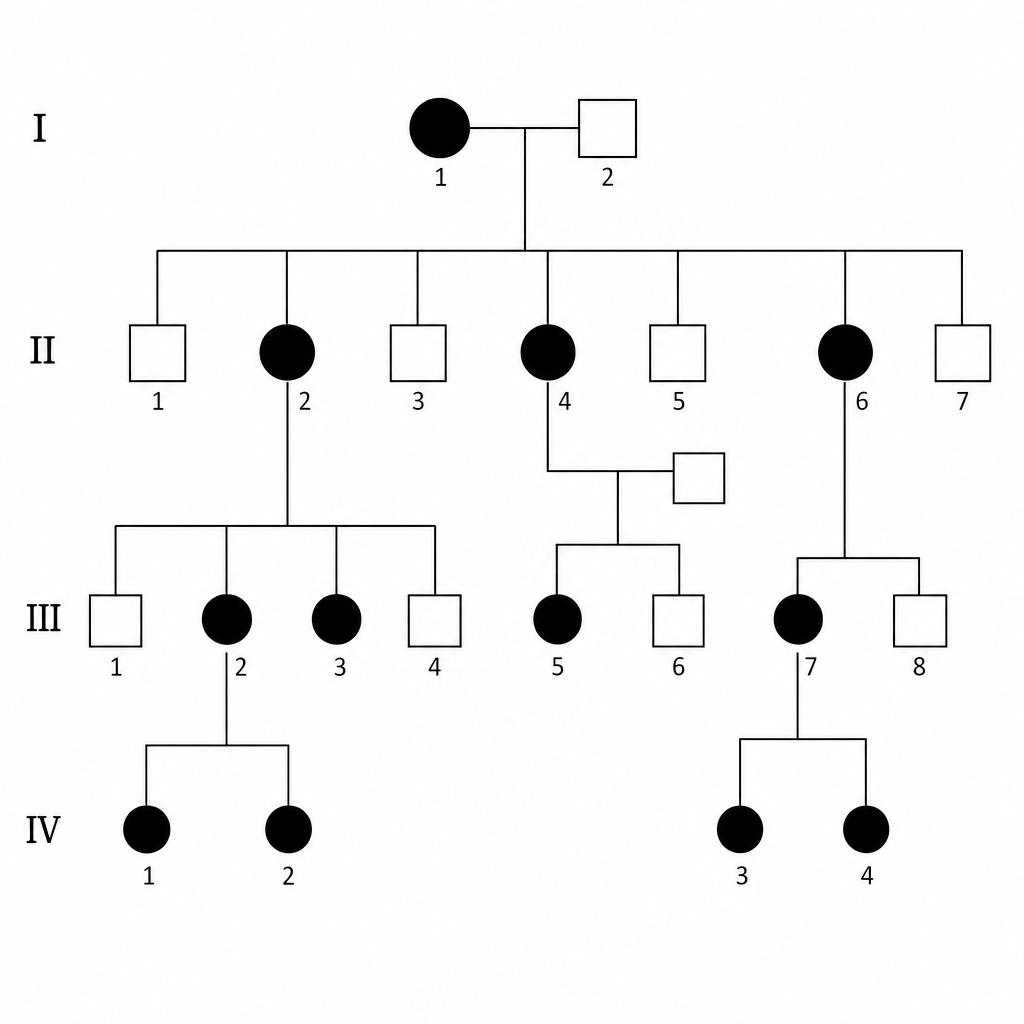
Which enzyme deficiency is most commonly responsible for the presence of a long clitoris and fused vagina?
A 9-year-old female child presented with polyuria, polydipsia, and metabolic acidosis. On slit lamp examination, crystal deposits are seen in the cornea. What is the diagnosis?
A 25-year-old male presented with pigmentation of the nose and pinna. After voiding, his urine becomes dark. What spinal abnormality is most likely to be present?
All of the following are associated with non-ketotic hypoglycemia, EXCEPT?
In a pregnant woman with elevated blood phenylalanine levels, her offspring is most likely to develop which of the following conditions?
Lesch-Nyhan syndrome is associated with deficiency of which of the following?
Development of pellagra-like skin lesions in carcinoid syndrome is primarily due to:
Hartnup disease can present with which of the following clinical features?
Hunter syndrome is due to the deficiency of which enzyme?
In Hartnup disease, which type of amino acids are primarily excreted into the urine?
Explanation: This question pertains to **Congenital Adrenal Hyperplasia (CAH)**, a group of autosomal recessive disorders characterized by enzyme deficiencies in the cortisol synthesis pathway. ### 1. Why 21-Hydroxylase is Correct **21-hydroxylase deficiency** is the most common cause of CAH (approx. 90-95% of cases). In this condition, the conversion of progesterone to 11-deoxycorticosterone and 17-OH progesterone to 11-deoxycortisol is blocked. This leads to: * **Cortisol deficiency:** Triggers increased ACTH secretion via negative feedback. * **Adrenal Hyperplasia:** Excess ACTH overstimulates the adrenal cortex. * **Androgen Excess:** Precursors are shunted toward the androgen synthesis pathway (DHEA and Androstenedione). In a female fetus, these high androgen levels during the critical period of sexual differentiation cause **virilization**, manifesting as clitoromegaly (long clitoris) and labial fusion (fused vagina), resulting in ambiguous genitalia. ### 2. Analysis of Incorrect Options * **B. 11-beta hydroxylase deficiency:** While this also causes virilization, it is less common (5%). It is uniquely characterized by **hypertension** due to the buildup of 11-deoxycorticosterone (a mineralocorticoid). * **C. 3-beta hydroxysteroid dehydrogenase deficiency:** This is very rare. It prevents the formation of all three classes of adrenal steroids. While it causes some virilization in females, it more typically results in incomplete masculinization (ambiguous genitalia) in **males**. ### 3. NEET-PG High-Yield Pearls * **Diagnostic Marker:** Elevated **17-hydroxyprogesterone (17-OHP)** is the gold standard for diagnosing 21-hydroxylase deficiency. * **Salt-Wasting:** Severe 21-hydroxylase deficiency leads to "salt-wasting" (hyponatremia, hyperkalemia, and hypotension) due to aldosterone deficiency. * **Mnemonic:** If the enzyme starts with **1** (11, 17), it causes hypertension. If it ends with **1** (21, 11), it causes virilization. Since 21-hydroxylase ends in 1 but does not start with 1, it causes virilization without hypertension.
Explanation: ### Explanation **Correct Answer: B. Cystinosis** **Mechanism:** Cystinosis is an autosomal recessive lysosomal storage disorder caused by a mutation in the **CTNS gene**, which encodes **cystinosin**, a lysosomal membrane transporter. Defective transport leads to the accumulation of **cystine crystals** within lysosomes across various tissues. The clinical presentation in this case points to **Fanconi Syndrome** (polyuria, polydipsia, and metabolic acidosis due to proximal renal tubular dysfunction), which is the hallmark of infantile nephropathic cystinosis. The pathognomonic finding is the presence of **hexagonal cystine crystals in the cornea** on slit-lamp examination. --- ### Why the other options are incorrect: * **A. Cystinuria:** This is a defect in the renal tubular reabsorption of COLA amino acids (Cystine, Ornithine, Lysine, Arginine). It presents with **cystine stones (calculi)** in the urinary tract, not systemic crystal deposition or Fanconi syndrome. * **C. Cystathioninuria:** An autosomal recessive deficiency of cystathionase. It is generally considered a benign metabolic anomaly with no specific clinical symptoms like corneal crystals or polyuria. * **D. Homocystinuria:** Caused by cystathionine β-synthase deficiency. It presents with ectopia lentis (downward dislocation), intellectual disability, and thromboembolism, but **not** corneal crystal deposition. --- ### NEET-PG High-Yield Pearls: * **Diagnosis:** Confirmed by measuring **intracellular cystine levels** in polymorphonuclear leukocytes. * **Treatment:** **Cysteamine** (a cystine-depleting agent) is the drug of choice. * **Renal Pathology:** Cystinosis is the most common cause of inherited Fanconi Syndrome in children. * **Biochemical Note:** Do not confuse *Cystine* (dimer of cysteine) with *Cysteine* (monomer). In cystinosis, it is the dimer that accumulates.
Explanation: ### Explanation **Diagnosis: Alkaptonuria** The clinical presentation of **pigmentation of the nose and pinna (ochronosis)** and **urine that turns dark upon standing** is pathognomonic for **Alkaptonuria**. This is an autosomal recessive disorder caused by a deficiency of the enzyme **Homogentisate 1,2-dioxygenase**, leading to the accumulation of Homogentisic Acid (HGA). #### 1. Why "Calcification of the disc" is correct: In Alkaptonuria, HGA and its oxidation products (alkapton) bind to connective tissues, a process called ochronosis. In the spine, this leads to severe **ochronotic arthropathy**. The most characteristic radiological finding is the **calcification of intervertebral discs**, often accompanied by narrowing of the disc spaces and eventual fusion (ankylosis), typically sparing the sacroiliac joints. #### 2. Why the other options are incorrect: * **A. Atlantoaxial subluxation:** This is a classic feature of Rheumatoid Arthritis or Down Syndrome, caused by laxity of the transverse ligament, not metabolic pigment deposition. * **B. Spondyloptosis:** This refers to the highest grade (Grade V) of spondylolisthesis, where one vertebra slides completely off the one below it. It is usually traumatic or developmental, not metabolic. * **C. Basilar invagination:** This is a craniovertebral junction abnormality (where the odontoid process protrudes into the foramen magnum), commonly seen in Paget’s disease or Osteogenesis Imperfecta. #### 3. High-Yield Clinical Pearls for NEET-PG: * **Enzyme Defect:** Homogentisate 1,2-dioxygenase. * **Biochemical Pathway:** Part of the Phenylalanine and Tyrosine catabolism. * **The "Dark Urine" Phenomenon:** HGA in the urine is oxidized to benzoquinone acetate when exposed to air (or alkaline pH), turning the urine black. * **Ochronosis:** Blue-black pigmentation is most visible in the sclera (Vogt’s sign) and cartilage (ear, nose). * **Diagnostic Test:** Ferric chloride test (yields a transient deep blue color). * **Management:** Low protein diet (restrict Tyrosine/Phenylalanine) and Nitisinone (inhibits HGA formation).
Explanation: ### Explanation The key to solving this question lies in understanding whether the body can perform **$\beta$-oxidation** of fatty acids during fasting. If $\beta$-oxidation is intact, acetyl-CoA is produced, leading to ketone body formation (**ketotic hypoglycemia**). If $\beta$-oxidation or its regulation is impaired, ketones are not produced (**non-ketotic hypoglycemia**). **1. Why Von Gierke’s Disease (Option A) is the Correct Answer:** Von Gierke’s (GSD Type I) is caused by a deficiency in **Glucose-6-Phosphatase**. While patients suffer from severe fasting hypoglycemia, their fatty acid oxidation pathway remains perfectly functional. In response to low insulin and high glucagon, the body aggressively breaks down fats. This leads to an overproduction of acetyl-CoA, resulting in **marked ketosis (ketotic hypoglycemia)**, along with lactic acidosis and hyperuricemia. **2. Analysis of Incorrect Options (Causes of Non-Ketotic Hypoglycemia):** * **Insulinoma (Option B):** High insulin levels inhibit hormone-sensitive lipase, preventing the release of fatty acids from adipose tissue. Without fatty acids, the liver cannot produce ketones. * **Carnitine Deficiency (Option C):** Carnitine is required to transport long-chain fatty acids into the mitochondria. Without it, $\beta$-oxidation cannot occur, leading to a lack of ketones. * **MCAD Deficiency (Option D):** This is a defect in the mitochondrial enzyme required to oxidize medium-chain fats. The block in the fatty acid breakdown pathway prevents the generation of acetyl-CoA for ketogenesis. **Clinical Pearls for NEET-PG:** * **Ketotic Hypoglycemia:** Think GSD Type I, Ketotic Hypoglycemia of Childhood, or Maple Syrup Urine Disease (MSUD). * **Non-Ketotic Hypoglycemia:** Think Hyperinsulinism (Insulinoma/Sulfonylureas) or Fatty Acid Oxidation Disorders (MCAD, LCAD, Carnitine defects). * **Differentiating MCAD vs. Insulinoma:** MCAD deficiency will typically show **dicarboxylic aciduria** on urine analysis, whereas insulinoma will show high C-peptide levels.
Explanation: This question addresses the concept of **Maternal Phenylketonuria (PKU) Syndrome**. ### **Explanation** When a pregnant woman has poorly controlled Phenylketonuria (PKU), her blood phenylalanine (Phe) levels are elevated. Phenylalanine is actively transported across the placenta via the L-type amino acid transporter. This results in fetal Phe levels being **1.5 to 2 times higher** than maternal levels. High concentrations of Phe are **teratogenic** to the developing fetal brain. It interferes with the transport of other essential amino acids across the blood-brain barrier and inhibits protein synthesis, leading to irreversible brain damage. Consequently, **Mental Retardation** (Intellectual Disability) is the most common and significant clinical outcome in these offspring, occurring in over 90% of cases if maternal Phe levels are not strictly controlled. ### **Analysis of Options** * **A. Mental Retardation (Correct):** The primary neurotoxic effect of hyperphenylalaninemia during gestation. * **B. Lighter complexion:** While patients with classic PKU have fair skin (due to decreased melanin synthesis from tyrosine), this is a phenotypic feature of the child's own genotype, not the primary teratogenic effect of maternal Phe levels. * **C. Microcephaly:** This is a common feature of Maternal PKU syndrome; however, in the hierarchy of clinical significance and frequency for NEET-PG, mental retardation is the hallmark neurodevelopmental deficit. * **D. Reduction of limb growth:** This is not a characteristic feature of Maternal PKU. The syndrome typically involves cardiac defects (e.g., VSD, Fallot’s tetralogy) and growth retardation, but not specific limb reduction defects. ### **High-Yield Clinical Pearls for NEET-PG** * **Maternal PKU Syndrome Tetrad:** Mental retardation, Microcephaly, Congenital Heart Disease, and Intrauterine Growth Retardation (IUGR). * **Management:** To prevent these defects, a Phe-restricted diet must be initiated **before conception** and maintained throughout pregnancy. * **Biochemical Note:** The damage occurs even if the fetus is heterozygous (a carrier) and does not have the PKU genotype itself.
Explanation: **Explanation:** **Lesch-Nyhan Syndrome (LNS)** is an X-linked recessive disorder characterized by a near-complete or **total deficiency** of the enzyme **Hypoxanthine-guanine phosphoribosyltransferase (HGPRT)**. 1. **Why Option B is correct:** HGPRT is a key enzyme in the **Purine Salvage Pathway**, responsible for converting hypoxanthine to IMP and guanine to GMP. In LNS, the total absence of HGPRT activity prevents the recycling of purines. This leads to an accumulation of PRPP (Phosphoribosyl pyrophosphate) and a compensatory increase in *de novo* purine synthesis. The end product of excess purine degradation is **Uric Acid**, leading to severe hyperuricemia. 2. **Why other options are incorrect:** * **Option A:** Partial deficiency of HGPRT results in **Kelley-Seegmiller Syndrome**. While these patients present with gout and kidney stones, they typically lack the severe neurological and self-mutilating behaviors seen in LNS. * **Options C & D:** PRPP is a substrate, not an enzyme. Increased PRPP levels are a *consequence* of HGPRT deficiency, not the cause. An *increase* in PRPP synthetase activity can cause gout, but its deficiency is not associated with LNS. **Clinical Pearls for NEET-PG:** * **Classic Triad:** Hyperuricemia (Orange sand in diapers/Urate stones), Neurological disability (Choreoathetosis/Spasticity), and **Self-mutilation** (biting lips and fingers). * **Biochemical Hallmark:** Elevated Uric acid and elevated PRPP levels. * **Inheritance:** X-linked recessive (primarily affects males). * **Treatment:** Allopurinol or Febuxostat (manages hyperuricemia but does not reverse neurological symptoms).
Explanation: ### Explanation **Underlying Medical Concept:** In a healthy individual, approximately **1% of dietary Tryptophan** is used to synthesize Serotonin (5-HT), while the majority is utilized for protein synthesis and the production of **Niacin (Vitamin B3)** via the Kynurenine pathway. In **Carcinoid Syndrome** (typically originating from neuroendocrine tumors of the midgut), the tumor cells become metabolically hyperactive. They divert up to **60% of the body's Tryptophan** into the synthesis of Serotonin. This massive "biochemical shift" creates a profound systemic deficiency of Tryptophan available for the Kynurenine pathway. Since Tryptophan is a precursor for Niacin, this diversion leads to secondary Niacin deficiency, manifesting clinically as **Pellagra** (Dermatitis, Diarrhea, Dementia). **Analysis of Options:** * **Option A (Correct):** The diversion of the precursor (Tryptophan) to the Serotonin pathway directly limits the endogenous synthesis of Niacin. * **Option B:** While the symptoms resemble dietary deficiency, the root cause in carcinoid syndrome is metabolic diversion, not a lack of intake. * **Option C:** The rash is not a direct effect of serotonin on the skin; it is a result of the underlying vitamin deficiency. * **Option D:** While carcinoid syndrome is a paraneoplastic process, the specific mechanism for the *pellagra-like lesions* is the biochemical depletion of Tryptophan. **High-Yield Clinical Pearls for NEET-PG:** * **The 60mg Rule:** 60 mg of Tryptophan yields 1 mg of Niacin. * **Diagnostic Marker:** Elevated urinary **5-HIAA** (5-Hydroxyindoleacetic acid), the breakdown product of serotonin. * **Other causes of Pellagra:** Hartnup disease (impaired Tryptophan absorption) and Isoniazid (INH) therapy (depletes Vitamin B6, a cofactor for Niacin synthesis). * **Classic Triad of Carcinoid:** Flushing, Diarrhea, and Right-sided heart failure (Tricuspid regurgitation).
Explanation: **Explanation:** **Hartnup disease** is an autosomal recessive disorder caused by a mutation in the **SLC6A19 gene**, which encodes a sodium-dependent neutral amino acid transporter. This defect leads to the impaired intestinal absorption and renal tubular reabsorption of neutral amino acids, most significantly **Tryptophan**. 1. **Why Option A is Correct:** Tryptophan is a vital precursor for the endogenous synthesis of **Niacin (Vitamin B3)**. In Hartnup disease, the deficiency of Tryptophan results in a secondary deficiency of Niacin. This manifests clinically as **Pellagra-like symptoms**, characterized by the "3 Ds": Dermatitis (photosensitive scaly rash), Diarrhea, and Dementia (ataxia and neurological symptoms). 2. **Why Other Options are Incorrect:** * **B. Nephrolithiasis:** This is characteristic of **Cystinuria**, where there is a defect in the transport of COAL (Cystine, Ornithine, Arginine, Lysine), leading to cystine stones. * **C. Protein intolerance:** This is typically seen in **Urea Cycle Disorders** (e.g., OTC deficiency), where protein ingestion leads to hyperammonemia. * **D. Microcephaly:** This is a common feature of **Maternal PKU** or certain TORCH infections, but not a primary feature of neutral amino acid transport defects. **Clinical Pearls for NEET-PG:** * **Diagnosis:** Confirmed by detecting **neutral aminoaciduria** (specifically Tryptophan) in the urine using paper chromatography. * **Treatment:** High-protein diet and **Nicotinamide (Niacin) supplementation**. * **Distinction:** Unlike dietary Pellagra, Hartnup disease will show high levels of neutral amino acids in the urine.
Explanation: **Explanation:** **Hunter Syndrome (Mucopolysaccharidosis Type II)** is a lysosomal storage disorder characterized by the accumulation of glycosaminoglycans (GAGs), specifically **Dermatan sulfate and Heparan sulfate**. 1. **Why Option A is Correct:** Hunter syndrome is caused by a deficiency of the enzyme **Iduronate sulfatase**. This enzyme is responsible for the degradation of sulfated iduronic acid residues in GAGs. A unique high-yield feature of Hunter syndrome is its inheritance pattern: it is the **only X-linked recessive** Mucopolysaccharidosis (MPS); all others are autosomal recessive. 2. **Why Other Options are Incorrect:** * **Option B (Hexosaminidase A):** Deficiency leads to **Tay-Sachs disease**, a sphingolipidosis characterized by cherry-red spots on the macula and no hepatosplenomegaly. * **Option C (Glucocerebrosidase):** Deficiency causes **Gaucher disease**, the most common lysosomal storage disorder, presenting with "wrinkled paper" appearance of macrophages and bone involvement. * **Option D (α-L Iduronidase):** Deficiency leads to **Hurler syndrome (MPS I)**. While clinically similar to Hunter syndrome, Hurler syndrome is more severe, autosomal recessive, and uniquely presents with **corneal clouding**. **High-Yield Clinical Pearls for NEET-PG:** * **Mnemonic for Hunter:** "The **Hunter** needs **X**-ray vision (X-linked) to see the **Target** (No corneal clouding)." * **Clinical Presentation:** Coarse facial features (gargoylism), hepatosplenomegaly, joint stiffness, and mental retardation. * **Diagnosis:** Increased urinary excretion of heparan and dermatan sulfate; confirmed by enzyme assay in leukocytes or fibroblasts.
Explanation: **Explanation:** **Hartnup disease** is an autosomal recessive disorder caused by a mutation in the **SLC6A19 gene**, which encodes a sodium-dependent **neutral amino acid transporter** located in the proximal renal tubules and the intestinal mucosa. 1. **Why Neutral Amino Acids are Correct:** The defective transporter is specific for neutral amino acids (e.g., Alanine, Valine, Threonine, and most importantly, **Tryptophan**). Because these amino acids cannot be reabsorbed in the kidneys, they are excreted in large amounts in the urine (**neutral aminoaciduria**). Similarly, impaired intestinal absorption leads to the bacterial breakdown of unabsorbed Tryptophan into indolic compounds, which are excreted in feces and urine. 2. **Why Other Options are Incorrect:** * **Basic Amino Acids (A):** Defective transport of basic amino acids (Lysine, Arginine, Ornithine) and Cystine is characteristic of **Cystinuria** (COLA mnemonic), not Hartnup disease. * **Acidic Amino Acids (B):** These (Glutamate, Aspartate) use different transport systems (e.g., EAAT) and are unaffected in this condition. * **Hydrophilic Amino Acids (D):** While some neutral amino acids are hydrophilic, this is too broad a category. The pathology specifically targets the "neutral" charge group. **NEET-PG High-Yield Clinical Pearls:** * **Pellagra-like symptoms:** Tryptophan is a precursor for **Niacin (Vitamin B3)**. Deficiency leads to the "3 Ds": Dermatitis (photosensitive), Diarrhea, and Dementia. * **Diagnosis:** Characterized by neutral aminoaciduria and the presence of **indican** in the urine (Obermayer test). * **Treatment:** High-protein diet and **Nicotinamide** supplementation.
Single Gene Disorders
Practice Questions
Biochemical Diagnosis of Genetic Disorders
Practice Questions
Inborn Errors of Metabolism
Practice Questions
Lysosomal Storage Diseases
Practice Questions
Glycogen Storage Diseases
Practice Questions
Disorders of Lipoprotein Metabolism
Practice Questions
Disorders of Purine and Pyrimidine Metabolism
Practice Questions
Hemoglobinopathies
Practice Questions
Porphyrias
Practice Questions
Biochemical Markers for Disease Diagnosis
Practice Questions
Newborn Screening for Genetic Disorders
Practice Questions
Enzyme Replacement Therapy
Practice Questions
Get full access to all questions, explanations, and performance tracking.
Start For Free