Which of the following is the main enzyme responsible for the activation of xenobiotics?
Which substance is involved in the conjugation process in the liver?
Which of the following acts as a major intracellular antioxidant and helps in detoxifying reactive oxygen species?
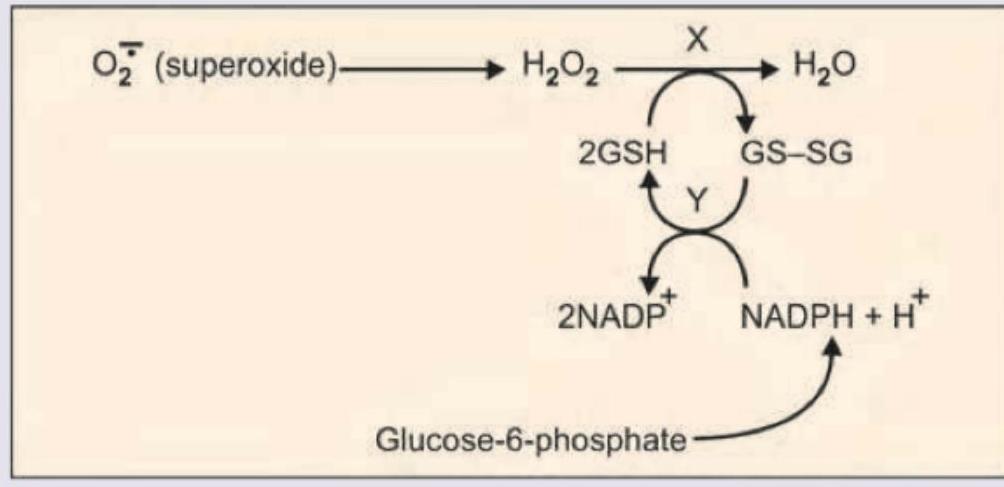
Which is correct about the image shown below?
Bilirubin conjugation with glucuronic acid has the following properties -
Glucuronide reaction is seen in
Ammonia is detoxified in brain to :
The following are major free radical scavengers except:
Bile salts undergo conjugation for enhanced solubility:
Glutathione is primarily used to detoxify which reactive oxygen species?
Explanation: ### Explanation **Correct Answer: A. Cytochrome P-450** **Why it is correct:** Detoxification of xenobiotics (foreign compounds like drugs and toxins) occurs in two phases. **Phase I reactions** involve functionalization (oxidation, reduction, or hydrolysis). **Cytochrome P-450 (CYP450)** is the primary enzyme system responsible for these reactions. While the goal is detoxification, these enzymes often "activate" relatively inert compounds into highly reactive electrophilic intermediates (bioactivation) before they are conjugated in Phase II. CYP450 enzymes are hemeproteins located primarily in the smooth endoplasmic reticulum of hepatocytes. **Why the other options are incorrect:** * **B. Glucuronyl transferase:** This is a **Phase II enzyme** responsible for conjugation. It attaches glucuronic acid to a substrate to make it more water-soluble for excretion. It typically terminates biological activity rather than activating it. * **C. Glutathione S-transferase:** Another **Phase II enzyme** that conjugates reduced glutathione (GSH) to electrophilic compounds. It is a major protective mechanism against oxidative stress and reactive metabolites. * **D. NADPH cytochrome P-450-reductase:** This enzyme acts as an **electron donor** to the CYP450 system. While essential for the catalytic cycle, it is a flavoprotein that facilitates the reaction rather than being the primary enzyme that binds and activates the xenobiotic substrate. **High-Yield Clinical Pearls for NEET-PG:** * **Phase I vs. Phase II:** Phase I (Functionalization) introduces a polar group; Phase II (Conjugation) increases water solubility. * **Inducers vs. Inhibitors:** Phenytoin, Rifampicin, and Phenobarbitone are potent **CYP450 inducers**, while Ketoconazole and Grapefruit juice are **inhibitors**. * **Most abundant isoform:** **CYP3A4** is responsible for metabolizing nearly 50% of all clinically used drugs. * **Acetaminophen toxicity:** Toxicity occurs when Phase II pathways are saturated, leading to the CYP450-mediated activation of paracetamol into the toxic metabolite **NAPQI**.
Explanation: ***Glucuronic Acid***- The conjugation process is a Phase II detoxification reaction in the liver that increases the compound's polarity and water solubility for excretion.- **Glucuronidation**, catalyzed by **UDP-glucuronosyltransferases (UGT)**, is the most common and critical conjugation pathway, where substrates (like **bilirubin** and drugs) are linked to **glucuronic acid** (provided by UDP-glucuronic acid).*Hyaluronic Acid*- This acid is a large, non-sulfated **glycosaminoglycan** and a primary component of the **extracellular matrix** and **synovial fluid**.- It functions mainly in tissue structure, hydration, and lubrication, not as a conjugating molecule in liver metabolism.*Gluconic Acid*- This is an oxidation product of **glucose**, often used in food and pharmaceutical industries (e.g., as a salt like ferrous gluconate).- While structurally related to glucose metabolites, it is **glucuronic acid**, not gluconic acid, that is utilized for Phase II **conjugation**.*Glycolic Acid*- This substance is the smallest **alpha-hydroxy acid (AHA)** and is widely known for its use as a chemical exfoliator in dermatology.- Although it is an endogenous metabolite, it is not involved in the major Phase II conjugation reactions in the liver; these reactions primarily utilize **glucuronic acid**, sulfate, or glutathione.
Explanation: ***Glutathione (Correct Answer)*** - **It is the most abundant non-enzymatic intracellular antioxidant**, found in high concentrations in nearly all cells. - It detoxifies **reactive oxygen species (ROS)**, particularly **hydrogen peroxide** and lipid hydroperoxides, through the **glutathione redox cycle**. - As a **tripeptide molecule** (not an enzyme), it directly acts as the major intracellular antioxidant. *Catalase (Incorrect)* - This is an **enzyme** responsible for the rapid decomposition of two molecules of **hydrogen peroxide (H₂O₂)** into water and oxygen. - While crucial for detoxification in peroxisomes, it is an enzyme, not the primary non-enzymatic antioxidant molecule like glutathione. *Superoxide dismutase (Incorrect)* - This is a **metalloenzyme** that catalyzes the dismutation of the highly reactive **superoxide radical (O₂⁻·)** into less reactive **hydrogen peroxide (H₂O₂)**. - It initiates the antioxidant defense but does not complete the neutralization of H₂O₂, which is handled by catalase or **glutathione peroxidase**. *Peroxidase (Incorrect)* - This is a general class of **enzymes** (e.g., **glutathione peroxidase**) that primarily use substrates like glutathione to reduce **hydrogen peroxide** or lipid peroxides to water or harmless alcohols. - It is an enzyme that works *with* antioxidants like glutathione, rather than being the major intracellular antioxidant molecule itself.
Explanation: ***X = Glutathione Peroxidase, Y = Glutathione Reductase*** - Enzyme X catalyzes the reduction of hydrogen peroxide (H2O2) to water (H2O), utilizing **reduced glutathione (2GSH)** as a cofactor, which is the function of **Glutathione Peroxidase**. - Enzyme Y catalyzes the regeneration of **reduced glutathione (2GSH)** from **oxidized glutathione (GS-SG)**, using **NADPH + H+** as a reducing agent, which is the function of **Glutathione Reductase**. *X = Glutathione Reductase, Y = Glutathione Peroxidase* - This option incorrectly assigns the roles of the enzymes, as Glutathione Reductase catalyzes the reduction of oxidized glutathione, not hydrogen peroxide. - Glutathione Peroxidase is responsible for detoxifying hydrogen peroxide, whereas Glutathione Reductase is involved in regenerating reduced glutathione. *X = Superoxide Dismutase, Y = Glutathione Reductase* - **Superoxide Dismutase** converts **superoxide (O2-)** to **hydrogen peroxide (H2O2)**; however, X is shown acting on H2O2, not O2-. - While Y is correctly identified as Glutathione Reductase, the incorrect identification of X makes this option false. *X = Glutathione Reductase, Y = Superoxide Dismutase* - This option incorrectly assigns both enzyme roles. X is not Glutathione Reductase, as it acts on hydrogen peroxide. - Y is not Superoxide Dismutase, as it is involved in the glutathione cycle, regenerating reduced glutathione.
Explanation: ***Hydrophobic to hydrophilic*** - Conjugation with glucuronic acid makes **bilirubin more water-soluble (hydrophilic)**, allowing it to be excreted in bile and urine. - **Unconjugated bilirubin** is hydrophobic and tightly bound to albumin in the bloodstream. *Hydrophilic to hydrophobic* - This statement is incorrect as conjugation aims to make bilirubin **more polar and water-soluble**, not less. - Converting a hydrophilic substance to hydrophobic would hinder its excretion. *Able to cross cell membrane* - **Conjugated bilirubin** is less able to cross cell membranes because of its increased polarity, and it is actively transported across cell membranes via specific transporters. - **Unconjugated bilirubin** can cross cell membranes, especially in the brain, leading to neurotoxicity (kernicterus). *Lipid soluble* - This describes **unconjugated bilirubin**, which is lipid-soluble and can cross cell membranes. - **Conjugation with glucuronic acid** specifically reduces lipid solubility, making it water-soluble for excretion.
Explanation: ***Phase 2*** - **Glucuronide conjugation** is a prominent **Phase 2 biotransformation reaction** where glucuronic acid is added to a drug or metabolite. - This reaction increases the **water solubility** of xenobiotics, facilitating their excretion from the body. - Catalyzed by **UDP-glucuronosyltransferase (UGT)** enzymes using **UDP-glucuronic acid** as the donor molecule. *NADPH-dependent reaction* - **Glucuronidation does not require NADPH** as a cofactor. - **NADPH** is primarily involved in **Phase 1 reactions** catalyzed by cytochrome P450 enzymes for oxidation and reduction reactions. - The glucuronidation reaction uses **UDP-glucuronic acid**, not NADPH, as the source of the glucuronic acid moiety. *Phase 1* - **Phase 1 reactions** typically involve **oxidation**, **reduction**, or **hydrolysis**, introducing or unmasking functional groups (e.g., -OH, -SH, -NH2). - These reactions aim to make the parent compound more polar and often serve as a prelude to Phase 2 reactions. - Glucuronidation is a Phase 2 conjugation reaction, not Phase 1. *Non enzymatic reaction* - **Glucuronidation** is a highly specific **enzymatic reaction** catalyzed by UDP-glucuronosyltransferase (UGT) enzymes. - **Non-enzymatic reactions** in drug metabolism are less common and typically involve spontaneous degradation or chemical rearrangements without enzyme involvement.
Explanation: ***Glutamine*** - In the brain, **ammonia** is primarily detoxified through its conversion into **glutamine** by the enzyme **glutamine synthetase**. - This process is crucial for preventing **neurotoxicity** as ammonia can disrupt neuronal function and energy metabolism. *Urea* - **Urea** is the primary end product of **ammonia detoxification** in the **liver** through the **urea cycle**. - While urea can cross the blood-brain barrier, it is not the main mechanism for local ammonia detoxification within brain cells. *GABA* - **GABA (gamma-aminobutyric acid)** is an **inhibitory neurotransmitter** formed from **glutamate**. - It plays a vital role in neuronal signaling but is not directly involved in the detoxification of ammonia in the brain. *Uric acid* - **Uric acid** is the end product of **purine metabolism** and acts as an antioxidant. - It is not directly involved in the detoxification pathway of ammonia in the brain or any other organ.
Explanation: ***Glutamine*** - **Glutamine** is an amino acid primarily involved in **protein synthesis**, immune function, and as a precursor for neurotransmitters, but it is not a direct antioxidant or free radical scavenger. - While it plays a role in maintaining cellular health, it does not directly neutralize **reactive oxygen species** like other listed compounds. *Glutathione* - **Glutathione** is a major endogenous antioxidant, directly neutralizing **free radicals** and participating in detoxification processes. - It's a key component of the **glutathione redox cycle**, protecting cells from oxidative damage. *Catalase* - **Catalase** is an enzyme that catalyzes the decomposition of hydrogen peroxide to water and oxygen, thus protecting cells from **oxidative damage**. - It is particularly important in neutralizing **reactive oxygen species** generated during metabolic processes. *Superoxide dismutase* - **Superoxide dismutase (SOD)** is an enzyme that catalyzes the dismutation of the **superoxide radical** into oxygen and hydrogen peroxide. - It is a crucial primary antioxidant defense against **oxidative stress**.
Explanation: ***After conjugation with taurine and glycine*** - This statement accurately describes the most common conjugation pathway for bile acids, increasing their **amphipathic properties** and solubility. - Conjugation with these amino acids forms **bile salts** (e.g., glycocholate, taurocholate), which are essential for **micelle formation** and fat digestion. - This is the primary mechanism by which bile acids become bile salts with enhanced solubility. *After conjugation with betaglucuronic acid* - While bile acids do undergo conjugation for increased solubility, they are primarily conjugated with glycine or taurine, not beta-glucuronic acid. - Conjugation with beta-glucuronic acid is a common detoxification pathway for many xenobiotics and bilirubin, but not the primary method for bile acids. *After conjugation with derived proteins* - Bile salts are primarily steroid derivatives and are not conjugated with derived proteins. - The purpose of conjugation is to increase hydrophilicity, which proteins would not achieve in this context. *After conjugation with lysine* - Lysine is an amino acid but is not involved in the conjugation of bile acids. - Bile acid conjugation specifically uses the amino acids glycine and taurine.
Explanation: ***Hydrogen peroxide*** - **Glutathione peroxidase**, an enzyme that utilizes glutathione (GSH), catalyzes the reduction of **hydrogen peroxide (H2O2)** to water, detoxifying it. - This reaction converts two molecules of GSH to oxidized glutathione (GSSG), which is subsequently reduced back to GSH by **glutathione reductase**. *Superoxide* - **Superoxide dismutase (SOD)** is the primary enzyme responsible for detoxifying **superoxide radicals (O2•-)** by converting them into hydrogen peroxide. - While hydrogen peroxide can then be detoxified by glutathione peroxidase, glutathione does not directly act on superoxide. *Peroxyl radical* - **Tocopherols**, such as **vitamin E**, are potent lipid-soluble antioxidants that primarily scavenge **peroxyl radicals** and prevent lipid peroxidation. - While glutathione can indirectly support the function of vitamin E by reducing oxidized tocopherols, it does not directly detoxify peroxyl radicals in the same way it handles hydrogen peroxide. *Singlet Oxygen* - **Singlet oxygen (1O2)** is a highly reactive non-radical species, often generated during photosensitization processes. - It is quenched primarily by **carotenoids** and **tocopherols**, which absorb its energy or react with it directly.
Phase I Reactions: Cytochrome P450 System
Practice Questions
Phase II Conjugation Reactions
Practice Questions
Glutathione and Detoxification
Practice Questions
Drug Metabolism
Practice Questions
Metabolism of Xenobiotics
Practice Questions
Alcohol Metabolism
Practice Questions
Free Radical Generation and Antioxidant Defense
Practice Questions
Antioxidant Enzymes
Practice Questions
Detoxification of Heavy Metals
Practice Questions
Ammonia Detoxification Pathways
Practice Questions
Bilirubin Metabolism and Jaundice
Practice Questions
Biotransformation in Liver Disease
Practice Questions
Get full access to all questions, explanations, and performance tracking.
Start For Free