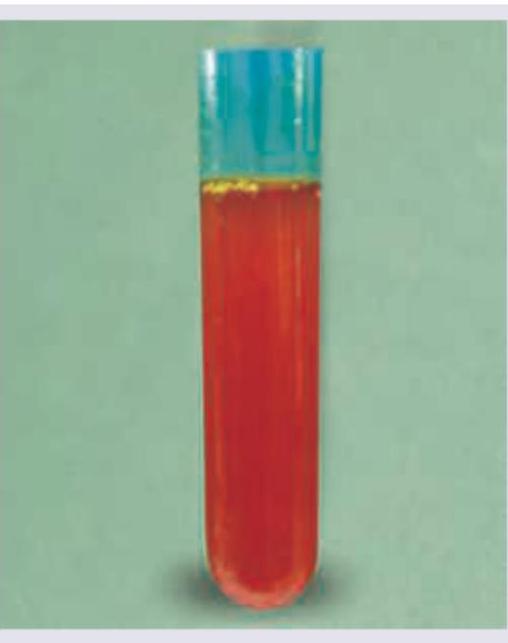
A sample of 5 mL urine of the patient was taken and aqueous solution of picric acid was added to it. The solution was made alkaline using NaOH and the following colour was produced. The test is called?
Which one of the following conditions can be screened during neonatal screening by biochemical tests?
Match the following molecules with their carriers in plasma: MOLECULES: 1. Thyroxine 2. Fatty acid 3. Hemoglobin 4. Heme CARRIERS: A. Hemopexin B. Prealbumin C. Albumin D. Haptoglobin
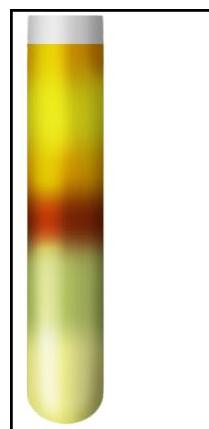
A urine sample shows a maroon-colored ring at the interface of two layers after adding reagents. Identify the test:
Which of the following options is false in a patient with advanced liver disease?
Preferred biochemical marker(s) in patients presenting with myocardial infarction:
Glutathione does all of the following except?
Which of the following enzymes can be found in CSF?
In a child presenting with obstructive jaundice all are elevated EXCEPT:
Bone resorption markers are:
Explanation: ***Jaffe's reaction*** - This test describes the **Jaffe reaction**, a colorimetric method used to detect **creatinine** by reacting it with **picric acid** in an alkaline environment, producing an orange-red color. - The intensity of the **orange-red color** is directly proportional to the amount of creatinine present in the urine sample. *Benedict's test* - **Benedict's test** is used to detect the presence of **reducing sugars**, such as glucose, in urine. - This test involves heating the sample with Benedict's reagent, and a color change from blue indicates the presence of reducing sugars. *Guthrie's test* - **Guthrie's test** is a **bacterial inhibition assay** used for newborn screening to detect metabolic disorders, most notably **phenylketonuria (PKU)**. - It involves placing a blood spot on a culture plate with bacteria and an inhibitor; growth around the blood spot indicates the presence of specific metabolites. *Friedel-Crafts reaction* - The **Friedel-Crafts reaction** is a set of organic reactions that involve the **alkylation** or **acylation** of aromatic compounds. - This reaction is primarily used in organic synthesis and is not a biochemical test for urine analysis.
Explanation: ***Congenital hypothyroidism*** - **Neonatal screening** for congenital hypothyroidism is a standard practice, using biochemical tests to measure **thyroid-stimulating hormone (TSH)** and **thyroxine (T4)** levels in dried blood spots. - Early detection and treatment prevent severe **intellectual disability** and developmental delays caused by thyroid hormone deficiency. *Congenital dislocation of hip* - This condition is primarily screened through **physical examination** (e.g., Ortolani and Barlow maneuvers) and imaging (e.g., ultrasound), not biochemical tests. - It involves a structural abnormality of the hip joint, not a metabolic or biochemical disorder. *Congenital rubella* - Diagnosis of congenital rubella involves detecting **rubella-specific IgM antibodies** or viral RNA, which are immunological/virological tests, not typical biochemical screening. - This is an infectious disease, not an inborn error of metabolism screened biochemically. *Chromosomal abnormalities* - Conditions like Down syndrome (Trisomy 21) are detected through **karyotyping** or **genetic tests**, which examine the number and structure of chromosomes. - While some biochemical markers are used in prenatal screening for chromosomal abnormalities (e.g., quad screen), direct neonatal screening for chromosomal abnormalities is not performed via general biochemical tests.
Explanation: ***1-B, 2-C, 3-D, 4-A*** - **Thyroxine** is primarily transported by **prealbumin (transthyretin)**, which has high affinity for thyroid hormones and prevents their rapid clearance. - **Fatty acids** bind to **albumin** at multiple binding sites, allowing efficient transport of these hydrophobic molecules in plasma. - **Hemoglobin** released from lysed red blood cells is bound by **haptoglobin** to prevent renal loss and iron wastage. - **Heme** groups are specifically transported by **hemopexin**, which has the highest binding affinity for heme among plasma proteins. *1-B, 2-C, 3-A, 4-D* - Incorrectly pairs **hemoglobin** with hemopexin; hemoglobin binds to **haptoglobin** to form stable complexes. - Incorrectly pairs **heme** with haptoglobin; free heme has highest affinity for **hemopexin**, not haptoglobin. *1-A, 2-B, 3-C, 4-D* - Incorrectly pairs **thyroxine** with hemopexin; thyroxine is primarily carried by **prealbumin** and thyroxine-binding globulin. - Incorrectly pairs **fatty acids** with prealbumin; fatty acids bind predominantly to **albumin** due to its multiple hydrophobic binding sites. *1-A, 2-D, 3-B, 4-C* - Incorrectly pairs **heme** with albumin; while albumin can bind heme weakly, **hemopexin** is the specific high-affinity carrier. - Incorrectly pairs **hemoglobin** with prealbumin; free hemoglobin forms specific complexes with **haptoglobin** for recycling.
Explanation: ***Rothera's test*** - The image displays a **maroon-colored ring** at the interface of two layers, which is a characteristic positive result for Rothera's test. - Rothera's test is used to detect the presence of **ketone bodies**, specifically **acetone and acetoacetate**, in urine. *Benedict's test* - Benedict's test is used to detect **reducing sugars**, such as glucose, in urine. - A positive Benedict's test typically produces a color change from blue to green, yellow, orange, or brick-red precipitate after heating, which is not what is seen here. *Biuret test* - The Biuret test is used to detect **peptide bonds** and thus the presence of **proteins**. - A positive Biuret test results in a **violet or purple color** when proteins are present, which is different from the reaction shown. *Fehling's test* - Fehling's test is another test used to detect the presence of **reducing sugars** in a sample. - A positive result is indicated by the formation of a **brick-red precipitate** of cuprous oxide after heating, which is not consistent with the image.
Explanation: ***Increased oxidative decarboxylation of alpha-ketoglutarate*** - In advanced liver disease, **hepatic encephalopathy** is a common complication due to the liver's inability to detoxify **ammonia**. - Alpha-ketoglutarate is crucial for detoxifying ammonia into glutamate and then glutamine, processes that involve reductive amination and **ATP consumption**, not increased oxidative decarboxylation. *Decreased ATP synthesis* - Advanced liver disease impairs various metabolic functions, including those of the **mitochondria**, leading to decreased ATP production. - This reduction in **energy reserves** affects numerous cellular processes and organ functions. *Hyperammonemia* - The liver is responsible for detoxifying **ammonia** into urea via the **urea cycle**. - In advanced liver disease, the impaired function of the liver leads to a buildup of ammonia in the blood, resulting in **hyperammonemia**. *Increased synthesis of glutamine and glutamate from alpha-ketoglutarate* - In the brain, when the liver fails to detoxify ammonia, **astrocytes** attempt to convert excess ammonia into **glutamine** using **alpha-ketoglutarate**. - This process is a compensatory mechanism to reduce ammonia toxicity, but it depletes alpha-ketoglutarate, which is a key intermediate in the **Krebs cycle**, leading to **cerebral energy deficits**.
Explanation: ***Cardiac specific Troponins*** - **Cardiac troponins** (cTnI and cTnT) are the preferred and most sensitive and specific biomarkers for diagnosing **myocardial infarction (MI)**. - They are proteins released into the bloodstream when myocardial cells are damaged, and their levels rise within hours of MI onset and remain elevated for several days. *All of the options* - While other markers like **CK-MB** and **Myoglobin** were historically used, **cardiac troponins** have superior specificity and sensitivity for MI. - The latest guidelines from major cardiology societies recommend troponins as the primary diagnostic markers. *Myoglobin* - **Myoglobin** is an early marker, but it is not specific to cardiac muscle and can be elevated in various conditions involving skeletal muscle damage. - Its short half-life means it can return to normal quickly, making it less reliable for diagnosing MI, especially if there's a delay in presentation. *CK-MB* - **Creatine Kinase-MB (CK-MB)** is a more specific marker than total CK for cardiac muscle damage but is still less specific than cardiac troponins. - It can be elevated in conditions like **myocarditis** or **pericarditis**, and its levels typically peak and decline earlier than troponins, limiting its diagnostic window.
Explanation: ***Decreases the stability of erythrocyte membranes*** - Glutathione actually **increases** the stability of erythrocyte membranes by protecting them from oxidative damage, particularly through its role in reducing **hydrogen peroxide** and organic hydroperoxides. - A deficiency in glutathione or the enzymes that reduce it (like **G6PD**) leads to increased oxidative stress, which **destabilizes** erythrocyte membranes and can cause **hemolysis**. *Scavenge peroxides* - Glutathione, in its reduced form (GSH), serves as a crucial **antioxidant** by **scavenging peroxides** through the action of **glutathione peroxidase**. - This reaction converts harmful **hydrogen peroxide** into water, protecting cellular components from oxidative damage. *Form conjugates with some drugs to increase water solubility.* - Glutathione plays a vital role in phase II detoxification reactions, where it forms **conjugates** with various xenobiotics and drugs. - This **conjugation** typically increases the **water solubility** of these compounds, facilitating their excretion from the body. *Participates in the transport of amino acids across some cell membranes* - Glutathione is involved in the **gamma-glutamyl cycle**, which is a mechanism for the **transport of amino acids** into cells, particularly in the kidney. - In this cycle, glutathione donates its **gamma-glutamyl group** to an amino acid, forming a gamma-glutamyl amino acid that is then transported across the membrane.
Explanation: ***LDH & CK*** - Both **lactate dehydrogenase (LDH)** and **creatine kinase (CK)** enzymes can be found in the cerebrospinal fluid (CSF). - Elevated levels of these enzymes in CSF can indicate **damage to brain tissue**, such as from ischemic stroke, trauma, or meningitis. - **CK-BB isoform** is the brain-specific form found in CSF. *ALT & LDH* - While **LDH** is found in CSF, **alanine aminotransferase (ALT)** is primarily a liver enzyme and is not typically found in significant concentrations in healthy CSF. - Presence of ALT in CSF would be highly unusual and not indicative of common neurological pathology. *ALT & CK* - **CK** is found in CSF, but **ALT** is an enzyme predominantly associated with **liver function** and is not a common or expected finding in CSF analysis. - Its presence in CSF would suggest contamination or severe, diffuse organ damage. *All of the options* - This option is incorrect because **ALT** is not typically found in CSF, making the combinations including ALT incorrect. - Only LDH and CK are consistently detected in CSF among the enzymes listed.
Explanation: ***Glutamate dehydrogenase*** - **Glutamate dehydrogenase (GLDH)** is an enzyme primarily found in the mitochondria of hepatocytes and is a marker of **hepatocellular damage**, not cholestasis or biliary obstruction. - While other enzymes are elevated in obstructive jaundice, GLDH elevation indicates **liver cell injury**, which is typically not the primary problem in pure obstruction. *5' Nucleotidase* - **5' nucleotidase** is a canalicular enzyme and its elevation is a **specific indicator of cholestasis** and biliary obstruction. - Its concentration is increased in conditions where there is **impaired bile flow**, making it a useful marker for obstructive jaundice. *Alkaline phosphatase* - **Alkaline phosphatase (ALP)** is an enzyme found in the liver (biliary ducts) and bone, and a significant increase in its levels is a key feature of **obstructive jaundice**. - High ALP levels indicate **biliary obstruction** or cholestasis due to impaired bile flow. *Gamma glutamyl transpeptidase* - **Gamma-glutamyl transpeptidase (GGT)** is an enzyme found in various tissues, including the liver, and its elevation is a **sensitive marker for cholestasis** and biliary obstruction. - GGT levels are typically elevated in parallel with ALP in diseases affecting the **bile ducts**, confirming the hepatic origin of elevated ALP.
Explanation: ***Urine total free deoxypyridinoline*** - **Deoxypyridinoline (DPD)**, a collagen cross-link, is released during **collagen degradation** in bone resorption. - Its excretion in urine reflects the overall rate of **bone matrix breakdown**. *Free glutamic acid cross linkage* - This is not a recognized or specific **biomarker for bone resorption**. - **Glutamic acid** is an amino acid, and its cross-linkages are not typically associated with bone turnover markers. *Serum propeptide of type I procollagen* - This marker, specifically **P1NP (Procollagen Type I N-terminal Propeptide)**, is a **bone formation marker**, indicating new collagen synthesis. - It reflects the activity of **osteoblasts** in building bone, not osteoclasts in breaking it down. *Osteocalcin* - **Osteocalcin** is primarily a **bone formation marker**, produced by osteoblasts. - While it can be found in the blood, its levels generally correlate with **osteoblastic activity** and bone turnover, rather than solely bone resorption.
Liver Function Tests
Practice Questions
Kidney Function Tests
Practice Questions
Cardiac Markers and Enzymes
Practice Questions
Pancreatic Function Tests
Practice Questions
Glucose Tolerance Tests
Practice Questions
Lipid Profile and Cardiovascular Risk
Practice Questions
Tumor Markers
Practice Questions
Hormonal Assays and Interpretation
Practice Questions
Electrolytes and Acid-Base Balance Tests
Practice Questions
Cerebrospinal Fluid Analysis
Practice Questions
Point-of-Care Testing
Practice Questions
Quality Control in Clinical Biochemistry
Practice Questions
Get full access to all questions, explanations, and performance tracking.
Start For Free