Diabetes mellitus is associated with which type of lactic acidosis?
Which of the following is NOT a component of Oral Rehydration Salts (ORS)?
Lactic acidosis is not seen in which of the following conditions or substances?
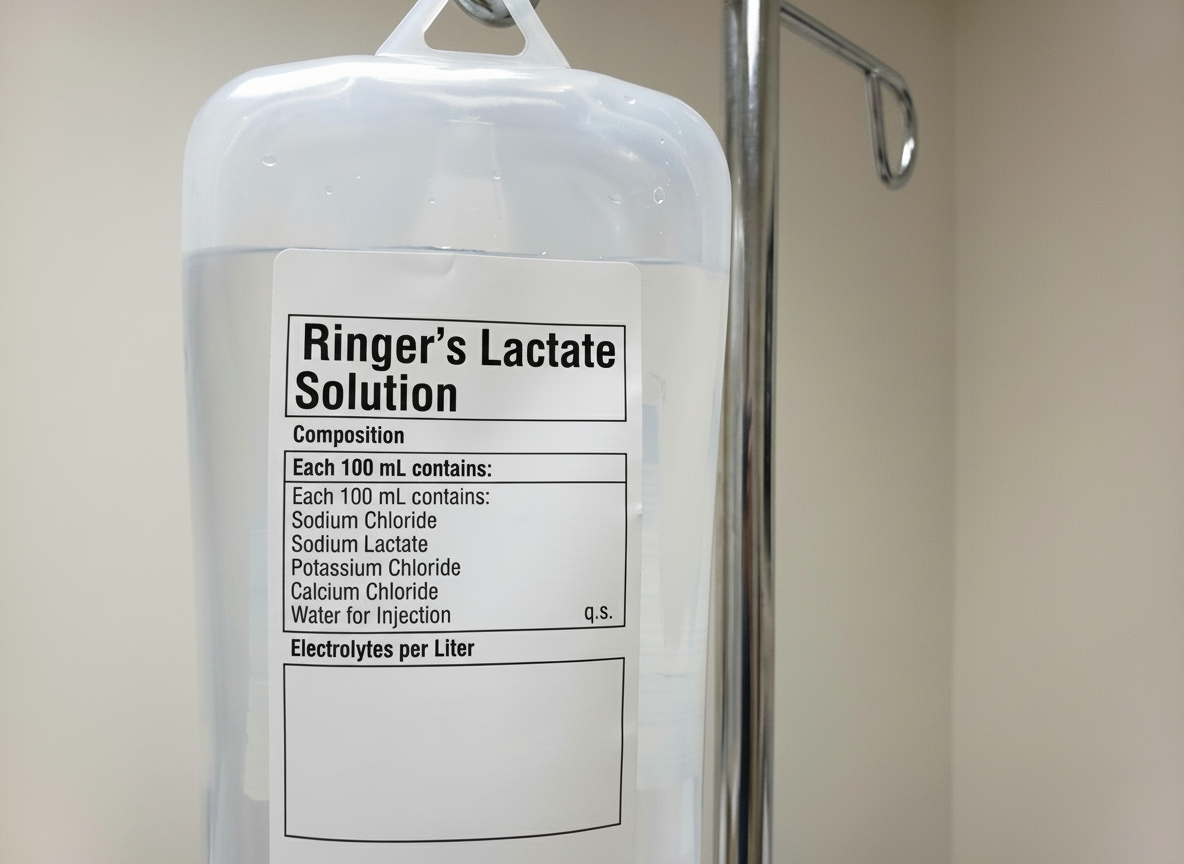
What is the total amount of potassium delivered to the patient after administering one bottle?
Normal anion gap is seen in all of the following conditions except:
What is the commonest cause of metabolic alkalosis?
A 45-year-old woman with Crohn disease and a small intestinal fistula develops tetany during the second week of parenteral nutrition. The laboratory findings include Na: 135 mEq/L K: 3.2 mEq/L Cl: 103 mEq/L HCO3 : 25 mEq/L Ca: 8.2 mEq/L Mg: 1.2 mEq/L PO4 : 2.4 mEq/L Albumin: 2.4. An arterial blood gas sample reveals a pH of 7.42, PCO2 of 38 mm Hg, and PO2 of 84 mm Hg. Which of the following is the most likely cause of the patient's tetany?
Persistent vomiting most likely causes which of the following?
Hypokalemia is not present in which of the following conditions?
Which of the following statements regarding insulin is true?
Explanation: ### Explanation Lactic acidosis is classified into two primary types based on the presence or absence of tissue hypoxia. **Why Type B is Correct:** **Type B lactic acidosis** occurs in the **absence of clinical evidence of tissue hypoxia** or hypoperfusion. In Diabetes Mellitus (DM), lactic acidosis occurs primarily due to metabolic derangements rather than oxygen debt. 1. **Metabolic Dysfunction:** In DM, there is an impairment of the enzyme **pyruvate dehydrogenase (PDH)**, leading to the diversion of pyruvate to lactate. 2. **Drug-Induced:** A classic high-yield association is the use of **Metformin** (a Biguanide), which inhibits mitochondrial respiration and gluconeogenesis, leading to lactate accumulation. 3. **Ketoacidosis:** Severe DKA can impair lactate clearance in the liver. **Analysis of Incorrect Options:** * **Type A Lactic Acidosis:** This is caused by **hypoxia or hypoperfusion** (e.g., shock, septicemia, severe hemorrhage, or heart failure). While a diabetic patient *can* develop shock, the primary association of the disease process itself is Type B. * **Type D Lactic Acidosis:** This is caused by **D-lactate** produced by abnormal gut bacteria, typically seen in **Short Bowel Syndrome**. Standard laboratory tests for lactate only measure the L-isomer, making this a distinct clinical entity unrelated to DM. **High-Yield Clinical Pearls for NEET-PG:** * **Normal Lactate Levels:** <2 mmol/L. Lactic acidosis is defined as lactate >5 mmol/L with a pH <7.35. * **Metformin Warning:** Metformin is contraindicated if the eGFR is <30 mL/min/1.73 m² due to the high risk of Type B lactic acidosis. * **Enzyme Link:** Deficiency of **Thiamine (B1)** can also cause Type B lactic acidosis because it is a cofactor for PDH.
Explanation: **Explanation:** The core principle of Oral Rehydration Salts (ORS) is the **SGLT-1 (Sodium-Glucose Linked Transporter)** mechanism in the small intestine. This transporter facilitates the coupled absorption of one molecule of glucose with two ions of sodium. As these solutes are absorbed, they create an osmotic gradient that pulls water into the bloodstream. Therefore, **glucose without salt** is ineffective for rehydration because, in the absence of sodium, the co-transport mechanism cannot function, and water absorption remains minimal. **Analysis of Options:** * **Sodium (A):** Essential for the SGLT-1 transporter and for replacing extracellular fluid volume lost during diarrhea. * **Potassium (B):** Crucial for replacing intracellular losses and preventing hypokalemia, which is common in diarrheal diseases. * **Glucose with salt (C):** This is the fundamental combination required to drive the active transport of water across the intestinal mucosa. **High-Yield Clinical Pearls for NEET-PG:** * **WHO Reduced Osmolarity ORS:** The current standard has a total osmolarity of **245 mOsm/L** (reduced from the older 311 mOsm/L) to decrease the risk of hypernatremia and reduce stool output. * **Composition (per Liter):** Sodium Chloride (2.6g), Glucose anhydrous (13.5g), Potassium Chloride (1.5g), and Trisodium Citrate (2.9g). * **Trisodium Citrate:** Added specifically to correct **metabolic acidosis** resulting from bicarbonate loss in stools. * **Zinc Supplementation:** Often given alongside ORS (20mg/day for 10-14 days) to reduce the duration and severity of diarrhea.
Explanation: **Explanation:** Lactic acidosis is a form of high anion gap metabolic acidosis (HAGMA) caused by the accumulation of lactate, typically due to tissue hypoxia or impaired metabolism of lactic acid. **Why Tolbutamide is the correct answer:** Tolbutamide is a first-generation sulfonylurea used in the treatment of Type 2 Diabetes. Unlike **Biguanides (e.g., Phenformin and Metformin)**, which inhibit mitochondrial respiration and gluconeogenesis leading to lactate accumulation, sulfonylureas work by stimulating insulin release from pancreatic beta cells. They do not interfere with lactate metabolism and, therefore, do not cause lactic acidosis. **Analysis of Incorrect Options:** * **Methanol Poisoning:** Methanol metabolism produces formic acid, which inhibits mitochondrial cytochrome c oxidase. This disrupts the electron transport chain, leading to anaerobic glycolysis and subsequent lactic acidosis. * **Respiratory Failure:** Severe respiratory failure leads to hypoxemia. In the absence of adequate oxygen, cells shift from aerobic metabolism to anaerobic glycolysis, producing excess lactic acid (Type A Lactic Acidosis). * **Circulatory Failure:** Conditions like shock or heart failure cause systemic hypoperfusion. This leads to inadequate oxygen delivery to tissues, resulting in profound Type A lactic acidosis. **NEET-PG High-Yield Pearls:** * **Classification:** Lactic acidosis is divided into **Type A** (Hypoxic: shock, anemia, heart failure) and **Type B** (Non-hypoxic: drugs like Metformin, Linezolid, or metabolic diseases). * **Drug-Induced:** Phenformin was withdrawn globally due to a high risk of lactic acidosis; Metformin carries a much lower risk but is contraindicated in renal failure. * **Mnemonic for HAGMA:** **MUDPILES** (Methanol, Uremia, DKA, Propylene glycol, Iron/INH, Lactic acidosis, Ethylene glycol, Salicylates).
Explanation: ***4 mmol*** - **Ringer's Lactate** (Hartmann's solution) contains **4 mEq/L** (4 mmol/L) of potassium chloride. - In one **1L bottle**, the total potassium delivered = 4 mEq/L × 1 L = **4 mmol**. *2 mmol* - This represents **half the actual potassium content** in Ringer's Lactate solution. - May be confused with **potassium phosphate** preparations that have different concentrations. *8 mmol* - This is **double the actual amount** of potassium in standard Ringer's Lactate. - Could be mistaken for **high-concentration potassium** solutions used in specific clinical scenarios. *10 mmol* - This exceeds the standard potassium content and represents a **concentrated potassium supplement**. - **Normal saline with added KCl** might contain this concentration, but not standard Ringer's Lactate.
Explanation: ### Explanation The **Anion Gap (AG)** is calculated as $[Na^+] - ([Cl^-] + [HCO_3^-])$. A **Normal Anion Gap Metabolic Acidosis (NAGMA)** occurs when the loss of bicarbonate is compensated by a proportional increase in chloride (Hyperchloremic acidosis). In contrast, **High Anion Gap Metabolic Acidosis (HAGMA)** occurs when unmeasured acid anions (like lactate or ketoacids) accumulate. **Why Methanol Poisoning is the Correct Answer:** Methanol poisoning causes **HAGMA**. Methanol is metabolized by alcohol dehydrogenase into **formic acid**. The accumulation of formate ions (unmeasured anions) increases the anion gap. This is typically associated with an "Osmolar Gap" as well. **Analysis of Incorrect Options (Causes of NAGMA):** * **Renal Tubular Acidosis (RTA):** Characterized by either the inability to reabsorb bicarbonate (Type 2) or secrete hydrogen ions (Type 1/4), leading to bicarbonate loss and compensatory hyperchloremia. * **Diarrhoea:** The most common cause of NAGMA. Gastrointestinal secretions are rich in $HCO_3^-$; their loss leads to a relative increase in serum chloride. * **Ureterosigmoidoscopy:** In this procedure, ureters are diverted into the sigmoid colon. The intestinal mucosa exchanges $Cl^-$ for $HCO_3^-$, leading to bicarbonate loss and hyperchloremic acidosis. **NEET-PG High-Yield Pearls:** 1. **Mnemonic for HAGMA:** **MUDPILES** (Methanol, Uremia, DKA, Propylene glycol, Iron/INH, Lactic acidosis, Ethylene glycol, Salicylates). 2. **Mnemonic for NAGMA:** **USED CARP** (Ureterosigmoidoscopy, Saline infusion, Endocrine/Addison’s, Diarrhoea, Carbonic anhydrase inhibitors, Ammonium chloride, RTA, Pancreatic fistula). 3. **Normal Anion Gap range:** 8–12 mEq/L. 4. **Gold Standard:** In methanol poisoning, look for **optic disc hyperemia** (snow-blindness) on fundoscopy.
Explanation: **Explanation:** **Pyloric stenosis** is the most common cause of metabolic alkalosis in clinical practice, particularly in the pediatric population. The underlying mechanism is the persistent loss of gastric secretions due to projectile vomiting. Gastric juice is rich in **Hydrochloric acid (HCl)** and **Potassium (KCl)**. 1. **Loss of H+:** For every proton lost in vomitus, a bicarbonate ion ($HCO_3^-$) is added to the blood (the "alkaline tide"), leading to **Metabolic Alkalosis**. 2. **Loss of Cl-:** This leads to **Hypochloremia**. To maintain electrical neutrality, the kidneys reabsorb bicarbonate instead of chloride, worsening the alkalosis. 3. **Volume Depletion:** Dehydration activates the Renin-Angiotensin-Aldosterone System (RAAS). Aldosterone promotes $Na^+$ reabsorption at the expense of $H^+$ and $K^+$ excretion in the distal tubule, leading to **Paradoxical Aciduria** (acidic urine despite systemic alkalosis). **Analysis of Incorrect Options:** * **A. Cancer of the stomach:** While it can cause obstruction, it is less common than pyloric stenosis and often presents with achlorhydria (lack of acid production). * **C. Small-bowel obstruction:** Obstruction distal to the ampulla of Vater results in the loss of both acidic gastric juice and alkaline pancreatic/biliary secretions, often leading to a **neutral pH** or **metabolic acidosis** (if primarily lower bowel). * **D. Diuretics:** Loop and thiazide diuretics cause metabolic alkalosis (contraction alkalosis), but they are a secondary cause compared to the classic presentation of pyloric stenosis. **High-Yield Clinical Pearls for NEET-PG:** * **Classic Triad:** Hypochloremic, Hypokalemic, Metabolic Alkalosis with Paradoxical Aciduria. * **Management:** The priority is fluid resuscitation with **0.9% Normal Saline** (to provide $Cl^-$) and Potassium supplementation before surgical correction (Ramstedt’s Myotomy).
Explanation: **Explanation:** The correct answer is **Hypomagnesemia (Option C)**. **Why Hypomagnesemia is the correct answer:** The patient presents with tetany, a state of increased neuromuscular excitability. While tetany is classically associated with hypocalcemia, this patient’s calcium level must be corrected for her low albumin. * **Corrected Calcium formula:** Measured Ca + [0.8 × (4.0 - Albumin)] * Calculation: $8.2 + [0.8 \times (4.0 - 2.4)] = 8.2 + 1.28 = \mathbf{9.48\ mg/dL}$. Since the corrected calcium is within the normal range (8.5–10.5 mg/dL), hypocalcemia is not the cause. However, the serum magnesium is significantly low (**1.2 mEq/L**; normal: 1.5–2.5 mEq/L). Hypomagnesemia causes tetany by lowering the threshold for nerve terminal depolarization and is a common complication in patients with small intestinal fistulas (loss of GI secretions) and those on long-term parenteral nutrition. **Why other options are incorrect:** * **A. Hyperventilation:** This causes respiratory alkalosis, which increases the binding of calcium to albumin, reducing ionized calcium. The ABG shows a normal pH (7.42) and $PCO_2$ (38 mmHg), ruling this out. * **B. Hypocalcemia:** As calculated above, the patient’s corrected calcium is normal. * **D. Essential fatty acid deficiency:** This typically presents with dermatitis, alopecia, and poor wound healing, not acute neuromuscular irritability. **NEET-PG High-Yield Pearls:** * **Refractory Hypokalemia:** If a patient’s potassium does not normalize despite supplementation, always check and correct magnesium levels first. * **PTH Resistance:** Severe hypomagnesemia causes tetany not only directly but also by inducing functional hypoparathyroidism (inhibiting PTH release and causing end-organ resistance to PTH). * **GI Losses:** Small bowel fistulas are rich in magnesium and potassium; chronic loss leads to depletion.
Explanation: **Explanation:** Persistent vomiting leads to a classic metabolic derangement known as **Hypokalemic, Hypochloremic Metabolic Alkalosis.** **1. Why Hypochloremia is Correct:** Gastric juice is rich in Hydrochloric acid (HCl). Persistent vomiting results in the massive loss of both Hydrogen ions ($H^+$) and Chloride ions ($Cl^-$). The loss of $Cl^-$ directly leads to **hypochloremia**. As $H^+$ is lost, the body’s bicarbonate ($HCO_3^-$) levels rise relatively, leading to metabolic alkalosis. **2. Analysis of Incorrect Options:** * **Hyperkalemia:** Incorrect. Vomiting causes **Hypokalemia**. This occurs due to direct loss in vomitus, but primarily due to secondary hyperaldosteronism (triggered by volume depletion) which causes the kidneys to excrete $K^+$ in exchange for $Na^+$. * **Acidic urine excretion:** Incorrect. Initially, urine is alkaline due to bicarbonate excretion. However, in severe cases, **Paradoxical Aciduria** occurs. Despite systemic alkalosis, the kidney preserves volume by reabsorbing $Na^+$ in exchange for $H^+$ (due to severe $K^+$ depletion), making the urine acidic. * **Hyperventilation:** Incorrect. In metabolic alkalosis, the body compensates via **Hypoventilation** (respiratory compensation) to retain $CO_2$ and lower the pH. **Clinical Pearls for NEET-PG:** * **Paradoxical Aciduria:** A high-yield concept where urine is acidic despite systemic alkalosis; it occurs due to concomitant volume depletion and hypokalemia. * **Treatment of choice:** Normal Saline (0.9% NaCl) infusion. It corrects volume depletion and provides $Cl^-$ to allow the kidneys to excrete excess $HCO_3^-$. * **Common Scenario:** Often tested in the context of **Infantile Hypertrophic Pyloric Stenosis (IHPS)**.
Explanation: **Explanation:** The correct answer is **Chronic Renal Failure (CRF)**. In CRF, the primary electrolyte abnormality is **Hyperkalemia**, not hypokalemia. This occurs because the kidneys lose their ability to excrete potassium due to a reduced Glomerular Filtration Rate (GFR) and impaired tubular secretion. As nephrons are lost, the body cannot effectively handle potassium loads, leading to its accumulation in the blood. **Analysis of Incorrect Options:** * **Vomiting:** Causes hypokalemia through two mechanisms: direct loss of K+ in gastric juice and, more significantly, secondary hyperaldosteronism triggered by volume depletion, which increases renal K+ excretion. * **Diarrhoea:** Lower GI secretions are rich in potassium and bicarbonate. Profuse diarrhoea leads to direct fecal loss of potassium. * **Diuretics:** Loop diuretics (e.g., Furosemide) and Thiazides inhibit sodium reabsorption, increasing sodium delivery to the distal tubule. This promotes potassium secretion into the urine, leading to hypokalemia. **NEET-PG High-Yield Pearls:** * **ECG in Hyperkalemia (CRF):** Tall tented T-waves, widened QRS complex, and loss of P-waves. * **ECG in Hypokalemia:** Flattened T-waves, prominent **U-waves**, and ST-segment depression. * **Exception:** While CRF typically causes hyperkalemia, certain renal conditions like **Renal Tubular Acidosis (RTA) Types I and II** and **Fanconi Syndrome** are classic causes of hypokalemia. * **Insulin and Alkalosis:** Both cause a "transcellular shift," moving potassium from the extracellular fluid into the cells, resulting in hypokalemia.
Explanation: ### Explanation **Correct Answer: B. Two polypeptide chains are bound by disulfide linkages** **1. Why Option B is Correct:** Insulin is a peptide hormone synthesized as **preproinsulin**, which is cleaved into **proinsulin**. Proinsulin consists of an A-chain, a B-chain, and a connecting C-peptide. Mature insulin is formed when the C-peptide is cleaved, leaving the **A-chain (21 amino acids)** and **B-chain (30 amino acids)** linked together by **two interchain disulfide bonds**. There is also one intrachain disulfide bond within the A-chain. **2. Why Other Options are Incorrect:** * **Option A:** Insulin is produced and secreted by the **Beta ($\beta$) cells** of the Islets of Langerhans in the pancreas. Alpha ($\alpha$) cells secrete glucagon. * **Option C:** While insulin **does** shift potassium into the cell (by stimulating the $Na^+/K^+$ ATPase pump), this question asks for the most definitive structural or physiological truth based on the provided key. *Note: In many clinical exams, C is also a physiological truth; however, B describes the fundamental biochemical structure of the molecule.* * **Option D:** The plasma half-life of endogenous or intravenous insulin is very short, approximately **5–6 minutes**. Subcutaneous insulin absorption varies by formulation (rapid vs. long-acting), but the molecular half-life remains brief once it reaches the circulation. **3. High-Yield NEET-PG Pearls:** * **C-Peptide:** Secreted in equimolar amounts with insulin. It is a key marker to differentiate endogenous insulin production (high C-peptide) from exogenous insulin surreptitious injection (low/absent C-peptide). * **Chromosomal Location:** The insulin gene is located on the short arm of **Chromosome 11**. * **Mechanism of Action:** Insulin acts via a **Tyrosine Kinase receptor** (catalytic receptor). * **Clinical Application:** Because insulin shifts $K^+$ into cells, a combination of **Insulin + Glucose** is a standard emergency treatment for **Hyperkalemia**.
Acid-Base Chemistry and Buffers
Practice Questions
pH Regulation in Body Fluids
Practice Questions
Respiratory Regulation of Acid-Base Balance
Practice Questions
Renal Regulation of Acid-Base Balance
Practice Questions
Respiratory and Metabolic Acidosis
Practice Questions
Respiratory and Metabolic Alkalosis
Practice Questions
Mixed Acid-Base Disorders
Practice Questions
Interpretation of Arterial Blood Gases
Practice Questions
Electrolyte Homeostasis
Practice Questions
Sodium and Water Balance
Practice Questions
Potassium Balance
Practice Questions
Calcium and Phosphate Metabolism
Practice Questions
Get full access to all questions, explanations, and performance tracking.
Start For Free