All of the following are methods for improving oxygenation using a ventilator, except:
A mini tracheostomy is performed through which anatomical structure?
Which of the following respiratory conditions is most alarming during patient sedation in a dental clinic?
Which of the following maneuvers is NOT included in clearing the airway?
Which of the following is used for oxygen therapy?
What is the fraction of oxygen in inspired air during mouth-to-mouth resuscitation?
Succinylcholine prevents bronchospasm by?
Which of the following modes of ventilation is NOT used for weaning patients from mechanical ventilation?
All of the following are benefits of prone ventilation except?
What is true about aspiration pneumonia?
Explanation: **Explanation:** The primary goal of improving oxygenation in mechanical ventilation is to increase the **Mean Airway Pressure (MAP)** and improve the ventilation-perfusion (V/Q) match. **Why High-Frequency Ventilation (HFV) is the correct answer:** While HFV (specifically High-Frequency Oscillatory Ventilation - HFOV) was historically used to improve oxygenation in severe ARDS, recent large-scale clinical trials (like the OSCAR and OSCILLATE trials) have shown it does **not** improve outcomes and may even be harmful in adults. In the context of standard management protocols for refractory hypoxia, it is no longer considered a primary "method for improving oxygenation" but rather a rescue therapy with limited evidence. In many modern exam contexts, it is the "odd one out" compared to established evidence-based strategies. **Analysis of Incorrect Options:** * **Low Tidal Volume and High PEEP:** This is the cornerstone of the ARDSNet protocol. High PEEP (Positive End-Expiratory Pressure) improves oxygenation by recruiting collapsed alveoli and increasing the functional residual capacity (FRC). * **ECMO:** This is the ultimate rescue therapy for refractory hypoxemia. It provides extracorporeal gas exchange, directly oxygenating the blood and allowing the lungs to "rest." * **Prone Ventilation:** This improves oxygenation by optimizing V/Q matching, reducing ventral-to-dorsal pleural pressure gradients, and recruiting posterior lung segments. **High-Yield Clinical Pearls for NEET-PG:** * **Primary determinant of Oxygenation:** Mean Airway Pressure (MAP) and $FiO_2$. * **Primary determinant of $CO_2$ removal:** Minute Ventilation (Tidal Volume × Respiratory Rate). * **ARDS Strategy:** "Lung Protective Ventilation" (Tidal volume 6 ml/kg PBW) is the gold standard. * **Prone Positioning:** Should be used for at least 16 hours a day in severe ARDS ($PaO_2/FiO_2$ ratio < 150).
Explanation: **Explanation:** **1. Why Option A is Correct:** A **mini-tracheostomy** (also known as percutaneous dilatational cricothyrotomy) is a specialized procedure where a small-bore cannula (typically 4mm) is inserted into the trachea specifically through the **cricothyroid membrane**. Unlike a formal tracheostomy, its primary purpose is not long-term ventilation, but rather **"tracheal toilet"** (suctioning of secretions) in patients with an ineffective cough reflex or to provide emergency oxygenation (Oxygen Jet Ventilation) in "cannot intubate, cannot ventilate" (CICV) scenarios. The cricothyroid membrane is the preferred site because it is superficial, relatively avascular, and located well below the vocal cords but above the thyroid isthmus. **2. Why Other Options are Incorrect:** * **Option B (2nd and 3rd tracheal rings):** This is the anatomical site for a **Standard (Surgical) Tracheostomy**. Placing a tube here requires surgical dissection and often involves retracting or dividing the thyroid isthmus. It is not the site for a "mini" or emergency cricothyroid procedure. * **Option C & D:** These are incorrect as the procedure is anatomically specific to the cricothyroid space to avoid major vascular structures and the thyroid gland. **3. High-Yield Clinical Pearls for NEET-PG:** * **Landmarks:** The cricothyroid membrane lies between the thyroid cartilage (superiorly) and the cricoid cartilage (inferiorly). * **Indication:** Most common indication for mini-tracheostomy is **sputum retention** in postoperative patients. * **Complication:** The most significant immediate risk is hemorrhage or injury to the posterior tracheal wall; a long-term risk is **subglottic stenosis**. * **Needle vs. Surgical:** In children under 8–12 years, needle cricothyrotomy is preferred over surgical methods to avoid damaging the narrow cricoid cartilage.
Explanation: **Explanation:** **Correct Option: A. Apnea** Apnea is defined as the complete cessation of airflow for at least 10 seconds. In the context of sedation, especially in a dental clinic where the airway is shared with the operator, apnea is the most alarming sign. It indicates a total failure of the respiratory drive or a complete upper airway obstruction. Without immediate intervention (repositioning, suctioning, or positive pressure ventilation), apnea leads rapidly to hypoxemia, hypercarbia, and eventual cardiac arrest. It represents the "point of no return" in respiratory compromise. **Incorrect Options:** * **B. Dyspnea:** This refers to the subjective feeling of "shortness of breath." While concerning, the patient is still actively breathing and attempting to compensate. * **C. Hyperpnea:** This is an increase in the depth and rate of breathing to meet metabolic demands. It is often a compensatory mechanism rather than a primary failure. * **D. Tachypnea:** This is simply an increased respiratory rate. While it may indicate early distress or pain, the patient is still moving air, making it less critical than the total absence of breathing. **Clinical Pearls for NEET-PG:** * **The "Silent" Danger:** During deep sedation, apnea can be silent. Pulse oximetry is a late indicator of apnea (especially if the patient is on supplemental oxygen); **Capnography (EtCO2)** is the gold standard for the earliest detection of apnea. * **Sedation Continuum:** Respiratory depression is a dose-dependent side effect of most sedative agents (Benzodiazepines, Opioids, Propofol). * **Management:** The first step in managing sedation-induced apnea is stimulation and airway maneuvers (Head tilt/Chin lift or Jaw thrust).
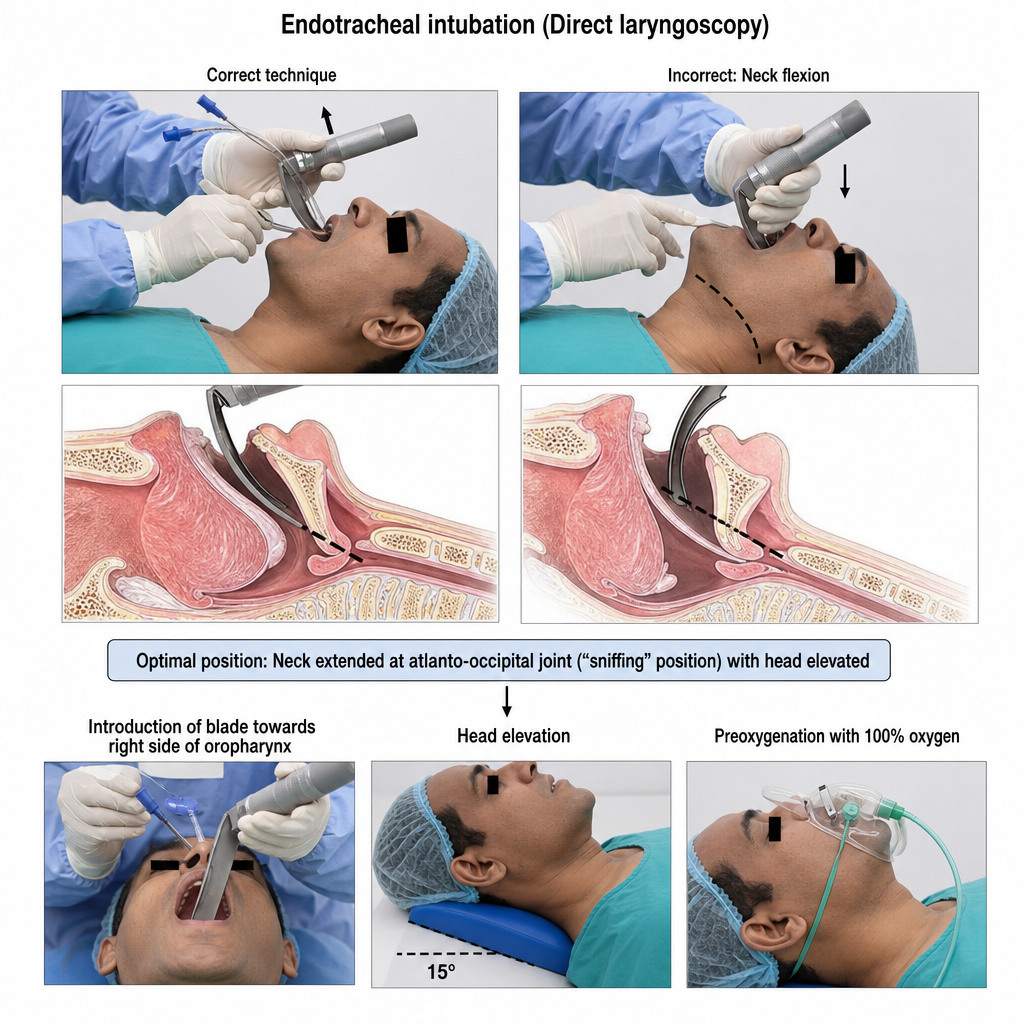
Explanation: **Explanation:** The primary goal of basic airway maneuvers is to relieve functional airway obstruction, most commonly caused by the tongue falling back against the posterior pharyngeal wall in an unconscious patient. **Why "Head Lift" is the Correct Answer:** "Head lift" is not a recognized maneuver for clearing the airway. In fact, lifting the head (flexing the neck) without extending the atlanto-occipital joint can actually worsen airway obstruction by kinking the trachea and pushing the tongue further back. The correct component of the standard maneuver is **Head Tilt**, which involves extending the neck to bring the oral, pharyngeal, and laryngeal axes into better alignment. **Analysis of Other Options:** * **Neck Tilt (Head Tilt):** This involves extending the head at the atlanto-occipital joint. It stretches the anterior neck structures, lifting the tongue away from the posterior pharynx. * **Chin Lift:** This maneuver involves lifting the mandible forward. Since the tongue is anatomically attached to the mandible via the genioglossus muscle, lifting the chin directly pulls the tongue forward, clearing the air passage. * **Mouth Gag:** While less common in basic life support, a mouth gag (or an oropharyngeal airway) is used in clinical settings to keep the mouth open and prevent the tongue or soft tissues from obstructing the flow of air, especially during surgical procedures or in patients with trismus. **High-Yield Clinical Pearls for NEET-PG:** * **Triple Maneuver:** Consists of Head tilt, Chin lift, and Jaw thrust. * **Cervical Spine Injury:** In cases of suspected trauma, **Head Tilt is contraindicated**. The **Jaw Thrust** is the safest maneuver as it minimizes cervical spine movement. * **Sniffing Position:** The ideal position for endotracheal intubation, achieved by neck flexion (using a pillow) and head extension.
Explanation: **Explanation:** The correct answer is **C. Hudson's mask**. Oxygen therapy involves the administration of oxygen at concentrations greater than that found in ambient air to treat or prevent hypoxia. **Why Hudson’s Mask is Correct:** A Hudson’s mask (also known as a simple face mask) is a low-flow oxygen delivery device. It covers the patient's nose and mouth and can deliver an inspired oxygen fraction ($FiO_2$) of approximately **35% to 60%** at flow rates of **5–10 Liters per minute (Lpm)**. It is a standard tool for providing supplemental oxygen to spontaneously breathing patients. **Analysis of Incorrect Options:** * **A. Pulse Oximeter:** This is a **monitoring device**, not a delivery device. It non-invasively measures the oxygen saturation ($SpO_2$) of arterial hemoglobin but does not provide oxygen to the patient. * **B. Nasal Cannula:** While a nasal cannula *is* used for oxygen therapy, in the context of standard MCQ patterns where both are listed, the Hudson's mask is often the preferred answer for "oxygen therapy" questions unless "low concentration" or "long-term" is specified. However, in many clinical exams, if only one must be chosen, the mask is the classic representation of a therapy interface. *(Note: In some versions of this question, Nasal Cannula is also a delivery device; however, the Hudson's mask is the specific "mask" designed for this purpose).* * **D. Guedel’s Airway:** This is an **oropharyngeal airway (OPA)**. Its primary function is to maintain airway patency by preventing the tongue from obstructing the epiglottis; it does not deliver oxygen itself. **High-Yield Clinical Pearls for NEET-PG:** * **Flow Rates:** Nasal Cannula (1–6 Lpm; $FiO_2$ 24–44%), Simple Mask (5–10 Lpm; $FiO_2$ 35–60%), Venturi Mask (Provides **precise** $FiO_2$; choice for COPD). * **Non-Rebreather Mask (NRM):** Delivers the highest $FiO_2$ (up to 90–100%) among low-flow systems. * **Safety:** Never use a simple mask at a flow rate of **<5 Lpm**, as this can lead to the accumulation and rebreathing of CO₂.
Explanation: **Explanation:** The fraction of inspired oxygen ($FiO_2$) during mouth-to-mouth resuscitation is approximately **0.16 (16%)**. This is based on the physiological composition of exhaled air. Atmospheric air contains approximately **21% oxygen**. During a normal respiratory cycle, a healthy individual extracts only about 4–5% of that oxygen for cellular metabolism. Consequently, the air exhaled by the rescuer still contains about **16–17% oxygen** and approximately 4% carbon dioxide. While this is lower than atmospheric air, it is sufficient to maintain life-sustaining arterial oxygen saturation in a victim, provided the rescuer delivers an adequate tidal volume. **Analysis of Options:** * **A (0.16): Correct.** This represents the oxygen concentration in exhaled air used during rescue breathing. * **B (0.19): Incorrect.** This value does not correspond to standard physiological gas concentrations. * **C (0.21): Incorrect.** This is the $FiO_2$ of **room air**. It would only be the inspired fraction if the victim were breathing spontaneously or being ventilated with a room-air bellows/bag. * **D (0.26): Incorrect.** This is higher than room air; achieving this would require supplemental oxygen delivery. **High-Yield Clinical Pearls for NEET-PG:** * **Mouth-to-Mask Ventilation:** If the rescuer uses a pocket mask with supplemental oxygen at 10–15 L/min, the $FiO_2$ can increase to approximately **0.50 (50%)**. * **Ambu Bag (Self-inflating bag):** Without supplemental oxygen, it delivers **21%**; with an oxygen source and a reservoir, it can deliver **90–100%** oxygen. * **Tidal Volume in CPR:** For mouth-to-mouth, the recommended volume is enough to cause a **visible chest rise** (approx. 500–600 ml) over 1 second.
Explanation: **Explanation:** **1. Why Depolarising Block is Correct:** Succinylcholine (Suxamethonium) is a depolarizing neuromuscular blocker (DNMB). It acts as an agonist at the nicotinic acetylcholine receptors (nAChR) at the neuromuscular junction. By causing persistent depolarization, it renders the muscle fibers resistant to further stimulation by acetylcholine, leading to flaccid paralysis. In the context of **bronchospasm**, Succinylcholine is the drug of choice during "cannot ventilate, cannot oxygenate" scenarios or severe laryngospasm. It prevents or relieves bronchospasm primarily by **paralyzing the skeletal muscles of the chest wall and diaphragm**, thereby increasing chest wall compliance and allowing for effective manual ventilation, rather than by a direct effect on bronchial smooth muscle. **2. Why Other Options are Wrong:** * **Direct muscle relaxation:** This refers to drugs like Dantrolene (which acts on the ryanodine receptor) or bronchodilators like Beta-2 agonists that act directly on smooth muscle. Succinylcholine requires a receptor-mediated depolarization at the motor endplate. * **Centrally acting muscle relaxation:** Drugs like Baclofen or Diazepam act on the CNS (spinal cord/brain). Succinylcholine acts peripherally at the neuromuscular junction. * **Dual action:** While Succinylcholine can exhibit a "Phase II block" (which resembles a non-depolarizing block) after prolonged infusion or high doses, its primary mechanism for preventing acute airway spasms is its initial depolarizing action. **3. NEET-PG High-Yield Pearls:** * **Drug of Choice:** Succinylcholine is the gold standard for **Rapid Sequence Induction (RSI)** due to its rapid onset (30–60s) and short duration (5–10 mins). * **Metabolism:** It is metabolized by **Pseudocholinesterase** (Plasma cholinesterase). * **Key Side Effects:** Hyperkalemia (avoid in burns/trauma), muscle fasciculations, and it is a potent trigger for **Malignant Hyperthermia**. * **Atypical Response:** Prolonged apnea occurs in patients with atypical pseudocholinesterase (diagnosed by Dibucaine number).
Explanation: **Explanation:** The goal of weaning is to transition the patient from full ventilatory support to spontaneous breathing by gradually increasing the work of breathing performed by the patient's own respiratory muscles. **1. Why Controlled Mechanical Ventilation (CMV) is the correct answer:** In CMV, the ventilator delivers a preset tidal volume or pressure at a fixed rate, regardless of the patient's effort. The machine does 100% of the work, and any spontaneous inspiratory efforts by the patient are ignored or suppressed (often requiring sedation/paralysis). Because it allows **zero patient participation**, it cannot be used for weaning; rather, it is used in patients who are apneic or require total respiratory rest. **2. Analysis of Incorrect Options:** * **SIMV:** This mode delivers a set number of mandatory breaths but allows the patient to take spontaneous breaths in between. Weaning is achieved by gradually reducing the mandatory rate, forcing the patient to take more spontaneous breaths. * **PSV:** This is a purely spontaneous mode where the ventilator provides a pressure "boost" during inspiration. It is one of the most common weaning methods, as the clinician can slowly decrease the pressure support level as the patient’s muscle strength improves. * **Assist-Control (ACV):** While often used for full support, ACV allows the patient to trigger the ventilator. As the patient initiates a breath, the machine delivers the full set volume. It can be used in early weaning phases to assess the patient's drive to breathe. **Clinical Pearls for NEET-PG:** * **Gold Standard for Weaning:** The **Spontaneous Breathing Trial (SBT)** using a T-piece or low-level PSV is currently considered the most effective weaning method. * **Rapid Shallow Breathing Index (RSBI):** Calculated as $f/V_T$ (Frequency/Tidal Volume in Liters). An **RSBI < 105** is a strong predictor of successful weaning. * **CMV Risk:** Prolonged use of CMV leads to **Ventilator-Induced Diaphragmatic Dysfunction (VIDD)** due to disuse atrophy.
Explanation: **Explanation:** Prone positioning is a life-saving maneuver used in Severe ARDS (P/F ratio <150) to improve oxygenation. The correct answer is **Option D** because prone positioning is actually associated with **poor tolerance of enteral feeding**. Patients in the prone position have increased intra-abdominal pressure, which leads to delayed gastric emptying, increased gastric residual volumes, and a higher risk of aspiration and vomiting. **Analysis of Options:** * **Option A (Recruitment):** In the supine position, the dorsal lung regions are collapsed due to the weight of the ventral structures. Prone positioning recruits these dorsal regions, which contain the largest portion of lung parenchyma, thereby increasing the surface area for gas exchange. * **Option B (Cardiac Displacement):** In the supine position, the heart rests on the left lower lobe, causing compression atelectasis. In the prone position, the heart rests on the sternum, relieving this pressure and improving ventilation in the retrocardiac lung zones. * **Option C (Homogenous Ventilation):** Prone positioning makes the pleural pressure gradient more uniform from ventral to dorsal regions. This results in a more homogenous distribution of tidal volume, reducing regional overdistension (volutrauma) and cyclical opening/closing (atelectrauma). **High-Yield NEET-PG Pearls:** * **PROSEVA Trial:** Demonstrated that early, prolonged prone positioning (at least 16 hours/day) significantly reduces mortality in severe ARDS. * **V/Q Matching:** Prone positioning improves V/Q matching because while ventilation shifts dorsally, perfusion remains relatively constant in the dorsal regions due to gravity and vascular anatomy. * **Contraindications:** Unstable spinal fractures, massive hemoptysis, and open abdomen (laparostomy).
Explanation: **Explanation:** Aspiration pneumonia (specifically Mendelson’s Syndrome when referring to chemical pneumonitis) occurs when gastric contents enter the lungs. The severity and incidence are determined by several critical factors: * **Volume of Aspirate (Option A):** The risk of significant pulmonary injury increases with the volume of material aspirated. Classically, a volume of **>0.4 mL/kg** (approximately 25-30 mL in an adult) is considered the threshold for high risk. * **pH of Aspirate (Option B):** The acidity of the gastric juice is a primary determinant of parenchymal damage. A **pH <2.5** is the critical cutoff; lower pH levels cause immediate chemical burns to the airway epithelium, leading to inflammation and pulmonary edema. * **Timing of Incidence (Option C):** In the perioperative period, aspiration is most frequent during **induction** and **extubation**. During induction, the transition from consciousness to unconsciousness involves the loss of protective airway reflexes (cough, laryngeal closure) and a decrease in lower esophageal sphincter tone, especially if the patient has a "full stomach." **Why "All of the Above" is correct:** Since the severity of the lung injury is a direct function of both the quantity (Volume) and quality (pH) of the gastric contents, and the clinical occurrence is statistically highest during the manipulation of the airway (Induction), all statements are clinically accurate. **High-Yield Clinical Pearls for NEET-PG:** * **Mendelson’s Syndrome:** Characterized by hypoxia, wheezing, and cyanosis within 2-12 hours of aspiration. * **Prophylaxis:** H2 blockers (Ranitidine), Proton Pump Inhibitors (Pantoprazole), and non-particulate antacids (Sodium Citrate) are used to increase pH and decrease volume. * **Management:** Immediate suctioning is vital. Prophylactic antibiotics and steroids are generally **not** recommended unless signs of bacterial infection or specific inflammatory complications develop. * **RSI:** Rapid Sequence Induction with cricoid pressure (Sellick’s maneuver) is the standard technique to prevent aspiration in high-risk patients.
Respiratory Physiology
Practice Questions
Airway Anatomy
Practice Questions
Preoxygenation Techniques
Practice Questions
Mask Ventilation
Practice Questions
Supraglottic Airway Devices
Practice Questions
Direct Laryngoscopy
Practice Questions
Video Laryngoscopy
Practice Questions
Fiberoptic Intubation
Practice Questions
Surgical Airway Management
Practice Questions
One-Lung Ventilation Techniques
Practice Questions
Ventilation Strategies During Anesthesia
Practice Questions
Extubation Criteria and Techniques
Practice Questions
Get full access to all questions, explanations, and performance tracking.
Start For Free