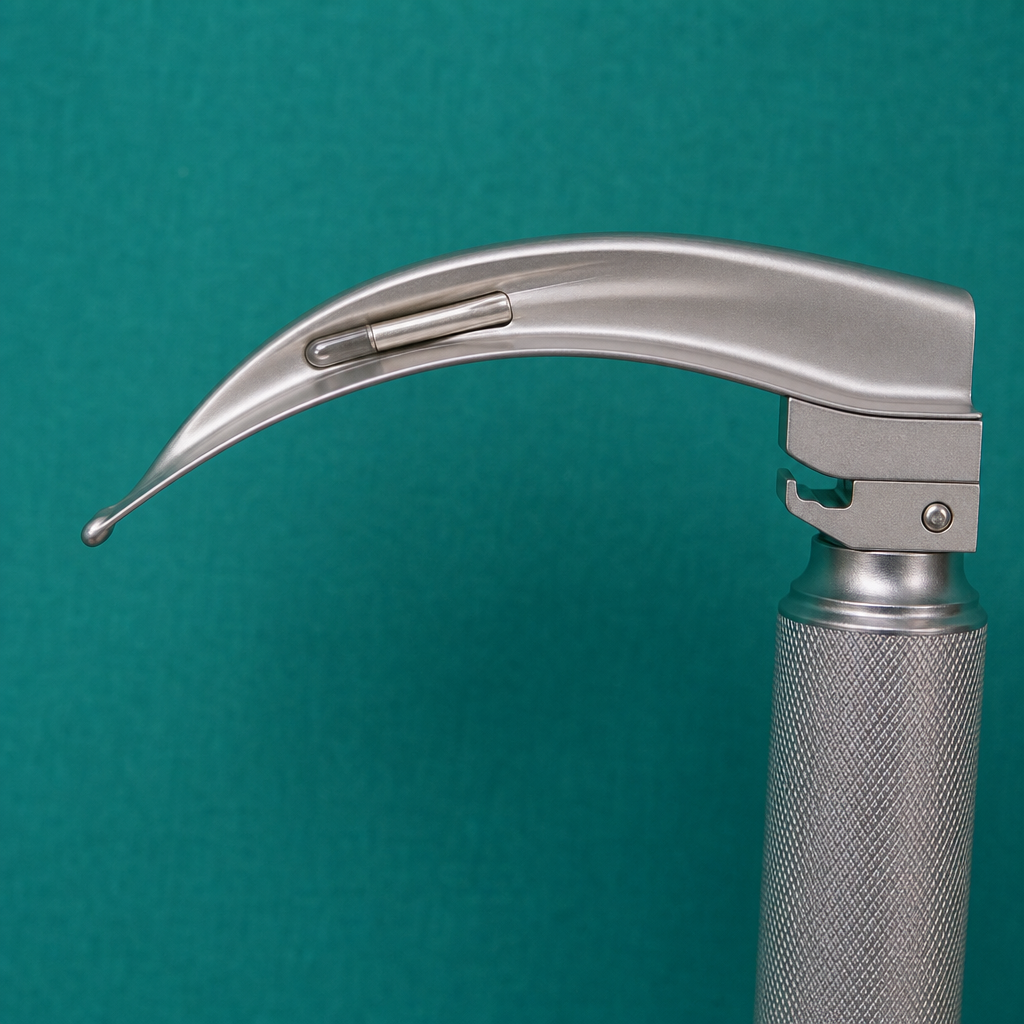
A 72-year-old man has multiple injuries and an altered sensorium after a high-speed motor vehicle collision. He is intubated for his decreased mental status. During intubation, a large amount of gastric contents are noted in the posterior pharynx and he aspirates. What is the appropriate initial treatment?
Which statement is false regarding endotracheal tube cuffs?
If a satisfactory laryngeal view is not achieved during laryngoscopy, which maneuver is performed?
What is the definition of Ventilator-Associated Pneumonia (VAP)?
What is the approximate pressure that should be applied during cricoid pressure application?
Which of the following statements about the pediatric airway is true?
According to the 2010 AHA Guidelines for CPR, what is the recommended sequence for basic life support?
Which of the following is NOT true about succinylcholine (scoline)?
What is the minimum concentration of oxygen required in anaesthesia?
Which supraglottic airway device offers the maximum airway seal during positive pressure ventilation?
Explanation: ### Explanation **Correct Option: A. Bronchoscopy for aspiration of particulate matter** The immediate management of witnessed aspiration focuses on clearing the airway to prevent mechanical obstruction and secondary lung injury. **Rigid or flexible bronchoscopy** is the gold standard for the initial treatment because it allows for the direct visualization and removal of large particulate matter that could cause atelectasis or localized inflammatory responses. Suctioning the oropharynx and trachea should be performed immediately, followed by bronchoscopy if solid food particles are suspected. **Why Incorrect Options are Wrong:** * **B. Steroids:** Multiple clinical trials have shown that corticosteroids do not improve outcomes, reduce the inflammatory response, or prevent the development of Acute Respiratory Distress Syndrome (ARDS) following aspiration. * **C. Prophylactic Antibiotics:** Aspiration initially causes a chemical pneumonitis (Mendelson’s syndrome), which is sterile. Prophylactic antibiotics are not recommended as they do not prevent infection and may lead to the selection of resistant organisms. They should only be started if there is no improvement after 48 hours or if signs of secondary bacterial pneumonia develop. * **D. Inhaled Nitric Oxide:** This is a pulmonary vasodilator used as a rescue therapy for severe refractory hypoxemia in ARDS. It is not an initial treatment for acute aspiration. **High-Yield Clinical Pearls for NEET-PG:** * **Mendelson’s Syndrome:** A chemical pneumonitis caused by the aspiration of gastric contents with a **pH < 2.5** and a volume **> 0.4 mL/kg (approx. 25 mL)**. * **Critical Time Window:** The chemical injury to the lung parenchyma occurs almost instantaneously upon contact with gastric acid. * **Management Priority:** 1. Immediate suctioning; 2. Bronchoscopy (if particles present); 3. Supportive care (Oxygen/PEEP). * **Antibiotic Rule:** Do not give "prophylactic" antibiotics; wait for clinical evidence of infection (fever, new infiltrates, purulent sputum) usually appearing 2–3 days later.
Explanation: **Explanation** The primary purpose of an endotracheal tube (ETT) cuff is to provide an **airtight seal** between the tube and the tracheal wall. This seal facilitates positive pressure ventilation and protects the lower airway from aspiration of gastric contents or secretions. **Why Option B is False:** The cuff is **not** designed to anchor or fix the tube in place. Securing the tube is achieved using adhesive tapes or ties around the patient’s mouth or neck. Relying on the cuff for stabilization would require excessive inflation, leading to tracheal mucosal ischemia. **Analysis of Other Options:** * **Option A:** Traditionally, infant ETTs were uncuffed because the narrowest part of a child's airway is the cricoid cartilage, which acts as a natural anatomical seal. While cuffed tubes are now increasingly used in pediatrics, the classic teaching for exams remains that infants typically use uncuffed tubes to prevent subglottic stenosis. * **Option C:** The capillary perfusion pressure of the tracheal mucosa is approximately **25–30 cm H₂O**. If cuff pressure exceeds this (ideally kept between 20–30 cm H₂O), it causes ischemia, which can lead to tracheal stenosis or tracheomalacia. * **Option D:** This is a core function of the cuff; it prevents air leaks during inspiration and prevents aspiration. **High-Yield Clinical Pearls for NEET-PG:** * **Cuff Type:** Most modern ETTs use **High-Volume Low-Pressure (HVLP)** cuffs to distribute pressure over a larger area, reducing the risk of mucosal damage. * **Microaspiration:** HVLP cuffs can form longitudinal folds that allow microaspiration; newer tapered-shaped cuffs (e.g., Lanz) aim to minimize this. * **Monitoring:** Cuff pressure should be monitored using a dedicated manometer, especially during prolonged surgeries or ICU stays.
Explanation: **Explanation:** The correct answer is **D. Backward-upward-rightward pressure (BURP maneuver)**. **1. Why BURP is correct:** When the laryngeal view is suboptimal (e.g., Cormack-Lehane Grade 2 or 3) during direct laryngoscopy, the **BURP maneuver** is the standard technique used to improve visualization. It involves an assistant applying manual pressure on the thyroid cartilage in three specific directions: **B**ackward (against the cervical vertebrae), **U**pward (superiorly), and **R**ightward. This maneuver displaces the larynx into the line of sight of the laryngoscopist, significantly improving the view of the glottis. **2. Why other options are incorrect:** * **A. Neck should be flexed:** While the "sniffing position" involves lower cervical flexion and upper cervical extension, further flexion of the neck *during* laryngoscopy usually obstructs the view rather than improving it. * **B & C. Chin lift and Jaw thrust:** These are basic airway maneuvers used to open the airway in a spontaneous breathing patient or during bag-mask ventilation to relieve soft tissue obstruction. They are not used to improve the laryngeal view once the laryngoscope is already in the mouth. **Clinical Pearls for NEET-PG:** * **BURP vs. SELLICK:** Do not confuse BURP with the **Sellick Maneuver** (Cricoid pressure). Sellick is used to prevent gastric regurgitation, whereas BURP is specifically to improve the laryngeal view. * **Cormack-Lehane Classification:** This system grades the laryngeal view (Grade 1: Full view; Grade 4: No epiglottis seen). BURP is most effective in converting a Grade 3 view to a Grade 2. * **OELM:** Optimal External Laryngeal Manipulation (OELM) is a variation where the intubator moves the larynx with their own right hand to find the best view, then has an assistant maintain that position.
Explanation: ### Explanation **1. Understanding the Correct Answer (Option B)** Ventilator-Associated Pneumonia (VAP) is a sub-type of Hospital-Acquired Pneumonia (HAP). By definition, it refers to a lower respiratory tract infection that develops **48 hours or more after endotracheal intubation** and initiation of mechanical ventilation. The 48-hour window is crucial because it distinguishes infections acquired within the healthcare setting from those that may have been incubating prior to intubation. **2. Analysis of Incorrect Options** * **Option A:** This describes the general definition of **Hospital-Acquired Pneumonia (HAP)**. While VAP is a form of HAP, VAP specifically requires the presence of an artificial airway (endotracheal or tracheostomy tube). * **Option C:** Pneumonia occurring within 48 hours of admission is generally classified as **Community-Acquired Pneumonia (CAP)**, as the pathogen was likely present before entering the hospital. * **Option D:** Infections occurring within 48 hours of intubation are usually attributed to micro-aspiration during the intubation process itself rather than the prolonged presence of the ventilator. **3. High-Yield NEET-PG Pearls** * **Classification:** * *Early-onset VAP:* Occurs within the first 4 days (usually caused by antibiotic-sensitive bacteria like *S. pneumoniae*). * *Late-onset VAP:* Occurs after 5 days (usually caused by MDR pathogens like *Pseudomonas aeruginosa* or *MRSA*). * **Diagnosis:** Clinical suspicion is based on the **CPIS (Clinical Pulmonary Infection Score)**, which includes fever, leucocytosis, purulent secretions, and new infiltrates on X-ray. * **Prevention (VAP Bundle):** * Head of bed elevation (30–45°). * Daily "sedation vacation" and weaning assessment. * Chlorhexidine mouth care. * Subglottic secretion suctioning. * **Most Common Organism:** *Pseudomonas aeruginosa* is the most frequently isolated pathogen in late-onset VAP.
Explanation: **Explanation:** Cricoid pressure, also known as **Sellick’s Maneuver**, is a technique used during Rapid Sequence Induction (RSI) to prevent the regurgitation of gastric contents into the pharynx, thereby reducing the risk of aspiration. **1. Why 30 N is correct:** The recommended force for effective cricoid pressure is **30 Newtons (N)**, which is approximately equivalent to 3 kg of pressure. This force is sufficient to occlude the esophagus against the body of the sixth cervical vertebra (C6) without causing airway obstruction or significant trauma. In clinical practice, it is recommended to apply **10 N** while the patient is awake/during pre-oxygenation and increase it to **30 N** once the patient loses consciousness. **2. Analysis of Incorrect Options:** * **20 N (Option A):** This force is often considered insufficient to reliably occlude the esophagus in an unconscious patient, increasing the risk of aspiration. * **40 N (Option C):** Applying force greater than 30 N is excessive. It can lead to airway distortion, making tracheal intubation difficult, and may cause esophageal rupture if the patient is actively vomiting. * **5 N (Option D):** This is negligible pressure and provides no clinical benefit in preventing regurgitation. **Clinical Pearls for NEET-PG:** * **Anatomical Landmark:** The cricoid cartilage is the only **complete cartilaginous ring** in the larynx. * **Contraindications:** Suspected cricoid/laryngeal fracture, active vomiting (risk of esophageal rupture), and unstable cervical spine injuries. * **Complications:** If applied incorrectly, it can cause laryngeal view distortion (Grade 3 or 4 Cormack-Lehane view) and difficulty in passing the endotracheal tube.
Explanation: In the pediatric airway, the **epiglottis** is relatively longer, stiffer, and narrower (often described as **U-shaped or Omega-shaped**). Crucially, it is attached to the hyoid bone at a **more acute angle** to the laryngeal axis, making it appear more anterior and floppy. This necessitates the use of a straight blade (e.g., Miller) to directly lift the epiglottis during intubation. **Analysis of Incorrect Options:** * **A. The larynx is more caudal:** Incorrect. The pediatric larynx is positioned **more cephalad (higher)**. In a neonate, the larynx is at the level of **C3–C4**, whereas in an adult, it descends to **C4–C5**. * **C. The glottic opening is the narrowest part:** Incorrect. Traditionally, the **cricoid cartilage** (subglottic region) was considered the narrowest part, giving the airway a "funnel shape." While recent MRI studies suggest the glottis may be the narrowest transverse dimension, for NEET-PG purposes, the **cricoid** remains the classic answer for the narrowest functional part. * **D. The trachea is longer:** Incorrect. The pediatric trachea is significantly **shorter** (approx. 4–5 cm in neonates vs. 10–12 cm in adults), increasing the risk of endobronchial intubation or accidental extubation with head movement. **High-Yield Clinical Pearls:** * **Tongue:** Relatively larger in proportion to the oral cavity (increases risk of obstruction). * **Occiput:** Prominent in infants; placing a "shoulder roll" (rather than a head ring) helps align the axes for intubation. * **Mainstem Bronchi:** Both bronchi leave the trachea at equal angles until age 2; therefore, foreign body aspiration or endobronchial intubation can occur on either side with equal frequency.
Explanation: **Explanation:** The 2010 AHA Guidelines for CPR introduced a fundamental shift in the sequence of Basic Life Support (BLS) from A-B-C to **C-A-B (Compression-Airway-Breathing)**. This change applies to adults, children, and infants (excluding newborns). **Why C-A-B is the Correct Answer:** The primary goal in sudden cardiac arrest is to maintain coronary and cerebral perfusion. In the previous A-B-C sequence, chest compressions were often delayed while the rescuer struggled to open the airway or deliver rescue breaths. By starting with **Compressions**, the rescuer immediately initiates blood flow. Most victims of witnessed arrest have high arterial oxygen saturation at the time of collapse; therefore, initial circulation is more critical than ventilation. Starting with compressions reduces the "no-flow time" and significantly improves survival rates. **Analysis of Incorrect Options:** * **A (A-B-C):** This was the standard prior to 2010. It is now discouraged because it delays the most critical intervention—chest compressions. * **B (C-B-A):** This sequence is illogical as the airway must be opened/cleared before effective breathing/ventilation can occur. * **D (B-A-C):** This sequence prioritizes breathing, which is incorrect for cardiac arrest where the primary failure is circulatory, not respiratory. **High-Yield Clinical Pearls for NEET-PG:** * **Compression Depth:** At least 2 inches (5 cm) in adults; at least 1/3rd the AP diameter of the chest in children/infants. * **Compression Rate:** 100–120 per minute. * **Compression-to-Ventilation Ratio:** 30:2 for all single rescuers (Adults/Children/Infants). For two-rescuer CPR in children/infants, the ratio is 15:2. * **Exception:** For **Newborns**, the sequence remains **A-B-C** because the cause of arrest is almost always respiratory.
Explanation: **Explanation:** Succinylcholine (Scoline) is the only **depolarizing neuromuscular blocker** used clinically. It works by mimicking acetylcholine at the nicotinic receptors of the motor endplate, causing persistent depolarization that prevents further muscle contraction. Therefore, Option C is incorrect (and the right answer) because it is not a non-depolarizing agent (like vecuronium or rocuronium). **Analysis of other options:** * **Option A (Fasciculations):** Before causing paralysis, succinylcholine causes disorganized muscle contractions known as fasciculations. This is a hallmark of depolarizing blocks. * **Option B (Increased Pressures):** Succinylcholine transiently increases **Intraocular Pressure (IOP)**, Intragastric Pressure, and Intracranial Pressure (ICP). This makes its use controversial in penetrating eye injuries or severe head trauma. * **Option D (Short-acting):** It has the fastest onset (30–60 seconds) and the shortest duration of action (5–10 minutes) among all relaxants, making it the drug of choice for **Rapid Sequence Induction (RSI)**. **High-Yield Clinical Pearls for NEET-PG:** 1. **Metabolism:** It is metabolized by **Pseudocholinesterase** (Plasma cholinesterase). Deficiency of this enzyme leads to prolonged apnea (Scoline Apnea). 2. **Hyperkalemia:** It can cause a rise in serum potassium (~0.5 mEq/L). It is strictly contraindicated in patients with burns, massive trauma, or upper motor neuron lesions due to the risk of fatal hyperkalemia. 3. **Malignant Hyperthermia:** Succinylcholine is a potent trigger for Malignant Hyperthermia (Treatment: Dantrolene). 4. **Side Effects:** Post-operative myalgia is a common complaint following its use.
Explanation: **Explanation:** The minimum concentration of oxygen required during anesthesia is **33%** (often referred to as a 1:2 ratio of Oxygen to Nitrous Oxide). This is a safety standard designed to prevent **hypoxic gas mixtures** and to provide a "safety margin" above the atmospheric oxygen concentration (21%). **Why 33% is correct:** Modern anesthesia machines are equipped with a **Hypoxic Guard (Link-25 system)**. This mechanical or pneumatic linkage ensures that for every 1 liter of Oxygen, a maximum of 2 liters of Nitrous Oxide can be delivered. This maintains a minimum FiO2 (Fraction of Inspired Oxygen) of approximately 25–33%. In clinical practice, 33% is the standard minimum to account for the increased metabolic demands and the reduction in Functional Residual Capacity (FRC) that occurs under general anesthesia. **Analysis of Incorrect Options:** * **15% & 18%:** These are sub-atmospheric concentrations. Delivering less than 21% oxygen will inevitably lead to hypoxemia and potential brain injury or death. * **50%:** While 50% (Entonox) is commonly used in labor analgesia or emergency settings, it is not the *minimum* required concentration for general anesthesia. **High-Yield Clinical Pearls for NEET-PG:** * **Hypoxic Guard:** Also known as the **Ratio Controller**, it prevents the delivery of a hypoxic mixture (FiO2 <0.25). * **Oxygen Flush:** Delivers 100% oxygen at a flow rate of **35–75 L/min** at a pressure of 45–60 psi, bypassing the flowmeters. * **Fail-Safe Valve:** This shuts off the flow of Nitrous Oxide if the Oxygen supply pressure drops below a certain threshold (usually 30 psi), preventing the delivery of 100% N2O. * **Diffusion Hypoxia (Fink Effect):** Occurs at the end of anesthesia when N2O is discontinued; 100% Oxygen should be given for 5–10 minutes to prevent this.
Explanation: **Explanation:** The **Laryngeal Mask Airway (LMA) ProSeal** is a second-generation supraglottic airway device (SAD) specifically designed to provide a superior seal compared to its predecessors. It features a larger, redesigned silicone cuff and a posterior bolster that pushes the mask forward, ensuring a tighter fit against the periglottic tissues. This allows it to withstand higher airway pressures (up to **30 cm H₂O**), making it the gold standard for positive pressure ventilation (PPV) among SADs. **Analysis of Options:** * **LMA Classic (Option B):** A first-generation device with a lower seal pressure (typically <20 cm H₂O). It lacks a gastric drainage channel and is prone to leaks during high-pressure ventilation. * **i-gel (Option C):** A second-generation, non-inflatable device made of thermoplastic elastomer. While it is easy to insert and provides a good seal (approx. 24–26 cm H₂O), it generally does not reach the high seal pressures achieved by the ProSeal. * **Laryngeal Tube (Option D):** A double-lumen tube that seals the esophagus and oropharynx. While effective, it is associated with higher mucosal pressure and is less commonly used than the ProSeal for routine high-pressure ventilation. **High-Yield Clinical Pearls for NEET-PG:** * **Gastric Channel:** The ProSeal has a dedicated drainage tube that allows for the passage of a Ryle’s tube to decompress the stomach, reducing the risk of aspiration. * **Second-Generation SADs:** Defined by the presence of a gastric drainage port and improved seal mechanisms (e.g., ProSeal, Supreme, i-gel). * **Indications:** ProSeal is often preferred in obese patients or laparoscopic surgeries where higher inspiratory pressures are required.
Respiratory Physiology
Practice Questions
Airway Anatomy
Practice Questions
Preoxygenation Techniques
Practice Questions
Mask Ventilation
Practice Questions
Supraglottic Airway Devices
Practice Questions
Direct Laryngoscopy
Practice Questions
Video Laryngoscopy
Practice Questions
Fiberoptic Intubation
Practice Questions
Surgical Airway Management
Practice Questions
One-Lung Ventilation Techniques
Practice Questions
Ventilation Strategies During Anesthesia
Practice Questions
Extubation Criteria and Techniques
Practice Questions
Get full access to all questions, explanations, and performance tracking.
Start For Free