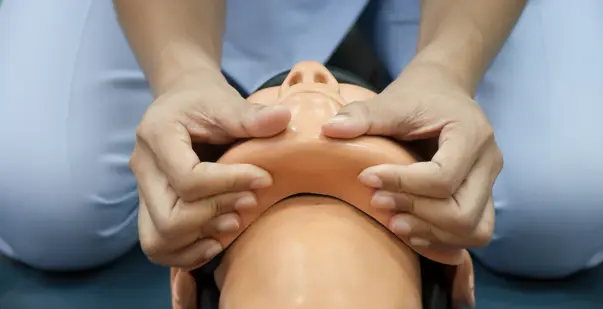
The procedure shown in the image is performed to maintain the airway. Which of the following techniques is being used?
In conventional oxygen therapy, which device will deliver the highest FiO2?
Endotracheal tube in the esophagus is best assessed by:
During rapid sequence intubation in a child after taking brief history and clinical examination next step is:
A patient is admitted following a road traffic accident. He has sustained significant blunt injury to his head, chest and abdomen and has a Glasgow Coma Scale score of 8/15. His saturations are poor at 89% on 15 L of oxygen a rebreathing mask. You note bruising around both eyes and blood-stained fluid issuing from his left ear, which forms concentric circles when dripped on a white sheet. You wish to support his airway to improve oxygenation. The first choice of airway adjunct would be
On doing laparoscopic cholecystectomy patient developed wheezing. Which of the following is used in the treatment?
Helium is used along with oxygen instead of plain oxygen because
A 70 kg young athlete was planned for surgery. During anesthesia, vecuronium was not available, so repeated doses of succinylcholine were given intermittently up to 640 mg. During recovery, the patient was not able to spontaneously respire and move limbs. What is the cause?
All of the following are advantages of LMA except:
Which of the following is an ideal method to prevent aspiration pneumonia?
Explanation: ***Jaw thrust*** - The image distinctly shows a rescuer performing a **jaw thrust maneuver** by placing fingers under the angles of the patient's mandible and displacing the jaw forward. - This technique is used to open the airway by lifting the tongue off the posterior pharyngeal wall, especially in cases of suspected **cervical spine injury**. *Head stabilization* - While important in trauma, **head stabilization alone** does not open the airway; it prevents movement without actively repositioning the jaw or head. - Head stabilization is a supportive technique, often used in conjunction with airway maneuvers, but it is not the primary airway-opening technique depicted. *In line manual stabilization* - **In-line manual stabilization** is a method where a rescuer holds the patient's head and neck in a neutral, in-line position to prevent movement, particularly during transport or other interventions. - This technique is used to protect the spine from further injury and prevents any movement from the head or neck. *Head tilt chin lift* - The **head tilt-chin lift** involves tilting the head back and lifting the chin, which is a different hand placement and body movement than what is shown. - This maneuver is contraindicated in suspected cervical spine injuries due to the risk of exacerbating spinal cord damage.
Explanation: **Non rebreathing mask** - This device features a **one-way valve** between the mask and the reservoir bag, preventing exhaled air from mixing with fresh oxygen. This allows for the delivery of the **highest possible FiO2** among conventional oxygen therapy devices, often up to 90-100%. - The **reservoir bag** ensures a continuous supply of high-concentration oxygen during inspiration, maximizing the amount of oxygen inhaled. *Hudson mask* - Also known as a **simple face mask**, it delivers a moderate FiO2 (40-60%) at flow rates of 5-10 L/min. - The open ports on the sides allow for mixing of room air with oxygen, making it less efficient for delivering very high oxygen concentrations. *Venturi mask* - This device uses the Venturi principle to deliver a **precise and consistent FiO2** by entraining room air with oxygen. - While it provides controlled oxygen delivery, its maximum FiO2 typically ranges from 24-60%, which is lower than a non-rebreathing mask. *Nasal cannula* - The nasal cannula delivers a relatively low FiO2 (24-44%) at flow rates of 1-6 L/min. - It is designed for **low-flow oxygen delivery** and is not suitable for patients requiring high concentrations of oxygen.
Explanation: ***CO2 Exhalation*** - Measuring **CO2 exhalation** (capnography) is the most reliable method to confirm endotracheal tube placement, as CO2 is present in the trachea but not in the esophagus. - A persistent **waveform on the capnograph** indicates proper tracheal intubation. *Direct laryngoscopy* - While helpful for initial visualization during intubation, **direct laryngoscopy** cannot confirm continuous tracheal placement after the tube is advanced. - It only confirms the tube passing through the vocal cords, not its final position in the trachea versus esophagus. *Auscultation* - **Auscultation** can be misleading because stomach sounds can be transmitted to the chest, and breath sounds can be heard in the epigastrium even with esophageal intubation. - It relies on subjective interpretation and is less definitive than capnography. *Chest wall movement* - Observing **chest wall movement** is not a definitive sign, as the chest can still rise with esophageal intubation due to air entering the stomach. - This method is unreliable and can be mistaken for proper ventilation, leading to dangerous delays in correcting tube misplacement.
Explanation: ***Administer oxygen*** - Pre-oxygenation with 100% oxygen is critical before **rapid sequence intubation (RSI)** to maximize **oxygen reserves** and extend the safe apnea time. - This step helps prevent **hypoxemia** during the intubation procedure, especially in children who have lower functional residual capacity. *Analgesic injection with Fentanyl* - While fentanyl is often used in RSI for its **analgesic** and **sedative properties**, it typically follows pre-oxygenation and is administered as part of the **induction phase**, often concurrently with a paralytic. - Administering fentanyl alone without prior oxygenation or other induction agents would not be the immediate next step in a structured RSI protocol. *Preanaesthetic medication with atropine and lignocaine* - **Atropine** may be used in children to prevent **bradycardia** during intubation, particularly in infants, but it's not the immediate next step after initial assessment; pre-oxygenation is more critical. - **Lidocaine** can be used to blunt the sympathetic response to intubation or to suppress cough, but it's not universally required and comes after pre-oxygenation and other induction medications. *IV anesthetic Diazepam/Ketamine* - **Diazepam** and **ketamine** are **induction agents** that cause sedation and loss of consciousness, but they are administered after pre-oxygenation and often just before the paralytic agent. - Administering an induction agent without adequate pre-oxygenation would increase the risk of **hypoxemia** during the subsequent apnea.
Explanation: ***Oropharyngeal airway*** - An **oropharyngeal airway (OPA)** is the most appropriate initial airway adjunct in a patient with a **depressed GCS (8/15)** and poor oxygenation, as it helps to relieve **upper airway obstruction** caused by the tongue falling back. - Given the potential for a **basal skull fracture** (bruising around eyes, blood-stained fluid from ear forming concentric circles), a **nasopharyngeal airway (NPA)** is contraindicated due to the risk of intracranial insertion. *Nasopharyngeal tube* - A **nasopharyngeal airway (NPA)** is contraindicated in this patient due to signs suggestive of a **basal skull fracture**, which include **raccoon eyes (periorbital bruising)** and **Battle's sign (bruising behind the ear)**, as well as the **halo sign (concentric circles of blood and CSF)** from the ear. - Inserting an NPA in such a scenario risks inadvertently entering the **cranial cavity**, leading to further neurological damage or infection. *Intubation* - While **intubation** may eventually be necessary given the patient's low GCS and poor oxygenation, it is not the *first choice* of airway adjunct. - The immediate priority is to establish a **patent airway** quickly and safely, which an OPA can achieve while preparations for definitive intubation are made. *Laryngeal mask* - A **laryngeal mask airway (LMA)** could be considered for airway management, but it is typically a more advanced adjunct than an OPA. - Its insertion requires a certain level of skill and might be more time-consuming than an OPA, which is crucial in an emergency setting.
Explanation: ***Administration of beta agonist*** - **Wheezing** during surgery suggests **bronchospasm**, which is effectively treated by **beta agonists** administered via inhalation to relax airway smooth muscles. - In a laparoscopic cholecystectomy, increased **intra-abdominal pressure** and **CO2 absorption** can trigger bronchoconstriction, making a rapid bronchodilator essential. *IV ketamine* - **Ketamine** has **bronchodilatory effects** and can be used in severe cases, but it's not the first-line treatment for acute wheezing due to its psychoactive and cardiovascular effects. - It would typically be considered if inhaled bronchodilators are insufficient or if there's an associated **anaphylactic reaction**. *IV lignocaine* - **Lignocaine** (lidocaine) can suppress airway reflexes and has some bronchodilatory properties, but it is primarily used as a **local anesthetic** or for treating arrhythmias. - Its role in acute **bronchospasm** is limited and not a primary treatment for wheezing. *Deepen the plane of anesthesia* - While light anesthesia can sometimes trigger bronchospasm, simply deepening the anesthetic plane may not be sufficient or safe if the wheezing is due to other causes like **allergy** or **CO2 retention**. - Without addressing the underlying cause directly, increasing anesthetic depth could lead to **hemodynamic instability**.
Explanation: ***It decreases turbulence*** - **Helium** is a very low-density gas, which makes the mixture of helium and oxygen significantly less dense than air or pure oxygen. - This lower density reduces **turbulent flow** in constricted airways, promoting laminar flow and decreasing the work of breathing, especially beneficial in conditions like **asthma** or **C.O.P.D**. *For analgesia* - **Helium** itself does not possess significant analgesic properties, even at high concentrations. - While some anesthetic gases provide analgesia, **helium** is not used for pain relief in respiratory therapy. *It decreases the dead space* - **Helium-oxygen mixtures** do not directly alter or decrease the anatomical or physiological dead space in the lungs. - Dead space is primarily determined by lung anatomy and ventilation-perfusion matching, not the inhaled gas composition. *It increases the absorption of oxygen* - The primary mechanism by which **helium-oxygen mixtures** improve oxygen delivery is by reducing the work of breathing, allowing for better ventilation and oxygen access to **alveoli**. - It does not directly enhance the **absorption coefficient** or diffusion rate of oxygen across the alveolar-capillary membrane.
Explanation: **Phase II blockade** - Prolonged administration of **succinylcholine** (> 30-60 minutes or high cumulative doses) can lead to a shift from Phase I to **Phase II block**. - In Phase II block, the neuromuscular junction exhibits characteristics similar to a **nondepolarizing block**, including fade on train-of-four stimulation and post-tetanic potentiation, leading to prolonged paralysis. *Muscle weakness due to repeated fasciculations* - While succinylcholine initially causes **fasciculations** due to depolarization, prolonged paralysis is not directly explained by muscle weakness from repeated fasciculations alone. - Fasciculations are a transient early effect and do not account for the sustained paralysis seen with high-dose, repeated administration. *Undiagnosed muscular dystrophy* - While certain **neuromuscular disorders** can alter response to muscle relaxants, there is no information in the scenario to suggest pre-existing muscular dystrophy. - Administering a large amount of succinylcholine accounts for the prolonged paralysis without needing to invoke an undiagnosed condition. *Pseudocholinesterase deficiency* - A deficiency in **pseudocholinesterase** would lead to a prolonged initial Phase I block with a typical dose of succinylcholine due to impaired metabolism. - However, the scenario describes **repeated doses** adding up to a very high cumulative amount (640 mg), pushing the patient into a Phase II block even if pseudocholinesterase levels were normal.
Explanation: ***Prevent aspiration*** - While the **LMA** provides a seal for ventilation, it does not fully isolate the trachea from the esophagus, making it **less effective** than an endotracheal tube in preventing aspiration of gastric contents. - Patients at high risk for aspiration (e.g., non-fasted, pregnant, or with reflux) are generally **contraindicated** for LMA use. *Alternative to Endotracheal intubation* - The **LMA** is a recognized alternative for airway management in many surgical procedures, especially those of **short duration** or when tracheal intubation is difficult. - It provides an effective seal for ventilation and oxygenation in situations where a secure endotracheal tube is not immediately feasible or desired. *More reliable than face mask* - The **LMA** creates a much more reliable and consistent seal around the laryngeal inlet compared to a face mask, reducing the need for continuous manual jaw lift and improving ventilation. - This improved seal minimizes gas leak and allows for more effective positive pressure ventilation. *Does not require laryngoscope & Visualization* - Inserrtion of an **LMA** is performed blindly, relying on anatomical landmarks rather than direct visualization of the vocal cords with a laryngoscope. - This simplifies the insertion process and can be advantageous in difficult airway scenarios or when equipment for direct laryngoscopy is unavailable.
Explanation: ***Endotracheal tube (cuffed)*** - A cuffed endotracheal tube forms a **seal** in the trachea, effectively preventing aspiration of gastric contents or oral secretions into the lungs. - This method is particularly crucial before and during surgical procedures involving general anesthesia, where normal airway protective reflexes are abolished. *Full stomach* - A **full stomach** significantly increases the risk of aspiration, as there is more gastric content available to be regurgitated into the airway. - This is a contraindication for immediate induction of general anesthesia and often necessitates a rapid sequence intubation. *Increase the intra abdominal pressure* - Increasing **intra-abdominal pressure** (e.g., due to obesity, insufflation for laparoscopy) can push gastric contents towards the esophagus, thereby increasing the risk of reflux and aspiration. - This effect is undesirable and directly contributes to aspiration risk rather than preventing it. *Inhalational anesthetic* - **Inhalational anesthetics** depress airway reflexes, making the patient more susceptible to aspiration. - While they are essential for maintaining anesthesia, they do not prevent aspiration; rather, other measures like intubation are necessary to counteract their effects.
Respiratory Physiology
Practice Questions
Airway Anatomy
Practice Questions
Preoxygenation Techniques
Practice Questions
Mask Ventilation
Practice Questions
Supraglottic Airway Devices
Practice Questions
Direct Laryngoscopy
Practice Questions
Video Laryngoscopy
Practice Questions
Fiberoptic Intubation
Practice Questions
Surgical Airway Management
Practice Questions
One-Lung Ventilation Techniques
Practice Questions
Ventilation Strategies During Anesthesia
Practice Questions
Extubation Criteria and Techniques
Practice Questions
Get full access to all questions, explanations, and performance tracking.
Start For Free