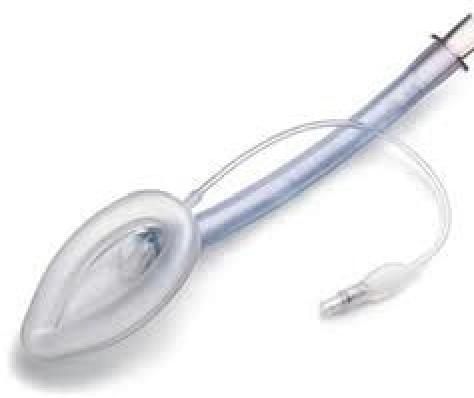
Laryngeal mask is contraindicated in all except?
What is the maximum oxygen concentration that can be attained using a Venturi mask?
During rapid induction of anesthesia, which of the following is true?
Sustained high inspiratory pressures during positive-pressure ventilation increase the risk of?
Atropine should never be administered when the patient is cyanosed due to the danger of:
Which of the following describes a time-sparing method of preoxygenation?
A 34-year-old unresponsive female is brought to the emergency department with no proper history. What is the next step in management?
What is the appropriate size of a tracheal tube for a newborn weighing 2.5 kg?
What is the ideal tidal volume in a patient ventilated for ARDS?
Which of the following parameters are adjusted to maintain optimum oxygenation?
Explanation: **Explanation:** The **Laryngeal Mask Airway (LMA)** is a supraglottic airway device (SAD) that sits above the glottis. The core concept tested here is the distinction between **absolute contraindications** (where the airway is physically obstructed or the lungs are unprotected) and **relative indications**. * **Why B is Correct:** **Ocular surgeries** are a common indication for LMA use. Unlike endotracheal intubation, LMA insertion and emergence are associated with minimal hemodynamic response and less coughing/bucking. This prevents sudden spikes in **intraocular pressure (IOP)**, which is critical in ophthalmic procedures. * **Why A is Incorrect:** **Oral tumors** can physically obstruct the placement of the LMA cuff or prevent a proper seal. Furthermore, they may distort the anatomy, making a supraglottic device unreliable. * **Why C is Incorrect:** **Massive maxillofacial injuries** often involve distorted upper airway anatomy, limited mouth opening (trismus), and significant bleeding/secretions. In such cases, a definitive airway (endotracheal tube) is required to prevent aspiration and bypass the trauma. * **Why D is Incorrect:** **High risk of aspiration** (e.g., full stomach, hiatal hernia, intestinal obstruction, morbid obesity) is a classic contraindication for standard LMAs. Because the LMA does not seal the trachea, it cannot protect the lungs from gastric contents. **High-Yield Clinical Pearls for NEET-PG:** * **Primary Indication:** Difficult airway management (cannot intubate, cannot ventilate) and short elective procedures. * **The "Gold Standard" for Aspiration Protection:** Cuffed Endotracheal Tube (ETT). * **LMA ProSeal:** A second-generation LMA that features a gastric drain tube, allowing for better protection against aspiration compared to the LMA Classic. * **Pressure Limit:** Keep cuff pressure **<60 cm H₂O** to avoid mucosal nerve injury (e.g., lingual or hypoglossal nerve palsy).
Explanation: **Explanation:** The **Venturi mask** is a high-flow oxygen delivery device that operates on the **Bernoulli principle** and the **Venturi effect**. It is designed to deliver a precise and constant inspired oxygen concentration ($FiO_2$) regardless of the patient's inspiratory flow rate. 1. **Why 60% is correct:** The Venturi mask works by passing 100% oxygen through a narrow orifice, which creates a vacuum that entrains a specific amount of room air through side ports. The final $FiO_2$ is determined by the size of the orifice and the air entrainment ports. Commercially available Venturi valves are color-coded to deliver specific concentrations: 24%, 28%, 31%, 35%, 40%, and a **maximum of 60%**. Beyond 60%, the ratio of air to oxygen becomes too low to maintain the "high-flow" characteristics required to meet the patient's total inspiratory demand. 2. **Why other options are incorrect:** * **90%–100% (Options A & B):** These concentrations can only be achieved using a **Non-Rebreather Mask (NRBM)** with a reservoir bag (up to 90-100%) or via mechanical ventilation/tight-fitting CPAP masks. * **80% (Option D):** This is typically achieved by a Partial Rebreather mask, not a Venturi system. **High-Yield Clinical Pearls for NEET-PG:** * **Device of Choice:** The Venturi mask is the gold standard for patients with **COPD** and Type II Respiratory Failure, as it prevents the suppression of the hypoxic respiratory drive by avoiding accidental over-oxygenation. * **Fixed Performance:** It is categorized as a "fixed performance device" because the delivered $FiO_2$ remains constant even if the patient's breathing pattern changes. * **Color Coding (High-Yield):** Blue (24%), White (28%), Orange (31%), Yellow (35%), Red (40%), and **Green (60%)**.
Explanation: **Explanation:** **Rapid Sequence Induction (RSI)** is a specialized technique used to secure the airway in patients at high risk of gastric aspiration (e.g., full stomach, intestinal obstruction, pregnancy). **Why Pre-oxygenation is Mandatory:** In RSI, the goal is to secure the airway as quickly as possible without manual ventilation to prevent gastric insufflation and subsequent aspiration. Since there is a period of apnea between the administration of the induction agent and intubation, **pre-oxygenation (denitrogenation)** is vital. It replaces the nitrogen in the Functional Residual Capacity (FRC) with oxygen, creating an "oxygen reservoir" that provides a safety margin of several minutes of apnea before desaturation occurs. **Analysis of Incorrect Options:** * **A. Sellick’s Maneuver (Cricoid Pressure):** Traditionally, this is a hallmark of RSI. It involves applying posterior pressure on the cricoid cartilage to occlude the esophagus and prevent regurgitation. While its routine use is currently debated, it is classically considered a standard component of the RSI protocol. * **C. Suxamethonium (Succinylcholine):** This is the **gold standard** muscle relaxant for RSI due to its rapid onset (30–60 seconds) and short duration. It is not contraindicated; rather, it is the drug of choice unless specific contraindications (like hyperkalemia or burns) exist. * **D. Mechanical Ventilation:** In classic RSI, positive pressure ventilation (bag-mask ventilation) is **avoided** after the patient loses consciousness to prevent air from entering the stomach, which increases the risk of vomiting and aspiration. **High-Yield Clinical Pearls for NEET-PG:** * **Rocunorium (1.2 mg/kg)** is the alternative of choice for RSI if Suxamethonium is contraindicated. * **The "No-Ventilation" Phase:** The time between induction and intubation is the most critical period where the patient is apneic. * **Positioning:** RSI is ideally performed in a slight head-up (reverse Trendelenburg) position to reduce the risk of passive regurgitation.
Explanation: **Explanation:** **1. Why Barotrauma is Correct:** Barotrauma refers to tissue damage resulting from pressure differences across a structure. In the context of positive-pressure ventilation (PPV), **sustained high inspiratory pressures** (specifically high Peak Inspiratory Pressure and Plateau Pressure) can lead to overdistension and rupture of the alveoli. This allows air to escape into extra-alveolar spaces, manifesting clinically as pulmonary interstitial emphysema, pneumothorax, pneumomediastinum, or subcutaneous emphysema. **2. Why Incorrect Options are Wrong:** * **Hypoventilation:** High inspiratory pressures are typically associated with *increased* tidal volumes or high airway resistance, not a decrease in minute ventilation. In fact, excessive pressure is often a byproduct of trying to overcome low compliance to *prevent* hypoventilation. * **Hypoxia:** While barotrauma can eventually lead to hypoxia (e.g., via a tension pneumothorax), high pressures are usually applied to *improve* oxygenation by recruiting alveoli. Therefore, hypoxia is a potential complication of the injury, but not the direct physiological result of the pressure itself. * **Hyperventilation:** This refers to an increase in alveolar ventilation leading to hypocapnia ($PaCO_2 < 35$ mmHg). While high pressures can result in large tidal volumes (volutrauma) that cause hyperventilation, the most direct and dangerous mechanical risk of high pressure is structural damage (barotrauma). **3. Clinical Pearls for NEET-PG:** * **Plateau Pressure ($P_{plat}$):** This is the most important parameter to monitor to prevent barotrauma. It should ideally be kept **$< 30$ cm $H_2O$**. * **Volutrauma vs. Barotrauma:** While barotrauma is pressure-related, **volutrauma** (damage from high tidal volumes) is now considered equally significant in causing Ventilator-Induced Lung Injury (VILI). * **Protective Lung Strategy:** To minimize these risks, the current standard is using low tidal volumes (6 mL/kg of predicted body weight). * **Be aware:** High intrathoracic pressure also decreases venous return, leading to **decreased cardiac output** and hypotension.
Explanation: **Explanation:** The administration of Atropine in a cyanosed patient is contraindicated due to the high risk of triggering fatal arrhythmias, specifically **Ventricular Fibrillation**, which leads to sudden cardiac collapse and subsequent **Respiratory Arrest**. **1. Why Respiratory Arrest is the correct answer:** Cyanosis indicates severe hypoxemia. In a hypoxic state, the myocardium becomes extremely irritable and sensitive to catecholamines and vagolytic agents. Atropine, being a parasympatholytic, increases the heart rate (tachycardia). When an oxygen-starved heart is suddenly forced to increase its workload and rate, it can trigger Ventricular Fibrillation (VF). Once VF occurs, cardiac output ceases, leading immediately to cessation of breathing (Respiratory Arrest). In the context of classical anesthesia teaching, the terminal event feared most following Atropine in hypoxia is the sudden stoppage of respiration following cardiac chaos. **2. Why other options are incorrect:** * **Cerebral Edema:** This is typically a result of chronic hypoxia, hypercapnia, or traumatic brain injury. While acute hypoxia can cause cellular swelling, it is not the immediate, acute danger associated with Atropine administration. * **Ventricular Fibrillation:** While VF is the *mechanism* that leads to the collapse, standard anesthesia textbooks (like Ajay Yadav or Miller) often emphasize the clinical outcome of **Respiratory Arrest** as the primary danger in this specific question context. (Note: In some clinical discussions, VF is considered the precursor, but Respiratory Arrest is the classic exam answer). **Clinical Pearls for NEET-PG:** * **Pre-oxygenation is Key:** Always ensure adequate oxygenation and ventilation (reversing cyanosis) before administering Atropine to treat bradycardia. * **Atropine in Pediatrics:** It is commonly used as a premedication in infants to prevent succinylcholine-induced or vagal-induced bradycardia, but only after ensuring the airway is secure. * **Rule of Thumb:** In a bradycardic, cyanosed patient, the first step is **100% Oxygen**, not Atropine.
Explanation: **Explanation:** Preoxygenation (denitrogenation) aims to replace the nitrogen in the functional residual capacity (FRC) with oxygen, creating an oxygen reservoir to delay desaturation during apnea. **Why Option A is Correct:** The standard method of preoxygenation is tidal volume breathing (TVB) of 100% oxygen for 3 minutes. However, in emergency or "time-sparing" scenarios, the **Four Vital Capacity (VC) breaths over 30 seconds** technique is used. This method utilizes deep, maximal inspirations to rapidly wash out nitrogen. Studies show that 4 VC breaths provide an arterial oxygen tension ($PaO_2$) comparable to 3 minutes of TVB, making it the gold-standard rapid technique for clinical practice. **Why Other Options are Incorrect:** * **Option B:** While eight VC breaths over 60 seconds provide a slightly higher margin of safety (longer time to desaturation) than four breaths, it is not the classic "time-sparing" definition taught for exams. Four breaths is the minimum threshold for rapid effectiveness. * **Option C:** Two VC breaths are insufficient to achieve adequate denitrogenation of the FRC, leaving the patient at risk for rapid desaturation during induction. **High-Yield Clinical Pearls for NEET-PG:** * **Goal:** To increase the "Duration of Apnea without Desaturation" (DAWD). * **The Reservoir:** The FRC acts as the primary oxygen store (approx. 2500 mL in adults). * **Efficacy:** 3 minutes of TVB is still superior to 4 VC breaths in terms of the duration of the "safety margin" before the $SpO_2$ drops below 90%. * **Special Populations:** In obese patients or pregnant women, FRC is decreased; therefore, preoxygenation is less effective and desaturation occurs much faster.
Explanation: ### Explanation This question follows the **Basic Life Support (BLS) algorithm** updated by the American Heart Association (AHA). In an emergency scenario involving an unresponsive patient, the sequence of actions is critical for survival. **Why Option A is Correct:** According to the BLS protocol, once a patient is found to be **unresponsive**, the next immediate step is to simultaneously **activate the emergency response system** and **check for a pulse and breathing**. In an adult, the **carotid pulse** is the preferred site. This check should take at least 5 seconds but no more than 10 seconds. This step is vital to differentiate between respiratory arrest (pulse present, no breathing) and cardiac arrest (no pulse, no breathing). **Why Other Options are Incorrect:** * **Option B (Check for responsiveness):** This has already been established in the question stem ("unresponsive female"). Repeating this step would delay life-saving interventions. * **Option C (Chest compressions):** Compressions are only initiated *after* confirming the absence of a pulse. Starting compressions on a patient with a perfusing rhythm can cause unnecessary complications. * **Option D (Shock 300 Joules):** Defibrillation is only indicated for specific "shockable" rhythms (VF/Pulseless VT) identified via an AED or ECG monitor. Furthermore, 300J is not the standard starting dose for modern biphasic defibrillators (usually 120–200J). **High-Yield Clinical Pearls for NEET-PG:** * **Sequence:** Unresponsiveness → Activate EMS → Pulse/Breathing check → CPR (if no pulse). * **Pulse Check Site:** Carotid in adults/children; **Brachial** in infants. * **Compression Depth:** 2 to 2.4 inches (5–6 cm) in adults. * **Compression Rate:** 100–120 per minute. * **Ratio:** 30:2 (1 or 2 rescuers) for adults; 15:2 for children/infants if 2 rescuers are present.
Explanation: The selection of an endotracheal tube (ETT) in neonates is primarily based on **gestational age and birth weight**, as the subglottic region (the narrowest part of the pediatric airway) must be protected from trauma while ensuring adequate ventilation. ### **Explanation of the Correct Answer** For a newborn weighing **2.5 kg**, the standard recommendation is a **3.0 mm ID (Internal Diameter)** uncuffed tube. * **The Rule of Thumb:** * <1 kg: 2.5 mm * 1–2 kg: 3.0 mm * >2 kg: 3.0 to 3.5 mm Since 2.5 kg falls into the healthy term/near-term category, 3.0 mm is the most appropriate starting size to avoid mucosal ischemia and post-extubation stridor. ### **Analysis of Incorrect Options** * **A. 2.0:** This size is too small for a 2.5 kg infant. It would significantly increase airway resistance and work of breathing. It is typically reserved for extremely premature neonates (<1 kg). * **C. 4.0:** This size is too large. It would likely cause trauma to the cricoid cartilage, leading to subglottic stenosis. A 4.0 mm tube is generally used for infants aged 6 months to 1 year. * **D. 5.0:** This size is appropriate for a child approximately 2–4 years old. ### **NEET-PG High-Yield Pearls** 1. **Formula for Paediatric ETT Size (Age >1 year):** * Uncuffed: $(Age / 4) + 4$ * Cuffed: $(Age / 4) + 3.5$ 2. **Depth of Insertion (Lip to Tip):** A quick bedside guide for neonates is **6 + weight in kg**. For this 2.5 kg baby, the depth would be ~8.5 cm. 3. **Narrowest Part of Airway:** In children, it is the **Cricoid Cartilage** (funnel-shaped airway), whereas in adults, it is the **Glottis/Vocal Cords** (cylindrical). 4. **Straight Blades (Miller):** Preferred in neonates because the epiglottis is long, stiff, and U-shaped (omega-shaped).
Explanation: The correct answer is **6 mL/kg (Option A)**. ### **Explanation** The primary goal in managing Acute Respiratory Distress Syndrome (ARDS) is **Lung Protective Ventilation (LPV)**. In ARDS, the lung is characterized as a "baby lung"—a significant portion of the alveoli are collapsed or fluid-filled, leaving only a small fraction of functional, aerated lung tissue. Using traditional tidal volumes (10–12 mL/kg) in these patients leads to **Volutrauma** (overdistension of alveoli) and **Biotrauma** (release of inflammatory mediators). The landmark **ARMA trial** by the ARDSNet group demonstrated that low tidal volume ventilation (**6 mL/kg of Predicted Body Weight**) significantly reduces mortality and increases ventilator-free days compared to traditional volumes. ### **Analysis of Incorrect Options** * **Option B (10 mL/kg):** This was the historical standard but is now known to cause barotrauma and volutrauma in ARDS patients, worsening lung injury. * **Options C & D (14–20 mL/kg):** These volumes are dangerously high and would lead to immediate pneumothorax or severe ventilator-associated lung injury (VALI). ### **High-Yield Clinical Pearls for NEET-PG** 1. **Predicted Body Weight (PBW):** Tidal volume must be calculated based on PBW (determined by height and sex), **not** actual body weight, because lung size does not increase with obesity. 2. **Plateau Pressure ($P_{plat}$):** The goal is to keep $P_{plat}$ **< 30 cm $H_2O$** to prevent alveolar rupture. 3. **Permissive Hypercapnia:** To maintain low tidal volumes, clinicians may allow $PaCO_2$ to rise and pH to drop (down to ~7.20), provided the patient tolerates it. 4. **PEEP:** High PEEP is used in ARDS to prevent **Atelectotrauma** (cyclic opening and closing of alveoli).
Explanation: In mechanical ventilation, it is crucial to distinguish between parameters that affect **oxygenation** (getting $O_2$ into the blood) and those that affect **ventilation** (removing $CO_2$ from the blood). ### Why PEEP and $FiO_2$ are Correct Oxygenation is primarily determined by the **Mean Airway Pressure (mPaw)** and the **Fraction of Inspired Oxygen ($FiO_2$)**. * **$FiO_2$:** Increasing the concentration of oxygen in the inspired gas directly increases the partial pressure of oxygen in the alveoli. * **PEEP (Positive End-Expiratory Pressure):** PEEP prevents alveolar collapse at the end of expiration (recruitment). This increases the functional residual capacity (FRC) and the surface area available for gas exchange, thereby improving oxygenation and reducing shunting. ### Why Other Options are Incorrect * **Tidal Volume (TV) and Respiratory Rate (RR):** These are the primary determinants of **Minute Ventilation** ($MV = TV \times RR$). Adjusting these parameters primarily affects the elimination of $CO_2$. Increasing them will lower $PaCO_2$ (causing respiratory alkalosis), but has a negligible direct effect on $PaO_2$. * **Options A, C, and D** are incorrect because they include at least one "ventilation" parameter (TV or RR) rather than focusing purely on "oxygenation" parameters. ### High-Yield Clinical Pearls for NEET-PG * **The "Oxygenation" Rule:** To improve $PaO_2$, increase $FiO_2$ or PEEP. * **The "Ventilation" Rule:** To decrease $PaCO_2$, increase Tidal Volume or Respiratory Rate. * **I:E Ratio:** Increasing the Inspiratory time (Inversed Ratio Ventilation) can also improve oxygenation by increasing the mean airway pressure. * **Toxicity Limit:** While increasing $FiO_2$ is the fastest way to improve oxygenation, $FiO_2 > 0.6$ for prolonged periods can lead to absorption atelectasis and free radical oxygen toxicity. Therefore, PEEP is often increased to allow for a reduction in $FiO_2$.
Respiratory Physiology
Practice Questions
Airway Anatomy
Practice Questions
Preoxygenation Techniques
Practice Questions
Mask Ventilation
Practice Questions
Supraglottic Airway Devices
Practice Questions
Direct Laryngoscopy
Practice Questions
Video Laryngoscopy
Practice Questions
Fiberoptic Intubation
Practice Questions
Surgical Airway Management
Practice Questions
One-Lung Ventilation Techniques
Practice Questions
Ventilation Strategies During Anesthesia
Practice Questions
Extubation Criteria and Techniques
Practice Questions
Get full access to all questions, explanations, and performance tracking.
Start For Free