Bradycardia is common after injection of:
A patient with chronic kidney disease on dialysis is posted for emergency laparotomy. Which of the following anesthetic agents is contraindicated in this patient?
What is the pin index code for nitrous oxide?
Which of the following drugs can be safely administered in patients with hepatic as well as renal failure?
Which of the following statements regarding the effect of neuromuscular blockers in patients with myasthenia gravis is FALSE?
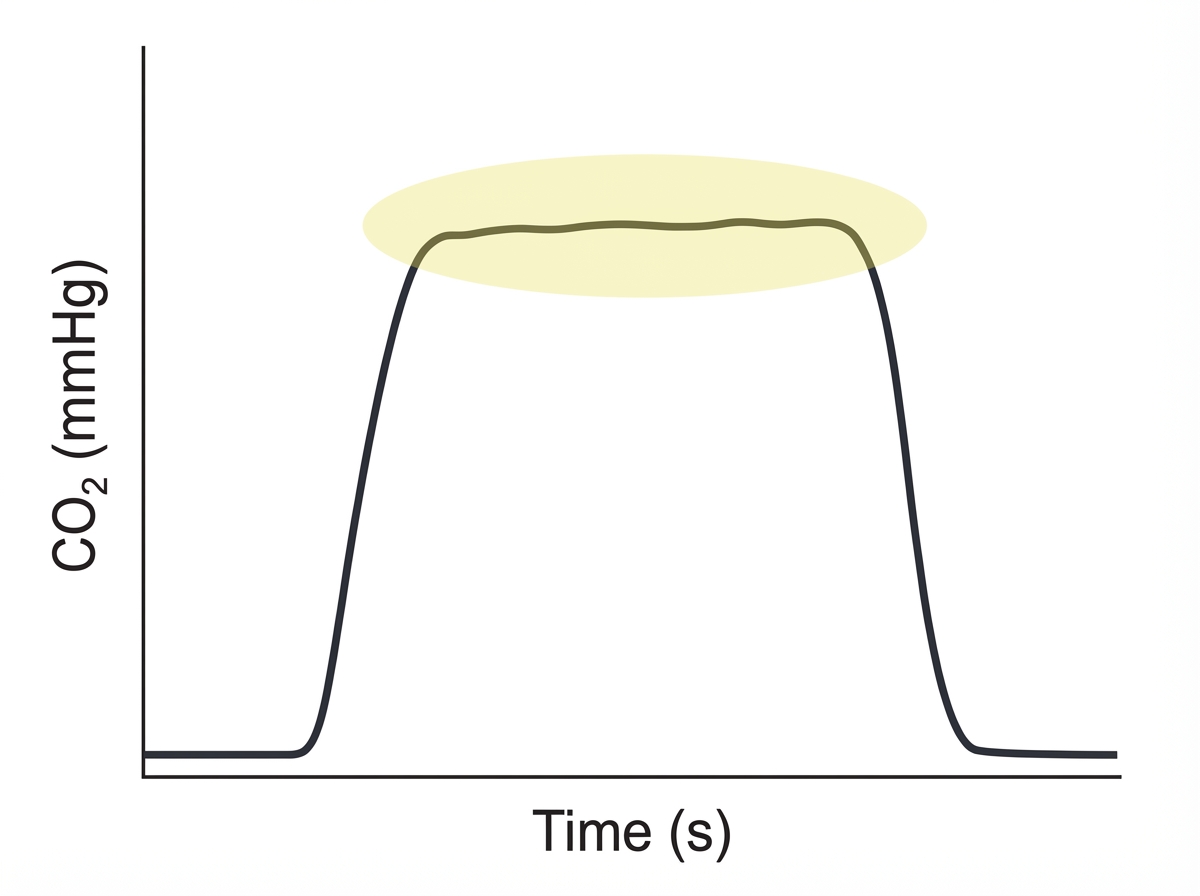
In which of the following conditions is a flat capnogram NOT seen?
What does the acronym AMBU stand for?
Central gas supplies may be located at all of the following places except?
Succinylcholine can cause which of the following electrolyte imbalances?
What is the recommended time gap between administrations in a train-of-four stimulation?
Explanation: **Explanation:** **Succinylcholine (Suxamethonium)** is a depolarizing neuromuscular blocker that is structurally composed of two joined molecules of acetylcholine. Its ability to cause bradycardia is rooted in its action on **muscarinic receptors** in the heart (specifically M2 receptors in the SA node). This effect is most pronounced in children (who have high vagal tone) or in adults following a second dose administered within 5 minutes of the first. **Analysis of Options:** * **Succinylcholine (Correct):** It mimics acetylcholine at cardiac muscarinic receptors, leading to sinus bradycardia, junctional rhythms, or even asystole. Pre-treatment with Atropine is often used in pediatrics to prevent this. * **Midazolam:** A benzodiazepine that typically causes minimal hemodynamic changes. It may cause a slight decrease in systemic vascular resistance but does not characteristically cause bradycardia. * **Dopamine:** A catecholamine that acts on $\beta_1$ receptors (increasing heart rate) and $\alpha_1$ receptors (vasoconstriction). It is used to treat bradycardia, not cause it. * **Isoprenaline:** A pure $\beta$-agonist ($\beta_1$ and $\beta_2$). It is a potent chronotrope used specifically to increase heart rate in cases of heart block or symptomatic bradycardia. **High-Yield Clinical Pearls for NEET-PG:** 1. **The "Second Dose" Phenomenon:** In adults, bradycardia is most common after the *second* dose of Succinylcholine due to sensitized muscarinic receptors. 2. **Hyperkalemia Risk:** Succinylcholine can increase serum potassium by 0.5 mEq/L; it is contraindicated in burns, crush injuries, and upper motor neuron lesions. 3. **Masseter Spasm:** It is a known trigger for Malignant Hyperthermia and can cause transient masseter muscle rigidity. 4. **Phase II Block:** Prolonged exposure or high doses can lead to a non-depolarizing-like block.
Explanation: **Explanation:** The correct answer is **Gallamine**. **1. Why Gallamine is the Correct Answer:** Gallamine is a long-acting non-depolarizing neuromuscular blocking agent that is **exclusively (100%) excreted by the kidneys** in an unchanged form. In patients with chronic kidney disease (CKD) or renal failure, the elimination of Gallamine is virtually non-existent, leading to prolonged neuromuscular blockade and "recurarization." Due to this absolute dependence on renal excretion, it is strictly contraindicated in patients with renal impairment. **2. Analysis of Incorrect Options:** * **d-Tubocurarine:** While it is primarily excreted by the kidneys (approx. 60-70%), it undergoes significant **biliary excretion** as an alternative pathway in renal failure. Thus, it is not strictly contraindicated, though it should be used with caution. * **Scoline (Succinylcholine):** It is metabolized by plasma pseudocholinesterase. While it can cause a transient rise in serum potassium (approx. 0.5 mEq/L), it is not contraindicated in CKD unless the patient is already **hyperkalemic** (K+ > 5.5 mEq/L). * **Halothane:** This is an inhalational anesthetic metabolized primarily by the liver (20%) and exhaled by the lungs. It does not depend on renal clearance and is not contraindicated in renal failure. **3. High-Yield Clinical Pearls for NEET-PG:** * **Drug of Choice (DOC):** **Atracurium** or **Cisatracurium** are the muscle relaxants of choice in renal failure because they undergo **Hofmann elimination** (organ-independent metabolism). * **Pancuronium & Decamethonium:** Like Gallamine, these are also primarily excreted by the kidneys and should be avoided. * **Vecuronium/Rocuronium:** These are mainly eliminated via the biliary system and are relatively safe in renal failure.
Explanation: ### Explanation The **Pin Index Safety System (PISS)** is a safety mechanism designed to prevent the accidental connection of the wrong gas cylinder to the anesthesia machine (Boyle’s apparatus). It consists of two pins on the yoke of the machine that must match specific holes on the valve of the cylinder. **Correct Option: C (3, 5)** The pin index for **Nitrous Oxide (N₂O)** is **3 and 5**. This configuration is unique to nitrous oxide cylinders, ensuring that this anesthetic gas cannot be mistakenly attached to an oxygen or medical air port. **Analysis of Incorrect Options:** * **A. 2, 5:** This is the pin index for **Oxygen (O₂)**. This is the most frequently tested code in NEET-PG, as oxygen is the most critical gas in anesthesia. * **B. 1, 5:** This is the pin index for **Medical Air**. Air is often used in modern anesthesia to reduce the concentration of inspired oxygen and prevent absorption atelectasis. * **D. 2, 6:** This is the pin index for **Entonox** (a 50:50 mixture of Oxygen and Nitrous Oxide), commonly used for labor analgesia and short procedures. **High-Yield Clinical Pearls for NEET-PG:** 1. **Carbon Dioxide (CO₂):** Pin index is **2, 6** (if >7%) or **1, 6** (if <7%). 2. **Cyclopropane:** Pin index is **3, 6**. 3. **Safety Logic:** The PISS is the "last line of defense" at the cylinder level, while the **Diameter Index Safety System (DISS)** prevents crossing of pipeline hoses. 4. **Color Coding:** Remember that in India (ISO standards), the N₂O cylinder is **Blue**, while the O₂ cylinder has a **Black body with a White shoulder**.
Explanation: **Explanation:** The correct answer is **Atracurium**. The primary reason it is safe in both hepatic and renal failure is its unique metabolism, which occurs independently of organ function. **1. Why Atracurium is correct:** Atracurium undergoes **Hofmann Elimination**, a spontaneous, non-enzymatic degradation that occurs at physiological pH and temperature. It also undergoes **ester hydrolysis** by non-specific plasma esterases. Because it does not rely on the liver for metabolism or the kidneys for excretion, its duration of action remains unchanged even in multi-organ failure. This makes it the "drug of choice" for muscle relaxation in patients with end-stage renal or liver disease. **2. Why other options are incorrect:** * **Vecuronium:** It is primarily metabolized by the liver (deacetylation) and excreted via bile (40-50%) and urine (20%). Its action is significantly prolonged in patients with hepatic dysfunction. * **Pancuronium:** It is a long-acting relaxant primarily excreted unchanged by the kidneys (80%). It is strictly contraindicated in renal failure due to the high risk of accumulation and prolonged paralysis. * **Mivacurium:** While it is metabolized by plasma cholinesterase (like succinylcholine), its metabolism is significantly slowed in liver disease due to decreased production of the cholinesterase enzyme, leading to a prolonged block. **Clinical Pearls for NEET-PG:** * **Laudanosine:** A major metabolite of Atracurium Hofmann elimination. It is a CNS stimulant that can lower the seizure threshold (though rarely clinical at standard doses). * **Cisatracurium:** An isomer of atracurium that also undergoes Hofmann elimination but produces less laudanosine and does not cause histamine release, making it even safer in clinical practice. * **Temperature/pH Dependency:** Hofmann elimination is slowed by hypothermia and acidosis, which can prolong the block of atracurium.
Explanation: **Explanation:** Myasthenia Gravis (MG) is an autoimmune disorder characterized by a decrease in the number of functional postsynaptic acetylcholine receptors (AChR) at the neuromuscular junction. This pathophysiology dictates the unique response of these patients to neuromuscular blockers (NMBs). **Why Option D is False (The Correct Answer):** While NMBs should be used judiciously, they are not strictly contraindicated. However, the statement regarding reversal is dangerously incorrect. Reversal agents like Neostigmine (anticholinesterases) must be used with extreme caution. Overdosing reversal agents can precipitate a **cholinergic crisis**, which mimics a myasthenic crisis by causing muscle weakness. Furthermore, many MG patients are already on pyridostigmine, which inhibits plasma cholinesterase, altering the metabolism of certain drugs. **Analysis of Other Options:** * **Option A (True):** Because there are fewer functional AChRs, a higher concentration of **Succinylcholine** (a depolarizing agent) is required to trigger depolarization. Thus, MG patients are **resistant** to its effects (ED95 is 2-3 times higher). * **Option B (True):** With fewer available receptors, even a small dose of a **non-depolarizing NMB** (e.g., Vecuronium, Rocuromium) can block a significant percentage of the remaining receptors, leading to extreme **sensitivity**. * **Option C (True):** Due to the unpredictable recovery and high risk of postoperative residual paralysis/respiratory failure, these patients often require mechanical ventilation until full strength is objectively confirmed. **NEET-PG High-Yield Pearls:** * **Succinylcholine:** Resistant (requires higher dose). * **Non-depolarizers:** Highly sensitive (use 1/10th to 1/20th of the normal dose). * **Sugammadex:** The preferred reversal agent for Aminosteroids (Roc/Vec) in MG as it avoids the side effects of anticholinesterases. * **Eaton-Lambert Syndrome:** Unlike MG, these patients are **sensitive to both** depolarizing and non-depolarizing NMBs.
Explanation: **Explanation:** The correct answer is **D (None of the above)** because all three conditions listed (Apnea, Complete laryngospasm, and Foreign body obstruction) result in a **flat capnogram**. **Underlying Concept:** Capnography measures the concentration of carbon dioxide ($CO_2$) in exhaled air. For a capnograph to show a waveform (the typical "top-hat" shape), there must be a continuous cycle of **ventilation** (movement of air out of the lungs) and **perfusion** (delivery of $CO_2$ to the lungs via blood). A flat line (zero $EtCO_2$) occurs when no $CO_2$ reaches the sensor, indicating a total failure of ventilation or a complete lack of pulmonary circulation. **Analysis of Options:** * **Apnea (Option A):** There is no respiratory effort or movement of air; hence, no $CO_2$ is exhaled. * **Complete Laryngospasm (Option B):** The vocal cords are fully closed, creating a total upper airway obstruction. Even if the patient makes respiratory efforts, no gas can pass the glottis to reach the $CO_2$ sensor. * **Foreign Body Obstruction (Option C):** If a foreign body completely occludes the upper airway, it prevents any exhaled gas from reaching the sampling port, resulting in a flat line. **Clinical Pearls for NEET-PG:** * **Sudden disappearance of $EtCO_2$:** Always rule out **circuit disconnection** (most common), accidental esophageal intubation, or total airway obstruction. * **Sudden drop to zero:** Can also indicate **cardiac arrest** (sudden loss of perfusion) or a massive pulmonary embolism. * **Curare Cleft:** A dip in the Phase III plateau indicating the patient is taking spontaneous breaths during mechanical ventilation (reversal of neuromuscular blockade). * **Shark-fin appearance:** Pathognomonic for **bronchospasm** (e.g., Asthma/COPD) due to prolonged expiratory upstroke.
Explanation: **Explanation:** The **AMBU bag**, technically known as a **Self-Inflating Resuscitator Bag**, is a fundamental tool in emergency medicine and anesthesiology. The acronym stands for **Artificial Manual Breathing Unit**. 1. **Why Option B is correct:** * **Artificial:** It provides ventilation to a patient who is not breathing or is breathing inadequately. * **Manual:** It requires the physical compression of the bag by a healthcare provider to deliver a tidal volume. * **Breathing Unit:** It functions as a portable system to maintain oxygenation and ventilation. 2. **Why other options are incorrect:** * **Automated (Options A & D):** AMBU bags are strictly manual. Automated ventilation refers to mechanical ventilators or transport ventilators. * **Mechanical (Options C & D):** While the bag has a mechanical valve system (like the non-rebreathing valve), the term "Mechanical" in respiratory medicine usually implies a machine-driven process (IPPV) rather than hand-held manual resuscitation. **Clinical Pearls for NEET-PG:** * **Components:** It consists of a self-expanding bag, a one-way non-rebreathing valve (to prevent rebreathing of exhaled CO2), and an oxygen reservoir. * **Oxygen Concentration:** Without a reservoir, it delivers ~40% O2. With an oxygen reservoir and 15L/min flow, it can deliver **90-100% FiO2**. * **Safety Feature:** Most pediatric AMBU bags include a **Pressure Release Valve (Pop-off valve)** set at **35-40 cm H2O** to prevent barotrauma. * **History:** It was developed by Holger Hesse and Henning Ruben in 1956.
Explanation: **Explanation:** The central gas supply system (Medical Gas Pipeline System - MGPS) is the backbone of gas delivery in a hospital. According to safety standards (such as HTM 02-01 and NFPA 99), the primary source of gas—whether it be a manifold room, liquid oxygen vacuum insulated evaporator (VIE), or medical air compressor—must be located in a **dedicated, secure, and isolated area.** **Why Option D is Correct:** Central gas supplies are **never** located inside the Operating Theatre (OT), regardless of whether the area is sterile or non-sterile. This is due to significant safety risks, including: * **Fire Hazard:** High concentrations of oxidizing gases (Oxygen/Nitrous Oxide) increase the risk of combustion. * **Noise and Heat:** Compressors and manifolds generate significant noise and heat, which interfere with the surgical environment. * **Logistics:** Replacing heavy cylinders or maintaining bulk tanks requires frequent access by technical staff, which would breach the zoning and infection control protocols of the OT suite. **Analysis of Incorrect Options:** * **Option A & C:** These are the standard requirements. Gas manifolds must be kept in a **specialized room or enclosure** that is well-ventilated, fire-resistant, and kept locked to prevent unauthorized access. * **Option B:** Large-scale storage, such as Liquid Oxygen (VIE) tanks, is almost always located **outdoors** due to the risk of pressure buildup and the need for easy access by supply tankers. **High-Yield Clinical Pearls for NEET-PG:** * **Color Coding:** Oxygen (White/Green), Nitrous Oxide (Blue), Medical Air (Yellow/Black & White), Vacuum (Yellow/White). * **Pressure:** The working pressure of the pipeline system is typically **4.1 bar (60 psi)**. * **Safety Systems:** The **Pin Index Safety System (PISS)** prevents wrong cylinder attachment to the machine, while the **Diameter Index Safety System (DISS)** prevents wrong pipeline connections. * **Reserve:** A manifold room usually contains two banks of cylinders (Duty and Standby) to ensure an uninterrupted supply.
Explanation: **Explanation:** **Succinylcholine** is a depolarizing neuromuscular blocking agent that acts as an agonist at the nicotinic acetylcholine receptors (nAChR) at the motor endplate. **Why Hyperkalemia occurs (The Correct Answer):** When Succinylcholine binds to the nAChR, it causes prolonged depolarization of the muscle membrane. This process opens ion channels, allowing sodium to flow into the cell and **potassium to flow out of the muscle cell into the extracellular fluid (ECF)**. In a healthy individual, this typically results in a transient, modest rise in serum potassium levels (approximately **0.5 mEq/L**). However, in certain pathological states (e.g., burns, massive trauma, or denervation injuries), there is an "upregulation" of extrajunctional receptors, leading to an exaggerated release of potassium that can cause life-threatening cardiac arrhythmias. **Why other options are incorrect:** * **Hypokalemia:** Succinylcholine causes the efflux of potassium from cells, which increases serum levels. It does not cause potassium to move into cells or increase its excretion, so hypokalemia is not a side effect. * **Both/None:** Since the mechanism specifically facilitates potassium release into the bloodstream, the effect is unidirectional toward hyperkalemia. **High-Yield Clinical Pearls for NEET-PG:** * **The "0.5 Rule":** Expect a 0.5 mEq/L rise in serum $K^+$ in normal patients. * **Contraindications:** Avoid Succinylcholine in patients with **major burns (>24-48 hours old)**, crush injuries, spinal cord injuries (paraplegia/quadriplegia), and muscular dystrophies (due to risk of rhabdomyolysis). * **Other Side Effects:** Fasciculations, muscle pain (myalgia), increased intraocular pressure, increased intracranial pressure, and it is a known trigger for **Malignant Hyperthermia**.
Explanation: **Explanation:** The correct answer is **None of the above** because the standard recommended time gap between two Train-of-Four (TOF) stimulations is **10 to 12 seconds**. **1. Understanding the Concept:** Train-of-Four (TOF) stimulation involves delivering four supramaximal impulses at a frequency of 2 Hz (0.5 seconds apart). This stimulation causes a depletion of the "immediately available" pool of acetylcholine (ACh) at the neuromuscular junction. If the test is repeated too quickly, the ACh stores do not have sufficient time to replenish, leading to a false "fade" or an inaccurate TOF ratio. To ensure the reliability of the monitoring and allow for neurotransmitter resynthesis/mobilization, a refractory period of at least **10–12 seconds** is required. **2. Analysis of Options:** * **Option A (10 seconds):** While 10 seconds is often cited as the minimum interval, the standard clinical recommendation in major textbooks (like Miller’s Anesthesia) is specifically **10 to 12 seconds**. Since "10 seconds" is only the lower limit and "None of the above" is an option, the latter is technically more accurate in a competitive exam context. * **Options B & C (20 and 40 seconds):** These intervals are unnecessarily long for TOF. However, they are relevant for other modes; for example, **Tetany (50 Hz)** requires a much longer recovery period (at least 1–2 minutes) because it causes massive ACh depletion. **3. High-Yield Clinical Pearls for NEET-PG:** * **Frequency:** TOF uses 2 Hz; Tetany uses 50–100 Hz. * **TOF Ratio:** Calculated as the height of the 4th twitch (T4) divided by the 1st twitch (T1). * **Clinical Significance:** A TOF ratio of **>0.9** is required at the adductor pollicis before safe tracheal extubation. * **Double Burst Stimulation (DBS):** Developed to be more sensitive than TOF for detecting residual neuromuscular blockade manually.
Anesthesia Machine Components
Practice Questions
Breathing Systems
Practice Questions
Vaporizers
Practice Questions
Gas Cylinders and Pipeline Supply
Practice Questions
Anesthesia Ventilators
Practice Questions
Standard Monitoring: ECG, BP, Pulse Oximetry
Practice Questions
Capnography
Practice Questions
Neuromuscular Monitoring
Practice Questions
Temperature Monitoring
Practice Questions
Invasive Hemodynamic Monitoring
Practice Questions
Equipment Troubleshooting
Practice Questions
Safety Features in Modern Anesthesia Equipment
Practice Questions
Get full access to all questions, explanations, and performance tracking.
Start For Free