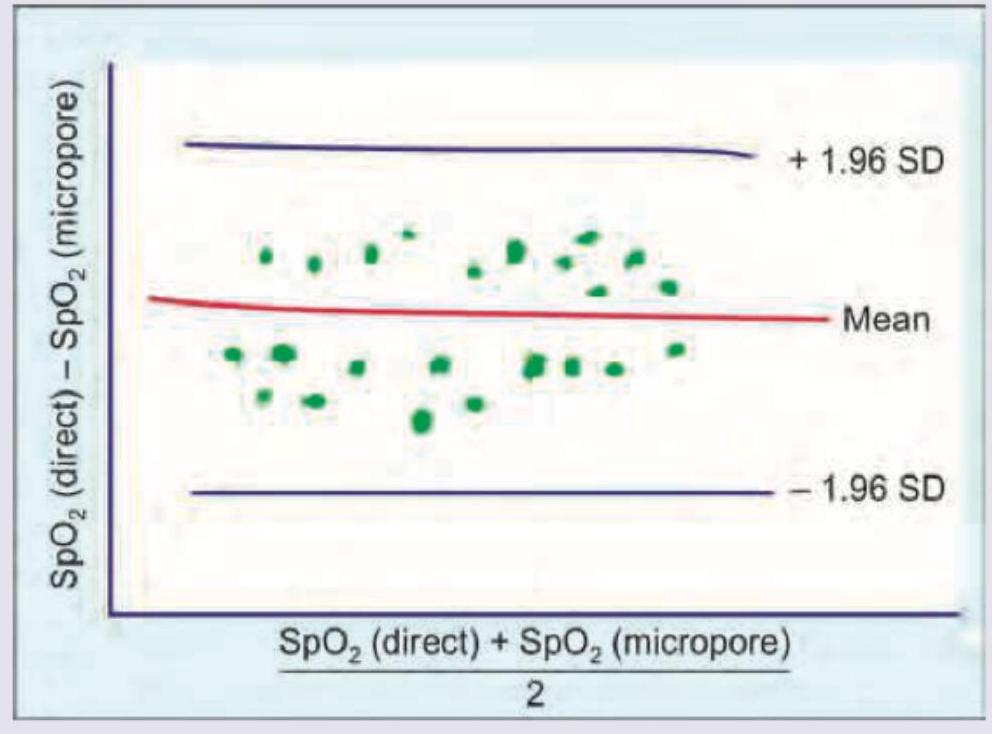
In comparison of pulse oximeter reading in neonates with and without micropore, which of the following is true about the plot shown below?
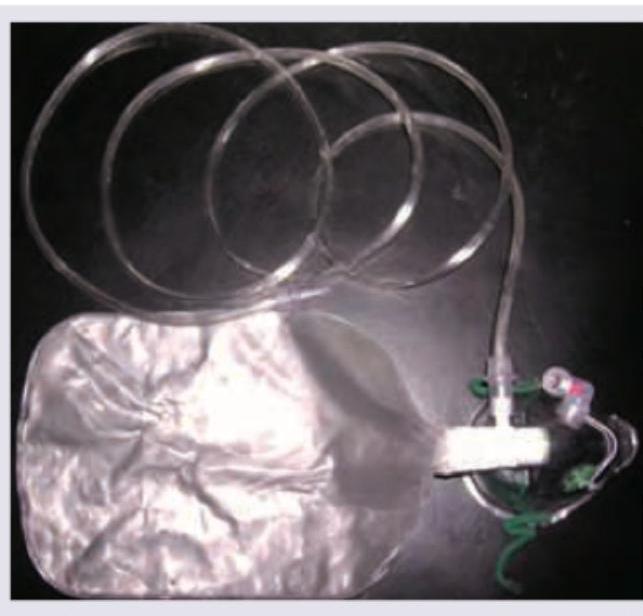
The image shows:
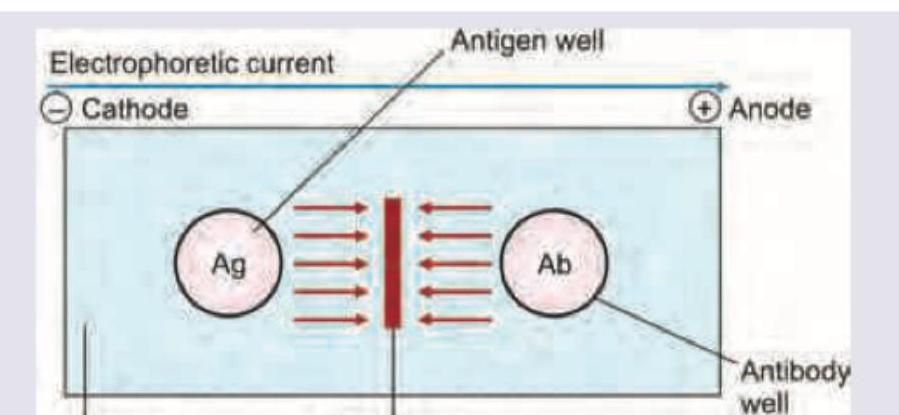
The image shows:
A pulmonary artery (Swan-Ganz) catheter measures all of the following except
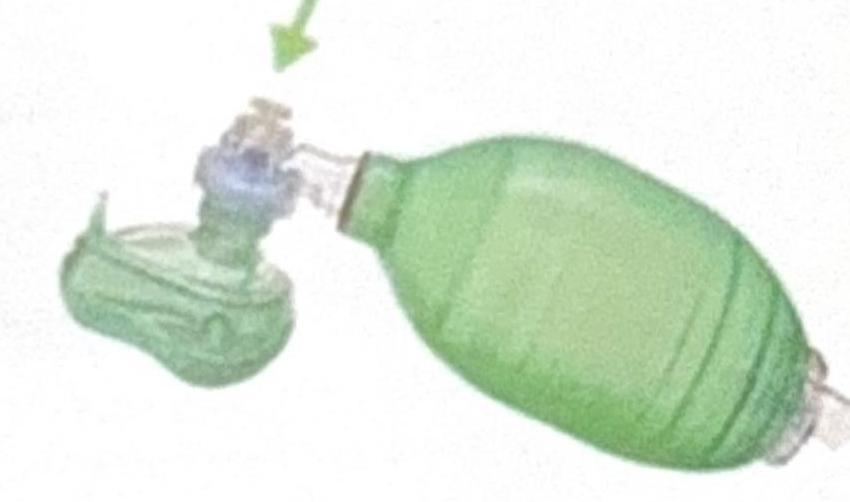
What is the pressure required to open the device shown in the image?
Which of the following is the best method to assess the degree of muscle relaxation?
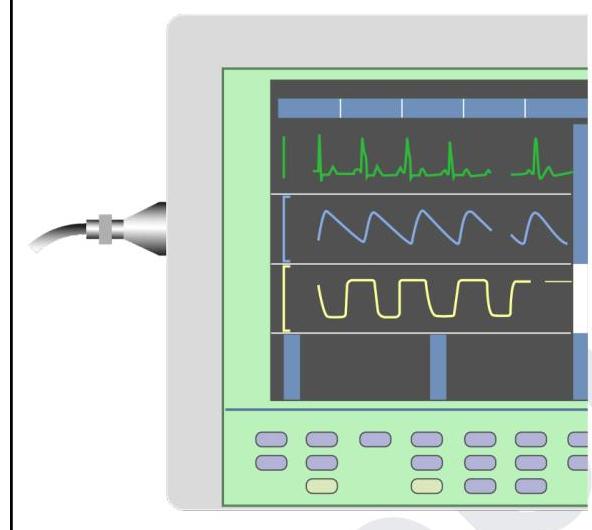
You are in the operating room and notice the tracing in yellow colour on this device. What does it indicate?
What is the color of the nitrous oxide cylinder?
Which of the following inhalational anaesthetic agent can cause hepatitis on repeated use?
In which of the following carbon dioxide absorbents is water used for hardening?
Explanation: ***Bland Altman plot*** - This plot is used to **assess agreement between two different methods of measurement** by plotting the difference between the two measurements against their average. - The plot displays the **mean difference** (red line) and **limits of agreement** (+/- 1.96 standard deviation, blue lines), indicating how well the two SpO2 measurements agree. *Funnel plot* - A funnel plot is primarily used in **meta-analyses** to check for publication bias or small study effects. - It plots the **effect size** from individual studies against a measure of their precision (e.g., standard error). *Forest plot* - A forest plot is used in **meta-analyses** to graphically present the results of individual studies included in the review, along with the overall summary effect. - It typically shows the **effect estimate and confidence interval** for each study, and a diamond representing the pooled estimate. *Kaplan Meier plot* - This plot is used to estimate the **survival function** from lifetime data, showing the probability of an event (e.g., death, disease recurrence) occurring over time. - It is commonly used in **clinical trials** to compare survival rates between different treatment groups.
Explanation: ***Counter immunoelectrophoresis*** - The image clearly depicts an **electrophoretic current** driving antigen (Ag) and antibody (Ab) towards each other in an agar medium to form a **precipitin line**. This is characteristic of counter immunoelectrophoresis. - In this method, the **antigen migrates toward the anode** and the **antibody migrates toward the cathode**, facilitating their meeting and precipitation. *Radial immunodiffusion* - This technique involves **antibodies uniformly dispersed in an agar gel**, and antigen is added to a well, diffusing radially to form a precipitin ring, which is not what is shown. - It does not utilize an **electric current** to accelerate the diffusion of reactants. *Double diffusion in two dimensions* - Also known as **Ouchterlony technique**, this method involves antigen and antibody diffusing independently from separate wells in an agar gel without the aid of an electric field. - The formation of precipitin lines occurs where the optimal concentrations of antigen and antibody meet, but no **electrophoresis** is involved. *Rocket electrophoresis* - Involves an **antibody uniformly distributed** in an agar gel, and antigen samples are placed in wells. An electric charge pulls the antigen through the antibody-containing gel, forming a **rocket-shaped precipitin peak**. - While it uses electrophoresis, the pattern of migration and **precipitin line formation** differs significantly from the diagram, which shows reactants moving towards each other.
Explanation: ***Rebreathing mask*** - The image clearly displays a **reservoir bag** and **oxygen tubing** attached to a mask-like structure, characteristic of a rebreathing mask used for oxygen delivery. - This device is designed to deliver high concentrations of oxygen, with or without partial rebreathing of exhaled air, depending on the type (partial or non-rebreather). *Nebulizer* - A nebulizer typically includes a **medication cup** and generates a **fine mist** for inhalation, which is not visible here. - While it uses tubing and can have a mask, the prominent reservoir bag is not a feature of a standard nebulizer. *AMBU Bag* - An **AMBU bag (Ambulatory Manual Bag Unit)** is a self-inflating bag resuscitator used for manual ventilation, characterized by a large, squeezable bag, an oxygen inlet, and a one-way valve for positive pressure ventilation. - The device in the image lacks the large, squeezable bag for manual ventilation and the specific valve system of an AMBU bag. *PEFR meter* - A **Peak Expiratory Flow Rate (PEFR) meter** is a small, handheld device used to measure how fast air is exhaled from the lungs. - It does not involve a reservoir bag or oxygen tubing and looks significantly different from the device pictured.
Explanation: ***Left ventricular end diastolic volume (LVEDV)*** - While a Swan-Ganz catheter can measure **pulmonary artery wedge pressure (PAWP)**, which is a surrogate for **left ventricular end-diastolic pressure (LVEDP)**, it cannot directly measure **left ventricular end-diastolic volume (LVEDV)**. - LVEDV requires imaging techniques like **echocardiography** or **cardiac MRI** for direct measurement. *Pulmonary artery wedge pressure (PAWP)* - The Swan-Ganz catheter can measure **PAWP**, which reflects **left atrial pressure** and, in the absence of mitral valve disease, - Is an estimate of **left ventricular end-diastolic pressure (LVEDP)**, therefore assessing left ventricular preload. *Mixed venous oxygen saturation (SvO2)* - The catheter has a fiberoptic sensor that can continuously measure **SvO2** from the pulmonary artery. - **SvO2** provides an assessment of the balance between oxygen supply and demand. *Cardiac output (CO)* - **Cardiac output** is commonly measured using the **thermodilution method** via the Swan-Ganz catheter. - A bolus of saline is injected into the right atrium, and temperature changes are detected in the pulmonary artery to calculate flow.
Explanation: ***30–40 cm H₂O*** - This pressure range is generally required to open the **Pop-Off Valve** (Pressure Relief Valve) in an Ambu bag (Bag-Valve-Mask) to prevent **barotrauma** to the patient's lungs. - The Pop-Off Valve is a safety feature that vents excess pressure to minimize the risk of **pneumothorax** or other lung injuries during manual ventilation. *10–20 cm H₂O* - This pressure range is typically within the normal ventilatory pressure used for gently inflating the lungs, not specifically for opening the **safety valve**. - While it's a safe pressure for ventilation, it's usually too low to activate the **overpressure relief mechanism** of the Pop-Off Valve. *10–20 mm H₂O* - This unit of millimeters of water (mm H₂O) is incorrect for standard ventilatory pressure measurements in this context; centimeters of water (cm H₂O) is the standard. - Furthermore, the magnitude is too low to represent the pressure required to open a **safety release valve** on a BVM. *30–40 mm H₂O* - Similar to the previous option, the unit of **millimeters of water (mm H₂O)** is not the standard measurement for this type of pressure in respiratory care. - While the numeric value is appropriate for safety valve activation, the ** गलत इकाई ** (wrong unit) makes this option incorrect.
Explanation: ***Train of four*** - **Train of four (TOF)** is the most common and reliable method for monitoring the depth of neuromuscular blockade. - It involves delivering four sequential supramaximal electrical stimuli to a peripheral nerve, typically the ulnar nerve, and measuring the resulting muscle twitches. The **TOF ratio** (amplitude of the fourth twitch divided by the first) indicates the degree of relaxation. *Electromyography* - **Electromyography (EMG)** measures the electrical activity of muscles at rest and during contraction, which is useful for diagnosing neuromuscular disorders. - While it measures muscle activity, it is not optimized for continuous, real-time assessment of drug-induced neuromuscular blockade during surgery. *Tetanic Stimulation* - **Tetanic stimulation** involves delivering a high-frequency, continuous electrical stimulus to a peripheral nerve, producing sustained muscle contraction (tetanus). - It is used to assess profound neuromuscular blockade but is less practical for routine monitoring of relaxation depth as it can cause patient discomfort and post-tetanic facilitation, making it less precise for quantifying recovery. *Double burst stimulation* - **Double burst stimulation (DBS)** applies two short bursts of electrical stimuli, separated by a brief interval, and is used to detect residual blockade when the TOF ratio is difficult to assess visually. - While useful for detecting slight residual paralysis, it is not the primary or best method for assessing the *degree* of blockade throughout its entire duration, as it primarily confirms effective recovery rather than quantifying the entire spectrum of relaxation.
Explanation: ***Capnography*** - The yellow tracing displays a waveform that is characteristic of a **capnogram**, which measures the concentration of **carbon dioxide (CO2)** in the expired breath over time. - The rectangular shape with a sudden rise, plateau, and rapid fall is typical of the **CO2 waveform** during a respiratory cycle. *O2 pressure in exhaled air* - While oxygen levels can be monitored, the characteristic waveform shown with its distinct plateau phase is specific to **carbon dioxide** measurement. - Oxygen monitoring provides different types of waveforms or numerical values, such as **pulsus oximetry**, which shows oxygen saturation. *O2 pressure in inhaled air* - Monitoring devices typically display **inspired oxygen concentration (FiO2)** as a numerical value rather than a waveform. - The waveform shown is indicative of gas exchange dynamics during **exhalation**, not inhalation. *Airway pressure* - Airway pressure tracings typically show a waveform that correlates with the **inspiratory and expiratory phases** of breathing, indicating the pressure within the airway. - However, the specific shape and plateau of the waveform in yellow are distinct from typical **airway pressure** curves and are characteristic of CO2.
Explanation: ***Blue*** - According to international color coding for medical gas cylinders, **nitrous oxide (N2O)** cylinders are uniformly colored **blue**. - This color coding helps in distinguishing different medical gases to prevent errors in healthcare settings. *Black* - **Black** is generally the color code for **nitrogen** cylinders in medical gas systems. - This color is distinct from nitrous oxide to avoid confusion during gas administration. *Blue body with white shoulder* - While cylinders have specific body and shoulder colors, a **blue body with a white shoulder** is typically associated with **medical air** in some regions, not nitrous oxide. - Nitrous oxide cylinders are completely blue. *White* - **White** is the color code for **oxygen** cylinders in some international and regional standards, though green is also common, depending on the country. - This color is not used for nitrous oxide cylinders.
Explanation: ***Halothane*** - Halothane is known to cause **halothane hepatitis** (also known as halothane-induced liver injury), a rare but severe form of liver damage, particularly on **repeated exposure**. - This is due to the **metabolism of halothane** in the liver, which can produce reactive intermediates that lead to immune-mediated liver cell necrosis. *Sevoflurane* - Sevoflurane is generally considered to have a **low incidence of liver toxicity** and is preferred in patients with pre-existing liver disease. - While it can be metabolized to fluoride ions, the clinical significance of this in terms of liver damage is considered to be minimal compared to halothane. *Ether* - **Diethlyl ether** is an older anesthetic agent that is no longer commonly used due to its flammability and slower induction/recovery times. - While it can cause some hepatic dysfunction, it is not primarily associated with the severe, immune-mediated hepatitis seen with halothane. *Isoflurane* - Isoflurane is an ether-based anesthetic with a much **lower metabolism** rate than halothane. - This reduced metabolism contributes to its **lower potential for liver toxicity** compared to halothane, making it a safer option for patients with liver concerns.
Explanation: ***None of the options*** - **Water** is not specifically used for "hardening" of carbon dioxide absorbents. Instead, water is a critical component in the **chemical reaction** that allows absorbents like sodalime and baralime to neutralize CO2. - The absorbents are manufactured with a specific water content (typically 15-20%) that is essential for their functionality and prevents them from drying out, which would reduce their efficiency and potentially produce harmful compounds. *Sodalime* - **Sodalime** is a mixture of calcium hydroxide, sodium hydroxide, and a small amount of potassium hydroxide, containing 15-20% **water**. - While water is crucial for its CO2 absorption capacity, it is not used as a hardening agent in the manufacturing process; binders are used for granule formation. *Baralime* - **Baralime** primarily consists of barium hydroxide and calcium hydroxide, also requiring a specific **water content** for its CO2 absorption reaction. - Similar to sodalime, water is vital for its chemical function, but other agents are used for its structural integrity, not water for hardening. *Both* - As explained above, neither **sodalime** nor **baralime** uses water specifically for "hardening" purposes in their manufacturing. - Water is a necessary component for the **chemical reaction** with CO2, but it does not serve as a hardening agent in their production process.
Anesthesia Machine Components
Practice Questions
Breathing Systems
Practice Questions
Vaporizers
Practice Questions
Gas Cylinders and Pipeline Supply
Practice Questions
Anesthesia Ventilators
Practice Questions
Standard Monitoring: ECG, BP, Pulse Oximetry
Practice Questions
Capnography
Practice Questions
Neuromuscular Monitoring
Practice Questions
Temperature Monitoring
Practice Questions
Invasive Hemodynamic Monitoring
Practice Questions
Equipment Troubleshooting
Practice Questions
Safety Features in Modern Anesthesia Equipment
Practice Questions
Get full access to all questions, explanations, and performance tracking.
Start For Free