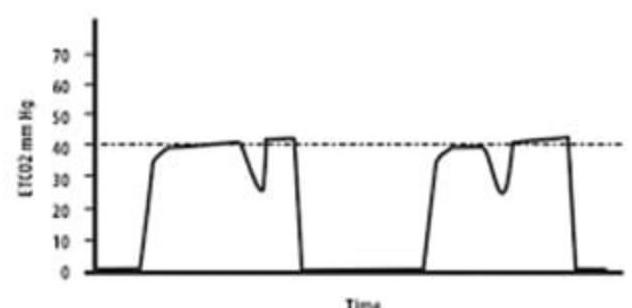
The names Brechner and Bethune are associated with which of the following devices?
A 74-year-old man with a history of myocardial infarction 3 years prior underwent elective repair of an abdominal aortic aneurysm. On the first postoperative day in the ICU, he is hypotensive and receiving dobutamine. What is the best method of physiologic monitoring necessary for this patient?
Laudanosine is a metabolic end product of which of the following medications?
Dexmedetomidine is:
What is the drug of choice for reversal of neuromuscular blockade by vecuronium?
Which muscle relaxant is exclusively excreted by the kidney?
In Magill circuit, airflow is related to minute volume by which ratio?
True regarding the Ruben's valve?
What is true regarding rotameters?
During general anesthesia, which nerve is commonly monitored using a nerve stimulator to assess neuromuscular blockade?
Explanation: **Explanation:** The correct answer is **End-tidal capnography (D)**. **Brechner and Bethune** are historical figures associated with the development and clinical application of capnography. **Brechner** (1962) was among the first to describe the use of infrared analyzers for continuous monitoring of CO2 in expired air during anesthesia. **Bethune** (1967) further refined the clinical utility of the capnograph, emphasizing its role in detecting circuit disconnections and accidental esophageal intubations. **Analysis of Incorrect Options:** * **A. Precordial Doppler:** This is the most sensitive non-invasive monitor for detecting **Venous Air Embolism (VAE)**. It is typically placed over the right atrium (2nd–6th intercostal space). * **B. Transesophageal Echocardiography (TEE):** This is the **gold standard** (most sensitive overall) for detecting VAE and assessing real-time cardiac function, but it is invasive. * **C. Plethysmography:** This refers to the measurement of volume changes in an organ or the whole body. In anesthesia, it is most commonly associated with the **Pulse Oximeter** (photoplethysmography). **High-Yield Clinical Pearls for NEET-PG:** * **Gold Standard for ETT Placement:** Capnography is the most reliable method to confirm endotracheal tube position. * **Sudden drop in EtCO2:** This is a critical sign of **Pulmonary Embolism** (due to increased dead space) or **Cardiac Arrest** (due to decreased cardiac output). * **Curare Cleft:** A notch in the Phase III (alveolar plateau) of the capnograph indicating that the patient is making spontaneous respiratory efforts against a muscle relaxant. * **Shark-fin appearance:** Pathognomonic for obstructive lung diseases like **Asthma or COPD**.
Explanation: ### Explanation **Why Pulmonary Artery Catheterization (PAC) is Correct:** The patient is a high-risk surgical case (post-AAA repair) with significant cardiac history (previous MI) and is currently in **cardiogenic or distributive shock** (hypotensive and requiring inotropic support with dobutamine). In such complex scenarios, PAC (Swan-Ganz catheter) is the gold standard for hemodynamic monitoring. It provides critical data including **Pulmonary Artery Wedge Pressure (PAWP)**, **Cardiac Output (CO)**, and **Systemic Vascular Resistance (SVR)**. This allows the clinician to differentiate between hypovolemia, heart failure, or vasodilation and titrate dobutamine and fluid therapy precisely. **Why the Other Options are Incorrect:** * **A. Central Venous Catheterization:** While it measures Central Venous Pressure (CVP), CVP only reflects right-sided heart pressures. In a patient with a history of MI and major vascular surgery, CVP is a poor predictor of left ventricular filling and fluid responsiveness. * **C. Blood-gas Monitoring:** While ABGs are essential for assessing acid-base status and oxygenation, they do not provide the continuous hemodynamic data (like CO or SVR) needed to manage hypotension in a patient on inotropes. * **D. Intracranial Pressure Monitoring:** This is indicated for neurosurgical emergencies or traumatic brain injury, not for post-AAA repair hemodynamic instability. **High-Yield Clinical Pearls for NEET-PG:** * **Indications for PAC:** Severe LV dysfunction, valvular heart disease, major vascular surgery (AAA), and complicated shock. * **PAWP vs. CVP:** PAWP is a more accurate reflection of Left Ventricular End-Diastolic Volume (LVEDV) than CVP. * **Dobutamine:** A synthetic catecholamine that acts primarily on $\beta_1$ receptors (increasing contractility) with mild $\beta_2$ effects (vasodilation). PAC is ideal to monitor the resulting increase in Cardiac Index. * **West Zones:** For accurate PAWP readings, the PAC tip must be in **Zone 3** of the lung (where arterial > venous > alveolar pressure).
Explanation: **Explanation:** **Atracurium** is a benzylisoquinolinium neuromuscular blocking agent that undergoes a unique form of spontaneous degradation known as **Hofmann elimination** (a non-enzymatic, pH and temperature-dependent process) and ester hydrolysis. **Laudanosine** is the primary tertiary amine metabolite produced during this breakdown. **Why the correct answer is right:** * **Atracurium (and Cisatracurium):** Both drugs produce laudanosine. Because laudanosine is metabolized by the liver and excreted in the urine, its levels can rise during prolonged infusions. * **Clinical Significance:** Laudanosine is a known **CNS stimulant**. At high concentrations, it can cross the blood-brain barrier and potentially lower the seizure threshold, leading to **convulsions** (though this is rare at standard clinical doses). **Why the other options are wrong:** * **Mivacurium:** It is primarily metabolized by **plasma cholinesterase** (pseudocholinesterase), similar to succinylcholine, and does not produce laudanosine. * **Doxacurium:** A long-acting benzylisoquinolinium that is primarily excreted unchanged in the urine and bile. * **Rocuronium:** An amino-steroid compound. It is not metabolized into laudanosine; it is primarily eliminated unchanged by the liver (70%) and kidneys. **High-Yield Clinical Pearls for NEET-PG:** * **Hofmann Elimination:** Is ideal for patients with **renal or hepatic failure** because the drug clears independently of these organs. * **Cisatracurium:** It is an isomer of atracurium. It is more potent, produces **less laudanosine** than atracurium, and does not cause histamine release. * **Temperature/pH:** Hofmann elimination is slowed by acidosis and hypothermia, prolonging the drug's duration of action.
Explanation: **Explanation:** **Dexmedetomidine** is a highly selective **alpha-2 ($\alpha_2$) adrenergic agonist**. It is considered an agent of choice for **conscious sedation** (procedural sedation) because it provides "cooperative sedation"—patients appear to be in a sleep-like state but are easily rousable and can follow commands without significant respiratory depression. * **Why Option B is correct:** Its unique ability to produce sedation via the *locus coeruleus* and analgesia via the spinal cord, while sparing the respiratory drive, makes it ideal for fiberoptic intubation and ICU sedation. * **Why Option A is incorrect:** Dexmedetomidine is an **agonist**, not an antagonist. It stimulates $\alpha_2$ receptors to inhibit the release of norepinephrine. * **Why Option C is incorrect:** Dexmedetomidine is **8 times more selective** for $\alpha_2$ receptors than clonidine ($\alpha_2:\alpha_1$ ratio of 1600:1 for dexmedetomidine vs. 200:1 for clonidine). * **Why Option D is incorrect:** While it has opioid-sparing effects and provides mild visceral analgesia, it is **not** classified as a "good" or potent analgesic on its own compared to opioids or NSAIDs. Its primary clinical utility is sedation. **High-Yield Clinical Pearls for NEET-PG:** * **Mechanism:** Selective $\alpha_2$ agonist acting on the **Locus Coeruleus** (sedation) and **Dorsal Horn** of the spinal cord (analgesia). * **Side Effects:** Most common are **Bradycardia** and **Hypotension** (due to decreased sympathetic outflow). * **Key Advantage:** Does not cause respiratory depression (unlike propofol or midazolam). * **Uses:** Awake fiberoptic intubation, ICU weaning, and pediatric procedural sedation.
Explanation: **Explanation:** The drug of choice for the reversal of neuromuscular blockade (NMB) induced by aminosteroid compounds like **Vecuronium** and **Rocuronium** is **Sugammadex**. **Why Sugammadex is the Correct Answer:** Sugammadex is a modified gamma-cyclodextrin that acts as a **selective relaxant binding agent**. Unlike traditional reversal agents, it works by encapsulating the steroid molecule in a 1:1 ratio, creating a water-soluble complex that is excreted by the kidneys. This mechanism allows for a rapid and complete reversal of even **deep neuromuscular blockade**, which was previously impossible with anticholinesterases. **Analysis of Incorrect Options:** * **Neostigmine (Option B):** Historically the standard reversal agent, it is an acetylcholinesterase inhibitor. It works indirectly by increasing acetylcholine at the NMJ. However, it has a "ceiling effect" (cannot reverse deep blocks), requires co-administration of an anticholinergic (Atropine/Glycopyrrolate) to prevent bradycardia, and has a slower onset compared to Sugammadex. * **Edrophonium (Option A):** A short-acting anticholinesterase primarily used in the Tensilon test for Myasthenia Gravis. It is rarely used for NMB reversal due to its brief duration and weaker action. * **Pyridostigmine (Option D):** Another anticholinesterase used mainly for the long-term treatment of Myasthenia Gravis; it has a slower onset than Neostigmine, making it less ideal for acute reversal in anesthesia. **High-Yield Clinical Pearls for NEET-PG:** * **Specificity:** Sugammadex works ONLY on aminosteroids (Rocuronium > Vecuronium > Pancuronium). It has **no effect** on benzylisoquinoliniums (e.g., Atracurium, Cisatracurium). * **Side Effects:** The most significant side effect is **anaphylaxis** (rare) and interference with **hormonal contraceptives** (patients should be advised to use backup contraception for 7 days). * **Dosing:** 2 mg/kg for moderate block; 4 mg/kg for deep block; 16 mg/kg for immediate rescue reversal after a 1.2 mg/kg dose of Rocuronium.
Explanation: ### Explanation **Correct Option: D. Gallamine** Gallamine triethiodide is a long-acting non-depolarizing neuromuscular blocker that is unique because it is **exclusively (100%) excreted unchanged by the kidneys**. Because it lacks any significant hepatic metabolism or biliary excretion, it is strictly contraindicated in patients with renal failure, as it will lead to prolonged paralysis and toxicity. **Analysis of Incorrect Options:** * **A. Scoline (Succinylcholine):** This is a depolarizing muscle relaxant metabolized rapidly by **pseudocholinesterase** (plasma cholinesterase) in the blood. Only a negligible amount is excreted by the kidneys. * **B. Atracurium:** This drug undergoes **Hofmann elimination** (spontaneous non-enzymatic degradation at physiological pH and temperature) and ester hydrolysis. It is the drug of choice in renal and hepatic failure because its clearance is independent of these organs. * **C. Vecuronium:** This is an intermediate-acting relaxant primarily excreted via **bile (40-50%)** and partially by the kidneys (approx. 20-30%). **High-Yield Clinical Pearls for NEET-PG:** * **Gallamine Side Effect:** It causes significant **tachycardia** due to its strong vagolytic effect (blocking M2 receptors in the SA node). * **Renal Failure Safe Drugs:** Atracurium and Cisatracurium are the safest choices. * **Pancuronium:** Another long-acting relaxant, but unlike Gallamine, it is only 80% renally excreted and 20% metabolized by the liver. * **Mnemonic:** Remember **"G"** for **G**allamine and **G**lomerulus (purely renal).
Explanation: The **Magill circuit (Mapleson A)** is the most efficient breathing system for **spontaneous ventilation**. To understand the Fresh Gas Flow (FGF) requirements, we must look at the functional mechanics of the circuit. ### Why the correct answer is right: In a Magill circuit, during the expiratory pause, the fresh gas flow pushes the exhaled dead space gas back toward the patient and fills the corrugated tubing. If the FGF is **equal to the Minute Volume (MV)**, it is sufficient to wash out the alveolar (CO2-rich) gas through the APL valve before the next inspiration begins. This prevents rebreathing. Therefore, for spontaneous respiration, the FGF requirement is **1x MV**. ### Why the incorrect options are wrong: * **A (1/2 of MV):** This flow is insufficient. It would allow exhaled alveolar gas to remain in the tubing, leading to significant rebreathing of CO2 and subsequent hypercapnia. * **C & D (2 to 3 times MV):** These higher flow rates are required for **Mapleson D, E, and F (Bain’s circuit)** during spontaneous ventilation to prevent rebreathing. Using such high flows in a Magill circuit is unnecessary and wasteful. ### High-Yield Clinical Pearls for NEET-PG: * **Efficiency Rule:** Mapleson **A** is best for **A**wake (Spontaneous) breathing. Mapleson **D** is best for **D**ead (Controlled) ventilation. * **Controlled Ventilation:** In the Magill circuit, if ventilation is controlled, the FGF requirement increases drastically (up to 3x MV), making it highly inefficient. * **Co-axial Version:** The **Lack’s circuit** is the co-axial version of the Mapleson A, designed to improve heat and moisture retention. * **Components:** The APL valve is located near the patient end in Mapleson A, which is a key identifying feature in image-based questions.
Explanation: **Explanation:** **Ruben’s Valve** is a classic example of a **non-rebreathing (NRB) valve** used in anesthesia circuits. It is a spring-loaded, unidirectional valve designed to ensure that the patient breathes fresh gas during inspiration and exhausts exhaled gas into the atmosphere, preventing any rebreathing of carbon dioxide. * **Why Option A is correct:** The core function of Ruben’s valve is to separate inspired and expired gases completely. During inspiration, the bobbin moves to open the inspiratory port; during expiration, the spring pushes the bobbin back to close the inlet and open the expiratory port. * **Why Option B is incorrect:** Ruben’s valve allows for **both** spontaneous and controlled (manual) ventilation. It is commonly used with Ambu bags (self-inflating bags) for resuscitation. * **Why Option C is incorrect:** It is a directional flow valve, not a pressure-reducing valve (like those found on gas cylinders to reduce high pressure to working pressure). * **Why Option D is incorrect:** A significant clinical hazard of Ruben’s valve is that it may **jam in the inspiratory position** (due to high flows or moisture), which can lead to barotrauma or pneumothorax. It does not typically jam in the expiratory position. **NEET-PG High-Yield Pearls:** 1. **Dead Space:** NRB valves like Ruben’s valve significantly reduce mechanical dead space. 2. **Drawback:** The main disadvantage is the clicking noise and the risk of the valve sticking due to moisture from exhaled breath. 3. **Usage:** Primarily used in portable resuscitation units and field anesthesia where soda lime for CO2 absorption is unavailable. 4. **Flow:** It requires a high fresh gas flow (FGF) equal to the patient's minute ventilation to function effectively in non-rebreathing circuits.
Explanation: **Explanation:** Rotameters (Variable Orifice Flowmeters) are essential components of the anesthesia machine used to measure the flow rate of medical gases. **Why Option B is Correct:** Rotameters operate on the principle of **gravity**. The flowmeter consists of a tapered glass tube containing a float. As gas enters from the bottom, it lifts the float until the upward pressure (drag) equals the downward force of gravity. Because the float must be perfectly balanced by its weight, the tube **must be kept in a vertical (upright) position**. If tilted, the float will touch the tube walls, causing friction and inaccurate readings. **Analysis of Incorrect Options:** * **Option A:** Rotameters depend on both laminar and turbulent flow. At **low flow rates**, the orifice is narrow (tubular), and flow is **laminar** (dependent on **viscosity**). At **high flow rates**, the orifice is wide (annular), and flow is **turbulent** (dependent on **density**). * **Option C:** Rotameters are **constant pressure drop, variable orifice** devices. As the float rises, the "annular space" (orifice) around it increases, but the pressure difference across the float remains constant (equal to the float's weight). * **Option D:** Modern rotameters are highly accurate across a wide range, including flows well below 1 L/min (often calibrated down to 50–100 mL/min). **High-Yield Clinical Pearls for NEET-PG:** * **Thorpe Tube:** The technical name for the tapered tube used in rotameters. * **Sequence:** In the flowmeter bank, **Oxygen** must always be placed **downstream** (closest to the outlet) to prevent the delivery of a hypoxic mixture in case of a leak in upstream flowmeters. * **Reading the Float:** Read at the **top** for a bobbin/plummet and at the **center** (widest part) for a ball-type float. * **Static Electricity:** Can cause the float to stick; tubes are coated with gold or tin to prevent this.
Explanation: ***Ulnar nerve*** - The **ulnar nerve** is the most common site for monitoring neuromuscular blockade because it is superficially located at the wrist, making it easily accessible for stimulation with surface electrodes. - Stimulation of the ulnar nerve causes contraction of the **adductor pollicis** muscle, leading to thumb adduction, which is a reliable and easily observable response to assess the degree of muscle relaxation. *Radial nerve* - The **radial nerve** is located deeper at the wrist compared to the ulnar nerve, making it more difficult to stimulate effectively with surface electrodes. - While it can be stimulated to produce wrist and finger extension, the response is generally less consistent and harder to quantify than the thumb adduction seen with ulnar nerve stimulation. *Median nerve* - Stimulation of the **median nerve** causes contraction of the thenar muscles, resulting in thumb opposition, which can be a more complex and sometimes painful response. - The median nerve lies between the tendons of the flexor carpi radialis and palmaris longus, making precise electrode placement more challenging and potentially leading to direct muscle stimulation. *Tibial nerve* - The **tibial nerve** can be stimulated behind the medial malleolus to elicit plantar flexion of the great toe (via the **flexor hallucis brevis** muscle). - However, the foot is often less accessible than the hand during surgery due to patient positioning and surgical draping, making the ulnar nerve a more practical choice.
Anesthesia Machine Components
Practice Questions
Breathing Systems
Practice Questions
Vaporizers
Practice Questions
Gas Cylinders and Pipeline Supply
Practice Questions
Anesthesia Ventilators
Practice Questions
Standard Monitoring: ECG, BP, Pulse Oximetry
Practice Questions
Capnography
Practice Questions
Neuromuscular Monitoring
Practice Questions
Temperature Monitoring
Practice Questions
Invasive Hemodynamic Monitoring
Practice Questions
Equipment Troubleshooting
Practice Questions
Safety Features in Modern Anesthesia Equipment
Practice Questions
Get full access to all questions, explanations, and performance tracking.
Start For Free