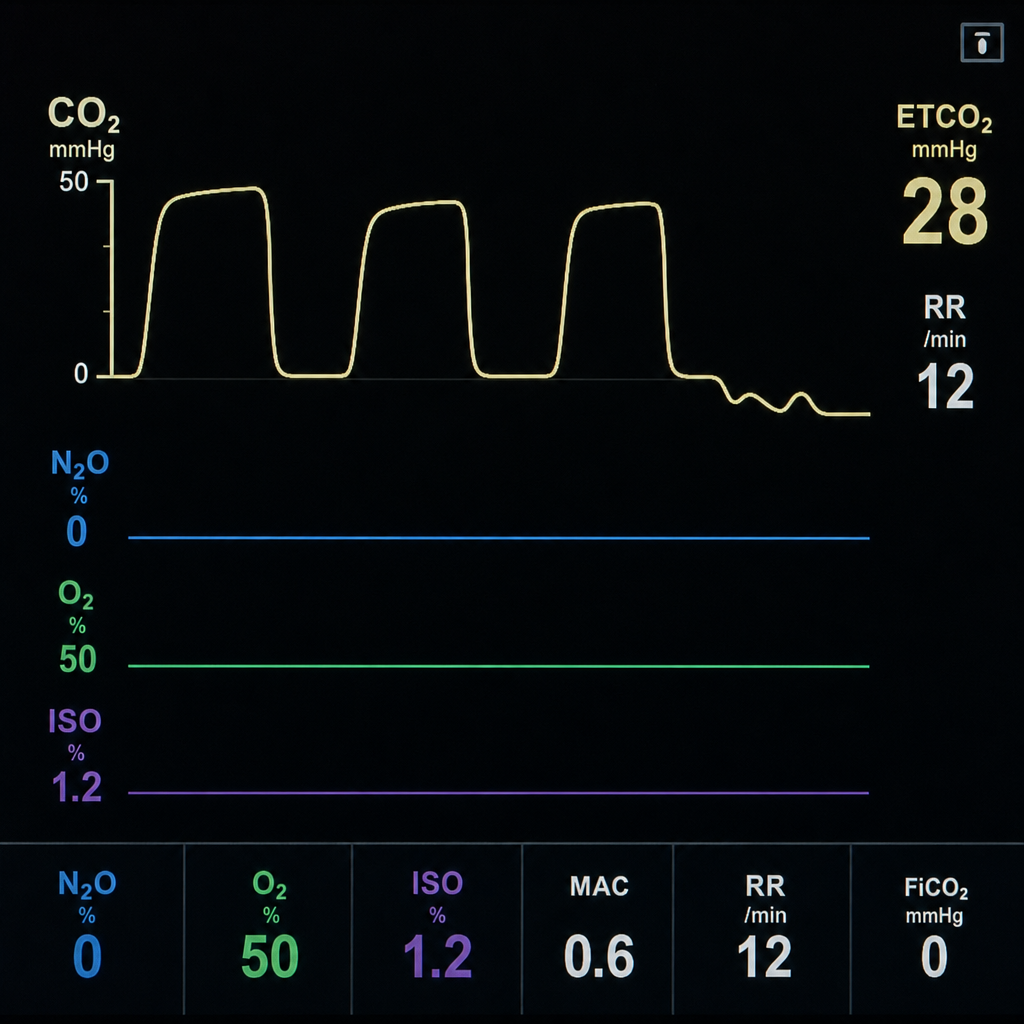
Which anesthetic agent is a contraindication in closed-system anaesthesiology?
Which scientific principle is the basis for the thermodilution method used in the measurement of cardiac output by a pulmonary catheter?
What is the optimal operating theatre temperature?
Which one of the following does NOT increase neuromuscular blockade?
Trilene (trichloroethylene) when used with Sodalime causes which of the following?
A patient developed fasciculations when a muscle relaxant was administered for surgery. Which of the following drugs is known to cause a train of fasciculations?
What is the most important constituent in soda lime for the reabsorption of CO2 in a closed circuit?
Which gas is supplied in a cylinder with a single pin index?
Which drug is inactivated in plasma by spontaneous non-enzymatic degradation?
For high-pressure storage of compressed gases, cylinders are made up of which material?
Explanation: **Explanation:** The correct answer is **Sevoflurane**. **Why Sevoflurane is the correct answer:** In a closed-system (or low-flow) anesthesia circuit, exhaled gases are passed through a carbon dioxide absorbent, typically **Soda Lime** or **Barium Hydroxide Lime (Baralyme)**. Sevoflurane is chemically unstable in the presence of these strong bases. It undergoes degradation to form a haloalkene known as **Compound A** (fluoromethyl-2,2-difluoro-1-(trifluoromethyl) vinyl ether). Compound A has been shown to be **nephrotoxic** in laboratory animals. The production of Compound A increases with low fresh gas flows (FGF), high concentrations of sevoflurane, and increased temperature of the absorbent. Therefore, to prevent the accumulation of Compound A, sevoflurane is generally avoided in strictly closed systems, and FDA guidelines recommend a minimum FGF of 1–2 L/min. **Why other options are incorrect:** * **Methoxyflurane:** While it is nephrotoxic due to the release of inorganic fluoride ions, it does not react with soda lime to form toxic degradation products like Compound A. It is rarely used today due to its high blood-gas solubility. * **Isoflurane and Desflurane:** These agents are highly stable in soda lime. While they can produce small amounts of carbon monoxide (CO) if the absorbent is completely desiccated (dry), they do not form Compound A and are safe for use in low-flow or closed-system anesthesia. **High-Yield Clinical Pearls for NEET-PG:** * **Compound A:** Associated with Sevoflurane + Soda Lime (Nephrotoxic). * **Carbon Monoxide (CO):** Associated with Desflurane > Isoflurane + **Dry** Soda Lime (causes carboxyhemoglobinemia). * **Indicator Dye:** Ethyl violet is the most common indicator in soda lime (turns from white to purple when exhausted). * **Regeneration:** Soda lime cannot be regenerated by resting; if it turns white again after use, it is still exhausted and must be replaced.
Explanation: **Explanation:** The **Stewart-Hamilton equation** is the mathematical foundation for calculating cardiac output (CO) using the indicator dilution technique. In the clinical setting of a Pulmonary Artery Catheter (Swan-Ganz), the **thermodilution method** is used. A known volume of cold saline (the indicator) is injected into the right atrium. A thermistor at the catheter tip (in the pulmonary artery) measures the change in blood temperature over time. The cardiac output is inversely proportional to the area under the temperature-time curve; a larger area indicates low CO, while a smaller area indicates high CO. **Analysis of Incorrect Options:** * **Hagen-Poiseuille Principle:** Describes the laminar flow of Newtonian fluids through a cylindrical pipe. It relates flow to pressure gradient, radius, length, and viscosity ($Q = \Delta P \pi r^4 / 8 \eta L$). It explains why large-bore IV cannulas allow faster fluid resuscitation. * **Bernoulli’s Principle:** States that an increase in the speed of a fluid occurs simultaneously with a decrease in pressure. In medicine, it is used in echocardiography to calculate pressure gradients across stenotic valves. * **Universal Gas Equation ($PV=nRT$):** Relates pressure, volume, and temperature of an ideal gas. It is fundamental to understanding cylinder pressures but irrelevant to blood flow measurement. **High-Yield Clinical Pearls for NEET-PG:** * **Gold Standard:** While thermodilution is the clinical standard, the **Fick Principle** (based on oxygen consumption) is the theoretical gold standard for CO measurement. * **Inaccuracy:** Thermodilution can be falsely elevated in **tricuspid regurgitation** or intracardiac shunts because the indicator is "lost" or recirculated. * **Injection:** The cold bolus should be injected rapidly (under 4 seconds) to ensure an accurate curve.
Explanation: The optimal operating theatre (OT) temperature is a balance between patient safety, surgical requirements, and staff comfort. **Explanation of the Correct Answer:** **Option A (21°C)** is the standard recommendation (typically ranging between **20°C to 23°C**). This temperature is chosen primarily to: 1. **Inhibit Bacterial Growth:** Lower temperatures reduce the rate of microbial proliferation, decreasing the risk of Surgical Site Infections (SSI). 2. **Staff Performance:** Surgeons and staff wear multiple layers of non-porous protective gear (gowns, masks, gloves) under intense surgical lights. A cooler environment prevents heat stress and fatigue, ensuring precision. 3. **Humidity Control:** Maintaining this temperature helps keep relative humidity between **40-60%**, which prevents static electricity (fire hazard) and inhibits fungal growth. **Analysis of Incorrect Options:** * **Option B (28°C):** This is too warm for surgical staff and promotes bacterial growth. However, this higher range may be used specifically in **neonatal or pediatric surgeries** to prevent rapid heat loss in infants. * **Option C (32°C) & D (37°C):** These temperatures are near or at core body temperature. While they would prevent patient hypothermia, they are impractical as they cause extreme discomfort, dehydration, and exhaustion for the surgical team, and significantly increase the risk of wound infection. **High-Yield Clinical Pearls for NEET-PG:** * **Hypothermia Risk:** While 21°C is good for the staff, it puts the patient at risk of **Inadvertent Perioperative Hypothermia (IPH)** due to radiation and convection. * **Patient Warming:** To counteract the cool OT environment, active warming measures like **Forced Air Warmers (Bair Hugger)** or warmed IV fluids are used. * **Air Changes:** The OT should have a minimum of **20 air changes per hour** with HEPA filters to maintain sterility.
Explanation: **Explanation:** The potentiation of neuromuscular blockade (NMB) by antibiotics is a high-yield topic in anesthesiology. Many antibiotics interfere with neuromuscular transmission, either by inhibiting the pre-junctional release of acetylcholine or by decreasing post-junctional sensitivity. **Why Erythromycin is the Correct Answer:** **Erythromycin** belongs to the **Macrolide** group of antibiotics. Unlike many other classes, macrolides (including Erythromycin and Azithromycin) generally **do not** have a clinically significant effect on neuromuscular blockade. Therefore, they do not potentiate the action of non-depolarizing muscle relaxants (NDMRs). **Analysis of Incorrect Options:** * **Streptomycin (Option C):** This is an **Aminoglycoside**. Aminoglycosides are the most potent potentiators of NMB. They act primarily by inhibiting the pre-junctional release of acetylcholine (by competing with Calcium ions) and, to a lesser extent, by reducing post-junctional sensitivity. (Mnemonic: *Neomycin > Streptomycin > Amikacin > Gentamicin*). * **Clindamycin and Lincomycin (Options A & B):** These are **Lincosamides**. They are significant potentiators of NMB because they act both pre-junctionally and post-junctionally. Notably, the blockade produced by lincosamides is often difficult to reverse with calcium or anticholinesterases. **High-Yield Clinical Pearls for NEET-PG:** 1. **Potentiators of NMB:** Aminoglycosides, Lincosamides, Polymyxins, Tetracyclines, and Magnesium. 2. **Aminoglycoside Reversal:** The blockade caused by aminoglycosides can sometimes be partially antagonized by **Calcium Gluconate**. 3. **Safe Antibiotics:** Penicillins, Cephalosporins, and Macrolides (like Erythromycin) are generally considered safe and do not significantly prolong neuromuscular blockade. 4. **Lincosamide Warning:** Clindamycin is particularly notorious for causing a blockade that is resistant to Neostigmine reversal.
Explanation: **Explanation:** The interaction between **Trichloroethylene (Trilene)** and **Soda Lime** (the carbon dioxide absorbent) is a classic high-yield topic in anesthesia. **Why ARDS is the correct answer:** Trichloroethylene is chemically unstable in the presence of heat and strong alkalis (like the sodium and potassium hydroxide found in Soda Lime). When passed through a CO2 absorber, it undergoes a degradation reaction to produce **Dichloroacetylene** and **Phosgene gas**. * **Dichloroacetylene** is highly neurotoxic, specifically targeting the cranial nerves (most commonly the Trigeminal and Facial nerves). * **Phosgene** is a potent pulmonary irritant that causes severe alveolar damage, leading to **Adult Respiratory Distress Syndrome (ARDS)** and pulmonary edema. Due to this risk, Trilene is strictly contraindicated for use in closed-circuit breathing systems. **Analysis of Incorrect Options:** * **A. Renal damage:** This is typically associated with **Methoxyflurane** (due to inorganic fluoride ions) or **Sevoflurane** (due to the formation of Compound A in soda lime), but not primarily with Trilene. * **C. Myocardial depression:** While most volatile anesthetics cause some degree of myocardial depression, it is not the specific toxic result of the Trilene-Soda Lime interaction. * **D. Hepatitis:** Halothane is the classic agent associated with drug-induced hepatitis ("Halothane Hepatitis"). **High-Yield Clinical Pearls for NEET-PG:** * **Neurotoxicity:** The most common cranial nerve affected by Dichloroacetylene is the **Trigeminal nerve (V)**, followed by the Facial nerve (VII). * **Color Coding:** Trilene is stored in **blue bottles** and is colored blue (with waxoline blue) to distinguish it from chloroform. * **Decomposition:** Trilene also decomposes into toxic products when exposed to light and moisture; hence it contains **thymol** as a preservative.
Explanation: **Explanation:** **Succinylcholine (Suxamethonium)** is the correct answer because it is the only **depolarizing neuromuscular blocking agent (DNMRB)** used clinically. It acts as an agonist at the nicotinic acetylcholine receptors (nAChR) at the motor endplate. Unlike acetylcholine, it is not metabolized by acetylcholinesterase, leading to prolonged depolarization. This initial, disorganized stimulation of muscle fibers manifests clinically as **fasciculations** (brief, involuntary muscle twitches) before the onset of flaccid paralysis. **Analysis of Incorrect Options:** * **Mivacurium:** A short-acting **non-depolarizing** neuromuscular blocker (NDNMRB). NDNMRBs act as competitive antagonists; they do not trigger an initial action potential, and thus do not cause fasciculations. * **Baclofen:** A centrally acting muscle relaxant (GABA-B agonist) used for chronic spasticity. It works in the spinal cord, not at the neuromuscular junction, and does not cause fasciculations. * **Gallamine:** An older long-acting NDNMRB. Like Mivacurium, it blocks receptors without activating them, avoiding fasciculations. It is rarely used today due to significant vagolytic effects (tachycardia). **High-Yield Clinical Pearls for NEET-PG:** * **Pre-curarization:** Fasciculations can be prevented by administering a small "priming dose" of a non-depolarizing relaxant (e.g., Vecuronium) 3 minutes before Succinylcholine. * **Side Effects:** Succinylcholine is associated with postoperative myalgia (due to fasciculations), hyperkalemia, increased intraocular/intragastric pressure, and is a potent trigger for **Malignant Hyperthermia**. * **Metabolism:** It is metabolized by **Pseudocholinesterase** (Plasma cholinesterase). Deficiency of this enzyme leads to prolonged apnea.
Explanation: **Explanation:** The primary function of soda lime in a circle system is the chemical removal of carbon dioxide to allow for the safe rebreathing of anesthetic gases. **Why Calcium Hydroxide is Correct:** Calcium hydroxide ($Ca(OH)_2$) is the **main constituent** of soda lime, making up approximately **80%** of the mixture. It is the principal agent responsible for the permanent sequestration of $CO_2$. The overall reaction is: $CO_2 + H_2O \rightarrow H_2CO_3$ $H_2CO_3 + 2NaOH \rightarrow Na_2CO_3 + 2H_2O + \text{Heat}$ $Na_2CO_3 + Ca(OH)_2 \rightarrow CaCO_3 + 2NaOH$ While sodium hydroxide acts as a catalyst to speed up the reaction, the bulk of the $CO_2$ is ultimately bound as **Calcium Carbonate ($CaCO_3$)**. **Analysis of Incorrect Options:** * **Sodium Hydroxide (NaOH):** Present in small amounts (~4%). It acts as a **catalyst** to initiate the reaction but is not the primary bulk constituent. * **Potassium Hydroxide (KOH):** Previously added as a catalyst but has been largely removed from modern soda lime because it was linked to the production of **Carbon Monoxide** (when using dry absorbent) and **Compound A** (with sevoflurane). * **Barium Hydroxide:** This was the main constituent of **Bara Lyme**, which is no longer used clinically due to its higher risk of fire and toxic byproduct formation compared to soda lime. **High-Yield NEET-PG Pearls:** * **Water Content:** Soda lime contains **14-19% water**; if it dries out, $CO_2$ absorption fails and toxic degradation products increase. * **Indicator:** Ethyl violet is the most common indicator (turns from white to **purple** as pH drops below 10.3). * **Mesh Size:** The standard size is **4–8 mesh** to provide a balance between high surface area for absorption and low resistance to gas flow. * **Silica:** Added in small amounts (0.2%) to harden the granules and prevent the formation of "alkaline dust," which can cause bronchospasm.
Explanation: ### Explanation The **Pin Index Safety System (PISS)** is a vital safety mechanism designed to prevent the accidental connection of the wrong gas cylinder to the anesthetic machine. It uses specific hole-and-pin configurations on the cylinder valve and the yoke of the machine. **Why Entonox is the correct answer:** Entonox is a 50:50 mixture of Oxygen and Nitrous Oxide. Unlike pure gases, which utilize a two-pin configuration to ensure specificity, Entonox uses a **single pin index** located at **position 7**. This unique single-pin configuration is a high-yield fact for exams, as it stands out from the standard two-pin combinations used for other medical gases. **Analysis of Incorrect Options:** * **A. Oxygen:** Uses a two-pin configuration at positions **2 and 5**. This is the most frequently tested pin index. * **B. Air:** Uses a two-pin configuration at positions **1 and 5**. * **C. Nitrogen:** Uses a two-pin configuration at positions **1 and 4**. (Note: Nitrous Oxide, often confused with Nitrogen, uses **3 and 5**). **High-Yield Clinical Pearls for NEET-PG:** * **Entonox Cylinder Color:** Blue body with White-and-Black quartered shoulders (representing its components). * **Poynting Effect:** This explains why Entonox remains a gas; however, if cooled below **-5.5°C (Leduc Effect)**, the gases separate (pseudocritical temperature), which can lead to the delivery of pure Nitrous Oxide first (hypoxic mixture). * **Summary of Common Pin Indices:** * Oxygen: 2, 5 * Nitrous Oxide: 3, 5 * Air: 1, 5 * **Entonox: 7** * Cyclopropane: 3, 6
Explanation: **Explanation:** The correct answer is **Atracurium**. This drug is unique among neuromuscular blocking agents (NMBAs) because it undergoes **Hofmann elimination**. **1. Why Atracurium is Correct:** Atracurium is a benzylisoquinolinium muscle relaxant that is inactivated in the plasma via two primary pathways: * **Hofmann Elimination:** A spontaneous, non-enzymatic chemical degradation that occurs at physiological pH and temperature. * **Ester Hydrolysis:** A process mediated by non-specific plasma esterases (not pseudocholinesterase). Because its metabolism is independent of renal or hepatic function, it is the drug of choice for patients with **renal or hepatic failure**. **2. Why the Other Options are Incorrect:** * **Vecuronium (B):** An aminosteroid NMBA primarily metabolized by the **liver** (deacetylation) and excreted via bile and urine. * **Pipecuronium (C) & Pancuronium (D):** Long-acting aminosteroids that are primarily excreted unchanged by the **kidneys**. They are contraindicated in renal failure due to the risk of prolonged blockade. **3. High-Yield Clinical Pearls for NEET-PG:** * **Cisatracurium:** An isomer of atracurium that also undergoes Hofmann elimination. It is more potent and produces less **laudanosine** (a metabolite that can cause seizures) and less histamine release compared to atracurium. * **Temperature & pH:** Since Hofmann elimination is spontaneous, it is **slowed by acidosis and hypothermia**, potentially prolonging the drug's duration of action. * **Mnemonic:** Remember **"A"** for **A**tracurium and **"H"** for **H**ofmann elimination.
Explanation: **Explanation:** Gas cylinders are high-pressure vessels designed to store compressed medical gases (like Oxygen at 137 bar or Nitrous Oxide at 52 bar). The choice of material is critical for safety, durability, and weight management. **1. Why Molybdenum Steel is Correct:** Modern gas cylinders are primarily manufactured from **Molybdenum steel** (an alloy of steel, chromium, and molybdenum). * **Strength-to-Weight Ratio:** Molybdenum significantly increases the tensile strength and toughness of the steel. This allows the cylinder walls to be thinner and lighter while still safely containing extremely high pressures. * **Corrosion Resistance:** It provides excellent resistance to structural fatigue and internal corrosion, which is vital for maintaining gas purity and structural integrity over decades of use. **2. Analysis of Incorrect Options:** * **Iron + Molybdenum:** Pure iron is too soft and prone to oxidation (rusting) to be used for high-pressure storage. It must be alloyed into steel (iron + carbon) to gain the necessary structural properties. * **Steel + Copper:** While copper has good thermal conductivity, it lacks the tensile strength required for high-pressure gas containment. Copper is typically used in low-pressure pipeline systems, not high-pressure cylinders. * **Cast Iron:** Cast iron is brittle. Under high pressure, a brittle material would shatter (explode) rather than deform, making it extremely dangerous for medical gas storage. **3. High-Yield Clinical Pearls for NEET-PG:** * **MRI Compatibility:** Standard molybdenum steel cylinders are **ferromagnetic** and cannot be taken into the MRI suite. For MRI environments, cylinders are made of **Aluminum** (non-ferrous). * **Testing:** Cylinders undergo **hydrostatic pressure testing** every 5 to 10 years to check for leaks and structural expansion. * **Safety Feature:** The **Frangible Disc** or **Fusible Plug** (made of Wood’s metal) protects the cylinder from bursting during extreme heat or overpressure. * **Color Coding (India/ISO):** Oxygen (Black body/White shoulder), Nitrous Oxide (Blue), CO2 (Grey), Air (Grey body/Black & White shoulder).
Anesthesia Machine Components
Practice Questions
Breathing Systems
Practice Questions
Vaporizers
Practice Questions
Gas Cylinders and Pipeline Supply
Practice Questions
Anesthesia Ventilators
Practice Questions
Standard Monitoring: ECG, BP, Pulse Oximetry
Practice Questions
Capnography
Practice Questions
Neuromuscular Monitoring
Practice Questions
Temperature Monitoring
Practice Questions
Invasive Hemodynamic Monitoring
Practice Questions
Equipment Troubleshooting
Practice Questions
Safety Features in Modern Anesthesia Equipment
Practice Questions
Get full access to all questions, explanations, and performance tracking.
Start For Free