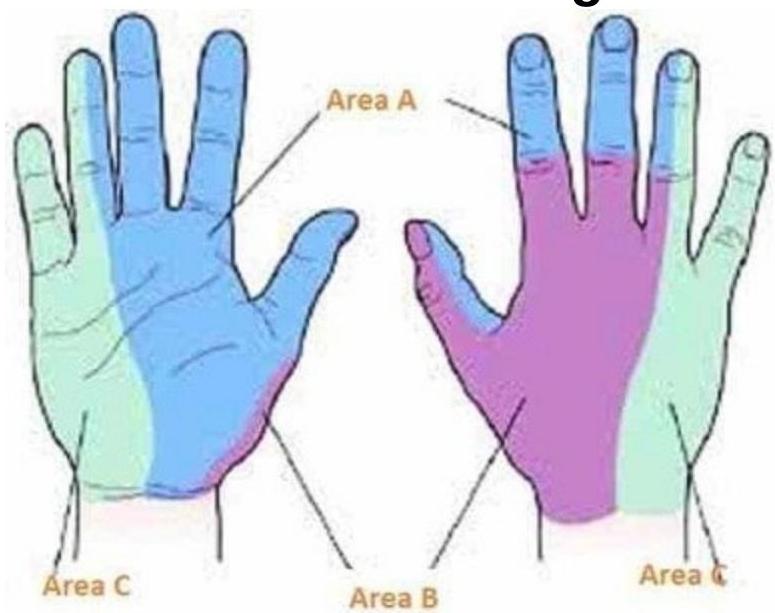
A patient presents with loss of sensation on the lateral 3½ fingers and thenar atrophy. Which nerve is most likely involved?
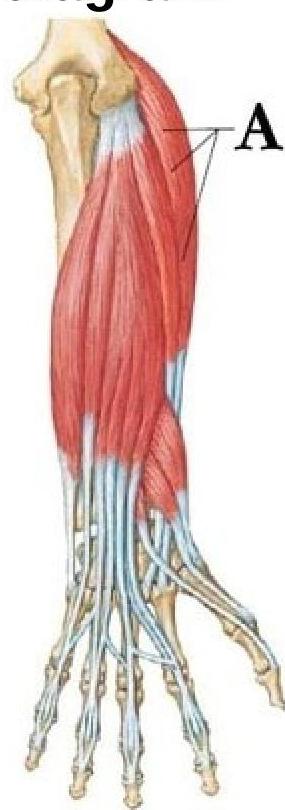
A patient presents with difficulty extending their wrist following trauma to the posterior forearm. Which of the following muscles would be most affected by injury to the posterior interosseous nerve?
A 16-year-old boy is brought to the emergency department after being tackled at a football game. Per his mom, he is the quarterback of his team and was head-butted in the left shoulder region by the opposing team. Shortly after, the mother noticed that his left arm was hanging by his torso and his hand was “bent backwards and facing the sky.” The patient denies head trauma, loss of consciousness, sensory changes, or gross bleeding. A physical examination demonstrates weakness in abduction, lateral rotation, flexion, and supination of the left arm and tenderness of the left shoulder region with moderate bruising. Radiograph of the left shoulder and arm is unremarkable. Which of the following is most likely damaged in this patient?
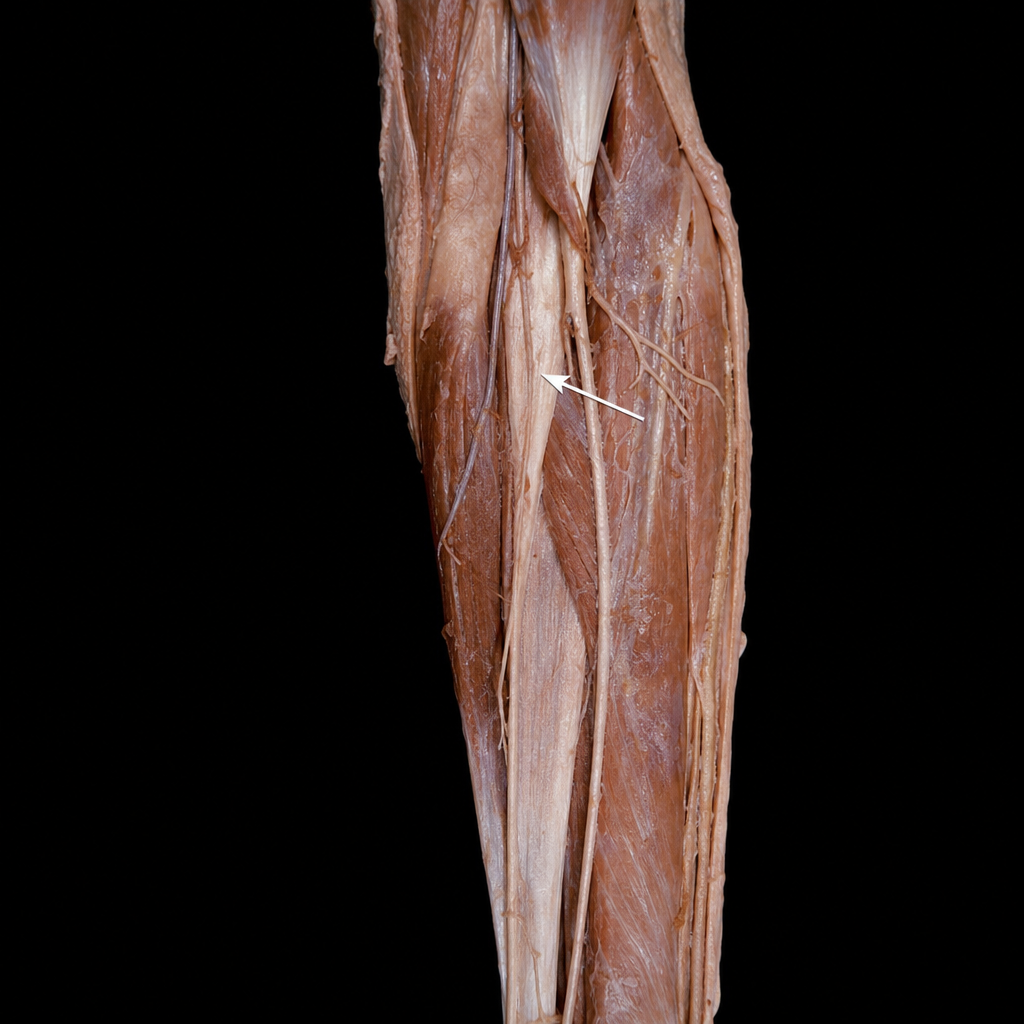
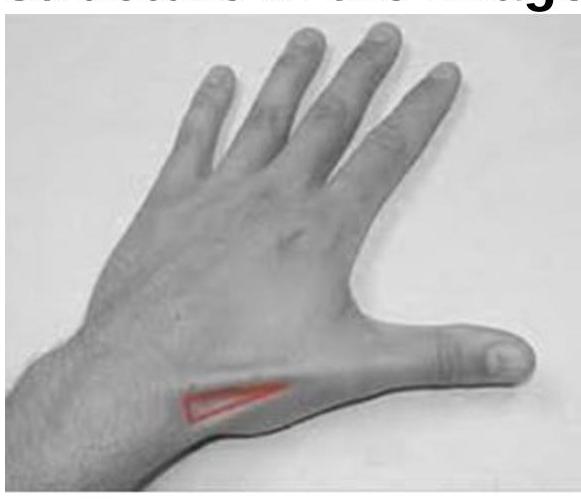
Tendons in the 2nd compartment of wrist?
Which bone connects the sternum to the scapula?
Which of the following structures passes through Guyon's canal?
Pointing index finger is seen in which nerve injury
NOT a content of carpal tunnel:-
Retraction of scapula is done by
Erb-Duchenne paralysis occurs by lesion to brachial plexus at the level of
Explanation: ***Median*** - The **median nerve** provides sensation to the **lateral 3½ fingers** (thumb, index, middle, and radial half of the ring finger) and innervates the **thenar muscles**, making its involvement consistent with the described symptoms [1]. - **Thenar atrophy** points directly to motor innervation loss of the thenar eminence, which is a key function of the median nerve. *Ulnar* - The **ulnar nerve** supplies sensation to the **medial 1½ fingers** (little finger and ulnar half of the ring finger) and innervates most of the **intrinsic hand muscles**, but not the thenar muscles [1]. - Damage typically causes **hypothenar atrophy** and **clawing** of the 4th and 5th digits, which are not described here. *Radial* - The **radial nerve** primarily provides sensation to the **dorsal aspect of the hand** and innervates the **extensor muscles of the forearm and hand**. - Its injury would typically lead to **wrist drop** and sensory loss in the dorsal hand, not thenar atrophy or lateral finger sensory loss. *Anterior interosseous nerve* - The **anterior interosseous nerve** is a **purely motor branch of the median nerve** that innervates muscles involved in **flexion of the thumb IP joint** and **index finger DIP joint**. - It does not have any sensory innervation, so loss of sensation in the lateral 3½ fingers would not be a symptom.
Explanation: ***Extensor digitorum*** - The **posterior interosseous nerve (PIN)** innervates most muscles of the **posterior compartment of the forearm**, including the extensor digitorum. [1] - Loss of function in the **extensor digitorum** would directly impair **extension of the fingers** and contribute significantly to difficulty extending the wrist. [1] *Extensor carpi ulnaris* - This muscle is also innervated by the **posterior interosseous nerve (PIN)** and contributes to **wrist extension** and **ulnar deviation**. - While its innervation by the PIN is correct, injury to the PIN would affect this muscle, but the *extensor digitorum* is more broadly responsible for the stated primary symptom (difficulty extending the wrist), as its primary action is finger and thus wrist extension. *Extensor carpi radialis brevis* - While it is a **wrist extensor**, it is innervated by the **deep branch of the radial nerve** *before* it becomes the posterior interosseous nerve. - Therefore, an isolated injury to the **posterior interosseous nerve** proper would typically spare the extensor carpi radialis brevis. *Extensor pollicis longus* - This muscle is indeed innervated by the **posterior interosseous nerve (PIN)** and acts to extend the **thumb**. [1] - While it would be affected, the primary problem described is difficulty extending the *wrist*, for which the extensor digitorum plays a more significant and general role than the extensor pollicis longus.
Explanation: ***C5-C6 nerve roots*** - The "bent backwards and facing the sky" hand posture indicates **Waiter's tip position**, a classic sign of **Erb-Duchenne palsy**, caused by damage to the upper trunk of the brachial plexus (C5-C6 roots) [1]. - Weakness in **abduction** (deltoid, supraspinatus), **lateral rotation** (infraspinatus, teres minor), **flexion** (biceps, coracobrachialis), and **supination** (biceps, supinator) are all consistent with C5-C6 nerve root involvement. *Ulnar nerve* - Ulnar nerve damage would result in a **claw hand deformity** (hyperextension of MCP joints and flexion of DIP/PIP joints of 4th and 5th digits) and weakness in intrinsic hand muscles, not the observed upper arm weakness. - Sensory loss involves the medial hand and little finger. *C8-T1 nerve roots* - Damage to the C8-T1 nerve roots (lower trunk) typically results in **Klumpke's palsy**, characterized by a more severe **claw hand** and paralysis of intrinsic hand muscles [1]. - This presentation does not match the observed functional deficits. *Long thoracic nerve* - Injury to the long thoracic nerve causes paralysis of the **serratus anterior muscle**, leading to **scapular winging**, especially when pushing against a wall. - While possible in shoulder trauma, it does not explain the widespread weakness in abduction, rotation, flexion, and supination of the arm.
Explanation: ***Extensor carpi radialis brevis and longus*** - The **second dorsal compartment** of the wrist houses the tendons of the **extensor carpi radialis longus (ECRL)** and **extensor carpi radialis brevis (ECRB)** muscles [1]. - These muscles are primarily responsible for **wrist extension** and **radial deviation** of the hand [1]. *Extensor pollicis longus* - The **extensor pollicis longus (EPL)** tendon is located in the **third dorsal compartment** of the wrist [1]. - Its main function is to **extend the thumb's interphalangeal joint** and contributes to extension and adduction of the thumb. *Extensor pollicis brevis* - The **extensor pollicis brevis (EPB)** tendon is found in the **first dorsal compartment** of the wrist [1]. - It works with the abductor pollicis longus to form the **anatomical snuffbox** and primarily **extends the metacarpophalangeal joint** of the thumb [1]. *Abductor pollicis longus* - The **abductor pollicis longus (APL)** tendon is also located in the **first dorsal compartment** of the wrist [1]. - Its primary actions are to **abduct** (move away from the palm) and **extend the thumb** at the carpometacarpal joint [1].
Explanation: ***Clavicle*** - The **clavicle**, or collarbone, is the only bone that directly connects the **axial skeleton** (via the sternum) to the **appendicular skeleton** (via the scapula). - It articulates medially with the **manubrium** of the sternum at the sternoclavicular joint and laterally with the **acromion** of the scapula at the acromioclavicular joint. *First rib* - The **first rib** articulates with the **manubrium** of the sternum but does not connect directly to the scapula. - Its primary role is to form part of the **thoracic cage**, protecting internal organs. *Manubrium* - The **manubrium** is the superior part of the **sternum** and articulates with the clavicles and the first two ribs. - It does not directly connect to the **scapula**; rather, the clavicle mediates this connection. *Second rib* - The **second rib** articulates with both the **manubrium** and the body of the sternum at the **sternal angle**. - Like the first rib, it is part of the **thoracic cage** and does not directly connect to the scapula.
Explanation: ### Ulnar nerve - The **ulnar nerve** passes through Guyon's canal, along with the ulnar artery, making it susceptible to compression here [1]. - Compression of the ulnar nerve in Guyon's canal can lead to motor and sensory deficits in its distribution, known as **ulnar tunnel syndrome** [1]. ### Flexor carpi radialis - The **flexor carpi radialis tendon** passes through a separate compartment in the carpal tunnel, distinct from Guyon's canal. - Its primary function is wrist flexion and radial deviation, and it is not associated with Guyon's canal. ### Radial nerve - The **radial nerve** courses along the lateral aspect of the forearm and hand and does not pass through Guyon's canal. - Its injury typically manifests as **wrist drop** and sensory loss over the dorsum of the hand. ### Median nerve - The **median nerve** passes through the carpal tunnel, which is medial to Guyon's canal in the wrist [1]. - Entrapment of the median nerve in the carpal tunnel causes **carpal tunnel syndrome**, characterized by symptoms in the thumb, index, middle, and radial half of the ring finger [1].
Explanation: ***Median*** - The **pointing index finger** sign occurs in **proximal median nerve injury** when attempting to make a fist, as the median nerve supplies **flexor digitorum superficialis (FDS)** and lateral half of **flexor digitorum profundus (FDP)**. - This creates the classic **"hand of benediction"** or **"pope's blessing"** sign where index and middle fingers remain extended due to loss of flexion capability. *Axillary* - Primarily innervates the **deltoid** and **teres minor muscles**, affecting **shoulder abduction** and external rotation. - Injury does not cause any **finger positioning abnormalities** or hand deformities. *Radial* - Injury causes **"wrist drop"** with inability to extend the wrist, thumb, and fingers at **MCP joints**. - Results in all fingers remaining **flexed due to unopposed flexor action**, not a pointing finger deformity. *Ulnar* - Injury causes **"claw hand"** deformity primarily affecting the **ring and little fingers** (4th and 5th digits). - Creates **hyperextension at MCP joints** and **flexion at PIP/DIP joints**, with the index finger typically less affected.
Explanation: ***Ulnar nerve*** - The **ulnar nerve** passes superficial to the **flexor retinaculum**, meaning it is not a direct content of the carpal tunnel [1]. - Instead, it travels through a separate space known as **Guyon's canal**, alongside the ulnar artery [1]. *Median nerve* - The **median nerve** is a primary content of the carpal tunnel and is susceptible to compression within this space, leading to carpal tunnel syndrome [1]. - It provides sensory innervation to the lateral palm and digits, and motor innervation to certain thenar muscles [1]. *Flexor digitorum profundus* - The tendons of the **flexor digitorum profundus** muscles (four of them) pass through the carpal tunnel to insert onto the distal phalanges. - These tendons are responsible for **flexion of the distal interphalangeal (DIP) joints** of the medial four fingers. *Flexor digitorum superficialis* - The tendons of the **flexor digitorum superficialis** muscles (four of them) also pass through the carpal tunnel. - They are responsible for **flexion of the proximal interphalangeal (PIP) joints** of the medial four fingers.
Explanation: ***Trapezius*** - The **trapezius** muscle, particularly the middle fibers, is responsible for **retracting the scapula**, pulling it medially towards the vertebral column. - This action is crucial for stabilizing the shoulder girdle and enabling various arm movements. *Serratus anterior* - The **serratus anterior** is primarily responsible for **protraction of the scapula** (pulling it forward) and stabilizing it against the thoracic wall. - It also aids in upward rotation of the scapula. *Supraspinatus* - The **supraspinatus** muscle is a rotator cuff muscle involved in the **initiation of arm abduction** (lifting the arm away from the body). - It does not directly contribute to scapular retraction. *Subscapularis* - The **subscapularis** is another rotator cuff muscle, primarily responsible for **internal rotation of the arm** and stabilization of the glenohumeral joint. - It has no direct role in scapular retraction.
Explanation: ***C5-C6*** - **Erb-Duchenne paralysis**, also known as **Erb's palsy**, results from injury to the upper roots of the **brachial plexus**, specifically the **C5 and C6 nerve roots** [1]. - This lesion commonly occurs due to **traction** on the upper trunk of the brachial plexus during difficult childbirth or trauma, leading to characteristic "waiter's tip" posture [1]. *C8-T1* - A lesion at the **C8-T1** level of the brachial plexus causes **Klumpke's paralysis**, which affects the intrinsic muscles of the hand and causes a "claw hand" deformity. - This is distinct from Erb's palsy, which primarily affects shoulder and elbow movements. *C6-C7* - While C6 is involved in Erb's palsy, a lesion specifically at **C6-C7** would implicate the middle trunk and is not the primary site for the classic Erb-Duchenne paralysis. - Isolated C7 involvement would primarily affect wrist extensors and finger extensors, which are different from the clinical presentation of Erb's palsy. *C4-C5* - Injury to **C4-C5** would affect the phrenic nerve (C3-C5) and contribute to diaphragm dysfunction, as well as the upper trapezius and levator scapulae, but it is not the typical presentation or origin of Erb-Duchenne paralysis specifically. - C5 is part of Erb's palsy, but the defining lesion involves both C5 and C6, not just C4-C5.
Pectoral Region and Axilla
Practice Questions
Arm and Cubital Fossa
Practice Questions
Forearm and Hand
Practice Questions
Joints of Upper Limb
Practice Questions
Nerves of Upper Limb
Practice Questions
Arterial Supply and Venous Drainage
Practice Questions
Lymphatic Drainage
Practice Questions
Muscles and Their Actions
Practice Questions
Applied Anatomy and Clinical Correlations
Practice Questions
Surface Anatomy and Landmarks
Practice Questions
Get full access to all questions, explanations, and performance tracking.
Start For Free