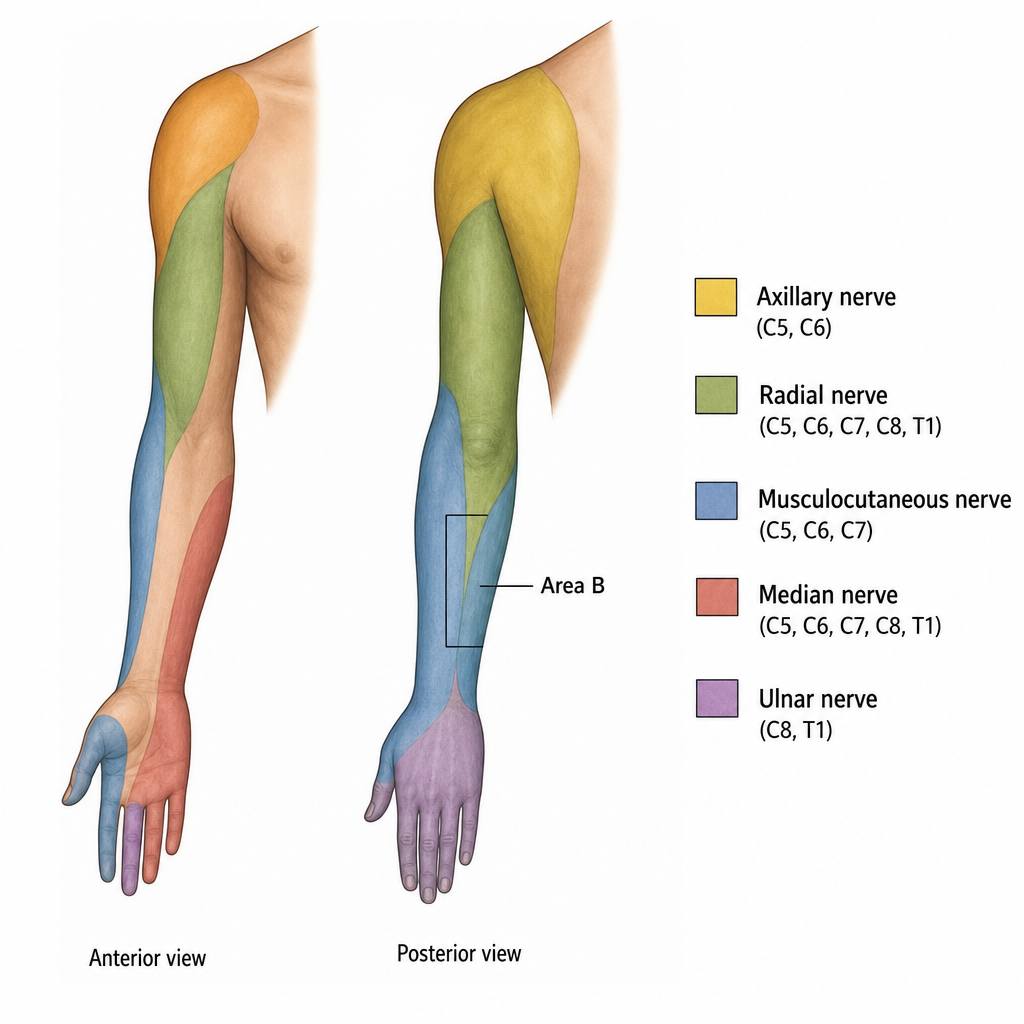
A 31-year-old patient complains of sensory loss over the anterior and posterior surfaces of the medial third of the hand and the medial one and one-half fingers. The patient is diagnosed with "funny bone" symptoms. Which of the following nerves is injured?
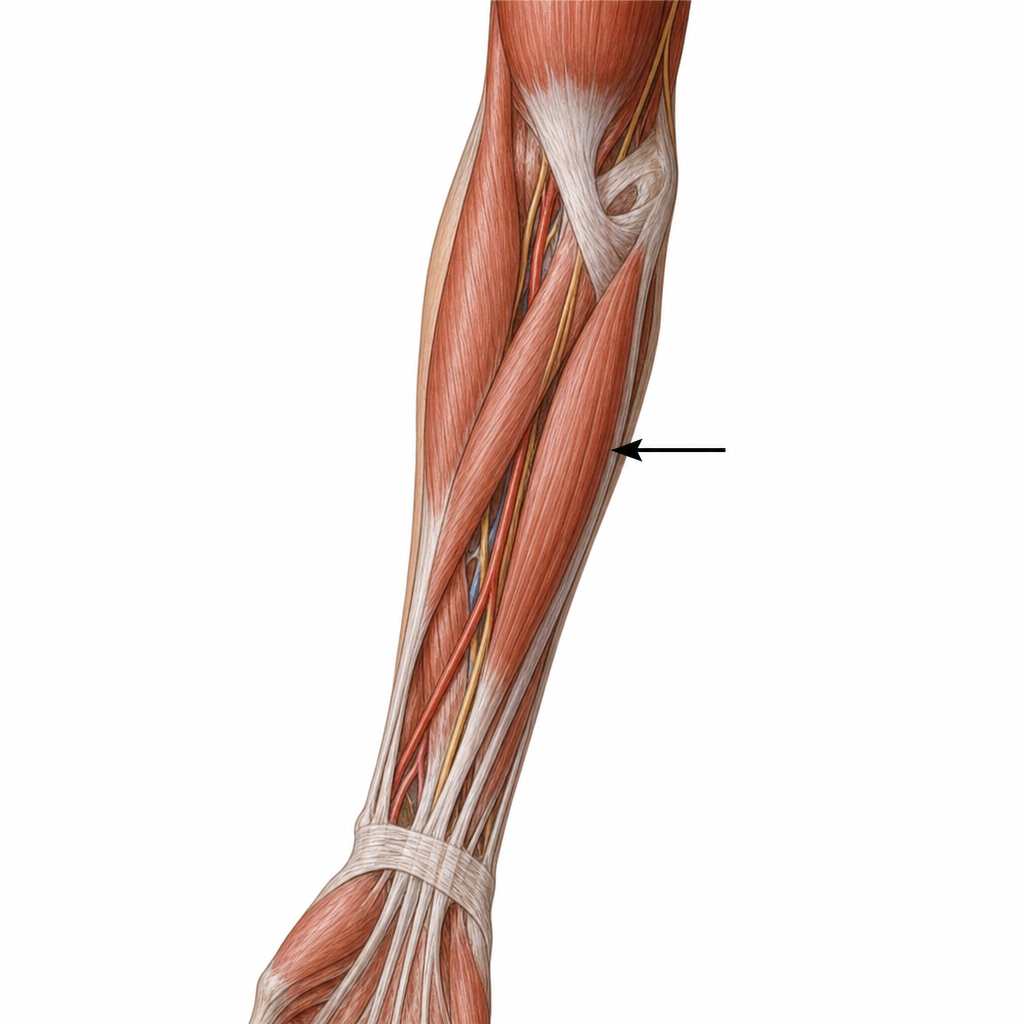
A 23-year-old female sustained an injury to her right index finger while making a bed. She experienced sudden, severe pain over the base of the terminal phalanx, followed by swelling and inability to completely extend the terminal interphalangeal joint. Which one of the following structures within the digit was most likely injured?
Which muscle is attached to the medial border of the scapula?
In a subclavian artery block at the outer border of the 1st rib, all of the following arteries help in maintaining the circulation to the upper limb, EXCEPT?
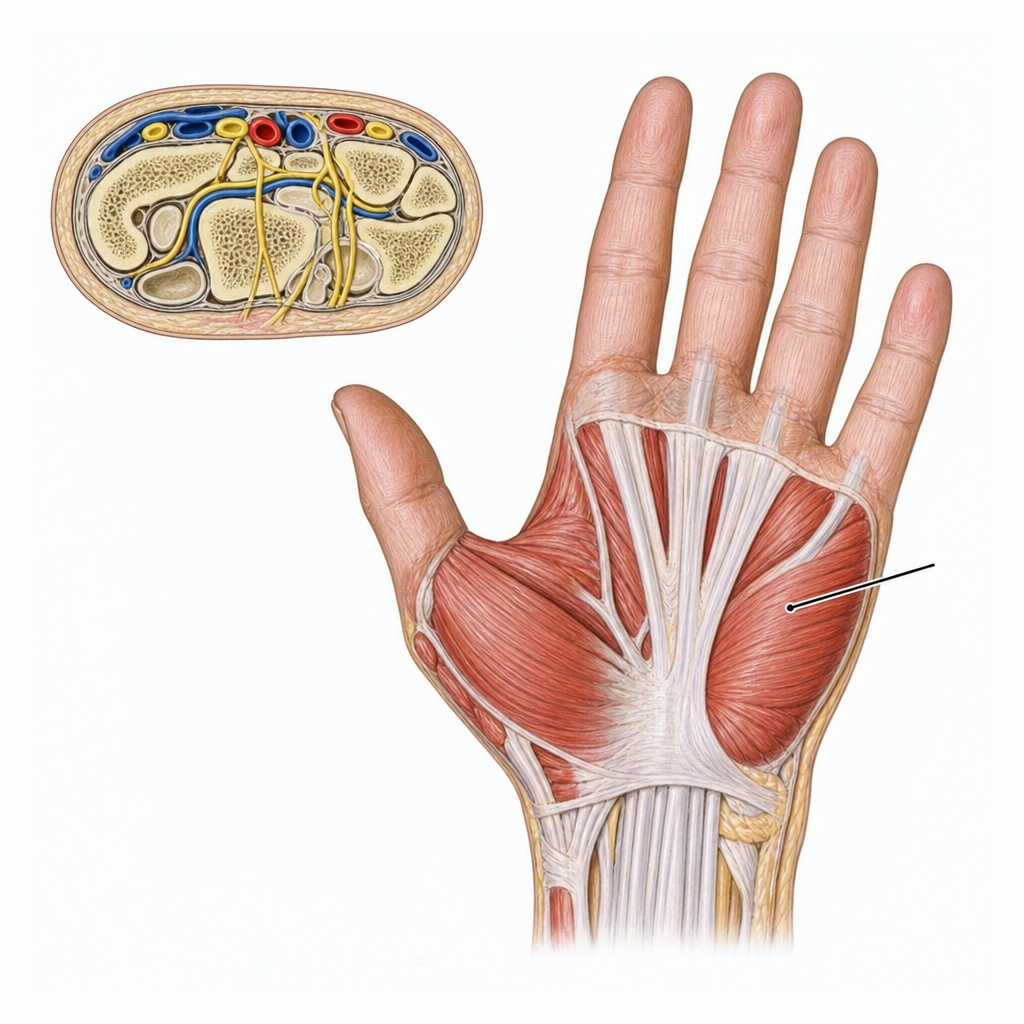
A 24-year-old medical student was bitten at the base of her thumb by her dog. The wound became infected and the infection spread into the radial bursa. The tendon(s) of which muscle will most likely be affected?
The inferior angle of the scapula is typically found at the level of which thoracic vertebra?
Which of the following is NOT found in the posterior cord of the Brachial plexus?
The ulnar nerve supplies all of the following muscles except:
Which of the following diagnostic studies is NOT useful in the evaluation of upper-extremity pain?
The ulnar nerve supplies all of the following muscles except:
Explanation: ### Explanation **1. Why the Correct Answer (Ulnar Nerve) is Right:** The ulnar nerve provides sensory innervation to the **medial one and one-half fingers** (little finger and medial half of the ring finger) and the corresponding **medial third of the hand** (hypothenar area) on both the palmar (anterior) and dorsal (posterior) aspects [1]. The "funny bone" refers to the ulnar nerve's vulnerable position as it passes behind the **medial epicondyle** of the humerus. Compression or trauma at this site leads to the classic paresthesia and sensory loss described in the question. **2. Why the Other Options are Incorrect:** * **Axillary Nerve:** Supplies the "regimental badge area" (skin over the lower part of the deltoid). It does not extend to the hand. * **Radial Nerve:** Primarily supplies the skin of the posterior arm, forearm, and the **lateral two-thirds of the dorsum of the hand** (excluding the fingertips, which are median nerve territory). * **Median Nerve:** Supplies the **lateral three and one-half fingers** and the lateral two-thirds of the palm [1]. It does not supply the medial side of the hand. **3. Clinical Pearls for NEET-PG:** * **Site of Injury:** The ulnar nerve is most commonly injured at the **elbow** (cubital tunnel/medial epicondyle) or the **wrist** (Guyon’s canal). * **Motor Deficit:** Injury leads to "Ulnar Claw Hand" (hyperextension at MCP joints and flexion at IP joints of the 4th and 5th digits). * **Froment’s Sign:** A positive test indicates ulnar nerve palsy due to paralysis of the Adductor Pollicis muscle. * **High-Yield Fact:** The ulnar nerve is known as the **"Musician’s Nerve"** because it controls most fine movements of the fingers.
Explanation: This clinical presentation describes a classic case of **Mallet Finger** (also known as Baseball Finger). ### **Explanation of the Correct Answer** The injury occurred while "making a bed," a common mechanism where the fingertip is struck by a heavy object (like a mattress), causing sudden forced flexion of an actively extended Distal Interphalangeal (DIP) joint. * **Anatomy:** The **Extensor Digitorum** tendon (specifically the terminal slip) inserts into the dorsal aspect of the **base of the distal phalanx**. * **Pathophysiology:** Rupture or avulsion of this insertion results in the inability to actively extend the DIP joint, leading to a characteristic "droop" of the fingertip. ### **Analysis of Incorrect Options** * **Option A:** Injury to the **median nerve** would cause sensory loss or motor deficits in the thenar muscles, but it would not cause a localized mechanical inability to extend a single DIP joint. * **Option B:** **Vincula longa** are small vascular folds of synovial membrane that supply blood to the flexor tendons. Their injury would affect tendon nutrition but wouldn't cause acute deformity or loss of extension. * **Option D:** The **Flexor Digitorum Profundus (FDP)** inserts onto the palmar base of the distal phalanx. Injury here (Jersey Finger) results in the inability to **flex** the DIP joint, not extend it. ### **NEET-PG High-Yield Pearls** * **Mallet Finger:** Loss of DIP extension; injury to terminal extensor tendon. * **Jersey Finger:** Loss of DIP flexion; injury to FDP tendon (common in rugby/football). * **Boutonnière Deformity:** Rupture of the **central slip** of the extensor hood; results in PIP flexion and DIP hyperextension [1]. * **Swan Neck Deformity:** Often seen in Rheumatoid Arthritis; characterized by PIP hyperextension and DIP flexion.
Explanation: The medial (vertebral) border of the scapula serves as a critical attachment site for muscles that stabilize and move the scapula against the thoracic wall. ### **Explanation of the Correct Answer** **A. Rhomboidus Major:** This muscle originates from the spinous processes of T2–T5 vertebrae and inserts into the **medial border of the scapula**, specifically from the level of the spine to the inferior angle. Along with the Rhomboidus Minor (inserted at the base of the spine) and Serratus Anterior (inserted on the costal aspect of the medial border), it plays a vital role in retracting and rotating the scapula. ### **Analysis of Incorrect Options** * **B. Teres Major:** This muscle arises from the oval area on the dorsal surface of the **inferior angle** and the lower third of the **lateral border** of the scapula. It inserts into the medial lip of the bicipital groove of the humerus. * **C. Deltoid:** This large multipennate muscle originates from the lateral third of the clavicle, the acromion, and the lower lip of the **crest of the spine of the scapula**, not the medial border. * **D. Infraspinatus:** This muscle occupies the **infraspinous fossa** on the dorsal surface of the scapula and inserts into the middle facet of the greater tubercle of the humerus. ### **High-Yield Clinical Pearls for NEET-PG** * **Serratus Anterior:** Often tested alongside Rhomboids; it inserts into the **ventral (costal) aspect** of the medial border. Paralysis of this muscle (Long Thoracic Nerve injury) leads to **"Winging of Scapula."** * **Levator Scapulae:** Also attaches to the medial border, specifically from the superior angle to the root of the spine. * **The "Cuff" Rule:** Remember that the SITS muscles (Supraspinatus, Infraspinatus, Teres Minor, Subscapularis) attach to the humerus, whereas the Rhomboids are "extrinsic" muscles connecting the axial skeleton to the scapula.
Explanation: ### Explanation The question tests your knowledge of the **scapular anastomosis**, a vital collateral circulation pathway that bypasses obstructions in the subclavian or axillary arteries. **1. Why "Superior Thoracic Artery" is the Correct Answer:** The block is at the **outer border of the 1st rib**, which marks the transition where the subclavian artery becomes the axillary artery. To maintain circulation to the upper limb, blood must flow from the subclavian branches (proximal to the block) into the axillary branches (distal to the block). * The **Superior Thoracic Artery** is the first branch of the **1st part of the axillary artery**. Since it arises immediately after the 1st rib, it is located distal to the block but does not participate in the scapular anastomosis. It supplies the upper intercostal spaces and has no retrograde connection to the subclavian artery to bypass this specific obstruction. **2. Analysis of Incorrect Options:** * **Thyrocervical Trunk (Option C):** This is a branch of the 1st part of the subclavian artery. It gives off the Suprascapular and Transverse cervical arteries, which are the primary "donors" of blood to the anastomosis. * **Suprascapular Artery (Option D):** Arising from the thyrocervical trunk, it travels to the posterior aspect of the scapula to anastomose with the circumflex scapular artery. * **Subscapular Artery (Option A):** This is a branch of the **3rd part of the axillary artery**. Its branch, the **circumflex scapular artery**, completes the circuit by receiving blood from the suprascapular and transverse cervical arteries, allowing blood to flow into the distal axillary artery. **Clinical Pearls for NEET-PG:** * **Scapular Anastomosis:** Connects the 1st part of the subclavian artery with the 3rd part of the axillary artery. * **Key Vessels:** Suprascapular and Deep branch of Transverse Cervical (from Subclavian) ↔ Circumflex Scapular (from Axillary). * **Direction of Flow:** In a block proximal to the subscapular artery, blood flow in the circumflex scapular artery **reverses** to reach the axillary artery.
Explanation: The correct answer is **Flexor pollicis longus (FPL)**. This question tests your knowledge of the synovial sheaths of the hand and their clinical significance in the spread of infection (tenosynovitis). [1] **Why Flexor Pollicis Longus is correct:** The **radial bursa** is the synovial sheath that surrounds the tendon of the Flexor pollicis longus as it passes through the carpal tunnel into the thumb. Anatomically, the radial bursa starts proximal to the flexor retinaculum and extends distally to the insertion of the FPL at the base of the distal phalanx of the thumb. Therefore, an infection at the base of the thumb can easily track proximally through this continuous synovial channel. [1] **Why the other options are incorrect:** * **Flexor digitorum profundus (FDP) & Flexor digitorum superficialis (FDS):** These tendons are contained within the **ulnar bursa**. While the ulnar bursa and radial bursa communicate in about 80% of individuals (the "horseshoe bursa" communication), the primary resident of the radial bursa is the FPL. * **Flexor carpi radialis (FCR):** This tendon has its own separate synovial sheath as it passes through a groove on the trapezium; it does not reside within the radial bursa. **Clinical Pearls for NEET-PG:** * **The Horseshoe Bursa:** In many patients, the radial bursa and ulnar bursa communicate at the level of the wrist. An infection starting in the thumb (radial bursa) can spread to the little finger (ulnar bursa), creating a "horseshoe-shaped" abscess. [1] * **Kanavel’s Signs:** Used to diagnose infectious tenosynovitis: 1) Finger held in flexion, 2) Fusiform swelling, 3) Tenderness along the sheath, 4) Pain on passive extension. * **Space of Parona:** A potential space in the distal forearm where infections from both bursae can converge.
Explanation: The scapula is a key landmark in surface anatomy, used to identify vertebral levels during physical examinations and procedures. ### **Explanation of the Correct Answer** The **inferior angle of the scapula** is the lowest point of the bone where the medial and lateral borders meet. In a person standing in the anatomical position with arms at the side, the inferior angle typically lies at the level of the **spinous process of the T7 vertebra** (and the body of T8). This is a constant anatomical landmark used to locate the 7th intercostal space or to identify the lower limit of the thoracic cavity posteriorly. ### **Analysis of Incorrect Options** * **A. T4:** This level corresponds roughly to the **Sternal Angle (Angle of Louis)** anteriorly. Posteriorly, it marks the level where the trachea bifurcates into primary bronchi. * **B. T5:** This is the level of the **Great Vessels** of the heart and the lower border of the T4/T5 intervertebral disc, which marks the division between the superior and inferior mediastinum. * **C. T6:** While close, this level is generally between the root of the spine and the inferior angle. ### **High-Yield Clinical Pearls for NEET-PG** * **Root of the Spine of Scapula:** Typically lies at the level of the **T3** spinous process. * **Superior Angle of Scapula:** Located at the level of the **T2** vertebra. * **Safe Triangle of Auscultation:** Bound by the trapezius, latissimus dorsi, and the medial border of the scapula; it is the best place to listen to lung sounds. * **Clinical Correlation:** During a thoracocentesis (pleural tap), the scapular landmarks help clinicians avoid the lungs and identify the correct intercostal space.
Explanation: The **Long thoracic nerve of Bell** is the correct answer because it arises directly from the **roots** of the brachial plexus (C5, C6, and C7), not from the cords. ### 1. Why the Correct Answer is Right The brachial plexus is organized into Roots, Trunks, Divisions, Cords, and Branches. The posterior cord is formed by the union of the posterior divisions of all three trunks (Upper, Middle, and Lower). The Long thoracic nerve originates before the trunks are even formed. It descends posterior to the plexus to supply the **Serratus anterior** muscle. ### 2. Analysis of Incorrect Options (Posterior Cord Branches) The branches of the posterior cord can be remembered by the mnemonic **ULTRA**: * **U – Upper subscapular nerve (Option D):** Supplies the subscapularis muscle. * **L – Lower subscapular nerve:** Supplies subscapularis and teres major. * **T – Thoracodorsal nerve:** Supplies the latissimus dorsi [1]. * **R – Radial nerve (Option C):** The largest branch of the posterior cord; supplies the extensor compartments of the arm and forearm. * **A – Axillary nerve (Option B):** Supplies the deltoid and teres minor muscles. ### 3. Clinical Pearls for NEET-PG * **Winged Scapula:** Damage to the Long thoracic nerve (often during radical mastectomy or chest tube insertion) leads to paralysis of the Serratus anterior, causing the medial border of the scapula to protrude. * **Wrist Drop:** Injury to the Radial nerve (the main continuation of the posterior cord) in the spiral groove results in the inability to extend the wrist. * **Quadrangular Space:** The Axillary nerve passes through this space along with the posterior circumflex humeral artery.
Explanation: ### Explanation The **ulnar nerve (C8, T1)**, often called the "musician’s nerve," is responsible for the fine motor movements of the hand. It supplies most of the intrinsic muscles of the hand, with a few notable exceptions. **Why Option D is Correct:** The **1st and 2nd lumbricals** are supplied by the **Median Nerve** [1]. The lumbricals follow a "2+2" rule: the lateral two (1st and 2nd) are supplied by the median nerve, while the medial two (3rd and 4th) are supplied by the deep branch of the ulnar nerve. **Analysis of Incorrect Options:** * **Adductor Pollicis (A):** Although it acts on the thumb (pollex), it is the only thenar-region muscle supplied by the **deep branch of the ulnar nerve**. This is a common trap in exams. * **Abductor Digiti Minimi (B):** This is part of the hypothenar eminence [2]. All hypothenar muscles (Abductor, Flexor, and Opponens digiti minimi) are supplied by the ulnar nerve [2]. * **Interossei (C):** All 7 interossei (4 dorsal and 3 palmar) are supplied by the deep branch of the ulnar nerve [2]. **High-Yield Clinical Pearls for NEET-PG:** * **The "MEAT" Mnemonic:** The Median nerve supplies **M**edian lumbricals (1st/2nd), **E**xhibits thenar muscles (**A**bductor pollicis brevis, **F**lexor pollicis brevis, **O**pponens pollicis—mnemonic **AFO**), and **T**henar eminence. * **Froment’s Sign:** Tests for ulnar nerve palsy. Due to paralysis of the **Adductor pollicis**, the patient compensates by flexing the thumb (using Flexor Pollicis Longus, supplied by the median nerve) to hold a piece of paper. * **Ulnar Claw Hand:** Results from a lesion at the wrist, characterized by hyperextension at the MCP joints and flexion at the IP joints of the 4th and 5th digits.
Explanation: **Explanation:** The correct answer is **Adson’s test**. While it is a classic physical examination maneuver used to assess for Thoracic Outlet Syndrome (TOS), it is **not a diagnostic study** (imaging or electrodiagnostic test) [1]. Furthermore, its clinical utility is highly debated because it has a high false-positive rate (up to 20% in healthy individuals), making it unreliable for a definitive diagnosis of upper-extremity pain. **Analysis of Options:** * **Cervical spine x-ray:** Essential to rule out cervical spondylosis, disc herniation, or a **cervical rib**, all of which are common causes of referred pain to the upper limb. * **Chest x-ray:** Crucial for identifying a **Pancoast tumor** (superior sulcus tumor) or apical lung pathologies that can compress the brachial plexus, causing radiating arm pain. * **Neural conduction studies (NCS):** The gold standard for diagnosing peripheral nerve entrapments, such as **Carpal Tunnel Syndrome** (median nerve) or Ulnar nerve compression at the elbow. **Clinical Pearls for NEET-PG:** * **Adson’s Test:** Performed by extending the patient's neck and rotating the head toward the affected side while taking a deep breath. A positive result is the **diminution or loss of the radial pulse**. * **Thoracic Outlet Syndrome (TOS):** Most commonly caused by compression in the scalene triangle [1]. * **Pancoast Tumor:** Often presents with **Horner’s Syndrome** (miosis, ptosis, anhidrosis) and ulnar distribution pain due to involvement of the C8-T1 nerve roots. * **Differential Diagnosis:** Always differentiate between radiculopathy (nerve root) and neuropathy (peripheral nerve) using NCS and EMG.
Explanation: The ulnar nerve, often called the **"Musician’s Nerve,"** is responsible for the fine motor control of the hand [2]. It supplies most of the intrinsic muscles of the hand (15 out of 20), with the notable exception of the **LOAF** muscles (Lateral two lumbricals, Opponens pollicis, Abductor pollicis brevis, and Flexor pollicis brevis), which are supplied by the median nerve [1]. **Why Option D is Correct:** The **1st and 2nd (lateral) lumbricals** are supplied by the **Median Nerve** [2]. These muscles originate from the tendons of the flexor digitorum profundus (FDP) associated with the index and middle fingers. In contrast, the 3rd and 4th (medial) lumbricals are supplied by the deep branch of the ulnar nerve. **Analysis of Incorrect Options:** * **Adductor Pollicis:** Despite being located in the thenar eminence area, it is the only thumb muscle supplied by the **Ulnar Nerve** (Deep branch). This is a classic "trap" in exams. * **Abductor Digiti Minimi:** This is a muscle of the hypothenar eminence. All hypothenar muscles are supplied by the **Ulnar Nerve** [2]. * **Interossei:** All interossei (4 Palmar and 4 Dorsal) are supplied by the deep branch of the **Ulnar Nerve** [2]. **High-Yield Clinical Pearls for NEET-PG:** * **Ulnar Paradox:** The higher the lesion (at the elbow), the less prominent the clawing, because the medial half of the FDP is also paralyzed, reducing flexion at the IP joints. * **Froment’s Sign:** Tests for adductor pollicis palsy (ulnar nerve). The patient compensates for weak adduction by flexing the thumb (using the FPL/Median nerve) to hold a piece of paper. * **Point of Injury:** The ulnar nerve is most commonly injured at the **medial epicondyle** of the humerus or in **Guyon’s canal** at the wrist [1].
Pectoral Region and Axilla
Practice Questions
Arm and Cubital Fossa
Practice Questions
Forearm and Hand
Practice Questions
Joints of Upper Limb
Practice Questions
Nerves of Upper Limb
Practice Questions
Arterial Supply and Venous Drainage
Practice Questions
Lymphatic Drainage
Practice Questions
Muscles and Their Actions
Practice Questions
Applied Anatomy and Clinical Correlations
Practice Questions
Surface Anatomy and Landmarks
Practice Questions
Get full access to all questions, explanations, and performance tracking.
Start For Free