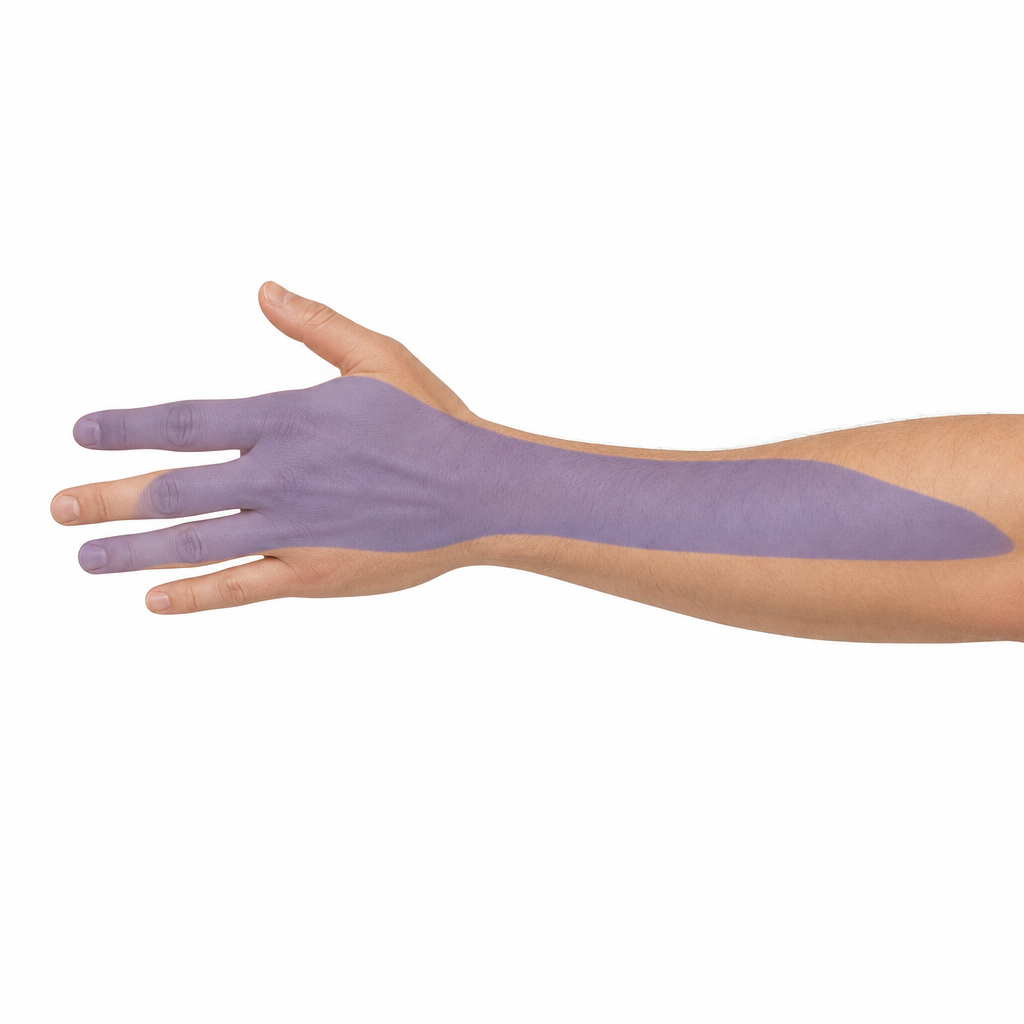
Subclavian steal syndrome is due to what?
What is the primary action of the anconeus muscle?
A 23-year-old woman sustains a deep cut to her ring finger by a kitchen knife and is unable to move the metacarpophalangeal joint. Which of the following pairs of nerves was most likely damaged?
Which carpal bone is described as being both the middle and the largest?
'Dropped shoulder' occurs due to paralysis of which muscle?
What anatomical structure is found within the anatomical snuff box?
What is true about the deep palmar arch?
Which of the following structures is NOT found within the carpal tunnel?
The distal end of the humerus develops from how many ossification centers?
In a man lifting a suitcase, posterior dislocation of the glenohumeral joint is prevented by which of the following muscles?
Explanation: **Explanation:** Subclavian Steal Syndrome (SSS) occurs due to a high-grade stenosis or occlusion of the subclavian artery **proximal to the origin of the vertebral artery**. **Why Option B is Correct:** In anatomical terms, the **vertebral artery** typically arises from the **first part** of the subclavian artery. Therefore, for "steal" to occur, the blockage must be distal to the beginning of the subclavian but proximal to the vertebral takeoff. While many textbooks describe the blockage in the "distal first part," in the context of standardized competitive exams like NEET-PG, the **second part** (located posterior to the scalenus anterior) is the classic answer choice representing a blockage that forces blood to flow retrogradely down the ipsilateral vertebral artery to supply the arm, "stealing" blood from the cerebral circulation. **Why Other Options are Incorrect:** * **Option A:** Blockage at the very beginning of the first part (pre-vertebral) is the most common site clinically, but if the blockage is too proximal, collateral pathways may differ. * **Option C:** Blockage of the **third part** is distal to the origin of the vertebral artery. While this causes limb ischemia, it **cannot** cause a "steal" because the vertebral artery remains patent and proximal to the obstruction. * **Option D:** This is a venous pathology (e.g., Paget-Schroetter syndrome) and has no relation to the arterial hemodynamics of the vertebral system. **NEET-PG High-Yield Pearls:** * **Clinical Presentation:** Patients present with **vertebrobasilar insufficiency** (dizziness, vertigo, syncope) triggered by **arm exercise**. * **Physical Exam:** A significant difference in blood pressure (usually **>20 mmHg**) between the two arms is a hallmark sign. * **Most Common Side:** The **left side** is more frequently involved (due to direct aortic origin). * **Reverse Flow:** The definitive diagnostic finding on Doppler ultrasound is **retrograde flow** in the ipsilateral vertebral artery.
Explanation: **Explanation:** The **Anconeus** is a small, triangular muscle located on the posterior aspect of the elbow. While it is often described as a weak extensor of the elbow, its primary functional role is the **"screwing movement"** of the elbow. 1. **Why Option A is Correct:** During the final stages of elbow extension, the anconeus contracts to pull the ulna laterally. This lateral abduction of the ulna allows the olecranon to lock into the olecranon fossa of the humerus, effectively "screwing" or stabilizing the joint in full extension. It also serves to pull the capsule of the elbow joint posteriorly to prevent it from being pinched during extension. 2. **Why Other Options are Incorrect:** * **B. Elbow flexion:** This is performed by the Brachialis (prime mover), Biceps Brachii, and Brachioradialis. The anconeus is an extensor. * **C. Forearm supination:** This is primarily the function of the Supinator muscle and the Biceps Brachii. * **D. Adduction of the arm:** This involves muscles acting on the glenohumeral joint, such as the Pectoralis major and Latissimus dorsi. **High-Yield Clinical Pearls for NEET-PG:** * **Nerve Supply:** Radial Nerve (C7, C8, T1). Specifically, it is supplied by the nerve to the medial head of the triceps. * **Origin/Insertion:** Originates from the posterior surface of the lateral epicondyle of the humerus and inserts into the lateral surface of the olecranon process. * **Clinical Significance:** It is considered a continuation of the triceps brachii and helps in stabilizing the elbow joint during pronation and supination.
Explanation: The movement of the metacarpophalangeal (MCP) joints involves both **extension** and **flexion/adduction/abduction**. To lose all movement at the MCP joint of the ring finger, both the nerve supplying the extensors and the nerve supplying the intrinsic muscles must be compromised. [1] 1. **Radial Nerve:** It supplies the **Extensor Digitorum** and **Extensor Digiti Miimi** (via the Posterior Interosseous Nerve) [1]. These muscles are the primary extensors of the MCP joints. Damage leads to an inability to extend the finger at the MCP level. 2. **Ulnar Nerve:** It supplies the **Palmar and Dorsal Interossei** and the **medial two Lumbricals**. These muscles are responsible for flexion at the MCP joints and abduction/adduction of the fingers [1]. Specifically, the ring finger's intrinsic motor supply is entirely ulnar-derived. **Analysis of Incorrect Options:** * **Median Nerve:** Supplies the lateral two lumbricals (index and middle fingers). It does not significantly contribute to the motor function of the ring finger's MCP joint [1]. * **Musculocutaneous Nerve:** Supplies the anterior compartment of the arm (Biceps, Brachialis, Coracobrachialis) and provides sensation to the lateral forearm. it has no motor role in finger movement. **High-Yield Clinical Pearls for NEET-PG:** * **MCP Joint Rule:** Extension is purely **Radial nerve**; Flexion/Abduction/Adduction is primarily **Ulnar nerve** (except for the index/middle lumbricals which are Median) [1]. * **Lumbricals:** "Flex the MCP and extend the IP joints." * **Interossei:** "DAB" (Dorsal Abduct) and "PAD" (Palmar Adduct). All are supplied by the Deep branch of the Ulnar nerve (C8, T1) [1]. * **Ring Finger:** Often considered the "border" finger, but for intrinsic muscle testing in exams, it is classically associated with the Ulnar nerve.
Explanation: **Explanation:** The **Capitate** is the correct answer because it is anatomically defined as the largest carpal bone and occupies a central (middle) position within the wrist. It is located in the distal row of carpal bones, articulating with the third metacarpal. Its name is derived from the Latin word *'caput'* (head), referring to its rounded proximal projection that fits into the concavity formed by the Scaphoid and Lunate. **Analysis of Options:** * **Scaphoid:** While it is the most commonly fractured carpal bone and the largest bone in the **proximal row**, it is smaller than the Capitate. * **Pisiform:** This is a sesamoid bone (located within the Flexor Carpi Ulnaris tendon) and is the **smallest** carpal bone. * **Hamate:** Known for its "hook" (unciform process), it is a large bone in the distal row but remains smaller than the Capitate. **High-Yield Clinical Pearls for NEET-PG:** * **Ossification Center:** The Capitate is the **first** carpal bone to ossify (appearing at approximately 1–3 months of age). * **Axis of Rotation:** The Capitate serves as the center of rotation for all wrist movements. * **Fracture Risk:** The Scaphoid is the most common carpal fracture, whereas the **Lunate** is the most common carpal bone to dislocate. * **Kienböck's Disease:** Refers to avascular necrosis of the Lunate, often tested alongside carpal anatomy.
Explanation: Explanation: The **Trapezius** muscle is primarily responsible for the elevation and stabilization of the scapula. It is innervated by the **Spinal Accessory Nerve (CN XI)**. When this nerve is damaged (often due to posterior triangle neck surgeries or trauma), the trapezius loses its tone and ability to support the shoulder girdle against gravity. Consequently, the scapula moves downwards and outwards (lateral displacement), leading to the clinical presentation known as **'Dropped Shoulder.'** Patients also experience difficulty in shrugging their shoulders and performing overhead abduction (above 90°). **Analysis of Incorrect Options:** * **Deltoid:** Innervated by the Axillary nerve. Paralysis leads to loss of shoulder contour (flattening) and inability to abduct the arm from 15° to 90°, but not a "dropped" shoulder. * **Teres Major:** Acts as an adductor and medial rotator of the humerus. Its paralysis does not significantly alter the resting position of the shoulder. * **Serratus Anterior:** Innervated by the Long Thoracic Nerve. Paralysis results in **'Winging of Scapula'** (medial border of scapula becomes prominent), particularly when pushing against a wall. **Clinical Pearls for NEET-PG:** * **Trapezius vs. Serratus Anterior:** Both are required for overhead abduction (>90°). Trapezius rotates the scapula such that the glenoid cavity faces upwards. * **Nerve Injury:** The Spinal Accessory Nerve is the most common nerve injured during cervical lymph node biopsies. * **Testing:** Trapezius strength is tested by asking the patient to shrug their shoulders against resistance.
Explanation: **Explanation:** The **anatomical snuffbox** is a triangular depression on the lateral aspect of the dorsum of the hand, located at the level of the carpal bones. **1. Why the Radial Artery is Correct:** The **radial artery** is the most significant structure found within the floor of the anatomical snuffbox. After originating in the cubital fossa, the radial artery winds dorsally around the lateral aspect of the radius and carpus to enter the snuffbox. It rests directly on the scaphoid and trapezium bones, making it a clinical site where the **radial pulse** can be palpated against the bone. **2. Why the Other Options are Incorrect:** * **Axillary Nerve (A):** This nerve is located in the shoulder region, passing through the quadrangular space to innervate the deltoid and teres minor. It does not extend to the hand. * **Brachial Artery (C):** This is the main artery of the arm. It terminates in the cubital fossa by dividing into the radial and ulnar arteries; it does not reach the wrist. * **Ulnar Artery (D):** This artery travels along the medial (ulnar) side of the forearm and enters the hand via Guyon’s canal, medial to the snuffbox. **3. High-Yield NEET-PG Clinical Pearls:** * **Boundaries:** Lateral (Anterior) – Abductor pollicis longus and Extensor pollicis brevis; Medial (Posterior) – Extensor pollicis longus [1]. * **Floor:** Formed by the **Scaphoid** and **Trapezium** bones [1]. Tenderness in the snuffbox after a fall on an outstretched hand (FOOSH) is highly suggestive of a **Scaphoid fracture**. * **Contents:** Radial artery (deep), Cephalic vein (superficial), and Superficial branch of the radial nerve (superficial).
Explanation: The **Deep Palmar Arch** is a vital arterial network in the hand, primarily responsible for supplying the deep structures of the palm and the metacarpal area. ### **Explanation of the Correct Option** * **Option C is correct:** The deep palmar arch gives off **three perforating branches**. These branches pass through the proximal ends of the 2nd, 3rd, and 4th interosseous spaces to anastomose with the dorsal metacarpal arteries, providing collateral circulation between the palmar and dorsal aspects of the hand. ### **Analysis of Incorrect Options** * **Option A:** The deep palmar arch is formed primarily by the **terminal part of the radial artery**, supplemented by the deep branch of the ulnar artery. (The superficial arch is primarily formed by the ulnar artery). * **Option B:** It lies **deep to the lumbricals** and the flexor tendons. It rests directly on the proximal ends of the metacarpal shafts and the interossei muscles. * **Option D:** It gives off **three palmar metacarpal arteries** (not four), which run distally in the 2nd, 3rd, and 4th interosseous spaces to join the common palmar digital arteries from the superficial arch. ### **High-Yield Facts for NEET-PG** * **Location:** It lies approximately 1 cm proximal to the superficial palmar arch. * **Nerve Relation:** It is closely associated with the **deep branch of the ulnar nerve**, which lies in its concavity [1]. * **Allen’s Test:** Used clinically to assess the patency of the radial and ulnar arteries before arterial blood sampling, ensuring the palmar arches are intact. * **Branches Summary:** 3 Palmar metacarpal arteries, 3 Perforating branches, and Recurrent branches (to the carpus).
Explanation: The **carpal tunnel** is a fibro-osseous gateway located on the palmar aspect of the wrist, formed by the deep carpal arch and the superficial flexor retinaculum (transverse carpal ligament) [1]. ### **Why Flexor Carpi Ulnaris (FCU) is the Correct Answer** The **Flexor carpi ulnaris tendon** does not pass through the carpal tunnel. Instead, it inserts onto the **pisiform bone** (and via ligaments onto the hamate and 5th metacarpal). It lies superficial and medial to the flexor retinaculum [1]. Similarly, the **Ulnar nerve and artery** pass superficial to the retinaculum through **Guyon’s canal**, making them common "distractor" options in NEET-PG questions. ### **Analysis of Incorrect Options** A total of **10 structures** pass through the carpal tunnel: * **Median Nerve (Option A):** The most superficial structure in the tunnel [1]; its compression leads to Carpal Tunnel Syndrome. * **Flexor Digitorum Superficialis (Option B):** 4 tendons (arranged in two layers: middle and ring finger tendons are superficial to index and little finger tendons). * **Flexor Pollicis Longus (Option C):** 1 tendon, located on the radial side of the tunnel. * *Note:* The remaining 4 tendons belong to the **Flexor Digitorum Profundus**. ### **High-Yield Clinical Pearls for NEET-PG** * **Palmar Cutaneous Branch of Median Nerve:** Arises proximal to the carpal tunnel and passes **superficial** to the retinaculum [1]. Therefore, sensation over the thenar eminence is **spared** in carpal tunnel syndrome. * **Flexor Carpi Radialis (FCR):** Often considered to be in its own separate compartment/tunnel within the lateral attachment of the flexor retinaculum; it is generally **not** considered a content of the carpal tunnel proper. * **Mnemonic:** "4+4+1+1" (4 FDS + 4 FDP + 1 FPL + 1 Median Nerve).
Explanation: The distal end of the humerus is a common high-yield topic in NEET-PG Anatomy, particularly regarding its complex ossification pattern. During development, most bones are modeled in cartilage and then transformed into bone by ossification (enchondral bone formation) [1]. ### **Explanation of the Correct Answer (D)** The distal end of the humerus develops from **four** distinct secondary ossification centers. These centers appear at different ages and eventually fuse to form the distal humeral epiphysis. The four centers are: 1. **Capitulum:** The first to appear (approx. 1 year). 2. **Trochlea:** Appears around 9–10 years. 3. **Lateral Epicondyle:** Appears around 10–12 years. 4. **Medial Epicondyle:** Appears around 5 years. *Note:* While the Medial Epicondyle is anatomically part of the distal humerus, it remains an extra-articular structure and often fuses separately from the other three, which merge into a single epiphysis before uniting with the shaft. ### **Why Other Options are Incorrect** * **A (2) & C (3):** These underestimate the complexity of the elbow joint. While the proximal humerus has 3 centers, the distal end requires more to accommodate the articulation with both the radius and ulna. * **B (5):** This is incorrect as there are only four primary secondary centers for the distal humerus itself. ### **High-Yield Clinical Pearls for NEET-PG** * **CRITOE Mnemonic:** To remember the chronological order of appearance of all elbow ossification centers: **C**apitulum (1y), **R**adial head (3y), **I**nternal (Medial) epicondyle (5y), **T**rochlea (7-9y), **O**lecranon (9-11y), **E**xternal (Lateral) epicondyle (11y). * **Supracondylar Fractures:** The most common pediatric elbow fracture; understanding these centers is vital to avoid misinterpreting an ossification center as a fracture fragment on X-ray. * **Fusion:** The distal epiphysis (except the medial epicondyle) fuses with the shaft at approximately **14–17 years**, making it the "growing end" of the humerus (the proximal end fuses later, around 20 years).
Explanation: ### Explanation **Correct Option: C. Coracobrachialis** The stability of the glenohumeral joint depends on both static (ligaments/labrum) and dynamic (muscles) stabilizers. When a person carries a heavy weight, such as a suitcase, the downward force of gravity tends to pull the humeral head inferiorly and, due to the orientation of the glenoid, potentially posteriorly. The **Coracobrachialis**, along with the short head of the biceps brachii, acts as a "shunt muscle." Because its origin (coracoid process) is superior and anterior to its insertion (medial humerus), its contraction provides a strong upward and forward pull. This prevents the humeral head from slipping downward and backward (posteriorly) under the strain of a heavy load. **Analysis of Incorrect Options:** * **A. Deltoid:** While the deltoid is a powerful abductor, its primary role in a resting weighted arm is to prevent inferior displacement. It does not specifically counteract posterior dislocation in this functional context. * **B. Latissimus dorsi:** This is a powerful adductor and internal rotator. Because it inserts into the bicipital groove from behind, its contraction would actually tend to pull the humerus posteriorly or inferiorly, rather than preventing it. * **D. Supraspinatus:** This muscle initiates abduction and holds the humeral head into the glenoid cavity (compression). While it is a dynamic stabilizer, it is primarily involved in preventing inferior displacement and providing stability during the first 15 degrees of movement, rather than resisting the posterior force of a heavy suitcase. **High-Yield NEET-PG Pearls:** * **Shunt Muscles:** Muscles like the Coracobrachialis and Biceps (short head) act along the long axis of the bone to resist disarticulating forces. * **Posterior Dislocation:** Rare (only 2-5% of shoulder dislocations). Classically associated with **seizures** or **electric shocks** due to the overwhelming strength of internal rotators (Latissimus dorsi, Pectoralis major, and Subscapularis). * **Rotator Cuff:** The SITS muscles (Supraspinatus, Infraspinatus, Teres minor, Subscapularis) provide the "dynamic ligament" support for the joint.
Pectoral Region and Axilla
Practice Questions
Arm and Cubital Fossa
Practice Questions
Forearm and Hand
Practice Questions
Joints of Upper Limb
Practice Questions
Nerves of Upper Limb
Practice Questions
Arterial Supply and Venous Drainage
Practice Questions
Lymphatic Drainage
Practice Questions
Muscles and Their Actions
Practice Questions
Applied Anatomy and Clinical Correlations
Practice Questions
Surface Anatomy and Landmarks
Practice Questions
Get full access to all questions, explanations, and performance tracking.
Start For Free