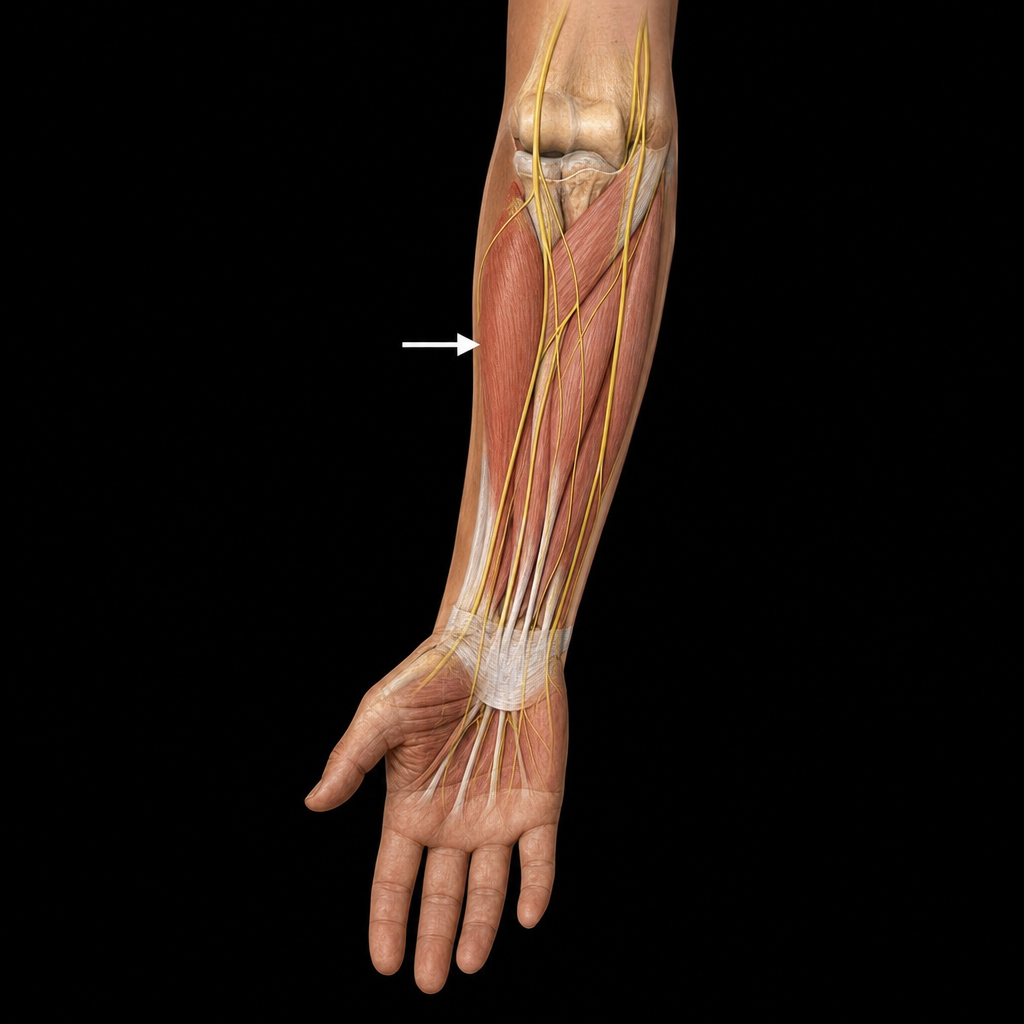
Carpal tunnel syndrome is caused by all of the following conditions EXCEPT:
Which of the following muscles is supplied by the posterior cord?
Which nerve arises from the root of the brachial plexus?
All of the following features can be observed after injury to the axillary nerve, except?
At what age does the ossification center for the lunate bone appear?
A 23-year-old male medical student fell asleep in his chair with an anatomy atlas wedged into his axilla. Upon waking, he was unable to extend the forearm, wrist, or fingers. Movements of the ipsilateral shoulder joint appear to be normal. Which of the following nerves was most likely compressed, producing these symptoms?
An extra cervical rib most commonly compresses which part of the brachial plexus?
What anatomical structure is contained within the anatomical snuffbox?
All are true about the pisiform bone, except?
Injury to the long thoracic nerve leads to which of the following clinical signs?
Explanation: **Explanation:** Carpal Tunnel Syndrome (CTS) is a clinical condition resulting from the compression of the **median nerve** as it passes through the carpal tunnel, beneath the flexor retinaculum. Any condition that increases the volume of the tunnel contents or decreases the size of the tunnel can lead to CTS. **Why Addison’s Disease is the correct answer:** Addison’s disease (primary adrenocortical insufficiency) is characterized by a deficiency of cortisol and aldosterone [2]. It typically leads to weight loss and dehydration, which does not cause fluid retention or space-occupying lesions in the carpal tunnel. In contrast, **Cushing’s syndrome** (excess cortisol) and **Acromegaly** are endocrine causes of CTS due to soft tissue hypertrophy [1]. **Analysis of other options:** * **Rheumatoid Arthritis:** This is a common cause due to **synovitis** (inflammation of the synovial sheaths of the flexor tendons), which increases pressure within the tunnel [1]. * **Hypothyroidism:** Myxedematous tissue and **glycosaminoglycan deposition** in the connective tissues lead to increased pressure on the median nerve. * **Diabetes Mellitus:** Chronic hyperglycemia leads to the glycosylation of collagen and microvascular changes, making the nerve more susceptible to compression and ischemia. **High-Yield Clinical Pearls for NEET-PG:** * **Most common nerve compressed:** Median nerve. * **Sensory loss:** Affects the lateral 3.5 digits (spares the thenar eminence due to the superficial palmar cutaneous branch arising proximal to the tunnel). * **Motor loss:** Weakness and atrophy of **LOAF** muscles (Lateral two Lumbricals, Opponens pollicis, Abductor pollicis brevis, Flexor pollicis brevis). * **Clinical Tests:** Phalen’s test (most sensitive) and Tinel’s sign. * **Other common associations:** Pregnancy (fluid retention), Amyloidosis, and Chronic Renal Failure (hemodialysis-associated).
Explanation: The **Posterior Cord** of the brachial plexus gives rise to five major nerves, easily remembered by the mnemonic **ULTRA** (Upper subscapular, Lower subscapular, Thoracodorsal, Radial, and Axillary nerves). [1] **Why Teres Minor is Correct:** The **Teres minor** is supplied by the **Axillary nerve** (C5, C6), which is a terminal branch of the posterior cord. This muscle is a key component of the rotator cuff and is responsible for lateral rotation of the humerus. **Analysis of Incorrect Options:** * **Subscapularis:** While this muscle is supplied by nerves originating from the posterior cord (Upper and Lower subscapular nerves), the question asks for the muscle supplied by the cord's derivatives. In many exam contexts, if a specific terminal branch muscle like Teres minor is present, it is the preferred answer. However, technically, Subscapularis is also supplied by posterior cord branches. * **Coracobrachialis:** Supplied by the **Musculocutaneous nerve**, which arises from the **Lateral cord**. * **Long head of biceps:** Also supplied by the **Musculocutaneous nerve** (Lateral cord). **High-Yield Clinical Pearls:** 1. **Axillary Nerve Landmark:** It passes through the **quadrangular space** alongside the posterior circumflex humeral artery. 2. **Regimental Badge Area:** Injury to the axillary nerve (often via surgical neck fractures of the humerus) leads to paralysis of the deltoid and teres minor, and loss of sensation over the lateral shoulder. 3. **Posterior Cord Nerves (ULTRA):** * **U**pper subscapular (Subscapularis) * **L**ower subscapular (Subscapularis & Teres major) * **T**horacodorsal (Latissimus dorsi) [1] * **R**adial (Extensors of arm/forearm) * **A**xillary (Deltoid & Teres minor)
Explanation: **Explanation:** The brachial plexus is organized into Roots, Trunks, Divisions, Cords, and Branches. Understanding which nerves arise from each level is a high-yield topic for NEET-PG. **Why Option A is correct:** The **Nerve to serratus anterior** (also known as the **Long Thoracic Nerve of Bell**) arises directly from the **roots** of the brachial plexus, specifically from the ventral rami of **C5, C6, and C7**. It is one of only two major nerves arising from the roots (the other being the Dorsal Scapular Nerve, C5). **Why the other options are incorrect:** * **Axillary nerve:** Arises from the **Posterior Cord** (C5, C6). * **Ulnar nerve:** Arises from the **Medial Cord** (C7, C8, T1). * **Suprascapular nerve:** Arises from the **Superior Trunk** (C5, C6). It is important to note that the trunks only give off two nerves: the Suprascapular nerve and the Nerve to Subclavius. **High-Yield Clinical Pearls for NEET-PG:** 1. **Winged Scapula:** Injury to the Long Thoracic Nerve (often during radical mastectomy or chest tube insertion) leads to paralysis of the serratus anterior, causing the medial border of the scapula to protrude ("winging"). The patient will also have difficulty with overhead abduction (above 90°). 2. **Erb’s Point:** This is the site on the Upper Trunk where six nerves meet. Injury here (Erb's Palsy) typically involves C5-C6 roots. 3. **Mnemonic for Roots:** Remember "**L**ong **D**istance" for nerves from roots (**L**ong Thoracic and **D**orsal Scapular).
Explanation: **Explanation:** The **axillary nerve (C5, C6)** is a branch of the posterior cord of the brachial plexus. It supplies the deltoid and teres minor muscles and provides sensory innervation to the skin over the lower half of the deltoid (Regimental badge area). **Why "Loss of overhead abduction" is the correct answer:** Abduction of the arm is a multi-stage process involving different muscles: 1. **0°–15°:** Initiated by the **Suprascapular nerve** (Supraspinatus). 2. **15°–90°:** Carried out by the **Axillary nerve** (Deltoid). 3. **90°–180° (Overhead):** Produced by the rotation of the scapula by the **Long thoracic nerve** (Serratus anterior) and the **Spinal accessory nerve** (Trapezius). Since overhead abduction is primarily the function of the Serratus anterior and Trapezius, it remains intact even if the axillary nerve is damaged. **Analysis of Incorrect Options:** * **Loss of rounded contour:** The deltoid muscle gives the shoulder its rounded shape. Paralysis leads to a "flat shoulder" or "squared-off" appearance. * **Loss of sensation (Lateral upper arm):** The axillary nerve gives off the **upper lateral cutaneous nerve of the arm**, which supplies the "Regimental badge area." * **Atrophy of the deltoid:** Denervation of the deltoid leads to muscle wasting, making the underlying greater tubercle of the humerus prominent. **High-Yield Clinical Pearls for NEET-PG:** * **Common sites of injury:** Surgical neck of the humerus fracture and anterior dislocation of the shoulder joint. * **Regimental Badge Sign:** Sensory loss over the lower deltoid is the most reliable clinical sign of axillary nerve injury. * **Quadrangular Space:** The axillary nerve passes through this space along with the posterior circumflex humeral artery.
Explanation: **Explanation:** The ossification of carpal bones follows a predictable chronological sequence, which is a high-yield topic for determining skeletal age in pediatric radiology. **1. Why the correct answer is right:** The **Lunate** bone typically begins to ossify at **4 years** of age. Carpal ossification generally proceeds in a spiral fashion, starting from the largest bone and moving toward the smallest. The sequence is: * **Capitate:** 1–3 months (First to appear) * **Hamate:** 2–4 months * **Triquetral:** 2–3 years * **Lunate: 4 years** * **Scaphoid, Trapezium, and Trapezoid:** 5–6 years * **Pisiform:** 10–12 years (Last to appear) **2. Why the incorrect options are wrong:** * **Option A (Birth):** No carpal bones are ossified at birth. The wrist is entirely cartilaginous at this stage. * **Option B (2nd Month):** This is the timing for the **Capitate** and **Hamate**, the first bones to appear. * **Option D (12 Years):** This corresponds to the ossification of the **Pisiform**, which is a sesamoid bone within the Flexor Carpi Ulnaris tendon and the last carpal bone to ossify. **3. Clinical Pearls for NEET-PG:** * **Mnemonic for Sequence:** "**C**apitate, **H**amate, **T**riquetral, **L**unate, **S**caphoid, **T**rapezium, **T**rapezoid, **P**isiform" (Can He Tell Little Sister To Take Photos). * **Rule of Thumb:** Generally, one carpal bone appears for every year of age until age 7 (excluding the pisiform). * **Clinical Significance:** Delayed ossification can indicate endocrine disorders (e.g., hypothyroidism) or constitutional growth delay. * **Kienböck's Disease:** A high-yield clinical condition involving avascular necrosis of the lunate.
Explanation: ### Explanation **1. Why the Radial Nerve is Correct:** The clinical presentation describes **"Saturday Night Palsy"** (or in this case, "Anatomy Student Palsy"). Compression of the **Radial nerve** in the axilla—often due to pressure from a chair back or crutches—leads to a loss of function in all muscles supplied by the nerve distal to the site of injury. * **Triceps Brachii:** Loss of forearm extension. * **Extensor Carpi Radialis/Ulnaris:** Loss of wrist extension (Wrist drop). * **Extensor Digitorum:** Loss of finger extension at the MCP joints. Since the compression occurred in the axilla, the long head of the triceps is involved, explaining the inability to extend the forearm. **2. Why the Incorrect Options are Wrong:** * **Lateral Cord:** This gives rise to the Musculocutaneous nerve. Injury would result in weak elbow flexion (Biceps) and sensory loss on the lateral forearm, not loss of extension. * **Medial Cord:** This gives rise to the Ulnar nerve. Injury would cause "Claw hand" and loss of intrinsic hand muscle function, but wrist/finger extension would remain intact. * **Median Nerve:** Injury would affect forearm pronation, wrist flexion, and thumb opposition (Ape thumb deformity), but would not cause wrist drop. **3. High-Yield Clinical Pearls for NEET-PG:** * **Level of Lesion:** If the Radial nerve is injured in the **spiral groove** (e.g., mid-shaft humerus fracture), the Triceps is usually spared (extension of forearm is possible), but wrist drop still occurs. * **Sensory Loss:** In axillary compression, there is sensory loss over the posterior arm, forearm, and the dorsal web space of the thumb. * **Rule of Thumb:** Radial nerve = **Extensors** (Great Extensor Nerve). If you can't "hitchhike" or "extend," think Radial.
Explanation: The **Lower Trunk (C8-T1)** of the brachial plexus is the most vulnerable structure in the presence of a cervical rib. **1. Why the Lower Trunk is correct:** A cervical rib is a supernumerary rib arising from the 7th cervical vertebra. As it extends laterally and anteriorly, it creates a narrow "bottleneck" in the scalene triangle. The lower trunk of the brachial plexus (formed by C8 and T1 roots) must arch over this extra rib or its fibrous band to reach the axilla. This anatomical positioning subjects the lower trunk to chronic mechanical compression or friction, leading to **Thoracic Outlet Syndrome (TOS)** [1]. Clinically, this manifests as wasting of the intrinsic muscles of the hand (T1) and sensory loss along the medial aspect of the forearm and hand (C8). **2. Why other options are incorrect:** * **Upper (C5-C6) and Middle (C7) Trunks:** These structures are positioned higher in the neck and do not come into direct contact with the cervical rib. They are more commonly involved in Erb’s palsy or trauma rather than compression by a cervical rib. * **Lateral Cord:** The cords are located distal to the trunks, behind the pectoralis minor muscle. Compression by a cervical rib occurs more proximally at the level of the trunks/roots. **3. Clinical Pearls for NEET-PG:** * **Vascular Involvement:** The **Subclavian Artery** is also frequently compressed (located anterior to the lower trunk), leading to a diminished radial pulse and cold extremities [1]. * **Adson’s Test:** A classic clinical test where the radial pulse disappears when the patient extends their neck and rotates the head toward the affected side while taking a deep breath. * **Differential Diagnosis:** Must be distinguished from Pancoast tumor (which also affects the lower trunk) and Ulnar nerve entrapment at the elbow.
Explanation: The **anatomical snuffbox** is a triangular depression on the radial aspect of the dorsum of the hand. It is a high-yield topic for NEET-PG, particularly regarding its boundaries and contents [1]. ### **Explanation of the Correct Answer** **A. Radial Artery:** This is the primary structure found in the floor of the snuffbox. After giving off the superficial palmar branch, the radial artery winds dorsally around the lateral side of the wrist, passing deep to the tendons of the abductor pollicis longus and extensor pollicis brevis to enter the snuffbox. Here, its pulsations can be palpated against the scaphoid and trapezium bones. ### **Why Other Options are Incorrect** * **B. Brachial Artery:** This artery terminates in the cubital fossa by dividing into the radial and ulnar arteries; it does not reach the wrist. * **C. Ulnar Artery:** This artery enters the hand via the Guyon’s canal on the medial (ulnar) side, far from the radial-sided snuffbox. * **D. Interosseous Artery:** These are branches of the ulnar artery that supply the deep muscles of the forearm and do not pass through the snuffbox. ### **Clinical Pearls for NEET-PG** 1. **Boundaries:** * **Anterior (Radial):** Tendons of Abductor Pollicis Longus (APL) and Extensor Pollicis Brevis (EPB) [1]. * **Posterior (Ulnar):** Tendon of Extensor Pollicis Longus (EPL) [1]. 2. **Floor:** Formed by the **Scaphoid** and **Trapezium** bones [1]. Tenderness in the snuffbox floor after a fall on an outstretched hand (FOOSH) is highly suggestive of a **Scaphoid fracture**. 3. **Other Contents:** The **Cephalic vein** begins in the snuffbox, and the **Superficial branch of the radial nerve** crosses over the tendons forming its boundaries.
Explanation: ### Explanation The **pisiform** is a unique carpal bone located in the proximal row of the wrist. Understanding its developmental and anatomical characteristics is crucial for NEET-PG. **1. Why Option C is correct (The "Except" statement):** Carpal bones are cartilaginous at birth and ossify in a specific chronological order [1]. The pisiform is the **last carpal bone to ossify**, typically appearing between the ages of **9 and 12 years**. Therefore, it is radiologically invisible on a newborn X-ray, making this statement false. **2. Analysis of other options:** * **Option A:** True. As mentioned, it is the final carpal bone to undergo ossification. (Mnemonic for order: **S**o **L**ong **T**ill **P**inkie, **H**ere **C**omes **T**he **T**humb — Scaphoid, Lunate, Triquetrum, **Pisiform**, Hamate, Capitate, Trapezoid, Trapezium. *Note: Capitate is the first to ossify at 1-3 months.*) * **Option B:** True. The pisiform serves as the insertion point for the **Flexor Carpi Ulnaris (FCU)** muscle. * **Option D:** True. It is anatomically classified as a **sesamoid bone** because it develops within the tendon of the Flexor Carpi Ulnaris. **3. Clinical Pearls & High-Yield Facts:** * **Articulations:** Unlike other carpals, it only has one articular facet (for the triquetrum) and does not participate in the radiocarpal (wrist) joint. * **Guyon’s Canal:** The pisiform forms the medial boundary of the ulnar canal (Guyon’s canal), which transmits the ulnar nerve and artery. * **Attachments:** Apart from the FCU, it provides attachment to the **pisohamate ligament**, **pisotriquetral ligament**, and the **abductor digiti minimi**. * **Palpation:** It is the most prominent bone on the ulnar side of the distal wrist crease.
Explanation: **Explanation:** The **long thoracic nerve (Nerve of Bell)** arises from the roots of the brachial plexus (**C5, C6, C7**). It supplies the **Serratus Anterior** muscle, which is responsible for protracting the scapula and keeping its medial border closely applied to the thoracic wall. 1. **Why "Winging of Scapula" is correct:** When the long thoracic nerve is injured (often due to trauma, radical mastectomy, or heavy lifting), the Serratus Anterior is paralyzed. Consequently, the medial border and inferior angle of the scapula become abnormally prominent, especially when the patient attempts to push against a wall. This clinical sign is known as **Winging of Scapula**. 2. **Why other options are incorrect:** * **Pointing Index:** Also known as "Ape Hand" or "Ochsner’s Test" sign, this occurs due to **Median nerve** injury, leading to the inability to flex the index finger. * **Claw Hand:** This is characteristic of **Ulnar nerve** injury, resulting in hyperextension at the metacarpophalangeal joints and flexion at the interphalangeal joints. * **Wrist Drop:** This is caused by **Radial nerve** injury (e.g., Saturday night palsy or mid-shaft humerus fracture), leading to paralysis of the wrist extensors. **High-Yield Clinical Pearls for NEET-PG:** * **Mnemonic for Roots:** "C5, 6, 7 raise your arms to heaven" (Long thoracic nerve). * **Serratus Anterior** is also known as the **"Boxer’s Muscle"** because it is essential for the forward punching motion. * Injury to the **Spinal Accessory Nerve** can also cause winging, but the scapula moves laterally and downwards, whereas in Long Thoracic injury, it moves medially and upwards.
Pectoral Region and Axilla
Practice Questions
Arm and Cubital Fossa
Practice Questions
Forearm and Hand
Practice Questions
Joints of Upper Limb
Practice Questions
Nerves of Upper Limb
Practice Questions
Arterial Supply and Venous Drainage
Practice Questions
Lymphatic Drainage
Practice Questions
Muscles and Their Actions
Practice Questions
Applied Anatomy and Clinical Correlations
Practice Questions
Surface Anatomy and Landmarks
Practice Questions
Get full access to all questions, explanations, and performance tracking.
Start For Free