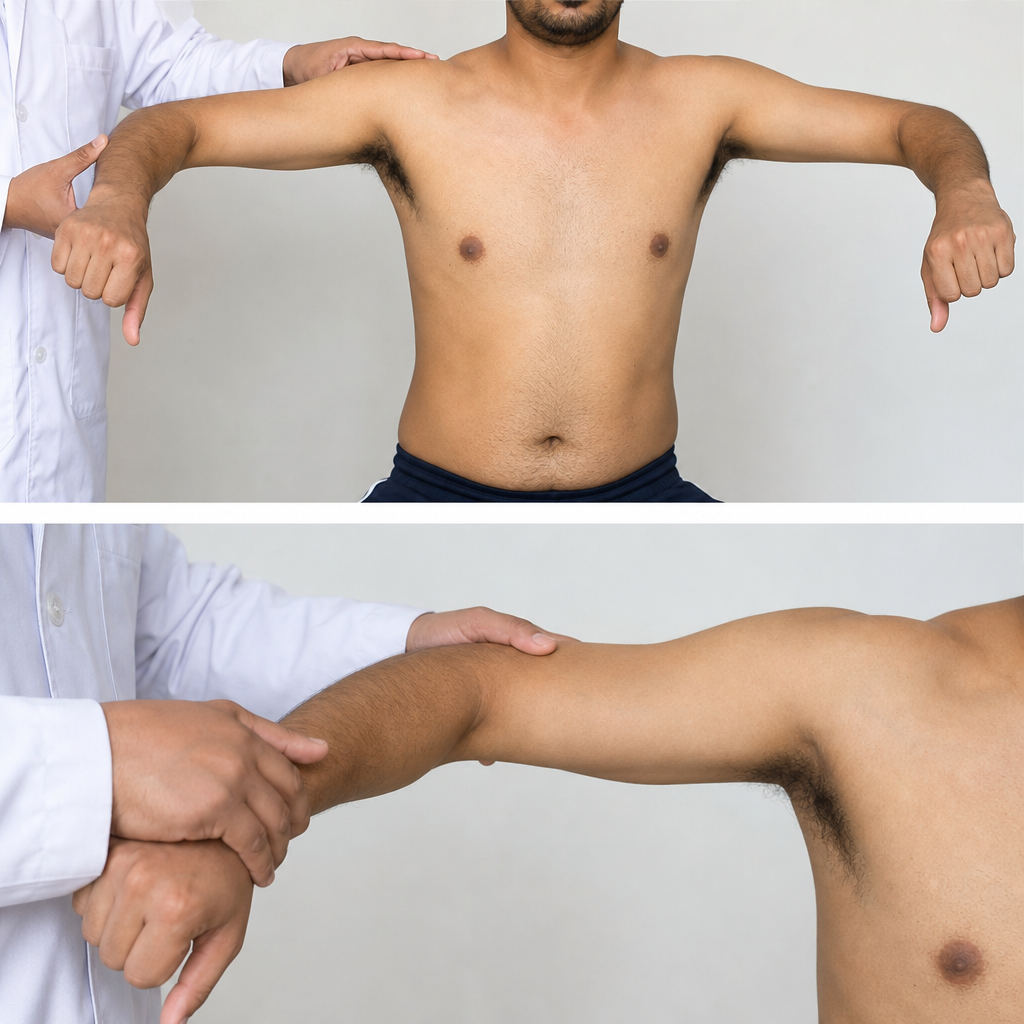
A rock climber falls on their shoulder, resulting in a chipping off of the lesser tubercle of the humerus. Which of the following structures would most likely have structural and functional damage?
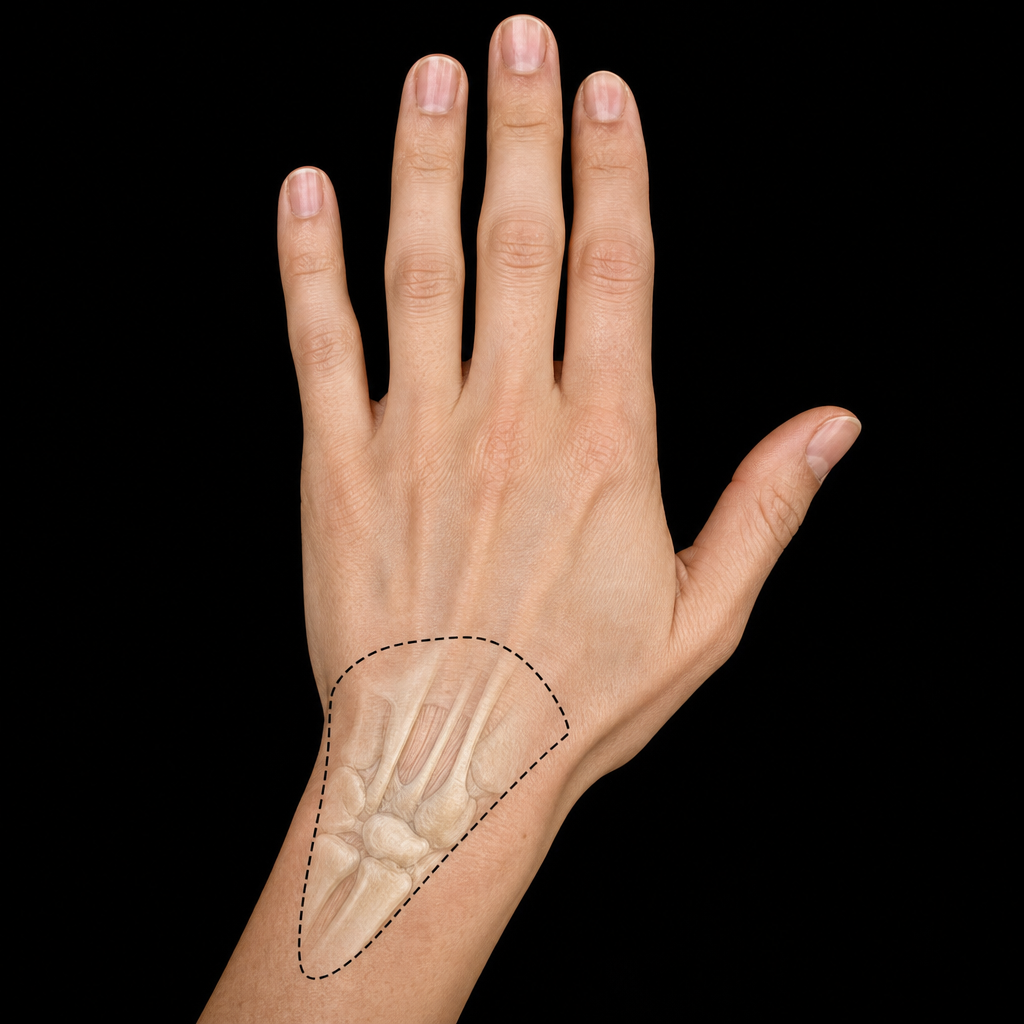
A patient has a tiny (0.2 cm), but exquisitely painful tumor under the nail of her index finger. Prior to surgery to remove it, local anesthetic block to a branch of which of the following nerves would be most likely to achieve adequate anesthesia?
Which nerve passes through the spiral groove of the humerus?
Injury to which of the following nerves leads to foot drop?
What is the nerve injury that causes a "claw hand" deformity as shown in the image?

Which of the following arteries does NOT participate in the anastomosis around the scapula?
Which among the following muscles receives dual nerve supply?
Postoperative examination revealed that the medial border and inferior angle of the left scapula became unusually prominent (projected posteriorly) when the arm was carried forward in the sagittal plane, especially if the patient pushed with outstretched arm against heavy resistance (e.g., a wall). What muscle must have been denervated during the axillary dissection?
All of the following statements about the brachial plexus are true EXCEPT:
The image shows a clinical finding in a patient's upper limb. Based on these findings, at which anatomical level has the patient most likely sustained a lesion?

Explanation: **Explanation:** The correct answer is **Subscapularis muscle**. **1. Why Subscapularis is correct:** The humerus has two primary bony projections at its proximal end: the greater and lesser tubercles. The **Subscapularis** is the only member of the rotator cuff (SITS) muscles that inserts onto the **lesser tubercle**. It originates from the subscapular fossa and acts as the primary internal rotator of the humerus. A fracture or "chipping off" of the lesser tubercle directly compromises the insertion point of the subscapularis, leading to both structural damage and functional loss of internal rotation. **2. Why the other options are incorrect:** The remaining three rotator cuff muscles insert onto the **greater tubercle** of the humerus in a specific superior-to-inferior sequence: * **A. Supraspinatus:** Inserts onto the highest impression of the greater tubercle (responsible for initiating abduction). * **B. Infraspinatus:** Inserts onto the middle impression of the greater tubercle (responsible for external rotation). * **D. Teres minor:** Inserts onto the lowest impression of the greater tubercle (responsible for external rotation). **Clinical Pearls for NEET-PG:** * **SITS mnemonic:** **S**upraspinatus, **I**nfraspinatus, **T**eres minor (Greater tubercle) and **S**ubscapularis (Lesser tubercle). * **Bicipital Groove:** Located between the two tubercles; it houses the long head of the biceps brachii tendon. * **Lift-off Test:** A clinical exam used to assess subscapularis integrity. If the patient cannot lift their hand away from their lower back, it indicates subscapularis weakness or injury. * **Nerve Supply:** Subscapularis is supplied by the upper and lower subscapular nerves (C5, C6).
Explanation: ### Explanation **Correct Option: B. Median nerve** The clinical presentation describes a **Glomus tumor**, a benign but highly painful vascular neoplasm typically found in the subungual (under the nail) region of the fingers [3]. The **Median nerve** provides sensory innervation to the palmar aspect of the lateral three and a half digits (thumb, index, middle, and lateral half of the ring finger) [2]. Crucially, it also supplies the **dorsal aspect of the distal phalanges (nail beds)** of these same fingers. Therefore, to anesthetize the nail bed of the index finger, a block of the median nerve (or its digital branches) is required [1]. **Why other options are incorrect:** * **A. Axillary nerve:** Supplies the deltoid and teres minor muscles and the skin over the lower deltoid (regimental badge area). It does not extend to the hand. * **C. Musculocutaneous nerve:** Continues as the lateral cutaneous nerve of the forearm. It provides sensation to the lateral forearm but does not supply the digits. * **D. Radial nerve:** While the superficial branch of the radial nerve supplies the dorsal skin of the lateral hand, it only reaches the proximal and middle phalanges. It does **not** supply the nail beds of the index, middle, or ring fingers. **High-Yield Clinical Pearls for NEET-PG:** * **Glomus Tumor Triad:** Paroxysmal pain, pinpoint tenderness, and cold hypersensitivity [3]. * **Nerve Supply of Nail Beds:** * Index, Middle, and Lateral half of Ring finger: **Median Nerve**. * Little finger and Medial half of Ring finger: **Ulnar Nerve**. * Thumb: **Median Nerve**. * **Safe Anesthesia:** When performing a digital nerve block, **never use epinephrine** (adrenaline) with the local anesthetic, as it can cause vasoconstriction of end-arteries leading to digital gangrene.
Explanation: Explanation: 1. Correct Answer: Radial Nerve The Radial Nerve (C5-T1) is the correct answer because it travels within the spiral groove (also known as the radial groove) located on the posterior aspect of the shaft of the humerus. It is accompanied in this groove by the profunda brachii artery. The nerve enters the groove after passing through the triangular space and exits by piercing the lateral intermuscular septum to enter the anterior compartment of the arm. 2. Analysis of Incorrect Options: * Ulnar Nerve: This nerve passes posterior to the medial epicondyle of the humerus (the "funny bone" area), not the spiral groove. * Musculocutaneous Nerve: This nerve pierces the coracobrachialis muscle and travels between the biceps brachii and brachialis muscles in the anterior compartment. * Interosseous Nerve: The Anterior and Posterior interosseous nerves are branches of the Median and Radial nerves, respectively, and are located in the forearm, not the humeral shaft. 3. Clinical Pearls & High-Yield Facts for NEET-PG: * Fracture Site: Mid-shaft humerus fractures commonly injure the radial nerve in the spiral groove, leading to Wrist Drop (loss of extension of the wrist and metacarpophalangeal joints). * Sparing of Triceps: In mid-shaft fractures, the long and medial heads of the triceps are often spared because their nerve branches arise proximal to the spiral groove. * Saturday Night Palsy: Compression of the radial nerve in the spiral groove (e.g., leaning over a chair) leads to temporary palsy. * Rule of Three: Remember the nerves related to the humerus: Axillary (Surgical neck), Radial (Spiral groove), Ulnar (Medial epicondyle) — Mnemonic: ARU.
Explanation: The correct answer is **Radial nerve**, though this question contains a common clinical "trap" regarding nomenclature. ### **1. Why Radial Nerve is the Correct Answer** In the context of the **Upper Limb**, the Radial nerve is responsible for the extension of the wrist and fingers [3]. Injury to the radial nerve (commonly at the spiral groove or due to "Saturday Night Palsy") leads to **Wrist Drop**. [2] **Note on the Question:** While "Foot Drop" is classically associated with the Common Peroneal Nerve (Lower Limb), in many medical examinations, the term is used analogously to describe the loss of extension. However, if this question appears in an **Upper Limb** section, "Foot Drop" is often a misnomer or a distractor for **Wrist Drop**. If the question intended to ask about the lower limb, Peroneal nerve would be the answer; but since the subject is Upper Limb, the examiner is testing the functional equivalent (extensor paralysis), which is the Radial Nerve. ### **2. Analysis of Incorrect Options** * **B. Ulnar Nerve:** Injury leads to **"Claw Hand"** (main en griffe) due to paralysis of the intrinsic hand muscles (interossei and lumbricals 3 & 4) [3]. * **C. Median Nerve:** Injury leads to **"Ape Thumb Deformity"** or **"Pointing Index"** (Ochsner’s test) due to loss of thenar muscles and lateral lumbricals [1]. * **D. Peroneal Nerve:** This nerve is located in the **Lower Limb**. Its injury causes true **Foot Drop**. In an Upper Limb specific module, this is considered an "out of system" distractor. ### **3. Clinical Pearls for NEET-PG** * **Radial Nerve:** The "Nerve of Extension." High-yield sites of injury: Axilla (Crutch palsy), Spiral groove (Humerus fracture), and Posterior Interosseous Nerve (PIN) at the Arcade of Frohse [2]. * **Wrist Drop vs. Finger Drop:** If the injury is distal to the elbow (PIN palsy), the patient may have finger drop but **spared** wrist extension (due to ECRL being supplied higher up) [3]. * **The "Rule of Drops":** * Wrist Drop = Radial Nerve * Foot Drop = Common Peroneal Nerve
Explanation: ***Ulnar nerve injury*** - The **ulnar nerve** innervates the **lumbricals to the ring and little fingers**, and when injured, causes **hyperextension at MCP joints** and **flexion at IP joints**, creating the characteristic **claw hand deformity**. - Loss of **interosseous muscles** and medial lumbricals results in inability to flex MCP joints and extend IP joints of the 4th and 5th digits. *Radial nerve injury* - Causes **wrist drop** due to loss of **wrist extensors** and **finger extensors** at the MCP joints. - Results in inability to extend the wrist and fingers, not the claw hand deformity seen with ulnar nerve injury. *Median nerve injury* - Causes **ape hand deformity** with loss of **thenar muscles** and inability to oppose the thumb. - Affects **lumbricals to index and middle fingers** but does not produce the characteristic claw hand involving ring and little fingers. *Axillary nerve injury* - Primarily affects the **deltoid muscle** causing inability to abduct the arm beyond 15 degrees. - Does not cause any hand deformities as it does not innervate muscles of the hand or forearm.
Explanation: ### Explanation The **scapular anastomosis** is a critical collateral circulation network that allows blood to reach the upper limb if the subclavian or axillary artery is obstructed. It primarily occurs between branches of the first part of the subclavian artery and the third part of the axillary artery. **Why "Infrascapular artery" is the correct answer:** There is no anatomical structure formally named the "infrascapular artery" involved in this network. This is a distractor term often confused with the *infraspinatus* branch of the suprascapular artery or the *subscapular* artery. Because it does not exist as a primary participating vessel, it is the correct choice for a "NOT" question. **Analysis of other options:** * **A. Circumflex scapular artery:** A branch of the **subscapular artery** (3rd part of the axillary artery). it curves around the lateral border of the scapula to enter the infraspinous fossa. * **B. Suprascapular artery:** A branch of the **thyrocervical trunk** (1st part of the subclavian artery). It passes over the superior transverse scapular ligament to reach the supraspinous and infraspinous fossae. * **C. Transverse cervical artery:** Specifically its **deep branch** (also known as the **dorsal scapular artery**). It runs along the medial (vertebral) border of the scapula. **High-Yield NEET-PG Pearls:** * **Location:** The anastomosis occurs mainly in the supraspinous and infraspinous fossae and along the medial border of the scapula. * **Clinical Significance:** If the axillary artery is ligated between the 1st and 3rd parts (proximal to the subscapular artery), blood flow to the arm is maintained via reversal of flow through the circumflex scapular artery. * **Mnemonic:** Remember **"S-S-D"** for the three main contributors: **S**uprascapular, **S**ubscapular (via circumflex scapular), and **D**orsal scapular arteries.
Explanation: **Explanation:** The correct answer is **Flexor digitorum profundus (FDP)**. In the context of the upper limb, certain muscles are known as "hybrid" or "composite" muscles because they are supplied by more than one nerve, typically reflecting their complex functional roles. **1. Why Flexor Digitorum Profundus is correct:** The FDP is a classic example of a hybrid muscle in the forearm [1]. It has a dual nerve supply: * **Medial half (digits 4 and 5):** Supplied by the **Ulnar nerve** (C8, T1). * **Lateral half (digits 2 and 3):** Supplied by the **Anterior Interosseous Nerve** (a branch of the Median nerve). This dual innervation explains why a high ulnar nerve palsy results in the "Ulnar Claw" (affecting the ring and little fingers), while the index and middle fingers remain functional. **2. Why the other options are incorrect:** * **Flexor digitorum superficialis:** Supplied solely by the **Median nerve**. * **Palmaris longus:** A vestigial muscle supplied solely by the **Median nerve**. * **Extensor carpi radialis:** The ECR Longus is supplied by the **Radial nerve**, and the ECR Brevis is supplied by the **Deep branch of the radial nerve** (or PIN) [3]; however, neither receives dual innervation from two different primary nerves. **3. NEET-PG High-Yield Clinical Pearls:** * **Other Hybrid Muscles of the Upper Limb:** * **Brachialis:** Musculocutaneous nerve (motor) and Radial nerve (proprioceptive). * **Pectoralis Major:** Medial and Lateral pectoral nerves. * **Adductor Magnus (Lower Limb):** Obturator and Sciatic (Tibial) nerves. * **Clinical Sign:** In **Median nerve palsy** at the wrist, the patient cannot flex the index finger at the DIP joint because the lateral half of the FDP is paralyzed [2].
Explanation: The clinical presentation described is a classic case of **"Winging of the Scapula."** **1. Why Serratus Anterior is correct:** The **Serratus anterior** muscle originates from the upper eight ribs and inserts into the costal surface of the **medial border of the scapula**. Its primary functions are **protraction** (pulling the scapula forward) and keeping the medial border of the scapula closely applied to the thoracic wall. * **Mechanism:** During axillary dissection (e.g., for breast cancer surgery), the **Long Thoracic Nerve (of Bell)** is at risk [1]. Denervation of the serratus anterior causes the medial border and inferior angle of the scapula to pull away from the rib cage and project posteriorly, especially when the patient pushes against resistance (outstretched arm). **2. Why other options are incorrect:** * **Levator scapulae & Rhomboideus major:** These muscles are supplied by the **Dorsal Scapular Nerve**. While they assist in retracting and elevating the scapula, their paralysis does not cause prominent winging during protraction. * **Pectoralis major:** Supplied by the medial and lateral pectoral nerves, it is a powerful adductor and medial rotator of the humerus [1]. It does not stabilize the scapula against the posterior thoracic wall. **3. High-Yield Clinical Pearls for NEET-PG:** * **Nerve Involved:** Long Thoracic Nerve (Roots: **C5, C6, C7** – *"C5, 6, 7 raise your wings to heaven"*). * **Clinical Sign:** Inability to abduct the arm above 90 degrees (overhead abduction) because the serratus anterior is required for upward rotation of the glenoid cavity. * **Common Causes:** Axillary lymph node dissection, chest tube insertion, or heavy carrying on the shoulder (e.g., "Backpack palsy") [1].
Explanation: The brachial plexus is formed by the ventral rami of **C5 to T1** spinal nerves. Understanding its formation is crucial for NEET-PG. **Why Option D is the Correct Answer (The False Statement):** The contribution of the **C4 root** characterizes a **pre-fixed** brachial plexus, not a post-fixed one. * **Pre-fixed plexus:** C4 contributes significantly, and T2 is absent. * **Post-fixed plexus:** T2 contributes significantly, and C5 is often reduced or absent. The plexus "shifts" downward. **Analysis of Other Options (True Statements):** * **Option A:** The **Lower Trunk** is indeed formed by the union of the C8 and T1 roots. (Upper trunk = C5-C6; Middle trunk = C7). * **Option B:** Each trunk divides into anterior and posterior divisions. The **Lateral Cord** is formed by the union of the anterior divisions of the upper and middle trunks. * **Option C:** The **Posterior Cord** is formed by the union of the posterior divisions of all three trunks (Upper, Middle, and Lower). **High-Yield Clinical Pearls for NEET-PG:** 1. **Erb’s Palsy:** Involves the
Explanation: ***Radial groove*** - The **wrist drop** shown indicates radial nerve palsy affecting the **posterior interosseous nerve** and **extensor carpi radialis longus**, which branch after the radial groove but before the elbow. - Lesion at the **spiral groove of humerus** typically spares the **triceps** (branches above this level) while affecting wrist and finger extensors, causing the characteristic wrist drop appearance. *Lower third of the forearm* - Injury here would only affect the **posterior interosseous nerve** branches, causing **finger drop** without wrist drop. - The **extensor carpi radialis longus** and **extensor carpi radialis brevis** would be spared, maintaining wrist extension capability. *Neck of the radius* - This would cause **posterior interosseous nerve palsy**, resulting in **finger extension weakness** but preserved wrist extension. - Patients can extend the wrist but cannot extend fingers at the **metacarpophalangeal joints**, unlike the complete wrist drop shown. *At the wrist* - Injury here affects only the **superficial radial nerve**, causing **sensory loss** over the dorsal hand between thumb and index finger. - **Motor function** remains intact as all motor branches have already separated proximally, so no wrist drop would occur.
Pectoral Region and Axilla
Practice Questions
Arm and Cubital Fossa
Practice Questions
Forearm and Hand
Practice Questions
Joints of Upper Limb
Practice Questions
Nerves of Upper Limb
Practice Questions
Arterial Supply and Venous Drainage
Practice Questions
Lymphatic Drainage
Practice Questions
Muscles and Their Actions
Practice Questions
Applied Anatomy and Clinical Correlations
Practice Questions
Surface Anatomy and Landmarks
Practice Questions
Get full access to all questions, explanations, and performance tracking.
Start For Free