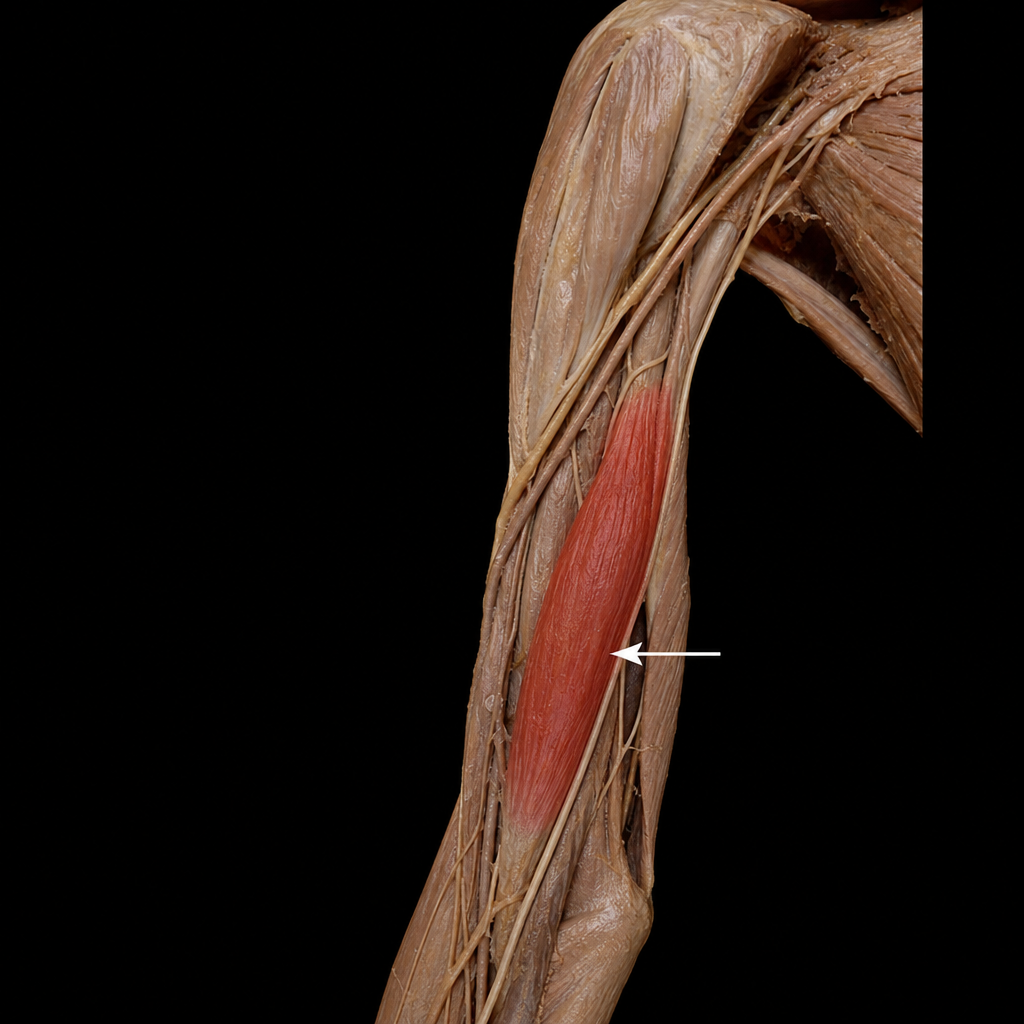
A patient woke up with difficulty in extending fingers, could make a grip and hold a pen. Dorsiflexion was normal. Sensory and motor examination was normal. Which nerve is most commonly involved?
Which of the following is NOT a constituent of the rotator cuff?
Axillary abscess is safely drained by which approach?
Which carpal bone articulates with the radius?
Which of the following arteries is present in the anatomical snuff box?
Which of the following statements about the hepatoduodenal ligament is false?
Which muscle arises from the supraglenoid tubercle?
Which muscle is inserted into the floor of the intertubercular sulcus of the humerus?
Which thumb action is totally affected in radial nerve trauma?
All of the following drain into the azygos vein, except?
Explanation: ### Explanation The clinical presentation describes a selective loss of finger extension with preserved wrist extension and sensation. This is the hallmark of **Posterior Interosseous Nerve (PIN)** palsy. **Why PIN is the correct answer:** The PIN is the deep motor branch of the Radial nerve. It supplies the extensors of the wrist and fingers. However, the **Extensor Carpi Radialis Longus (ECRL)** is supplied by the Radial nerve *proper* before it bifurcates. In PIN palsy, the ECRL remains functional, allowing for **normal or weak dorsiflexion** (often with radial deviation). The patient cannot extend the metacarpophalangeal joints because the PIN-innervated muscles (EDC, EIP, EDM) are paralyzed. Grip strength is maintained because the median and ulnar nerves (flexors) are intact. **Analysis of Incorrect Options:** * **C8-T1 Nerve Roots:** These roots contribute to the ulnar and median nerves. Damage would cause significant weakness in intrinsic hand muscles (wasting) and loss of finger flexion (grip), which contradicts the case. * **Lower Brachial Plexus:** Similar to C8-T1, this would result in **Klumpke’s Palsy**, characterized by a "claw hand" and sensory loss along the medial aspect of the forearm and hand. * **Hand Area in Cortex:** A cortical lesion (Stroke) would typically present with upper motor neuron signs (spasticity, hyperreflexia) and would rarely cause isolated finger extension loss without involving other motor functions or the face. **NEET-PG High-Yield Pearls:** * **PIN vs. Radial Nerve Palsy:** In Radial nerve palsy (e.g., Saturday Night Palsy), there is **Wrist Drop**. In PIN palsy, there is **Finger Drop** but wrist extension is preserved. * **Sensation:** The PIN is a purely motor nerve (though it carries proprioception to the wrist joint); therefore, there is **no cutaneous sensory loss**. * **Arcade of Frohse:** The most common site of PIN compression is the proximal edge of the supinator muscle.
Explanation: The **Rotator Cuff** (also known as the musculotendinous cuff) is a functional unit formed by the tendons of four muscles that blend with the fibrous capsule of the shoulder joint. Its primary role is to stabilize the multidirectional glenohumeral joint by pulling the humeral head into the glenoid cavity. **Why Teres Major is the Correct Answer:** The **Teres major** is often called the "Lat’s little helper" because it shares the same actions as the Latissimus dorsi (adduction, extension, and internal rotation). Crucially, it inserts into the **medial lip of the bicipital groove** of the humerus, rather than the tuberosities. Because it does not attach to or blend with the joint capsule, it is **not** a member of the rotator cuff. **Analysis of Other Options:** The rotator cuff muscles can be remembered by the mnemonic **SITS**: * **Supraspinatus (C):** Originates in the supraspinous fossa and inserts on the superior facet of the **greater tubercle**. It initiates the first 15° of abduction. * **Infraspinatus (D):** Originates in the infraspinous fossa and inserts on the middle facet of the **greater tubercle**. It is a powerful external rotator. * **Teres minor (B):** Originates from the lateral border of the scapula and inserts on the inferior facet of the **greater tubercle**. It also assists in external rotation. * **Subscapularis (Not listed):** The only member to insert on the **lesser tubercle**; it is the primary internal rotator. **High-Yield Clinical Pearls for NEET-PG:** 1. **Supraspinatus** is the most commonly injured muscle in rotator cuff tears. 2. **The Subacromial bursa** lies between the acromion and the supraspinatus tendon. 3. The rotator cuff is deficient **inferiorly**, which explains why most shoulder dislocations occur in an antero-inferior direction.
Explanation: ### Explanation **1. Why the Floor is the Correct Approach:** The axilla is a pyramid-shaped space containing vital neurovascular structures (axillary artery, vein, and brachial plexus). An abscess in this region is drained by an incision through the **floor of the axilla** (axillary fascia). This approach is chosen because the floor is the most superficial point of access and, more importantly, the incision is made **midway between the anterior and posterior axillary folds** and directed toward the **medial wall**. This specific direction avoids injury to the major neurovascular bundle located near the lateral wall and apex. **2. Analysis of Incorrect Options:** * **Medial Wall:** This wall is formed by the serratus anterior and the upper ribs. It contains the **long thoracic nerve** (Nerve of Bell). An incision here risks causing "winged scapula." * **Lateral Wall:** This is the narrowest part of the axilla where the humerus, coracobrachialis, and biceps brachii are located. The **axillary neurovascular bundle** lies closest to this wall; an incision here carries a high risk of life-threatening hemorrhage or permanent nerve damage. * **Anterior/Posterior Walls:** These are formed by bulky muscles (Pectoralis major anteriorly; Latissimus dorsi, Teres major, and Subscapularis posteriorly). Cutting through these muscles increases morbidity, causes significant bleeding, and limits direct access to the abscess cavity [1]. **3. Clinical Pearls for NEET-PG:** * **Direction of Incision:** Always cut midway between the folds and directed medially to protect the **axillary vein**, which is the most superficial large vessel [1]. * **Hilton’s Method:** Abscesses in areas with vital structures (like the axilla or neck) are drained using Hilton's method—incising the skin and then using blunt dissection with a hemostat to avoid vascular injury. * **Nerve at Risk:** During axillary clearance (e.g., in breast cancer surgery), the **intercostobrachial nerve** is the most commonly injured nerve, leading to numbness in the medial aspect of the upper arm [1].
Explanation: **Explanation:** The wrist joint (radiocarpal joint) is a synovial joint of the ellipsoid variety. It is formed by the articulation between the distal end of the **radius** (and the articular disc of the inferior radioulnar joint) and the proximal row of carpal bones. **Why Scaphoid is Correct:** The distal surface of the radius has two distinct articular facets: a lateral triangular facet for the **scaphoid** and a medial quadrangular facet for the **lunate**. Therefore, the scaphoid directly articulates with the radius to transmit forces from the hand to the forearm. **Analysis of Incorrect Options:** * **Trapezium (A):** This is a distal row carpal bone. It articulates with the scaphoid proximally and the first metacarpal distally (forming the thumb CMC joint), but it has no contact with the radius. * **Capitate (C):** The largest carpal bone, located in the distal row. It occupies a central position, articulating with the scaphoid and lunate proximally, but not the radius. * **Hamate (D):** A distal row bone characterized by its hook (uncus). It articulates with the triquetrum proximally and the 4th/5th metacarpals distally. **High-Yield Clinical Pearls for NEET-PG:** * **Fracture Scaphoid:** It is the most commonly fractured carpal bone. Tenderness in the **Anatomical Snuffbox** is a classic sign. Due to retrograde blood supply, it is prone to **Avascular Necrosis (AVN)**. * **Lunate Dislocation:** The lunate is the most commonly dislocated carpal bone, often resulting in Median nerve compression. * **The Ulna:** Note that the ulna does **not** articulate directly with any carpal bones; it is separated from them by the triangular fibrocartilage complex (TFCC).
Explanation: **Explanation:** The **Radial artery** is the correct answer because of its specific course through the wrist. After giving off the superficial palmar branch, the radial artery winds dorsally around the lateral aspect of the carpus, deep to the tendons of the abductor pollicis longus and extensor pollicis brevis. It then enters the **anatomical snuff box**, where it lies on the floor (formed by the scaphoid and trapezium bones). This is a high-yield clinical site where the radial pulse can be palpated against the scaphoid. **Analysis of Incorrect Options:** * **Anterior interosseous artery:** This is a branch of the common interosseous artery (from the ulnar artery). It travels deep in the forearm on the interosseous membrane and ends by joining the dorsal carpal arch; it does not enter the snuff box. * **Brachial artery:** This artery terminates in the cubital fossa by dividing into the radial and ulnar arteries. It is located far proximal to the wrist. * **Ulnar artery:** This artery enters the hand via **Guyon’s canal**, superficial to the flexor retinaculum and medial to the pisiform bone. It remains on the anterior (palmar) aspect of the wrist. **NEET-PG High-Yield Pearls:** * **Boundaries of Snuff Box:** Lateral (Abductor pollicis longus, Extensor pollicis brevis); Medial (Extensor pollicis longus). * **Contents:** Radial artery, Cephalic vein (superficial), and branches of the Superficial Radial Nerve. * **Clinical Significance:** Tenderness in the snuff box post-trauma is highly suggestive of a **Scaphoid fracture**, the most commonly fractured carpal bone.
Explanation: ### Explanation The question asks to identify the **false** statement regarding the hepatoduodenal ligament. Interestingly, in the provided options, **Option A is a true statement**, which suggests a discrepancy in the question's framing or the provided key. However, based on standard anatomical facts, here is the breakdown: **1. Why Option A is technically "True" (and why the question likely intended to ask for a different false statement):** The **lesser omentum** is composed of two parts: the **hepatogastric ligament** (connecting the liver to the lesser curvature of the stomach) and the **hepatoduodenal ligament** (connecting the liver to the duodenum) [1]. Therefore, Option A is anatomically correct. **2. Analysis of other options:** * **Option B (True):** The ligament extends specifically from the **porta hepatis** (the hilum of the liver) to the first 2 cm of the **superior part of the duodenum**. * **Option C (True):** It contains the **portal triad**: the hepatic artery proper, the common bile duct, and the portal vein [1]. The bile duct is usually lateral, the artery is medial, and the vein is posterior. * **Option D (True):** The **Pringle Maneuver** involves clamping or manually compressing the hepatoduodenal ligament to control hemorrhage from the liver during surgery by obstructing the inflow of blood from the hepatic artery and portal vein. **Clinical Pearls for NEET-PG:** * **Foramen of Winslow (Epiploic Foramen):** The hepatoduodenal ligament forms the **anterior boundary** of this opening, which connects the greater and lesser sacs. * **Pringle Maneuver Failure:** If bleeding continues despite the Pringle maneuver, the source is likely the **inferior vena cava** or the **hepatic veins** [2]. * **Contents:** Besides the portal triad, it also contains lymphatics and the hepatic plexus of nerves [1].
Explanation: The **supraglenoid tubercle** is a small bony prominence located at the superior aspect of the glenoid cavity of the scapula. It serves as the specific site of origin for the **long head of the biceps brachii**. ### Why Option A is Correct: The **long head of the biceps brachii** arises from the supraglenoid tubercle. Its tendon is unique because it is **intracapsular but extrasynovial**; it passes over the head of the humerus within the shoulder joint capsule before exiting through the bicipital groove. ### Why the Other Options are Incorrect: * **Short head of biceps (B):** Arises from the apex of the **coracoid process** of the scapula (along with the coracobrachialis). * **Long head of triceps (C):** Arises from the **infraglenoid tubercle** of the scapula. A common mnemonic to distinguish these is: **B**iceps is **S**uperior (Supraglenoid) and **T**riceps is **I**nferior (Infraglenoid). * **Coracobrachialis (D):** Arises from the apex of the **coracoid process** via a common tendon with the short head of the biceps. ### High-Yield Clinical Pearls for NEET-PG: * **SLAP Lesion:** Superior Labrum Anterior to Posterior lesions often involve the attachment site of the long head of the biceps at the supraglenoid tubercle/superior labrum. * **Nerve Supply:** The biceps brachii and coracobrachialis are supplied by the **Musculocutaneous nerve (C5-C7)**, while the triceps is supplied by the **Radial nerve (C6-C8)**. * **Yergason’s Test:** Used clinically to detect tendonitis or stability of the long head of the biceps tendon in the bicipital groove.
Explanation: The **intertubercular sulcus (bicipital groove)** of the humerus is a critical landmark for the insertion of three major muscles of the upper limb. A high-yield mnemonic to remember their arrangement from lateral to medial is **"The Lady between two Majors."** ### 1. Why Latissimus Dorsi is Correct The **Latissimus dorsi** (the "Lady") inserts into the **floor** of the intertubercular sulcus. It originates from the lower thoracic vertebrae and iliac crest, acting as a powerful adductor, extensor, and internal rotator of the arm [1]. ### 2. Analysis of Incorrect Options * **Pectoralis major (Option C):** This muscle inserts into the **lateral lip** of the bicipital groove [1]. It forms the anterior wall of the axilla. * **Teres major (Option B):** This muscle inserts into the **medial lip** of the bicipital groove. Along with the latissimus dorsi, it helps in internal rotation. * **Deltoid (Option D):** This muscle does not insert into the sulcus; it inserts into the **deltoid tuberosity** on the lateral aspect of the mid-shaft of the humerus. ### 3. NEET-PG High-Yield Pearls * **Contents of the Sulcus:** The intertubercular sulcus contains the **long head of the biceps brachii tendon** (enclosed in a synovial sheath) and the **ascending branch of the anterior circumflex humeral artery**. * **The "Lady" Mnemonic:** * **Lateral lip:** Pectoralis **Major** [1] * **Floor:** Latissimus **Dorsi** (The Lady) * **Medial lip:** Teres **Major** * **Clinical Significance:** The bicipital groove is a common site for **bicipital tendinitis**, often seen in athletes performing overhead throwing motions.
Explanation: **Explanation:** The **Radial Nerve** is the primary nerve responsible for the extension of all joints of the upper limb. In the forearm, its deep branch (Posterior Interosseous Nerve) supplies the three muscles responsible for thumb extension: **Extensor Pollicis Longus (EPL)**, **Extensor Pollicis Brevis (EPB)**, and **Abductor Pollicis Longus (APL)** [1]. Therefore, radial nerve trauma results in a total loss of thumb extension at the metacarpophalangeal and interphalangeal joints [1]. **Analysis of Options:** * **A. Abduction:** While the Abductor Pollicis Longus (Radial nerve) is lost, abduction is not "totally" affected because the **Abductor Pollicis Brevis** is supplied by the **Median Nerve**. The patient can still perform palmar abduction. * **B. Adduction:** This action is performed by the **Adductor Pollicis**, which is supplied by the **Ulnar Nerve** (deep branch). It remains intact in radial nerve injury [1]. * **D. Flexion:** Thumb flexion is performed by the **Flexor Pollicis Longus** (Anterior Interosseous Nerve/Median) and **Flexor Pollicis Brevis** (Median and Ulnar nerves) [2]. These are unaffected by radial nerve trauma. **Clinical Pearls for NEET-PG:** * **Wrist Drop:** The hallmark sign of high radial nerve injury (e.g., Saturday Night Palsy or Midshaft Humerus fracture). * **PIN Palsy:** Injury to the Posterior Interosseous Nerve causes "Finger Drop" and loss of thumb extension, but **no sensory loss** and usually no wrist drop (as ECRL is spared). * **Rule of Threes:** The radial nerve supplies three muscles for the thumb: EPL, EPB, and APL. All three are essential for extension and hitchhiking motion [1].
Explanation: The **Azygos vein** is a major venous channel that ascends through the posterior mediastinum, acting as a bridge between the superior and inferior vena cava. ### **Why Option A is the Correct Answer** The **Left Superior Intercostal Vein** typically drains into the **Left Brachiocephalic Vein**. It is formed by the union of the 2nd, 3rd, and sometimes 4th posterior intercostal veins on the left side. It crosses the arch of the aorta (between the phrenic and vagus nerves) to reach the brachiocephalic vein, rather than draining into the azygos system. ### **Analysis of Incorrect Options** * **B. Accessory hemiazygos vein:** This vein collects blood from the 5th to 8th left posterior intercostal veins. It crosses the T8 vertebral body to drain directly into the azygos vein. * **C. 5th to 11th posterior intercostals (Right):** The right side is straightforward. The 1st drains into the brachiocephalic; the 2nd-4th form the right superior intercostal vein (which enters the azygos arch); and the **5th through 11th** drain directly into the azygos vein. * **D. Esophageal veins:** The azygos vein receives several visceral tributaries, including esophageal, bronchial, and pericardial veins [1]. ### **High-Yield Clinical Pearls for NEET-PG** * **Formation:** The azygos vein is formed by the union of the **Right Ascending Lumbar** and **Right Subcostal** veins at the level of T12. * **Termination:** It arches over the root of the right lung to enter the **Superior Vena Cava (SVC)** at the level of T4. * **Portosystemic Anastomosis:** The esophageal veins provide a critical link between the portal system (Left Gastric Vein) and the systemic system (Azygos Vein). In portal hypertension, these veins dilate to form **esophageal varices**. * **Mnemonic:** On the **Right**, everything eventually hits the Azygos. On the **Left**, the "Top" (1st) and "Upper Middle" (Superior Intercostal) go to the Brachiocephalic, while the rest go to Hemiazygos/Accessory Hemiazygos.
Pectoral Region and Axilla
Practice Questions
Arm and Cubital Fossa
Practice Questions
Forearm and Hand
Practice Questions
Joints of Upper Limb
Practice Questions
Nerves of Upper Limb
Practice Questions
Arterial Supply and Venous Drainage
Practice Questions
Lymphatic Drainage
Practice Questions
Muscles and Their Actions
Practice Questions
Applied Anatomy and Clinical Correlations
Practice Questions
Surface Anatomy and Landmarks
Practice Questions
Get full access to all questions, explanations, and performance tracking.
Start For Free