What is the medial boundary of the anatomical snuffbox?
The first lumbrical canal communicates with which of the following spaces?
All of the following bony structures form the floor of the anatomical snuff box, EXCEPT?
The pronator quadratus muscle shares its innervation with which of the following muscles?
The short head of the biceps brachii muscle is attached to which anatomical structure?
Which muscle is NOT paralysed in Erb's palsy?
Clinical testing of the function of the long thoracic nerve is done by:
Paralysis of the opponens muscle leads to the loss of which of the following functions of the thumb?
Abduction of the shoulder is caused by all muscles except:
Which is the main muscle responsible for the opposition of the thumb?
Explanation: The **Anatomical Snuffbox** is a triangular depression located on the lateral aspect of the dorsum of the hand [1]. Understanding its boundaries is a high-yield topic for NEET-PG. ### **1. Why Option A is Correct** The boundaries of the snuffbox are defined by the tendons of the extrinsic muscles of the thumb [1]. * **Medial (Ulnar) Boundary:** Formed by the tendon of the **Extensor Pollicis Longus (EPL)** [1]. This tendon uses the dorsal tubercle of the radius (Lister’s tubercle) as a pulley to change direction, making it the distinct medial border. * **Lateral (Radial) Boundary:** Formed by two tendons—the **Abductor Pollicis Longus (APL)** and the **Extensor Pollicis Brevis (EPB)** [1]. ### **2. Why Other Options are Incorrect** * **Options B & C (EPB and APL):** These two tendons form the **lateral** (radial) boundary of the snuffbox, not the medial [1]. * **Option D (Flexor Carpi Ulnaris):** This is a muscle of the anterior (flexor) compartment of the forearm and is located on the palmar-medial aspect of the wrist, far from the anatomical snuffbox. ### **3. Clinical Pearls for NEET-PG** * **Floor:** Formed by the **Scaphoid** and **Trapezium** bones. Tenderness in the snuffbox after a fall on an outstretched hand (FOOSH) is highly suggestive of a **Scaphoid fracture**. * **Contents:** The **Radial Artery** passes through the floor of the snuffbox. The **Cephalic vein** begins here, and the **Superficial branch of the Radial nerve** crosses the roof. * **Roof:** Formed by skin and superficial fascia.
Explanation: The hand contains several deep fascial spaces that are clinically significant for the spread of infections. The **Thenar Space** and the **Midpalmar Space** are the two primary deep spaces of the palm, separated by a fibrous septum extending from the third metacarpal bone [1]. ### **Explanation of the Correct Answer** The **first lumbrical canal** acts as a direct anatomical conduit between the fingers and the deep palmar spaces. Specifically, the first lumbrical muscle originates from the tendon of the Flexor Digitorum Profundus (FDP) of the index finger [2]. Its fascial sheath (canal) communicates proximally with the **Thenar Space**. Therefore, an infection in the index finger can track proximally through this canal into the thenar space. ### **Analysis of Incorrect Options** * **Midpalmar Space (B):** This space communicates with the **second, third, and fourth lumbrical canals**. It lies medial to the thenar space, deep to the flexor tendons of the middle, ring, and little fingers [1]. * **Adductor Space (A):** This is a potential space located deep to the thenar space, specifically behind the adductor pollicis muscle [1]. It does not have a direct communication with the lumbrical canals. * **Hypothenar Space (D):** This space contains the hypothenar muscles and is tightly enclosed by fascia; it does not communicate with the lumbrical canals. ### **High-Yield Clinical Pearls for NEET-PG** * **Kanavel’s Signs:** Used to diagnose infectious tenosynovitis (often involving these spaces). * **Communication Rule:** * 1st Lumbrical Canal → Thenar Space. * 2nd, 3rd, & 4th Lumbrical Canals → Midpalmar Space. * **The
Explanation: The **Anatomical Snuffbox** is a triangular depression on the radial aspect of the wrist. Understanding its boundaries is high-yield for NEET-PG, as it contains vital neurovascular structures [1]. ### **Why Lunate is the Correct Answer** The **Lunate** bone is located in the proximal row of the carpus, medial to the scaphoid. It lies deep to the carpal tunnel and does not extend laterally enough to reach the floor of the anatomical snuffbox. Therefore, it does not contribute to its bony base. ### **Analysis of Other Options (The Floor)** The floor of the snuffbox is formed by the bones that lie directly beneath the radial artery as it traverses the area. From proximal to distal, these include: * **Scaphoid (Option A):** Forms the proximal part of the floor [1]. It is the most commonly fractured carpal bone, often presenting with tenderness in the snuffbox [2]. * **Trapezium (Option C):** Forms the distal part of the floor, articulating with the first metacarpal. * **Base of the First Metacarpal (Option D):** Forms the distal-most boundary of the floor. ### **Clinical Pearls for NEET-PG** * **Boundaries:** * *Anterior (Radial):* Tendons of Abductor Pollicis Longus (APL) and Extensor Pollicis Brevis (EPB) [1]. * *Posterior (Ulnar):* Tendon of Extensor Pollicis Longus (EPL) [1]. * **Contents:** The **Radial Artery** (deepest structure), the **Cephalic Vein**, and the **Superficial branch of the Radial Nerve**. Imagine [3]. * **Clinical Significance:** Tenderness in the snuffbox after a fall on an outstretched hand (FOOSH) is pathognomonic for a **Scaphoid fracture**, even if initial X-rays are negative [4].
Explanation: The Pronator Quadratus is a deep muscle of the anterior compartment of the forearm. To answer this question, one must understand the specific branching pattern of the Median nerve. 1. Why Flexor Pollicis Longus (FPL) is correct: The Median nerve gives off a major branch called the Anterior Interosseous Nerve (AIN) as it passes between the two heads of the pronator teres. The AIN supplies the "Deep Trio" of the anterior forearm: * Flexor Pollicis Longus [2] * Pronator Quadratus * Lateral half (radial half) of the Flexor Digitorum Profundus. Since both Pronator Quadratus and FPL are supplied by the AIN, they share the same innervation. 2. Why the other options are incorrect: * Flexor Digitorum Superficialis (FDS) & Palmaris Longus: These are superficial/intermediate muscles supplied by the main trunk of the Median nerve [1], not its AIN branch. * Flexor Carpi Ulnaris (FCU): This muscle is supplied by the Ulnar nerve [1]. It is one of the "one and a half" muscles in the anterior forearm not supplied by the Median nerve (the other being the medial half of the FDP). High-Yield Clinical Pearls for NEET-PG: * AIN Syndrome (Kiloh-Nevin Syndrome): Damage to the AIN results in the inability to make the "OK" sign. The patient cannot flex the interphalangeal joint of the thumb (FPL) and the distal interphalangeal joint of the index finger (FDP), resulting in a "pinch" rather than a circle. * Pure Motor Nerve: The AIN is a purely motor nerve (though it provides sensory fibers to the wrist joint capsule), so there is no cutaneous sensory loss in AIN syndrome. * Deepest Muscle: Pronator quadratus is the deepest muscle of the forearm and the chief initiator of pronation.
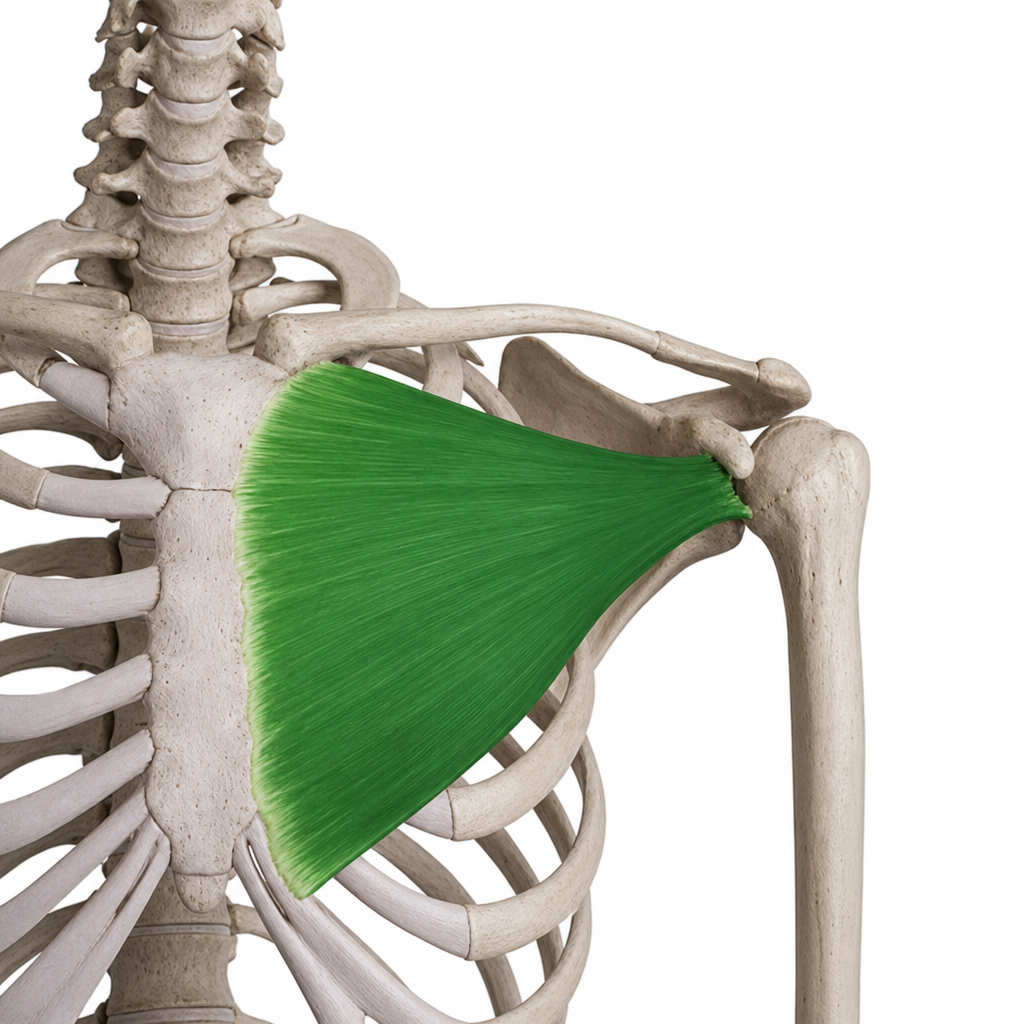
Explanation: **Explanation:** The **Biceps Brachii** is a two-headed muscle in the anterior compartment of the arm. The **short head** arises via a thick flattened tendon from the tip of the **coracoid process** of the scapula, where it shares a common origin with the coracobrachialis muscle. **Analysis of Options:** * **A. Coracoid Process (Correct):** This is the site of origin for the short head of the biceps, the coracobrachialis, and the insertion site for the pectoralis minor. * **B. Supraglenoid Tubercle:** This is the site of origin for the **long head** of the biceps brachii. The long head tendon is intracapsular but extrasynovial as it traverses the shoulder joint. * **C. Acromion Process:** This serves as the origin for the middle fibers of the deltoid muscle and provides attachment to the trapezius; it does not give origin to the biceps. * **D. Bicipital Groove (Intertubercular Sulcus):** This is the anatomical pathway through which the tendon of the **long head** of the biceps passes. It is also the site of insertion for the "Lady between two majors" (Latissimus dorsi on the floor, Pectoralis major on the lateral lip, and Teres major on the medial lip). **High-Yield NEET-PG Pearls:** * **Insertion:** Both heads of the biceps unite to insert into the **posterior part of the radial tuberosity** and the bicipital aponeurosis. * **Nerve Supply:** Musculocutaneous nerve (C5–C7). * **Action:** It is the most powerful **supinator** of the forearm at the flexed elbow and a flexor of the elbow joint. * **Clinical Sign:** Rupture of the long head tendon leads to a characteristic bunching of the muscle belly, known as the **"Popeye deformity."**
Explanation: Erb’s Palsy (Waitman’s tip deformity) is a traction injury to the upper trunk of the brachial plexus, specifically involving the C5 and C6 nerve roots. The muscles paralyzed are those innervated by nerves arising from these roots [1]. 1. Why Triceps is the correct answer: The Triceps brachii is primarily innervated by the Radial nerve, with its major root value being C7 (and C8). Since Erb’s palsy specifically spares the C7, C8, and T1 roots, the triceps remains functional. In fact, the "waiter's tip" position occurs partly because the triceps is unopposed, keeping the elbow in extension [1]. 2. Why the other options are incorrect: * Biceps (C5, C6): Innervated by the Musculocutaneous nerve. It is paralyzed, leading to the loss of elbow flexion and supination. * Brachialis (C5, C6): Also innervated by the Musculocutaneous nerve; its paralysis contributes to the inability to flex the elbow. * Brachioradialis (C5, C6): Innervated by the Radial nerve, but its fibers originate from the upper trunk. Its paralysis contributes to the loss of flexion at the mid-prone position. Clinical Pearls for NEET-PG: * Site of Injury: Erb’s Point (junction of 6 nerves). * Deformity (Policeman’s tip): Arm is Adducted (loss of Abductors: Supraspinatus/Deltoid), Medially rotated (loss of Lateral rotators: Infraspinatus/Teres minor), and Elbow is Extended with Forearm Pronated [1]. * Reflexes lost: Biceps and Supinator reflexes. * Sensory loss: A small area over the lower part of the Deltoid (Regimental badge area).
Explanation: ### Explanation **1. Why Option D is Correct:** The **long thoracic nerve** (C5, C6, C7) supplies the **Serratus Anterior** muscle. The primary functions of this muscle are protraction of the scapula and **rotation of the scapula upwards**. This upward rotation is essential for overhead abduction (elevating the arm above 90 degrees). When the long thoracic nerve is paralyzed, the patient cannot rotate the scapula sufficiently to raise the arm above the head. Clinical testing involves asking the patient to push against a wall (to check for "winging") or to raise the arm above the head. **2. Analysis of Incorrect Options:** * **Option A (Adduction against resistance):** This tests the **Pectoralis Major** (medial and lateral pectoral nerves) and **Latissimus Dorsi** (thoracodorsal nerve). * **Option B (Holding abduction against resistance):** This primarily tests the **Deltoid** (axillary nerve), which maintains abduction between 15 and 90 degrees. * **Option C (Initiating abduction):** This tests the **Supraspinatus** (suprascapular nerve), which is responsible for the first 0–15 degrees of abduction. **3. High-Yield Clinical Pearls for NEET-PG:** * **Origin:** Arises from the **roots** of the brachial plexus (C5-C7). * **Clinical Sign:** Injury leads to **"Winging of Scapula"** (medial border of the scapula becomes prominent, especially when pushing against a wall). * **Common Causes of Injury:** Radical mastectomy (axillary lymph node dissection), carrying heavy loads on the shoulder ("knapsack palsy"), or thoracic surgery. * **Mnemonic:** "C5, 6, 7 raise your arms to heaven" (refers to the nerve roots and the action of overhead abduction).
Explanation: The **Opponens Pollicis** is a key intrinsic muscle of the hand, belonging to the thenar eminence. Its primary action is **opposition**, a complex movement that involves a combination of abduction, flexion, and medial rotation of the first metacarpal at the carpometacarpal (CMC) joint. This movement allows the tip of the thumb to touch the tips of the other fingers. **Why Pinching is Correct:** Pinching (specifically "pulp-to-pulp" or "tip-to-tip" pinch) is the functional hallmark of opposition. By rotating the thumb to face the other digits, the opponens pollicis enables the precision grip required for picking up small objects. Paralysis of this muscle results in the inability to rotate the thumb across the palm, making pinching impossible. **Analysis of Incorrect Options:** * **Flexion:** Primarily performed by the **Flexor Pollicis Brevis** (thenar) [1] and **Flexor Pollicis Longus** (forearm) [1]. * **Extension:** Primarily performed by the **Extensor Pollicis Longus** and **Extensor Pollicis Brevis** (posterior compartment of the forearm) [2]. * **Abduction:** Primarily performed by the **Abductor Pollicis Brevis** (thenar) and **Abductor Pollicis Longus** (forearm) [2]. **High-Yield Clinical Pearls for NEET-PG:** * **Nerve Supply:** The Opponens Pollicis is supplied by the **Recurrent branch of the Median Nerve (C8, T1)** [2]. * **Ape Thumb Deformity:** Damage to the median nerve at the wrist (e.g., Carpal Tunnel Syndrome) leads to thenar atrophy and loss of opposition, causing the thumb to fall into the same plane as the fingers [2]. * **Mnemonic (Meatloaf):** The Median nerve supplies the **LOAF** muscles (Lateral two Lumbricals, Opponens pollicis, Abductor pollicis brevis, Flexor pollicis brevis).
Explanation: **Explanation:** The abduction of the shoulder is a complex, multi-stage movement involving several muscles acting in a coordinated sequence. The **Teres major** is the correct answer because it does not contribute to abduction; instead, it acts as an **adductor**, internal rotator, and extensor of the humerus (often called "Lat's little helper"). **Breakdown of Abduction Stages:** 1. **0°–15° (Initiation):** Primarily performed by the **Supraspinatus** (Option C). 2. **15°–90°:** Primarily performed by the **Deltoid** (multipennate fibers). 3. **90°–180° (Overhead Abduction):** Requires upward rotation of the scapula. This is achieved by the **Serratus anterior** (Option B) and the **Trapezius** (Option A) (specifically the upper and lower fibers). **Why the other options are incorrect:** * **Supraspinatus:** Essential for the first 15 degrees and stabilizes the humeral head in the glenoid cavity. * **Serratus anterior & Trapezius:** These are "scapular rotators." Without their ability to rotate the glenoid cavity upwards, the humerus would hit the acromion, preventing overhead movement. **High-Yield Clinical Pearls for NEET-PG:** * **The Scapulohumeral Rhythm:** For every 2° of humeral abduction, there is 1° of scapular rotation (2:1 ratio). * **Nerve Injuries:** Injury to the **Long Thoracic Nerve** (Serratus anterior) causes "Winging of Scapula" and inability to abduct above 90°. * **Painful Arc Syndrome:** Pain during 60°–120° of abduction usually indicates Supraspinatus tendinitis or subacromial bursitis. * **Teres Major Nerve Supply:** Lower subscapular nerve (C5, C6).
Explanation: **Explanation:** The **Opponens pollicis** is the primary muscle responsible for the complex movement of **opposition**, which allows the tip of the thumb to touch the tips of the other fingers. This movement is a combination of abduction, flexion, and medial rotation of the first metacarpal at the carpometacarpal (CMC) joint. **Why the correct answer is right:** The Opponens pollicis is a member of the **thenar eminence**. It originates from the flexor retinaculum and the tubercle of the trapezium and inserts into the entire length of the lateral border of the first metacarpal. Its specific anatomical orientation allows it to pull the first metacarpal medially and forward, rotating it to face the other digits—the defining action of opposition. **Analysis of incorrect options:** * **Abductor pollicis brevis:** Primarily responsible for **abduction** (moving the thumb away from the palm in a plane perpendicular to it). While it assists in the early phase of opposition, it is not the "main" muscle. * **Flexor pollicis brevis:** Primarily **flexes** the thumb at the metacarpophalangeal (MCP) joint [1]. * **Adductor pollicis:** This is an extrinsic-like deep muscle of the hand (not part of the thenar eminence) that **adducts** the thumb toward the middle finger. It is supplied by the **ulnar nerve**, unlike the thenar muscles [2]. **High-Yield Clinical Pearls for NEET-PG:** * **Nerve Supply:** All thenar muscles (Opponens pollicis, APB, FPB) are supplied by the **Recurrent branch of the Median nerve (C8, T1)** [2]. * **Ape Thumb Deformity:** Damage to the median nerve leads to atrophy of the thenar eminence and loss of opposition, causing the thumb to fall into the same plane as the fingers [2]. * **Mnemonic:** The thenar muscles can be remembered by **"OAF"** (Opponens, Abductor brevis, Flexor brevis).
Pectoral Region and Axilla
Practice Questions
Arm and Cubital Fossa
Practice Questions
Forearm and Hand
Practice Questions
Joints of Upper Limb
Practice Questions
Nerves of Upper Limb
Practice Questions
Arterial Supply and Venous Drainage
Practice Questions
Lymphatic Drainage
Practice Questions
Muscles and Their Actions
Practice Questions
Applied Anatomy and Clinical Correlations
Practice Questions
Surface Anatomy and Landmarks
Practice Questions
Get full access to all questions, explanations, and performance tracking.
Start For Free