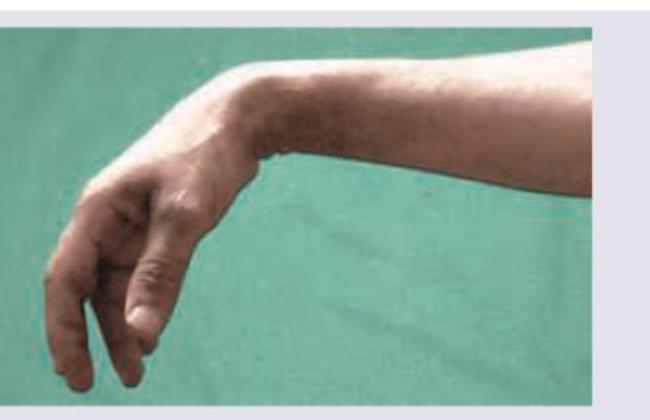
The musculocutaneous nerve is a branch of which part of the brachial plexus?
The radial styloid process gives attachment to which of the following muscles?
Which nerve is closely related to the shoulder joint capsule?
In case of blockade of the 2nd part of the axillary artery, blood supply to the upper limb is maintained by which anastomosis?
The third head of the coracobrachialis muscle is associated with which anatomical structure?
The oblique cord is related to which of the following muscles?
Loss of sensation in the lateral 3 and 1/2 fingers is indicative of injury to which nerve(s)?
A 21-year-old woman presents with shoulder and arm injury after a fall during horseback riding. Examination reveals inability to adduct her arm due to paralysis of which of the following muscles?
Which nerve runs along with the profunda brachii artery in the spiral groove?
Which of the following structures is present in the lateral wall of the axilla?
Explanation: **Explanation:** The **musculocutaneous nerve (C5–C7)** is a terminal branch of the **lateral cord** of the brachial plexus. The lateral cord is formed by the union of the anterior divisions of the upper (C5-C6) and middle (C7) trunks. It typically pierces the coracobrachialis muscle and provides motor innervation to the anterior compartment of the arm (Biceps brachii, Coracobrachialis, and Brachialis) before continuing as the lateral cutaneous nerve of the forearm. **Analysis of Options:** * **Root (Option A):** Roots (C5-T1) give rise to nerves like the Long Thoracic and Dorsal Scapular nerves, but not terminal branches of the arm. * **Medial Cord (Option B):** This cord gives rise to the Ulnar nerve, Medial Cutaneous nerves of the arm/forearm, and the medial head of the Median nerve. * **Posterior Cord (Option D):** This cord gives rise to the Axillary and Radial nerves (mnemonic: **ULTRA** – Upper subscapular, Lower subscapular, Thoracodorsal, Radial, Axillary). **NEET-PG High-Yield Pearls:** 1. **The "M" Shape:** The musculocutaneous nerve forms the lateral limb of the characteristic "M" shape seen over the third part of the axillary artery. 2. **Clinical Deficit:** Injury to this nerve results in the loss of forearm flexion (biceps/brachialis) and loss of sensation along the lateral aspect of the forearm. 3. **The "BBC" Nerve:** A simple mnemonic for the muscles it supplies: **B**iceps brachii, **B**rachialis, and **C**oracobrachialis. 4. **Median Nerve Origin:** Remember that the Median nerve is unique because it receives contributions from *both* the lateral and medial cords.
Explanation: Explanation: The **radial styloid process** is a conical projection on the lateral aspect of the distal radius. It serves as the insertion point for the **Brachioradialis** muscle. **1. Why Brachioradialis is correct:** The Brachioradialis is a unique muscle of the posterior compartment of the forearm. Unlike most extensors, it acts as a flexor of the elbow (especially in the mid-prone position). It originates from the upper two-thirds of the lateral supracondylar ridge of the humerus and inserts into the **base of the styloid process of the radius**. This distal insertion provides a long lever arm, making it a powerful "shunt muscle" that stabilizes the elbow during rapid movements. **2. Analysis of Incorrect Options:** * **Extensor carpi ulnaris (A):** This muscle inserts into the base of the **5th metacarpal bone**, not the radius. * **Supinator (B):** It inserts into the **upper one-third of the lateral surface** of the shaft of the radius, well above the styloid process. * **Anconeus (D):** This small muscle inserts into the lateral aspect of the **olecranon process** and the upper posterior surface of the ulna. **3. NEET-PG High-Yield Pearls:** * **De Quervain’s Tenosynovitis:** The tendons of the Abductor Pollicis Longus (APL) and Extensor Pollicis Brevis (EPB) pass through the first dorsal compartment, located right against the radial styloid. * **Chauffeur’s Fracture:** Also known as a Hutchinson fracture, this is an intra-articular oblique fracture of the **radial styloid process**, often caused by direct compression of the scaphoid against the radius. * **Palpation:** The radial styloid process lies approximately 1 cm more distal than the ulnar styloid process—a key landmark used in the clinical assessment of Colles' fractures.
Explanation: ### Explanation **Correct Answer: D. Axillary Nerve** The **axillary nerve (C5, C6)** is the correct answer because of its intimate anatomical relationship with the inferior aspect of the shoulder joint capsule. After originating from the posterior cord of the brachial plexus, the axillary nerve passes through the **quadrangular space** and winds around the **surgical neck of the humerus**. At this point, it lies directly inferior to the glenohumeral joint capsule. This proximity makes it highly vulnerable to injury during **inferior dislocations** of the shoulder or fractures of the surgical neck of the humerus. **Analysis of Incorrect Options:** * **A. Radial Nerve:** While it also arises from the posterior cord, it passes inferior to the teres major to enter the radial groove on the posterior shaft of the humerus, distal to the joint capsule. * **B. Ulnar Nerve:** This nerve runs medially in the arm and is most clinically related to the medial epicondyle of the humerus, far from the shoulder capsule. * **C. Subscapular Nerve:** The upper and lower subscapular nerves supply the subscapularis and teres major muscles. While they are in the vicinity of the anterior axilla, they do not wrap around the joint capsule like the axillary nerve. **Clinical Pearls for NEET-PG:** * **Hilton’s Law:** The axillary nerve supplies the shoulder joint, the deltoid, and the teres minor. According to Hilton’s Law, a nerve supplying a joint also supplies the muscles moving that joint and the skin over it. * **Regimental Badge Area:** Injury to the axillary nerve leads to loss of sensation over the lateral aspect of the upper arm and paralysis of the deltoid (loss of abduction beyond 15°). * **Quadrangular Space Boundaries:** Superior (Teres minor), Inferior (Teres major), Medial (Long head of triceps), Lateral (Surgical neck of humerus). It contains the axillary nerve and posterior circumflex humeral artery.
Explanation: **Explanation:** The **axillary artery** is divided into three parts by the pectoralis minor muscle. When there is a slow-growing occlusion or ligation of the **2nd part** of the axillary artery, a collateral circulation is established via the **anastomosis around the scapula** (often referred to in exams by its primary component, the dorsal scapular anastomosis). **Why Option A is Correct:** This anastomosis connects branches of the **subclavian artery** with branches of the **3rd part of the axillary artery**, effectively bypassing the 1st and 2nd parts. The key vessels involved are: 1. **Suprascapular artery** (from the thyrocervical trunk of the subclavian). 2. **Dorsal scapular artery** (from the subclavian or thyrocervical trunk). 3. **Circumflex scapular artery** (a branch of the subscapular artery, which arises from the **3rd part** of the axillary artery). By reversing the flow through the circumflex scapular artery, blood reaches the 3rd part of the axillary artery, ensuring the upper limb remains perfused [1]. **Why Other Options are Incorrect:** * **B. Ventral scapular anastomosis:** This is not a standard anatomical term used for this collateral pathway. * **C. Circle of Willis:** This is the primary collateral network for the brain, located at the base of the skull. * **D. Anastomosis around the internal thoracic artery:** While the internal thoracic artery provides collateral flow in cases of aortic coarctation (via intercostal arteries), it does not bypass an axillary artery blockade. **High-Yield NEET-PG Pearls:** * **Ligation Site:** Ligation of the axillary artery **proximal** to the subscapular artery (1st or 2nd part) is safe due to this anastomosis. However, ligation **distal** to the subscapular artery (3rd part) is dangerous as it cuts off the collateral bypass to the arm [1]. * **Mnemonic for Scapular Anastomosis:** **"S-D-C"** (Suprascapular, Dorsal scapular, Circumflex scapular).
Explanation: **Explanation:** The **coracobrachialis** muscle typically consists of two heads in humans, but embryologically it is a three-layered muscle. The **third (deep) head** is often considered a vestigial structure that, when present, may form a fibrous band known as **Struther’s ligament**. 1. **Why Option A is Correct:** Struther’s ligament is a fibrous band extending from a bony projection called the **supracondylar process** (on the anteromedial aspect of the humerus) to the medial epicondyle. It represents the remnant of the lower part of the third head of the coracobrachialis. Clinically, the **median nerve** and **brachial artery** pass beneath this ligament, making it a potential site for high median nerve compression. 2. **Why Other Options are Incorrect:** * **Brachioradialis (B):** This is a muscle of the superficial posterior compartment of the forearm, unrelated to the coracobrachialis or Struther’s ligament. * **Radial collateral ligament (C):** This is a stabilizing ligament on the lateral side of the elbow joint. * **Ulnar ligament (D):** This refers to the medial collateral ligament of the elbow; while located medially, it has no developmental association with the coracobrachialis. **High-Yield NEET-PG Pearls:** * **Nerve Supply:** Coracobrachialis is pierced by and supplied by the **Musculocutaneous nerve**. * **Struther’s Ligament vs. Arcade of Struthers:** Do not confuse them. Struther’s ligament is at the distal humerus (median nerve), while the **Arcade of Struthers** is a thin aponeurotic band in the distal third of the arm that can compress the **ulnar nerve**. * **Supracondylar Process:** Present in only ~1% of the population; its presence is a prerequisite for Struther’s ligament.
Explanation: The **oblique cord** (or chorda obliqua) is a small, flat ligamentous band that extends between the radius and the ulna. It originates from the lateral side of the **ulnar tuberosity** and runs downward and laterally to be inserted into the radius, just below the **radial tuberosity**. **Why Flexor Pollicis Longus (FPL) is correct:** The oblique cord lies in the same plane as the interosseous membrane but its fibers run in the opposite direction. Crucially, its lower border is continuous with the fascia covering the **Flexor pollicis longus**. In many individuals, the FPL takes a partial origin from the oblique cord itself. **Analysis of Incorrect Options:** * **A. Supinator:** The supinator muscle is located more superiorly and posteriorly in the forearm. While it relates to the radial tuberosity, it does not have a direct structural continuity with the oblique cord. * **C. Flexor digitorum profundus (FDP):** The FDP originates primarily from the anterior and medial surfaces of the ulna and the interosseous membrane, but it is medial to the site of the oblique cord. * **D. Flexor digitorum superficialis (FDS):** The FDS has a broad origin (humeroulnar and radial heads), but its radial head originates from the anterior oblique line of the radius, distal to the insertion of the oblique cord. **High-Yield Facts for NEET-PG:** * **Fiber Direction:** The fibers of the oblique cord run **downwards and laterally**, whereas the fibers of the interosseous membrane run **downwards and medially**. * **Gap:** There is a gap between the upper border of the interosseous membrane and the oblique cord through which the **posterior interosseous vessels** pass. * **Function:** It acts as a tie-beam to prevent displacement of the radius during forceful movements, though its functional significance is considered minimal compared to the interosseous membrane.
Explanation: ### Explanation The sensory innervation of the hand is a high-yield topic for NEET-PG, requiring a clear distinction between the **palmar** and **dorsal** surfaces. **1. Why Median and Radial Nerves are Correct:** The question specifies "lateral 3 and 1/2 fingers" without limiting the area to the palm or the dorsum. Therefore, both surfaces must be considered: * **Median Nerve:** Supplies the palmar surface of the lateral 3 and 1/2 fingers and the **nail beds (dorsum of distal phalanges)** of these same fingers [1]. * **Radial Nerve (Superficial branch):** Supplies the dorsal surface of the lateral 3 and 1/2 fingers, *excluding* the nail beds [2]. * **Conclusion:** To have a total loss of sensation in these fingers (both front and back), both the median and radial nerves must be involved. **2. Analysis of Incorrect Options:** * **Option A (Only Median):** This would only cause sensory loss on the palmar aspect and nail beds; the dorsal skin (proximal/middle phalanges) would remain intact due to the radial nerve. * **Option B & D (Ulnar Nerve):** The ulnar nerve supplies the **medial 1 and 1/2 fingers** (little finger and medial half of the ring finger) on both the palmar and dorsal sides [1]. It does not contribute to the lateral 3 and 1/2 fingers. **3. Clinical Pearls for NEET-PG:** * **Autonomous Zones:** The most reliable area to test the **Median nerve** is the tip of the index finger; for the **Ulnar nerve**, it is the tip of the little finger; and for the **Radial nerve**, it is the dorsal first web space. * **Carpal Tunnel Syndrome:** Compression of the median nerve at the wrist leads to paresthesia in the lateral 3 and 1/2 fingers, but the **palmar cutaneous branch** (sparing the central palm) is often uninvolved as it passes superficial to the flexor retinaculum [1]. * **Rule of Thumb:** If a question mentions "loss of sensation on the **palmar** aspect" only, think Median nerve. If it says "lateral 3 and 1/2 fingers" generally, consider both Median and Radial.
Explanation: ### Explanation **Correct Option: C. Latissimus dorsi** The **Latissimus dorsi** is a powerful muscle of the posterior axillary wall. Its primary actions are **adduction, extension, and medial rotation** of the humerus (often remembered by the mnemonic "The Lady between two Majors"—it inserts into the floor of the bicipital groove between the Pectoralis major and Teres major). In the context of a shoulder injury, paralysis of this muscle significantly impairs the ability to pull the arm toward the midline (adduction) against resistance. **Analysis of Incorrect Options:** * **A. Teres minor:** This muscle is part of the rotator cuff. Its primary action is **lateral rotation** of the arm and stabilization of the glenohumeral joint. * **B. Supraspinatus:** This rotator cuff muscle is responsible for the **initiation of abduction** (first 0–15 degrees). It does not contribute to adduction. * **C. Infraspinatus:** Similar to the Teres minor, this muscle acts as a powerful **lateral rotator** of the arm. **Clinical Pearls for NEET-PG:** * **Nerve Supply:** Latissimus dorsi is supplied by the **Thoracodorsal nerve** (C6, C7, C8), a branch of the posterior cord of the brachial plexus. * **Clinical Testing:** To test the Latissimus dorsi, the patient is asked to adduct the elevated arm against resistance or to cough (it is an accessory muscle of expiration, hence the "Climbing muscle" or "Coughing muscle"). * **Surgical Significance:** The Latissimus dorsi flap is commonly used in reconstructive surgeries, such as breast reconstruction. * **Injury Association:** Damage to the thoracodorsal nerve often occurs during axillary lymph node dissection or surgeries in the inferior part of the axilla.
Explanation: **Explanation:** The **Radial nerve** is the correct answer because of its specific anatomical course in the posterior compartment of the arm. After originating from the posterior cord of the brachial plexus, the radial nerve enters the **spiral (radial) groove** on the posterior surface of the humerus. It is accompanied here by the **profunda brachii artery** (deep artery of the arm). This neurovascular bundle lies directly against the bone, making it highly vulnerable to injury in mid-shaft fractures of the humerus. **Analysis of Incorrect Options:** * **Ulnar Nerve:** Runs in the medial compartment and passes behind the medial epicondyle of the humerus (cubital tunnel), not the spiral groove. It is accompanied by the superior ulnar collateral artery. * **Median Nerve:** Descends in the anterior compartment of the arm within the medial bicipital groove, lateral to the brachial artery initially, then crossing to its medial side. It has no relation to the spiral groove. * **Musculocutaneous Nerve:** Pierces the coracobrachialis muscle and travels between the biceps brachii and brachialis muscles in the anterior compartment. **High-Yield Clinical Pearls for NEET-PG:** * **Fracture Correlation:** Mid-shaft humerus fractures commonly injure the radial nerve in the spiral groove, leading to **"Wrist Drop"** due to paralysis of the extensors of the wrist and digits. * **Saturday Night Palsy:** Compression of the radial nerve in the spiral groove (e.g., hanging an arm over a chair) leads to temporary loss of function. * **Triangular Space:** The profunda brachii artery and radial nerve enter the posterior compartment via the **lower triangular space** (bounded by teres major, long head of triceps, and humerus).
Explanation: To master the anatomy of the axilla for NEET-PG, it is essential to visualize it as a four-sided pyramid. The **lateral wall** is the narrowest part of the axilla, formed by the bicipital groove (intertubercular sulcus) of the humerus. ### **Explanation of the Correct Answer** The **Axillary vessels** (axillary artery and vein) and the branches of the **Brachial plexus** are the primary contents of the axilla. These structures are enclosed within the **axillary sheath** and are situated against the lateral wall as they transition into the arm. Specifically, the axillary artery and vein lie in close proximity to the humerus at this narrow junction. ### **Analysis of Incorrect Options** * **A. Subscapular vessels:** These are located on the **posterior wall** of the axilla, associated with the subscapularis muscle. * **B. Brachial plexus:** While the cords of the brachial plexus are contents of the axilla, the question asks for the structure most specifically defining the lateral boundary/wall. In many standard anatomical descriptions, the "vessels" are the landmark content for the lateral aspect, though the cords surround them. (Note: If both are options, axillary vessels are the more traditional anatomical landmark for the lateral wall contents). * **C. Long thoracic nerve:** This nerve (Nerve of Bell) descends on the **medial wall** of the axilla, lying on the superficial surface of the serratus anterior muscle [1]. ### **High-Yield NEET-PG Pearls** * **Boundaries:** * **Anterior Wall:** Pectoralis major and minor. * **Posterior Wall:** Subscapularis, Teres major, and Latissimus dorsi. * **Medial Wall:** Upper 4 ribs and Serratus anterior. * **Lateral Wall:** Bicipital groove of the humerus. * **Clinical Correlation:** During axillary lymph node dissection (e.g., for breast cancer), the **Long thoracic nerve** (medial wall) and **Thoracodorsal nerve** (posterior wall) must be preserved to avoid "winged scapula" and weakness in arm adduction, respectively [1].
Pectoral Region and Axilla
Practice Questions
Arm and Cubital Fossa
Practice Questions
Forearm and Hand
Practice Questions
Joints of Upper Limb
Practice Questions
Nerves of Upper Limb
Practice Questions
Arterial Supply and Venous Drainage
Practice Questions
Lymphatic Drainage
Practice Questions
Muscles and Their Actions
Practice Questions
Applied Anatomy and Clinical Correlations
Practice Questions
Surface Anatomy and Landmarks
Practice Questions
Get full access to all questions, explanations, and performance tracking.
Start For Free