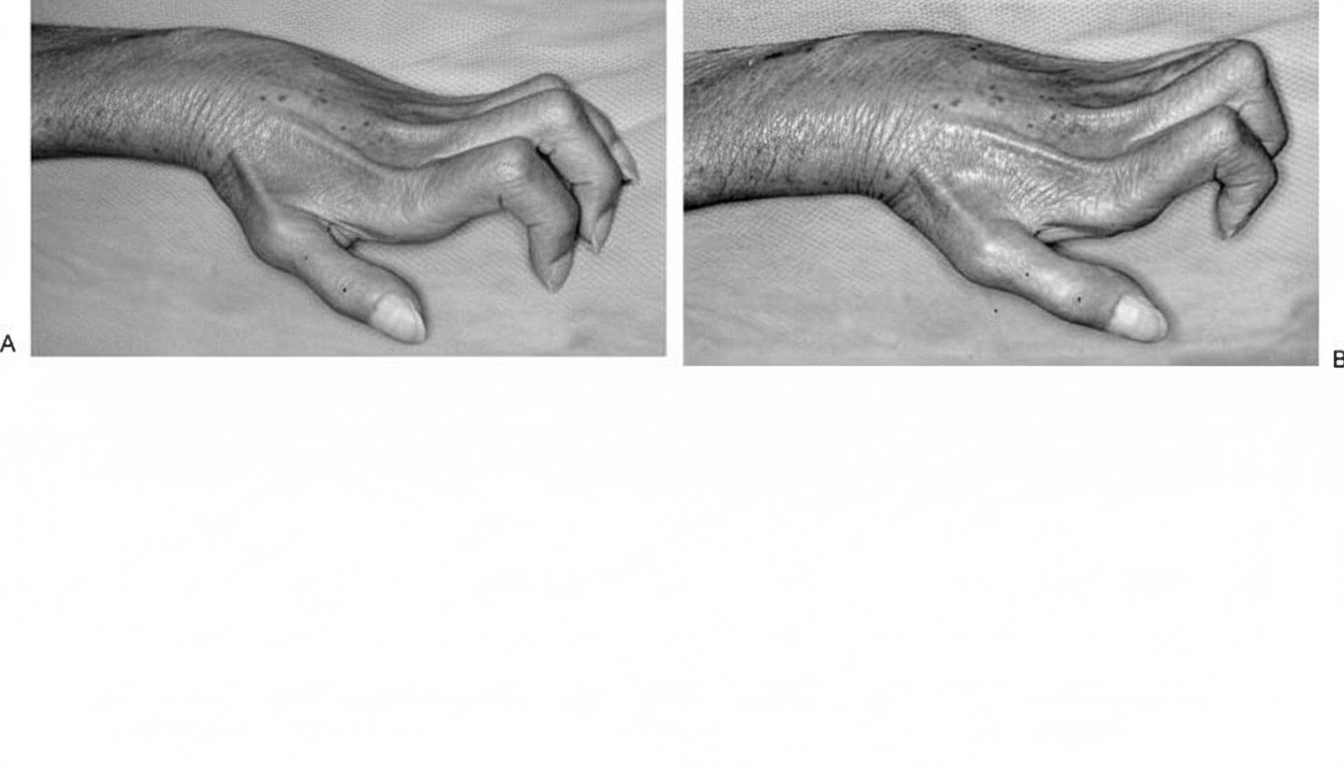
What is the nerve supply of the flexor digitorum profundus (FDP) muscle?
Which is the first carpal bone to ossify?
Which nerve supplies the flexor pollicis longus?
Which dermatome corresponds to the middle finger?
Damage to the C7 nerve root causes weakness of which of the following movements?
The metacarpophalangeal joint is classified as which type of joint?
Which of the following movements of the thumb is lost in ulnar nerve injury?
Which of the following statements is NOT true about Klumpke's paralysis?
Which of the following is NOT a content of the axilla?
Which muscles are supplied by the axillary nerve?
Explanation: The **Flexor Digitorum Profundus (FDP)** is a unique muscle of the forearm known as a **"hybrid" or "composite" muscle** because it receives a dual nerve supply. ### 1. Why Option A is Correct The FDP is located in the deep layer of the anterior compartment of the forearm. Its innervation is split based on the digits it controls: * **Medial Half (supplying the 4th and 5th digits):** Innervated by the **Ulnar Nerve** (C8, T1). * **Lateral Half (supplying the 2nd and 3rd digits):** Innervated by the **Anterior Interosseous Nerve (AIN)**, which is a branch of the **Median Nerve**. Since Option A correctly identifies the medial half's supply, it is the right choice. ### 2. Why Other Options are Incorrect * **Option B:** The medial half is supplied by the ulnar nerve, not the median nerve. * **Option C:** The lateral half is supplied by the median nerve (via the AIN), not the ulnar nerve. * **Option D:** The radial nerve supplies the posterior compartment (extensors) of the forearm; it does not supply the FDP. ### 3. Clinical Pearls for NEET-PG * **The "Claw Hand" Paradox:** In high ulnar nerve palsy (at the elbow), the medial half of the FDP is paralyzed. This means the patient cannot flex the DIP joints of the ring and little fingers, making the "clawing" look *less* prominent than in a low lesion. * **Testing FDP:** It is the only muscle that flexes the **Distal Interphalangeal (DIP) joints** [1]. To test it, stabilize the PIP joint and ask the patient to flex the fingertip. * **Other Hybrid Muscles:** Remember other dual-supply muscles for the exam: Adductor Magnus, Pectineus, and Brachialis.
Explanation: The ossification of carpal bones follows a predictable chronological sequence, which is a high-yield topic for assessing bone age in pediatric radiology. All carpal bones are cartilaginous at birth and typically ossify in a **clockwise direction** (starting from the capitate) in the left hand. During fetal development, most bones are modeled in cartilage and then transformed into bone by ossification [1]. **1. Why Capitate is Correct:** The **Capitate** is the largest carpal bone and the very first to begin ossification, typically appearing at **1–3 months** of age. It is followed closely by the Hamate. **2. Analysis of Incorrect Options:** * **Hamate (Option D):** This is the second bone to ossify, appearing shortly after the capitate (usually by **3–4 months**). * **Lunate (Option B):** Ossification occurs much later, typically around **4–5 years** of age. * **Scaphoid (Option A):** This is one of the later bones to ossify, usually appearing between **5–6 years** of age. **3. High-Yield Sequence (NEET-PG Memory Aid):** A useful mnemonic to remember the order of ossification (from first to last) is: **"Capitate, Hamate, Triquetrum, Lunate, Scaphoid, Trapezium, Trapezoid, Pisiform."** * **1st Year:** Capitate & Hamate * **3rd Year:** Triquetrum * **4th Year:** Lunate * **5th Year:** Scaphoid, Trapezium, Trapezoid * **12th Year:** Pisiform (The last carpal bone to ossify; it is a sesamoid bone in the tendon of Flexor Carpi Ulnaris). **Clinical Pearl:** In pediatric practice, a radiograph of the **non-dominant hand and wrist** (usually the left) is the standard method for determining **skeletal maturity (Bone Age)** by comparing the number and development of these ossification centers against standard atlases (e.g., Greulich and Pyle).
Explanation: The **Flexor Pollicis Longus (FPL)** is a deep muscle of the anterior compartment of the forearm. It is supplied by the **Anterior Interosseous Nerve (AIN)**, which is the largest branch of the **Median Nerve** [1]. 1. **Why B is correct:** The Median nerve supplies all muscles of the anterior compartment of the forearm except for the Flexor Carpi Ulnaris and the medial half of the Flexor Digitorum Profundus [1]. Specifically, the AIN (C8, T1) supplies the "deep trio": Flexor Pollicis Longus, the lateral half of Flexor Digitorum Profundus, and Pronator Quadratus. 2. **Why A is incorrect:** The Ulnar nerve supplies only 1.5 muscles in the forearm (Flexor Carpi Ulnaris and the medial half of Flexor Digitorum Profundus) [1]. It primarily supplies the intrinsic muscles of the hand. 3. **Why C & D are incorrect:** The Radial nerve and its deep branch, the Posterior Interosseous Nerve (PIN), supply the muscles of the **posterior compartment** (extensors) of the forearm [2]. **Clinical Pearls for NEET-PG:** * **Kiloh-Nevin Syndrome (AIN Syndrome):** Damage to the AIN results in the inability to flex the distal phalanges of the thumb and index finger. Clinically, the patient cannot make a proper **"OK" sign**; instead, they produce a "pinch" (pulp-to-pulp) because the FPL and FDP are paralyzed. * **High-Yield Tip:** Remember that the AIN is a **purely motor nerve** (though it provides sensory fibers to the wrist joint capsule), so AIN syndrome presents with motor loss but **no cutaneous sensory deficit**.
Explanation: **Explanation:** The cutaneous innervation of the upper limb follows a specific segmental pattern derived from the brachial plexus (C5-T1). The **C7 dermatome** is responsible for the sensory supply to the **middle finger** [1]. It typically encompasses the central portion of the posterior forearm and the middle finger (both palmar and dorsal surfaces). **Analysis of Options:** * **C7 (Correct):** This is the "central" dermatome of the hand [1]. In clinical practice, testing sensation on the pad of the middle finger is the standard method to assess the C7 nerve root. * **C5 (Incorrect):** This dermatome supplies the lateral (radial) aspect of the arm, specifically over the deltoid muscle and the lateral side of the upper arm. * **C4 (Incorrect):** This supplies the skin over the "cape" area of the shoulder and the root of the neck (supraclavicular region). * **C2 (Incorrect):** This is a cranial/cervical dermatome supplying the back of the head and the area behind the ear; it does not extend to the limbs. **High-Yield Clinical Pearls for NEET-PG:** * **The "Hand Rule":** To remember hand dermatomes, use the three-finger rule: **C6** (Thumb/Radial side), **C7** (Middle finger), and **C8** (Little finger/Ulnar side). * **T1 & T2:** T1 supplies the medial forearm, while T2 supplies the medial upper arm and axilla. * **Clinical Correlation:** A herniated disc at the **C6-C7 level** typically compresses the **C7 nerve root**, leading to pain or numbness radiating specifically to the middle finger and weakness in elbow extension (Triceps).
Explanation: **Explanation:** The **C7 nerve root** is the most commonly involved root in cervical radiculopathy. It provides the primary motor supply to the **triceps** (elbow extension) and the **flexor carpi radialis** (wrist flexion). Therefore, damage to C7 leads to weakness in wrist flexion and elbow extension, along with a diminished triceps reflex. **Analysis of Options:** * **Wrist flexion (Correct):** Primarily mediated by the C7 nerve root (via the flexor carpi radialis). While C6 also contributes, C7 is the dominant segmental innervation for this movement. * **Elbow flexion (Incorrect):** This is primarily mediated by the **C5 and C6** nerve roots (musculocutaneous nerve supplying the biceps and brachialis). * **Supination (Incorrect):** This is primarily a function of the biceps brachii (**C5, C6**) and the supinator muscle (**C6**). * **Finger abduction (Incorrect):** This is a function of the dorsal interossei, which are innervated by the ulnar nerve, specifically the **T1** nerve root (and partly C8). **NEET-PG High-Yield Pearls:** * **C5:** Deltoid (Shoulder abduction), Biceps reflex. * **C6:** Biceps (Elbow flexion), Brachioradialis reflex, "Wrist drop" if radial nerve is affected at this level. * **C7:** Triceps (Elbow extension), Wrist flexors, Triceps reflex. * **C8:** Finger flexors (Grip strength). * **T1:** Interossei (Finger abduction/adduction). * **Clinical Tip:** C7 sensory loss typically presents as numbness in the **middle finger**.
Explanation: ### Explanation **1. Why Condyloid Joint is Correct:** The metacarpophalangeal (MCP) joints are classified as **synovial condyloid (ellipsoid) joints**. In this arrangement, an oval-shaped convex surface (the metacarpal head) fits into a concave elliptical cavity (the base of the proximal phalanx). This structural configuration allows for movement in two primary planes (biaxial): **flexion/extension** and **abduction/adduction**, along with limited circumduction. **2. Why Other Options are Incorrect:** * **Pivot joint (Option A):** These allow rotation around a single longitudinal axis (e.g., the superior radioulnar joint or the atlanto-axial joint). The MCP joint does not permit independent axial rotation. * **Ball and socket joint (Option B):** While similar to condyloid joints, these are multiaxial and allow movement in three planes, including active rotation (e.g., shoulder and hip joints). The MCP joint lacks the third degree of freedom (rotation). * **Saddle-shaped joint (Option D):** Also known as sellar joints, these feature reciprocal concavo-convex surfaces. The classic example in the hand is the **1st Carpometacarpal (CMC) joint** of the thumb. **3. Clinical Pearls & High-Yield Facts for NEET-PG:** * **Collateral Ligaments:** These ligaments at the MCP joints are **slack during extension** and **taut during flexion**. This is why abduction/adduction is easy when the fingers are straight but restricted when the fist is clenched. * **Interphalangeal (IP) Joints:** Unlike the MCP joints, the IP joints are **hinge joints**, allowing movement in only one plane (flexion/extension). * **Rheumatoid Arthritis (RA):** The MCP joints are characteristically involved in RA, often leading to "ulnar drift" deformity, whereas Osteoarthritis (OA) more commonly affects the DIP joints (Heberden’s nodes) [1].
Explanation: The correct answer is **Adduction**. The thumb's adduction is performed by the **Adductor Pollicis** muscle [1]. Unlike most other muscles of the thenar eminence, the Adductor Pollicis is supplied by the **Deep Branch of the Ulnar Nerve (C8, T1)** [1]. Therefore, in an ulnar nerve injury, this specific movement is lost. **Analysis of Options:** * **Opposition (A):** This is primarily performed by the **Opponens Pollicis**, which is supplied by the **Recurrent Branch of the Median Nerve** [1]. * **Extension (B):** Thumb extension is performed by the **Extensor Pollicis Longus and Brevis**, both of which are supplied by the **Posterior Interosseous Nerve (a branch of the Radial Nerve)** [1]. * **Abduction (D):** Abduction is performed by the **Abductor Pollicis Brevis** (Median Nerve) and **Abductor Pollicis Longus** (Radial Nerve) [1]. **Clinical Pearls for NEET-PG:** 1. **Froment’s Sign:** When a patient with ulnar nerve palsy tries to grip a piece of paper between the thumb and index finger, they cannot adduct the thumb. Instead, they flex the thumb at the interphalangeal joint using the **Flexor Pollicis Longus** (Median nerve) to compensate. This is a classic diagnostic sign. 2. **The "1.5" Rule:** The ulnar nerve supplies all intrinsic muscles of the hand *except* the **LOAF** muscles (Lateral two Lumbricals, Opponens pollicis, Abductor pollicis brevis, and Flexor pollicis brevis), which are supplied by the Median nerve [1]. 3. **Ulnar Paradox:** A high ulnar nerve lesion (at the elbow) results in a less prominent claw hand than a low lesion (at the wrist) because the long flexors (FDP) are also paralyzed, reducing the flexion of the fingers.
Explanation: Klumpke’s paralysis is a lower brachial plexus injury typically caused by hyperabduction of the arm (e.g., falling from a tree and clutching a branch or birth trauma). **Why Option D is the Correct Answer (The False Statement):** Horner’s syndrome is **frequently associated** with Klumpke’s paralysis, not "never." The injury involves the **T1 nerve root**. Since the T1 root carries preganglionic sympathetic fibers destined for the head and neck (via the superior cervical ganglion), damage at this level disrupts the sympathetic supply to the eye. This results in the classic triad of miosis, ptosis, and anhidrosis. **Analysis of Other Options:** * **Option A:** Klumpke’s paralysis specifically involves the **lower trunk (C8 and T1)** of the brachial plexus. * **Option B:** The T1 root supplies the **intrinsic muscles of the hand** (interossei, thenar, and hypothenar muscles). Their paralysis leads to significant loss of fine motor functions. * **Option C:** A **"Claw Hand" (Main en griffe)** deformity occurs due to the paralysis of lumbricals. This leads to hyperextension at the metacarpophalangeal (MCP) joints and flexion at the interphalangeal (IP) joints, primarily affecting the ring and little fingers. **High-Yield Clinical Pearls for NEET-PG:** * **Erb’s Palsy (C5-C6):** Upper trunk injury; "Waiter’s tip" or "Policeman’s tip" deformity. * **Klumpke’s Palsy (C8-T1):** Lower trunk injury; "Claw hand" deformity. * **Sensory Loss:** In Klumpke’s, anesthesia occurs along the medial border of the forearm and hand (ulnar aspect). * **Differential:** True "Total Claw Hand" involves both Ulnar and Median nerve damage, but Klumpke's is the classic plexus-level cause.
Explanation: The axilla is a pyramid-shaped space between the upper arm and the chest wall. Understanding its contents is a high-yield topic for NEET-PG. [1] ### **Why "Roots of the Brachial Plexus" is the Correct Answer** The **Roots** (C5-C8, T1) and **Trunks** of the brachial plexus are located in the **posterior triangle of the neck**, passing between the scalenus anterior and medius muscles. [2] They enter the axilla only after they have formed **Cords**. Therefore, the axilla contains the **Cords and Branches** of the brachial plexus, but not the roots or trunks. [1] ### **Analysis of Incorrect Options** * **Axillary tail of the breast (Tail of Spence):** This is a small part of the mammary gland that pierces the deep fascia (clavipectoral fascia) and lies within the axilla. [3] * **Axillary vessels:** The axillary artery (a continuation of the subclavian) and the axillary vein are the primary neurovascular contents of the axillary space. [1][2] * **Axillary sheath:** This is a fibrous sleeve derived from the **prevertebral fascia** of the neck that encloses the axillary artery and the cords of the brachial plexus as they enter the axilla. ### **High-Yield Clinical Pearls for NEET-PG** * **Boundaries:** The **Apex** (Cervico-axillary canal) is bounded by the 1st rib, clavicle, and superior border of the scapula. * **Axillary Artery:** It is divided into three parts by the **Pectoralis minor** muscle. [1] * **Lymph Nodes:** There are five groups of axillary lymph nodes (Lateral, Anterior, Posterior, Central, and Apical). [1][3] The **Apical group** receives lymph from all other groups. * **Nerve to Serratus Anterior (Long Thoracic Nerve):** It lies on the medial wall of the axilla. Damage during axillary clearance leads to **"Winging of Scapula."**
Explanation: The **axillary nerve (C5, C6)** is a terminal branch of the posterior cord of the brachial plexus. It passes through the quadrangular space alongside the posterior circumflex humeral artery to supply specific structures in the shoulder region. **1. Why Option B is Correct:** The axillary nerve provides motor innervation to exactly two muscles: * **Deltoid:** The primary abductor of the arm (after the first 15 degrees). * **Teres Minor:** A component of the rotator cuff responsible for lateral rotation of the humerus. **2. Analysis of Incorrect Options:** * **Options A & C:** These include the **Teres Major**. This is a common "distractor" in NEET-PG. The Teres major is supplied by the **lower subscapular nerve**, not the axillary nerve. * **Option D:** While the deltoid is the largest muscle supplied, this option is incomplete as it omits the teres minor. **3. Clinical Pearls for NEET-PG:** * **Quadrangular Space:** The axillary nerve is most commonly injured here or during a **surgical neck of humerus fracture** or **anterior dislocation of the shoulder**. * **Sensory Supply:** It gives off the **upper lateral cutaneous nerve of the arm**, which supplies the skin over the lower half of the deltoid (the **"Regimental Badge Area"**). Loss of sensation here is a classic sign of axillary nerve palsy. * **Motor Deficit:** Injury results in the inability to abduct the arm beyond 15 degrees and atrophy of the deltoid, leading to a "flat shoulder" appearance.
Pectoral Region and Axilla
Practice Questions
Arm and Cubital Fossa
Practice Questions
Forearm and Hand
Practice Questions
Joints of Upper Limb
Practice Questions
Nerves of Upper Limb
Practice Questions
Arterial Supply and Venous Drainage
Practice Questions
Lymphatic Drainage
Practice Questions
Muscles and Their Actions
Practice Questions
Applied Anatomy and Clinical Correlations
Practice Questions
Surface Anatomy and Landmarks
Practice Questions
Get full access to all questions, explanations, and performance tracking.
Start For Free