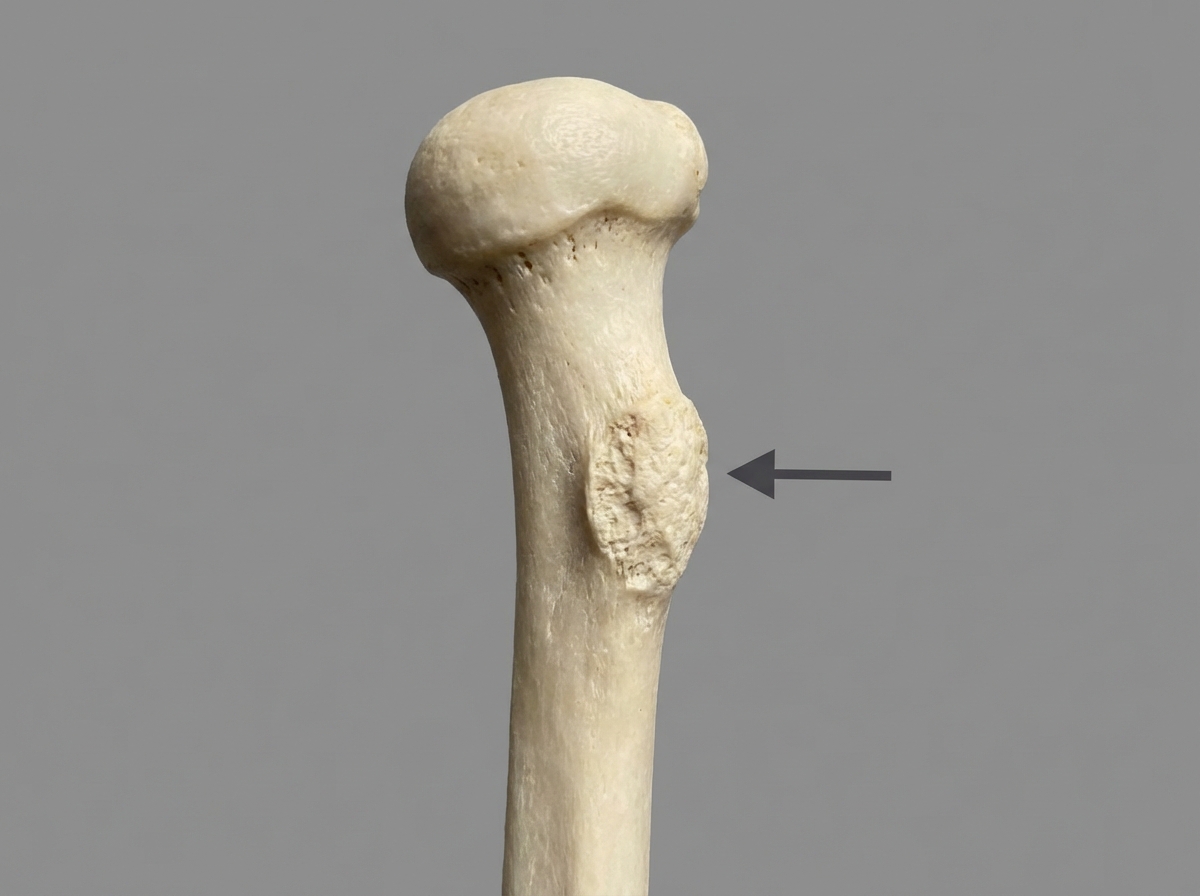
Entrapment neuropathy at the arcade of Frohse involves which nerve?
What are the roots involved in Erb's palsy?
A 19-year-old boy sustained a shoulder injury after falling from a motorbike. The doctor diagnosed him with Erb's palsy. Which of the following signs and symptoms would NOT be observed in this condition?
Which is the first ossification center to appear around the elbow joint?
The musculocutaneous nerve pierces which of the following muscles?
Froment's sign is a clinical feature of which condition?
A 52-year-old woman presented with weakness of shoulder movements. Investigations revealed quadrangular space syndrome. Which of the following nerves is likely to be affected?
Fracture of the surgical neck of the humerus leads to loss of abduction movement of the corresponding shoulder joint due to injury of which nerve?
An 11-year-old boy falls down the stairs. A physician examines a radiograph of the boy's shoulder region. If the structure indicated by the letter A is calcified, which of the following muscles is most likely paralyzed?

Froment's sign is seen in which nerve palsy?
Explanation: **Explanation:** The **Posterior Interosseous Nerve (PIN)** is the deep terminal branch of the radial nerve. The **Arcade of Frohse** (also known as the supinator arch) is the most common site for its entrapment. It is a fibrous arch formed by the proximal thickened edge of the superficial layer of the **supinator muscle**. Compression at this site leads to **Posterior Interosseous Nerve Syndrome**, characterized by weakness of the finger and thumb extensors without any sensory loss (as the PIN is purely motor distal to the supinator). **Analysis of Incorrect Options:** * **A. Median nerve:** Commonly entrapped at the wrist (Carpal Tunnel Syndrome) or between the two heads of the pronator teres (Pronator Syndrome) [1]. * **C. Ulnar nerve:** Most frequently compressed at the elbow in the **Cubital Tunnel** (behind the medial epicondyle) or at the wrist in **Guyon’s canal** [1]. * **D. Axillary nerve:** Typically injured during anterior dislocation of the shoulder or fractures of the surgical neck of the humerus; it is not subject to entrapment in the forearm. **High-Yield Clinical Pearls for NEET-PG:** * **PIN vs. Radial Nerve Injury:** PIN palsy spares the ECRL (Extensor Carpi Radialis Longus), so the patient can still extend the wrist, but it results in **radial deviation** during extension. * **Sensory Sparing:** Unlike the main radial nerve, PIN entrapment has **no cutaneous sensory deficit** because the superficial radial nerve (sensory) branches off before the arcade. * **Finger Drop:** PIN injury causes "finger drop" (inability to extend MCP joints) but not "wrist drop" (which occurs with higher radial nerve lesions).
Explanation: **Explanation:** **1. Why the Correct Answer is Right:** Erb’s palsy (Upper Brachial Plexus Injury) results from damage to the **Erb’s point**, which is the junction of six nerves. The primary site of injury is the **upper trunk** of the brachial plexus, which is formed by the union of the **Anterior Primary Rami (APR) of C5 and C6**. In anatomy, the brachial plexus is formed exclusively by the anterior primary rami of spinal nerves C5 to T1. Therefore, any paralysis involving the plexus must involve the anterior rami, as the posterior rami supply the intrinsic back muscles and overlying skin, not the limb muscles. **2. Why the Incorrect Options are Wrong:** * **Options A, C, and D:** These are incorrect because they mention **Posterior primary rami**. The posterior rami do not contribute to the formation of the brachial plexus. * **Option C (C8-T1):** Damage to the anterior rami of C8-T1 leads to **Klumpke’s palsy** (Lower Brachial Plexus Injury), characterized by a "claw hand" deformity, not Erb's palsy. **3. Clinical Pearls for NEET-PG:** * **Mechanism of Injury:** Undue increase in the angle between the head and shoulder (e.g., birth trauma/shoulder dystocia or falling on the shoulder). * **Deformity:** Known as **"Policeman’s tip hand"** or **"Waiter’s tip hand."** * **Clinical Presentation:** The arm is adducted and medially rotated; the forearm is extended and pronated. * **Muscles Involved:** Primarily the Biceps brachii, Brachialis, Deltoid, Supraspinatus, Infraspinatus, and Brachioradialis. * **Nerves at Erb's Point:** C5 root, C6 root, Suprascapular nerve, Nerve to Subclavius, Anterior division of upper trunk, and Posterior division of upper trunk.
Explanation: **Explanation:** **Erb’s Palsy** (Waiter’s Tip Deformity) results from an injury to the **Upper Trunk** of the brachial plexus, specifically involving the **C5 and C6** nerve roots [1]. The characteristic deformity occurs due to the paralysis of muscles supplied by these roots. **Why "Loss of pronation" is the correct answer:** In Erb’s palsy, the forearm is characteristically **fixed in pronation**. This occurs because the **Supinator** (C5-C6) and the **Biceps brachii** (C5-C6) are paralyzed. Since the supinators are lost, the pronators (Pronator teres/quadratus, supplied by C6-T1) act unopposed. Therefore, the patient experiences a **loss of supination**, not a loss of pronation. **Analysis of incorrect options:** * **Loss of abduction:** Paralyzed **Deltoid** (Axillary nerve, C5-C6) and **Supraspinatus** (Suprascapular nerve, C5-C6) lead to an adducted shoulder. * **Loss of external rotation:** Paralyzed **Infraspinatus** and **Teres minor** (C5-C6) result in the arm being medially (internally) rotated. * **Loss of flexion at the elbow:** Paralyzed **Biceps brachii** and **Brachialis** (Musculocutaneous nerve, C5-C6) result in an extended elbow. **NEET-PG High-Yield Pearls:** * **Site of Injury:** Erb’s Point (junction of 6 nerves: C5, C6 roots; Suprascapular and Nerve to Subclavius; Anterior and Posterior divisions of the upper trunk). * **Deformity Summary:** Shoulder adducted and medially rotated; Elbow extended; Forearm pronated (**"Policeman’s tip"** or **"Porter’s tip"**). * **Reflexes:** Biceps and Supinator reflexes are lost; Moro reflex is asymmetrical. * **Sensory Loss:** Small area over the lower part of the deltoid (regimental badge area).
Explanation: The elbow joint is a high-yield topic in NEET-PG Anatomy and Orthopedics, specifically regarding the chronological appearance of secondary ossification centers. ### **Explanation** The correct answer is **Capitellum**. The ossification centers around the elbow appear at specific ages, which can be easily remembered using the mnemonic **CRITOE**. The Capitellum is the very first center to appear, typically at **1 year** of age. **The CRITOE Sequence:** 1. **C**apitellum: 1 year 2. **R**adial Head: 3 years 3. **I**nternal (Medial) Epicondyle: 5 years 4. **T**rochlea: 7 years 5. **O**lecranon: 9 years 6. **E**xternal (Lateral) Epicondyle: 11 years ### **Why the other options are incorrect:** * **Radial Head:** Appears at approximately **3 years**, making it the second center to appear. * **Olecranon:** Appears much later, around **9 years**. * **Lateral Epicondyle:** This is the final center to appear in the sequence, typically at **11 years**. ### **Clinical Pearls for NEET-PG:** * **Mnemonic Tip:** Always remember the sequence **1-3-5-7-9-11** (odd numbers) to correspond with the **CRITOE** letters. * **Medial vs. Lateral:** The Medial (Internal) Epicondyle appears at 5 years, while the Lateral (External) Epicondyle appears last at 11 years. This distinction is a common trap in exams. * **Radiographic Significance:** Knowledge of these ages is crucial in pediatric trauma to distinguish a normal developing ossification center from an avulsion fracture. * **Fusion:** Most of these centers fuse with the shaft by age 14–17, except for the medial epicondyle, which may fuse later (up to age 18–20).
Explanation: **Explanation:** The **musculocutaneous nerve** (C5–C7) is a terminal branch of the lateral cord of the brachial plexus. It is the primary nerve of the anterior compartment of the arm. **1. Why Coracobrachialis is Correct:** The musculocutaneous nerve classically **pierces the coracobrachialis muscle** to enter the anterior compartment of the arm. After piercing this muscle, it descends between the biceps brachii (superficial) and the brachialis (deep), supplying all three muscles. This anatomical landmark is a frequent "high-yield" identification point in both cadaveric exams and clinical MCQs. **2. Why the Other Options are Incorrect:** * **Brachialis:** While the musculocutaneous nerve supplies the brachialis and lies on its superficial surface, it does not pierce it. Note: The brachialis has a dual nerve supply (Musculocutaneous and Radial nerve). * **Biceps brachii:** The nerve runs deep to this muscle but does not pierce its belly. * **Brachioradialis:** This muscle belongs to the posterior (extensor) compartment of the forearm and is supplied by the **radial nerve**. **3. Clinical Pearls & High-Yield Facts:** * **Sensory Continuation:** After supplying the flexors of the arm, the nerve continues as the **Lateral Cutaneous Nerve of the Forearm**, providing sensation to the lateral aspect of the forearm up to the base of the thumb. * **Injury:** Damage to this nerve results in a significant loss of elbow flexion (biceps/brachialis) and weak supination, along with sensory loss on the lateral forearm. * **Reflex:** It is the afferent and efferent limb for the **Biceps Reflex (C5-C6)**.
Explanation: **Explanation:** **Froment’s sign** is a classic clinical test used to identify **Ulnar nerve palsy**, specifically assessing the integrity of the **Adductor Pollicis** muscle. 1. **Why Ulnar Nerve Palsy is Correct:** The Adductor Pollicis is the only muscle of the thumb supplied by the Ulnar nerve (Deep branch) [1]. When a patient with ulnar nerve palsy attempts to grip a piece of paper between the thumb and index finger (adduction), the Adductor Pollicis fails. To compensate, the patient uses the **Flexor Pollicis Longus (FPL)**, which is supplied by the **Median nerve** [1]. This results in compensatory **flexion of the interphalangeal (IP) joint** of the thumb, which is a positive Froment’s sign. 2. **Why Other Options are Incorrect:** * **Radial nerve palsy:** Characterized by "Wrist Drop" due to paralysis of the extensors [1]. It does not affect thumb adduction or IP joint flexion. * **Median nerve palsy:** Would result in "Ape Thumb" deformity (loss of opposition) and a weak FPL [1]. In fact, if the median nerve is also damaged, Froment’s sign cannot be elicited because the compensatory mechanism (IP flexion) is lost. * **Tibial nerve palsy:** This affects the lower limb, leading to loss of plantar flexion and intrinsic foot muscle paralysis; it has no relevance to hand signs. **Clinical Pearls for NEET-PG:** * **Jeanne’s Sign:** If the thumb MCP joint also shows hyperextension during this test (due to loss of adductor stability), it is called Jeanne’s sign. * **Wartenberg’s Sign:** Another ulnar nerve sign where the little finger remains abducted due to weakness of the 3rd palmar interosseous muscle. * **Mnemonic:** "Ulnar nerve = **U**nable to adduct; **U**ses FPL."
Explanation: **Explanation:** **Quadrangular Space Syndrome (QSS)** is a clinical condition caused by the compression of the **axillary nerve** and the posterior circumflex humeral artery as they pass through the quadrangular space in the shoulder region. **1. Why Axillary Nerve is Correct:** The quadrangular space is an anatomical gap in the posterior wall of the axilla. Its boundaries are: * **Superior:** Teres minor muscle. * **Inferior:** Teres major muscle. * **Medial:** Long head of the triceps brachii. * **Lateral:** Surgical neck of the humerus. The **axillary nerve** (C5, C6) is the primary neural structure traversing this space. Compression (often due to muscle hypertrophy or fibrous bands) leads to weakness in shoulder abduction (deltoid) and external rotation (teres minor), along with sensory loss over the "regimental badge" area. **2. Why Other Options are Incorrect:** * **Brachial Plexus:** This is a large network of nerves located in the neck and axilla. While the axillary nerve originates from the posterior cord of the plexus, the plexus itself does not pass through the quadrangular space. * **Median Nerve:** This nerve travels in the anterior compartment of the arm and enters the forearm through the cubital fossa; it is not related to the posterior shoulder spaces. * **Radial Nerve:** The radial nerve exits the axilla via the **triangular interval** (located inferior to the quadrangular space) to enter the spiral groove of the humerus. **Clinical Pearls for NEET-PG:** * **Triangular Space (Medial):** Contains the circumflex scapular artery (No nerve). * **Triangular Interval (Lateral/Inferior):** Contains the **Radial nerve** and Profunda brachii artery. * **Key Symptom:** QSS often presents with vague shoulder pain and deltoid atrophy, frequently seen in overhead athletes (e.g., pitchers, swimmers).
Explanation: ### Explanation **Correct Option: C. Axillary nerve** The **axillary nerve (C5, C6)**, a branch of the posterior cord of the brachial plexus, travels through the quadrangular space and winds around the **surgical neck of the humerus**. It supplies the **deltoid** and **teres minor** muscles. * **Mechanism:** A fracture at the surgical neck directly compresses or lacerates the axillary nerve. * **Functional Loss:** The deltoid is the primary abductor of the arm from 15° to 90°. Injury leads to paralysis of the deltoid, resulting in the loss of abduction and characteristic flattening of the shoulder contour. **Analysis of Incorrect Options:** * **A. Radial nerve:** This nerve runs in the **radial (spiral) groove** at the mid-shaft of the humerus. Injury here leads to "wrist drop" due to paralysis of the extensors of the wrist and fingers. * **B. Musculocutaneous nerve:** This nerve pierces the coracobrachialis and supplies the anterior compartment of the arm (Biceps, Brachialis). It is rarely injured in humeral fractures but would affect elbow flexion if damaged. * **D. Median nerve:** This nerve travels medially and is most commonly injured in **supracondylar fractures** of the humerus, leading to the "Ape thumb" deformity or "Hand of Benediction." **High-Yield Clinical Pearls for NEET-PG:** * **Sensory Loss:** Axillary nerve injury also causes loss of sensation over the lower half of the deltoid, known as the **"Regimental Badge Area."** * **Humerus Fracture Sites & Nerve Injuries:** 1. Surgical Neck → **Axillary Nerve** 2. Mid-shaft (Spiral groove) → **Radial Nerve** 3. Supracondylar → **Median Nerve** 4. Medial Epicondyle → **Ulnar Nerve** * **Abduction Sequence:** 0–15° (Supraspinatus), 15–90° (Deltoid), >90° (Serratus anterior & Trapezius).
Explanation: ***Infraspinatus*** - Structure A represents the **suprascapular ligament** at the **suprascapular notch**, and its calcification compresses the **suprascapular nerve**. - The **suprascapular nerve** specifically innervates the **infraspinatus muscle** (along with supraspinatus), making it the only option affected by this compression. *Deltoid* - Innervated by the **axillary nerve** (C5-C6), which passes through the **quadrangular space** below the shoulder joint. - Calcification of the **suprascapular ligament** does not affect the **axillary nerve** pathway or the deltoid muscle function. *Teres major* - Supplied by the **lower subscapular nerve** (C6-C7), a branch of the **posterior cord** of the brachial plexus. - The **suprascapular nerve** compression has no impact on the **subscapular nerves** or teres major function. *Teres minor* - Innervated by the **axillary nerve** (C5-C6), similar to the deltoid muscle. - Calcification at the **suprascapular notch** does not involve the **quadrangular space** where the axillary nerve travels.
Explanation: **Explanation:** **Froment’s sign** is a classic clinical test used to assess for **Ulnar nerve palsy**, specifically the paralysis of the **Adductor Pollicis** muscle [2]. *Note: There appears to be a discrepancy in the provided key; clinically and academically, Froment's sign is the hallmark of Ulnar nerve injury.* 1. **Mechanism (Why it occurs):** When a patient is asked to hold a piece of paper between the thumb and index finger (key pinch), the paralyzed Adductor Pollicis (supplied by the Ulnar nerve) cannot perform the action [2]. To compensate and prevent the paper from slipping, the patient recruits the **Flexor Pollicis Longus (FPL)**. Since the FPL is supplied by the **Median nerve** (specifically the Anterior Interosseous branch), it causes compensatory **flexion of the Interphalangeal (IP) joint** of the thumb [2]. This "thumb flexion" is a positive Froment’s sign [2]. 2. **Analysis of Options:** * **Ulnar Nerve (Correct Clinical Answer):** Paralysis of the Adductor Pollicis leads to the compensatory flexion seen in Froment's sign [2]. * **Median Nerve:** Injury here would cause "Ape thumb" deformity or loss of opposition [1]. If the Median nerve were paralyzed, the patient could *not* perform the compensatory flexion required for a positive Froment's sign. * **Anterior Interosseous Nerve (AIN):** A branch of the Median nerve. AIN palsy results in the inability to flex the thumb IP joint, leading to a "Square pinch" or positive **Kiloh-Nevin sign** (inability to make the "OK" sign). * **Radial Nerve:** Injury leads to **Wrist drop** and inability to extend the thumb/fingers [1]. **High-Yield Clinical Pearls for NEET-PG:** * **Jeanne’s Sign:** Hyperextension of the thumb MCP joint (seen alongside Froment's sign in Ulnar palsy). * **Mannerfelt-Stack Syndrome:** Rupture of FPL tendon (mimics AIN palsy). * **Wartenberg’s Sign:** Inability to adduct the little finger (Ulnar nerve palsy) [2]. * **Card Test:** Tests Palmar Interossei (Ulnar nerve).
Pectoral Region and Axilla
Practice Questions
Arm and Cubital Fossa
Practice Questions
Forearm and Hand
Practice Questions
Joints of Upper Limb
Practice Questions
Nerves of Upper Limb
Practice Questions
Arterial Supply and Venous Drainage
Practice Questions
Lymphatic Drainage
Practice Questions
Muscles and Their Actions
Practice Questions
Applied Anatomy and Clinical Correlations
Practice Questions
Surface Anatomy and Landmarks
Practice Questions
Get full access to all questions, explanations, and performance tracking.
Start For Free