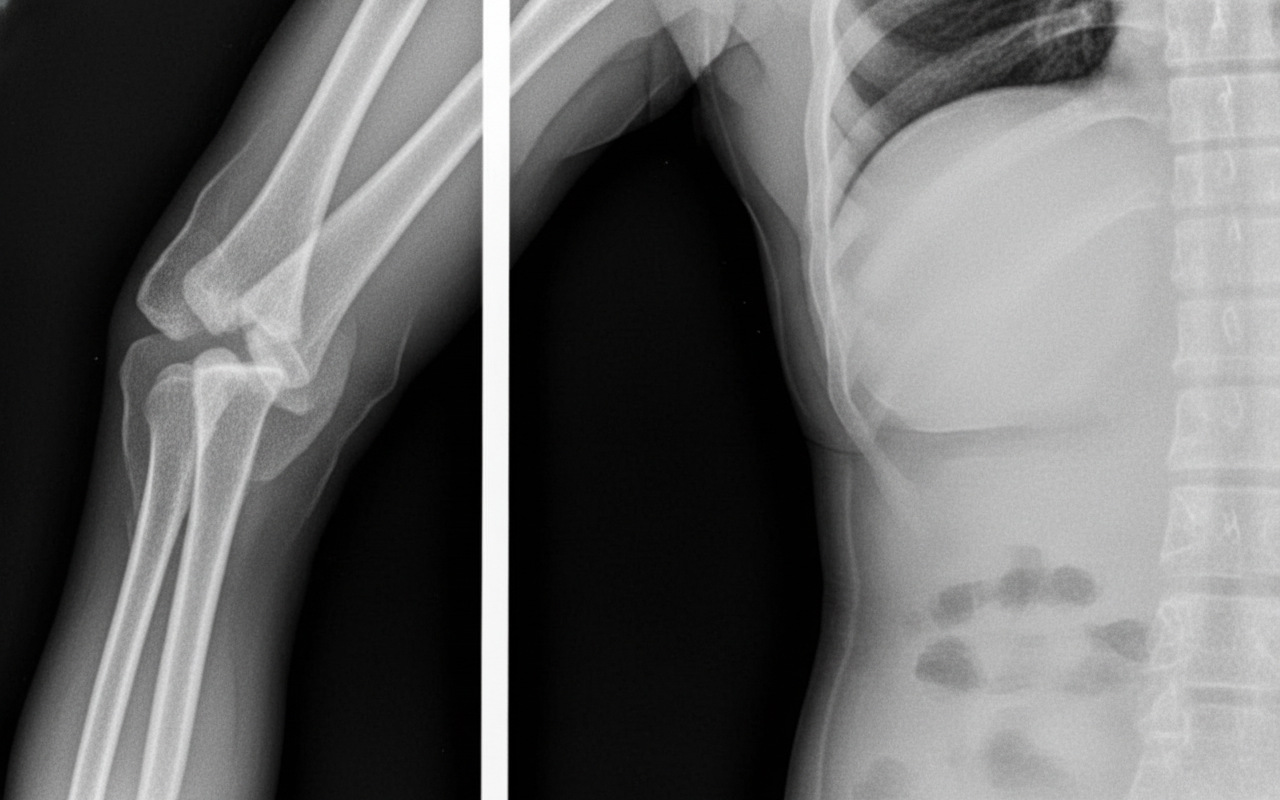
A rugby player fell onto his shoulder some weeks ago. He now presents with a painful lump about 4 cm in diameter on the top of his shoulder. What has he injured?
Boundaries of the upper triangular space include all except?
Klumpke's paralysis affects which nerve roots?
All of the following are affected in low radial nerve palsy except?
Which structure passes deep to the flexor retinaculum at the wrist?
A patient is diagnosed to have anterior interosseous nerve syndrome. Which of the following muscles is not affected in this syndrome?
Which of the following muscles has an attachment on the marked part?

A 48-year-old female court stenographer is admitted to the orthopedic clinic with symptoms of carpal tunnel syndrome, with which she has suffered for almost a year. Which muscles most typically become weakened in this condition?
Which of the following arteries is a branch of the first part of the axillary artery?
In crutch paralysis, which nerve is most frequently affected?
Explanation: ### Explanation **1. Why the Acromioclavicular (AC) Joint is Correct:** The clinical presentation describes a classic **Acromioclavicular Joint Dislocation** (often called a "shoulder separation"). A direct fall onto the point of the shoulder forces the acromion downward while the clavicle remains stabilized by the sternoclavicular joint. This results in the tearing of the AC ligaments and, in more severe cases, the coracoclavicular (CC) ligaments. The "painful lump" on top of the shoulder is the **lateral end of the clavicle**, which becomes prominent as it loses its attachment to the acromion. **2. Why the Other Options are Incorrect:** * **Common Extensor Origin:** This is located at the **lateral epicondyle of the humerus** (elbow). Injury here leads to "Tennis Elbow," not a shoulder lump. * **Head of the Humerus:** A fracture or dislocation of the humeral head would typically present with a "squared-off" shoulder appearance (in anterior dislocation) or pain deep within the glenohumeral joint, rather than a localized lump on the *top* of the shoulder. * **Sternoclavicular Joint:** This joint is located medially, where the clavicle meets the sternum. An injury here would cause a lump at the base of the neck/chest, not the top of the shoulder. **3. High-Yield Clinical Pearls for NEET-PG:** * **Step-off Deformity:** The visible gap or elevation of the clavicle in AC joint injuries is often referred to as a "step-off" deformity. * **Piano Key Sign:** A pathognomonic clinical test where pressing down on the elevated distal clavicle causes it to move down and spring back up, similar to a piano key. * **Ligamentous Support:** The AC joint is stabilized by the weak AC ligament (horizontal stability) and the strong **Coracoclavicular (CC) ligament** (vertical stability), which consists of the **conoid** and **trapezoid** parts. * **Mechanism of Injury:** Most common in contact sports like rugby or cycling accidents.
Explanation: The **Upper Triangular Space** is one of the three intermuscular spaces found in the axillary region. Understanding its boundaries is essential for localizing neurovascular structures in the posterior shoulder. ### **Explanation of the Correct Answer** The correct answer is **C (Subscapularis)**. While the subscapularis muscle forms the anterior wall of the axilla, it does **not** form a boundary of the upper triangular space. The boundaries are formed by muscles and tendons located on the posterior aspect of the scapula. ### **Analysis of Options** * **A. Teres minor:** This forms the **superior** boundary of the space. * **B. Teres major:** This forms the **inferior** boundary of the space. * **D. Triceps:** Specifically, the **long head of the triceps brachii** forms the **lateral** boundary. ### **High-Yield NEET-PG Facts** To master this topic, remember the "Rule of Three" for the intermuscular spaces: 1. **Upper Triangular Space:** * **Boundaries:** Teres minor (superior), Teres major (inferior), Long head of triceps (lateral). * **Content:** **Circumflex scapular artery** (an important contributor to the scapular anastomosis). 2. **Quadrangular Space:** * **Boundaries:** Teres minor (superior), Teres major (inferior), Long head of triceps (medial), Surgical neck of humerus (lateral). * **Contents:** **Axillary nerve** and **Posterior circumflex humeral artery**. 3. **Lower Triangular Space (Triangular Hiatus):** * **Boundaries:** Teres major (superior), Long head of triceps (medial), Lateral head of triceps/Humerus (lateral). * **Contents:** **Radial nerve** and **Profunda brachii artery**. **Clinical Pearl:** In NEET-PG, questions often focus on the contents. Remember: The **Upper** space has an **artery only**, while the **Quadrangular** and **Lower** spaces contain both a **nerve and an artery**.
Explanation: **Explanation:** **Klumpke’s paralysis** is a lower brachial plexus injury resulting from the involvement of the **C8 and T1 nerve roots**. This injury typically occurs due to hyperabduction of the arm, such as when someone clutches an object while falling from a height or during a breech delivery (birth injury). 1. **Why C8, T1 is Correct:** These roots primarily supply the intrinsic muscles of the hand (via the ulnar and median nerves) and the long flexors of the fingers. Damage leads to a characteristic **"Claw Hand"** (main en griffe) deformity due to the paralysis of lumbricals, which normally flex the MCP joints and extend the IP joints. 2. **Why Other Options are Incorrect:** * **C5, C6:** These roots form the upper trunk. Injury here leads to **Erb’s Paralysis**, characterized by the "Policeman’s tip" or "Waiter’s tip" deformity. * **C6, C7 & C4, C5:** These combinations do not correspond to the classic clinical syndromes of the brachial plexus. C4 is a pre-fixed contribution, while C7 is the middle trunk. **High-Yield Clinical Pearls for NEET-PG:** * **Horner’s Syndrome:** Often associated with Klumpke’s paralysis if the **T1 root** is avulsed proximal to the sympathetic chain (presenting with ptosis, miosis, and anhidrosis). * **Mechanism:** Hyperabduction (Klumpke's) vs. Increase in neck-shoulder angle (Erb's). * **Muscles affected:** Mainly the Interossei, Lumbricals, and Thenar/Hypothenar muscles. * **Sensory Loss:** Occurs along the medial border of the forearm and hand (ulnar aspect).
Explanation: ### Explanation The radial nerve's clinical presentation depends on the level of the lesion. To answer this question, one must distinguish between **High Radial Nerve Palsy** (at the axilla or spiral groove) and **Low Radial Nerve Palsy** (at or below the elbow). **1. Why Extensor Carpi Radialis Longus (ECRL) is the correct answer:** In low radial nerve palsy (often involving the **Posterior Interosseous Nerve - PIN**), the lesion occurs after the nerve has already given off branches to the more proximal muscles. The **ECRL** is supplied by the radial nerve proper **above the elbow joint** (proximal to its division into superficial and deep branches). Therefore, in a low lesion (like PIN palsy), the ECRL remains functional, allowing the patient to still perform wrist extension (often with radial deviation). **2. Analysis of Incorrect Options:** * **Extensor Carpi Radialis Brevis (ECRB):** This muscle is typically supplied by the deep branch of the radial nerve or the PIN. It is frequently affected in low radial nerve palsy, leading to weakened wrist extension. * **Finger Extensors:** These include the Extensor Digitorum, Extensor Indicis, and Extensor Digiti Mimimi. All are supplied by the **PIN**, which is the primary nerve affected in low radial nerve palsy. Their loss leads to the inability to extend the MCP joints. * **Sensation on dorsum of hand:** While a pure PIN palsy (motor) spares sensation, "Low Radial Nerve Palsy" as a general term often includes lesions of the **Superficial Radial Nerve** (distal 1/3 of forearm), which would result in sensory loss over the first dorsal web space. However, since ECRL is definitively spared in all "low" lesions, it remains the most accurate "except" choice. **3. High-Yield Clinical Pearls for NEET-PG:** * **Wrist Drop:** Occurs in high radial nerve palsy (e.g., Saturday Night Palsy, Crutch Palsy) because ECRL, ECRB, and ECU are all paralyzed. * **Finger Drop (without Wrist Drop):** Characteristic of **PIN palsy** (Low Radial Nerve Palsy) because ECRL is spared. * **PIN Sparing:** The PIN supplies all muscles of the posterior compartment of the forearm **except** Brachioradialis, ECRL, and the Anconeus (and sometimes ECRB). * **Arcade of Frohse:** The most common site of PIN compression (superior border of the supinator muscle).
Explanation: **Explanation:** The **flexor retinaculum** (transverse carpal ligament) converts the concave anterior surface of the carpus into the **carpal tunnel** [1]. Understanding the contents of this tunnel is a high-yield topic for NEET-PG. **1. Why the Median Nerve is Correct:** The median nerve is the most superficial structure within the carpal tunnel, passing directly deep to the flexor retinaculum [1]. Along with the median nerve, the tunnel contains nine tendons: four of the *flexor digitorum superficialis*, four of the *flexor digitorum profundus*, and one of the *flexor pollicis longus*. **2. Why the Other Options are Incorrect:** * **Ulnar Nerve & Ulnar Artery:** These structures pass **superficial** to the flexor retinaculum through a separate fibro-osseous canal known as **Guyon’s canal** (ulnar canal) [1]. They do not enter the carpal tunnel. * **Radial Nerve:** At the wrist, the superficial branch of the radial nerve is located laterally and posteriorly; it does not pass through any anterior compartment or deep to the retinaculum. **3. Clinical Pearls & High-Yield Facts:** * **Carpal Tunnel Syndrome (CTS):** Compression of the median nerve within the tunnel leads to paresthesia in the lateral 3.5 fingers and wasting of the **thenar muscles** (LOAF: Lateral two lumbricals, Opponens pollicis, Abductor pollicis brevis, Flexor pollicis brevis). * **Palmar Cutaneous Branch:** This branch of the median nerve arises proximal to the wrist and passes **superficial** to the retinaculum [1]. Therefore, sensation over the thenar eminence is **spared** in carpal tunnel syndrome. * **Palmaris Longus:** If present, its tendon passes superficial to the flexor retinaculum.
Explanation: The **Anterior Interosseous Nerve (AIN)** is the largest branch of the Median nerve, arising in the proximal forearm. It is a purely motor nerve that supplies the deep muscles of the anterior compartment of the forearm. **Why Option D is correct:** The **Flexor Digitorum Superficialis (FDS)** is a muscle of the intermediate layer of the forearm. It is supplied directly by the **main trunk of the Median nerve** before it gives off the AIN branch. Therefore, in AIN syndrome, the FDS remains functional. **Why other options are incorrect:** The AIN specifically supplies exactly **2.5 muscles** in the deep flexor compartment: * **Flexor Pollicis Longus (Option A):** Responsible for flexion of the thumb IP joint. * **Pronator Quadratus (Option B):** Responsible for forearm pronation. * **Lateral half (Radial half) of Flexor Digitorum Profundus (Option C):** Responsible for flexion of the DIP joints of the index and middle fingers. **Clinical Pearls for NEET-PG:** 1. **Kiloh-Nevin Syndrome:** Another name for AIN syndrome. It is often an entrapment neuropathy (e.g., between heads of pronator teres). 2. **The "OK" Sign Test:** This is the classic clinical test for AIN syndrome. A patient with AIN palsy cannot make a circle with their thumb and index finger (pulp-to-pulp contact instead of tip-to-tip) due to weakness of FPL and the lateral half of FDP. 3. **Sensory Sparing:** Since the AIN has no cutaneous branches, there is **no sensory loss** in the hand, distinguishing it from a proximal Median nerve injury [1].
Explanation: ***Pectoralis minor*** - The **pectoralis minor** muscle has its insertion on the **coracoid process** of the scapula, which is the marked anatomical structure. - This muscle originates from the **3rd-5th ribs** and helps in **protraction** and **depression** of the scapula. *Long head of biceps* - The **long head of biceps brachii** originates from the **supraglenoid tubercle** of the scapula, not the coracoid process. - It passes through the **bicipital groove** of the humerus and assists in **shoulder flexion** and **forearm supination**. *Pectoralis major* - The **pectoralis major** inserts on the **lateral lip of the bicipital groove** of the humerus, not on any part of the scapula. - It originates from the **clavicle**, **sternum**, and **costal cartilages** and is responsible for **shoulder adduction** and **internal rotation**. *Long head of triceps* - The **long head of triceps brachii** originates from the **infraglenoid tubercle** of the scapula, which is located below the glenoid cavity. - This muscle is primarily responsible for **elbow extension** and **shoulder adduction**, not attachment to the coracoid process.
Explanation: **Explanation:** **1. Why "Thenar" is correct:** Carpal tunnel syndrome (CTS) results from the compression of the **median nerve** as it passes through the carpal tunnel deep to the flexor retinaculum [1]. The median nerve provides motor innervation to the **thenar muscles** (Abductor pollicis brevis, Flexor pollicis brevis, and Opponens pollicis) via its recurrent branch. Chronic compression leads to denervation, resulting in weakness and characteristic wasting (atrophy) of the thenar eminence, often described as "ape-hand" deformity. **2. Why other options are incorrect:** * **Dorsal and Palmar Interossei (A & D):** These muscles are exclusively innervated by the **deep branch of the ulnar nerve**. They are responsible for abduction (DAB) and adduction (PAD) of the fingers and remain unaffected in CTS. * **Lumbricals III and IV (B):** These are the medial two lumbricals, which are innervated by the **ulnar nerve**. The median nerve innervates only the lateral two lumbricals (I and II). **3. Clinical Pearls for NEET-PG:** * **Sensory Loss:** Occurs over the palmar aspect of the lateral 3½ digits [1]. Note that the **palmar cutaneous branch** of the median nerve arises *proximal* to the carpal tunnel; thus, sensation over the central palm is usually spared [2]. * **Tinel’s Sign:** Percussion over the flexor retinaculum causes tingling in the median nerve distribution. * **Phalen’s Test:** Forced flexion of the wrist for 60 seconds exacerbates symptoms. * **Most Common Nerve Involved:** Median nerve is the most common nerve involved in entrapment neuropathies of the upper limb.
Explanation: The axillary artery is the continuation of the subclavian artery, extending from the outer border of the first rib to the lower border of the teres major muscle. It is divided into three parts by the **pectoralis minor muscle**: * **1st Part:** Medial to the muscle (1 branch) * **2nd Part:** Posterior to the muscle (2 branches) * **3rd Part:** Lateral to the muscle (3 branches) **Correct Option Explanation:** * **B. Superior thoracic artery:** This is the **only** branch of the first part. It is a small vessel that supplies the first and second intercostal spaces and the upper part of the serratus anterior. **Incorrect Options Explanation:** * **A. Lateral thoracic artery:** This is a branch of the **second part**. It follows the lower border of the pectoralis minor and is a major supply to the breast [1]. * **D. Thoracoacromial artery:** This is also a branch of the **second part**. It pierces the clavipectoral fascia and divides into four branches (Acromial, Deltoid, Pectoral, and Clavicular). * **C. Subscapular artery:** This is the largest branch of the axillary artery and arises from the **third part**. **High-Yield NEET-PG Pearls:** 1. **Mnemonic for branches:** "**S**he **T**asted **L**ittle **A**pples **S**o **P**ink" (**S**uperior thoracic, **T**horacoacromial, **L**ateral thoracic, **A**nterior circumflex humeral, **S**ubscapular, **P**osterior circumflex humeral). 2. **Clinical Correlation:** The axillary artery is closely related to the cords of the brachial plexus (named according to their position relative to the second part). 3. **Surgical Landmark:** The pectoralis minor is the key landmark for identifying the parts of the artery during axillary lymph node dissection [1].
Explanation: **Explanation:** **Crutch Paralysis** occurs due to prolonged or improper use of crutches, where the pressure of the crutch pad is directed into the apex of the axilla rather than being supported by the torso. **Why Axillary Nerve is the Correct Answer:** The **axillary nerve** is the most frequently affected nerve in crutch paralysis because of its anatomical position. It originates from the posterior cord of the brachial plexus and winds around the surgical neck of the humerus. When a patient leans heavily on a crutch, the pressure is applied directly against the upper part of the humerus and the axillary folds, compressing the axillary nerve. This leads to weakness in shoulder abduction (deltoid) and sensory loss over the "regimental badge" area. **Analysis of Incorrect Options:** * **Median Nerve:** Located more medially and deeply in the arm; it is typically spared in axillary pressure injuries but may be involved in "Carpal Tunnel Syndrome" or supracondylar fractures. * **Radial Nerve:** While the radial nerve can be compressed in the axilla (leading to "Saturday Night Palsy"), it is more commonly injured in the **radial groove** of the humerus. In the context of crutch use, the axillary nerve is statistically more vulnerable to direct upward pressure. * **Musculocutaneous Nerve:** This nerve is protected by the coracobrachialis muscle and is rarely involved in isolation due to external pressure. **Clinical Pearls for NEET-PG:** * **Saturday Night Palsy:** Compression of the radial nerve in the spiral groove (presents with wrist drop). * **Honeymoon Palsy:** Compression of the radial nerve in the axilla by another person's head. * **Quadrangular Space Syndrome:** Can also lead to axillary nerve compression, often due to hypertrophy of surrounding muscles or trauma. * **Key Symptom:** In crutch paralysis, look for **weakness in deltoid** and loss of the rounded contour of the shoulder.
Pectoral Region and Axilla
Practice Questions
Arm and Cubital Fossa
Practice Questions
Forearm and Hand
Practice Questions
Joints of Upper Limb
Practice Questions
Nerves of Upper Limb
Practice Questions
Arterial Supply and Venous Drainage
Practice Questions
Lymphatic Drainage
Practice Questions
Muscles and Their Actions
Practice Questions
Applied Anatomy and Clinical Correlations
Practice Questions
Surface Anatomy and Landmarks
Practice Questions
Get full access to all questions, explanations, and performance tracking.
Start For Free