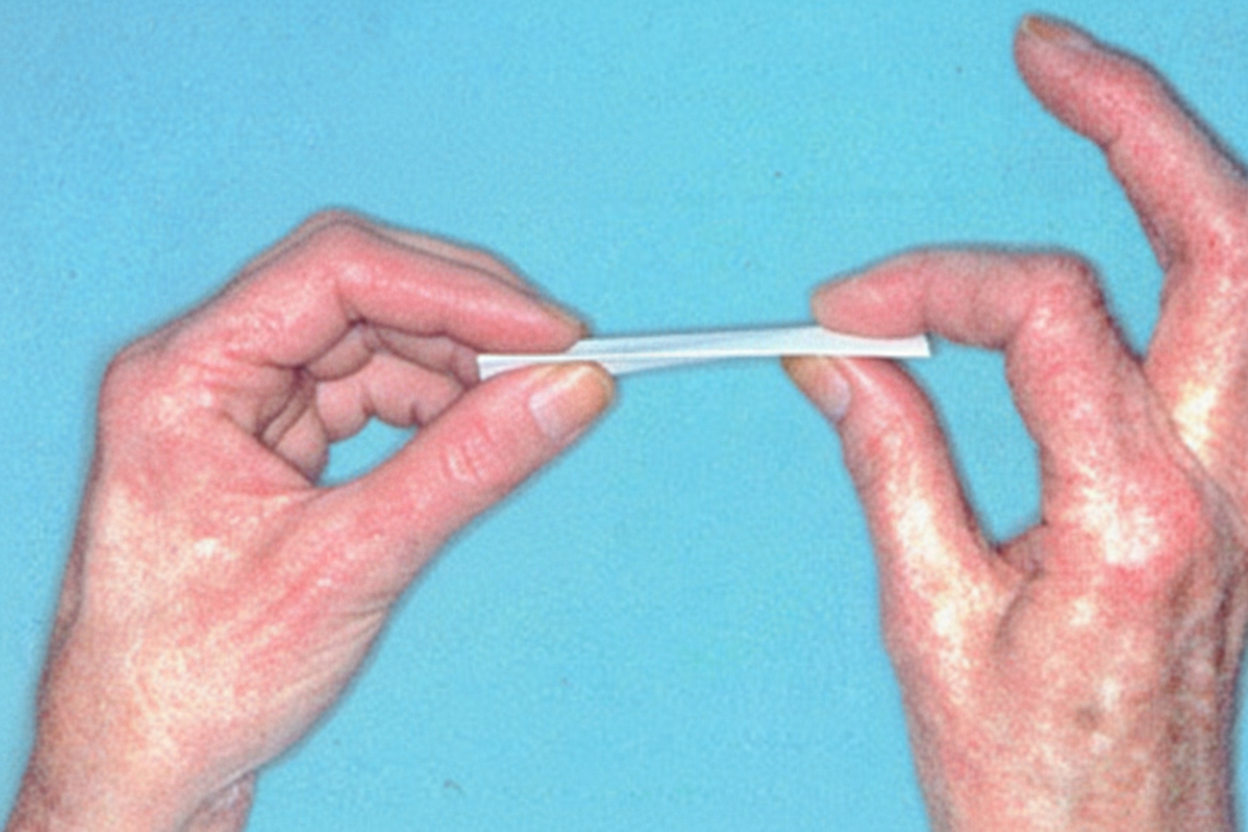
Fracture of the shaft of the humerus commonly damages which nerve?
Contents of the anatomical snuff box include:
At which anatomical level does the radial nerve divide?
All of the following take part in the formation of the wrist joint, except?
What is true about the cephalic vein?
All of the following form the boundaries of the lower triangular space of the arm, EXCEPT?
Extension at the MCP joint is primarily achieved by which of the following muscles?
Klumpke’s paralysis involves which spinal nerve roots?
The anterior interosseous nerve supplies all muscles except?
Which muscle produces supination when the elbow is flexed?
Explanation: The **radial nerve** is the most frequently injured nerve in fractures of the humeral shaft, particularly those involving the **middle third**. This is due to the close anatomical relationship where the nerve winds around the posterior aspect of the humerus in the **spiral (radial) groove**, lying directly against the periosteum. **Why the other options are incorrect:** * **Axillary nerve:** This nerve is most commonly injured in fractures of the **surgical neck** of the humerus or during anterior dislocations of the shoulder joint. * **Median nerve:** It is typically injured in **supracondylar fractures** of the humerus (along with the brachial artery), rather than shaft fractures. * **Ulnar nerve:** This nerve is most vulnerable at the **medial epicondyle** (where it sits in the retrocondylar groove) or in fractures of the medial epicondyle itself. **Clinical Pearls for NEET-PG:** 1. **Clinical Presentation:** Injury to the radial nerve at the humeral shaft results in **Wrist Drop** due to paralysis of the extensors of the wrist and digits. 2. **Holstein-Lewis Fracture:** A spiral fracture of the distal one-third of the humerus that is specifically associated with radial nerve neuropraxia [1]. 3. **Sensory Loss:** Patients typically exhibit anesthesia over the **dorsal aspect of the first web space**. 4. **Rule of Thumb:** Remember the "S-A-R-U" mnemonic for humerus fractures: **S**urgical neck = **A**xillary nerve; **R**adial groove = **R**adial nerve; **U**lnar groove = **U**lnar nerve.
Explanation: The **Anatomical Snuffbox** is a triangular depression on the lateral aspect of the wrist, visible during thumb extension. Understanding its boundaries versus its contents is a frequent high-yield topic for NEET-PG [1]. ### **Why Radial Artery is the Correct Answer** The **Radial Artery** is the primary structure passing through the **floor** of the anatomical snuffbox. After giving off the superficial palmar branch, the artery winds dorsally around the lateral side of the carpus, deep to the tendons of the abductor pollicis longus and extensor pollicis brevis, to lie in the snuffbox before passing between the two heads of the first dorsal interosseous muscle. ### **Analysis of Incorrect Options** * **B & C (Tendon of APL and EPB):** These structures form the **lateral (anterior) boundary** of the snuffbox [1]. They are part of the "walls" rather than the "contents." * **D (Scaphoid bone):** Along with the trapezium, the scaphoid forms the **floor** of the snuffbox. While it is a landmark within the area, in standard anatomical nomenclature, "contents" typically refers to neurovascular structures or tendons passing *through* the space, whereas the scaphoid is a structural boundary. ### **High-Yield Clinical Pearls for NEET-PG** * **Boundaries:** * **Medial (Posterior):** Tendon of Extensor Pollicis Longus (EPL) [1]. * **Lateral (Anterior):** Tendons of Abductor Pollicis Longus (APL) and Extensor Pollicis Brevis (EPB) [1]. * **Floor:** Scaphoid and Trapezium bones. * **Contents:** Radial artery, Cephalic vein (starts here), and the superficial branch of the Radial nerve. * **Clinical Significance:** Tenderness in the snuffbox is a classic sign of a **Scaphoid fracture**. The radial pulse can also be palpated here.
Explanation: ### Explanation The radial nerve is the largest branch of the brachial plexus (C5-T1). Its division into terminal branches is a high-yield anatomical landmark for the elbow region. **Why Option B is Correct:** As the radial nerve descends the arm, it pierces the lateral intermuscular septum to enter the anterior compartment. It then passes **anterior to the lateral epicondyle** of the humerus, lying in a deep groove between the Brachialis and Brachioradialis muscles. At this specific level (the joint line), it divides into its two terminal branches: 1. **Superficial branch:** A purely sensory nerve. 2. **Deep branch (Posterior Interosseous Nerve - PIN):** A motor nerve that enters the supinator muscle through the Arcade of Frohse. **Why the Other Options are Incorrect:** * **Options A & C (Medial Epicondyle):** The **Ulnar nerve** is the primary nerve associated with the medial epicondyle. It passes *posterior* to it (the "funny bone" location). The Median nerve passes anterior to the medial epicondyle but does not divide there. * **Option D (Posterior Lateral Epicondyle):** While the radial nerve is posterior to the *humerus* (in the spiral groove), it must move anteriorly before reaching the elbow to divide. **NEET-PG High-Yield Pearls:** * **Injury Site:** Fracture of the **mid-shaft humerus** (spiral groove) typically spares the triceps but causes **wrist drop**. * **PIN Syndrome:** Compression of the deep branch at the **Arcade of Frohse** (supinator) causes motor loss of finger extensors but **no sensory loss**, distinguishing it from more proximal radial nerve injuries. * **The "BEAST" Muscles:** The radial nerve supplies the **B**rachioradialis, **E**xtensors, **A**nconeus, **S**upinator, and **T**riceps.
Explanation: The **wrist joint (Radiocarpal joint)** is a synovial joint of the ellipsoid variety. The core concept to remember for NEET-PG is that the **ulna is excluded** from this joint by a fibrocartilaginous structure. ### Why the Distal End of Ulna is the Correct Answer: The distal end of the ulna does not articulate directly with the carpal bones. It is separated from the carpal bones (specifically the triquetrum and lunate) by the **Triangular Fibrocartilage Complex (TFCC)** or the articular disc of the inferior radioulnar joint. Therefore, the ulna does not participate in the formation of the wrist joint proper. ### Why the Other Options are Incorrect: * **Distal end of Radius:** This forms the proximal articular surface of the wrist joint. It has two facets: a lateral triangular facet for the scaphoid and a medial quadrangular facet for the lunate. * **Scaphoid:** This is a lateral carpal bone of the proximal row that articulates directly with the radial facet during all movements of the wrist. * **Triquetrum:** While the scaphoid and lunate are the primary articulators, the triquetrum comes into contact with the articular disc (TFCC) during **adduction (ulnar deviation)** of the hand, making it a functional part of the radiocarpal unit. ### High-Yield Clinical Pearls: 1. **Articular Surfaces:** Proximal surface = Distal radius + Articular disc. Distal surface = Scaphoid + Lunate + Triquetrum. 2. **Colles’ Fracture:** A fracture of the distal end of the radius (dinner fork deformity) often involves the wrist joint, whereas ulnar styloid fractures are secondary. 3. **Most Commonly Fractured Carpal Bone:** Scaphoid (risk of avascular necrosis). 4. **Most Commonly Dislocated Carpal Bone:** Lunate.
Explanation: **Explanation:** The **cephalic vein** is a major superficial vein of the upper limb, essential for clinical procedures and anatomical orientation. **1. Why Option C is Correct:** The cephalic vein originates from the lateral side of the dorsal venous arch of the hand [1]. It ascends along the lateral aspect of the forearm and arm [1]. In the shoulder region, it enters the **deltopectoral groove** (the space between the deltoid and pectoralis major muscles) alongside the deltoid branch of the thoracoacromial artery [1]. It then pierces the clavipectoral fascia to drain into the **axillary vein** [1]. **2. Why the Other Options are Incorrect:** * **Option A:** It terminates by draining into the **axillary vein**, not the brachial vein [1]. The basilic vein is the one that joins the brachial veins to form the axillary vein. * **Option B:** It does not accompany the ulnar nerve. The ulnar nerve is medial, whereas the cephalic vein is **lateral** [1]. It is more closely associated with the lateral cutaneous nerve of the forearm. * **Option D:** It drains the **lateral side** of the forearm [1]. The basilic vein is responsible for the medial drainage. **3. High-Yield Clinical Pearls for NEET-PG:** * **Cutdown Site:** The cephalic vein in the deltopectoral groove is a consistent landmark for permanent cardiac pacemaker lead insertion. * **Median Cubital Vein:** This vein connects the cephalic and basilic veins in the cubital fossa and is the preferred site for venipuncture [1]. * **Mnemonic:** Remember **"C"** for **C**ephalic and **"L"** for **Lateral** (the "C" looks like a "L" rotated). **B**asilic is **M**edial (**BM** - Basilic Medial).
Explanation: The **lower triangular space** is one of the three intermuscular spaces found in the axillary region, serving as a critical anatomical gateway for neurovascular structures passing from the axilla to the posterior compartment of the arm. [1] ### **Explanation of the Correct Answer** **C. Pectoralis major** is the correct answer because it is a muscle of the anterior chest wall and forms the anterior fold of the axilla [1]. It does not participate in forming the boundaries of the posterior intermuscular spaces (quadrangular, upper triangular, or lower triangular spaces). ### **Analysis of the Boundaries** The lower triangular space is bounded by: * **Superiorly (Base):** Lower border of the **Teres major** muscle (Option A). * **Laterally:** Medial border of the **Shaft of the humerus** (Option B). * **Medially:** Lateral border of the **Long head of triceps** brachii (Option D). ### **Clinical Pearls & High-Yield Facts for NEET-PG** 1. **Contents:** The most high-yield fact is the content of this space: the **Radial nerve** and the **Profunda brachii artery**. 2. **Clinical Correlation:** Fractures of the mid-shaft of the humerus often involve this space, potentially leading to radial nerve palsy (resulting in "wrist drop"). 3. **Comparison Table for Quick Revision:** * **Upper Triangular Space:** Contains Circumflex scapular artery. * **Quadrangular Space:** Contains Axillary nerve and Posterior circumflex humeral artery. * **Lower Triangular Space:** Contains Radial nerve and Profunda brachii artery. **Mnemonic:** To remember the contents of the lower triangular space, think **"R-P"** (Radial nerve and Profunda brachii).
Explanation: ### Explanation **1. Why Extensor Digitorum is Correct:** The **Extensor Digitorum (ED)** is the primary muscle responsible for extension at the Metacarpophalangeal (MCP) joints of the medial four fingers [2]. It originates from the common extensor origin (lateral epicondyle) and inserts into the extensor expansions. While it can assist in extending the Interphalangeal (IP) joints, its mechanical advantage is greatest at the MCP joint. Isolated contraction of the ED results in hyperextension at the MCP joint. **2. Why the Other Options are Incorrect:** * **Lumbricals:** These are unique muscles that originate from the tendons of Flexor Digitorum Profundus. Their primary action is to **flex the MCP joints** and **extend the IP joints** (the "Z-position") [1]. * **Dorsal Interossei (DAB):** Their primary action is **Abduction** of the fingers at the MCP joints [1]. Like lumbricals, they also assist in MCP flexion and IP extension. * **Palmar Interossei (PAD):** Their primary action is **Adduction** of the fingers at the MCP joints. They also contribute to the "Z-position" (MCP flexion, IP extension) [1]. **3. Clinical Pearls & High-Yield Facts for NEET-PG:** * **The "Z-Position":** Flexion at MCP + Extension at IP joints is a combined action of the Lumbricals and Interossei (collectively called the intrinsic muscles of the hand) [1]. * **Claw Hand:** Paralysis of the lumbricals and interossei (Ulnar nerve palsy) leads to the opposite of the Z-position: **Hyperextension at MCP** (due to unopposed Extensor Digitorum) and **Flexion at IP joints** (due to unopposed FDP/FDS). * **Nerve Supply:** Extensor Digitorum is supplied by the **Posterior Interosseous Nerve (C7, C8)**, a branch of the Radial nerve [2]. * **Extensor Indicis & Extensor Digiti Minimi:** These provide independent MCP extension for the index and little fingers, respectively [2].
Explanation: **Explanation:** **Klumpke’s paralysis** is a lower brachial plexus injury resulting from the involvement of the **C8 and T1 spinal nerve roots**. 1. **Why C8 and T1 is correct:** These roots form the lower trunk of the brachial plexus. Injury typically occurs due cab to **hyperabduction of the arm** (e.g., clutching an object while falling from a height or a breech delivery where the arm is pulled over the head). The T1 root is primarily responsible for supplying the **intrinsic muscles of the hand** (interossei, thenar, and hypothenar muscles). Damage leads to "Total Claw Hand" due to the unopposed action of long extensors and flexors. 2. **Analysis of Incorrect Options:** * **C5 and C6:** These roots form the upper trunk. Injury here leads to **Erb’s Palsy**, characterized by the "Policeman’s tip" or "Waiter’s tip" deformity. * **C6 and C7 / C7 and T1:** These combinations do not correspond to the classic clinical syndromes of the brachial plexus trunks. C7 primarily continues as the middle trunk. **High-Yield Clinical Pearls for NEET-PG:** * **Deformity:** Total Claw Hand (hyperextension at MCP joints and flexion at IP joints). * **Horner’s Syndrome:** Often associated with Klumpke’s paralysis if the T1 preganglionic sympathetic fibers are involved (causing ptosis, miosis, and anhidrosis). * **Sensory Loss:** Occurs along the ulnar border of the forearm and hand (medial cutaneous nerve of forearm and hand). * **Mnemonic:** **E**rb’s = **U**pper (C5-C6); **K**lumpke’s = **L**ower (C8-T1).
Explanation: ### Explanation The **Anterior Interosseous Nerve (AIN)** is the largest branch of the **Median Nerve**, arising in the upper part of the forearm. It is a purely motor nerve (with sensory fibers only for the wrist joint) that travels along the anterior surface of the interosseous membrane [1]. **Why Flexor Digitorum Superficialis (FDS) is the correct answer:** The FDS is located in the **intermediate layer** of the anterior forearm. It is supplied directly by the **main trunk of the Median Nerve** before it gives off the AIN branch. Therefore, it is not supplied by the AIN. **Analysis of Incorrect Options:** The AIN supplies the **deep layer** of the anterior forearm muscles, which includes: * **Flexor Pollicis Longus (FPL):** Entirely supplied by the AIN. * **Pronator Quadratus (PQ):** The terminal branch of the AIN supplies this muscle. * **Flexor Digitorum Profundus (FDP):** The AIN supplies only the **lateral half** (index and middle finger tendons). The medial half is supplied by the Ulnar Nerve. --- ### High-Yield Clinical Pearls for NEET-PG: 1. **Kiloh-Nevin Syndrome (AIN Syndrome):** Compression of the AIN leads to weakness of the FPL and the lateral half of the FDP. 2. **The "OK" Sign:** Patients with AIN palsy cannot make a circle with their thumb and index finger (they cannot flex the IP joint of the thumb and DIP joint of the index finger). Instead, they produce a **"pinch"** or a flattened triangle. 3. **Mnemonic for AIN supply:** **"P-P-F"** (Pronator quadratus, Profundus-lateral half, Flexor pollicis longus). 4. **Sensory Supply:** Remember that while the AIN is "motor," it provides sensory innervation to the **wrist and distal radioulnar joints**, but *not* to the skin.
Explanation: The **Biceps brachii** is the correct answer because it is the most powerful supinator of the forearm, but its mechanical advantage is highly dependent on the position of the elbow. The muscle inserts into the **radial tuberosity**. When the elbow is flexed to 90°, the biceps tendon is perpendicular to the radius, providing the maximum torque required for powerful supination (e.g., tightening a screw). **Analysis of Options:** * **Biceps brachii (Correct):** It acts as the primary supinator during flexed-elbow activities. When the elbow is extended, its supinatory power significantly diminishes. * **Supinator (Incorrect):** While this muscle supinates the forearm, it is the primary mover during **slow, unresisted supination** or when the elbow is fully extended. It lacks the power of the biceps in a flexed position. * **Coracobrachialis (Incorrect):** This muscle is located in the arm and acts primarily as a flexor and adductor of the glenohumeral (shoulder) joint. It has no attachment to the radius or ulna and thus cannot rotate the forearm. * **Brachialis (Incorrect):** Known as the "workhorse" of elbow flexion, it inserts into the **ulnar tuberosity**. Since the ulna does not rotate during pronation/supination, the brachialis has no role in these movements. **NEET-PG High-Yield Pearls:** * **Nerve Supply:** Biceps and Brachialis are supplied by the **Musculocutaneous nerve (C5-C7)**. * **Screwdriver Muscle:** Biceps brachii is often referred to as the "screwdriver muscle" because of its role in powerful supination at 90° flexion. * **Paralysis:** In a Musculocutaneous nerve injury, supination is still possible (via the Supinator muscle, supplied by the Radial nerve), but it is significantly weakened.
Pectoral Region and Axilla
Practice Questions
Arm and Cubital Fossa
Practice Questions
Forearm and Hand
Practice Questions
Joints of Upper Limb
Practice Questions
Nerves of Upper Limb
Practice Questions
Arterial Supply and Venous Drainage
Practice Questions
Lymphatic Drainage
Practice Questions
Muscles and Their Actions
Practice Questions
Applied Anatomy and Clinical Correlations
Practice Questions
Surface Anatomy and Landmarks
Practice Questions
Get full access to all questions, explanations, and performance tracking.
Start For Free