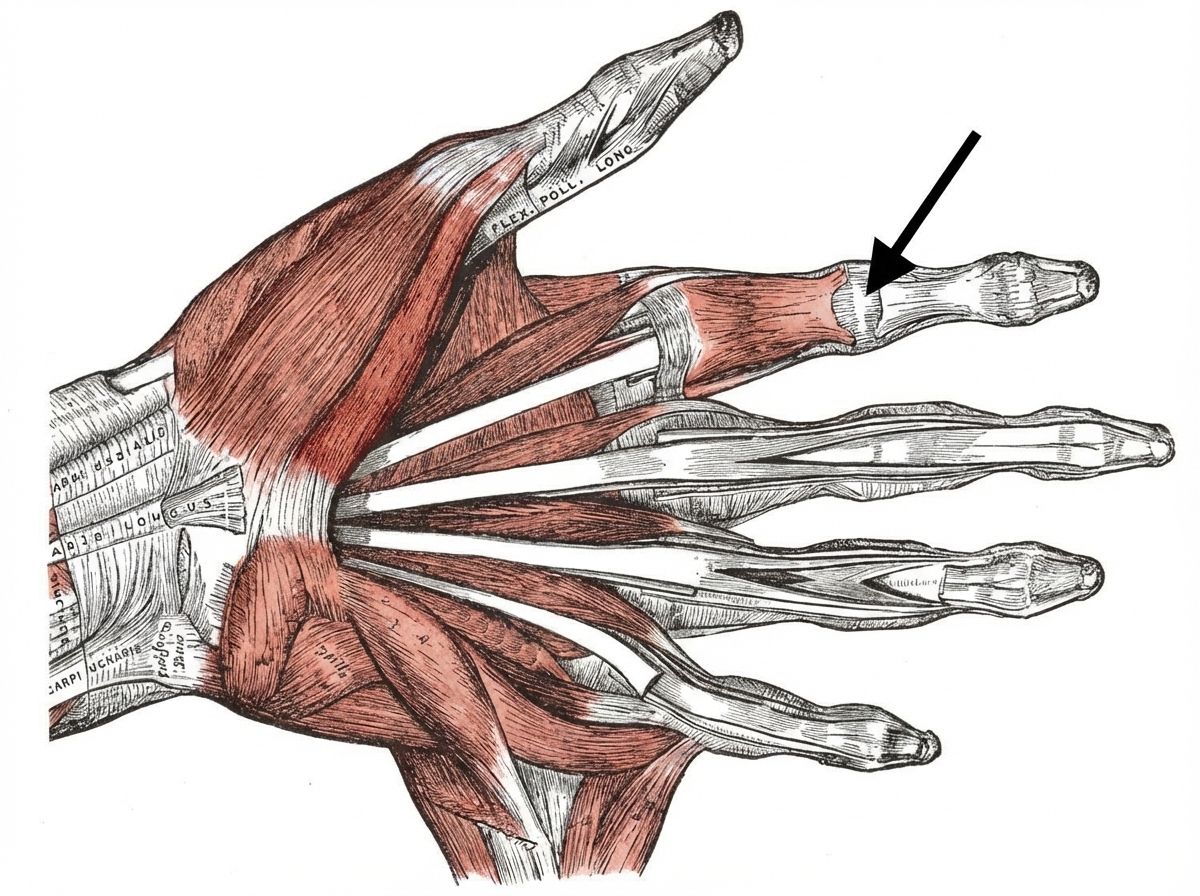
Which of the following structures is NOT contained within the carpal tunnel?
Injury to the radial nerve in the lower part of the spiral groove may result in all EXCEPT:
Where is the extensor carpi ulnaris inserted?
What is the primary function of the lumbrical muscles?
What is the root value of the long thoracic nerve?
The posterior cord of the brachial plexus is formed by which divisions?
An elderly patient complains of shoulder pain and has difficulty abducting his arm. Arthroscopy is performed with dye injection into the shoulder joint followed by an X-ray. The radiologist notes that the dye has leaked from the shoulder joint into the subacromial bursa. Which tendon rupture would allow for this dye leakage?
What is the medial boundary of the cubital fossa?
Which of the following is TRUE regarding the level of the superficial palmar arch?
If the C5 and C6 nerve roots are injured, sensation loss in which part of the upper limb will occur?
Explanation: The **carpal tunnel** is a fibro-osseous gateway located at the wrist, formed by the carpal bones (floor) and the **flexor retinaculum** (roof) [1]. Understanding its contents is a high-yield topic for NEET-PG. ### Why Palmaris Longus is the Correct Answer The **Palmaris longus** tendon does not enter the carpal tunnel. Instead, it passes **superficial** to the flexor retinaculum and attaches to the apex of the palmar aponeurosis. It is a vestigial muscle, absent in approximately 15% of the population, and is often used as a landmark for the median nerve. ### Analysis of Incorrect Options * **Median Nerve (C):** This is the most important structure within the tunnel [1]. Compression of this nerve leads to **Carpal Tunnel Syndrome (CTS)**. * **Flexor Digitorum Superficialis (A):** Four tendons of the FDS pass through the tunnel, arranged in two layers (middle and ring finger tendons are superficial to the index and little finger tendons). * **Flexor Digitorum Profundus (B):** Four tendons of the FDP pass through the deepest part of the tunnel. * *Note:* The 10th structure in the tunnel is the **Flexor Pollicis Longus** tendon. ### Clinical Pearls for NEET-PG * **Contents (Total 10):** 1 Median Nerve + 4 FDS tendons + 4 FDP tendons + 1 FPL tendon. * **Structures Superficial to the Tunnel:** Palmaris longus, Ulnar nerve, Ulnar artery, and the Palmar cutaneous branch of the Median nerve [1] (which is why sensation to the thenar eminence is spared in CTS). * **Flexor Carpi Radialis:** This tendon passes through a separate compartment/split in the flexor retinaculum and is technically not considered a content of the carpal tunnel proper [1].
Explanation: To understand this question, one must master the **topographical anatomy of the radial nerve** as it descends the arm. ### **Explanation of the Correct Option** **Option B** is the correct answer because it is a **false statement**. The nerve to the **Extensor Carpi Radialis Longus (ECRL)** arises from the radial nerve in the lower third of the arm, *after* it has left the spiral groove and pierced the lateral intermuscular septum. Therefore, an injury in the **lower part of the spiral groove** will involve the fibers destined for the ECRL, leading to its paralysis. It is not "spared." ### **Analysis of Other Options** * **Option A (Weakened supination):** True. While the Biceps Brachii (musculocutaneous nerve) is the primary supinator, the **Supinator muscle** is supplied by the deep branch of the radial nerve. An injury in the spiral groove paralyzes the supinator, weakening the movement. * **Option C (Paralysis of anconeus):** True. The nerve to the anconeus arises within the spiral groove and descends through the medial head of the triceps to reach the muscle. * **Option D (Intact extension at elbow):** True. The branches to the **long and medial heads of the Triceps** arise in the axilla and the uppermost part of the spiral groove. By the time the nerve reaches the *lower* part of the groove, these branches have already been given off, leaving elbow extension largely intact. ### **NEET-PG High-Yield Pearls** * **Saturday Night Palsy:** Refers to radial nerve compression in the spiral groove. * **Wrist Drop:** The hallmark clinical sign of radial nerve injury at or above the elbow (due to paralysis of all wrist extensors). * **Sensory Loss:** In spiral groove injuries, there is sensory loss over the narrow strip of the posterior forearm and the dorsal surface of the lateral 3.5 fingers (excluding nail beds). * **Rule of Thumb:** If the injury is in the **axilla**, the Triceps is gone (no elbow extension). If the injury is in the **spiral groove**, the Triceps is spared, but the wrist is dropped.
Explanation: ### Explanation **Correct Answer: C. Base of the 5th metacarpal** The **Extensor Carpi Ulnaris (ECU)** is a muscle located in the superficial layer of the posterior compartment of the forearm. It originates from the lateral epicondyle of the humerus (via the common extensor origin) and the posterior border of the ulna. Its primary function is to extend and adduct (ulnar deviate) the wrist. To perform these actions effectively, it inserts onto the **medial side of the base of the 5th metacarpal bone**. [1] #### Analysis of Incorrect Options: * **Option A & B:** The base of the proximal and distal phalanges of the thumb are insertion sites for the **Extensor Pollicis Brevis** and **Extensor Pollicis Longus**, respectively. These muscles belong to the deep group of the posterior compartment and act specifically on the thumb. [1] * **Option D:** The **Scaphoid** is a carpal bone. While several ligaments attach here, no major forearm extensor muscle inserts directly onto the scaphoid. Most wrist extensors bypass the carpal bones to insert onto the bases of the metacarpals to provide a better mechanical advantage for wrist movement. [1] #### High-Yield Clinical Pearls for NEET-PG: * **Nerve Supply:** Like most muscles in the posterior compartment, the ECU is supplied by the **Posterior Interosseous Nerve (C7, C8)**, which is a continuation of the deep branch of the radial nerve. [1] * **Synergistic Action:** During ulnar deviation, the ECU works synergistically with the **Flexor Carpi Ulnaris (FCU)**. * **Anatomical Compartment:** The ECU tendon passes through the **6th dorsal compartment** of the extensor retinaculum (the most medial compartment). [1] * **Comparison:** Remember that the Extensor Carpi Radialis Longus (ECRL) inserts at the base of the **2nd metacarpal**, while the Extensor Carpi Radialis Brevis (ECRB) inserts at the base of the **3rd metacarpal**. [1]
Explanation: The lumbrical muscles are unique intrinsic muscles of the hand that originate from the tendons of the **Flexor Digitorum Profundus (FDP)** and insert into the **extensor expansions** on the radial side of the proximal phalanges [1]. ### Why Option A is Correct The primary action of the lumbricals is to **flex the metacarpophalangeal (MCP) joints** while simultaneously **extending the interphalangeal (IP) joints** (both proximal and distal) [1]. This specific movement is often referred to as the "Z-pose" or the "writing position." This occurs because the lumbricals pass anterior to the transverse axis of the MCP joint (causing flexion) but insert into the extensor hood posterior to the axis of the IP joints (causing extension). ### Why Other Options are Incorrect * **Option B:** Lumbricals **extend** the IP joints. Flexion at the IP joints is primarily performed by the Flexor Digitorum Superficialis (at PIP) and Flexor Digitorum Profundus (at DIP). * **Options C & D:** Adduction and Abduction are functions of the **Interossei** muscles. Remember the mnemonic **PAD-DAB**: **P**almar interossei **AD**duct; **D**orsal interossei **AB**duct. ### High-Yield Clinical Pearls for NEET-PG * **Innervation:** Lumbricals follow a "1/2 ulnar, 1/2 median" rule. The **1st and 2nd** (lateral) are supplied by the **Median nerve**, while the **3rd and 4th** (medial) are supplied by the **Ulnar nerve** [2]. * **Lumbrical Paradox:** If the FDP tendon is cut distal to the lumbrical origin, attempting to flex the finger results in IP extension instead, as the force is diverted through the lumbrical. * **Clawing:** In Ulnar nerve palsy, the loss of the medial two lumbricals leads to the "Ulnar Claw Hand" (hyperextension at MCP and flexion at IP joints).
Explanation: ### Explanation **Correct Option: B (C-5, 6, 7)** The **Long Thoracic Nerve** (also known as the Nerve of Bell) arises directly from the **ventral rami of C5, C6, and C7** roots of the brachial plexus. It descends posterior to the brachial plexus and the first part of the axillary artery to reach the medial wall of the axilla, where it supplies the **Serratus Anterior** muscle. **Analysis of Incorrect Options:** * **A (C-3, 4, 5):** This is the root value of the **Phrenic Nerve**, which supplies the diaphragm. * **C (C-7, 8, T-1):** These roots contribute to the formation of the medial cord and nerves like the Ulnar nerve (though Ulnar is typically C8-T1, sometimes receiving a C7 contribution). * **D (C-2, 3, 4):** These roots form part of the **Cervical Plexus**, supplying the skin and muscles of the neck (e.g., Lesser Occipital, Great Auricular nerves). **High-Yield Clinical Pearls for NEET-PG:** 1. **Clinical Presentation:** Injury to this nerve leads to **"Winging of Scapula"** due to paralysis of the Serratus Anterior. The patient will be unable to perform overhead abduction (beyond 90°) and will have difficulty with "pushing" movements. 2. **Mechanism of Injury:** It is most commonly injured during surgical procedures like **Radical Mastectomy** (axillary lymph node dissection) or due to direct trauma/pressure in the axilla. 3. **Mnemonic:** *"C5, 6, 7 raise your arms to heaven"* (referring to its role in overhead abduction via the Serratus Anterior). 4. **Unique Feature:** Unlike most branches of the brachial plexus, it arises directly from the **roots**, not from the trunks, divisions, or cords.
Explanation: ### Explanation The brachial plexus is organized into Roots, Trunks, Divisions, Cords, and Branches. The formation of the **Posterior Cord** is a high-yield concept based on the embryological division of muscles into anterior (flexor) and posterior (extensor) compartments. **1. Why the Correct Answer is Right:** The **Posterior Cord** is formed by the union of the **dorsal (posterior) divisions of all three trunks** (Upper, Middle, and Lower). These divisions carry fibers from all spinal levels of the plexus (C5-T1). Because it is formed by dorsal divisions, the posterior cord and its terminal branches (Radial and Axillary nerves) primarily supply the extensor compartments of the upper limb. **2. Analysis of Incorrect Options:** * **Option A & B:** A single division from one trunk cannot form a cord. The upper trunk's ventral division contributes to the Lateral Cord, while its dorsal division is only one-third of the Posterior Cord. * **Option C:** The ventral divisions of the upper and middle trunks join to form the **Lateral Cord**. The ventral division of the lower trunk continues alone as the **Medial Cord**. Ventral divisions generally supply the flexor compartments (via Musculocutaneous, Median, and Ulnar nerves). **3. NEET-PG High-Yield Clinical Pearls:** * **Mnemonic for Cords:** **L**ateral (from **L**ateral and **M**iddle trunks), **P**osterior (from **A**ll three), **M**edial (from **M**edial trunk only). * **Positional Landmark:** Cords are named based on their relationship to the **second part of the Axillary Artery**. * **Posterior Cord Branches (Mnemonic: STAR):** **S**ubscapular (Upper & Lower), **T**horacodorsal, **A**xillary, and **R**adial nerves [1]. * **Clinical Correlation:** A lesion to the posterior cord results in "Wrist Drop" (Radial nerve) and loss of shoulder abduction (Axillary nerve).
Explanation: **Explanation:** The correct answer is **Supraspinatus**. This question tests your understanding of the anatomical relationship between the glenohumeral joint and the surrounding bursae. **1. Why Supraspinatus is correct:** The **Supraspinatus tendon** forms the superior part of the rotator cuff and lies directly beneath the **subacromial bursa**. Crucially, the subacromial bursa and the glenohumeral joint cavity are normally separated by the rotator cuff tendons. If the Supraspinatus tendon ruptures (a common injury in elderly patients due to chronic impingement), a communication is created between the joint cavity and the bursa. Therefore, dye injected into the joint space will leak into the subacromial bursa, confirming a full-thickness tear. **2. Why other options are incorrect:** * **Deltoid:** This is a superficial muscle. While it overlies the subacromial bursa, it does not form the wall between the joint cavity and the bursa. * **Infraspinatus:** While part of the rotator cuff, the Supraspinatus is the most frequently ruptured tendon and is the primary structure separating the joint from the subacromial bursa. * **Latissimus dorsi:** This muscle inserts into the floor of the bicipital groove and is not involved in the superior boundary of the shoulder joint capsule. **Clinical Pearls for NEET-PG:** * **Rotator Cuff Muscles (SITS):** Supraspinatus (Abduction 0-15°), Infraspinatus (External rotation), Teres minor (External rotation), Subscapularis (Internal rotation). * **Most Common Site of Tear:** The "Critical Zone" of the Supraspinatus tendon (near its insertion on the greater tubercle) due to poor vascularity. * **Painful Arc Syndrome:** Pain during abduction between 60° and 120° often indicates Supraspinatus tendinitis or subacromial bursitis.
Explanation: The **cubital fossa** is a triangular depression located on the anterior aspect of the elbow. Understanding its boundaries is high-yield for NEET-PG, as it serves as a transition zone for neurovascular structures entering the forearm. ### **Explanation of Boundaries** The cubital fossa is shaped like an inverted triangle: * **Medial Boundary (Correct Answer):** Formed by the **lateral border of the Pronator teres**. It is important to note that the medial border of the fossa is the lateral edge of this muscle. * **Lateral Boundary:** Formed by the **medial border of the Brachioradialis**. * **Superior Boundary (Base):** An imaginary horizontal line connecting the medial and lateral epicondyles of the humerus. * **Apex:** Directed downwards, where the Brachioradialis crosses the Pronator teres. * **Floor:** Formed by the Brachialis (medially) and the Supinator (laterally). * **Roof:** Formed by skin, superficial fascia (containing the median cubital vein), and the bicipital aponeurosis. ### **Why Other Options are Incorrect** * **Brachioradialis:** This muscle forms the **lateral** boundary of the fossa. * **Supinator:** This muscle forms part of the **floor** of the fossa, not its boundaries. ### **High-Yield Clinical Pearls** 1. **Contents (Medial to Lateral - "MBBR"):** **M**edian nerve, **B**rachial artery, **B**iceps brachii tendon, and **R**adial nerve. 2. **Median Cubital Vein:** Located in the roof; it is the preferred site for venipuncture. It is separated from the underlying brachial artery by the **bicipital aponeurosis** (the "grace de Dieu" fascia). 3. **Supracondylar Fracture:** The most common fracture involving this area in children, which can lead to **Volkmann’s Ischemic Contracture** due to brachial artery injury.
Explanation: The **superficial palmar arch** is a critical arterial network in the hand, primarily formed by the terminal branch of the **ulnar artery**, usually completed by the superficial palmar branch of the radial artery [1]. ### **Explanation of the Correct Answer** The surface projection of the superficial palmar arch is located at the level of the **distal border of the fully extended thumb** (Kaplan’s cardinal line) [1]. This landmark is essential for surgeons to avoid arterial injury during palmar incisions. ### **Analysis of Incorrect Options** * **A. Proximal border of extended thumb:** This level corresponds roughly to the **deep palmar arch**, which lies approximately 1 cm proximal to the superficial arch. * **C. Proximal transverse palm crease:** This crease lies proximal to the arch. The arch is situated in the mid-palmar space, distal to this line. * **D. Distal transverse palm crease:** This crease roughly corresponds to the level of the **metacarpophalangeal (MCP) joints** and the commencement of the digital arteries, which is distal to the convexity of the superficial palmar arch. ### **High-Yield Clinical Pearls for NEET-PG** * **Formation:** Ulnar artery (Main contribution) + Superficial palmar branch of Radial artery [1]. * **Location:** It lies deep to the palmar aponeurosis and superficial to the long flexor tendons [1]. * **Deep Palmar Arch:** Formed mainly by the **Radial artery**; its surface marking is the **proximal border** of the extended thumb. * **Allen’s Test:** Used clinically to assess the patency of the radial and ulnar arteries and the adequacy of the palmar arches before arterial sampling.
Explanation: This question tests your knowledge of **dermatomes** and the clinical presentation of **Erb’s Palsy**. ### **Explanation of the Correct Answer** The **C5 and C6 nerve roots** form the upper trunk of the brachial plexus. In the upper limb, the C6 dermatome specifically supplies the skin over the **lateral aspect of the forearm, the thumb, and the radial side of the index finger**. Therefore, an injury to these roots (most commonly seen in Erb’s Palsy) results in sensory loss along the pre-axial border of the limb, specifically the thumb and index finger [1]. ### **Analysis of Incorrect Options** * **B. Little finger:** Sensation to the little finger and the medial side of the hand is provided by the **C8 nerve root** (via the ulnar nerve). * **C. Upper medial part of the arm:** This area is supplied by the **T2 nerve root** (Intercostobrachial nerve) and the **T1 nerve root** (Medial cutaneous nerve of the arm). * **D. Upper medial side of the forearm:** This area is supplied by the **C8 and T1 nerve roots** via the Medial cutaneous nerve of the forearm. ### **High-Yield Clinical Pearls for NEET-PG** * **Erb’s Palsy (C5-C6):** Caused by an increase in the angle between the neck and shoulder. The classic deformity is the **"Policeman’s tip" or "Waiter’s tip" hand** (Adducted shoulder, internally rotated arm, and extended elbow). * **Klumpke’s Palsy (C8-T1):** Caused by hyperabduction of the arm. It results in a **"Claw hand"** deformity and sensory loss on the ulnar side of the forearm and hand. * **Dermatome Mnemonics:** * **C6:** "Six" looks like a **G** (for thumb/radial side). * **C8:** Little finger. * **T1:** Medial elbow/forearm.
Pectoral Region and Axilla
Practice Questions
Arm and Cubital Fossa
Practice Questions
Forearm and Hand
Practice Questions
Joints of Upper Limb
Practice Questions
Nerves of Upper Limb
Practice Questions
Arterial Supply and Venous Drainage
Practice Questions
Lymphatic Drainage
Practice Questions
Muscles and Their Actions
Practice Questions
Applied Anatomy and Clinical Correlations
Practice Questions
Surface Anatomy and Landmarks
Practice Questions
Get full access to all questions, explanations, and performance tracking.
Start For Free