What is the most commonly used vein for intravenous injection?
A 52-year-old band director suffered problems in her right arm several days after strenuous field exercises for a major athletic tournament. Examination in the orthopedic clinic reveals wrist drop and weakness of grasp but normal extension of the elbow joint. There is no loss of sensation in the affected limb. Which nerve was most likely affected?
All of the following are true regarding the axillary artery except?
What are the root values of the nerves supplying the muscles needed for the latter part of the following action?

Which muscle will be paralyzed when the radial nerve is injured just below the spiral groove?
The biceps brachii muscle originates from which of the following structures?
Apposition of the thumb involves which of the following movements?
Finger drop with no sensory loss is an injury of which nerve?
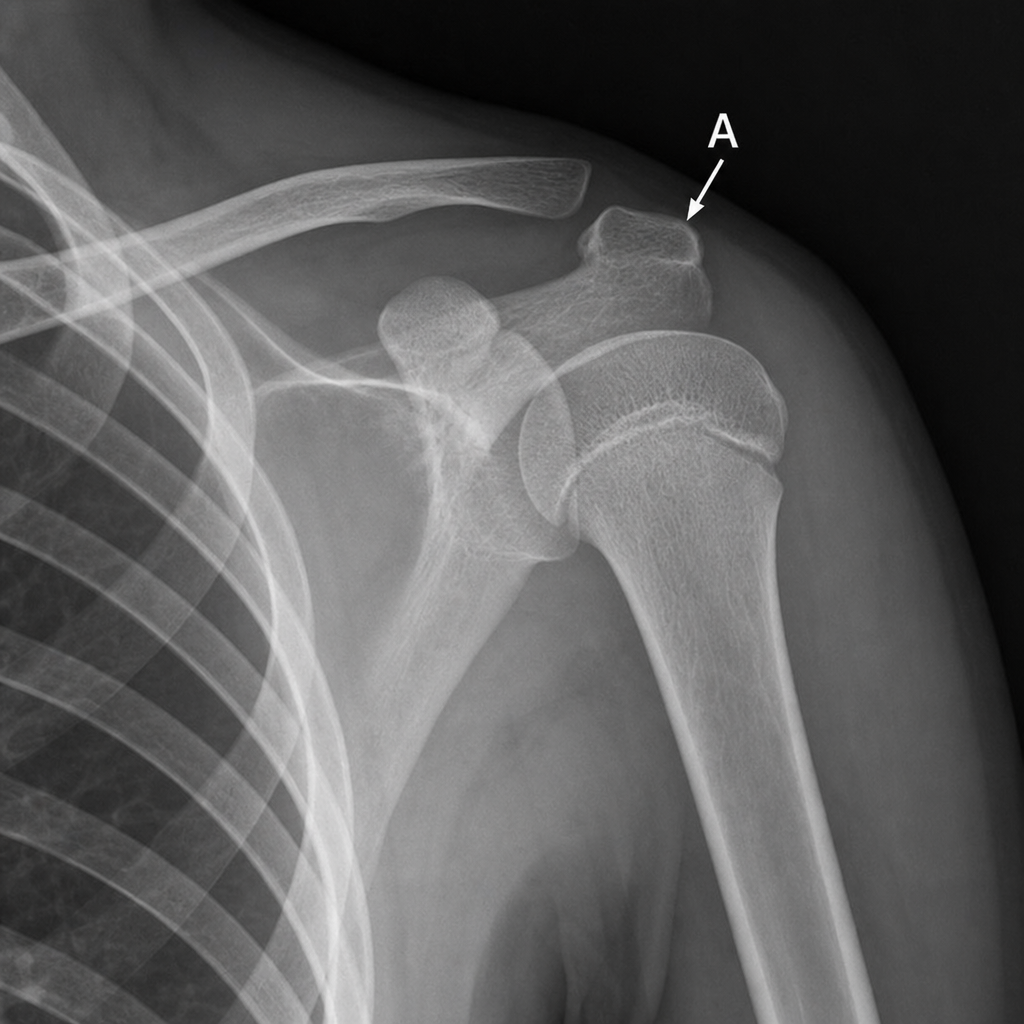
All of the following are muscles of the rotator cuff except?
All of the following muscles constitute the rotator cuff muscles, EXCEPT?
Explanation: The median cubital vein is the most preferred site for intravenous (IV) injections and venipuncture because of its anatomical advantages in the cubital fossa. It is a superficial vein that shunts blood from the cephalic vein to the basilic vein [1]. Why it is the correct choice: 1. Stability: It is often "fixed" by the underlying bicipital aponeurosis, preventing it from rolling during needle insertion. 2. Accessibility: It is superficial and usually has a large caliber, making it easy to palpate and visualize. 3. Safety: The bicipital aponeurosis separates the median cubital vein from the deeper brachial artery and median nerve, providing a protective structural barrier against accidental arterial puncture. Analysis of Incorrect Options: * Cephalic Vein: Located laterally in the arm [1]. While frequently used, it is often smaller and more mobile (prone to rolling) compared to the median cubital vein. * Basilic Vein: Located medially. Although it is a large vein, it is less preferred because it is not as well-anchored by deep fascia in the forearm and lies in close proximity to the medial cutaneous nerve of the forearm and the brachial artery (where the aponeurosis is thinner). * Median Vein of the Forearm: This vein drains the venous plexus of the palm and ends in either the basilic or median cubital vein. It is generally too small and variable for routine large-bore IV access. Clinical Pearls for NEET-PG: * Bicipital Aponeurosis: Also known as the "grace de Dieu" fascia; it is the key structure protecting the brachial artery during venipuncture. * Venous Patterns: The arrangement of veins in the cubital fossa typically follows an 'H-shaped' or 'M-shaped' pattern. * Cutaneous Nerves: Be mindful that the lateral cutaneous nerve of the forearm lies near the cephalic vein, and the medial cutaneous nerve lies near the basilic vein.
Explanation: The clinical presentation of **wrist drop** without sensory loss and with **preserved elbow extension** is the hallmark of a **Posterior Interosseous Nerve (PIN)** injury. 1. **Why PIN is correct:** The PIN is the deep motor branch of the Radial nerve. It supplies the extensors of the wrist (except Extensor Carpi Radialis Longus) and fingers. A lesion here causes "finger drop" and "wrist drop" (due to weakness of ECRB and ECU). Crucially, the branches to the **Triceps** (elbow extension) and the **sensory superficial radial nerve** arise proximal to the PIN's origin (at the supinator muscle), explaining why elbow extension and sensation remain intact. 2. **Why other options are incorrect:** * **Ulnar Nerve:** Injury leads to "Claw hand," not wrist drop, and involves sensory loss over the medial 1.5 fingers. * **Median Nerve:** Injury causes "Ape thumb" deformity and loss of sensation over the lateral 3.5 digits. * **Anterior Interosseous Nerve (AIN):** This is a motor branch of the Median nerve. Injury results in the inability to make the "OK" sign (weakness of Flexor Pollicis Longus and Flexor Digitorum Profundus to the index finger); it does not cause wrist drop [1]. **High-Yield NEET-PG Pearls:** * **PIN Syndrome:** Often caused by compression at the **Arcade of Frohse** (superior border of the supinator muscle). * **Radial Nerve vs. PIN:** If the lesion is in the axilla (Crutch palsy), elbow extension is lost. If the lesion is at the spiral groove (Saturday night palsy), elbow extension is *spared* (nerve to long head arises high), but sensory loss is present. * **Key Distinction:** PIN palsy = Motor loss + No sensory loss + Normal elbow extension.
Explanation: ### Explanation The axillary artery is the direct continuation of the **subclavian artery**. Its anatomical boundaries and divisions are high-yield topics for NEET-PG. **1. Why Option C is the correct answer (The False Statement):** The axillary artery begins at the **outer border of the first rib** (not the second rib). It terminates at the **lower border of the teres major muscle**, where it continues as the brachial artery. Therefore, the statement in Option C is anatomically incorrect regarding its origin. **2. Analysis of Incorrect Options (True Statements):** * **Option A:** This is true. The subclavian artery becomes the axillary artery once it crosses the outer border of the first rib. * **Option B & D:** These are true. The **pectoralis minor muscle** is the key landmark that divides the artery into three parts [1]: * **1st Part:** Proximal (superior) to the muscle. * **2nd Part:** Posterior (behind) to the muscle. * **3rd Part:** Distal (inferior) to the muscle. **3. Clinical Pearls & High-Yield Facts:** * **Branches Rule:** The number of branches corresponds to the part of the artery: * **1st Part (1 branch):** Superior thoracic artery. * **2nd Part (2 branches):** Thoraco-acromial and Lateral thoracic arteries. * **3rd Part (3 branches):** Subscapular, Anterior circumflex humeral, and Posterior circumflex humeral arteries. * **Relation to Brachial Plexus:** The cords of the brachial plexus (Lateral, Medial, and Posterior) are named based on their relationship to the **second part** of the axillary artery. * **Aneurysm/Compression:** Axillary artery compression can occur during the use of crutches (crutch palsy) or in overhead athletes, potentially leading to thrombosis or distal embolism. The medial pectoral nerve lies within a neurovascular bundle that wraps around the lateral border of the pectoralis minor muscle [1].
Explanation: ***C5, C6, C7*** - The latter phase of shoulder abduction (90-180°) requires **scapular rotation** by the **serratus anterior** muscle, innervated by the **long thoracic nerve** (C5, C6, C7). - The **upper and middle trapezius** also contribute to scapular rotation during this phase, receiving innervation from the **spinal accessory nerve** and cervical nerves including **C5, C6, C7**. *C7, C8* - These root values primarily supply muscles involved in **wrist and finger movements** rather than scapular rotation. - **C7, C8** innervate muscles like the **triceps** and **flexor carpi ulnaris**, which are not essential for the latter phase of shoulder abduction. *C8, T1* - These nerve roots mainly supply the **intrinsic hand muscles** and some **forearm flexors**, not scapular rotators. - **C8, T1** form part of the **medial pectoral nerve** and **ulnar nerve**, which are not involved in the latter phase of shoulder abduction. *C5, C6* - While these roots supply the **deltoid** and **supraspinatus** crucial for initial abduction (0-90°), they are insufficient for the latter phase alone. - The **serratus anterior** requires **C7** contribution in addition to **C5, C6** for complete scapular rotation during full shoulder abduction.
Explanation: ### Explanation The **radial nerve** follows a specific sequence of innervation as it descends the arm. Understanding the level of injury is crucial for predicting which muscles are spared and which are paralyzed. **1. Why Option D is Correct:** The radial nerve enters the **spiral (radial) groove** on the posterior aspect of the humerus. Before entering and while inside the groove, it supplies the heads of the triceps. However, the nerve to the **Extensor Carpi Radialis Longus (ECRL)**, along with the Brachioradialis and Extensor Carpi Radialis Brevis, arises **distal to the spiral groove**, typically in the lower third of the arm (lateral supracondylar ridge area). Therefore, an injury just below the spiral groove will spare the triceps but paralyze the ECRL and all subsequent muscles in the forearm. **2. Why the Other Options are Incorrect:** * **C. Long head of triceps:** This is the first branch of the radial nerve, arising in the **axilla** before the nerve enters the spiral groove. * **A. Lateral head of triceps:** The nerve to the lateral head arises **within the spiral groove** or just before entering it. * **B. Medial head of triceps:** This head receives two branches; the first arises in the axilla (traveling with the ulnar nerve as the "ulnar collateral nerve") and the second arises within the spiral groove. * *Note:* Since all triceps branches arise at or above the spiral groove, the triceps remains functional (allowing elbow extension) if the injury occurs below this level. **3. NEET-PG High-Yield Pearls:** * **Saturday Night Palsy/Crutch Palsy:** Injury in the **axilla**; results in "Total Radial Nerve Palsy" (Loss of elbow extension + Wrist drop). * **Mid-shaft Humerus Fracture:** Injury in the **spiral groove**; elbow extension is spared, but **wrist drop** occurs. * **Wrist Drop:** Caused by paralysis of the ECRL and other extensors. * **Sensory Loss:** Injury below the spiral groove will still result in sensory loss over the dorsal aspect of the first web space (Superficial Radial Nerve).
Explanation: **Explanation** The question asks for the origin of the **Biceps Brachii** muscle. However, there is a significant discrepancy in the provided key: the Biceps Brachii originates from the scapula, while the **Brachialis** muscle originates from the anterior surface of the humerus. **1. Understanding the Correct Anatomy (The Discrepancy)** The Biceps Brachii is a two-headed muscle: * **Long Head:** Originates from the **Supraglenoid tubercle** of the scapula. * **Short Head:** Originates from the **Coracoid process** of the scapula. * **Note:** If the question intended to ask about the **Brachialis**, the "Anterior surface of the humerus" would be correct. For Biceps Brachii, options A and C are the actual anatomical origins. **2. Analysis of Options** * **Option A (Supraglenoid tubercle):** Correct anatomical origin for the Long Head of the Biceps. The tendon runs intracapsularly but extrasynovially through the bicipital groove. * **Option B (Glenoid labrum):** The long head of the biceps is continuous with the superior part of the labrum (relevant in SLAP lesions), but the primary bony origin is the tubercle. * **Option C (Coracoid process):** Correct anatomical origin for the Short Head of the Biceps (along with Coracobrachialis and Pectoralis minor). * **Option D (Anterior surface of humerus):** This is the origin of the **Brachialis** muscle, which lies deep to the biceps and is the primary flexor of the elbow. **High-Yield Clinical Pearls for NEET-PG:** * **Innervation:** Both Biceps and Brachialis are supplied by the **Musculocutaneous nerve (C5-C7)**. * **Insertion:** Biceps inserts into the **Radial tuberosity** (enabling supination); Brachialis inserts into the **Ulnar tuberosity**. * **Action:** Biceps is the most powerful **supinator** of the flexed forearm. * **Biceps Reflex:** Tests the **C5-C6** spinal segments.
Explanation: **Explanation:** The movement of **opposition** (or apposition) of the thumb is a complex, multi-axial sequence occurring primarily at the first carpometacarpal (CMC) joint. It allows the pulp of the thumb to touch the tips of the other fingers. **1. Why Adduction is the Correct Component:** Opposition is not a single movement but a combination of **Abduction, Flexion, and Medial Rotation (Pronation)**, followed by **Adduction**. While the initial phase requires abduction to clear the palm, the final "clamping" or "apposition" phase—where the thumb is pressed against the finger to provide grip strength—is achieved through **Adduction**. In the context of this question, adduction is the terminal component that completes the contact. **2. Analysis of Incorrect Options:** * **Abduction:** This occurs at the start of opposition to move the thumb away from the palm, but it does not bring the thumb into contact with the fingers. * **Pronation:** This is a component of opposition (medial rotation of the metacarpal), but it is a rotational movement, not the final "apposition" movement itself. * **Supination:** This is the opposite of the required rotation. Lateral rotation (supination) occurs during **reposition** (returning the thumb to the anatomical position). **High-Yield Clinical Pearls for NEET-PG:** * **Muscles:** Opposition is primarily performed by the **Opponens Pollicis** (supplied by the Recurrent branch of the **Median Nerve**, C8-T1). * **Joint Type:** The 1st CMC joint is a **Saddle-type synovial joint**, which provides the necessary degrees of freedom for opposition. * **Ape Thumb Deformity:** Loss of the ability to oppose the thumb due to a Median nerve injury, leading to thenar eminence wasting.
Explanation: **Explanation:** The correct answer is the **Posterior Interosseous Nerve (PIN)**. This is a classic high-yield concept in Anatomy based on the functional division of the radial nerve. **1. Why PIN is correct:** The PIN is the deep motor branch of the radial nerve. It arises in the cubital fossa and enters the posterior compartment of the forearm by passing through the **Arcade of Frohse** (supinator muscle). It supplies all the extensor muscles of the forearm except the Brachioradialis and Extensor Carpi Radialis Longus (ECRL) [1]. Since the PIN is a **purely motor nerve**, its injury leads to a "finger drop" (inability to extend the MCP joints) without any sensory deficit [1]. **2. Why other options are incorrect:** * **High Radial Nerve:** Injury (e.g., in the axilla or spiral groove) results in **Wrist Drop** (loss of wrist extensors) and sensory loss over the first dorsal web space. * **Low Radial Nerve:** This term is vague but usually refers to the nerve after the spiral groove. If the main trunk is hit before the bifurcation, sensory loss will still be present. * **Superficial Radial Nerve:** This is a **purely sensory nerve**. Injury would cause numbness over the anatomical snuffbox/dorsal hand but no motor weakness (no finger drop). **Clinical Pearls for NEET-PG:** * **Finger Drop vs. Wrist Drop:** In PIN palsy, the patient can often still extend the wrist (though with radial deviation) because the ECRL is supplied by the radial nerve *before* it becomes the PIN [1]. * **Saturday Night Palsy:** Refers to high radial nerve compression (Wrist drop + Sensory loss). * **Wartenberg’s Syndrome:** Compression of the superficial radial nerve (Sensory only). * **Rule of Thumb:** If the question mentions "motor loss only" in the posterior forearm, always look for PIN.
Explanation: **Explanation:** The **Rotator Cuff** (also known as the musculotendinous cuff) is a functional unit of four muscles that stabilize the glenohumeral joint by pulling the humeral head into the glenoid cavity. A common mnemonic to remember these muscles is **SITS**. **Why Teres Major is the correct answer:** While the **Teres Major** is anatomically close to the rotator cuff, it is **not** part of it. It originates from the lower third of the lateral border of the scapula and inserts into the medial lip of the bicipital groove of the humerus. Unlike the rotator cuff muscles, its tendon does not fuse with the joint capsule. It acts as an adductor and medial rotator of the arm (often called "Lat's little helper"). **Analysis of incorrect options:** * **Supraspinatus (S):** Initiates the first 0–15° of abduction. It is the most commonly injured muscle in rotator cuff tears. * **Infraspinatus (I):** Primarily responsible for lateral (external) rotation of the arm. * **Teres Minor (T):** Also responsible for lateral rotation. It is distinguished from Teres Major by its insertion on the greater tubercle and its nerve supply (Axillary nerve). * *(Note: The 'S' in SITS also stands for **Subscapularis**, which provides medial rotation).* **High-Yield Clinical Pearls for NEET-PG:** 1. **Insertion Sites:** Supraspinatus, Infraspinatus, and Teres Minor insert on the **Greater Tubercle** of the humerus. Subscapularis inserts on the **Lesser Tubercle**. 2. **Nerve Supply:** Supraspinatus and Infraspinatus are supplied by the **Suprascapular nerve** (C5, C6). 3. **Clinical Test:** The "Empty Can Test" (Jobe's test) is used to assess Supraspinatus injury. 4. **Painful Arc Syndrome:** Usually indicates Supraspinatus tendinitis, with pain occurring between 60° and 120° of abduction.
Explanation: ### Explanation The **Rotator Cuff** (also known as the musculotendinous cuff) is a functional unit formed by the tendons of four muscles that blend with the fibrous capsule of the shoulder joint. These muscles provide dynamic stability to the glenohumeral joint by "holding" the head of the humerus in the shallow glenoid cavity. A common mnemonic to remember these muscles is **SITS**: 1. **S**upraspinatus 2. **I**nfraspinatus 3. **T**eres **minor** 4. **S**ubscapularis **Why Teres Major is the Correct Answer:** While the **Teres minor** is a member of the rotator cuff, the **Teres major** is not. Although it originates near the rotator cuff muscles (inferior angle of the scapula), it inserts into the medial lip of the bicipital groove of the humerus. It does not attach to the joint capsule and therefore does not contribute to the stability of the rotator cuff. **Analysis of Incorrect Options:** * **Supraspinatus:** Initiates the first 0–15° of arm abduction. It is the **most commonly injured** rotator cuff muscle. * **Infraspinatus:** Acts as a powerful lateral (external) rotator of the arm. * **Subscapularis:** The only rotator cuff muscle that inserts on the **lesser tubercle** (the others insert on the greater tubercle) and acts as a medial rotator. **High-Yield Clinical Pearls for NEET-PG:** * **The "Gatekeeper":** The rotator cuff is deficient **inferiorly**, which explains why most shoulder dislocations occur in an antero-inferior direction. * **Painful Arc Syndrome:** Often caused by Supraspinatus tendinitis, typically presenting with pain during abduction between 60° and 120°. * **Nerve Supply:** Supraspinatus and Infraspinatus are both supplied by the **Suprascapular nerve (C5, C6)**.
Pectoral Region and Axilla
Practice Questions
Arm and Cubital Fossa
Practice Questions
Forearm and Hand
Practice Questions
Joints of Upper Limb
Practice Questions
Nerves of Upper Limb
Practice Questions
Arterial Supply and Venous Drainage
Practice Questions
Lymphatic Drainage
Practice Questions
Muscles and Their Actions
Practice Questions
Applied Anatomy and Clinical Correlations
Practice Questions
Surface Anatomy and Landmarks
Practice Questions
Get full access to all questions, explanations, and performance tracking.
Start For Free