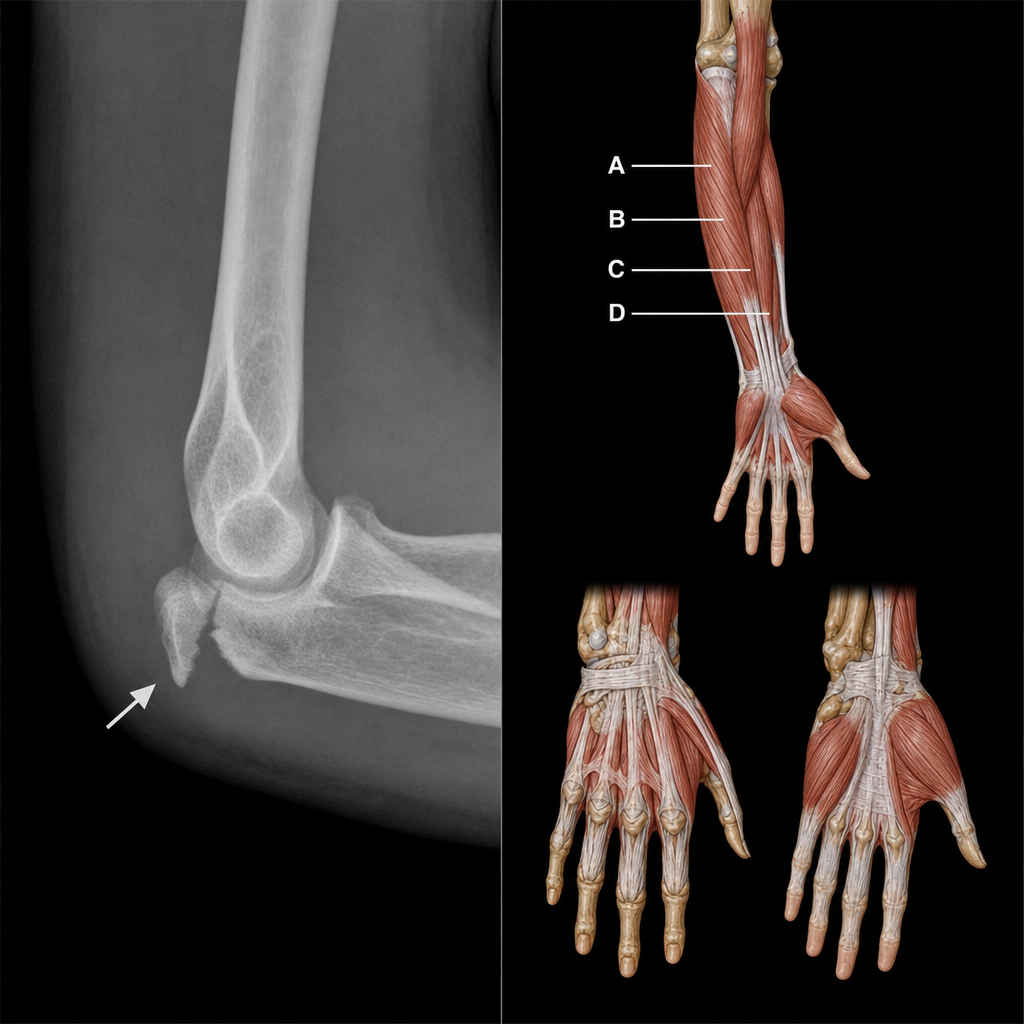
Which muscle in the extensor compartment of the forearm causes flexion of the elbow?
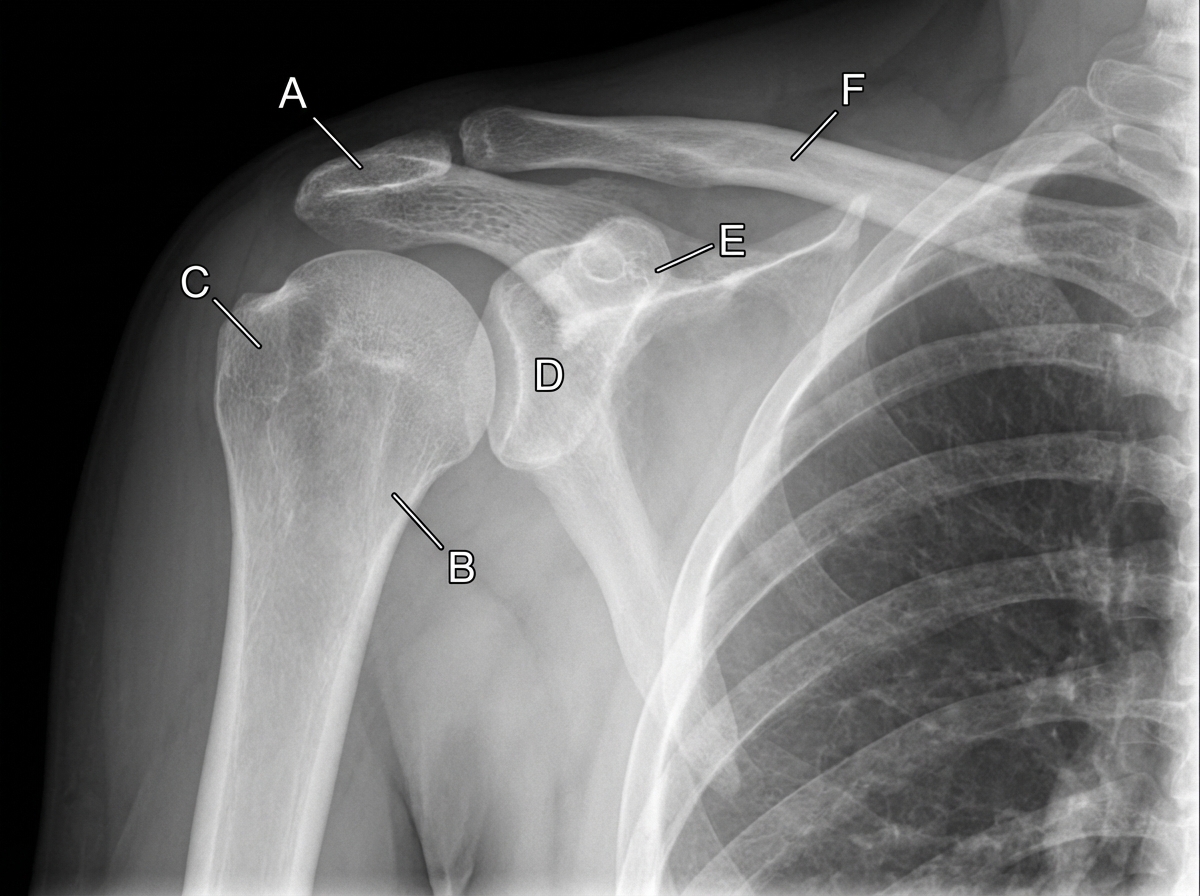
Which muscle is NOT attached to the coracoid process?
What is the nerve supply of the Teres major muscle?
Bennet's fracture involves which part of the bone?
Which muscle crosses the shoulder joint?
Weakness of which muscle would result in the following type of lesion?

Which of the following muscles is NOT attached to the coracoid process of the scapula?
Which of the following muscles is responsible for shrugging the shoulders?
Which structure lies superficial to the bicipital aponeurosis in the cubital fossa?
The deep branch of the ulnar nerve primarily supplies which of the following muscles?
Explanation: The **Brachioradialis** is a unique muscle of the forearm. While it is anatomically located in the superficial layer of the posterior (extensor) compartment and is innervated by the **Radial nerve**, its primary physiological function is **flexion of the elbow**, especially when the forearm is in a mid-prone position. **Why Brachioradialis is correct:** Most muscles in the extensor compartment originate from the lateral epicondyle and act on the wrist or fingers. However, the Brachioradialis originates higher up on the **lateral supracondylar ridge** of the humerus and inserts into the distal radius. Because its bulk lies anterior to the elbow joint axis, it acts as a powerful flexor rather than an extensor. **Analysis of Incorrect Options:** * **Abductor pollicis longus (B):** A deep layer muscle of the posterior compartment [1]. Its primary action is abduction and extension of the thumb at the CMC joint [1]. * **Extensor pollicis longus (C):** A deep layer muscle that extends the terminal phalanx of the thumb [1]. * **Extensor carpi radialis longus (D):** While it also originates from the supracondylar ridge and is a "hybrid" muscle, its primary action is extension and abduction (radial deviation) of the **wrist**, not flexion of the elbow [1]. **High-Yield NEET-PG Pearls:** * **The "Shunting" Muscle:** Brachioradialis acts as a shunt muscle, providing stability to the elbow joint during rapid flexion and extension. * **Innervation Paradox:** It is one of the few muscles supplied by the Radial nerve (C5, C6) that is a flexor. * **Testing:** It is best tested by flexing the elbow against resistance in the **mid-prone position** (the "hammering" position). * **Reflex:** The Brachioradialis reflex tests the **C6** spinal nerve root.
Explanation: The **coracoid process** of the scapula is a crucial bony landmark in the upper limb, serving as an attachment point for three muscles and several ligaments. ### **Why the Long Head of Biceps is the Correct Answer** The **Long head of the biceps brachii** does not attach to the coracoid process. Instead, it originates from the **supraglenoid tubercle** of the scapula. Its tendon passes intra-capsularly over the head of the humerus and descends through the bicipital groove. ### **Analysis of Incorrect Options** * **Coracobrachialis (Option A):** Originates from the **tip** of the coracoid process (sharing a common tendon with the short head of biceps). * **Short head of biceps (Option B):** Originates from the **tip** of the coracoid process. * **Pectoralis minor (Option C):** Inserts into the **medial border and upper surface** of the coracoid process. It is the only muscle of the three that *inserts* here; the others *originate* from it. ### **NEET-PG High-Yield Pearls** * **Mnemonic for Coracoid Attachments:** **"B-C-P"** (Biceps short head, Coracobrachialis, Pectoralis minor). * **Ligamentous Attachments:** The coracoid also serves as the attachment for the **Coracoclavicular ligament** (composed of the Conoid and Trapezoid ligaments), which is the primary stabilizer of the acromioclavicular joint. * **Clinical Significance:** A fracture of the coracoid process is rare but can occur in shoulder dislocations or direct trauma. It may result in "avulsion" due to the forceful contraction of the attached muscles.
Explanation: The **Teres major** muscle is an important muscle of the scapular region, often referred to as the "Latissimus dorsi's little helper" because it shares the same actions (adduction, extension, and medial rotation of the humerus). [1] ### 1. Why the Correct Answer is Right The **Lower subscapular nerve (C5, C6)** arises from the posterior cord of the brachial plexus. It supplies two muscles: the **Subscapularis** (lower fibers) and the **Teres major**. It is essential to remember that while the upper subscapular nerve only supplies the subscapularis, the lower subscapular nerve has a dual distribution. ### 2. Why the Other Options are Wrong * **Suprascapular nerve (C5, C6):** This nerve arises from the upper trunk of the brachial plexus and supplies the **Supraspinatus** and **Infraspinatus** muscles. * **Axillary nerve (C5, C6):** This nerve supplies the **Deltoid** and the **Teres minor**. A common point of confusion in exams is distinguishing between Teres major (Lower subscapular n.) and Teres minor (Axillary n.). * **Upper subscapular nerve (C5, C6):** This nerve supplies only the upper portion of the **Subscapularis** muscle. ### 3. NEET-PG High-Yield Pearls * **The "Lats' Little Helper":** Teres major inserts into the **medial lip** of the bicipital groove of the humerus (Latissimus dorsi inserts into the floor). * **Quadrangular Space:** The Teres major forms the **inferior boundary** of the quadrangular space (the superior boundary is the Teres minor). * **Nerve Mnemonic:** Remember that the **Axillary nerve** supplies the "Minor" (Teres minor), while the **Lower Subscapular nerve** supplies the "Major" (Teres major). * **Posterior Cord Branches:** Remember the mnemonic **STAR** (Subscapular [Upper & Lower], Thoracodorsal, Axillary, Radial).
Explanation: ### Explanation **Correct Answer: A. Base of the 1st metacarpal** **Why it is correct:** Bennett’s fracture is a specific type of **oblique intra-articular fracture** occurring at the **base of the first metacarpal** (thumb). The fracture involves the carpometacarpal (CMC) joint [1]. The mechanism typically involves axial loading along the longitudinal axis of the thumb while it is in a partially flexed position. The hallmark of this injury is the displacement: the small volar-ulnar fragment remains attached to the **anterior oblique ligament**, while the main shaft of the metacarpal is pulled laterally and proximally by the **Abductor Pollicis Longus (APL)** muscle, leading to subluxation. **Why the other options are incorrect:** * **B. Neck of the 1st metacarpal:** Fractures here are rare and do not involve the joint surface; they are usually extra-articular. * **C. Base of the 5th metacarpal:** A fracture-dislocation at the base of the 5th metacarpal is known as a **"Reverse Bennett’s fracture."** * **D. Neck of the 5th metacarpal:** This is the classic site for a **"Boxer’s fracture,"** typically caused by punching a hard object [1]. **High-Yield Clinical Pearls for NEET-PG:** * **Rolando Fracture:** A comminuted (T or Y-shaped) intra-articular fracture at the base of the 1st metacarpal. It carries a worse prognosis than Bennett's. * **Deformity Force:** In Bennett's, the **APL** is the primary muscle responsible for the proximal displacement of the metacarpal shaft. * **Management:** Because it is unstable and intra-articular, it often requires **ORIF** (Open Reduction Internal Fixation) or K-wire fixation to prevent long-term arthritis.
Explanation: ### Explanation The shoulder joint (glenohumeral joint) is crossed by several muscles, but the **Long Head of the Biceps Brachii** is unique due to its **intracapsular but extrasynovial** course. **1. Why Biceps Long Head is the Correct Answer:** The long head of the biceps originates from the **supraglenoid tubercle** of the scapula. Its tendon passes directly through the glenohumeral joint cavity, over the head of the humerus, and exits the joint through the bicipital groove. Because it resides within the joint capsule, it plays a critical role in stabilizing the humeral head against the glenoid cavity during arm movements. **2. Analysis of Other Options:** * **Biceps Short Head:** Originates from the **coracoid process** (extra-articular). While it acts on the shoulder joint as a weak flexor, it does not "cross" or pass through the joint cavity like the long head. * **Triceps Long Head:** Originates from the **infraglenoid tubercle**. While it technically crosses the joint inferiorly to reach the olecranon, in the context of standard anatomy questions regarding "crossing the joint" (specifically referring to the intracapsular course), the Biceps Long Head is the classic and most significant answer. * **Coracobrachialis:** Originates from the coracoid process and inserts into the humerus. It is a stabilizer and flexor but remains entirely extracapsular. **3. High-Yield Clinical Pearls for NEET-PG:** * **Transverse Humeral Ligament:** This ligament holds the long head of the biceps tendon in the bicipital groove. * **SLAP Lesion:** (Superior Labrum Anterior to Posterior) involves a tear where the long head of the biceps tendon attaches to the glenoid labrum. * **Popeye Deformity:** Occurs due to a rupture of the long head of the biceps tendon, causing the muscle belly to bunch up in the distal arm.
Explanation: ***Serratus Anterior*** - Weakness of the **serratus anterior** causes **winged scapula**, where the medial border of the scapula protrudes posteriorly when pushing against a wall or doing push-ups. - Innervated by the **long thoracic nerve of Bell** (C5-C7), and its paralysis prevents proper **protraction and stabilization** of the scapula against the chest wall. *Deltoid* - Weakness results in inability to **abduct the arm** beyond the first 15 degrees and difficulty with shoulder flexion and extension. - Innervated by the **axillary nerve**; weakness does not cause scapular winging but rather **deltoid atrophy** and loss of shoulder contour. *Pectoralis major* - Weakness causes difficulty with **adduction, flexion, and internal rotation** of the arm, particularly when pushing or pressing movements. - Innervated by **medial and lateral pectoral nerves**; weakness results in **loss of anterior axillary fold** but does not affect scapular positioning. *Infraspinatus* - Weakness impairs **external rotation** of the arm and contributes to **rotator cuff dysfunction** with potential shoulder instability. - Innervated by the **suprascapular nerve**; weakness causes difficulty with **external rotation** but does not produce scapular winging.
Explanation: The **coracoid process** of the scapula is a crucial "hook-like" bony landmark that serves as an attachment point for three muscles and three ligaments. ### **Explanation of the Correct Answer** **D. Long head of triceps:** This is the correct answer because the long head of the triceps brachii originates from the **infraglenoid tubercle** of the scapula, not the coracoid process. It then descends to insert into the olecranon process of the ulna. ### **Analysis of Incorrect Options** The coracoid process serves as the origin for two muscles and the insertion for one: * **A. Coracobrachialis:** Originates from the **tip** of the coracoid process (along with the short head of biceps). * **B. Short head of biceps:** Originates from the **tip** of the coracoid process. * **C. Pectoralis minor:** Inserts into the **medial border and upper surface** of the coracoid process. ### **High-Yield NEET-PG Clinical Pearls** * **Mnemonic for Coracoid Attachments:** Remember **"B-C-P"** (Biceps short head, Coracobrachialis, Pectoralis minor). * **Ligamentous Attachments:** The coracoid process also provides attachment to the **Coraco-acromial**, **Coraco-humeral**, and **Coraco-clavicular** (Conoid and Trapezoid parts) ligaments. * **Surgical Landmark:** The coracoid process is often referred to as the **"Surgeon's Lighthouse"** because it serves as a key landmark to avoid neurovascular structures (like the brachial plexus and axillary artery) during shoulder surgery. * **Long head of Biceps:** Do not confuse this with the short head; the long head of the biceps originates from the **supraglenoid tubercle**.
Explanation: **Explanation:** The **Trapezius** is the correct answer because its **upper fibers** are primarily responsible for the elevation of the scapula, a movement clinically known as "shrugging the shoulders." It is a large, superficial muscle of the back that acts on the pectoral girdle. **Why the other options are incorrect:** * **Rhomboid minor:** While it helps in the elevation and retraction of the scapula, its primary role is to square the shoulders and stabilize the scapula against the thoracic wall. It is not the prime mover for shrugging. * **Serratus anterior:** Known as the "boxer’s muscle," it is responsible for **protraction** of the scapula and holds the medial border of the scapula against the rib cage. Paralysis of this muscle leads to "winging of scapula." * **Latissimus dorsi:** Known as the "climbing muscle," it performs adduction, extension, and medial rotation of the humerus. It actually acts to **depress** the shoulder rather than elevate it. **High-Yield Clinical Pearls for NEET-PG:** * **Nerve Supply:** The Trapezius is unique as it is supplied by the **Spinal Accessory Nerve (CN XI)** for motor function and C3-C4 spinal nerves for proprioception. * **Testing:** To test the Spinal Accessory Nerve, the patient is asked to shrug their shoulders against resistance. * **Overhead Abduction:** The Trapezius (upper and lower fibers) works with the Serratus anterior to rotate the scapula upward, allowing for abduction of the arm beyond 90 degrees.
Explanation: ### Explanation The **bicipital aponeurosis** (lacertus fibrosus) is a flat, fibrous expansion of the biceps brachii tendon that passes obliquely across the cubital fossa to fuse with the deep fascia of the forearm. It serves as a critical anatomical landmark, acting as a protective shield for deeper structures. **1. Why "Veins" is correct:** The bicipital aponeurosis separates the superficial structures from the deep structures of the cubital fossa. The **median cubital vein** and the **medial antebrachial cutaneous nerve** lie **superficial** to the aponeurosis. This anatomical arrangement is clinically significant during venipuncture; the aponeurosis protects the underlying brachial artery and median nerve from accidental needle injury. **2. Why other options are incorrect:** * **Brachial Artery (C):** This structure lies **deep** to the bicipital aponeurosis. The aponeurosis protects the artery during blood draws. * **Radial Nerve (B):** The radial nerve is located in the lateral part of the cubital fossa, tucked deeply between the brachialis and brachioradialis muscles. * **Ulnar Nerve (A):** The ulnar nerve does not pass through the cubital fossa at all; it travels posterior to the medial epicondyle of the humerus. **3. Clinical Pearls for NEET-PG:** * **Contents of Cubital Fossa (Lateral to Medial):** Remember the mnemonic **MBBR** (Median nerve, Brachial artery, Biceps tendon, Radial nerve). * **Floor of Cubital Fossa:** Formed by the Brachialis and Supinator muscles. * **Roof of Cubital Fossa:** Formed by skin, superficial fascia (containing the median cubital vein), and the bicipital aponeurosis. * **Blood Pressure:** The brachial artery, lying deep to the aponeurosis, is the standard site for auscultating Korotkoff sounds.
Explanation: ### Explanation The **ulnar nerve** is often referred to as the "musician's nerve" because it controls the fine movements of the fingers [1]. After passing through Guyon’s canal, it divides into superficial and deep branches. The **deep branch** is purely motor and supplies most of the intrinsic muscles of the hand. **Why Adductor Pollicis is Correct:** The **Adductor pollicis** is a key muscle of the thenar eminence but, unlike the other three thenar muscles (supplied by the median nerve), it is supplied by the **deep branch of the ulnar nerve**. This is a classic anatomical exception and a high-yield fact for exams. **Analysis of Incorrect Options:** * **Flexor digitorum superficialis (FDS):** This muscle is located in the intermediate layer of the anterior compartment of the forearm and is supplied by the **median nerve**. * **First lumbrical:** The first and second lumbricals (lateral two) are supplied by the **median nerve** [2]. The third and fourth lumbricals (medial two) are supplied by the deep branch of the ulnar nerve. **High-Yield Clinical Pearls for NEET-PG:** * **The "Rule of 1.5":** In the forearm, the ulnar nerve supplies only 1.5 muscles: the Flexor Carpi Ulnaris and the medial half of the Flexor Digitorum Profundus. * **Hand Supply:** The ulnar nerve supplies all intrinsic muscles of the hand **EXCEPT** the **LOAF** muscles (Lateral two Lumbricals, Opponens pollicis, Abductor pollicis brevis, and Flexor pollicis brevis), which are supplied by the median nerve [2]. * **Froment’s Sign:** This clinical test assesses ulnar nerve palsy. When a patient attempts to grip paper between the thumb and index finger, the weakness of the **Adductor pollicis** causes them to flex the thumb at the IP joint (using the Flexor Pollicis Longus, supplied by the median nerve) to compensate.
Pectoral Region and Axilla
Practice Questions
Arm and Cubital Fossa
Practice Questions
Forearm and Hand
Practice Questions
Joints of Upper Limb
Practice Questions
Nerves of Upper Limb
Practice Questions
Arterial Supply and Venous Drainage
Practice Questions
Lymphatic Drainage
Practice Questions
Muscles and Their Actions
Practice Questions
Applied Anatomy and Clinical Correlations
Practice Questions
Surface Anatomy and Landmarks
Practice Questions
Get full access to all questions, explanations, and performance tracking.
Start For Free