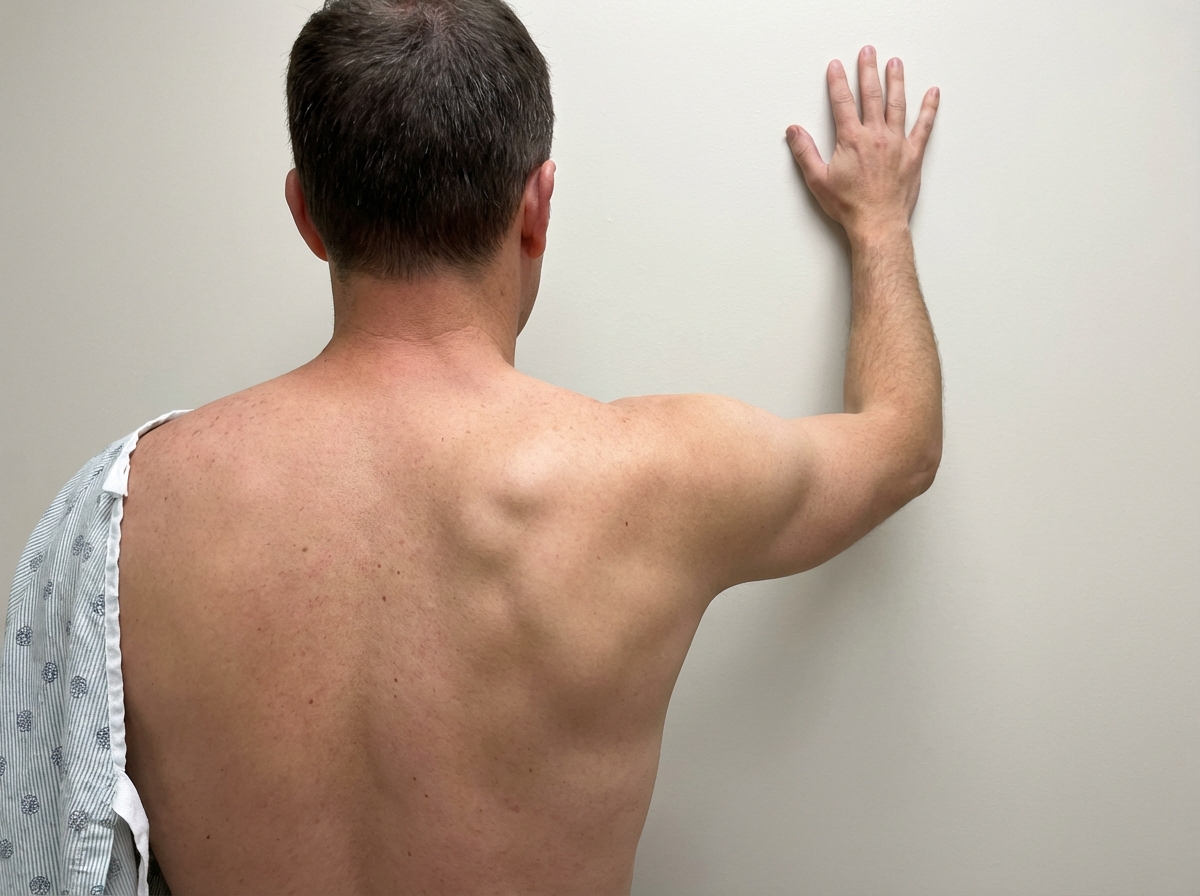
Trauma to the neck of the humerus can result in damage to which nerve?
A 7-year-old boy falls from a tree house and is brought to the emergency department. On examination, he has weakness in rotating his arm laterally due to a nerve injury. Which of the following conditions is most likely to cause a loss of this nerve function?
The long head of the Biceps brachii muscle is attached to which anatomical structure?
Which of the following statements about the radial nerve are true?
Which of the following statements regarding the deep palmar arch is TRUE?
Which of the following statements is false regarding the radial nerve?
The medial epicondyle is associated with which of the following?
Atrophy of intrinsic muscles of the hand, sensory deficit on the medial side of the forearm and hand, and diminished radial pulse on turning the head to the affected side could be due to which of the following conditions?
A 12-year-old patient presents with a severely damaged nail on their index finger after accidentally crushing the finger while closing a door. A decision is made to excise the injured nail. In preparation for the procedure, the physician would most likely anesthetize a branch of which of the following nerves?
Wrist drop is due to injury to which nerve?
Explanation: The **axillary nerve** (C5, C6) is the correct answer because of its intimate anatomical relationship with the **surgical neck of the humerus**. It passes through the quadrangular space and winds around the posterior aspect of the surgical neck alongside the posterior circumflex humeral artery. Fractures at this site or anterior dislocations of the shoulder joint frequently result in axillary nerve palsy, leading to paralysis of the deltoid and teres minor muscles and sensory loss over the "regimental badge" area. **Analysis of Incorrect Options:** * **Radial Nerve:** This nerve is most commonly injured in fractures of the **mid-shaft (spiral groove)** of the humerus, leading to wrist drop. * **Ulnar Nerve:** This nerve is typically damaged in fractures of the **medial epicondyle** of the humerus, as it runs posteriorly in the ulnar groove. * **Median Nerve:** This nerve is most vulnerable in **supracondylar fractures** of the humerus (displaced anteriorly) or penetrating injuries to the cubital fossa. **High-Yield Clinical Pearls for NEET-PG:** * **Surgical Neck Fracture:** Axillary nerve injury (Loss of shoulder abduction >15 degrees). * **Spiral Groove Fracture:** Radial nerve injury (Wrist drop). * **Supracondylar Fracture:** Median nerve injury (Ape thumb deformity/Hand of Benediction) and risk of Volkmann’s Ischemic Contracture. * **Medial Epicondyle Fracture:** Ulnar nerve injury (Claw hand). * **Quadrangular Space Boundaries:** Superior (Teres minor), Inferior (Teres major), Medial (Long head of triceps), Lateral (Surgical neck of humerus).
Explanation: **Explanation:** The clinical presentation describes a loss of **lateral rotation** of the arm. The primary muscles responsible for lateral rotation are the **Infraspinatus** (Suprascapular nerve) and the **Teres minor** (Axillary nerve). Among the options provided, the injury involves the **Axillary nerve (C5-C6)**. **Why the Correct Answer is Right:** The axillary nerve passes through the quadrangular space, winding around the surgical neck of the humerus. It is highly vulnerable to injury during **inferior (or anterior-inferior) dislocation of the glenohumeral joint** and fractures of the surgical neck of the humerus. Damage to this nerve results in paralysis of the deltoid (loss of abduction) and the teres minor, leading to the weakness in lateral rotation described. **Analysis of Incorrect Options:** * **A. Lateral cord injury:** This would primarily affect the Musculocutaneous nerve (biceps/brachialis) and the lateral root of the Median nerve. It does not supply the muscles responsible for lateral rotation. * **B. Supracondylar fracture:** This typically injures the **Median nerve** or the Brachial artery. It results in "Hand of Benediction" or Volkmann’s ischemic contracture, not lateral rotation deficits. * **C. Knife wound on Teres major:** The teres major is an **internal (medial) rotator** and adductor of the arm (supplied by the lower subscapular nerve). Injury here would not cause a loss of lateral rotation. **NEET-PG High-Yield Pearls:** * **Axillary Nerve:** Supplies Deltoid and Teres minor; provides sensation to the "Regimental Badge Area." * **Shoulder Dislocation:** Most common is anterior-inferior; Axillary nerve is the most commonly injured nerve. * **Lateral Rotators:** Infraspinatus (Suprascapular n.), Teres minor (Axillary n.), and posterior fibers of Deltoid. * **Waiters Tip Position (Erb’s Palsy):** Caused by C5-C6 root injury, resulting in an adducted and **medially rotated** arm due to loss of these lateral rotators.
Explanation: The **Biceps brachii** is a two-headed muscle of the anterior compartment of the arm. Understanding its dual origin is a high-yield topic for NEET-PG. ### **Explanation of the Correct Answer** * **Option A (Coracoid process):** This is the correct origin for the **Short head** of the biceps brachii. It arises from the apex of the coracoid process of the scapula, sharing a common tendon with the Coracobrachialis muscle. ### **Analysis of Incorrect Options** * **Option B (Acromion process):** This is the origin site for the middle fibers of the Deltoid muscle. No part of the biceps attaches here. * **Option C (Supraglenoid tubercle):** This is the origin of the **Long head** of the biceps brachii. The long head tendon is intracapsular but extrasynovial, passing over the head of the humerus. * **Option D (Bicipital groove):** Also known as the intertubercular sulcus, this is the **pathway** through which the long head of the biceps tendon travels, held in place by the transverse humeral ligament. It is not the site of attachment. ### **High-Yield Clinical Pearls for NEET-PG** 1. **Insertion:** Both heads unite to form a single tendon that inserts into the **posterior part of the radial tuberosity**. A bursa separates the tendon from the anterior part of the tuberosity. 2. **Bicipital Aponeurosis:** This is a membranous band that runs medially from the tendon to the deep fascia of the forearm, protecting the underlying brachial artery and median nerve. 3. **Nerve Supply:** Musculocutaneous nerve (C5, C6, C7). 4. **Action:** It is the **chief supinator** of the forearm (when the elbow is flexed) and a powerful flexor of the elbow. 5. **Clinical Sign:** Rupture of the long head tendon results in a "Popeye deformity," where the muscle belly forms a prominent bulge in the distal arm.
Explanation: The radial nerve (C5-T1) is the largest branch of the brachial plexus and is a high-yield topic for NEET-PG. To understand the correct answer, let’s evaluate the anatomical course and clinical significance of the nerve: **Analysis of Statements:** 1. **Origin (True):** It arises from the **posterior cord** of the brachial plexus. 2. **Course (True):** It enters the arm behind the brachial artery and passes through the **lower triangular space** (with the profunda brachii artery) to reach the spiral groove. 3. **Motor Supply (True):** It supplies all three heads of the **triceps brachii** and the **anconeus** before entering the forearm. 4. **Sensory Supply (False):** The radial nerve does **not** supply the skin over the medial side of the arm; that is the domain of the Medial Cutaneous Nerve of the Arm (T1). The radial nerve provides the Posterior Cutaneous Nerve of the Arm. 5. **Clinical Correlation (True):** Injury in the spiral groove (e.g., humerus fracture) leads to **wrist drop** due to paralysis of the extensors of the wrist and digits. **Why Option C is Correct:** Statements 1, 2, 3, and 5 accurately describe the origin, course, motor distribution, and clinical pathology of the radial nerve. Statement 4 is incorrect because the radial nerve supplies the posterior and lower lateral aspects of the arm, not the medial side. **High-Yield NEET-PG Pearls:** * **Saturday Night Palsy:** Compression of the radial nerve in the axilla (affects triceps; elbow extension lost). * **Spiral Groove Injury:** Most common site of injury; elbow extension is **spared** (nerves to triceps branch off higher up), but wrist drop occurs. * **PIN (Posterior Interosseous Nerve):** The deep branch of the radial nerve; it supplies the extensors but has **no sensory distribution** to the skin. Injury causes "finger drop" without sensory loss.
Explanation: The **deep palmar arch** is a vital arterial network in the hand, primarily formed by the terminal part of the **radial artery** and completed by the deep branch of the ulnar artery. ### Why Option C is Correct: The deep palmar arch lies in the deepest compartment of the palm. Anatomically, it is situated **deep (posterior) to the long flexor tendons** (Flexor Digitorum Superficialis and Profundus) and the **lumbrical muscles**. It rests directly on the bases of the metacarpal bones and the interosseous muscles. This deep position protects the arch during gripping activities. ### Why Other Options are Incorrect: * **Option A:** The deep palmar arch gives rise to **three palmar metacarpal arteries**, which eventually join the common digital arteries. It is the **superficial palmar arch** that primarily gives rise to the three common digital arteries. * **Option B:** The deep palmar arch is located approximately **1 cm proximal** to the superficial palmar arch. Surface-wise, it corresponds to the **proximal transverse skin crease** of the palm, whereas the superficial arch lies at the level of the distal border of the fully abducted thumb (Kaplan’s line). ### NEET-PG High-Yield Pearls: * **Formation:** Radial artery (major contributor) + Deep branch of Ulnar artery. * **Nerve Relation:** The **deep branch of the ulnar nerve** lies in the concavity of the deep palmar arch. * **Branches:** It gives off three palmar metacarpal arteries, three perforating branches (to the dorsal metacarpal arteries), and recurrent branches to the carpus. * **Surface Anatomy:** It lies about one finger-breadth proximal to the superficial arch.
Explanation: ### Explanation **1. Why Option D is the Correct Answer (The False Statement):** The **Anterior Interosseous Nerve (AIN)** is actually a branch of the **Median Nerve**, not the radial nerve [1]. It arises in the proximal forearm and supplies the deep muscles of the anterior (flexor) compartment: the flexor pollicis longus, the lateral half of the flexor digitorum profundus, and the pronator quadratus [1]. **2. Analysis of Incorrect Options (True Statements):** * **Option A:** The radial nerve is the largest branch of the **posterior cord** of the brachial plexus. * **Option B:** It is the primary nerve of the **extensor compartment** of both the arm (triceps) and the forearm (via its deep branch/posterior interosseous nerve). * **Option C:** It carries fibers from all five roots of the brachial plexus (**C5, C6, C7, C8, and T1**), making it a high-yield anatomical fact. **3. NEET-PG High-Yield Clinical Pearls:** * **Posterior Interosseous Nerve (PIN):** This is the continuation of the deep branch of the radial nerve after it passes through the **Supinator muscle (Arcade of Frohse)**. Injury to the PIN causes "finger drop" but **no sensory loss**, as it is purely motor. * **Wrist Drop:** Classic presentation of radial nerve injury in the spiral groove (e.g., Saturday Night Palsy or mid-shaft humerus fracture). * **Sensory Testing:** The best site to test the sensory integrity of the radial nerve is the **dorsum of the first web space**. * **AIN Syndrome:** Patients cannot make the "OK" sign due to paralysis of the flexor pollicis longus and flexor digitorum profundus (index finger) [1].
Explanation: The medial epicondyle of the humerus is a critical anatomical landmark closely associated with the **ulnar nerve**. The ulnar nerve runs in a groove on the posterior aspect of the medial epicondyle (the cubital tunnel), making it highly susceptible to injury during fractures or compression at this site. [1] ### **Why Option B is Correct:** The ulnar nerve provides motor innervation to most of the intrinsic muscles of the hand, including the **hypothenar eminence** (abductor digiti minimi, flexor digiti minimi brevis, and opponens digiti minimi). A lesion at the medial epicondyle leads to denervation of these muscles, resulting in visible **atrophy of the hypothenar eminence** and a "claw hand" deformity (involving the 4th and 5th digits). ### **Why Other Options are Incorrect:** * **Option A (Loss of sensation of the thenar eminence):** The thenar eminence is primarily supplied by the **median nerve**. Injury to the median nerve (typically at the wrist or supracondylar region) would affect this area, not an ulnar nerve injury at the medial epicondyle. * **Option C (Wrist drop):** This is a classic sign of **radial nerve** injury, usually occurring due to a mid-shaft humerus fracture (radial groove) or "Saturday night palsy." ### **NEET-PG High-Yield Pearls:** * **Ulnar Paradox:** A lesion at the elbow (medial epicondyle) causes *less* dramatic clawing than a lesion at the wrist because the ulnar half of the Flexor Digitorum Profundus (FDP) is also paralyzed, reducing the flexion of the IP joints. * **Muscles spared in Ulnar Nerve injury:** The thenar muscles and the first two lumbricals (supplied by the Median nerve). * **Sensory loss:** In medial epicondyle injuries, sensation is lost over the medial 1.5 fingers and the medial aspect of the palm (due to involvement of the palmar cutaneous branch).
Explanation: ### Explanation The clinical presentation points toward **Thoracic Outlet Syndrome (TOS)**, specifically caused by a **Cervical Rib**. A cervical rib is a supernumerary rib arising from the C7 vertebra that can compress the neurovascular structures passing through the scalene triangle [1]. **Why Cervical Rib is correct:** 1. **Neurological Deficit:** It compresses the **lower trunk of the brachial plexus (C8-T1)**. This leads to atrophy of the intrinsic muscles of the hand (T1) and sensory loss along the medial aspect of the forearm and hand (C8/T1). Neurogenic manifestations are reported in more than 90% of TOS cases [1]. 2. **Vascular Deficit:** It compresses the **subclavian artery**. The "diminished radial pulse on turning the head" is a classic description of **Adson’s Test**, where the scalene muscles further tighten against the cervical rib, compromising arterial flow [1]. Symptoms of subclavian artery compression include fatigue, weakness, and paresthesia [1]. **Why the other options are incorrect:** * **Carpal Tunnel Syndrome:** Involves compression of the *median nerve* at the wrist. It affects the lateral side of the hand (thumb, index, middle fingers) and does not cause medial forearm sensory loss or pulse changes. * **Enlarged Axillary Lymph Nodes:** While these can cause pressure, they typically affect the cords of the brachial plexus or axillary vein. They do not typically present with the specific positional vascular changes seen in TOS. * **Supracondylar Fracture of Humerus:** Usually leads to injury of the median or radial nerves or the brachial artery. It is an acute traumatic event and does not involve the C8-T1 distribution or the subclavian artery. **High-Yield Clinical Pearls for NEET-PG:** * **Adson’s Test:** Disappearance of the radial pulse when the patient inspires deeply and turns the head toward the affected side; diagnostic for TOS [1]. * **Gilliatt-Sumner Hand:** The characteristic wasting of the thenar and hypothenar eminences seen in neurogenic TOS. * **Klumpke’s Palsy:** Also involves the C8-T1 roots, but is usually due to birth trauma or falling from a height, presenting with a "claw hand" but without the vascular symptoms of a cervical rib.
Explanation: ### Explanation **1. Why the Median Nerve is Correct:** The sensory innervation of the hand is a high-yield topic for NEET-PG. The **median nerve** provides cutaneous sensation to the palmar aspect of the lateral three and a half digits (thumb, index, middle, and lateral half of the ring finger) [1]. Crucially, it also supplies the **dorsal aspect of the distal phalanges (nail beds)** of these same fingers. Since the injury involves the nail of the index finger, a digital block targeting branches of the median nerve is required to achieve anesthesia for nail excision [1]. **2. Analysis of Incorrect Options:** * **Anterior Interosseous Nerve (AIN):** This is a purely motor branch of the median nerve (supplying the Flexor Pollicis Longus, Pronator Quadratus, and lateral half of the Flexor Digitorum Profundus). It has no cutaneous distribution and cannot provide anesthesia for a nail procedure. * **Musculocutaneous Nerve:** This nerve terminates as the Lateral Cutaneous Nerve of the Forearm. It provides sensation to the lateral forearm but does not extend into the digits. * **Radial Nerve:** While the superficial branch of the radial nerve supplies the skin on the dorsal aspect of the lateral hand and the proximal parts of the lateral 3.5 digits, it **does not** reach the nail beds of the index, middle, or ring fingers. **3. Clinical Pearls for NEET-PG:** * **The "Nail Bed Rule":** Remember that the median nerve "wraps around" to the back of the fingers to supply the nail beds of the index, middle, and half of the ring finger. After nail bed repair, placing the cleansed nail back under the fold can prevent adhesions [2]. * **Ulnar Nerve:** Supplies both palmar and dorsal surfaces (including nail beds) of the medial 1.5 digits (little finger and medial half of the ring finger). * **Digital Block Technique:** When performing a digital block, the anesthetic is injected at the base of the finger to target the palmar digital nerves (branches of the median or ulnar nerves) [1].
Explanation: **Explanation:** **Radial nerve** injury is the classic cause of **wrist drop**. This occurs because the radial nerve (C5-T1) supplies all the muscles in the posterior compartment of the forearm (extensors). These muscles are responsible for extending the wrist and the metacarpophalangeal joints. When the nerve is damaged—most commonly due to a mid-shaft humerus fracture (at the spiral groove) or "Saturday Night Palsy" (compression in the axilla)—the extensors are paralyzed. The unopposed action of the flexor muscles causes the wrist to remain in a flexed position, known as wrist drop. **Why other options are incorrect:** * **Ulnar nerve:** Injury leads to **"Claw Hand"** (Main en griffe), characterized by hyperextension of the MCP joints and flexion of the IP joints, primarily affecting the ring and little fingers. * **Median nerve:** Injury results in **"Ape Thumb Deformity"** (loss of thumb opposition) or the **"Hand of Benediction"** (when attempting to make a fist). * **Posterior interosseous nerve (PIN):** While the PIN is a branch of the radial nerve, its injury typically causes **"Finger Drop"** rather than a complete wrist drop. This is because the *Extensor Carpi Radialis Longus* (ECRL) is supplied by the radial nerve proper *before* it bifurcates, allowing for some preserved wrist extension. **Clinical Pearls for NEET-PG:** * **Spiral Groove Injury:** Most common site; results in wrist drop but **spares the Triceps** (extension of the elbow is preserved). * **Axillary Injury:** Results in wrist drop **plus** loss of Triceps function. * **Sensory Loss:** Usually seen in the "dorsal thumb web space."
Pectoral Region and Axilla
Practice Questions
Arm and Cubital Fossa
Practice Questions
Forearm and Hand
Practice Questions
Joints of Upper Limb
Practice Questions
Nerves of Upper Limb
Practice Questions
Arterial Supply and Venous Drainage
Practice Questions
Lymphatic Drainage
Practice Questions
Muscles and Their Actions
Practice Questions
Applied Anatomy and Clinical Correlations
Practice Questions
Surface Anatomy and Landmarks
Practice Questions
Get full access to all questions, explanations, and performance tracking.
Start For Free