Which of the following actions is NOT caused by the deltoid muscle?
The capitate bone articulates with all of the following EXCEPT:
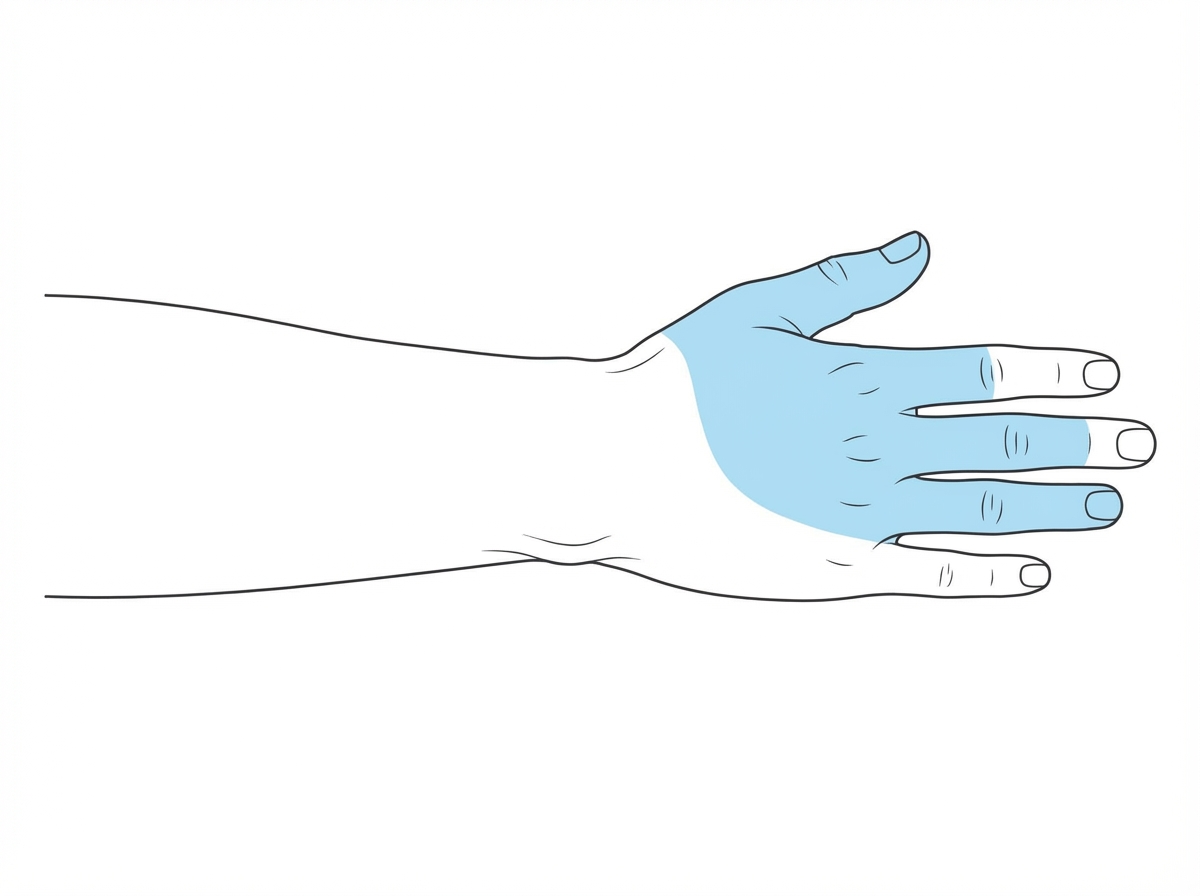
Compression of a nerve within the carpal tunnel produces inability to?
Which of the following structures does NOT pass through the carpal tunnel?
Identify the ligament:

Which of the following statements best describes the pectoral girdle and shoulder?
Which tendon is absent in the palm?
A 69-year-old man has numbness in the middle three digits of his right hand and finds it difficult to grasp objects with that hand. He has atrophy of the thenar eminence. Which of the following conditions is the most likely cause of the problems in his hand?
All of the following structures pass through the deltopectoral triangle, EXCEPT?
A patient loses the ability to flex their forefinger. The nerve that supplies the muscles responsible for this action is formed from which of the following cord(s) of the brachial plexus?
Explanation: The deltoid muscle is a primary multipennate muscle of the shoulder, characterized by its three distinct sets of fibers (anterior, middle, and posterior) that originate from the lateral clavicle, acromion, and spine of the scapula. The muscle is primarily an abductor of the shoulder, with its middle fibers serving as the chief abductors from 15° to 90°. Adduction is performed by muscles like the Pectoralis major, Latissimus dorsi, and Teres major, which act as antagonists to the deltoid. The anterior (clavicular) fibers are responsible for flexion and internal rotation, while the posterior (spinal) fibers are involved in extension and lateral rotation.
Explanation: The **capitate** is the largest carpal bone and occupies a central position in the wrist. To answer this question, one must visualize the carpal rows and the specific articulations of the capitate. ### **Explanation of the Correct Answer** **C. Trapezium:** The capitate does **not** articulate with the trapezium. The trapezium is located in the distal carpal row on the most lateral (radial) side. It articulates with the scaphoid proximally, the trapezoid medially, and the 1st and 2nd metacarpals distally. The capitate is separated from the trapezium by the **trapezoid** bone. ### **Analysis of Incorrect Options** * **A. Second Metacarpal:** The capitate has a large distal surface that articulates primarily with the **3rd metacarpal**, but it also has small facets for the **2nd and 4th metacarpals**. * **B. Lunate:** The rounded "head" of the capitate fits into the concavity formed by the lunate and scaphoid. The lunate sits directly proximal to the capitate. * **D. Scaphoid:** The capitate articulates with the scaphoid on its lateral (radial) aspect, specifically at the proximal-lateral quadrant of the capitate's head. ### **High-Yield NEET-PG Pearls** * **Articulations:** The capitate articulates with **7 bones**: Scaphoid, Lunate (proximal); Hamate (medial); Trapezoid (lateral); and 2nd, 3rd, and 4th Metacarpals (distal). * **Center of Rotation:** The capitate is considered the center of the wrist's movements; the axis for radial/ulnar deviation and flexion/extension passes through its head. * **Ossification:** The capitate is the **first** carpal bone to ossify (usually by 1–3 months of age). * **Clinical:** In perilunate dislocations, the capitate is typically displaced posteriorly relative to the lunate.
Explanation: **Explanation:** The **Median Nerve** is the structure compressed in **Carpal Tunnel Syndrome (CTS)** [1]. After passing through the carpal tunnel, it gives off a **recurrent branch** (the "million-dollar nerve") that supplies the muscles of the **thenar eminence**. **1. Why "Oppose the thumb" is correct:** The thenar muscles include the *Abductor Pollicis Brevis*, *Flexor Pollicis Brevis*, and **Opponens Pollicis**. Opposition is a complex movement initiated by the Opponens Pollicis. In CTS, denervation of this muscle leads to an inability to touch the tip of the thumb to the tips of the other fingers. **2. Why the other options are incorrect:** * **A. Abduct the thumb:** While the *Abductor Pollicis Brevis* (Median nerve) is affected, thumb abduction is also performed by the *Abductor Pollicis Longus*, which is supplied by the **Posterior Interosseous Nerve** (Radial nerve). Thus, abduction is weakened but not completely lost. * **B. Adduct the thumb:** This is performed by the *Adductor Pollicis*, which is supplied by the **Deep branch of the Ulnar Nerve**. It remains functional in CTS. * **C. Flex the distal phalanx:** This is the function of the *Flexor Pollicis Longus*. This muscle is supplied by the **Anterior Interosseous Nerve** in the forearm, *before* the median nerve enters the carpal tunnel [1]. **High-Yield Clinical Pearls for NEET-PG:** * **Ape Thumb Deformity:** Long-standing CTS leads to thenar atrophy, causing the thumb to fall into the same plane as the fingers. * **Sensory Sparing:** The **Palmar Cutaneous Branch** of the median nerve arises proximal to the carpal tunnel; therefore, sensation over the central palm is **preserved** in CTS [1]. * **Tests:** Phalen’s test and Tinel’s sign are classic clinical provocations for diagnosis.
Explanation: The **carpal tunnel** is a fibro-osseous gateway located at the wrist, bounded deeply by the carpal bones and superficially by the **flexor retinaculum** (transverse carpal ligament). [1] Understanding its contents is high-yield for NEET-PG. ### **Explanation of the Correct Answer** **D. Palmaris longus tendon:** This is the correct answer because the Palmaris longus tendon passes **superficial** to the flexor retinaculum. [1] It does not enter the carpal tunnel. Instead, it inserts into the apex of the palmar aponeurosis. It is a vestigial muscle, absent in approximately 15% of the population. ### **Analysis of Incorrect Options** The carpal tunnel contains exactly **10 structures**: 9 tendons and 1 nerve. [1] * **A. Flexor digitorum profundus (FDP):** These **4 tendons** pass through the tunnel within a common synovial sheath (ulnar bursa). * **B. Flexor digitorum superficialis (FDS):** These **4 tendons** also pass through the tunnel. Note that the tendons for the 3rd and 4th digits lie superficial to the 2nd and 5th digits. * **C. Flexor pollicis longus (FPL):** This **single tendon** passes through the radial side of the tunnel in its own synovial sheath (radial bursa). ### **High-Yield Clinical Pearls** * **The Median Nerve:** This is the most important non-tendinous structure in the tunnel. [1] Compression leads to **Carpal Tunnel Syndrome**, characterized by thenar atrophy and sensory loss in the lateral 3.5 digits. * **Structures passing superficial to the Flexor Retinaculum:** Palmaris longus, Ulnar nerve, Ulnar artery, and the Palmar cutaneous branches of the Median and Ulnar nerves. [1] * **Flexor Carpi Radialis (FCR):** Often a "distractor" in exams; it travels in a separate compartment/groove within the lateral attachment of the flexor retinaculum, not the main tunnel. [2]
Explanation: ***Coraco-acromial ligament*** - Forms the **coraco-acromial arch** by connecting the **coracoid process** of the scapula to the **acromion**, creating a protective roof over the humeral head. - Clinically important in **shoulder impingement syndrome** as it can compress the **supraspinatus tendon** and **subacromial bursa** during overhead movements. *Acromio-clavicular ligament* - Connects the **lateral end of the clavicle** to the **acromion process** of the scapula, stabilizing the AC joint. - Does not form an arch structure and is located more laterally than the coraco-acromial ligament. *Coraco-humeral ligament* - Extends from the **coracoid process** of the scapula to the **greater tubercle** of the humerus, strengthening the shoulder joint capsule. - Functions to limit **external rotation** and **inferior translation** of the humeral head, not forming a protective arch. *Sterno-clavicular ligament* - Reinforces the **sternoclavicular joint** by connecting the **sternum** to the **medial end of the clavicle**. - Located at the **medial aspect** of the shoulder girdle, far from the subacromial space and coraco-acromial arch.
Explanation: **Explanation:** **1. Why Option A is Correct:** The clavicle is a unique bone in the human body. It is the **first bone to begin ossification** in the fetus (around the 5th to 6th week of intrauterine life). Notably, it is the only long bone that undergoes **intramembranous ossification**, although its ends later ossify via endochondral ossification. **2. Why the Other Options are Incorrect:** * **Option B:** The clavicle most commonly fractures at the **junction of the lateral one-third and medial two-thirds**. This is the weakest point of the bone because it is where the curvature changes and the cross-section transitions from cylindrical to flattened. * **Option C:** The **subscapularis bursa** (located between the subscapularis tendon and the neck of the scapula) **always communicates** with the synovial cavity of the shoulder joint. This serves to reduce friction during rotation. * **Option D:** Under normal anatomical conditions, the **subacromial bursa does not communicate** with the shoulder joint capsule. They are separated by the rotator cuff tendons (specifically the supraspinatus). Communication between the two is a clinical sign of a full-thickness rotator cuff tear. **Clinical Pearls for NEET-PG:** * **Clavicle:** It is the only long bone held horizontally and the only one with no medullary cavity. * **Shoulder Joint:** It is the most mobile joint in the body but also the most frequently dislocated (usually in an anterior-inferior direction). * **Rotator Cuff (SITS):** Supraspinatus, Infraspinatus, Teres minor, and Subscapularis. The Supraspinatus is the most commonly injured muscle in this group.
Explanation: **Explanation:** The correct answer is **Extensor pollicis brevis (EPB)**. To answer this question, one must distinguish between the muscles of the anterior (flexor) compartment and the posterior (extensor) compartment of the forearm and hand. **1. Why Extensor Pollicis Brevis is the Correct Answer:** The EPB is a muscle of the **posterior compartment** of the forearm [1]. Its tendon passes through the first dorsal compartment of the extensor retinaculum and inserts onto the **dorsal surface** of the base of the proximal phalanx of the thumb [1]. Because it is an extensor, its course is entirely restricted to the dorsal aspect of the wrist and hand; it never enters the palmar (volar) surface. **2. Analysis of Incorrect Options:** * **Flexor digitorum superficialis (FDS) & Flexor digitorum profundus (FDP):** These are long flexor tendons that originate in the forearm, pass through the carpal tunnel, and traverse the **palm** to reach the fingers [2]. * **Opponens pollicis:** This is an intrinsic muscle of the hand located specifically in the **thenar eminence (palm)** [2]. It originates from the flexor retinaculum and inserts into the lateral border of the first metacarpal. **3. High-Yield Clinical Pearls for NEET-PG:** * **Anatomical Snuffbox:** The EPB forms the anterior (radial) boundary of the snuffbox, along with the Abductor pollicis longus (APL) [1]. * **De Quervain’s Tenosynovitis:** This clinical condition involves inflammation of the tendons in the first dorsal compartment (EPB and APL) [1]. It is tested using **Finkelstein’s test**. * **The "Outcroppers":** EPB, APL, and Extensor pollicis longus are known as the "outcropping" muscles of the deep posterior forearm. * **Rule of Thumb:** All "Flexor" tendons and "Opponens" muscles are found on the palmar side, while "Extensor" tendons are found on the dorsal side.
Explanation: ### Explanation **1. Why the Correct Answer is Right:** The patient presents with the classic triad of **Carpal Tunnel Syndrome (CTS)**: sensory loss in the lateral 3.5 digits, motor weakness (difficulty grasping), and **thenar atrophy**. The **median nerve** passes through the carpal tunnel; its compression leads to paresthesia in its cutaneous distribution and denervation of the "LOAF" muscles (Lateral two lumbricals, Opponens pollicis, Abductor pollicis brevis, and Flexor pollicis brevis). [2] Thenar atrophy is a late sign indicating significant motor nerve damage. **2. Why the Incorrect Options are Wrong:** * **Options B & D (Ulnar Nerve):** Ulnar nerve injury (at the elbow or Guyon’s canal) would cause numbness in the medial 1.5 digits (pinky and half of ring finger) and atrophy of the **hypothenar eminence** and interossei (leading to a "claw hand"), which contradicts this patient's symptoms. * **Option C (Cervical Spondylosis):** While cervical radiculopathy (e.g., C6-C7) can cause hand numbness, it typically presents with neck pain, weakness in more proximal muscle groups (like triceps or wrist extensors), and diminished reflexes (e.g., triceps reflex), rather than isolated thenar atrophy. **3. NEET-PG High-Yield Pearls:** * **Contents of Carpal Tunnel:** Median nerve + 9 tendons (4 Flexor Digitorum Superficialis, 4 Flexor Digitorum Profundus, 1 Flexor Pollicis Longus). * **Sensory Sparing:** The **palmar cutaneous branch** of the median nerve arises *proximal* to the carpal tunnel; therefore, sensation over the central palm is usually **preserved** in CTS. [1] * **Clinical Tests:** **Phalen’s test** (forced flexion) and **Tinnel’s sign** (percussion over the retinaculum) are classic bedside maneuvers. * **Most Common Cause:** Idiopathic; however, associated with pregnancy, hypothyroidism, diabetes, and rheumatoid arthritis.
Explanation: ### Explanation The **Deltopectoral Triangle** (also known as the Clavipectoral Triangle) is a small anatomical space in the upper limb that serves as a vital gateway for neurovascular structures. **Why the Axillary Nerve is the Correct Answer:** The **Axillary nerve** does not pass through the deltopectoral triangle. Instead, it arises from the posterior cord of the brachial plexus and exits the axilla through the **quadrangular space** (alongside the posterior circumflex humeral artery) to wind around the surgical neck of the humerus. It lies deep to the deltoid muscle, far from the superficial boundaries of the deltopectoral triangle. **Analysis of Other Options:** The deltopectoral triangle is bounded by the Clavicle (superiorly), Deltoid (laterally), and Pectoralis Major (medially). Its floor is formed by the clavipectoral fascia. The structures piercing this fascia or traveling within the triangle include: * **Cephalic Vein (Option A):** This is the most significant structure in the triangle. It ascends in the deltopectoral groove and pierces the clavipectoral fascia to drain into the axillary vein. * **Deltopectoral Lymph Nodes (Option C):** These nodes are located within the triangle, receiving lymphatic drainage from the lateral side of the arm and hand. * **Thoracoacromial Artery (Option D):** Specifically, the **deltoid branch** of this artery passes through the triangle to supply the adjacent muscles. **NEET-PG High-Yield Pearls:** * **Contents of the Triangle:** Remember the mnemonic **"C-A-T"**: **C**ephalic vein, **A**cromiothoracic (Thoracoacromial) artery, and **T**horacic (Lateral pectoral) nerve. * **Clinical Significance:** The cephalic vein in this triangle is a common site for **central venous access** [1] or the insertion of permanent pacemaker leads. * **Surgical Landmark:** The deltopectoral groove is the standard anatomical landmark for the **deltopectoral approach** to the shoulder joint (e.g., for shoulder arthroplasty).
Explanation: The ability to flex the forefinger (index finger) is primarily mediated by the **Median Nerve** [1]. Specifically, the **Flexor Digitorum Profundus (FDP)** to the index finger and the **Flexor Digitorum Superficialis (FDS)** are responsible for flexion at the distal and proximal interphalangeal joints, respectively [1]. Both are innervated by the median nerve. The median nerve is formed by the union of two roots: 1. The **Lateral root**, which arises from the **Lateral cord** (C5, C6, C7). 2. The **Medial root**, which arises from the **Medial cord** (C8, T1). Therefore, the nerve responsible for this action is derived from both the medial and lateral cords. **Analysis of Incorrect Options:** * **A & C:** Neither the lateral nor the medial cord alone forms the median nerve. The lateral cord alone forms the Musculocutaneous nerve, while the medial cord alone forms the Ulnar nerve. * **D:** The posterior cord forms the Radial and Axillary nerves. While the radial nerve handles extension, it does not supply the primary flexors of the fingers. **High-Yield NEET-PG Pearls:** * **The "M" of the Brachial Plexus:** Formed by the Musculocutaneous, Median, and Ulnar nerves. * **Pointing Index (Benedict’s Sign):** When a patient with a median nerve injury attempts to make a fist, the index and middle fingers remain extended due to loss of FDS and the lateral half of FDP [1]. * **Anterior Interosseous Nerve (AIN):** A branch of the median nerve that supplies the FDP to the index finger. Damage to the AIN results in the inability to make the "OK" sign.
Pectoral Region and Axilla
Practice Questions
Arm and Cubital Fossa
Practice Questions
Forearm and Hand
Practice Questions
Joints of Upper Limb
Practice Questions
Nerves of Upper Limb
Practice Questions
Arterial Supply and Venous Drainage
Practice Questions
Lymphatic Drainage
Practice Questions
Muscles and Their Actions
Practice Questions
Applied Anatomy and Clinical Correlations
Practice Questions
Surface Anatomy and Landmarks
Practice Questions
Get full access to all questions, explanations, and performance tracking.
Start For Free