Which carpal bone has a hook?
Which artery passes through the upper triangular space?
What is the nerve supply of the rhomboid major muscle?
What forms the head of the scapula?
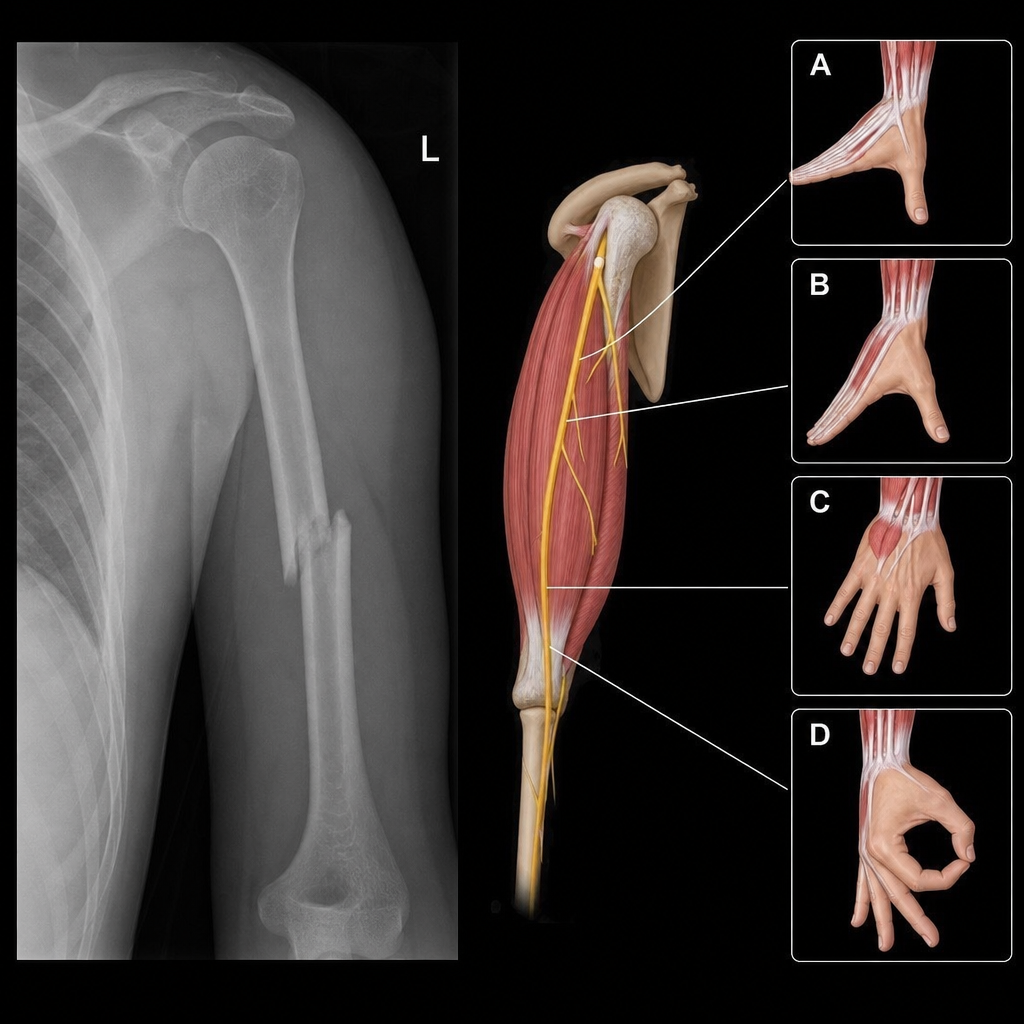
What is the most appropriate ending for the sentence: The median nerve:
Which muscle is spared in Erb's palsy?
A 17-year-old boy with a stab wound received multiple injuries on the upper part of the arm and required surgery. If the brachial artery were ligated at its origin, which of the following arteries would supply blood to the profunda brachii artery?
What type of joint is the wrist joint?
Median nerve injury at the wrist causes what functional deficit?
Which structure is present in the area marked by the arrow?

Explanation: **Explanation:** The **Hamate** is a wedge-shaped carpal bone located in the distal row on the medial (ulnar) side of the wrist. Its most defining characteristic is the **hook of the hamate** (Hamulus), a curved, volar projection that serves as a crucial attachment point for the flexor retinaculum [1] and the muscles of the hypothenar eminence (opponens digiti minimi and flexor digiti minimi brevis). **Analysis of Options:** * **Hamate (Correct):** Features the prominent "hook" on its palmar surface. It also forms the lateral boundary of the **Guyon’s canal** (ulnar canal) [1]. * **Capitate:** The largest carpal bone, characterized by a rounded "head" that articulates with the lunate, not a hook. * **Lunate:** A crescent-shaped bone in the proximal row. It is the most commonly dislocated carpal bone but lacks any bony projections. * **Pisiformis:** A pea-shaped sesamoid bone located within the tendon of the flexor carpi ulnaris. While it is a palpable landmark, it does not possess a hook. **Clinical Pearls for NEET-PG:** 1. **Guyon’s Canal Syndrome:** The ulnar nerve and artery pass between the hook of the hamate and the pisiform [1]. Fractures of the hook of the hamate (common in golfers or baseball players) can cause ulnar nerve compression. 2. **Carpal Tunnel:** The hook of the hamate forms the medial attachment for the flexor retinaculum (roof of the carpal tunnel) [1]. 3. **Ossification:** The capitate is the first carpal bone to ossify (around 1–3 months of age), followed by the hamate.
Explanation: The **upper triangular space** (also known as the medial triangular space) is a key anatomical gateway in the scapular region. Understanding its boundaries is essential for identifying its contents. ### **Explanation of the Correct Answer** The **circumflex scapular artery** is a branch of the subscapular artery. It passes through the upper triangular space to reach the infraspinous fossa, where it participates in the scapular anastomosis. * **Boundaries of the Upper Triangular Space:** * **Superior:** Teres minor muscle. * **Inferior:** Teres major muscle. * **Lateral:** Long head of the triceps brachii. ### **Analysis of Incorrect Options** * **A. Profunda brachii artery:** This artery, along with the radial nerve, travels through the **lower triangular space** (bounded by teres major, long head of triceps, and the humerus). * **B. Anterior circumflex humeral artery:** This arises from the third part of the axillary artery and winds around the surgical neck of the humerus; it does not pass through any of the triangular spaces. * **C. Posterior circumflex humeral artery:** This artery, along with the **axillary nerve**, passes through the **quadrangular space** (bounded by teres minor, teres major, long head of triceps, and the surgical neck of the humerus). ### **High-Yield NEET-PG Pearls** * **The "Rule of Threes":** Remember that the **Long head of Triceps** is the vertical divider. It forms the lateral boundary of the upper triangle and the medial boundary of the quadrangular and lower triangular spaces. * **Scapular Anastomosis:** The circumflex scapular artery provides a critical collateral pathway between the first part of the subclavian artery (via the suprascapular artery) and the third part of the axillary artery. * **Nerve association:** Unlike the quadrangular space (axillary nerve) and lower triangular space (radial nerve), the **upper triangular space contains no major nerve**, only the circumflex scapular artery.
Explanation: The **Rhomboid Major** is a extrinsic muscle of the back that acts to retract and rotate the scapula. ### **Explanation of the Correct Answer** The **Dorsal Scapular Nerve (C5)** is the correct answer. It arises directly from the **C5 root** of the brachial plexus. It pierces the middle scalene muscle and descends deep to the levator scapulae and the rhomboids (major and minor) along the medial border of the scapula, providing motor innervation to all three muscles. ### **Analysis of Incorrect Options** * **Options A & B (Spinal Accessory Nerve):** This is the XI cranial nerve. It provides motor innervation to the **Trapezius** and **Sternocleidomastoid** muscles. While the trapezius overlies the rhomboids, its nerve supply is distinct. * **Option D (Thoracodorsal Nerve):** Also known as the nerve to **Latissimus Dorsi**, it arises from the posterior cord of the brachial plexus (C6, C7, C8) [1]. ### **High-Yield Clinical Pearls for NEET-PG** * **Nerve Root:** The Dorsal Scapular Nerve is a "pre-trunk" branch of the brachial plexus, originating solely from the **C5 ventral ramus**. * **Clinical Testing:** To test the rhomboids, the patient is asked to push their elbows backward against resistance with hands on hips. * **Winged Scapula:** While *Serratus Anterior* palsy (Long Thoracic Nerve) causes lateral winging, a lesion of the *Dorsal Scapular Nerve* causes the scapula to move laterally and upward (mild winging), as the rhomboids can no longer retract the medial border. * **Blood Supply:** The nerve is usually accompanied by the **dorsal scapular artery** (or the deep branch of the transverse cervical artery).
Explanation: ### Explanation The scapula is a large, flat, triangular bone that possesses three angles: superior, inferior, and lateral. **Why the Lateral Angle is correct:** The **lateral angle** of the scapula is the thickest part of the bone and is truncated to form the **head of the scapula**. This head bears the **glenoid cavity**, a shallow, pyriform articular surface that articulates with the head of the humerus to form the glenohumeral (shoulder) joint. Immediately medial to the head is a slightly constricted region known as the **neck**. **Analysis of Incorrect Options:** * **A. Coracoid process:** This is a hook-like projection arising from the superior border of the head of the scapula, pointing forward and laterally. It serves as an attachment point for the short head of biceps brachii, coracobrachialis, and pectoralis minor. * **B. Acromion process:** This is a large, flattened bony projection that continues from the spine of the scapula. It articulates with the clavicle and forms the summit of the shoulder. * **D. Spine:** This is a shelf-like triangular plate of bone on the posterior surface of the scapula that divides it into supraspinous and infraspinous fossae. **High-Yield Clinical Pearls for NEET-PG:** * **Glenoid Labrum:** A fibrocartilaginous rim that deepens the glenoid cavity to increase joint stability. * **Supraglenoid Tubercle:** Located at the apex of the glenoid cavity; it provides origin to the long head of the **biceps brachii**. * **Infraglenoid Tubercle:** Located just below the glenoid cavity; it provides origin to the long head of the **triceps brachii**. * **Safe Zone:** The lateral angle/head is a critical landmark in shoulder arthroplasty and internal fixation of scapular fractures.
Explanation: The median nerve is a major nerve of the upper limb formed by the union of the **lateral root** (from the lateral cord, C5–C7) and the **medial root** (from the medial cord, C8–T1). **1. Why Option C is Correct:** The median nerve is primarily a nerve of the forearm and hand. In the arm, it travels alongside the brachial artery but **does not provide any motor or cutaneous branches** (except for a small vasomotor branch to the brachial artery). Its motor innervation begins only after it enters the forearm, where it supplies most of the long flexors. The median nerve passes through the carpal tunnel to provide sensation to the thumb, index, and middle fingers [1]. **2. Analysis of Incorrect Options:** * **Option A:** It arises from the **lateral and medial cords**, not the posterior cord. The posterior cord gives rise to the axillary and radial nerves. * **Option B:** In the arm, the median nerve actually crosses from the **lateral to the medial side** of the brachial artery (usually at the level of the insertion of the coracobrachialis). * **Option D:** The median nerve enters the forearm by passing between the two heads of the **pronator teres**. It is the **ulnar nerve** that passes between the two heads of the flexor carpi ulnaris. **High-Yield NEET-PG Pearls:** * **Supracondylar Fracture of Humerus:** This is the most common site of injury for the median nerve in the arm. * **Ligament of Struthers:** A rare anatomical variation where the median nerve can be compressed in the lower arm. * **Ape Thumb Deformity:** Result of a proximal median nerve injury leading to loss of thumb opposition. * **Pronator Syndrome:** Compression of the nerve between the two heads of the pronator teres.
Explanation: **Explanation:** **Erb’s Palsy** (Waiter’s Tip deformity) results from an injury to the **Upper Trunk** of the brachial plexus, specifically involving the **C5 and C6** nerve roots [1]. The muscles paralyzed are those innervated by nerves arising from these roots. **Why Coracobrachialis is spared:** The **Coracobrachialis** is innervated by the **Musculocutaneous nerve**, but its fibers are derived predominantly from the **C7** spinal segment (with some contribution from C5 and C6). In clinical practice and standard anatomical teaching for NEET-PG, the Coracobrachialis is considered "spared" or less affected because its primary functional innervation is often attributed to C7, which remains intact in an upper trunk injury. **Analysis of Incorrect Options:** * **Deltoid (A):** Innervated by the **Axillary nerve (C5, C6)**. It is severely affected, leading to loss of abduction and the characteristic "flat shoulder" appearance. * **Brachialis (B) & Biceps (C):** Both are innervated by the **Musculocutaneous nerve**, but unlike the coracobrachialis, their primary functional supply comes from **C5 and C6**. Their paralysis leads to the loss of elbow flexion and forearm supination. **High-Yield Clinical Pearls for NEET-PG:** * **Site of Injury:** Erb’s Point (junction of 6 nerves). * **Deformity:** Shoulder adducted and internally rotated, elbow extended, forearm pronated (**Policeman’s tip/Waiter’s tip hand**) [1]. * **Sensory Loss:** Over the "Regimental Badge" area (deltoid) and the lateral aspect of the forearm. * **Reflexes Lost:** Biceps and Supinator reflexes. * **Mnemonic:** The "C5-C6" muscles involved are **D**eltoid, **B**iceps, **B**rachialis, and **B**rachioradialis (**D**on't **B**e **B**ad **B**oy).
Explanation: **Explanation:** The correct answer is **Posterior humeral circumflex (Option C)**. This question tests your knowledge of the collateral circulation around the shoulder and the branching pattern of the axillary and brachial arteries. **Why it is correct:** The **Profunda brachii artery** (Deep artery of the arm) is the first major branch of the brachial artery. If the brachial artery is ligated at its origin (proximal to the profunda brachii), blood flow must reach the arm via anastomoses. An important clinical anastomosis exists between the **Posterior humeral circumflex artery** (a branch of the 3rd part of the axillary artery) and the **ascending branch of the profunda brachii artery**. This connection allows retrograde blood flow into the profunda brachii, bypassing the proximal ligation of the brachial artery. **Why the other options are incorrect:** * **Lateral thoracic (A):** A branch of the 2nd part of the axillary artery; it supplies the serratus anterior and breast tissue but does not anastomose with the profunda brachii. * **Subscapular (B):** While it participates in the scapular anastomosis (via the circumflex scapular branch), it does not directly supply the profunda brachii. * **Superior ulnar collateral (D):** This is a distal branch of the brachial artery itself. If the brachial artery is ligated at its origin, this artery would also lose its primary blood supply. **NEET-PG High-Yield Pearls:** * **Scapular Anastomosis:** Involves the Suprascapular (from Thyrocervical trunk), Circumflex Scapular (from Subscapular), and Dorsal Scapular arteries. * **Ligation Site:** Ligation of the brachial artery **distal** to the profunda brachii is usually well-tolerated due to the collateral circulation around the elbow. * **Quadrangular Space:** The Posterior humeral circumflex artery travels through this space alongside the **Axillary nerve**, making it a common site for combined neurovascular injury.
Explanation: The **wrist joint (Radiocarpal joint)** is a synovial joint formed by the articulation between the distal end of the radius (and the articular disc of the inferior radioulnar joint) and the proximal row of carpal bones (Scaphoid, Lunate, and Triquetrum). ### Why Ellipsoid? An **Ellipsoid (Condyloid) joint** consists of an oval-shaped convex surface fitting into an elliptical concave cavity. This configuration allows for movement in two axes (biaxial): 1. **Flexion/Extension** (Transverse axis) 2. **Abduction/Adduction** (Anteroposterior axis) It does **not** allow for independent rotation. ### Analysis of Incorrect Options: * **A. Hinge joint:** These are uniaxial joints (e.g., Elbow, Interphalangeal joints) that allow movement in only one plane (flexion/extension). * **B. Saddle joint:** Characterized by opposing surfaces that are reciprocally concavo-convex. The classic example is the **1st Carpometacarpal joint** (thumb). * **D. Ball and socket joint:** These are multiaxial joints (e.g., Shoulder, Hip) allowing movement in three planes, including rotation. ### High-Yield Clinical Pearls for NEET-PG: * **Bones involved:** The **Ulna does not participate** in the wrist joint; it is separated by a triangular fibrocartilage complex (TFCC). * **Pisiform:** This carpal bone is a sesamoid bone (in the tendon of Flexor Carpi Ulnaris) and does not take part in the radiocarpal articulation. * **Range of Motion:** Extension is more limited than flexion due to the stronger palmar radiocarpal ligaments. Adduction (ulnar deviation) is greater than abduction because the radial styloid process extends further distally.
Explanation: The median nerve is often referred to as the **"Laborer’s nerve."** At the wrist (low lesion), it passes through the carpal tunnel and supplies the **thenar muscles** (Abductor pollicis brevis, Flexor pollicis brevis, and Opponens pollicis) via its recurrent branch [1]. The **Opponens pollicis** is specifically responsible for rotating the thumb across the palm to touch the tips of other fingers. Therefore, a lesion at the wrist leads to paralysis of these muscles, resulting in the **loss of opposition** and "Ape thumb deformity" (where the thumb falls into the same plane as the fingers). **Analysis of Incorrect Options:** * **A. Claw hand:** This is typically caused by an **Ulnar nerve** injury. It results from the paralysis of the medial two lumbricals and interossei, leading to hyperextension at the MCP joints and flexion at the IP joints. * **C. Policeman's tip deformity:** This is characteristic of **Erb’s Palsy** (injury to the upper trunk of the brachial plexus, C5-C6). The limb hangs by the side, adducted and medially rotated. * **D. Saturday night palsy:** This refers to **Radial nerve** compression in the spiral groove (axilla/humerus), typically presenting with **wrist drop** due to paralysis of the extensors. **NEET-PG High-Yield Pearls:** * **Point of Distinction:** A *high* median nerve lesion (at the elbow) causes "Ape thumb" PLUS "Pointing index/Benediction gesture" when attempting to make a fist. * **Sensory Loss:** In wrist lesions (like Carpal Tunnel Syndrome), sensation is lost over the lateral 3.5 fingers, but the **palmar cutaneous branch** (sparing the skin over the thenar eminence) is often spared if the injury is distal to its origin [1]. * **Mnemonic:** The median nerve supplies **LOAF** muscles in the hand (2 **L**umbricals, **O**pponens pollicis, **A**bductor pollicis brevis, **F**lexor pollicis brevis).
Explanation: ***Radial artery*** - The **radial artery** runs along the **lateral aspect** of the distal forearm and wrist, making it the most superficial structure at this location. - It is easily **palpable** at the wrist between the **flexor carpi radialis tendon** and the **radius bone**, commonly used for pulse assessment. *Median nerve* - The **median nerve** travels through the **carpal tunnel** beneath the **flexor retinaculum**, deep to the skin surface. - It is located more **centrally** at the wrist, not in the lateral position where the arrow points. *Ulnar artery* - The **ulnar artery** runs along the **medial aspect** of the forearm and wrist, lateral to the **flexor carpi ulnaris tendon**. - It forms the **superficial palmar arch** and is located on the **ulnar side**, opposite to the marked location. *Ulnar nerve* - The **ulnar nerve** travels in **Guyon's canal** at the wrist, between the **pisiform bone** and **hook of hamate**. - It is positioned on the **medial side** of the wrist, not at the lateral radial location indicated by the arrow.
Pectoral Region and Axilla
Practice Questions
Arm and Cubital Fossa
Practice Questions
Forearm and Hand
Practice Questions
Joints of Upper Limb
Practice Questions
Nerves of Upper Limb
Practice Questions
Arterial Supply and Venous Drainage
Practice Questions
Lymphatic Drainage
Practice Questions
Muscles and Their Actions
Practice Questions
Applied Anatomy and Clinical Correlations
Practice Questions
Surface Anatomy and Landmarks
Practice Questions
Get full access to all questions, explanations, and performance tracking.
Start For Free