Guyon's canal is associated with which of the following structures?
All of the following muscles form the rotator cuff EXCEPT?
Which muscle is primarily responsible for overhead abduction at the shoulder joint?
Injury to the long thoracic nerve can be tested by asking the patient to perform which action?
The coracohumeral ligament is a degenerated part of which muscle?
A patient who sustained an injury cannot abduct their right arm and cannot lift it. Examination reveals tenderness near the right upper arm, and an X-ray shows a fracture of the surgical neck of the humerus. Which muscle was paralyzed?
A patient complains of pain with repeated movements of his thumb, often referred to as thumb claudication. The physician performs the Allen test and notes an insufficiency of the radial artery. Which of the following conditions would result from radial artery stenosis?
A patient presented with numbness of the little and ring finger and atrophy of the hypothenar muscles. Which nerve is damaged?
All of the following nerves arise from the posterior cord of the brachial plexus, EXCEPT?
Which of the following groups of axillary lymph nodes is considered a terminal group?
Explanation: **Explanation:** **Guyon’s Canal (Ulnar Canal)** is a fibro-osseous tunnel located on the medial side of the wrist. It serves as a conduit for the **ulnar nerve** and the **ulnar artery** as they pass from the forearm into the hand. * **Why Option B is Correct:** The canal is bounded medially by the pisiform bone and laterally by the hook of the hamate [1]. The roof is formed by the palmar carpal ligament and the palmaris brevis muscle. The ulnar nerve enters the canal and divides into superficial and deep branches within it. Compression here leads to **Guyon’s canal syndrome**. **Why the other options are incorrect:** * **A. Anterior Interosseous Nerve:** This is a branch of the median nerve that travels deep in the forearm (between the flexor digitorum profundus and flexor pollicis longus) and does not pass through the wrist. * **C. Median Nerve:** This nerve passes through the **carpal tunnel**, which lies lateral and deep to Guyon’s canal [1]. * **D. Radial Artery:** This artery passes through the **anatomical snuffbox** on the lateral (radial) aspect of the wrist to reach the dorsum of the hand [1]. **High-Yield Clinical Pearls for NEET-PG:** * **Handlebar Palsy:** Common in long-distance cyclists due to direct pressure on Guyon’s canal, leading to sensory loss in the medial 1.5 fingers and weakness of intrinsic hand muscles. * **Zone of Compression:** Unlike carpal tunnel syndrome, Guyon’s canal syndrome often spares the palmar cutaneous branch (which arises proximal to the wrist), meaning sensation over the hypothenar eminence may remain intact. * **Contents:** Remember that both the **ulnar nerve** and **ulnar artery** are contents; the nerve is typically medial to the artery.
Explanation: The **Rotator Cuff** (also known as the musculotendinous cuff) is a functional unit formed by the tendons of four specific muscles that blend with the fibrous capsule of the shoulder joint. Its primary role is to stabilize the humeral head within the glenoid cavity during movements. ### Why Deltoid is the Correct Answer: The **Deltoid (Option C)** is a large, superficial muscle that forms the rounded contour of the shoulder. While it is the primary abductor of the arm (beyond 15 degrees), it is **not** part of the rotator cuff. It does not insert into the joint capsule and acts as a "shunt muscle" rather than a stabilizer of the glenoid labrum. ### Explanation of Incorrect Options (Rotator Cuff Muscles): The rotator cuff is easily remembered by the mnemonic **SITS**: * **Supraspinatus (Option D):** Originates from the supraspinous fossa and inserts on the greater tubercle. It initiates the first 0–15° of abduction. * **Infraspinatus:** Originates from the infraspinous fossa and inserts on the greater tubercle. It is a lateral rotator. * **Teres minor (Option A):** Originates from the lateral border of the scapula and inserts on the greater tubercle. It also assists in lateral rotation. * **Subscapularis (Option B):** The only member that inserts on the **lesser tubercle**. It is a powerful medial rotator. ### High-Yield Clinical Pearls for NEET-PG: * **Most commonly injured muscle:** Supraspinatus (due to its location beneath the acromion process, making it prone to impingement). * **Nerve Supply:** Supraspinatus and Infraspinatus are supplied by the **Suprascapular nerve**; Teres minor by the **Axillary nerve**; Subscapularis by the **Upper and Lower Subscapular nerves**. * **The "Gatekeeper":** The rotator cuff is deficient **inferiorly**, which explains why anterior-inferior shoulder dislocations are the most common.
Explanation: Abduction at the shoulder joint is a complex, coordinated movement involving multiple muscles acting at different stages. To achieve **overhead abduction** (above 90°), the scapula must rotate upward to reposition the glenoid cavity. **Why Serratus Anterior is correct:** The **Serratus anterior** (supplied by the Long Thoracic Nerve) is the primary muscle responsible for the **upward rotation of the scapula**. Along with the Trapezius, it rotates the scapula so that the glenoid fossa faces upwards, allowing the humerus to move beyond the horizontal plane (90° to 180°). Without this scapular rotation, the humerus would hit the acromion process, halting abduction. **Analysis of Incorrect Options:** * **Supraspinatus:** Responsible for the **initiation** of abduction (first 0–15°). It stabilizes the humeral head in the glenoid cavity. * **Deltoid:** The primary abductor from **15° to 90°**. While essential, it cannot lift the arm above the head without the synergistic upward rotation of the scapula. * **Pectoralis major:** This is primarily an **adductor** and medial rotator of the arm; it opposes abduction. **High-Yield Clinical Pearls for NEET-PG:** * **Winged Scapula:** Damage to the Long Thoracic Nerve (C5-C7) paralyzes the Serratus anterior, leading to an inability to perform overhead abduction and a protruding medial border of the scapula. * **Scapulohumeral Rhythm:** The ratio of glenohumeral movement to scapulothoracic movement is generally **2:1**. * **The
Explanation: **Explanation:** The **long thoracic nerve (Nerve of Bell)** arises from the roots of the brachial plexus (**C5, C6, C7**) and supplies the **Serratus Anterior** muscle. The primary function of this muscle is to protract the scapula and keep its medial border firmly opposed to the thoracic wall. **Why Option A is Correct:** When a patient is asked to **push against a wall** with outstretched hands, the Serratus Anterior must contract to stabilize the scapula against the rib cage. If the long thoracic nerve is injured, the muscle fails, and the medial border of the scapula protrudes posteriorly. This clinical sign is known as **"Winging of the Scapula."** **Why Other Options are Incorrect:** * **Option B:** While the Serratus Anterior (along with the Trapezius) helps in rotating the scapula for abduction above 90°, "pushing against a wall" is the specific provocative test used to elicit winging. * **Option C:** Touching the opposite shoulder primarily involves the Pectoralis Major and Deltoid (adduction and internal rotation). * **Option D:** Lifting a heavy object primarily tests the Trapezius (elevation) and the muscles of the arm/forearm (biceps/brachialis). **NEET-PG High-Yield Pearls:** * **Mechanism of Injury:** The nerve is superficial; it is commonly injured during **mastectomy** (axillary lymph node dissection), chest tube insertion, or heavy carrying on the shoulder. * **Mnemonic for Roots:** "C5, 6, 7 raise your wings to heaven." * **Clinical Presentation:** Patients often complain of difficulty in overhead lifting or combing hair due to impaired upward rotation of the scapula.
Explanation: The **coracohumeral ligament** is a broad, functional band that strengthens the upper part of the shoulder joint capsule. From an embryological and comparative anatomy perspective, it is considered the **degenerated (vestigial) tendon of the Pectoralis minor muscle**. In many lower mammals, the Pectoralis minor inserts directly into the humerus. However, in humans, the insertion has shifted proximally to the coracoid process. The distal portion of the original tendon has persisted as a ligamentous band stretching from the lateral border of the coracoid process to the greater tubercle of the humerus. **Analysis of Options:** * **Pectoralis minor (Correct):** Its ancestral insertion was the humerus; the coracohumeral ligament represents the remnant of this primitive insertion. * **Biceps brachii:** The long head is intracapsular but extrasynovial; it does not form this ligament. * **Coracobrachialis:** This muscle shares the coracoid origin but remains a distinct muscular entity inserting into the humeral shaft. * **Latissimus dorsi:** This muscle inserts into the floor of the bicipital groove and is unrelated to the superior joint capsule. **High-Yield NEET-PG Pearls:** * **Function:** The coracohumeral ligament is the primary restraint against **inferior subluxation** of the humeral head when the arm is adducted (at rest). * **Morphology:** It blends with the tendon of the supraspinatus and the capsule of the shoulder joint. * **Clinical Correlation:** Thickening and contracture of this ligament are key pathological findings in **Adhesive Capsulitis (Frozen Shoulder)**, significantly restricting external rotation.
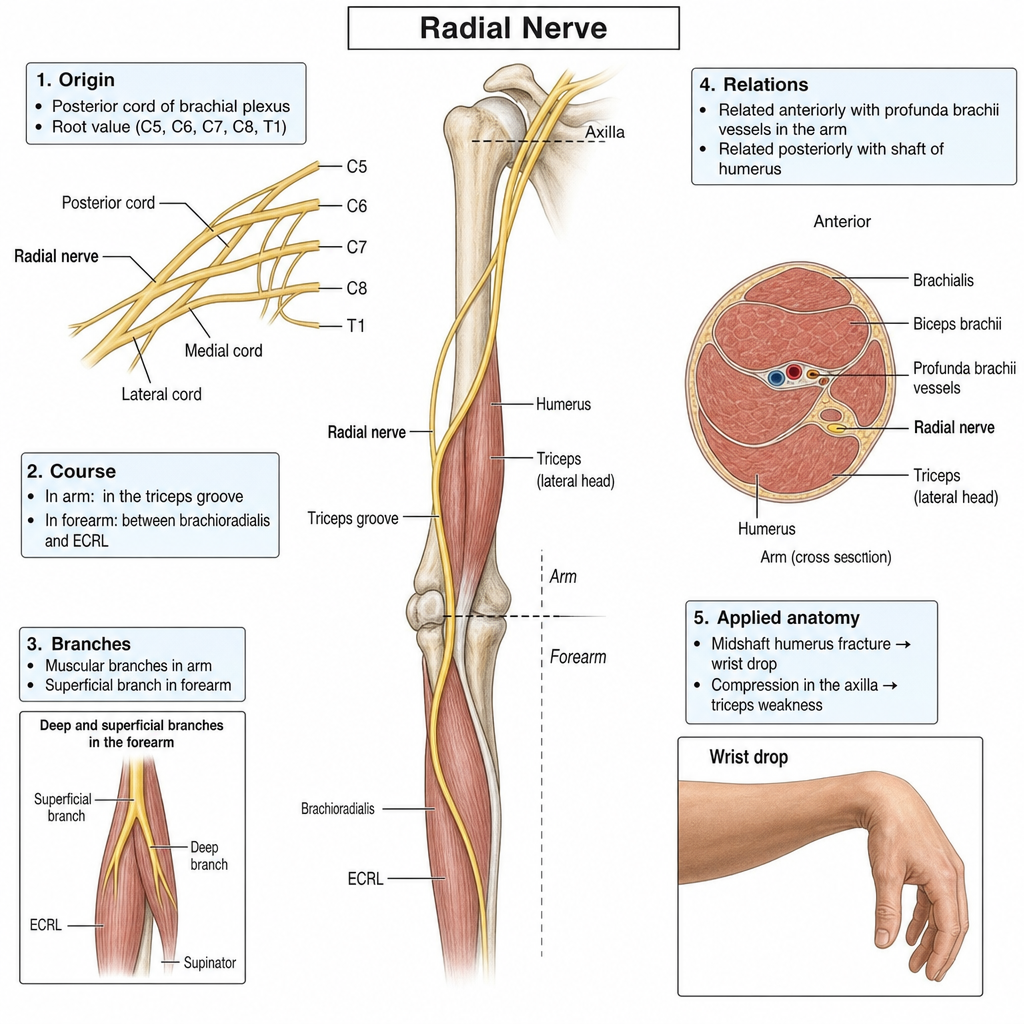
Explanation: ### Explanation **1. Why Supraspinatus is the Correct Answer:** The patient presents with an inability to **abduct** the arm. Abduction of the shoulder is a coordinated movement involving specific muscles at different ranges: * **0–15°:** Initiated by the **Supraspinatus** (Suprascapular nerve). * **15–90°:** Performed by the **Deltoid** (Axillary nerve). * **>90°:** Performed by the Serratus Anterior and Trapezius (scapular rotation). In a fracture of the **surgical neck of the humerus**, the **Axillary nerve** is the most commonly injured structure. While the Deltoid is paralyzed in such cases, the question specifies the patient "cannot abduct" at all. If the Supraspinatus is also compromised (often due to associated rotator cuff tears or secondary inhibition from pain/trauma at the insertion site), the initiation of abduction is lost. Among the options provided, the Supraspinatus is the only muscle listed that is a primary abductor. **2. Analysis of Incorrect Options:** * **A. Subscapularis:** Responsible for **internal rotation** and adduction. * **C. Infraspinatus:** Responsible for **external rotation**. * **D. Teres major:** Responsible for **adduction** and internal rotation ("The little helper of Latissimus dorsi"). **3. NEET-PG High-Yield Clinical Pearls:** * **Nerve at Risk:** Surgical neck fracture = **Axillary Nerve** (supplies Deltoid and Teres Minor). * **Mid-shaft fracture:** Radial Nerve (results in Wrist Drop) [1]. * **Supracondylar fracture:** Median Nerve. * **Medial Epicondyle fracture:** Ulnar Nerve. * **Rotator Cuff (SITS):** Supraspinatus (Abduction), Infraspinatus (External rotation), Teres minor (External rotation), Subscapularis (Internal rotation). The Supraspinatus is the most commonly injured muscle in rotator cuff tears.
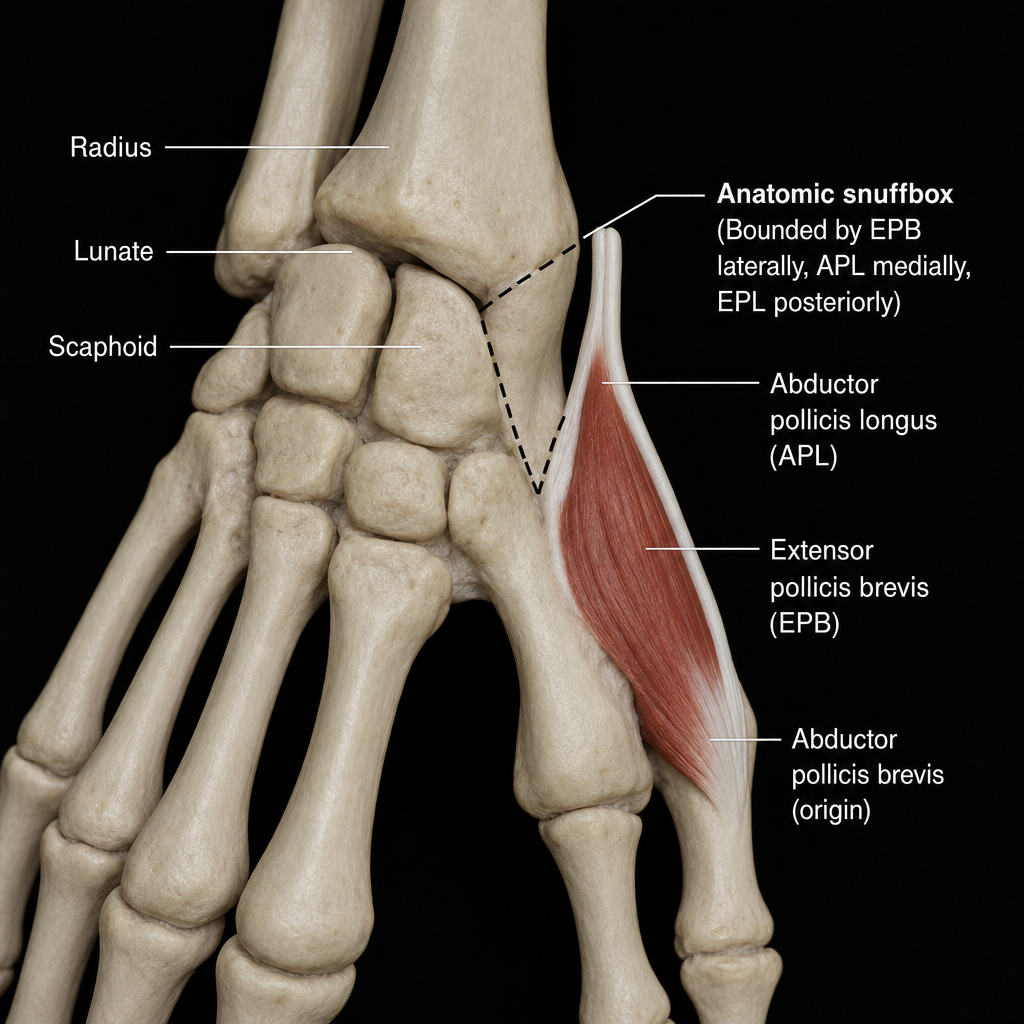
Explanation: The radial artery is the primary source of blood supply to the thumb and the deep structures of the hand. Understanding its course and branches is high-yield for NEET-PG. ### **Explanation of the Correct Answer** The **radial artery** enters the palm by passing between the two heads of the first dorsal interosseous muscle. Once in the deep plane, it gives off two major branches: the **princeps pollicis artery** (the main supply to the thumb) and the **radialis indicis artery** (supply to the lateral side of the index finger). Therefore, stenosis of the radial artery directly leads to decreased blood flow in the princeps pollicis, causing "thumb claudication" during activity. [1] ### **Analysis of Incorrect Options** * **Option A:** The **superficial palmar arch** is primarily formed by the **ulnar artery**. While the radial artery contributes a superficial palmar branch, ulnar artery patency usually maintains flow in this arch. * **Option B:** The artery passing **superficial** to the flexor retinaculum is the **ulnar artery**. The radial artery passes deep to the tendons of the abductor pollicis longus and extensor pollicis brevis (in the anatomical snuffbox). * **Option C:** The extensor muscles of the forearm are primarily supplied by the **posterior interosseous artery** (a branch of the common interosseous from the ulnar artery) and the **interosseous recurrent artery**. Radial artery stenosis would not cause ischemia of the *entire* extensor compartment. ### **NEET-PG High-Yield Pearls** * **Allen Test:** Used to assess the patency of the radial and ulnar arteries and the adequacy of the palmar arches before arterial sampling. * **Anatomical Snuffbox:** The radial artery lies in the floor of the snuffbox, where its pulsations can be felt against the scaphoid and trapezium. * **Deep Palmar Arch:** Formed mainly by the terminal part of the **radial artery**, anastomosing with the deep branch of the ulnar artery.
Explanation: ### Explanation The patient presents with a combination of **sensory loss** (numbness of the little and ring finger) and **motor loss** (atrophy of the hypothenar muscles). To solve this, one must understand the functional anatomy of the ulnar nerve at the wrist (Guyon’s canal) [1]. **1. Why Option C is Correct:** The ulnar nerve enters the hand and divides into a **superficial branch** (primarily sensory to the medial 1.5 fingers) and a **deep branch** (purely motor to the hypothenar muscles, interossei, and adductor pollicis) [1]. Since the patient has *both* sensory and motor deficits, the lesion must be proximal to this bifurcation—specifically, the main trunk of the ulnar nerve before it divides. **2. Why Other Options are Incorrect:** * **Option A:** The palmar cutaneous branch supplies the skin over the medial palm but spares the fingers. Isolated damage would not cause hypothenar atrophy. * **Option B:** The deep branch is purely motor. Damage here would cause muscle atrophy (claw hand/hypothenar wasting) but **no sensory loss** in the fingers. * **Option D:** The posterior cord gives rise to the radial and axillary nerves. Damage would typically present with "wrist drop" and sensory loss on the dorsal aspect of the hand, not the ulnar distribution. ### NEET-PG Clinical Pearls: * **Guyon’s Canal Syndrome:** Compression of the ulnar nerve at the wrist [1]. If the lesion is at the hook of the hamate, it often affects only the deep branch (motor only). * **Ulnar Paradox:** The higher the lesion (at the elbow), the *less* prominent the clawing because the medial half of the Flexor Digitorum Profundus (FDP) is also paralyzed. * **Froment’s Sign:** Tests for adductor pollicis palsy (deep branch of ulnar nerve); the patient compensates by flexing the thumb IP joint (median nerve/FPL).
Explanation: The Brachial Plexus is a high-yield topic for NEET-PG. To answer this question, one must recall the specific branches arising from the cords. ### **Explanation** The **Musculocutaneous nerve** is the correct answer because it arises from the **Lateral Cord** (C5, C6, C7), not the posterior cord. It pierces the coracobrachialis muscle and supplies the muscles of the anterior compartment of the arm. The **Posterior Cord** (formed by the posterior divisions of all three trunks) gives off five branches, easily remembered by the mnemonic **ULTRA**: 1. **U**pper subscapular nerve (C5, C6) 2. **L**ower subscapular nerve (C5, C6) 3. **T**horacodorsal nerve (Nerve to Latissimus Dorsi) (C6, C7, C8) [1] 4. **R**adial nerve (C5–T1) – The largest branch. 5. **A**xillary nerve (C5, C6) ### **Analysis of Incorrect Options** * **Option A & B (Upper & Lower Subscapular nerves):** These are direct branches of the posterior cord. They supply the subscapularis muscle (Lower also supplies Teres major). * **Option C (Thoracodorsal nerve):** This is a branch of the posterior cord that supplies the Latissimus dorsi ("Climber’s muscle") [1]. ### **High-Yield Clinical Pearls for NEET-PG** * **Erb’s Palsy:** Involves the "Upper Trunk" (C5-C6), leading to a "Waiter’s tip" deformity. * **Klumpke’s Palsy:** Involves the "Lower Trunk" (C8-T1), leading to a "Claw hand." * **Winged Scapula:** Caused by injury to the **Long Thoracic Nerve** (arises from Roots C5, C6, C7), not the cords. * **Radial Nerve:** The most common nerve injured in mid-shaft humerus fractures (Spiral groove).
Explanation: The axillary lymph nodes are organized into five main groups based on their anatomical location within the axilla. Understanding the flow of lymph is crucial for NEET-PG, as it follows a hierarchical pattern from peripheral to central groups. **Why Apical is Correct:** The **Apical (Subclavicular) group** is considered the **terminal group** because it represents the final common pathway for all lymph draining from the upper limb and the breast. These nodes are situated at the apex of the axilla, medial to the axillary vein and above the pectoralis minor. They receive efferents from all other axillary node groups (Pectoral, Subscapular, Lateral, and Central). The efferents from the apical nodes unite to form the **subclavian lymph trunk**, which drains into the thoracic duct or the right lymphatic duct. **Why Other Options are Incorrect:** * **Pectoral (Anterior):** These are primary nodes located along the lower border of the pectoralis minor. They primarily drain the major portion of the breast and the anterior thoracic wall. * **Subscapular (Posterior):** Located along the subscapular vessels, these drain the posterior thoracic wall and the scapular region. * **Central:** These nodes lie deep in the axillary fat. While they receive lymph from the pectoral, subscapular, and lateral groups, they are an intermediate station that ultimately drains into the apical nodes. **High-Yield Clinical Pearls:** * **Sentinel Node Biopsy:** Usually involves the pectoral group, as it is the first station for breast cancer metastasis. * **Rotter’s Nodes:** These are interpectoral nodes located between the pectoralis major and minor; they drain directly into the apical group. * **Level Classification:** In surgery (Berg’s levels), Level I is lateral to pectoralis minor, Level II is behind it, and **Level III (Apical)** is medial/superior to it [1].
Pectoral Region and Axilla
Practice Questions
Arm and Cubital Fossa
Practice Questions
Forearm and Hand
Practice Questions
Joints of Upper Limb
Practice Questions
Nerves of Upper Limb
Practice Questions
Arterial Supply and Venous Drainage
Practice Questions
Lymphatic Drainage
Practice Questions
Muscles and Their Actions
Practice Questions
Applied Anatomy and Clinical Correlations
Practice Questions
Surface Anatomy and Landmarks
Practice Questions
Get full access to all questions, explanations, and performance tracking.
Start For Free