Which structure is present superficial to the galea aponeurotica (epicranial aponeurosis)?
Damage to the coracobrachialis muscle and to the nerve passing through it could reasonably be expected to produce all of the following, EXCEPT?
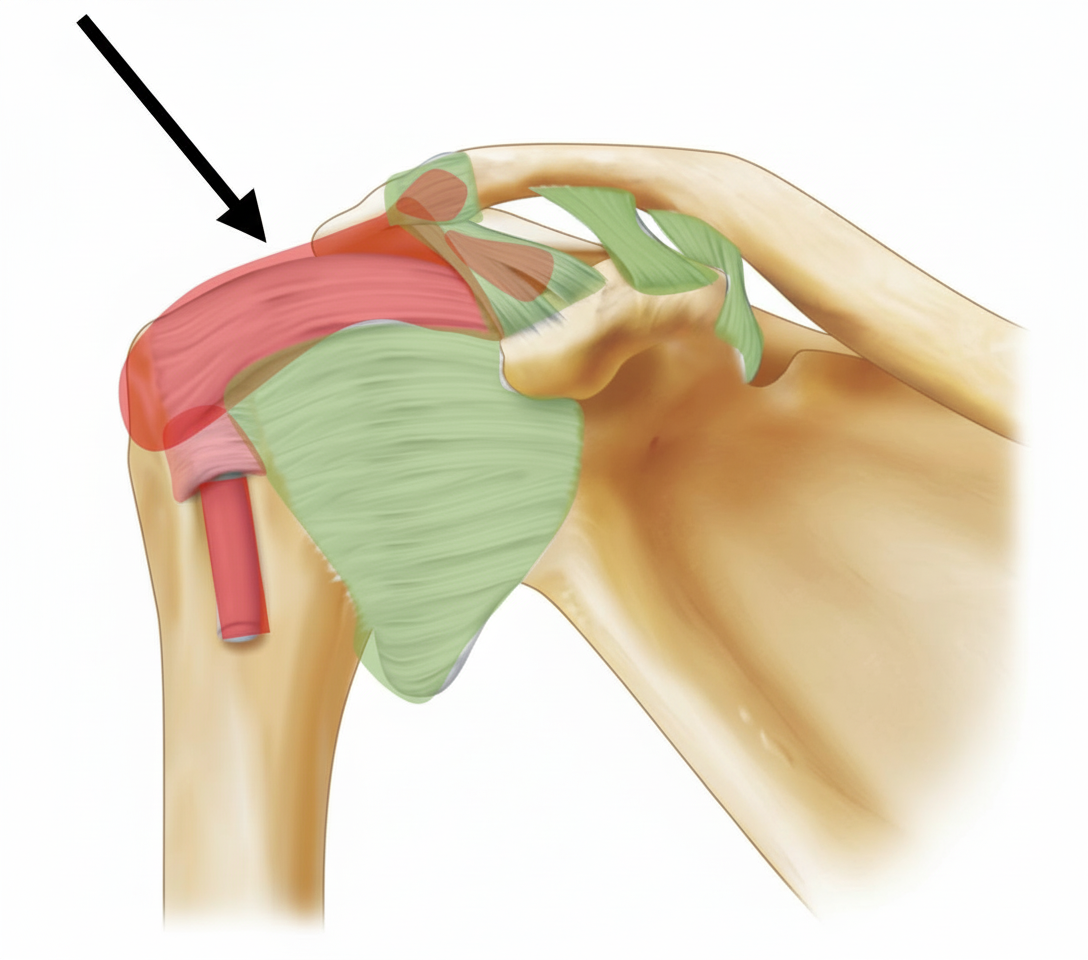
Which muscle does not insert on the greater tuberosity?
Neglected whitlow may lead to necrosis of which part of the distal phalanx?
In a subclavian artery block at the outer border of the 1st rib, all of the following arteries help in maintaining circulation to the upper limb except?
The nerve affected in carpal tunnel syndrome is:
A 22-year-old male football player suffered a wrist injury while falling with force on his outstretched hand. When the anatomic snuffbox is exposed in surgery, an artery is visualized crossing the fractured bone that provides a floor for this space. What artery was visualized?
Which muscle forms the anterior wall of the axilla?
A 25-year-old woman presents to the emergency department following a motor vehicle collision. Radiographic examination reveals a fracture at the spiral groove of the humerus. A cast is applied, and 3 days later, the patient reports severe pain throughout her arm. Physical examination reveals a swollen, pale, and cool arm. The radial pulse is absent, and any movement of the arm causes excruciating pain. Which of the following conditions will most likely characterize these physical examination findings?
Which of the following statements about the brachial plexus is FALSE?
Explanation: The Galea Aponeurotica (epicranial aponeurosis) is a tough layer of dense fibrous tissue that forms the third layer of the scalp, connecting the frontal and occipital bellies of the occipitofrontalis muscle. The correct answer is D. Median cubital vein. While the question appears to have a topographical mismatch (as the Median cubital vein is located in the cubital fossa of the upper limb and the Galea is in the scalp), in the context of standard medical examinations, this question often tests the student's ability to identify superficial structures versus deep structures. The Median cubital vein is a superficial vein located in the subcutaneous tissue (superficial fascia), making it "superficial" to deep fascia/aponeurosis in its respective region. Analysis of Incorrect Options: A. Brachial Artery: This is a deep structure of the arm, traveling beneath the deep fascia and the bicipital aponeurosis. B. Radial Nerve: This nerve travels deep in the arm (radial groove) and forearm, though its superficial branch is cutaneous, the nerve itself is generally considered deep to the major aponeurotic structures. C. Median Nerve: This nerve travels deep within the carpal tunnel and the cubital fossa, situated deep to the bicipital aponeurosis. NEET-PG High-Yield Pearls: 1. Layers of the Scalp (SCALP): Skin, Connective tissue (dense), Aponeurosis (Galea), Loose areolar tissue (the "Dangerous Area"), and Pericranium. 2. The Dangerous Area: The 4th layer (Loose areolar tissue) is called the dangerous area because emissary veins communicate through it, potentially carrying infection from the scalp to the intracranial dural venous sinuses. 3. Cephalic & Basilic Veins: These are also superficial veins of the upper limb often used for venipuncture, similar to the Median cubital vein.
Explanation: ### Explanation The muscle described is the **coracobrachialis**, and the nerve passing through it is the **musculocutaneous nerve (C5–C7)**. This nerve is a branch of the lateral cord of the brachial plexus and supplies the muscles of the anterior compartment of the arm. **Why Option D is the Correct Answer (The "Except"):** The musculocutaneous nerve terminates as the **lateral cutaneous nerve of the forearm**, providing sensation to the lateral aspect of the forearm down to the wrist. It does **not** supply the palm. Cutaneous sensation over the lateral palm is primarily supplied by the **median nerve** (palmar cutaneous branch). Therefore, damage to the musculocutaneous nerve will not affect the lateral palm. **Analysis of Incorrect Options:** * **A. Weakened flexion at the elbow:** The musculocutaneous nerve supplies the **brachialis** and **biceps brachii**, the primary flexors of the elbow. * **B. Weakened flexion at the shoulder:** Both the **coracobrachialis** and the long head of the **biceps brachii** assist in shoulder flexion. * **C. Weakened supination of the forearm:** The **biceps brachii** is the most powerful supinator of the forearm when the elbow is flexed. Loss of its innervation significantly weakens this movement. **High-Yield NEET-PG Pearls:** * **The "BBC" Muscles:** The musculocutaneous nerve supplies the **B**iceps brachii, **B**rachialis, and **C**oracobrachialis. * **Piercing Nerve:** The musculocutaneous nerve is unique because it **pierces** the coracobrachialis muscle. * **Sensory Loss:** Injury results in anesthesia over the **lateral (radial) border of the forearm** (Pre-axial border). * **Reflex:** Damage to this nerve leads to a lost or diminished **biceps tendon reflex**.
Explanation: ### Explanation The **Greater Tuberosity** of the humerus is the insertion site for three of the four rotator cuff muscles. These muscles are often remembered by the mnemonic **"SIT"** (Supraspinatus, Infraspinatus, and Teres minor). **1. Why Subscapularis is the Correct Answer:** The **Subscapularis** is the only rotator cuff muscle that inserts on the **Lesser Tuberosity** of the humerus. Functionally, it acts as the primary internal rotator of the shoulder, whereas the muscles of the greater tuberosity primarily facilitate abduction and external rotation. **2. Analysis of Incorrect Options:** The greater tuberosity has three distinct "facets" (impressions) for muscle attachment: * **Supraspinatus (Option B):** Inserts on the **superior facet**. It initiates the first 0–15 degrees of arm abduction. * **Infraspinatus (Option C):** Inserts on the **middle facet**. It is a powerful external rotator. * **Teres minor (Option A):** Inserts on the **inferior facet**. It also assists in external rotation. **3. Clinical Pearls & High-Yield Facts for NEET-PG:** * **Rotator Cuff Mnemonic:** **SITS** (Supraspinatus, Infraspinatus, Teres minor, Subscapularis). Note that **Teres Major** is NOT part of the rotator cuff. * **Bicipital Groove:** Located between the greater and lesser tuberosities, it lodges the long head of the biceps tendon. * **Nerve Supply:** Subscapularis is supplied by the Upper and Lower Subscapular nerves (C5, C6). * **Clinical Test:** The **Lift-off test** or **Belly-press test** is used to assess the integrity of the Subscapularis muscle.
Explanation: The distal phalanx of the finger is unique due to its blood supply and anatomical compartments. A **whitlow (felon)** is an abscess in the pulp space of the finger. This space is divided into several tight, non-compliant compartments by fibrous septa that run from the skin to the periosteum. **1. Why Option A is correct:** The blood supply to the **distal four-fifths** of the terminal phalanx is provided by small branches of the digital arteries that run through these tight pulp compartments. When pus accumulates (whitlow), the pressure within these compartments rises rapidly, compressing the vessels and causing **ischemic necrosis** of the bone. [1] **2. Why Options B and C are incorrect:** The **proximal one-fifth (base)** of the distal phalanx is spared from necrosis. This is because the epiphysis (base) of the bone receives its blood supply from a separate branch of the digital artery that arises proximal to the pulp space. Therefore, the whole tip is not involved, and the necrosis is specifically limited to the diaphysis (distal 4/5th). **Clinical Pearls for NEET-PG:** * **Pulp Space Anatomy:** The fibrous septa create a "closed-box" system; hence, even a small amount of inflammation causes exquisite pain. [1] * **Osteomyelitis:** Neglected whitlow is a common cause of terminal phalanx osteomyelitis. [1] * **Surgical Management:** Treatment requires a lateral incision to divide the fibrous septa and decompress the space, avoiding the tactile part of the finger pad. * **Nerve Supply:** The pulp is richly supplied by sensory receptors (Meissner’s and Pacinian corpuscles), explaining the high intensity of pain.
Explanation: ### Explanation The question tests your knowledge of the **scapular anastomosis**, a critical collateral circulation pathway that bypasses obstructions in the subclavian or axillary arteries. **1. Why "Superior Thoracic Artery" is the correct answer:** The block occurs at the **outer border of the 1st rib**, which is the anatomical landmark where the subclavian artery becomes the axillary artery. To maintain circulation to the upper limb, blood must flow from the proximal subclavian branches to the distal axillary branches. The **superior thoracic artery** is the first branch of the axillary artery. Since it arises *distal* to the 1st rib but *proximal* to the subscapular artery (the main distal re-entry point), it does not participate in the scapular anastomosis and cannot bypass the block. **2. Analysis of Incorrect Options:** * **Thyrocervical Trunk (Option C):** This is a branch of the 1st part of the subclavian artery. It gives off the Suprascapular and Transverse cervical arteries, which are the primary "donors" of blood to the anastomosis. * **Suprascapular Artery (Option D):** Arising from the thyrocervical trunk, it travels posteriorly to the scapula to communicate with the circumflex scapular artery. * **Subscapular Artery (Option A):** A branch of the 3rd part of the axillary artery. Its branch, the **circumflex scapular artery**, receives blood from the suprascapular and transverse cervical arteries, allowing blood to re-enter the axillary artery distal to the block. **Clinical Pearls for NEET-PG:** * **Scapular Anastomosis:** Connects the 1st part of the Subclavian artery with the 3rd part of the Axillary artery. * **Key Vessels:** Suprascapular & Deep branch of Transverse Cervical (from Subclavian) ↔ Circumflex Scapular (from Axillary). * **Direction of Flow:** In a block proximal to the subscapular artery, blood flow in the circumflex scapular artery **reverses** to reach the axillary artery. * **High-Yield Landmark:** The Subclavian artery ends and the Axillary artery begins at the **outer border of the 1st rib**.
Explanation: The carpal tunnel is a narrow fibro-osseous passage on the palmar aspect of the wrist. Its boundaries are the carpal bones (floor) and the flexor retinaculum (roof) [1]. It contains nine tendons and one nerve: the Median Nerve [1]. Carpal Tunnel Syndrome (CTS) occurs due to compression of this nerve within the tunnel, leading to pain, paresthesia in the lateral 3.5 fingers, and wasting of the thenar muscles [1]. **Analysis of Incorrect Options:** * **Radial Nerve:** This nerve travels posteriorly in the arm and forearm. It does not pass through the carpal tunnel; its sensory branches pass over the anatomical snuffbox [1]. * **Anterior Interosseous Nerve (AIN):** This is a motor branch of the median nerve that arises in the proximal forearm. It supplies the deep flexors (FPL, lateral half of FDP, and PQ) and terminates at the wrist joint, but it does not enter the carpal tunnel [2]. * **Superficial Palmar Branch of Radial Nerve:** This branch provides sensation to the lateral aspect of the dorsum of the hand. It passes superficial to the extensor retinaculum, not through the carpal tunnel. **High-Yield Clinical Pearls for NEET-PG:** * **Palmar Sparing:** In CTS, sensation over the **thenar eminence is preserved** because the *palmar cutaneous branch* of the median nerve arises proximal to and passes superficial to the flexor retinaculum [1], [2]. * **Contents of Carpal Tunnel:** 1 Median Nerve + 4 tendons of FDS + 4 tendons of FDP + 1 tendon of FPL. * **Clinical Tests:** Phalen’s test (wrist flexion) and Tinel’s sign (percussion over the retinaculum) are classic diagnostic maneuvers. * **Most Common Cause:** Idiopathic; however, it is associated with Pregnancy, Myxedema (Hypothyroidism), Rheumatoid Arthritis, and Acromegaly.
Explanation: The clinical scenario describes a classic injury to the **scaphoid bone**, which forms the floor of the **anatomic snuffbox**. The patient fell on an outstretched hand (FOOSH), the most common mechanism for scaphoid fractures [1]. **Why the Radial Artery is Correct:** The **radial artery** is the key vascular structure passing through the anatomic snuffbox. After giving off the superficial palmar branch, the radial artery winds dorsally around the lateral aspect of the wrist, passing deep to the tendons of the abductor pollicis longus and extensor pollicis brevis. It then crosses the floor of the snuffbox (specifically over the scaphoid and trapezium) before piercing the two heads of the first dorsal interosseous muscle to enter the palm. **Why the Incorrect Options are Wrong:** * **Ulnar Artery:** This artery enters the hand via Guyon’s canal, medial to the flexor carpi ulnaris [3]. It is located on the medial (ulnar) side of the wrist, far from the snuffbox. * **Anterior/Posterior Interosseous Arteries:** These are branches of the common interosseous artery (from the ulnar artery) that supply the forearm compartments. While the posterior interosseous artery terminates by joining the dorsal carpal arch, it does not cross the floor of the snuffbox. **High-Yield Clinical Pearls for NEET-PG:** * **Boundaries of Snuffbox:** Lateral (Abductor pollicis longus, Extensor pollicis brevis); Medial (Extensor pollicis longus); Floor (Scaphoid and Trapezium). * **Contents:** Radial artery (deep), Cephalic vein (superficial), and Superficial branch of the radial nerve. * **Scaphoid Fracture Risk:** The scaphoid has a **retrograde blood supply** from the radial artery. A fracture at the waist can lead to **avascular necrosis (AVN)** of the proximal pole [2]. * **Tenderness:** Point tenderness in the anatomic snuffbox is pathognomonic for a scaphoid fracture.
Explanation: The **axilla** (armpit) is a pyramid-shaped space between the upper arm and the thorax. Understanding its boundaries is high-yield for NEET-PG, as it houses the brachial plexus and axillary vessels. **1. Why Pectoralis Major is Correct:** The **Anterior Wall** of the axilla is formed by three structures: the **Pectoralis major** (most superficial), the Pectoralis minor, and the subclavius muscle (enclosed by the clavipectoral fascia). The Pectoralis major forms the bulk of this wall and its lower border creates the **anterior axillary fold**. **2. Analysis of Incorrect Options:** * **Humerus (Option B):** The humerus (specifically the bicipital groove) forms the narrow **Lateral Wall** of the axilla, where the anterior and posterior walls converge. * **Latissimus dorsi (Option C):** Along with the Subscapularis and Teres major, the Latissimus dorsi forms the **Posterior Wall** [1]. Its lower border forms the **posterior axillary fold**. * **Teres major (Option D):** This muscle also contributes to the **Posterior Wall** and the posterior axillary fold. **3. High-Yield Clinical Pearls for NEET-PG:** * **Medial Wall:** Formed by the upper 4-5 ribs and the **Serratus anterior** muscle. Injury to the long thoracic nerve here leads to "winging of scapula." * **Apex (Cervico-axillary canal):** Bounded by the clavicle (anteriorly), first rib (medially), and upper border of the scapula (posteriorly). * **Axillary Lymph Nodes:** These are embedded in the axillary fat and are crucial for staging breast cancer. The **Pectoralis minor** is the key landmark used to divide the axillary lymph nodes into three levels (I, II, and III). [1]
Explanation: ### Explanation **Correct Answer: C. Compartment Syndrome** The clinical presentation of severe pain out of proportion to the injury, swelling, pallor, coolness, and pulselessness following a fracture and casting is classic for **Compartment Syndrome** [1]. **Mechanism:** A fracture at the spiral groove (midshaft humerus) causes internal bleeding and edema. Applying a restrictive cast further limits the space for tissue expansion [1]. This leads to increased intracompartmental pressure, which exceeds capillary perfusion pressure. The resulting ischemia affects nerves and muscles, leading to the **"6 Ps"**: Pain (out of proportion), Pallor, Poikilothermia (coolness), Pulselessness, Paresthesia, and Paralysis [1]. Pain on passive stretching is the earliest and most sensitive clinical sign. --- ### Why Other Options are Incorrect: * **A. Venous Thrombosis:** While it causes swelling and pain, it typically presents with warmth and redness (rubor) rather than pallor and coolness. Pulses remain palpable. * **B. Thoracic Outlet Syndrome:** This involves compression of the neurovascular bundle at the neck/shoulder. While it can cause ischemia, it is not typically an acute complication of a humeral shaft fracture and casting. * **C. Raynaud’s Disease:** This is a vasospastic disorder usually triggered by cold or stress, primarily affecting the fingers. It does not present with severe swelling or post-traumatic pain. --- ### NEET-PG High-Yield Pearls: * **Most Common Site:** The leg (tibia fracture) is the most common site overall, but in the upper limb, it often follows supracondylar or humeral fractures. * **Volkmann’s Ischemic Contracture:** The end-stage result of untreated compartment syndrome in the forearm, leading to permanent fibrosis and claw-like deformity [1]. * **Diagnosis:** Primarily clinical; however, a compartment pressure **>30 mmHg** or a Delta pressure (Diastolic BP – Compartment Pressure) **<30 mmHg** is diagnostic. * **Management:** Immediate removal of the cast/constrictive dressing. If symptoms persist, **emergency fasciotomy** is the definitive treatment [1].
Explanation: ### Explanation The **brachial plexus** is a complex network of nerves (C5–T1) that provides motor and sensory innervation to the upper limb. To identify the false statement, one must distinguish between the branches arising from the **roots, trunks, and cords**. **1. Why Option C is the Correct (False) Statement:** The **long thoracic nerve** (Nerve to Serratus Anterior) does not arise from the posterior cord. Instead, it arises directly from the **roots of C5, C6, and C7**. This is a high-yield distinction because it originates more proximally than the cords. **2. Analysis of Other Options:** * **Option A (True):** The **radial nerve** is the largest branch of the **posterior cord** (C5–T1). It provides the main supply for the extensor compartments of the arm and forearm. * **Option B (True):** The **axillary nerve** (C5, C6) is a major branch of the **posterior cord**. It supplies the deltoid and teres minor muscles. * **Option D (True):** The brachial plexus begins with five roots (C5–T1). The **C5 and C6 roots** unite to form the **upper (superior) trunk**. **Clinical Pearls for NEET-PG:** * **Erb’s Palsy:** Involves injury to the **upper trunk** (C5, C6), resulting in the "waiter’s tip" deformity. * **Klumpke’s Palsy:** Involves injury to the "lower trunk" (C8, T1), leading to a "claw hand." * **Winged Scapula:** Caused by damage to the **long thoracic nerve**, paralyzing the serratus anterior. * **Mnemonic for Posterior Cord Branches (STAR):** **S**ubscapular (upper/lower), **T**horacodorsal [1], **A**xillary, and **R**adial nerves. [1] Townsend. Sabiston Textbook Of Surgery. 20E ed. Head and Neck, pp. 843-844.
Pectoral Region and Axilla
Practice Questions
Arm and Cubital Fossa
Practice Questions
Forearm and Hand
Practice Questions
Joints of Upper Limb
Practice Questions
Nerves of Upper Limb
Practice Questions
Arterial Supply and Venous Drainage
Practice Questions
Lymphatic Drainage
Practice Questions
Muscles and Their Actions
Practice Questions
Applied Anatomy and Clinical Correlations
Practice Questions
Surface Anatomy and Landmarks
Practice Questions
Get full access to all questions, explanations, and performance tracking.
Start For Free