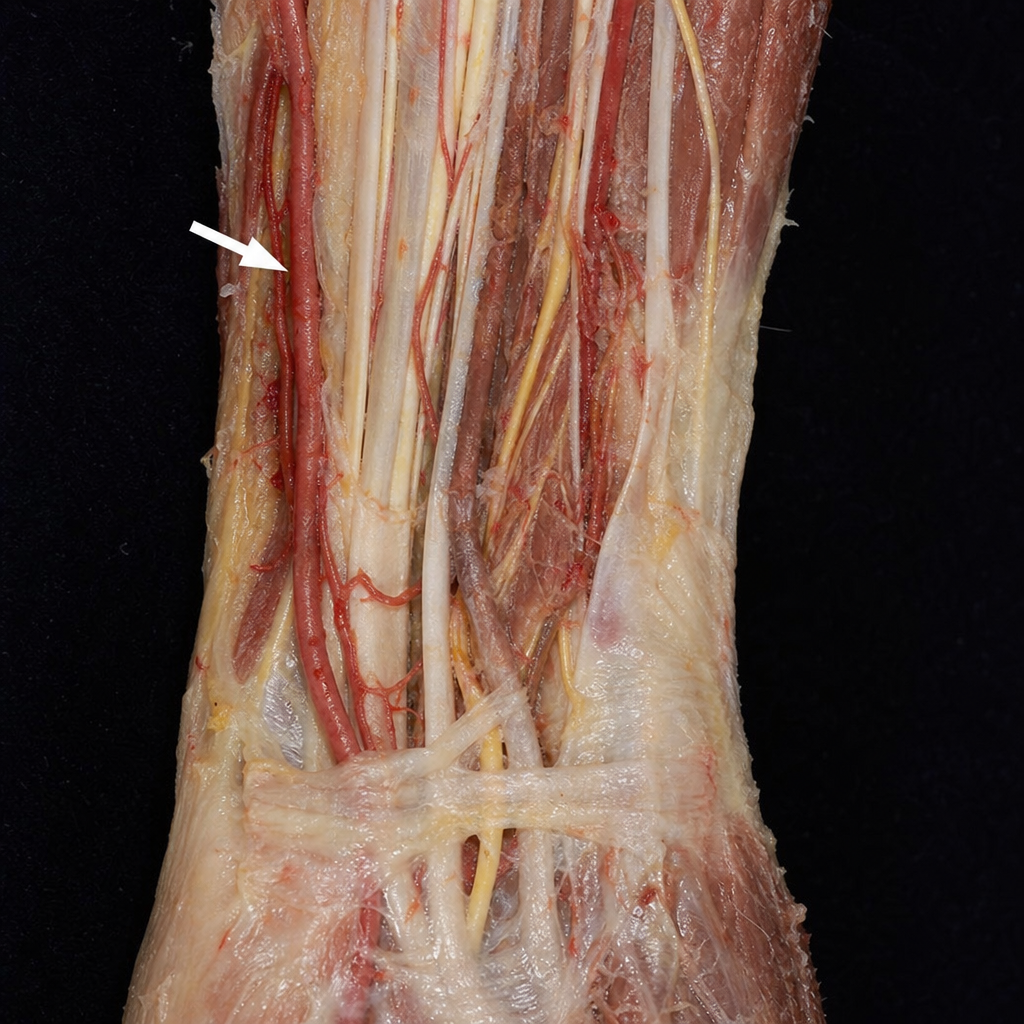
Which muscle acts as the protractor of the scapula?
All the thenar muscles of the hand are supplied by the median nerve except?
All of the following are considered to be rotator cuff muscles except?
What is the nerve supply to the hypothenar muscles?
Which spinal nerve roots primarily supply the intrinsic muscles of the hand?
A median nerve lesion at the wrist causes all of the following, except?
A 35-year-old man presents with a stab wound to the most medial aspect of the proximal portion of the cubital fossa. Which of the following structures would most likely be damaged?
What is the primary function of the lumbrical muscles of the hand?
A boy presents with injury to the medial epicondyle of the humerus. Which of the following would not be seen?
Lesions of the musculocutaneous nerve can result in all of the following, EXCEPT:
Explanation: **Explanation:** **1. Why Serratus Anterior is Correct:** The **Serratus anterior** is the primary protractor of the scapula. It originates from the outer surfaces of the upper eight ribs and inserts into the costal surface of the medial border of the scapula. When it contracts, it pulls the scapula forward around the chest wall (protraction), an action essential for reaching forward or pushing (often called the **"Boxer’s muscle"**). Additionally, its lower fibers help in the upward rotation of the scapula, allowing for abduction of the arm beyond 90 degrees. **2. Analysis of Incorrect Options:** * **Rhomboid Major:** This muscle acts as an **antagonist** to the serratus anterior. It originates from the spine and inserts into the medial border, acting to **retract** (pull back) and stabilize the scapula. * **Deltoid:** This is the primary abductor of the arm at the glenohumeral joint. It does not directly protract the scapula; its main roles are abduction, flexion, and extension of the humerus. * **Pectoralis Major:** While it is a powerful adductor and medial rotator of the humerus, it is not a primary protractor of the scapula. Its deep counterpart, the Pectoralis minor, assists in protraction, but Serratus anterior remains the chief muscle for this movement. **3. Clinical Pearls for NEET-PG:** * **Nerve Supply:** Serratus anterior is supplied by the **Long Thoracic Nerve (C5, C6, C7)**. * **Clinical Correlation:** Injury to the long thoracic nerve (e.g., during radical mastectomy or chest tube insertion) leads to **"Winging of Scapula,"** where the medial border of the scapula becomes prominent, and the patient cannot protract the arm or perform overhead abduction. * **Applied Anatomy:** The muscle is also known as the "Life-saving muscle" because it helps in forced inspiration.
Explanation: ### Explanation The intrinsic muscles of the hand are primarily supplied by the **Ulnar nerve**, with the exception of the **LOAF** muscles (Lateral two Lumbricals, Opponens pollicis, Abductor pollicis brevis, and Flexor pollicis brevis), which are supplied by the **Median nerve** [2]. **Why Adductor Pollicis is the correct answer:** The **Adductor pollicis** is functionally a part of the thumb muscles but anatomically belongs to the deep palmar group. It is supplied by the **deep branch of the Ulnar nerve (C8, T1)** [2]. It does not originate from the flexor retinaculum like the true thenar muscles, but rather from the metacarpal bones. **Analysis of Incorrect Options:** * **Opponens pollicis:** A true thenar muscle supplied by the recurrent branch of the Median nerve. It is responsible for opposition [2]. * **Abductor pollicis brevis:** The most superficial thenar muscle, supplied by the Median nerve. It abducts the thumb at the CMC joint [2]. * **Flexor pollicis brevis (FPB):** The superficial head is supplied by the Median nerve [1], [2]. (Note: The deep head of FPB often receives dual innervation or ulnar supply, but for exam purposes, it is classified under the Median nerve-supplied thenar group). **High-Yield Clinical Pearls for NEET-PG:** * **Ape Thumb Deformity:** Caused by Median nerve injury at the wrist (e.g., Carpal Tunnel Syndrome), leading to paralysis of the thenar muscles and loss of opposition. * **Froment’s Sign:** Tests for **Adductor pollicis** palsy (Ulnar nerve injury). The patient compensates for adduction weakness by flexing the thumb interphalangeal joint using the Flexor Pollicis Longus (Median nerve). * **Mnemonic:** Remember **
Explanation: **Explanation:** The **Rotator Cuff (SITS muscles)** is a functional anatomical unit consisting of four muscles that stabilize the glenohumeral joint by compressing the humeral head into the glenoid cavity. **Why Teres Major is the Correct Answer:** While the **Teres major** is closely related to the shoulder region, it is **not** part of the rotator cuff. It originates from the lower third of the lateral border of the scapula and inserts into the medial lip of the bicipital groove of the humerus. Unlike rotator cuff muscles, its primary functions are adduction, extension, and internal rotation of the arm (acting as "Latissimus dorsi's little helper"), and it does not provide direct stability to the joint capsule. **Analysis of Incorrect Options:** * **A. Supraspinatus:** Initiates the first 15° of abduction. It is the most commonly injured rotator cuff muscle. * **B. Infraspinatus:** A powerful external rotator of the shoulder. * **C. Teres minor:** Also an external rotator; it is distinguished from Teres major by its insertion on the greater tubercle and its nerve supply (Axillary nerve). **High-Yield Clinical Pearls for NEET-PG:** * **Mnemonic:** Remember **SITS** (Supraspinatus, Infraspinatus, Teres minor, Subscapularis). * **Insertions:** Supraspinatus, Infraspinatus, and Teres minor insert on the **Greater Tubercle**. Subscapularis is the only one that inserts on the **Lesser Tubercle**. * **Nerve Supply:** Supraspinatus and Infraspinatus are supplied by the **Suprascapular nerve** (C5, C6). * **Clinical Sign:** A tear in the Supraspinatus leads to a positive **"Empty Can Test"** or **"Drop Arm Test."**
Explanation: The **ulnar nerve** is the primary motor nerve of the hand, often referred to as the "musician's nerve." It supplies all the muscles of the **hypothenar eminence**, which include the Abductor digiti minimi, Flexor digiti minimi brevis, and Opponens digiti minimi [2]. These muscles are responsible for the fine movements of the little finger. The ulnar nerve also supplies the Palmaris brevis, all Interossei, the medial two Lumbricals, and the Adductor pollicis [2][4]. **Analysis of Options:** * **Median nerve:** Supplies the "LOAF" muscles (Lateral two Lumbricals, Opponens pollicis, Abductor pollicis brevis, and Flexor pollicis brevis) [4]. It primarily governs the **thenar eminence** and precision grip. * **Radial nerve:** Supplies the extensor compartment of the forearm and the skin on the dorsum of the hand [3][4]. It does not supply any intrinsic muscles of the hand. * **Musculocutaneous nerve:** Supplies the muscles of the anterior compartment of the arm (Biceps brachii, Coracobrachialis, and Brachialis) and terminates as the lateral cutaneous nerve of the forearm. **High-Yield Clinical Pearls for NEET-PG:** * **Guyon’s Canal Syndrome:** Compression of the ulnar nerve at the wrist (between the pisiform and hook of hamate) leads to wasting of the hypothenar muscles [1]. * **Ulnar Paradox:** The higher the lesion (at the elbow), the less prominent the clawing of the fingers, because the long flexors (FDP) are also paralyzed. * **Froment’s Sign:** Tests for ulnar nerve palsy; the patient compensates for a weak Adductor pollicis by using the Flexor pollicis longus (Median nerve) to hold a piece of paper.
Explanation: **Explanation:** The intrinsic muscles of the hand (thenar, hypothenar, interossei, and lumbricals) are primarily supplied by the **C8 and T1 nerve roots**. These roots form the lower trunk of the brachial plexus [1]. Fibers from these roots travel through the median and ulnar nerves to reach the hand. Specifically, the **T1 root** is considered the most critical contributor to the motor supply of these small muscles. **Analysis of Options:** * **C8 and T1 (Correct):** These roots supply the "fine motor" functions of the hand. Damage to these roots (e.g., in Klumpke’s Palsy) leads to significant wasting of the intrinsic muscles and a "claw hand" deformity. * **C4:** This root primarily contributes to the phrenic nerve (diaphragm) and sensory supply to the shoulder area; it has no involvement in hand function. * **C5:** This root supplies the "proximal" muscles of the upper limb, such as the deltoid and supraspinatus (shoulder abduction). * **C6:** This root is primarily responsible for wrist extension (via the extensor carpi radialis) and the brachioradialis reflex. **Clinical Pearls for NEET-PG:** * **Klumpke’s Palsy:** An injury to the lower trunk (C8-T1) caused by hyper-abduction of the arm (e.g., clutching a tree branch while falling). It results in total claw hand due to the loss of lumbricals [1]. * **T1 Dermatome:** The sensory supply for T1 is located on the medial aspect of the forearm. * **The "Point and Pinch" Rule:** C5/C6 control the shoulder/elbow; C7 controls the wrist/fingers extension; **C8/T1** control the intrinsic hand grip and finger movements.
Explanation: The median nerve enters the hand through the carpal tunnel and supplies the **LOAF** muscles: **L**ateral two lumbricals (1st and 2nd), **O**pponens pollicis, **A**bductor pollicis brevis, and **F**lexor pollicis brevis [1]. **Why Option B is the Correct Answer:** The **Adductor pollicis** is the only muscle of the thumb that is **not** supplied by the median nerve. It is supplied by the **deep branch of the ulnar nerve** (C8, T1). Therefore, a median nerve lesion at the wrist (such as in Carpal Tunnel Syndrome) will spare this muscle. **Analysis of Incorrect Options:** * **Option A (Thenar atrophy):** The thenar eminence is formed by the Abductor pollicis brevis, Flexor pollicis brevis, and Opponens pollicis. Since these are supplied by the recurrent branch of the median nerve, a lesion at the wrist leads to muscle wasting (Ape-thumb deformity). * **Option C (Weakness of 1st and 2nd lumbricals):** These muscles are directly innervated by the digital branches of the median nerve in the hand. * **Option D (Weakness of Flexor pollicis brevis):** The superficial head of this muscle is supplied by the median nerve; thus, it is affected in low median nerve palsies. **NEET-PG High-Yield Pearls:** * **Ape-Thumb Deformity:** Characterized by thenar atrophy and the thumb being held in adduction (due to unopposed action of Adductor pollicis). * **Point of Distinction:** If the lesion is at the **elbow** (High Median Nerve Palsy), there is additional loss of FDP (lateral half) and FPL, leading to the **Hand of Benediction** when attempting to make a fist [2]. * **Froment’s Sign:** Used to test Adductor pollicis; a positive sign (flexion of the thumb IP joint) indicates ulnar nerve palsy, not median.
Explanation: ### Explanation The **cubital fossa** is a triangular depression located on the anterior aspect of the elbow. To answer this question, one must recall the arrangement of structures from **Lateral to Medial** (the "MBBR" or "TAN" mnemonic). **1. Why the Median Nerve is Correct:** The contents of the cubital fossa, arranged from lateral to medial, are: * **B**iceps brachii tendon * **B**rachial artery * **M**edian nerve The **Median nerve** is the most medial structure within the fossa. Therefore, a stab wound to the most medial aspect of the proximal cubital fossa would directly involve the median nerve before it exits between the two heads of the pronator teres. **2. Analysis of Incorrect Options:** * **Biceps brachii tendon (A):** This is the most lateral of the three central structures (Tendon, Artery, Nerve). * **Radial nerve (B):** The radial nerve lies deep and lateral to the cubital fossa, situated between the brachialis and brachioradialis muscles. It is not considered a content of the fossa by most anatomical definitions, or it is the "most lateral" if included. * **Brachial artery (C):** This structure lies central to the fossa, medial to the biceps tendon but lateral to the median nerve. **3. Clinical Pearls for NEET-PG:** * **Boundaries:** Lateral (Brachioradialis), Medial (Pronator teres), Superior (Imaginary line between epicondyles). * **Roof:** Contains the **Median cubital vein** (common site for venipuncture), which is separated from the brachial artery by the **bicipital aponeurosis** (the "protection" layer). * **Supracondylar Fracture:** The Median nerve and Brachial artery are the structures most at risk in displaced supracondylar fractures of the humerus.
Explanation: The **lumbrical muscles** are four small, worm-like muscles located in the palm. Their unique anatomical characteristic is that they originate from the tendons of the **Flexor Digitorum Profundus (FDP)** and insert into the **extensor expansions** on the radial side of the proximal phalanges [1]. **Why Option A is Correct:** Due to their specific insertion into the extensor expansion, the lumbricals pass anterior to the transverse axis of the **metacarpophalangeal (MCP) joints** and posterior to the axis of the **interphalangeal (IP) joints**. This orientation allows them to simultaneously produce **flexion at the MCP joints** and **extension at the proximal and distal IP joints** [1]. This combined movement is often referred to as the "Z-position" or the "writing position" of the hand. **Analysis of Incorrect Options:** * **Option B:** While lumbricals do extend the IP joints, **adduction** is the primary function of the **Palmar Interossei** (PAD). * **Option C:** Adduction and abduction are functions of the **Interossei** (Palmar and Dorsal, respectively), not the lumbricals. * **Option D:** While lumbricals flex the MCP joints, **abduction** is the primary function of the **Dorsal Interossei** (DAB). **High-Yield Clinical Pearls for NEET-PG:** * **Innervation:** Lumbricals 1 and 2 (radial side) are supplied by the **Median Nerve**, while 3 and 4 (ulnar side) are supplied by the **Ulnar Nerve** (Deep branch). * **Lumbrical Paradox:** In cases of FDP tendon injury, attempting to flex the finger may result in IP extension because the force is transmitted through the lumbrical muscle to the extensor hood. * **Ulnar Claw Hand:** Loss of lumbrical function (specifically 3rd and 4th) leads to hyperextension at the MCP and flexion at the IP joints due to unopposed action of long extensors and flexors.
Explanation: The **Ulnar Nerve** passes behind the **medial epicondyle** of the humerus [1]. An injury at this site results in a high ulnar nerve palsy. **Why Option B is the Correct Answer:** The 3rd and 4th digits (middle and ring fingers) are primarily controlled by the **Median nerve** (Lumbricals 1 & 2) and the **Ulnar nerve** (Lumbricals 3 & 4 and Interossei). While ulnar nerve injury causes weakness in the 4th and 5th digits, it does **not** cause "complete paralysis" of the 3rd and 4th digits because the Median nerve remains intact, preserving the function of the lateral lumbricals and the long flexors (FDP) to the middle finger [1]. **Analysis of Incorrect Options:** * **Option A:** The **Flexor Carpi Ulnaris (FCU)** is supplied by the ulnar nerve. Paralysis of the FCU leads to weakened wrist flexion and impaired ulnar deviation. * **Option C:** The ulnar nerve supplies all **hypothenar muscles** (Abductor, Flexor, and Opponens digiti minimi). Denervation leads to visible muscle wasting (atrophy) of the hypothenar eminence. * **Option D:** The ulnar nerve provides sensory innervation to the medial 1.5 fingers and the associated hypothenar area [1]. Injury at the medial epicondyle interrupts these fibers, causing anesthesia or paresthesia. **NEET-PG High-Yield Pearls:** * **Ulnar Paradox:** The higher the lesion (at the elbow), the *less* prominent the clawing because the Flexor Digitorum Profundus (medial half) is also paralyzed, reducing the flexion of the IP joints. * **Froment’s Sign:** Tests for Adductor Pollicis (ulnar nerve) palsy; the patient compensates by flexing the thumb IP joint (Median nerve/FPL). * **Guyon’s Canal:** A common site for distal ulnar nerve compression at the wrist.
Explanation: ### Explanation The **musculocutaneous nerve (C5–C7)** is a branch of the lateral cord of the brachial plexus. It supplies the muscles of the anterior compartment of the arm and continues as the lateral cutaneous nerve of the forearm. **Why Option B is the correct answer (The Exception):** The **Biceps brachii** is a powerful supinator and a flexor of the supinated forearm. However, when the forearm is **pronated**, the biceps is mechanically disadvantaged. In this position, the **Brachialis** (partially supplied by the radial nerve) and the **Brachioradialis** (supplied by the radial nerve) become the primary flexors. Therefore, while flexion in supination is severely weakened in a musculocutaneous lesion, flexion in a **pronated** forearm is relatively preserved due to the intact radial nerve. **Analysis of Incorrect Options:** * **Option A:** The musculocutaneous nerve terminates as the **Lateral cutaneous nerve of the forearm**, which supplies the skin over the lateral (volar and dorsal) aspect of the forearm. A lesion results in sensory loss in this region. * **Option C & D:** The nerve provides motor supply to the "BBC" muscles: **B**rachialis, **B**iceps brachii, and **C**oracobrachialis. Denervation leads to atrophy and wasting of these muscles. **High-Yield Clinical Pearls for NEET-PG:** * **Root Value:** C5, C6, C7. * **Course:** It pierces the **Coracobrachialis** muscle (a classic identification point in cadaveric questions). * **Reflex:** It is the efferent limb for the **Biceps reflex (C5, C6)**. * **Sensory Loss:** Only occurs below the elbow (lateral forearm), as the nerve is purely motor in the arm.
Pectoral Region and Axilla
Practice Questions
Arm and Cubital Fossa
Practice Questions
Forearm and Hand
Practice Questions
Joints of Upper Limb
Practice Questions
Nerves of Upper Limb
Practice Questions
Arterial Supply and Venous Drainage
Practice Questions
Lymphatic Drainage
Practice Questions
Muscles and Their Actions
Practice Questions
Applied Anatomy and Clinical Correlations
Practice Questions
Surface Anatomy and Landmarks
Practice Questions
Get full access to all questions, explanations, and performance tracking.
Start For Free