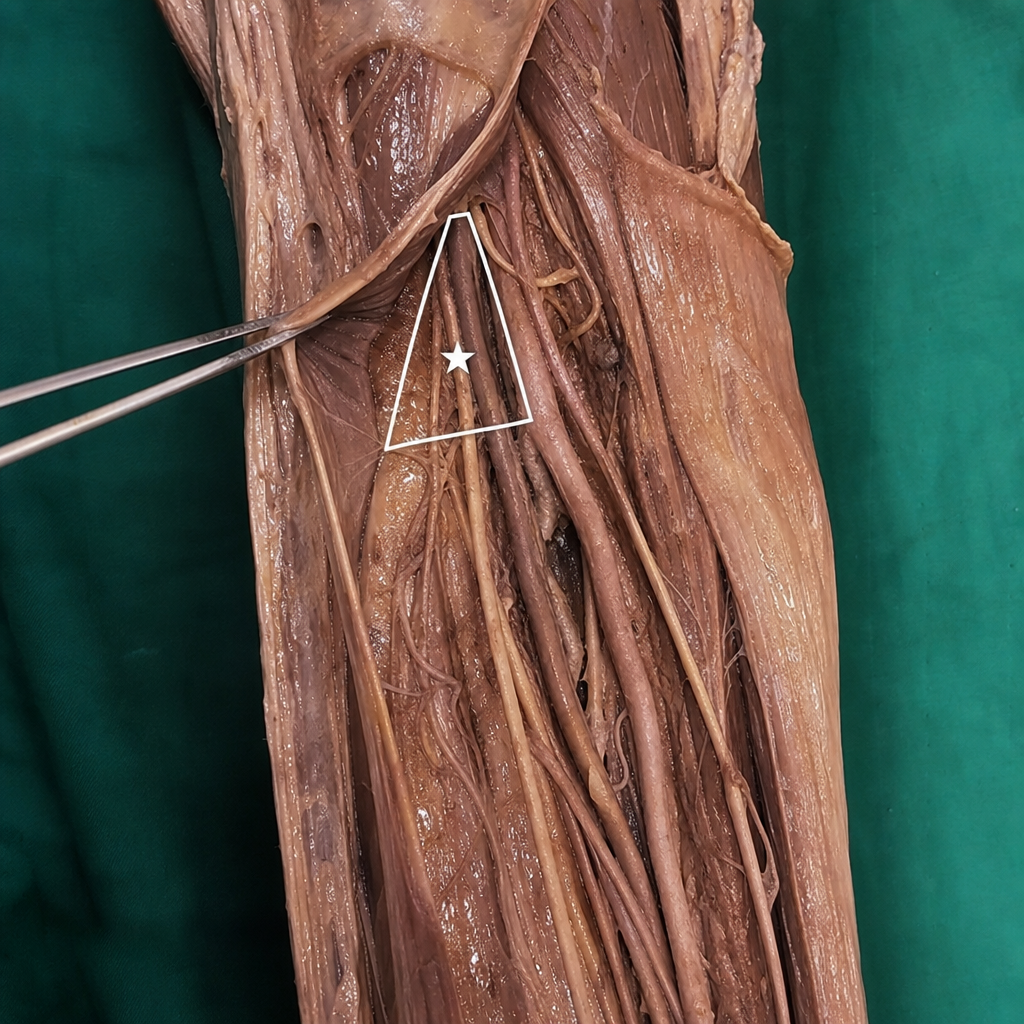
Which muscle initiates the abduction of the shoulder?
A physician asks a patient to hold her right upper arm close to her lateral chest wall, and bend the arm at the elbow so that the palm is facing upward. The physician then directs the patient to turn her hand so that the palm faces downward, without bending her wrist. This maneuver causes discomfort to the patient, which the physician notes as pain on?
Claw hand is caused by a lesion of which nerve?
Which of the following is NOT a branch arising directly from the root of the brachial plexus?
A 27-year-old male painter presents with inability to abduct his arm more than 15 degrees and difficulty with lateral rotation after a fall. Radiography shows an oblique fracture of the humerus. He also has sensory loss over the shoulder area. Which of the following injuries most likely corresponds to these findings?
Klumpke's paralysis presents with all of the following clinical features except?
Which of the following is an artery of the forearm?
A 29-year-old man presents with a stab wound, inability to raise his arm above the horizontal, and a "winged scapula." Which of the following structures of the brachial plexus would most likely be damaged?
Saturday night palsy involves which nerve?
Which spinal nerve roots supply the dermatome for the thumb and index finger region?
Explanation: Abduction of the shoulder is a complex, coordinated movement involving several muscles acting at different stages. The **Supraspinatus** is responsible for the **initiation of abduction** (the first 0–15 degrees). It acts as part of the rotator cuff, stabilizing the humeral head in the glenoid cavity, which provides a fulcrum for the deltoid to take over the movement from 15 to 90 degrees. **Analysis of Options:** * **Supraspinatus (Correct):** It is the primary initiator. Without it, the deltoid would pull the humeral head upward against the acromion rather than rotating it outward. * **Trapezius:** Along with the Serratus anterior, the Trapezius is responsible for the **overhead rotation** of the scapula (abduction beyond 90 degrees). It does not initiate the movement. * **Serratus Anterior:** Known as the "boxer's muscle," it protracts the scapula and assists in upward rotation for abduction above 90 degrees. * **Levator Scapulae:** This muscle elevates the scapula and assists in downward rotation; it is not involved in shoulder abduction. **High-Yield Clinical Pearls for NEET-PG:** * **The "Painful Arc" Syndrome:** Pain during abduction between 60° and 120° often indicates Supraspinatus tendinitis or subacromial bursitis. * **Innervation:** Supraspinatus is supplied by the **Suprascapular nerve (C5, C6)**. * **Drop Arm Test:** A clinical test used to diagnose a Supraspinatus tear; the patient is unable to lower the arm smoothly from an abducted position. * **Muscle Sequence:** 0–15° (Supraspinatus) → 15–90° (Deltoid) → >90° (Serratus anterior and Trapezius).
Explanation: ### Explanation **1. Analysis of the Correct Option (D): Pronation of the forearm** The maneuver described involves rotating the forearm so that the palm, which was initially facing upward (**supination**), now faces downward (**pronation**). This movement occurs at the proximal and distal radioulnar joints. In pronation, the radius crosses over the stationary ulna. If the patient experiences pain during this specific action, the physician identifies the movement as the source of discomfort. **2. Analysis of Incorrect Options:** * **A & B (Abduction and Adduction):** These movements do not occur at the elbow or radioulnar joints in the manner described. The elbow is a hinge joint primarily allowing flexion and extension. While "abduction/adduction" can refer to the shoulder or wrist (radial/ulnar deviation), they do not involve the rotational "palm up to palm down" movement. * **C (Flexion of the forearm):** Flexion is the act of "bending the arm at the elbow" to decrease the angle between the arm and forearm. The question states the patient *already* bent her elbow and then performed a *subsequent* rotation. The pain occurred during the rotation, not the initial bending. **3. Clinical Pearls & High-Yield Facts for NEET-PG:** * **Muscles of Pronation:** Pronator teres (proximal) and Pronator quadratus (distal). Both are supplied by the **Median Nerve**. * **Muscles of Supination:** Biceps brachii (powerful supinator when the elbow is flexed) and the Supinator muscle. * **Clinical Correlation:** Pain during pronation can indicate **Pronator Teres Syndrome** (compression of the median nerve) or pathology at the **radial head**, such as a fracture or subluxation (Nursemaid’s elbow). * **Axis of Movement:** Rotation occurs around an axis extending from the center of the radial head to the center of the distal ulna.
Explanation: **Explanation:** The **Ulnar nerve** is known as the "musician’s nerve." A lesion to this nerve results in a **claw hand (main en griffe)** deformity [1]. This occurs due to the paralysis of the **medial two lumbricals** and all **interossei** muscles. Normally, lumbricals flex the metacarpophalangeal (MCP) joints and extend the interphalangeal (IP) joints. In their absence, the antagonistic action of the long extensors and flexors leads to hyperextension at the MCP joints and flexion at the IP joints, most prominently in the ring and little fingers. **Analysis of Incorrect Options:** * **Median nerve:** Lesion typically causes "Ape thumb deformity" (loss of thenar opposition) or "Hand of Benediction" (when attempting to make a fist) [1]. A combined median and ulnar nerve palsy results in a "Total Claw Hand." * **Axillary nerve:** Damage leads to paralysis of the deltoid and teres minor, resulting in loss of shoulder abduction and a "flat shoulder" appearance. * **Radial nerve:** Injury leads to "Wrist drop" due to paralysis of the extensors of the wrist and fingers. **High-Yield Clinical Pearls for NEET-PG:** 1. **Ulnar Paradox:** A lesion at the **wrist** causes a more grotesque clawing than a lesion at the **elbow**. This is because, in high lesions, the medial half of the Flexor Digitorum Profundus (FDP) is also paralyzed, reducing the flexion of the IP joints. 2. **Froment’s Sign:** Used to test for ulnar nerve palsy; it assesses the paralysis of the Adductor Pollicis. 3. **Guyon’s Canal:** A common site for ulnar nerve compression at the wrist [1].
Explanation: ### Explanation The brachial plexus is organized into Roots, Trunks, Divisions, Cords, and Branches. Understanding the level at which specific nerves originate is a high-yield topic for NEET-PG. **Why "Nerve to Subclavius" is the correct answer:** The **Nerve to subclavius (C5, C6)** arises from the **Upper Trunk** of the brachial plexus, not the roots. Along with the Suprascapular nerve, it is one of the two branches that originate specifically from the trunk level. **Analysis of Incorrect Options:** * **A. Branches to longus colli and scaleni muscles:** These are small muscular branches that arise directly from the **Roots (C5–C8)** before they unite to form trunks. * **B. Long Thoracic Nerve (Nerve of Bell):** This nerve arises directly from the **Roots of C5, C6, and C7**. It descends behind the plexus to supply the Serratus anterior. * **C. Dorsal Scapular Nerve:** This nerve arises directly from the **Root of C5**. It pierces the scalenus medius to supply the Rhomboids and Levator scapulae. **High-Yield Clinical Pearls for NEET-PG:** 1. **Erb’s Point:** This is the site on the Upper Trunk where six nerves meet/originate. Injury here (Erb’s Palsy) involves the Nerve to subclavius and Suprascapular nerve. 2. **Winged Scapula:** Damage to the Long Thoracic Nerve (Root branch) leads to paralysis of the Serratus anterior, causing the medial border of the scapula to become prominent. 3. **Mnemonic for Root Branches:** "**L**ong **D**orsal" (Long Thoracic and Dorsal Scapular). 4. **Note:** No branches arise from the **Divisions** of the brachial plexus.
Explanation: **Explanation:** The clinical presentation points toward an injury to the **Axillary Nerve (C5, C6)**. The axillary nerve winds around the **surgical neck of the humerus** within the quadrangular space, accompanied by the posterior circumflex humeral artery. 1. **Why Option C is correct:** A fracture at the surgical neck commonly damages the axillary nerve, which innervates the **Deltoid** and **Teres Minor** muscles. * **Motor Loss:** The Deltoid is the primary abductor of the arm from 15° to 90°. Loss of function results in the inability to abduct beyond the initial 15° (initiated by the supraspinatus). Teres minor assists in lateral rotation; its paralysis weakens this movement. * **Sensory Loss:** The axillary nerve gives off the upper lateral cutaneous nerve of the arm, supplying the skin over the lower deltoid—the **"Regimental Badge area."** 2. **Why other options are incorrect:** * **Option A:** Medial epicondyle fractures typically involve the **Ulnar nerve**, leading to "claw hand" and sensory loss in the medial 1.5 fingers, not shoulder symptoms. * **Option B:** Glenoid fossa fractures are rare and usually associated with shoulder dislocations; they do not specifically target the axillary nerve in the same predictable manner as a humeral neck fracture. * **Option D:** The anatomical neck is the attachment site of the joint capsule. Fractures here are less common and more likely to cause avascular necrosis of the humeral head rather than isolated axillary nerve palsy. **High-Yield Clinical Pearls for NEET-PG:** * **Nerve-Bone Relationships:** Surgical neck = Axillary nerve; Spiral groove = Radial nerve; Medial epicondyle = Ulnar nerve. * **Abduction Sequence:** 0-15° (Supraspinatus), 15-90° (Deltoid), >90° (Serratus anterior & Trapezius). * **Regimental Badge Sign:** Pathognomonic for axillary nerve injury.
Explanation: **Explanation:** **Klumpke’s Paralysis** is a lower brachial plexus injury involving the **C8 and T1 nerve roots**. It typically occurs due to hyper-abduction of the arm (e.g., clutching an object while falling from a height or during a breech delivery). **Why "Wrist Drop" is the correct answer:** Wrist drop is caused by a lesion of the **Radial Nerve (C5-T1)**, specifically affecting the extensors of the wrist. While the radial nerve does contain C8/T1 fibers, the primary motor supply for wrist extension comes from C6-C7. Wrist drop is classically associated with mid-shaft humerus fractures or "Saturday Night Palsy," not lower plexus injuries. **Analysis of Incorrect Options:** * **Claw Hand:** This is the hallmark of Klumpke’s. T1 fibers supply all **intrinsic muscles of the hand**. Paralysis of the lumbricals leads to the characteristic deformity: hyperextension at the MCP joints and flexion at the IP joints. * **Sensory loss along the medial border:** The **Medial Cutaneous Nerve of the Forearm** is derived from the medial cord (C8-T1). Therefore, a lower plexus injury results in anesthesia along the ulnar/medial aspect of the forearm and hand. * **Horner’s Syndrome:** The T1 root carries **preganglionic sympathetic fibers** to the face and eye. Injury to T1 can disrupt these fibers, leading to miosis, ptosis, and anhidrosis. **High-Yield Clinical Pearls for NEET-PG:** * **Erb’s Palsy (C5-C6):** "Waiter’s Tip" deformity; involves loss of abduction, lateral rotation, and supination. * **Klumpke’s Palsy (C8-T1):** "Claw Hand" deformity; involves loss of intrinsic hand muscles + potential Horner’s Syndrome. * **Nerve Root vs. Deformity:** Remember, **C5-C6 = Shoulder/Elbow** issues; **C8-T1 = Hand/Sympathetic** issues.
Explanation: **Explanation:** The **ulnar artery** is one of the two terminal branches of the brachial artery (the other being the radial artery). It begins in the cubital fossa and descends through the medial aspect of the **forearm** to the hand. It is the larger of the two terminal branches and is responsible for supplying the medial muscles of the forearm and forming the superficial palmar arch. **Analysis of Incorrect Options:** * **Axillary artery:** This is the continuation of the subclavian artery, extending from the outer border of the first rib to the lower border of the teres major muscle. It is located in the **axilla (armpit)**. * **Brachial artery:** This is the continuation of the axillary artery. it runs from the lower border of the teres major to the cubital fossa. It is the primary artery of the **arm (brachium)**. * **Femoral artery:** This is the main arterial supply to the **lower limb**, originating as a continuation of the external iliac artery behind the inguinal ligament. **NEET-PG High-Yield Pearls:** * **Allen’s Test:** Used clinically to assess the patency of the ulnar artery before performing radial artery punctures. * **Common Origin:** Both the ulnar and radial arteries arise at the level of the **neck of the radius** in the cubital fossa. * **Ulnar Nerve Relationship:** In the distal two-thirds of the forearm, the ulnar artery runs lateral to the ulnar nerve. * **Interosseous Arteries:** The ulnar artery gives off the common interosseous artery, which further divides to supply the deep compartments of the forearm.
Explanation: ### Explanation **1. Why the Correct Answer is Right:** The clinical presentation of a **"winged scapula"** and the inability to abduct the arm above the horizontal (due to loss of scapular rotation) indicates paralysis of the **Serratus Anterior muscle**. This muscle is exclusively supplied by the **Long Thoracic Nerve (Nerve of Bell)**. Anatomically, the Long Thoracic Nerve arises directly from the **Roots (C5, C6, and C7)** of the brachial plexus before they form trunks. Therefore, a stab wound or injury resulting in winging of the scapula must involve the roots of the plexus or the nerve itself as it descends along the lateral thoracic wall. **2. Why the Incorrect Options are Wrong:** * **Medial Cord:** Gives rise to the ulnar nerve and the medial head of the median nerve. Injury here would cause sensory loss in the medial arm/forearm and weakness of intrinsic hand muscles, not scapular winging. * **Posterior Cord:** Gives rise to the axillary and radial nerves. Injury would lead to "wrist drop" or loss of initial abduction (deltoid), but the Long Thoracic Nerve has already branched off proximal to this level. * **Lower Trunk (C8-T1):** Injury (like Klumpke’s palsy) affects the small muscles of the hand and causes a "claw hand" deformity. It does not involve the C5-C7 roots required for the Long Thoracic Nerve. **3. Clinical Pearls for NEET-PG:** * **Long Thoracic Nerve (C5, C6, C7):** "C5, 6, 7 raise your wings to heaven." * **Testing:** Winging is most prominent when the patient is asked to **push against a wall** with outstretched hands. * **Surgical Risk:** This nerve is classically injured during **radical mastectomy** or axillary lymph node dissection. * **Overhead Abduction:** While the Deltoid (Axillary nerve) and Supraspinatus (Suprascapular nerve) initiate abduction, the Serratus Anterior and Trapezius are essential for rotating the scapula to achieve abduction **above 90 degrees**.
Explanation: No changes were made to the original explanation because the provided references did not meet the relevance criteria for the specific question regarding Saturday night palsy and the radial nerve.
Explanation: The dermatomes of the upper limb follow a sequential distribution based on the brachial plexus. The correct answer is **C6 and C7** because of the specific sensory mapping of the lateral and central aspects of the hand. * **C6:** Supplies the lateral aspect of the forearm and the **thumb** (radial side) [1]. * **C7:** Supplies the **index and middle fingers**, as well as the center of the palm and the back of the hand [1]. **Analysis of Options:** * **Option A (C5, C6):** C5 primarily supplies the lateral aspect of the arm (deltoid region) up to the elbow. While C6 covers the thumb, C5 does not reach the fingers. * **Option C (C7, C8):** While C7 covers the index finger, C8 supplies the **ring and little fingers** (medial/ulnar side of the hand) [1]. * **Option D (C8, T1):** C8 supplies the medial fingers, and T1 supplies the medial aspect of the forearm and arm. **High-Yield Clinical Pearls for NEET-PG:** 1. **The "Hand Rule":** Remember the sequence—C6 (Thumb), C7 (Index/Middle), C8 (Ring/Little). 2. **Reflex Correlation:** C6 is the root for the **Brachioradialis reflex**, while C7 is the root for the **Triceps reflex**. 3. **Clinical Correlation:** A herniated disc at the **C5-C6 level** typically compresses the C6 nerve root, leading to paresthesia in the thumb. A disc at **C6-C7** affects the C7 root, impacting the index and middle fingers. 4. **T1 Landmark:** The T1 dermatome is often tested as the skin of the medial arm/axilla.
Pectoral Region and Axilla
Practice Questions
Arm and Cubital Fossa
Practice Questions
Forearm and Hand
Practice Questions
Joints of Upper Limb
Practice Questions
Nerves of Upper Limb
Practice Questions
Arterial Supply and Venous Drainage
Practice Questions
Lymphatic Drainage
Practice Questions
Muscles and Their Actions
Practice Questions
Applied Anatomy and Clinical Correlations
Practice Questions
Surface Anatomy and Landmarks
Practice Questions
Get full access to all questions, explanations, and performance tracking.
Start For Free