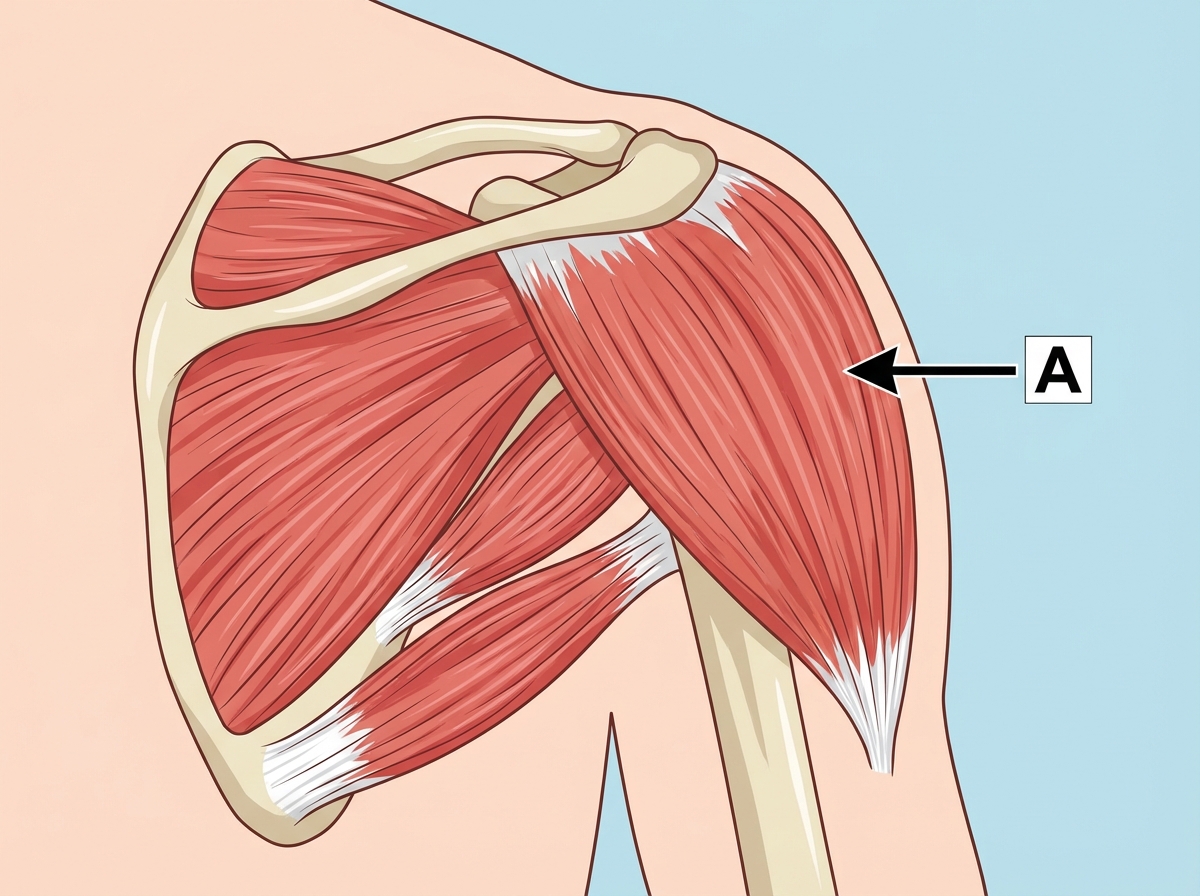
A penetrating wound to the axilla that severs the posterior cord of the brachial plexus would denervate which muscle?
The mammary gland is a type of which of the following?
The Pen Test is primarily used to assess the function of which nerve?
All of the following structures pass through the intermediate compartment of the extensor retinaculum except?
A boy fell down from a tree and has a fracture of the neck of the humerus. He cannot raise his arm due to the involvement of which nerve?
Which movements of the thumb are not affected in a radial nerve injury?
The circumflex scapular artery is a branch of which structure?
A 23-year-old male soldier accidentally punctured the ventral side of the fifth digit at the base of the distal phalanx while sharpening his knife. The wound became infected and spread into the palm, within the sheath of the flexor digitorum profundus tendons. If the infection were left untreated, into which of the following spaces could it most likely spread?
What is the persistent remnant of the axial artery of the upper limb?
Erb's palsy occurs due to involvement of which part of the brachial plexus?
Explanation: The **posterior cord** of the brachial plexus is formed by the union of the posterior divisions of all three trunks (C5-T1). It gives rise to five major branches, easily remembered by the mnemonic **ULTRA**: **U**pper subscapular, **L**ower subscapular, **T**horacodorsal, **R**adial, and **A**xillary nerves. 1. **Why Deltoid is Correct:** The **Axillary nerve** (C5, C6) is a terminal branch of the posterior cord. It supplies the **deltoid** and teres minor muscles. Therefore, severing the posterior cord results in the denervation of the deltoid, leading to loss of shoulder abduction (beyond 15 degrees) and atrophy of the shoulder contour. 2. **Why Other Options are Incorrect:** * **Serratus anterior:** Supplied by the **Long Thoracic nerve**, which arises directly from the **roots** (C5, C6, C7) of the brachial plexus, not the cords. * **Pronator teres:** Supplied by the **Median nerve**, which is formed by the contribution of the **lateral and medial cords**, not the posterior cord. * **Biceps brachii:** Supplied by the **Musculocutaneous nerve**, which is a branch of the **lateral cord** (C5-C7). **High-Yield Clinical Pearls for NEET-PG:** * **Radial Nerve:** The largest branch of the posterior cord; injury leads to **wrist drop**. * **Quadrangular Space:** The axillary nerve passes through this space along with the posterior circumflex humeral artery. * **Thoracodorsal Nerve:** Also from the posterior cord; supplies the **Latissimus dorsi** ("Climber's muscle") [1]. * **Posterior Cord Injury:** Typically results in "Crutch Palsy" or "Saturday Night Palsy," primarily affecting the extensors of the arm and forearm.
Explanation: ### Explanation **Correct Option: A. Modified sweat gland** The mammary gland is histologically classified as a **modified apocrine sweat gland**. During development, it arises from the **ectoderm** as a downgrowth of the epidermis into the underlying mesenchyme along the "milk line" (mammary ridge) [1]. It is specifically an **apocrine** gland because the apical portion of the secretory cells is pinched off along with the secretory product (milk fats), while the milk proteins are secreted via an eccrine (merocrine) mechanism [1]. **Analysis of Incorrect Options:** * **B. Ceruminous gland:** These are modified sweat glands located in the external auditory canal that produce earwax (cerumen). While they share the "modified sweat gland" classification, they are anatomically and functionally distinct from mammary tissue. * **C. Sebaceous gland:** These are holocrine glands usually associated with hair follicles that secrete sebum. While sebaceous glands are present on the areola (Montgomery’s tubercles) to provide lubrication, the mammary gland itself is not a sebaceous derivative. * **D. Both sweat and sebaceous gland:** This is incorrect as the primary structural and embryological origin of the breast tissue is strictly that of a modified sweat gland. **High-Yield Clinical Pearls for NEET-PG:** * **Location:** The mammary gland lies in the **superficial fascia** of the pectoral region (except for the axillary tail of Spence, which pierces the deep fascia) [2]. * **Lymphatic Drainage:** Approximately **75%** of lymph drains into the **axillary nodes** (primarily the Pectoral/Anterior group). * **Suspensory Ligaments of Cooper:** These fibrous bands connect the dermis to the deep fascia; their contraction by a tumor causes **skin dimpling** [2]. * **Development:** It develops from the **milk line**, which extends from the axilla to the groin. Failure of regression can lead to polythelia (extra nipples) or polymastia (extra breasts) [1].
Explanation: The **Pen Test** is a clinical assessment used to evaluate the motor function of the **Median Nerve**, specifically the integrity of the **Abductor Pollicis Brevis (APB)** muscle. [1] ### 1. Why the Median Nerve is Correct The Median nerve supplies the muscles of the **thenar eminence** (LOAF: Lumbricals 1 & 2, Opponens pollicis, Abductor pollicis brevis, Flexor pollicis brevis). The APB is responsible for **palmar abduction**—moving the thumb perpendicular to the plane of the palm. [1] * **The Test:** The patient’s hand is placed flat on a table (supine). They are asked to touch a pen held horizontally above the thumb. If the Median nerve is injured (as in Carpal Tunnel Syndrome or Ape Thumb Deformity), the patient cannot abduct the thumb to touch the pen. ### 2. Why Other Options are Incorrect * **Ulnar Nerve:** Assessed via **Froment’s Sign** (testing Adductor Pollicis) or the **Card Test** (testing Palmar Interossei for adduction). [1] Ulnar nerve injury leads to "Claw Hand." * **Radial Nerve:** Assessed by checking for **Wrist Drop** or the ability to extend the wrist and metacarpophalangeal joints. [1] * **Posterior Interosseous Nerve (PIN):** A motor branch of the Radial nerve. Injury results in "Finger Drop" (loss of extension at MCP joints) without wrist drop, as the Extensor Carpi Radialis Longus is spared. ### 3. Clinical Pearls for NEET-PG * **Ape Thumb Deformity:** Caused by Median nerve palsy; characterized by the thumb falling into the same plane as the fingers due to loss of thenar muscle action. * **Ochsner’s Clasping Test:** Another test for Median nerve (specifically FDP of index/middle fingers); the index finger remains straight when clasping hands. * **Point of Injury:** High Median nerve lesions (at the elbow) affect the long flexors, while low lesions (at the wrist) primarily affect the thenar muscles. [1]
Explanation: The extensor retinaculum of the wrist is divided into **six fibro-osseous compartments** by septa passing from the retinaculum to the radius and ulna [1]. ### **Explanation of the Correct Answer** The **4th compartment** (often referred to as the intermediate compartment) contains the Extensor Digitorum (ED), Extensor Indicis (EI), the Posterior Interosseous Nerve (PIN), and the **Anterior Interosseous Artery (AIA)** [1]. The **Anterior Interosseous Vein (AIV)** is the correct answer (the "except") because, while the AIA pierces the interosseous membrane to enter the posterior compartment, the AIV typically drains into the deep venous system of the forearm before reaching the extensor retinaculum. In some anatomical contexts, the **Posterior Interosseous Artery** is also associated with this space, but the AIV is not a standard constituent of the 4th compartment. ### **Analysis of Incorrect Options** * **A & B (Extensor Digitorum & Extensor Indicis):** These are the primary tendons passing through the 4th compartment [1]. They share a common synovial sheath. * **C (Posterior Interosseous Nerve):** This nerve (a branch of the radial nerve) passes deep to the tendons in the 4th compartment to provide sensory innervation to the wrist joint capsule. ### **High-Yield Facts for NEET-PG** To master the extensor retinaculum, remember the contents of all six compartments (Lateral to Medial): 1. **1st:** Abductor Pollicis Longus (APL), Extensor Pollicis Brevis (EPB) — *Site of De Quervain’s Tenosynovitis* [1]. 2. **2nd:** Extensor Carpi Radialis Longus (ECRL), Extensor Carpi Radialis Brevis (ECRB) [1]. 3. **3rd:** Extensor Pollicis Longus (EPL) — *Hooks around Lister’s Tubercle* [1]. 4. **4th:** ED, EI, PIN, and AIA [1]. 5. **5th:** Extensor Digiti Minimi (EDM) [1]. 6. **6th:** Extensor Carpi Ulnaris (ECU) [1]. **Mnemonic:** **2-2-1-2-1-1** (Number of tendons in each compartment).
Explanation: **Explanation:** The correct answer is **Axillary nerve**. **1. Why Axillary Nerve is Correct:** The axillary nerve (C5, C6) winds around the **surgical neck of the humerus** within the quadrangular space. Fractures at this specific site are the most common cause of axillary nerve injury. This nerve supplies the **deltoid muscle**, which is the primary abductor of the arm from 15° to 90°. Consequently, damage to this nerve leads to paralysis of the deltoid, making the patient unable to raise (abduct) their arm. **2. Why Other Options are Incorrect:** * **Supraspinatus (Suprascapular) nerve:** While the supraspinatus initiates abduction (0-15°), it is not typically injured in humeral neck fractures as it arises from the brachial plexus trunk and travels through the suprascapular notch. * **Musculocutaneous nerve:** This nerve supplies the anterior compartment of the arm (Biceps, Coracobrachialis, Brachialis). Injury would affect elbow flexion, not primarily shoulder abduction. * **Radial nerve:** This nerve is most commonly injured in fractures of the **mid-shaft (spiral groove)** of the humerus, leading to "wrist drop," rather than neck fractures. **3. NEET-PG High-Yield Clinical Pearls:** * **Sensory Loss:** Axillary nerve injury also results in loss of sensation over the lower half of the deltoid, known as the **"Regimental Badge Area."** * **Deformity:** Chronic axillary nerve palsy leads to atrophy of the deltoid, resulting in the **"loss of rounded contour of the shoulder." * **Humeral Fracture Sites & Nerves:** * Surgical Neck → Axillary Nerve * Spiral Groove → Radial Nerve * Supracondylar → Median Nerve * Medial Epicondyle → Ulnar Nerve
Explanation: **Explanation:** The **Radial Nerve** is primarily responsible for the motor innervation of the posterior compartment of the arm and forearm [1]. In the hand, it supplies no intrinsic muscles; its contribution to thumb movement is limited to the **Extensor Pollicis Longus (EPL)**, **Extensor Pollicis Brevis (EPB)**, and **Abductor Pollicis Longus (APL)** via its deep branch (Posterior Interosseous Nerve) [1]. **1. Why Opposition is the correct answer:** Opposition is a complex movement involving flexion, abduction, and medial rotation of the thumb. It is primarily mediated by the **Opponens Pollicis** muscle, which is located in the thenar eminence. This muscle is innervated by the **Recurrent branch of the Median Nerve** [1]. Since the Median nerve remains intact in a pure radial nerve injury, opposition is preserved. **2. Why the other options are incorrect:** * **Extension (Option C):** Thumb extension at the CMC, MCP, and IP joints is performed by the EPL and EPB [1]. These are supplied by the Posterior Interosseous Nerve (PIN), a branch of the radial nerve. Thus, extension is lost. * **Abduction (Option B):** While the Abductor Pollicis Brevis (Median nerve) helps, the **Abductor Pollicis Longus (APL)** is a major abductor of the thumb and is supplied by the radial nerve (PIN) [1]. Therefore, abduction is significantly weakened/affected. **High-Yield Clinical Pearls for NEET-PG:** * **Wrist Drop:** The hallmark of high radial nerve injury (e.g., Saturday Night Palsy or Mid-shaft humerus fracture). * **Rule of Thumb:** The **Median Nerve** is the "Nerve of Precision" (controls thenar muscles for opposition), while the **Ulnar Nerve** is the "Nerve of Power" (adduction via Adductor Pollicis) [1]. * **Sensory Loss:** In radial nerve injury, sensory loss is typically minimal, localized to the small area of the **dorsal first web space**.
Explanation: **Explanation:** The **circumflex scapular artery** is the larger of the two terminal branches of the **subscapular artery**. The subscapular artery itself is the largest branch of the **third part of the axillary artery**. The circumflex scapular artery curves around the lateral border of the scapula, passing through the **upper triangular space** (bounded by Teres minor, Teres major, and the long head of triceps). It plays a vital role in the **scapular anastomosis**, which ensures collateral circulation to the upper limb if the axillary artery is obstructed. **Analysis of Options:** * **Option A (Thyrocervical trunk):** This is a branch of the first part of the subclavian artery. It gives off the suprascapular and transverse cervical arteries, which contribute to the scapular anastomosis but do not give rise to the circumflex scapular artery. * **Option C (Subclavian artery):** While the subclavian artery eventually becomes the axillary artery, it does not directly give off the circumflex scapular artery. * **Option D (Aorta):** The aorta gives rise to the brachiocephalic trunk (on the right) and the subclavian artery (on the left), making it too proximal to be the direct source. **High-Yield Clinical Pearls for NEET-PG:** * **Scapular Anastomosis:** Involves the Suprascapular artery (from Thyrocervical trunk), Deep branch of Transverse cervical artery (from Thyrocervical trunk), and Circumflex scapular artery (from Subscapular artery). * **Upper Triangular Space:** Contains the circumflex scapular artery. * **Quadrangular Space:** Contains the axillary nerve and posterior circumflex humeral artery. * **Lower Triangular Space:** Contains the radial nerve and profunda brachii artery.
Explanation: ### Explanation The correct answer is **C. Mid-palmar space**. **1. Why the Correct Answer is Right:** The infection originates in the **synovial sheath** of the flexor tendons of the fifth digit. Anatomically, the synovial sheath of the little finger is continuous with the **Ulnar Bursa**, which wraps around the tendons of the Flexor Digitorum Superficialis (FDS) and Flexor Digitorum Profundus (FDP) as they pass through the carpal tunnel. [1] The palm contains two deep potential spaces: the **Thenar space** and the **Mid-palmar space**, separated by a fibrous septum attached to the third metacarpal [1]. The Mid-palmar space lies deep to the flexor tendons of the 3rd, 4th, and 5th digits. Because the ulnar bursa (which houses the 5th digit's tendons) is located directly anterior to/within the medial part of the palm, a ruptured infection from this sheath most naturally tracks into the **Mid-palmar space** [1]. **2. Why the Other Options are Wrong:** * **A. Central compartment:** This contains the flexor tendons and lumbricals but is a superficial anatomical division rather than the deep potential space where abscesses typically sequester and spread. * **B. Hypothenar compartment:** This contains the muscles of the little finger (abductor, flexor, and opponens digiti minimi). It is enclosed by the hypothenar fascia and does not communicate directly with the flexor synovial sheaths. * **D. Thenar compartment:** This space is located laterally and is associated with the synovial sheath of the **thumb (Radial Bursa)** and the index finger [1]. **3. Clinical Pearls for NEET-PG:** * **Continuity:** The synovial sheaths of the **thumb** (Radial Bursa) and **little finger** (Ulnar Bursa) usually communicate with the wrist, whereas the sheaths for the 2nd, 3rd, and 4th digits are typically "blind" and end in the palm [1]. * **Kanavel’s Signs:** Used to diagnose infectious tenosynovitis (Flexed position, Fusiform swelling, Tenderness along the sheath, Pain on passive extension). * **Space Boundaries:** The Mid-palmar space is bounded laterally by the **medial septum** (attached to the 3rd metacarpal) [1]. Therefore, infections of the 3rd, 4th, and 5th digits involve the Mid-palmar space, while the 2nd digit involves the Thenar space.
Explanation: ### Explanation The development of the arterial system in the upper limb follows a specific embryological sequence. The **axial artery** is the primary primitive vessel that arises from the seventh cervical intersegmental artery and runs down the center of the developing limb bud. **Why the Anterior Interosseous Artery is Correct:** As the limb develops, the original axial artery undergoes significant remodeling. In the forearm, the axial artery persists as the **anterior interosseous artery** and the **median artery** (though the latter usually regresses). Therefore, the anterior interosseous artery is considered the direct continuation and persistent remnant of the primitive axial trunk in the distal forearm. **Analysis of Incorrect Options:** * **Radial and Ulnar Arteries (A & B):** These are not remnants of the axial artery. They appear later in development as new sprouts from the brachial artery (radial) and the axial trunk (ulnar) that eventually surpass the original axial vessel in size and functional importance. * **Posterior Interosseous Artery (D):** This vessel arises as a branch from the axial artery but is not considered its primary persistent remnant. **High-Yield NEET-PG Pearls:** * **Axial Artery Derivatives:** In the adult, the axial artery is represented by the **Axillary**, **Brachial**, **Anterior Interosseous**, and **Deep Palmar Arch**. * **The Median Artery:** Occasionally, the median artery (a branch of the axial artery) persists into adulthood, accompanying the median nerve. If it persists, it may contribute to the superficial palmar arch. * **Sequence of Development:** The axial artery appears first, followed by the ulnar artery, and finally the radial artery.
Explanation: **Explanation:** **Erb’s Palsy** (Waiters’s tip deformity) is a clinical condition resulting from an injury to the **Upper Trunk** of the brachial plexus, specifically at the junction of C5 and C6 nerve roots, known as **Erb’s Point** [2]. 1. **Why the Upper Trunk is Correct:** Erb’s point is the site where six nerves meet (C5, C6 roots, suprascapular nerve, nerve to subclavius, and the anterior/posterior divisions of the upper trunk). Injury here—often due to birth trauma such as shoulder dystocia or a fall on the shoulder—paralyzes muscles supplied by C5 and C6, including the deltoid, biceps brachii, brachialis, and supraspinatus [1][2]. This results in the characteristic "policeman’s tip" position: arm adducted, medially rotated, and forearm extended and pronated. 2. **Why other options are incorrect:** * **Middle Trunk (C7):** Isolated middle trunk injuries are rare. Involvement would primarily affect the radial nerve distribution (extensors), not the classic Erb's presentation. * **Medial Cord:** Injury here typically involves C8-T1 fibers, leading to **Klumpke’s Paralysis**, characterized by a "claw hand" due to the loss of intrinsic hand muscles. * **Lateral Trunk:** This is a distractor; the brachial plexus consists of roots, trunks, divisions, cords, and branches. There is no "lateral trunk," only a lateral cord. **High-Yield Clinical Pearls for NEET-PG:** * **Nerves involved:** Suprascapular, Axillary, and Musculocutaneous nerves. * **Deformity components:** Adduction (loss of deltoid/supraspinatus), Medial rotation (loss of infraspinatus/teres minor), and Extension/Pronation (loss of biceps/brachialis). * **Reflexes:** The Biceps and Supinator reflexes are lost. * **Sensory loss:** Small area over the lower part of the deltoid (regimental badge area).
Pectoral Region and Axilla
Practice Questions
Arm and Cubital Fossa
Practice Questions
Forearm and Hand
Practice Questions
Joints of Upper Limb
Practice Questions
Nerves of Upper Limb
Practice Questions
Arterial Supply and Venous Drainage
Practice Questions
Lymphatic Drainage
Practice Questions
Muscles and Their Actions
Practice Questions
Applied Anatomy and Clinical Correlations
Practice Questions
Surface Anatomy and Landmarks
Practice Questions
Get full access to all questions, explanations, and performance tracking.
Start For Free