The P2 heart sound is best appreciated in which location?
A patient who has had a skiing accident is brought to the emergency room. The region around his knee is swollen. The skin of his foot is pale and no dorsalis pedis pulse can be detected. An X-ray reveals a fracture of the femur immediately proximal to the femoral condyles. Which of the following arteries has been compressed by the displacement of this fracture?
The skin at the level of the umbilicus is supplied by which spinal nerve?
The highest point of the iliac crest is at which vertebral level?
A thin radiolucent line which follows the root outline on X-rays is?
The mental foramen, which appears as a radiolucency and can be mistaken for periapical pathology, lies close to the apex of which tooth?
Where is the 'S1' or 'lub' heart sound, associated with the closure of the mitral and tricuspid valves, best auscultated?
Which anatomical landmark represents the surface projection of the internal jugular vein?
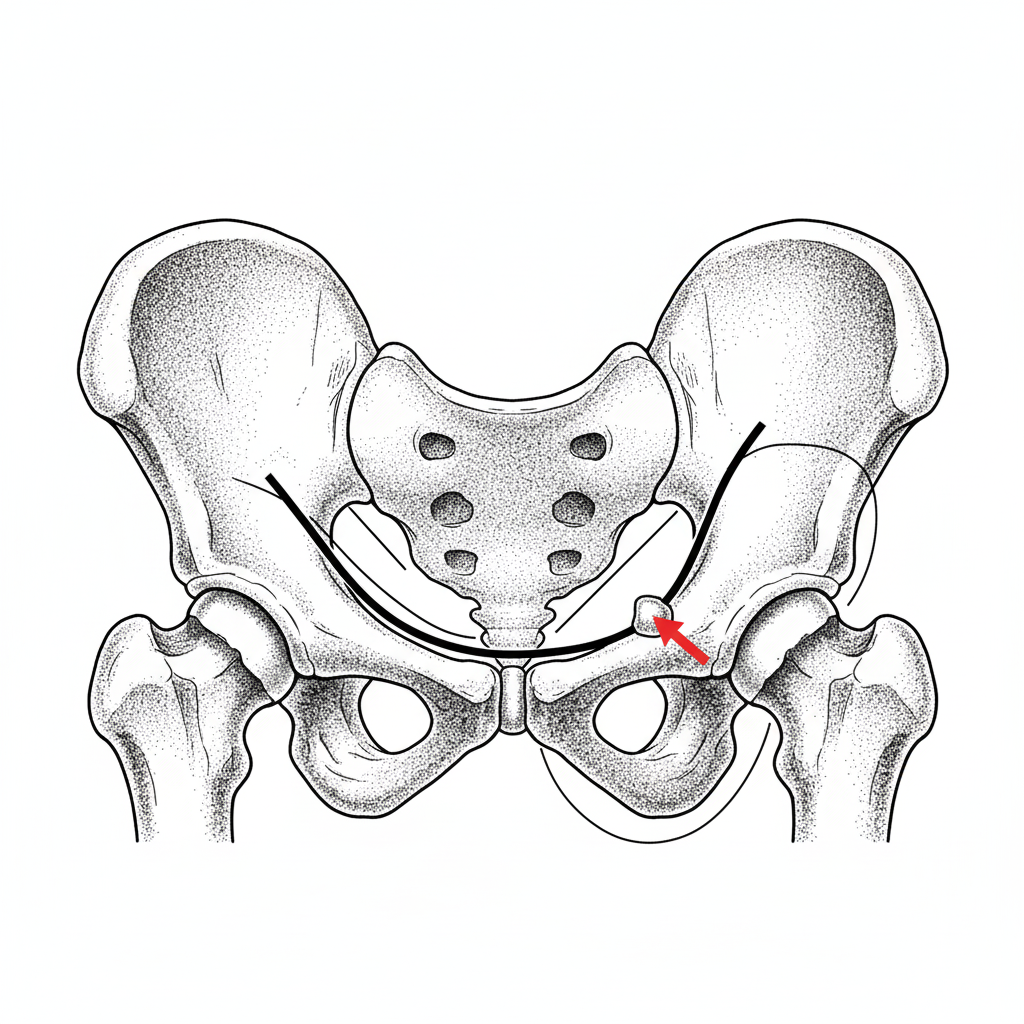
What anatomical landmark is described by Shenton's line?
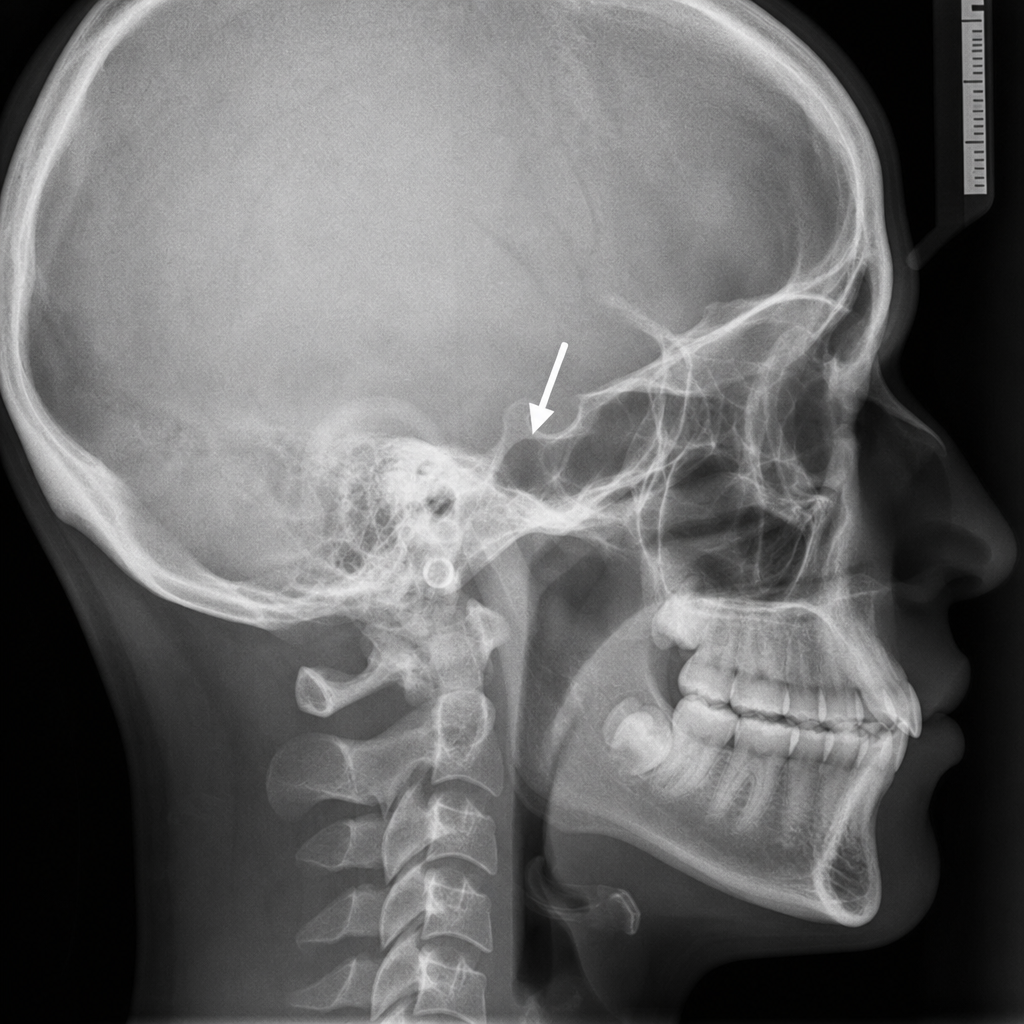
What is the approximate distance of the macula from the temporal margin of the optic disc?
Explanation: ### Explanation The second heart sound (S2) is produced by the closure of the semilunar valves (Aortic and Pulmonary) at the beginning of ventricular diastole [1]. It consists of two components: **A2** (Aortic) and **P2** (Pulmonary). **Why Option A is Correct:** The **Pulmonary area** is located in the **2nd left intercostal space (ICS)**, immediately lateral to the sternal border. Although the pulmonary valve is anatomically situated behind the junction of the 3rd left costal cartilage with the sternum, the sound is carried by the blood flow upwards and to the left. Therefore, the P2 component is best auscultated at the 2nd left ICS. **Analysis of Incorrect Options:** * **Option B (2nd right ICS):** This is the **Aortic area**. While S2 is heard here, it is primarily the A2 component. * **Option C (4th ICS):** The 4th and 5th left ICS at the lower left sternal border correspond to the **Tricuspid area**. * **Option D (3rd ICS):** The 3rd left ICS is known as **Erb’s point**. While S2 is well-heard here, it is a collective site for murmurs (like aortic regurgitation) rather than the specific primary site for P2. **High-Yield Clinical Pearls for NEET-PG:** * **Physiological Splitting:** During inspiration, intrathoracic pressure drops, increasing venous return to the right heart. This delays pulmonary valve closure, causing P2 to occur slightly after A2 [1]. * **Reverse (Paradoxical) Splitting:** Seen in conditions like Left Bundle Branch Block (LBBB) or Aortic Stenosis, where A2 is delayed and occurs after P2. * **Fixed Splitting:** A classic diagnostic sign of an **Atrial Septal Defect (ASD)**. * **Loud P2:** A hallmark sign of **Pulmonary Hypertension**.
Explanation: ### Explanation **1. Why the Correct Answer is Right:** The scenario describes a **supracondylar fracture of the femur**. In this injury, the distal fragment of the femur is typically displaced **posteriorly** due to the powerful pull of the two heads of the gastrocnemius muscle. The **popliteal artery** lies in the popliteal fossa, directly posterior to the popliteal surface of the femur and the knee joint capsule [1]. Because the artery is tethered to the femur by the adductor hiatus above and the soleus arch below, it has limited mobility. Consequently, the sharp edge of the posteriorly displaced distal femoral fragment can easily compress or lacerate the popliteal artery, leading to distal ischemia (pale foot and absent dorsalis pedis pulse) [1]. **2. Why the Incorrect Options are Wrong:** * **Anterior Tibial Artery (A):** This is a terminal branch of the popliteal artery that begins at the lower border of the popliteus muscle. It is located too distal to be directly compressed by a supracondylar femoral fracture. * **Femoral Artery (B):** The femoral artery becomes the popliteal artery as it passes through the adductor hiatus [1]. While it is proximal to the injury, the specific site of a supracondylar fracture involves the vessel once it has already entered the popliteal fossa. * **Posterior Tibial Artery (D):** Similar to the anterior tibial artery, this is a distal branch beginning at the leg level. While its pulse (dorsalis pedis) is lost, the site of *compression* is the parent vessel (popliteal) at the knee [2]. **3. Clinical Pearls for NEET-PG:** * **Supracondylar Fracture:** Distal fragment tilts **posteriorly** (Gastrocnemius pull) → Popliteal artery injury [1]. * **Posterior Dislocation of Knee:** This is another high-yield emergency frequently associated with popliteal artery damage [3]. * **Five P’s of Ischemia:** Pain, Pallor, Pulselessness, Paresthesia, and Paralysis [2]. * **Anatomy Note:** The popliteal artery is the **deepest** structure in the popliteal fossa, making it the most vulnerable to bony injuries of the femur and tibia.
Explanation: ### Explanation **Correct Answer: B. T 10** The skin of the anterior abdominal wall is supplied by the ventral rami of the lower six thoracic nerves (T7–T12) and the first lumbar nerve (L1) [1]. These nerves follow a segmental distribution known as **dermatomes**. The **T10 spinal nerve** specifically supplies the dermatome that encompasses the level of the **umbilicus**. This is a classic anatomical landmark used frequently in clinical examinations to localize spinal cord levels. **Analysis of Incorrect Options:** * **A. T9:** This nerve supplies the dermatome located just above the umbilicus, roughly halfway between the xiphoid process and the umbilicus. * **C. T11:** This nerve supplies the skin area immediately below the umbilicus. * **D. T12:** This nerve (subcostal nerve) supplies the skin of the lower abdomen, just above the suprapubic region. **Clinical Pearls & High-Yield Facts for NEET-PG:** 1. **Xiphoid Process:** Supplied by the **T7** dermatome. 2. **Inguinal Ligament/Groin:** Supplied by the **L1** dermatome (Iliohypogastric and Ilioinguinal nerves) [1]. 3. **Referred Pain:** Pain from **acute appendicitis** initially presents in the periumbilical region because the appendix and the T10 dermatome share the same spinal cord segment for visceral and somatic afferents. 4. **Beevor’s Sign:** A clinical sign where the umbilicus moves upwards when a patient attempts to crunch/sit up; it indicates paralysis of the lower abdominal muscles (T10–T12), often seen in spinal cord injuries at the T10 level.
Explanation: **Explanation:** The **iliac crest** is a vital surface landmark in clinical anatomy. Its highest point (the supracristal plane) corresponds to the level of the **L4 spinous process** or the **L3-L4 intervertebral disc space**. **1. Why A is Correct:** In clinical practice and radiology, a horizontal line connecting the highest points of both iliac crests is known as **Tuffier’s Line** (or the Jacoby line). This line typically intersects the vertebral column at the level of the **L4 spinous process** or the **L3-L4 interspace**. This is the standard landmark used to identify the safe site for performing a lumbar puncture (spinal tap), as the spinal cord ends at L1-L2 in adults. **2. Why the other options are incorrect:** * **B (L4-5):** While the iliac crest is near this level, the *highest* point is anatomically documented at the L3-L4 junction. L4-L5 is the level often chosen for needle insertion to avoid the conus medullaris, but it is not the peak of the crest. * **C & D (L5-S1 and S1-2):** These levels are too low. The anterior superior iliac spine (ASIS) and the sacral promontory are associated with these lower levels, but not the superior-most curve of the crest. **Clinical Pearls for NEET-PG:** * **Lumbar Puncture:** Performed at L3-L4 or L4-L5 to ensure the needle enters the subarachnoid space below the termination of the spinal cord (L1 in adults, L3 in infants). * **Umbilicus:** Usually corresponds to the L3-L4 disc level (though variable with obesity). * **Bifurcation of Aorta:** Occurs at the level of **L4**, just slightly below the highest point of the iliac crest. * **IVC Formation:** Occurs at the level of **L5** by the union of common iliac veins.
Explanation: The correct answer is **Periodontal ligament (PDL)**. In dental radiography, the appearance of structures is determined by their mineral density. 1. **Why Periodontal Ligament is correct:** The PDL is a fibrous connective tissue structure that occupies the space between the tooth root and the alveolar bone. Because it is soft tissue (non-mineralized), it does not attenuate X-rays significantly, appearing as a **thin radiolucent (dark) line** that precisely follows the contour of the root. 2. **Why other options are incorrect:** * **Lamina dura:** This is the thin layer of dense cortical bone lining the alveolar socket. On an X-ray, it appears as a continuous **radiopaque (white) line** immediately lateral to the PDL space. * **Nutrient canal:** These are small canals carrying neurovascular bundles. While radiolucent, they typically appear as vertical lines in the anterior mandible or maxilla, not following the root outline. * **Pulp:** The pulp is soft tissue located **inside** the tooth (within the pulp chamber and root canals), not surrounding the root outline. **High-Yield Clinical Pearls for NEET-PG:** * **Space Width:** The normal PDL space is very narrow (approx. 0.15–0.25 mm). * **Pathology:** A **widening** of the radiolucent PDL space is a key early radiographic sign of periapical pathology (like an abscess) or occlusal trauma. * **Loss of Lamina Dura:** The disappearance of the adjacent radiopaque line (lamina dura) is a significant diagnostic feature in systemic conditions like **Hyperparathyroidism** and local conditions like periapical infection.
Explanation: ### Explanation **1. Why the Correct Answer is Right:** The **mental foramen** is an opening on the facial surface of the mandible through which the mental nerve and vessels emerge. Anatomically, its most common position is directly below the **apex of the mandibular second premolar** or between the apices of the first and second premolars. On an intraoral periapical (IOPA) radiograph, it appears as a well-defined oval or round radiolucency. Because of its proximity to the root tip, it can be misdiagnosed as a periapical granuloma or cyst (periapical pathology) if the clinician does not check for the continuity of the lamina dura and the vitality of the tooth. **2. Analysis of Incorrect Options:** * **A. Mandibular 1st molar:** The mental foramen is located anterior to the molar region. The radiolucency seen near the 1st molar is usually the submandibular fossa or the beginning of the mandibular canal. * **B. Maxillary 1st molar:** This is anatomically impossible as the mental foramen is a landmark of the **mandible**. The maxillary 1st molar is associated with the maxillary sinus. * **C. Mandibular canine:** The foramen is located posterior to the canine. The area near the canine apex may show the "mental fossa," but not the foramen itself. **3. Clinical Pearls & High-Yield Facts for NEET-PG:** * **Nerve Supply:** The mental nerve is a branch of the **inferior alveolar nerve** (a branch of the mandibular division of the Trigeminal nerve). * **Age-related changes:** In infants, the foramen is near the lower border; in adults, it is midway; in edentulous elderly patients with bone resorption, it may lie close to the **alveolar crest**. * **Differential Diagnosis:** To distinguish the foramen from pathology, take a second radiograph at a different angle (Shift Shot/Slob Rule); the foramen will move relative to the apex, whereas a true lesion stays attached. * **Anesthesia:** The **Mental Nerve Block** is performed by depositing local anesthetic near this foramen to numb the lower lip and chin.
Explanation: The first heart sound (**S1**), or "lub," is produced by the vibrations associated with the closure of the **Atrioventricular (AV) valves** (Mitral and Tricuspid) at the onset of ventricular systole [1]. While S1 is heard over the entire precordium, it is best auscultated at the **Apex of the heart**. The apex is formed entirely by the left ventricle and is located at the **fifth left intercostal space in the midclavicular line**. This site corresponds to the **Mitral Area**, where the sound of the mitral valve closure is loudest due to the proximity of the left ventricle to the chest wall. **Analysis of Incorrect Options:** * **Option A (Jugular notch):** This is located at the superior border of the manubrium sterni. It is not a standard auscultatory site for heart sounds but is relevant for palpating tracheal position or aortic arch aneurysms. * **Option B (Second left intercostal space):** This is the **Pulmonary Area**. It is the primary site for hearing the pulmonary component of the second heart sound (S2). * **Option C (Second right intercostal space):** This is the **Aortic Area**. It is the primary site for hearing the aortic component of the second heart sound (S2). **NEET-PG High-Yield Pearls:** * **S1** marks the beginning of systole and is synchronous with the carotid pulse [1]. * **Tricuspid Area:** Best heard at the left lower sternal border (4th/5th intercostal space). * **Erb’s Point (3rd left ICS):** Often considered the best place to hear S2 murmurs like Aortic Regurgitation. * **Surface Anatomy:** The apex beat in children (under 4 years) is usually in the 4th intercostal space, lateral to the midclavicular line.
Explanation: **Explanation:** The **Internal Jugular Vein (IJV)** is the largest vein in the neck, collecting blood from the brain, face, and neck. Understanding its surface projection is crucial for procedures like central venous catheterization. **1. Why Option A is Correct:** The surface marking of the IJV is represented by a broad line connecting two points: * **Superior point:** The lobule of the ear. * **Inferior point:** The medial end of the clavicle (specifically, the depression between the sternal and clavicular heads of the sternocleidomastoid muscle). This line corresponds to the vein’s course as it descends within the carotid sheath, deep to the sternocleidomastoid muscle, to join the subclavian vein and form the brachiocephalic vein. **2. Analysis of Incorrect Options:** * **Options B & C:** The **middle and lateral thirds of the clavicle** are incorrect because the IJV descends vertically toward the root of the neck. The *External Jugular Vein (EJV)*, however, crosses the sternocleidomastoid obliquely and is better represented by a line toward the middle of the clavicle. * **Option D:** While the **mastoid process** is near the ear lobule, the standard anatomical landmark for the superior extent of the IJV projection is the lobule of the ear, which aligns more accurately with the jugular foramen at the skull base. **3. Clinical Pearls for NEET-PG:** * **Central Venous Pressure (CVP):** The IJV is preferred over the EJV for measuring CVP because it is in a direct line with the superior vena cava and lacks valves. * **Cannulation:** The IJV is typically accessed at the apex of the triangle formed by the two heads of the sternocleidomastoid muscle and the clavicle. * **Relation to Carotid:** In the carotid sheath, the IJV lies **lateral** to the common carotid artery and the vagus nerve (which lies posteriorly between them).
Explanation: **Explanation:** **Shenton’s Line** is a fundamental radiological landmark used in the evaluation of the hip joint on an Anteroposterior (AP) X-ray. It is an imaginary curved line formed by the continuous arc of the **medial margin of the femoral neck** and the **inferior (lower) border of the superior pubic ramus**. 1. **Why Option A is correct:** In a normal, healthy hip, this arc should be smooth and unbroken. A disruption or "step-off" in Shenton’s line indicates a loss of anatomical alignment between the femur and the pelvis. 2. **Why other options are incorrect:** * **Option B:** The line follows the *lower* border of the ramus, not the higher border; using the higher border would not create a continuous arc with the femoral neck. * **Options C & D:** These landmarks (ischial tuberosity and ASIS) are used for other clinical measurements (like Bryant’s triangle or Nelaton’s line) but do not constitute Shenton’s line. **Clinical Pearls for NEET-PG:** * **Significance:** A broken Shenton’s line is a high-yield sign for diagnosing **Developmental Dysplasia of the Hip (DDH)**, **femoral neck fractures**, and **Slipped Capital Femoral Equiphysis (SCFE)**. * **Positioning:** The line is most accurate when the hip is in neutral position or slight internal rotation. External rotation can sometimes "break" the line even in a normal hip (pseudo-disruption). * **Related Landmark:** Compare this with **Skinner’s Line**, which relates the tip of the greater trochanter to the acetabulum.
Explanation: **Explanation:** The **macula lutea** is a yellowish, oval area located at the posterior pole of the eyeball, responsible for high-acuity central vision. Anatomically, the macula is situated **lateral (temporal)** to the optic disc [1]. The center of the macula (the fovea centralis) lies approximately **3 mm lateral** to the temporal margin of the optic disc and about 1 mm inferior to its center. In terms of disc diameters (DD), this distance is roughly 2 DD (since the average optic disc diameter is 1.5 mm). **Analysis of Options:** * **Option A (1 mm) & B (2 mm):** These distances are too short. A distance of 1-2 mm would place the macula almost touching or overlapping with the peripapillary region of the optic nerve. * **Option C (3 mm):** This is the standard anatomical measurement. It represents the physiological gap required to separate the exit point of the optic nerve from the visual axis. * **Option D (4 mm):** This distance is too far. While the entire macula is about 5.5 mm in diameter, its *center* is consistently measured at 3–3.5 mm from the disc margin. **High-Yield Clinical Pearls for NEET-PG:** * **The Blind Spot:** The optic disc lacks photoreceptors and corresponds to the physiological blind spot. It is located **15 degrees nasal** to the visual axis. * **Fovea Centralis:** The thinnest part of the retina, containing only cones (no rods), located at the center of the macula. * **Cherry Red Spot:** Seen in Central Retinal Artery Occlusion (CRAO) and Tay-Sachs disease; it appears red because the thin fovea allows the underlying vascular choroid to show through, contrasted against the pale, edematous retina [2]. * **Blood Supply:** The fovea is avascular (Foveal Avascular Zone - FAZ) and depends entirely on the choriocapillaris for nutrition.
Surface Landmarks of the Head and Neck
Practice Questions
Surface Landmarks of the Thorax
Practice Questions
Surface Landmarks of the Abdomen
Practice Questions
Surface Landmarks of the Limbs
Practice Questions
Radiographic Anatomy
Practice Questions
CT Anatomy
Practice Questions
MRI Anatomy
Practice Questions
Ultrasonographic Anatomy
Practice Questions
Angiographic Anatomy
Practice Questions
Sectional and Cross-sectional Anatomy
Practice Questions
Anatomical Correlations in Common Imaging
Practice Questions
Interventional Radiological Anatomy
Practice Questions
Get full access to all questions, explanations, and performance tracking.
Start For Free