What is true regarding the surface anatomy of the internal jugular vein?
What is the approximate distance of the gastroesophageal junction from the upper incisors?
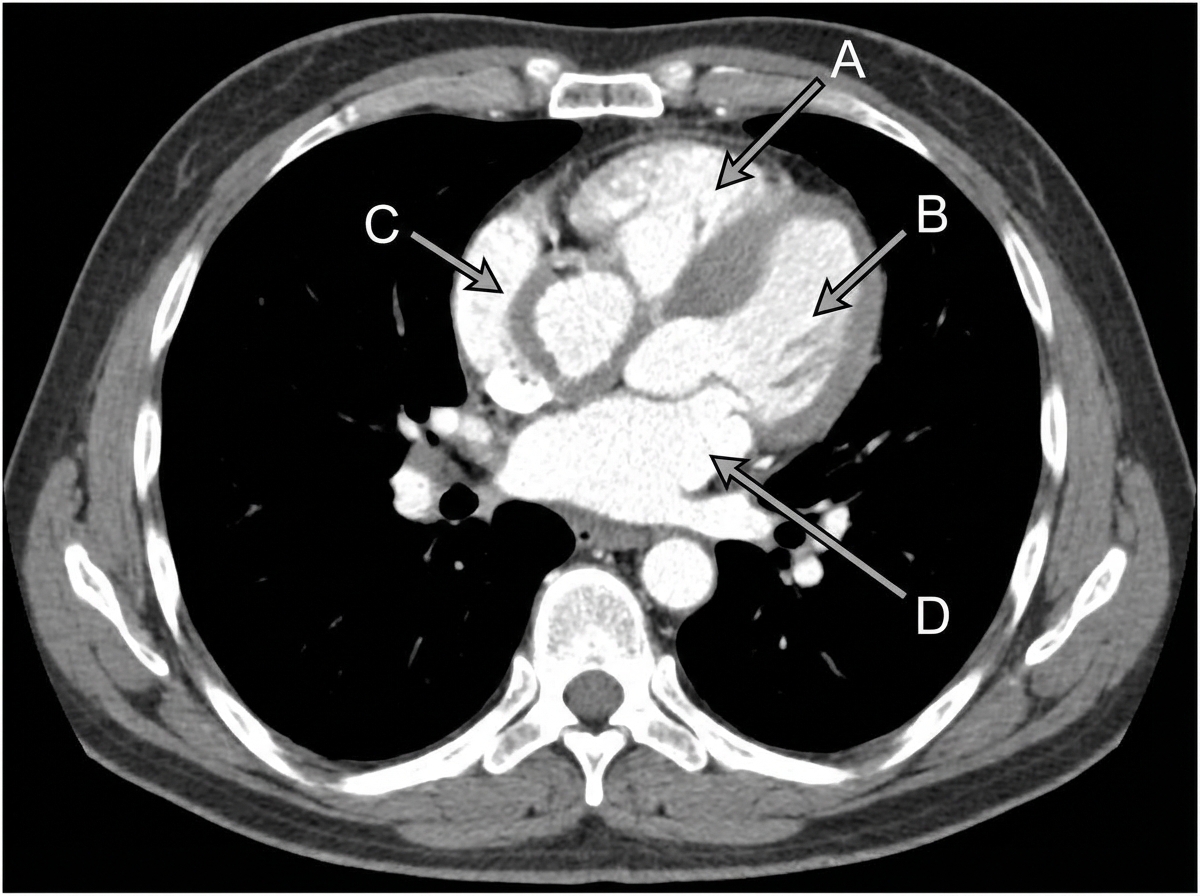
Which of the following represents the surface marking of the aortic valve?
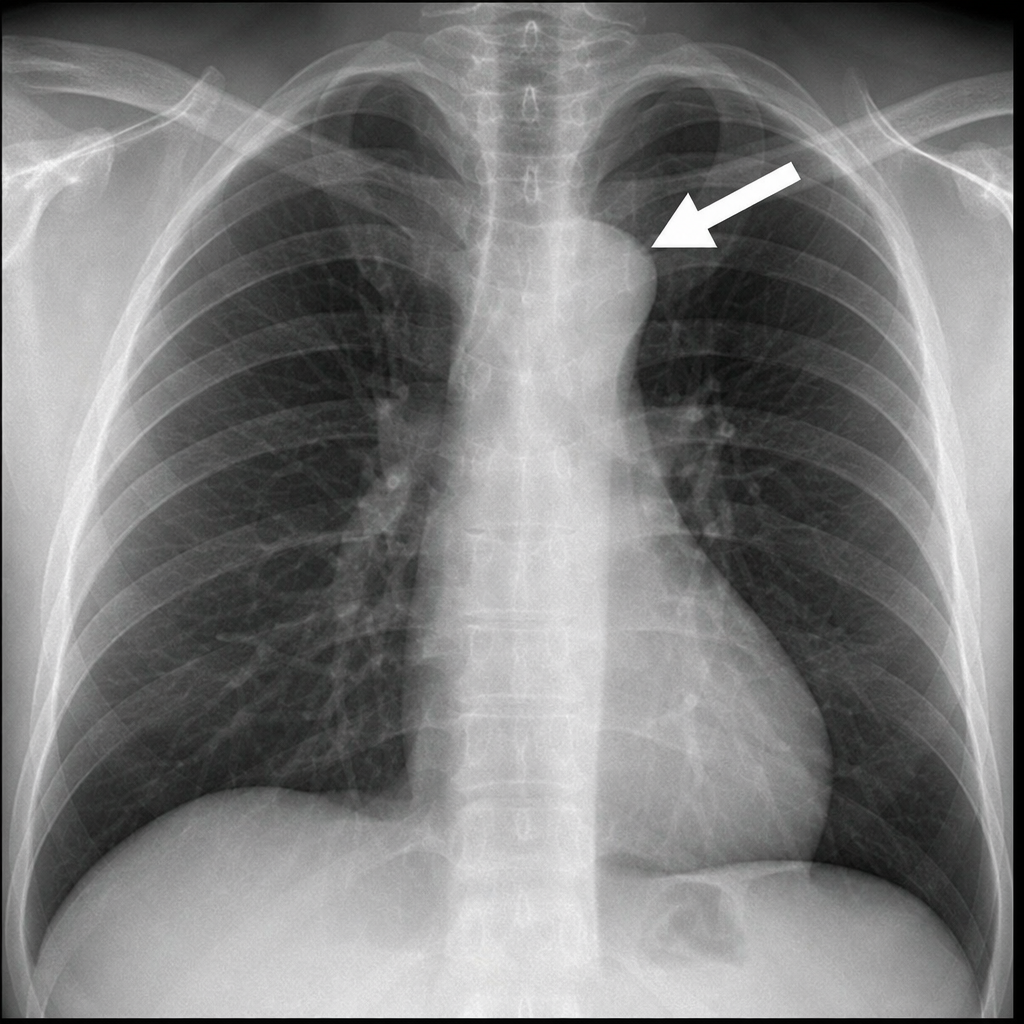
Which of the following does not contribute to the hilar shadow?
Which anatomical landmark represents the surface projection of the internal jugular vein?
What is the approximate size of the optic disc in millimeters?
Which spinal segment supplies the umbilicus?
Which organ does not move with respiration?
Shenton's line is:
The bony landmark shown in the diagram is used to differentiate between inguinal and femoral hernias. What is this landmark?

Explanation: The **Internal Jugular Vein (IJV)** is a major venous channel in the neck, and its surface marking is a high-yield topic for both anatomy and clinical procedures like central venous pressure (CVP) monitoring. ### **Explanation of the Correct Answer** The surface marking of the IJV is represented by a broad line connecting two points: 1. **Superior Point:** The lobule of the ear (representing the jugular bulb just below the jugular foramen). 2. **Inferior Point:** The medial end of the clavicle (specifically the sternoclavicular joint). The vein descends vertically within the **carotid sheath**, lateral to the internal and common carotid arteries, and deep to the sternocleidomastoid (SCM) muscle. It ends behind the medial end of the clavicle by joining the subclavian vein to form the brachiocephalic vein. ### **Analysis of Incorrect Options** * **Option A & D:** The **midpoint of the clavicle** is the surface marking for the **Subclavian Vein** (where it is accessed for catheterization). * **Option C:** The **lateral end of the clavicle** does not correspond to any major vertical vascular structure in the neck. * **Note on External Jugular Vein (EJV):** The EJV is marked by a line from the angle of the mandible to the midpoint of the clavicle, crossing the SCM obliquely. ### **NEET-PG High-Yield Pearls** * **Relation to SCM:** The IJV lies deep to the SCM. Its lower end is found in the **lesser supraclavicular fossa** (the triangle between the sternal and clavicular heads of the SCM). * **Clinical Use:** The IJV is preferred for central line insertion because it has a straight course to the right atrium and lacks valves (allowing for JVP assessment). * **Right vs. Left:** The Right IJV is usually preferred for cannulation as it is larger and provides a more direct path to the Superior Vena Cava.
Explanation: The esophagus is a muscular tube approximately **25 cm** in length. However, in clinical practice (such as endoscopy), measurements are taken from the **upper incisor teeth**. The gastroesophageal (GE) junction is located at the level of the **T11 vertebra**, which corresponds to a distance of approximately **40 cm** from the incisors. [1] **Breakdown of Distances from Upper Incisors:** * **15 cm:** This marks the **commencement of the esophagus** at the cricopharyngeal sphincter (lower border of the cricoid cartilage/C6 level). This is the narrowest point of the esophagus. On endoscopy, the cervical esophagus corresponds to approximately 15 to 20 cm from the incisors. [1] * **25 cm:** This corresponds to the level where the **arch of the aorta and the left main bronchus** cross the esophagus (T4/T5 level). This is approximately 20 to 25 cm from the incisors. [1] * **40 cm:** This is the distance to the **gastroesophageal junction**, where the esophagus pierces the diaphragm (T10) and enters the stomach (T11). [1] **Why the other options are incorrect:** * **15 cm:** Too proximal; represents the esophageal inlet. [1] * **25 cm:** Represents the mid-esophagus/broncho-aortic constriction. [1] * **60 cm:** Too distal; this distance would typically reach the pylorus or the first part of the duodenum. **Clinical Pearls for NEET-PG:** 1. **Constrictions:** Remember the "15-25-40" rule for the three major anatomical constrictions (Cervical, Thoracic, and Diaphragmatic). Some texts include a fourth at 22 cm (Aortic arch). 2. **Vertebral Levels:** Esophagus starts at **C6**, pierces the diaphragm at **T10**, and ends at **T11**. 3. **Portosystemic Anastomosis:** The GE junction is a critical site for portosystemic shunting; esophageal varices develop here in portal hypertension due to communication between the left gastric vein and the azygos vein.
Explanation: To master surface anatomy for NEET-PG, it is crucial to distinguish between the **anatomical location** (where the valve is) and the **auscultatory area** (where the sound is best heard). [1] ### **1. Why Option A is Correct** The **aortic valve** is anatomically situated behind the left half of the sternum, at the level of the **lower border of the left 3rd costal cartilage** and the adjoining part of the sternum. [1] It is a semilunar valve that prevents backflow from the aorta into the left ventricle. ### **2. Analysis of Incorrect Options** * **Option B (Right 3rd costal cartilage):** This is the anatomical location of the **Superior Vena Cava** entering the right atrium, not the aortic valve. * **Option C (Right 2nd intercostal space):** This is the **Auscultatory Area** for the aortic valve. Sound is conducted here by the column of blood in the ascending aorta, which is closest to the chest wall at this point. * **Option D (Right 3rd intercostal space):** This does not correspond to a primary cardiac valve landmark. ### **3. High-Yield Clinical Pearls for NEET-PG** To remember the anatomical positions of the four valves, use the mnemonic **"P-M-A-T"** (Pulmonary, Mitral, Aortic, Tricuspid) from superior to inferior: * **Pulmonary Valve:** Left 3rd costal cartilage (Upper border). [1] * **Aortic Valve:** Left 3rd costal cartilage (Lower border). [1] * **Mitral Valve:** Left 4th costal cartilage. * **Tricuspid Valve:** Right/Middle of sternum at the level of the 4th/5th intercostal space. **Key Distinction:** If a question asks for the **site of auscultation**, the answer is the Right 2nd Intercostal Space. If it asks for **surface marking/anatomical position**, the answer is the Left 3rd Costal Cartilage.
Explanation: The **hilar shadow** on a standard frontal chest X-ray is a complex opacity formed primarily by the vascular and bronchial structures entering and leaving the lungs. Understanding its composition is high-yield for radiological anatomy [1]. ### Why Lower Lobe Pulmonary Veins is the Correct Answer: The hilar shadow is predominantly formed by the **pulmonary arteries** and the **upper lobe pulmonary veins**. The **lower lobe pulmonary veins** do not contribute to the hilum because they enter the left atrium at a level **inferior and posterior** to the hilum. On a chest radiograph, these veins are seen crossing the lower lung fields toward the heart, separate from the main hilar opacity. ### Analysis of Incorrect Options: * **A. Pulmonary Arteries:** These are the primary contributors to the hilar shadow. The right pulmonary artery and the left pulmonary artery (which arches over the left main bronchus) form the bulk of the density seen on X-ray. * **B. Upper Lobe Pulmonary Veins:** These veins pass through the hilar region to reach the superior aspect of the left atrium, contributing significantly to the superior and lateral margins of the hilar shadow. * **D. Lobar Bronchi:** While air-filled and less dense than vessels, the walls of the major bronchi and the surrounding connective tissue/lymph nodes contribute to the overall structural volume of the hilum [1]. ### High-Yield NEET-PG Pearls: * **The "Left is Higher" Rule:** The left hilum is normally higher than the right hilum in 95% of individuals because the left pulmonary artery arches over the left main bronchus. * **Hilar Point:** This is the angle formed by the intersection of the superior pulmonary vein and the descending pulmonary artery. Displacement of this point is a sensitive sign of lung collapse or masses. * **Vascular Dominance:** Remember that nearly **80% of the hilar density** is vascular (arteries > veins).
Explanation: The **Internal Jugular Vein (IJV)** is a vital vascular structure in the neck, and its surface projection is a high-yield topic for clinical procedures like central venous catheterization. **1. Why Option A is Correct:** The surface marking of the IJV is represented by a line connecting two points: * **Upper point:** The **ear lobule** (which corresponds to the level of the jugular foramen at the skull base). * **Lower point:** The **medial end of the clavicle** (specifically the sternoclavicular joint). The vein descends vertically behind the Sternocleidomastoid (SCM) muscle, lying lateral to the Internal and Common Carotid arteries within the carotid sheath. **2. Analysis of Incorrect Options:** * **Option B & C:** The **middle and lateral thirds of the clavicle** are landmarks for the **External Jugular Vein (EJV)**. The EJV runs obliquely across the SCM muscle and pierces the deep fascia above the middle third of the clavicle to join the subclavian vein. * **Option D:** While the **mastoid process** is near the ear lobule, the standard anatomical landmark for the IJV's superior extent in surface marking is the lobule. The mastoid process is more commonly used as a landmark for the insertion of the SCM muscle. **3. Clinical Pearls for NEET-PG:** * **Cannulation:** The IJV is typically accessed in the "Sedillot’s triangle"—the space between the sternal and clavicular heads of the SCM muscle. * **Right vs. Left:** The **Right IJV** is preferred for central line placement because it is larger, more superficial, and provides a straight path to the Right Atrium. * **JVP:** The Internal Jugular Vein (not the External) is used to measure **Jugular Venous Pressure** because it lacks valves and is in direct continuity with the Right Atrium.
Explanation: **Explanation:** The **optic disc** (optic nerve head) is the anatomical location where ganglion cell axons exit the eye to form the optic nerve [1]. It is a vertically oval structure with an average diameter of approximately **1.5 mm**. Understanding this dimension is crucial for clinical fundoscopy, as the optic disc serves as the standard "unit of measurement" (Disc Diameter) for locating other retinal lesions. **Analysis of Options:** * **Option B (1.5 mm):** This is the correct anatomical average. While it can range from 1.2 mm to 1.8 mm, 1.5 mm is the standard value used in medical examinations. * **Option A (0.5 mm):** This is too small for the disc; however, it is approximately the diameter of the **foveola** (the central-most floor of the fovea). * **Option C (5.5 mm):** This is the approximate diameter of the entire **macula lutea**. * **Option D (10.5 mm):** This value has no anatomical correlation with the posterior pole of the eye; the entire eyeball diameter is only about 24 mm. **High-Yield Clinical Pearls for NEET-PG:** * **Blind Spot:** The optic disc lacks photoreceptors (rods and cones), corresponding to the physiological blind spot in the visual field [1]. * **Location:** It is situated 3–4 mm nasal to the fovea. * **Cup-Disc Ratio:** A normal ratio is < 0.3. An increase in this ratio (cupping) is a hallmark sign of **Glaucoma** [2]. * **Papilledema:** This refers to bilateral optic disc swelling due to increased intracranial pressure. On fundoscopy, it presents with blurring of disc margins and loss of venous pulsations.
Explanation: **Explanation:** The correct answer is **T10**. This question tests the knowledge of dermatomes—the specific areas of skin supplied by a single spinal nerve root. **1. Why T10 is correct:** The umbilicus is a key anatomical landmark used to map the sensory distribution of the thoracic spinal nerves [1]. The **T10 dermatome** consistently supplies the skin at the level of the umbilicus [1]. This is a crucial reference point in clinical examinations to localize spinal cord injuries or determine the level of spinal anesthesia. **2. Analysis of Incorrect Options:** * **T4:** Supplies the skin at the level of the **nipples** (intermammary line). * **T6:** Supplies the skin at the level of the **xiphoid process** [1]. * **T8:** Supplies the upper abdominal wall, midway between the xiphoid process and the umbilicus. **3. Clinical Pearls & High-Yield Facts for NEET-PG:** * **Referred Pain:** In early appendicitis, visceral pain is referred to the **T10 (umbilical) region** because the appendix and the umbilicus share the same spinal segment for sensory fibers [1]. As the parietal peritoneum becomes inflamed, the pain shifts to the Right Iliac Fossa (McBurney’s point) [1]. * **L1 Dermatome:** Supplies the skin over the **inguinal ligament** and the pubic symphysis [1]. * **C3, C4, C5:** "Keep the diaphragm alive" (Phrenic nerve), but the **C4** dermatome also covers the "cape" of the shoulder (supraclavicular nerves). * **Beevor’s Sign:** A clinical test where the umbilicus moves upward when a patient attempts to sit up; it indicates paralysis of the lower abdominal muscles (T10-T12) with sparing of the upper ones, often seen in spinal cord lesions at the T10 level.
Explanation: The movement of abdominal organs during respiration is primarily determined by their relationship to the **diaphragm**. When the diaphragm contracts during inspiration, it descends, pushing the underlying viscera downward. **Why Pancreas is the Correct Answer:** The **Pancreas** is a **retroperitoneal organ** (except for the tail) that is firmly fixed to the posterior abdominal wall. Unlike the liver or stomach, it lacks a mesentery that would allow for significant mobility. More importantly, it is not directly attached to the diaphragm. Its fixed position behind the peritoneum and its attachments to the duodenum and the posterior body wall make it relatively stationary during respiratory cycles. **Why the other options are incorrect:** * **Liver (B):** The liver is in direct contact with the inferior surface of the diaphragm (attached via the coronary ligaments and the area nudum). It moves significantly (up to 2-3 cm) with every breath [1]. * **Kidney (A):** Although retroperitoneal, the kidneys lie within the renal fascia (Gerota’s fascia) and move vertically along the psoas muscle during diaphragmatic excursion [2]. * **Stomach (C):** As an intraperitoneal organ with a flexible mesentery, the stomach is pushed downward by the descending liver and diaphragm during inspiration. **NEET-PG High-Yield Pearls:** * **Retroperitoneal Organs (SAD PUCKER):** Suprarenal glands, Aorta/IVC, Duodenum (2nd/3rd parts), **Pancreas (except tail)**, Ureters, Colon (Ascending/Descending), Kidneys, Esophagus, Rectum. * **Clinical Significance:** During percutaneous biopsies or surgeries, surgeons must account for the "respiratory swing" of the liver and kidneys, whereas the pancreas remains a stable target. * The **Tail of the Pancreas** is the only part that is intraperitoneal (contained within the lienorenal ligament) [3].
Explanation: **Shenton’s Line** is a fundamental radiological landmark used to assess the integrity of the hip joint on an Anteroposterior (AP) X-ray. It is an imaginary continuous arc formed by the **inferior border of the femoral neck** and the **superior border of the obturator foramen**. In a normal, healthy hip, this curve is smooth and unbroken. Any interruption or "step-off" in this line indicates a structural abnormality, most commonly a **fractured neck of femur** or a **developmental dysplasia of the hip (DDH)**. **Analysis of Incorrect Options:** * **Option A:** This describes **Nélaton’s line**. It is used clinically to assess the position of the greater trochanter; if the tip of the GT is felt above this line, it suggests a hip dislocation or femoral neck fracture. * **Option B:** This describes **Bryant’s Triangle** (specifically the hypotenuse). A shortening of the distance between the ASIS and the GT is a classic sign of proximal femoral displacement. * **Option C:** This is simply the **interspinal plane**, used as a surface landmark for abdominal quadrants and pelvic leveling, but it has no specific name related to hip pathology. **High-Yield Clinical Pearls for NEET-PG:** * **Disruption of Shenton’s Line:** Highly sensitive for diagnosing **DDH** in infants and **impacted neck of femur fractures** in adults. * **Ward’s Triangle:** A radiolucent area in the neck of the femur formed by the intersection of trabecular systems; it is the first site to show signs of osteoporosis. * **Skinner’s Line:** A horizontal line through the tip of the GT and a vertical line through the axis of the femoral shaft; the fovea centralis should normally lie above the horizontal line.
Explanation: ***Pubic tubercle*** - The **pubic tubercle** is the key anatomical landmark that differentiates **inguinal hernias** (which emerge **superomedial** to it) from **femoral hernias** (which emerge **inferolateral** to it). - It serves as a palpable bony prominence on the **superior pubic ramus** that can be easily identified during clinical examination to distinguish hernia types. *Pubic symphysis* - The **pubic symphysis** is a **midline cartilaginous joint** between the two pubic bones, not a lateral landmark used for hernia differentiation. - It lies **medially** and does not provide the specific anatomical reference point needed to distinguish between inguinal and femoral hernia locations. *Ilio-pectinate line* - The **ilio-pectinate line** forms part of the **pelvic brim** and separates the true and false pelvis, not a surface landmark for hernia differentiation. - It is located **deeper** within the pelvis and cannot be palpated externally during clinical examination of hernias. *Iliopubic eminence* - The **iliopubic eminence** is located more **laterally** on the superior pubic ramus and is not the primary landmark for hernia differentiation. - While it's an anatomical feature of the pubic bone, it lacks the **specific positional relationship** to hernia emergence sites that the pubic tubercle provides.
Surface Landmarks of the Head and Neck
Practice Questions
Surface Landmarks of the Thorax
Practice Questions
Surface Landmarks of the Abdomen
Practice Questions
Surface Landmarks of the Limbs
Practice Questions
Radiographic Anatomy
Practice Questions
CT Anatomy
Practice Questions
MRI Anatomy
Practice Questions
Ultrasonographic Anatomy
Practice Questions
Angiographic Anatomy
Practice Questions
Sectional and Cross-sectional Anatomy
Practice Questions
Anatomical Correlations in Common Imaging
Practice Questions
Interventional Radiological Anatomy
Practice Questions
Get full access to all questions, explanations, and performance tracking.
Start For Free