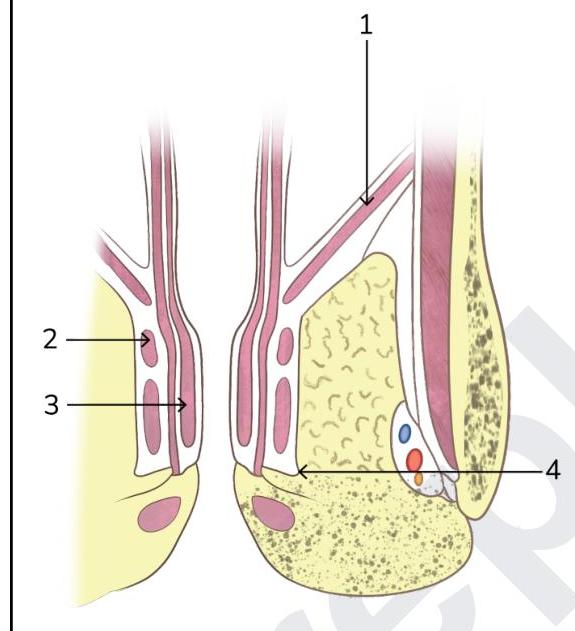
The mesovarium attaches which structure to the ovary?
The intricately and prodigiously looped system of veins and arteries that lie on the surface of the epididymis is known as?
Anteversion of the uterus is maintained by which ligament?
All of the following structures pass through the greater sciatic foramen, EXCEPT?
Somatic innervation to the pelvic organs is provided by which nerve?
A 26-year-old man presents with fever, nausea, pain, and itching in the perineal region. On examination by a urologist, he is diagnosed with infected bulbourethral (Cowper's) glands. Which of the following structures is affected by this infection?
A 41-year-old woman undergoes a scheduled tubal ligation. Two days postoperatively, she develops a high fever and signs of hypovolemic shock. Radiographic examination reveals a large hematoma adjacent to the external iliac artery. Which of the following vessels was most likely injured?
Which of the following is NOT a content of the deep perineal pouch?
A 34-year-old woman presents with urinary incontinence. An MRI reveals a significant tear in one of the pelvic skeletal muscles. Which of the following muscles is most significant in maintaining continence?
The fourchette is formed by the joining of which structures?
Explanation: The **mesovarium** is a short, double-layered fold of peritoneum that attaches the anterior border of the ovary to the **posterior layer of the broad ligament** [1]. It serves as a conduit for the ovarian vessels and nerves to enter the ovarian hilum [1]. **Why the correct answer is right:** The broad ligament is a wide fold of peritoneum that connects the uterus to the pelvic walls and floor. It is divided into three parts: the mesometrium (largest part), the mesosalpinx (drapes over the fallopian tube), and the **mesovarium** [1]. Therefore, the mesovarium is anatomically a specialized extension of the broad ligament. **Analysis of incorrect options:** * **A. Uterus:** The ovary is connected to the uterus by the **ligament of the ovary** (ovarian ligament), not the mesovarium. * **B. Lateral pelvic wall:** The ovary is attached to the lateral pelvic wall by the **suspensory ligament of the ovary** (infundibulopelvic ligament), which contains the ovarian artery and vein [1]. * **D. Ovarian ligament:** This is a fibromuscular band (a remnant of the gubernaculum) that connects the proximal (uterine) pole of the ovary to the lateral wall of the uterus. **High-Yield Facts for NEET-PG:** * **Germinal Epithelium:** The mesovarium stops at the hilum of the ovary [1]. Beyond this point, the peritoneal mesothelium changes into the simple cuboidal "germinal epithelium" covering the ovary. * **Contents of Suspensory Ligament:** Often confused with the mesovarium, the suspensory ligament contains the **ovarian artery** (a direct branch of the abdominal aorta) [1]. * **Gubernaculum Remnants:** In females, the gubernaculum persists as two structures: the **ovarian ligament** and the **round ligament of the uterus**.
Explanation: The correct answer is **C. Pampiniform plexus.** The **pampiniform plexus** is a complex network of approximately 8–12 veins that originate from the mediastinum testis and lie along the surface of the epididymis and within the spermatic cord. These veins eventually coalesce to form the testicular vein. Its primary physiological role is **thermoregulation**; it acts as a counter-current heat exchanger, cooling the arterial blood in the testicular artery before it reaches the testes [1]. This is crucial because spermatogenesis requires a temperature approximately 2–3°C lower than core body temperature [1]. **Analysis of Incorrect Options:** * **A. Choroid plexus:** A vascular network found within the ventricles of the brain responsible for producing cerebrospinal fluid (CSF). * **B. Tuberal plexus:** Part of the vascular supply to the hypothalamus and pituitary gland (specifically the pars tuberalis). * **D. Pectiniform septum:** The incomplete fibrous midline septum that separates the two corpora cavernosa of the penis. **High-Yield Clinical Pearls for NEET-PG:** * **Varicocele:** Abnormal dilatation and tortuosity of the pampiniform plexus, often described as a **"bag of worms"** on palpation. It is more common on the **left side** because the left testicular vein drains into the left renal vein at a right angle, leading to higher hydrostatic pressure. * **Nutcracker Syndrome:** Compression of the left renal vein between the SMA and Aorta, which can lead to a secondary varicocele. * **Right Testicular Vein:** Drains directly into the Inferior Vena Cava (IVC) at an acute angle.
Explanation: The position of the uterus is defined by two angles: **Anteversion** (the long axis of the cervix relative to the vagina) and **Anteflexion** (the long axis of the body of the uterus relative to the cervix) [1]. **Why the Round Ligament is Correct:** The **Round ligament** of the uterus originates from the uterine horns (corua), passes through the inguinal canal, and attaches to the labia majora. Its primary function is to pull the fundus of the uterus **forward and downward**, thereby maintaining the angle of **anteversion**, especially during pregnancy. While it is a relatively weak support for preventing prolapse, it is the specific structure responsible for the anterior tilt. **Analysis of Incorrect Options:** * **Cardinal (Mackenrodt’s) Ligament:** These are the most important ligaments for preventing **uterine prolapse**. They provide lateral support to the cervix and the vaginal vault but do not primarily determine the angle of version [2]. * **Uterosacral Ligament:** These pull the cervix backward toward the sacrum. Working in conjunction with the round ligament, they help maintain the uterus in an anteverted position [2], but the round ligament is the classic answer for maintaining the specific forward tilt of the fundus. * **Pubocervical Ligament:** These connect the cervix to the posterior surface of the pubis, supporting the bladder and the anterior vaginal wall [2]. **High-Yield NEET-PG Pearls:** 1. **Primary Support of Uterus:** The pelvic diaphragm (Levator ani) is the most important dynamic support; the Cardinal ligament is the most important static/mechanical support. 2. **Remnant:** The round ligament is a remnant of the **Gubernaculum**. 3. **Pain Pathway:** Stretching of the round ligament during the second trimester of pregnancy causes "Round Ligament Pain" in the inguinal region.
Explanation: The **Greater Sciatic Foramen (GSF)** is the "gateway" of the pelvis, connecting the pelvic cavity to the gluteal region. To answer this question correctly, one must distinguish between structures that *pass through* the foramen and those that *exit and then re-enter* the pelvis. ### **Explanation of the Correct Answer** While the **Pudendal nerve (B)** and the **Internal pudendal vessels (D)** both exit the pelvis via the Greater Sciatic Foramen, they immediately hook around the sacrospinous ligament and **re-enter** the pelvis/perineum via the **Lesser Sciatic Foramen (LSF)**. In the context of NEET-PG questions, when "Pudendal nerve" is the keyed answer against other gluteal structures, it refers to its unique status as a structure that belongs to the **Lesser Sciatic Foramen** for its final destination (the perineum). *Note: Technically, both B and D follow this path; however, in many standard textbooks and exams, the Pudendal nerve is the classic "exception" highlighted for its re-entry.* ### **Analysis of Incorrect Options** * **A. Piriformis muscle:** This is the "key" muscle of the gluteal region. It passes through the GSF and divides it into supra-piriform and infra-piriform compartments. * **C. Inferior gluteal vessels:** These exit the pelvis through the GSF, specifically through the infra-piriform compartment, to supply the gluteus maximus. * **D. Internal pudendal vessel:** Similar to the pudendal nerve, it exits the GSF but is often grouped with GSF structures in broader lists. ### **High-Yield Clinical Pearls for NEET-PG** * **Structures passing through BOTH GSF and LSF:** (Mnemonic: **PIN**) **P**udendal nerve, **I**nternal pudendal vessels, and **N**erve to obturator internus. * **Supra-piriform compartment:** Contains only the Superior gluteal nerve and vessels. * **Infra-piriform compartment:** Contains the Inferior gluteal nerve/vessels, Sciatic nerve, Posterior cutaneous nerve of the thigh, and the "PIN" structures. * **Sciatic Nerve:** The largest structure passing through the GSF (infra-piriform). Compression here leads to "Piriformis Syndrome."
Explanation: The **Pudendal nerve (S2–S4)** is the primary **somatic** nerve of the perineum and pelvic floor. While the internal pelvic viscera (like the bladder and rectum) are primarily controlled by the autonomic nervous system (pelvic splanchnic nerves and hypogastric plexuses), the somatic innervation to the external genitalia and the voluntary sphincters of the pelvic organs is provided by the pudendal nerve. It supplies the external anal sphincter and the external urethral sphincter, allowing for voluntary control over defecation and micturition. **Analysis of Options:** * **Greater (T5–T9) and Lesser (T10–T11) splanchnic nerves:** These are **sympathetic (autonomic)** nerves that arise from the thoracic sympathetic trunk. They provide vasomotor and sensory supply to the upper abdominal viscera, not the pelvic organs. * **Ilioinguinal nerve (L1):** This is a somatic nerve, but it supplies the skin over the root of the penis/mons pubis and the anterior 1/3rd of the scrotum/labia majora. It does not provide innervation to the pelvic organs or their sphincters. **High-Yield NEET-PG Pearls:** * **Course:** The pudendal nerve leaves the pelvis through the **greater sciatic foramen** and re-enters through the **lesser sciatic foramen**, passing through the **Alcock’s canal** (pudendal canal). * **Pudendal Nerve Block:** Performed by palpating the **ischial spine** transvaginally; it is used to provide anesthesia during the second stage of labor or for an episiotomy. * **S2, 3, 4 keeps the poo/pee off the floor:** A common mnemonic to remember that these spinal segments (via the pudendal nerve) control the voluntary sphincters.
Explanation: **Explanation:** The **Bulbourethral glands (Cowper’s glands)** are two small, pea-sized exocrine glands in the male reproductive system. To answer this question, one must recall their precise anatomical location: they are situated within the **Deep Perineal Pouch**. 1. **Why "Sphincter urethrae" is correct:** The deep perineal pouch is a space bounded by the perineal membrane inferiorly and the pelvic fascia superiorly. Its primary contents include the membranous urethra and the **sphincter urethrae muscle**. Since the bulbourethral glands are embedded within the fibers of the sphincter urethrae muscle in the deep pouch, an infection of these glands directly involves this structure. 2. **Why the other options are incorrect:** * **Superficial perineal space:** This space contains the root of the penis (bulbs and crura) and the greater vestibular (Bartholin's) glands in females. While the *ducts* of Cowper’s glands pierce the perineal membrane to open into the bulbous urethra (located in the superficial pouch), the *glands themselves* are in the deep pouch. * **Production of sperm/Testis:** Sperm production (spermatogenesis) occurs exclusively in the seminiferous tubules of the **testes**. Cowper’s glands contribute pre-ejaculate fluid for lubrication and neutralization of urinary acidity; they have no role in sperm production. **High-Yield NEET-PG Pearls:** * **Homology:** Cowper’s glands in males are homologous to the **Bartholin’s glands** in females. However, note the difference in location: Bartholin’s glands are in the *superficial* pouch, while Cowper’s are in the *deep* pouch. * **Duct Opening:** Cowper’s gland ducts open into the **bulbous (spongy) urethra**, making them a common site for post-gonorrheal infections. * **Deep Pouch Contents (Male):** Membranous urethra, Sphincter urethrae, Bulbourethral glands, and Internal pudendal artery/nerve branches.
Explanation: Explanation: The correct answer is **Ovarian arteries**. **1. Why Ovarian Arteries are Correct:** During a tubal ligation, the surgeon manipulates the fallopian tubes and the **suspensory ligament of the ovary (infundibulopelvic ligament)**. The ovarian artery, a direct branch of the abdominal aorta, travels within this ligament to reach the ovary and the lateral end of the fallopian tube [1]. Anatomically, the ovarian artery crosses the **external iliac artery** at the pelvic brim to enter the true pelvis [1]. Injury to this high-pressure vessel can lead to a retroperitoneal hematoma adjacent to the external iliac artery, resulting in rapid blood loss and hypovolemic shock. **2. Why Incorrect Options are Wrong:** * **Ascending/Descending branches of Uterine Arteries:** These arise from the internal iliac artery and run along the lateral aspect of the uterus (within the broad ligament) [2]. While they supply the medial portion of the tube, they are located more medially and inferiorly, away from the external iliac artery. * **Superior Vesical Artery:** This is a branch of the patent portion of the umbilical artery (internal iliac system) supplying the upper part of the bladder. It is not involved in the surgical field of a tubal ligation. **3. Clinical Pearls for NEET-PG:** * **Ureter Relation:** The ureter passes "under the water" (posterior to the uterine artery) and is also in close proximity to the ovarian vessels at the pelvic brim [1]. * **Blood Supply:** The fallopian tube has a dual blood supply: the ovarian artery (lateral) and the uterine artery (medial) [1]. * **Anatomical Landmark:** The point where the ovarian vessels cross the external iliac artery is a high-yield landmark for identifying the ureter during pelvic surgery [1].
Explanation: The **deep perineal pouch** is an anatomical space located between the superior and inferior fascia of the urogenital diaphragm. Understanding its contents is high-yield for NEET-PG, as it differs significantly between males and females. ### **Why the Prostatic Urethra is the Correct Answer** The **prostatic urethra** is located within the pelvic cavity, surrounded by the prostate gland, and lies **superior** to the deep perineal pouch. The part of the urethra that actually traverses the deep perineal pouch is the **membranous urethra** (the shortest and least dilatable part). Therefore, the prostatic urethra is not a content of this space. ### **Analysis of Incorrect Options** * **A. External urethral sphincter:** This skeletal muscle surrounds the membranous urethra within the deep pouch and is responsible for voluntary control of micturition. * **B. Bulbourethral (Cowper’s) glands:** In **males**, these glands are located specifically within the deep perineal pouch (though their ducts pierce the perineal membrane to open into the bulbous urethra in the superficial pouch). * **C. Deep transverse perineal muscle:** This muscle lies within the deep pouch, providing structural support to the pelvic floor and perineal body. ### **High-Yield Clinical Pearls for NEET-PG** * **Gender Difference:** The **Bulbourethral glands** are in the deep pouch in males, but the homologous **Great Vestibular (Bartholin’s) glands** in females are located in the **superficial pouch**. * **Urethral Injury:** Rupture of the membranous urethra (e.g., in pelvic fractures) leads to extravasation of urine into the **deep perineal pouch**. * **Nerve Supply:** All muscles of the deep perineal pouch are supplied by the **perineal branch of the pudendal nerve (S2-S4)**.
Explanation: The **Pubococcygeus** is the most critical component of the **Levator Ani** muscle complex. It originates from the posterior aspect of the pubic bone and forms a U-shaped sling (specifically the **Puborectalis** fibers) around the pelvic viscera [1]. Its primary function is to maintain constant tonic contraction, which supports the pelvic organs and elevates the pelvic floor [1]. In females, it plays a vital role in urinary continence by maintaining the **vesicourethral angle** and compressing the urethra against the pubic bone during increases in intra-abdominal pressure (e.g., coughing or sneezing). Damage to this muscle, often during childbirth, is a leading cause of stress urinary incontinence. **Analysis of Incorrect Options:** * **Obturator Internus:** This is a muscle of the lateral pelvic wall that acts as a lateral rotator of the hip. It is covered by the obturator fascia, which provides an attachment point (tendinous arch) for the levator ani, but it does not directly contribute to continence. * **Piriformis:** This muscle forms the posterolateral wall of the true pelvis. Its primary function is lateral rotation and abduction of the thigh; it has no role in supporting pelvic viscera. * **Coccygeus (Ischiococcygeus):** This is the posterior-most part of the pelvic floor, stretching from the ischial spine to the coccyx. While it supports the pelvic floor, it does not surround the urethra or rectum and is less significant for continence than the pubococcygeus. **Clinical Pearls for NEET-PG:** * **Levator Ani Components:** Consists of Pubococcygeus (most important), Puborectalis (maintains anorectal angle), and Iliococcygeus [1]. * **Perineal Body:** The central tendon of the perineum; injury here often involves the pubococcygeus and can lead to pelvic organ prolapse [2]. * **Nerve Supply:** Primarily the **Pudendal nerve (S2-S4)** and direct branches from the sacral plexus [3].
Explanation: ### Explanation **Correct Answer: B. Labia minora** The **fourchette** (also known as the frenulum of the labia minora) is a thin fold of skin formed by the posterior fusion of the **labia minora** [1]. It marks the posterior boundary of the vestibule. In nulliparous women, it is typically well-defined, but it is often lacerated or stretched during childbirth. #### Analysis of Options: * **Option A (Labia majora):** The labia majora fuse posteriorly to form the **posterior commissure**, which lies just behind the fourchette. Anteriorly, they merge to form the mons pubis. * **Option C (Labia majora with labia minora):** These structures run parallel to each other but do not fuse together to form a specific anatomical landmark like the fourchette. * **Option D (Cervix and vagina):** These are internal pelvic organs. The junction between the cervix and the vaginal vault forms the **fornices** (anterior, posterior, and lateral), not external structures [2]. #### NEET-PG Clinical Pearls & High-Yield Facts: 1. **Episiotomy:** During a mediolateral episiotomy, the incision begins at the fourchette and extends posterolaterally to avoid damage to the anal sphincter. 2. **Obstetric Tears:** The fourchette is the most common site for first-degree perineal tears during delivery. 3. **Vestibule Boundaries:** The space between the labia minora is the **vestibule**, which contains the urethral orifice, vaginal orifice, and the openings of the Bartholin’s glands [1, 2]. 4. **Anterior Fusion:** Anteriorly, the labia minora split to enclose the clitoris, forming the **prepuce** (superiorly) and the **frenulum of the clitoris** (inferiorly) [1].
Pelvic Walls and Floor
Practice Questions
Pelvic Viscera
Practice Questions
Urogenital Organs
Practice Questions
Pelvic Vasculature
Practice Questions
Pelvic Innervation
Practice Questions
Male Perineum
Practice Questions
Female Perineum
Practice Questions
Pelvic Lymphatics
Practice Questions
Applied Anatomy and Clinical Correlations
Practice Questions
Gender Differences in Pelvic Anatomy
Practice Questions
Get full access to all questions, explanations, and performance tracking.
Start For Free