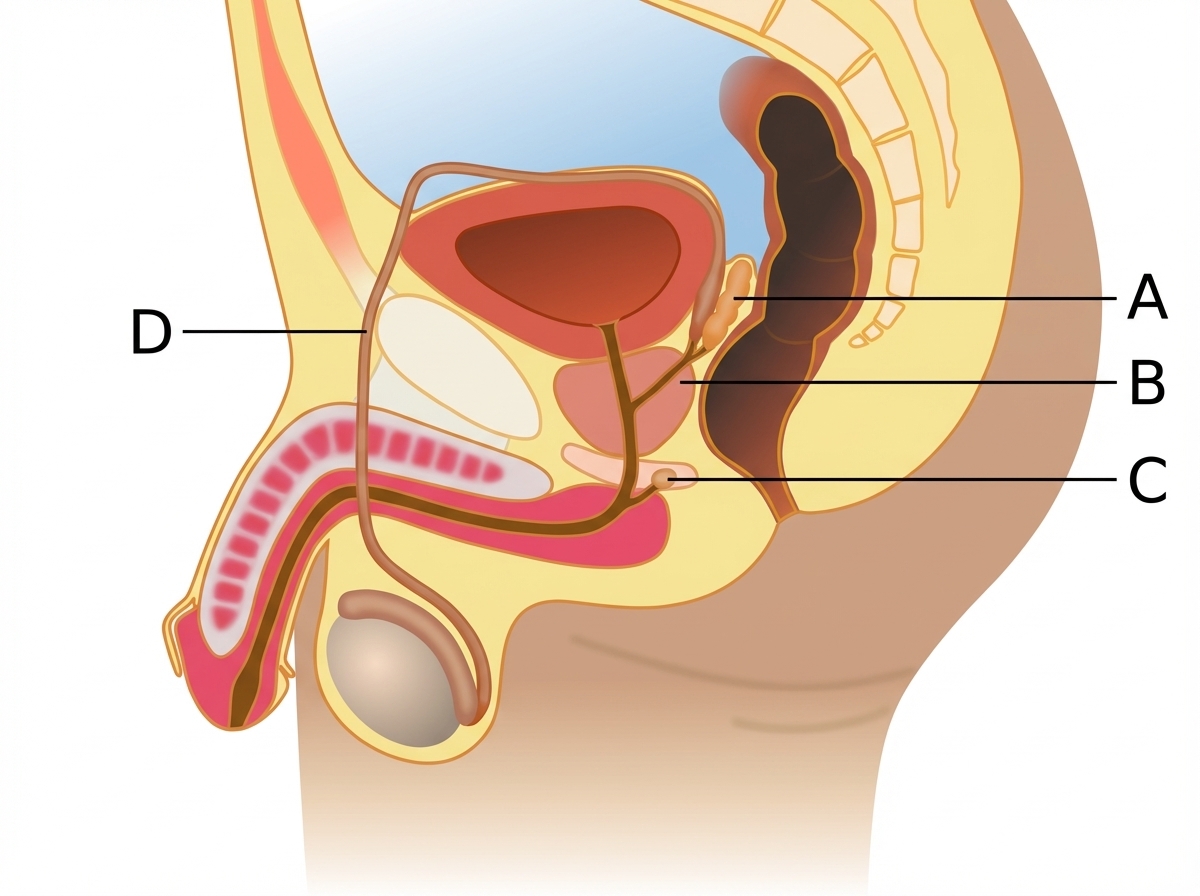
True for the vagina?
The Pouch of Douglas is anatomically situated between which structures?
What is true about the fallopian tube?
A 42-year-old woman presents with painful urination. A dipstick test reveals leukocytosis, confirming a urinary tract infection. What is the best anatomic explanation for the increased susceptibility of women to urinary tract infections compared to men?
The blood-testis barrier is formed by which of the following cells?
Which of the following statements about the ovary is INCORRECT?
What is the anatomical level of the levator ani muscle relative to the cervix?
All of the following nerves are involved in the process of erection of the penis, EXCEPT:
Which of the following is the immediate anterior relation to the uterus?
Which of the following is not in the posterior relationship to the rectum?
Explanation: ### Explanation **Correct Answer: C. Lacks mucus secreting glands** The vagina is unique because its wall **completely lacks any anatomical glands**. The lubrication of the vagina is achieved through: 1. **Vaginal Transudate:** Fluid seeping through the vaginal epithelium from the subepithelial capillary plexus. 2. **Cervical Mucus:** Secretions from the endocervical glands that flow down into the vaginal canal [2]. 3. **Bartholin’s Glands:** Located in the superficial perineal pouch, providing lubrication to the vestibule [3]. --- ### Analysis of Incorrect Options: * **A. Lined by columnar epithelium:** The vagina is lined by **Non-keratinized Stratified Squamous Epithelium**. This provides protection against friction during intercourse. It is rich in glycogen, which is fermented by Doderlein’s bacilli to maintain an acidic pH. * **B. Anterior fornix is deepest:** The **Posterior fornix** is the deepest of the four fornices [1]. It is clinically significant because it is related to the **Pouch of Douglas (Rectouterine pouch)**, making it the site for culdocentesis [1]. * **D. Anterior wall is longer:** The **Posterior wall (approx. 9 cm)** is longer than the **Anterior wall (approx. 7.5 cm)**. This is because the cervix enters the vagina through the upper part of the anterior wall at an angle [1]. --- ### NEET-PG High-Yield Pearls: * **pH of Vagina:** Normally **3.8 to 4.5** (acidic) due to lactic acid production by *Lactobacillus acidophilus* (Doderlein’s bacilli). * **Lymphatic Drainage:** * Upper 1/3: Internal and External Iliac nodes. * Middle 1/3: Internal Iliac nodes. * Lower 1/3 (below hymen): **Superficial Inguinal nodes**. * **Development:** The upper 4/5th develops from the **Mullerian ducts** (Paramesonephric), while the lower 1/5th develops from the **Sino-vaginal bulbs** (Urogenital sinus) [4].
Explanation: **Explanation:** The **Pouch of Douglas**, also known as the **Rectouterine Pouch**, is the most dependent (lowest) part of the peritoneal cavity in the female body when standing. It is formed by the reflection of the peritoneum from the posterior surface of the uterus onto the anterior surface of the rectum [1]. **Why Option D is Correct:** Anatomically, the peritoneum descends from the posterior wall of the uterus and the posterior vaginal fornix before reflecting upwards onto the rectum [1]. This creates a deep recess situated specifically between the **uterus (anteriorly)** and the **rectum (posteriorly)** [1]. **Analysis of Incorrect Options:** * **Option A (Bladder and Uterus):** This space is the **Vesicouterine pouch**. It is shallower than the Pouch of Douglas and is formed by the peritoneal reflection between the bladder and the uterus [1]. * **Option B (Bladder and Pubic Symphysis):** This is the **Retropubic space (Space of Retzius)**. It is an extraperitoneal space containing fat and a venous plexus, not a peritoneal pouch. * **Option C (Bladder and Rectum):** This describes the **Rectovesical pouch**, which is the male equivalent of the Pouch of Douglas (as males lack a uterus). **High-Yield Clinical Pearls for NEET-PG:** * **Culdocentesis:** Because it is the lowest point of the peritoneal cavity, inflammatory fluid (pus), bile, or blood (e.g., from a ruptured ectopic pregnancy) collects here. It can be aspirated via the **posterior vaginal fornix** [1]. * **Pelvic Abscess:** Common site for abscess formation following pelvic inflammatory disease (PID). * **Internal Hernia:** Loops of the small intestine can sometimes descend into this pouch.
Explanation: The fallopian tube (uterine tube) is a muscular tube approximately 10 cm long that facilitates the transport of ova and sperm. [1] ### **Explanation of Options** * **Correct Answer (C):** The fallopian tube is lined by **simple columnar ciliated epithelium**. These cilia beat toward the uterus, creating a current that helps transport the ovum and zygote. [2] Interspersed among these are non-ciliated **Peg cells**, which provide nutrition to the gametes. * **Option A:** The fallopian tube **lacks a submucosa**. The mucosa (endometrium-like but thinner) sits directly on the muscularis layer. * **Option B:** The tube is highly **hormone-dependent**. Estrogen increases the height of the epithelium and the number of cilia, while progesterone increases the number of secretory Peg cells. * **Option D:** The fallopian tube lies in the **upper free margin of the broad ligament** (specifically the **mesosalpinx**), not the round ligament. [1] ### **High-Yield NEET-PG Clinical Pearls** 1. **Narrowest Part:** The **Interstitial (Intramural) part** is the narrowest segment (1 mm diameter). 2. **Widest Part:** The **Ampulla** is the widest and longest part; it is the most common site for **fertilization** and **ectopic pregnancy**. [2] 3. **Blood Supply:** It has a dual supply from both the **Uterine artery** (medial 2/3) and the **Ovarian artery** (lateral 1/3). [1] 4. **Lymphatic Drainage:** Lymph drains primarily into the **Para-aortic (Pre-aortic) nodes**, following the ovarian vessels. 5. **Kartagener Syndrome:** Patients with primary ciliary dyskinesia may face subfertility due to impaired tubal ciliary movement.
Explanation: ### Explanation **Correct Option: C. The female urethra is significantly shorter than the male urethra.** The primary anatomical reason for the higher incidence of Urinary Tract Infections (UTIs) in females is the length and location of the urethra. The **female urethra is approximately 4 cm long**, whereas the male urethra is significantly longer (about 18–20 cm). This shorter distance allows uropathogens (most commonly *E. coli* from the perianal region) to ascend more easily into the bladder [1]. Additionally, the female urethral meatus is located in close proximity to the anus and vestibule, facilitating fecal-oral bacterial colonization. **Analysis of Incorrect Options:** * **Option A:** The diversity of vaginal flora (predominantly *Lactobacillus*) actually serves as a protective barrier by maintaining an acidic pH. It is the disruption of this flora, rather than its "lesser diversity," that predisposes to infection. * **Option B:** While prostatic fluid does contain **zinc-rich antibacterial fractions** that provide some protection in males, the *primary* anatomical deterrent in men is the sheer length of the urethral tract. [1] * **Option D:** The female urethra is not "within" the vagina; it is located **anterior to the vaginal opening** within the vestibule. However, its proximity to the vagina means that mechanical trauma during intercourse (honeymoon cystitis) can push bacteria into the bladder. **High-Yield NEET-PG Pearls:** * **Urethral Length:** Female (~4 cm) vs. Male (~18–20 cm). * **Most Common Organism:** *Escherichia coli* (Uropathogenic E. coli/UPEC) is the leading cause of UTIs in both genders. [1] * **Sphincters:** The internal urethral sphincter (smooth muscle) is at the bladder neck, while the external sphincter (skeletal muscle) is located in the **deep perineal pouch**. * **Lymphatic Drainage:** The female urethra drains primarily to the **internal iliac lymph nodes** (the distal portion may drain to superficial inguinal nodes).
Explanation: The **blood-testis barrier (BTB)** is a physical barrier between the blood vessels and the seminiferous tubules of the testes. It is formed by **tight junctions (Zonula occludens)** between the basolateral membranes of adjacent **Sertoli cells** [1]. **Why Sertoli cells are correct:** Sertoli cells are the "nurse cells" of the testes. The tight junctions between them divide the seminiferous epithelium into a **basal compartment** (containing spermatogonia) and an **adluminal compartment** (containing developing spermatocytes) [1]. This barrier prevents the immune system from recognizing the haploid germ cells as "foreign" (since they develop after the immune system is established), thereby preventing the formation of anti-sperm antibodies. **Analysis of Incorrect Options:** * **B. Ependymal cells:** These are ciliated epithelial cells that line the ventricles of the brain and the central canal of the spinal cord; they are involved in CSF production. * **C. Mesenchymal cells:** These are multipotent stem cells found in bone marrow and connective tissue that can differentiate into various cell types (osteoblasts, chondrocytes, etc.), but they do not form the BTB. * **D. Spermatozoa:** These are the mature male gametes produced at the end of spermatogenesis; they are the "protected" cells, not the "protectors" forming the barrier [2]. **High-Yield Clinical Pearls for NEET-PG:** * **Functions of Sertoli Cells:** They secrete **Inhibin** (inhibits FSH), **Androgen Binding Protein (ABP)** (maintains high local testosterone), and **Müllerian Inhibiting Substance (MIS)** during fetal life [2, 4]. * **Blood-Brain Barrier (BBB):** Often confused with BTB; the BBB is formed by the tight junctions of **endothelial cells** of cerebral capillaries, supported by astrocyte foot processes. * **Clinical Correlation:** Trauma or infection (like Mumps orchitis) that breaches the BTB can lead to the formation of anti-sperm antibodies, resulting in **immune-mediated infertility**.
Explanation: The ovary is a unique intraperitoneal organ located in the **ovarian fossa** on the lateral pelvic wall. Understanding its anatomical relations is crucial for NEET-PG [1]. **1. Why Option D is the Correct (Incorrect Statement):** The ovary lies in the ovarian fossa, which is bounded posteriorly by the **ureter** and the **internal iliac artery**, and anteriorly by the **external iliac artery** [2]. It rests on the **obturator nerve and vessels**. It does **not** lie on the psoas major; the psoas major is located more laterally and superiorly in the posterior abdominal wall and false pelvis [2]. **2. Analysis of Other Options:** * **Option A & C:** The ovary is attached to the posterior layer of the broad ligament by a short fold of peritoneum called the **mesovarium** [1]. Its anterior border (mesovarian border) is where the peritoneum stops, forming the **White Line of Waldeyer**. Thus, the ovary itself is "naked" (not covered by germinal peritoneum), but it is technically positioned posterior to the broad ligament. * **Option B:** This is a common point of confusion. The ovary is connected to the lateral angle of the uterus by the **ligament of the ovary** (proper ovarian ligament). However, in many clinical contexts and older texts, the "round ligament" can be confused with the **Round Ligament of the Uterus** (which goes to the labia majora). Note: In the context of this specific question's construction, the location (Option D) is the most definitive anatomical error. **High-Yield Clinical Pearls for NEET-PG:** * **Nerve Supply:** Referred pain from the ovary (e.g., in torsion or cysts) is often felt in the **medial thigh** due to the proximity of the **obturator nerve**. * **Epithelium:** The ovary is covered by **cuboidal epithelium** (germinal epithelium), not mesothelium. * **Lymphatic Drainage:** Lymph from the ovaries drains directly to the **Para-aortic (Lateral aortic) lymph nodes** at the level of L1, following the ovarian arteries [3].
Explanation: The **levator ani muscle** is the principal component of the pelvic diaphragm, forming a funnel-shaped floor that supports the pelvic viscera. ### **Explanation of the Correct Answer** The levator ani muscle is situated **below the level of the cervix**. Anatomically, the uterus and cervix are intraperitoneal/subperitoneal organs located within the pelvic cavity [3]. The levator ani forms the "floor" of this cavity [1]. The cervix sits superior to the pelvic diaphragm, while the vagina pierces through the levator ani (at the levator hiatus) to reach the perineum [2]. Therefore, the muscle acts as a physical shelf supporting the cervix and uterus from below. ### **Analysis of Incorrect Options** * **Option A (Above):** If the levator ani were above the cervix, it would be located in the abdominal cavity, failing to provide the necessary structural support to prevent uterine prolapse. * **Option C (At the level):** While the cervix is anchored by ligaments (like the cardinal and uterosacral ligaments) which attach to the pelvic fascia covering the muscles, the muscular bulk of the levator ani itself lies inferior to the cervical canal. ### **NEET-PG High-Yield Pearls** * **Components:** Levator ani consists of three parts: **Puborectalis, Pubococcygeus, and Iliococcygeus**. * **Clinical Correlation:** Weakness or injury to the levator ani (often during childbirth) is the leading cause of **Pelvic Organ Prolapse (POP)** and stress urinary incontinence [1]. * **Nerve Supply:** Primarily by the **nerve to levator ani (S4)** and branches of the pudendal nerve (S2-S4). * **The "Hammock" Concept:** Think of the levator ani as a hammock; the cervix and uterus rest on top of this hammock.
Explanation: To understand the mechanism of penile erection, one must distinguish between the autonomic pathways (parasympathetic and sympathetic) and the somatic pathways. ### **Why Hypogastric Plexus is the Correct Answer** The **Hypogastric plexus** (specifically the Superior Hypogastric Plexus) primarily carries **sympathetic** fibers. In the context of male sexual function, sympathetic stimulation is responsible for **ejaculation and detumescence** (the subsidence of erection). Sympathetic nerves cause vasoconstriction of the helicine arteries, which prevents blood from filling the corpora cavernosa. Therefore, it is not involved in the *process of erection*; rather, it opposes it. ### **Explanation of Other Options** * **Nervi erigentes (S2, S3, S4):** These are the pelvic splanchnic nerves. They provide the **parasympathetic** innervation essential for erection [1]. They trigger the release of Nitric Oxide (NO), causing vasodilation of the helicine arteries and engorgement of erectile tissue [1]. ("**P**oint" = **P**arasympathetic/Erection). * **Pudendal Nerve:** This is a somatic nerve (S2–S4). While it doesn't initiate the vascular response, its perineal branch supplies the **Ischiocavernosus and Bulbospongiosus muscles**. Contraction of these muscles compresses the venous return, maintaining high intra-cavernosal pressure and increasing rigidity [1]. * **Sacral Plexus:** This is the anatomical origin of both the Pudendal nerve and the Nervi erigentes. Since its derivatives are essential for the reflex and maintenance of erection, it is considered involved in the process. ### **High-Yield NEET-PG Pearls** * **Mnemonic:** **P**oint and **S**hoot. **P**arasympathetic = **P**ointing (Erection); **S**ympathetic = **S**hooting (Ejaculation). * **Neurotransmitter:** Nitric Oxide (NO) is the primary mediator for erection [1]. * **Clinical Correlation:** Radical prostatectomy can damage the **cavernous nerves** (branches of the prostatic plexus/nervi erigentes), leading to organic erectile dysfunction.
Explanation: The uterus is a pelvic organ situated between the urinary bladder anteriorly and the rectum posteriorly [1]. Understanding its peritoneal reflections is crucial for NEET-PG. ### **Why Option B is Correct** The peritoneum covers the superior surface of the uterus and reflects onto the superior surface of the urinary bladder. This reflection creates a shallow peritoneal pocket known as the **uterovesical pouch** (or vesicouterine pouch). Because this pouch contains a thin film of peritoneal fluid and potentially loops of small intestine, it is the **immediate** anatomical relation situated directly between the anterior wall of the uterine body and the bladder. ### **Analysis of Incorrect Options** * **A. Urinary Bladder:** While the bladder is anterior to the uterus, it is separated from the uterine body by the uterovesical pouch. The bladder is only in *direct* contact with the supravaginal portion of the cervix (separated by thin connective tissue, not peritoneum). * **C. Pubic Symphysis:** This is located much further anteriorly, separated from the uterus by the urinary bladder and the retropubic space (Space of Retzius) [1]. * **D. Urogenital Diaphragm:** This is a musculofascial layer of the perineum located inferior to the pelvic floor. It relates to the urethra and vagina [1], not the anterior surface of the uterus. ### **High-Yield Clinical Pearls** * **Pouch of Douglas (Rectouterine Pouch):** The posterior relation of the uterus; it is the deepest point of the female peritoneal cavity and the site where fluid (blood/pus) collects [1]. * **Hysterectomy Caution:** During surgery, the bladder must be dissected away from the "vesicouterine fold" of the peritoneum to avoid injury when clamping the uterine arteries. * **Uterine Position:** The normal position is **anteverted** (angle between cervix and vagina) and **anteflexed** (angle between uterine body and cervix), causing it to rest upon the superior surface of the bladder [1].
Explanation: The rectum is a pelvic organ that begins at the level of the S3 vertebra and follows the curve of the sacrum [1]. Understanding its relations is crucial for pelvic surgery and clinical examinations. ### **Why Seminal Vesicles is the Correct Answer** The **seminal vesicles** are located **anterior** to the rectum in males. They lie between the posterior wall of the bladder and the anterior wall of the rectum, separated by the rectovesical fascia (Denonvilliers' fascia). Therefore, they are an anterior relation, not posterior. ### **Analysis of Incorrect Options (Posterior Relations)** The posterior relations of the rectum consist of structures lying between the rectum and the sacrum/coccyx (the "retrorectal space"): * **Sacral Vertebrae (A):** The rectum lies directly in front of the lower three sacral vertebrae, the coccyx, and the anococcygeal ligament [1]. * **Superior Rectal Artery (B):** This is the continuation of the inferior mesenteric artery. It descends in the sigmoid mesocolon to reach the posterior aspect of the rectum, where it divides into two branches. * **Middle Rectal Artery (D):** While it approaches the rectum laterally, its branches are distributed along the posterolateral aspects of the lower rectum. Other posterior structures include the sympathetic trunks, sacral plexus, and the piriformis muscle. ### **High-Yield NEET-PG Pearls** * **Digital Rectal Examination (DRE):** In males, the structures palpable **anteriorly** are the prostate, seminal vesicles, and the bladder base. In females, the vagina and cervix are anterior. * **Fascia of Denonvilliers:** This is a key surgical plane between the rectum and the urogenital organs; it acts as a barrier to the spread of malignancies. * **Waldeyer’s Fascia:** This is the parietal pelvic fascia that covers the sacrum and posterior aspect of the rectum.
Pelvic Walls and Floor
Practice Questions
Pelvic Viscera
Practice Questions
Urogenital Organs
Practice Questions
Pelvic Vasculature
Practice Questions
Pelvic Innervation
Practice Questions
Male Perineum
Practice Questions
Female Perineum
Practice Questions
Pelvic Lymphatics
Practice Questions
Applied Anatomy and Clinical Correlations
Practice Questions
Gender Differences in Pelvic Anatomy
Practice Questions
Get full access to all questions, explanations, and performance tracking.
Start For Free