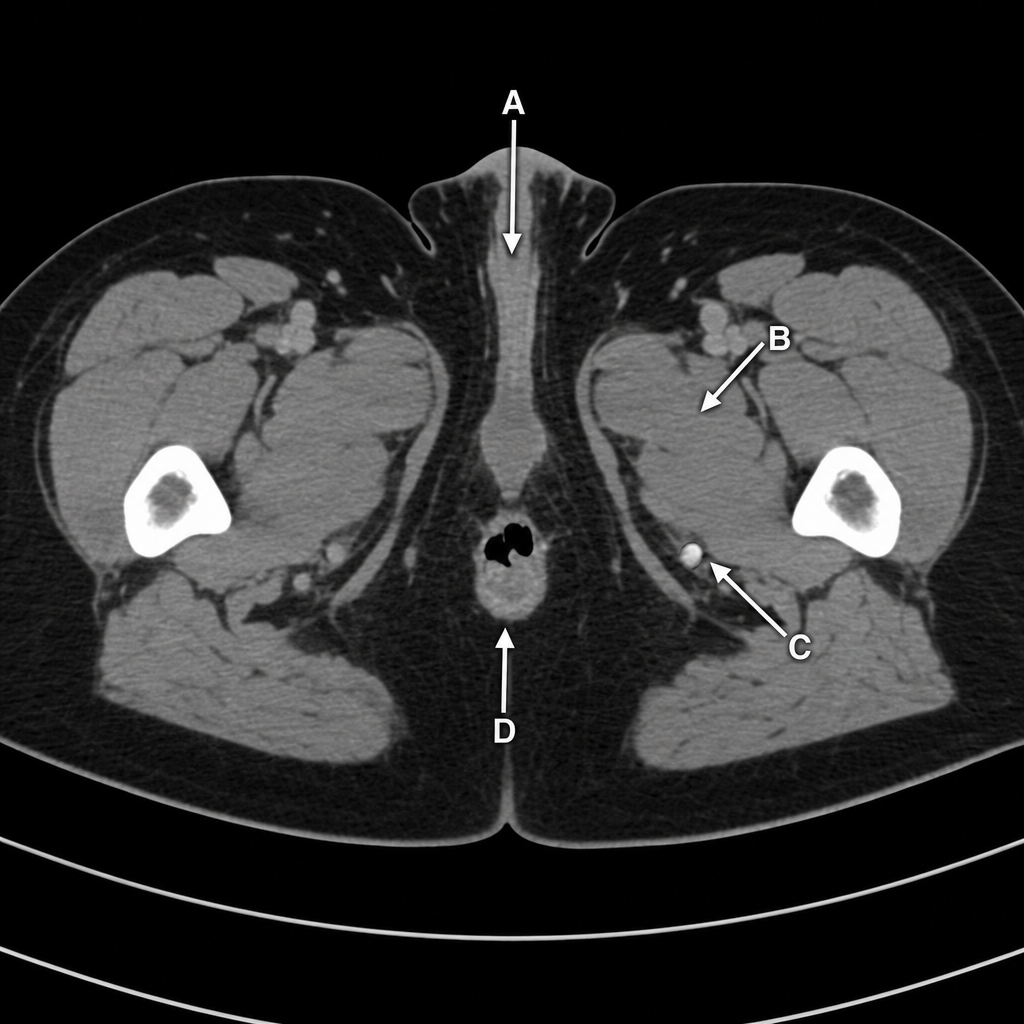
The anorectal ring is formed by the following muscles, except:
The preauricular sulcus is a part of which bone?
A 29-year-old carpenter sustains severe injuries of the pelvic splanchnic nerve by a deep puncture wound, which has become contaminated. The injured parasympathetic preganglionic fibers in the splanchnic nerve are most likely to synapse in which of the following ganglia?
The type of joint between the sacrum and the coccyx is a:
A 42-year-old man presented with severe pain in the lower back radiating to the pubic symphysis. Ultrasonography revealed a 3mm stone in the left ureter. In which of the following sites is the stone most likely to be lodged?
Which of the following structures is drained directly to the deep inguinal lymph nodes?
Which ligament connects the cervix and the fornix to the lateral wall of the pelvis?
The superior vesical arteries are direct branches of the:
What is coaptation?
The prostatic artery is a branch of which artery?
Explanation: The **anorectal ring** is a vital muscular landmark located at the junction of the anal canal and the rectum. It is essential for fecal continence, and its surgical preservation is critical during procedures like fistula-in-ano surgery. ### 1. Why Option B is the Correct Answer The anorectal ring is a composite muscular band formed by the fusion of specific muscles at the upper end of the anal canal. The **superficial part of the external anal sphincter** is excluded because it is a middle component that attaches to the perineal body anteriorly and the coccyx (via the anococcygeal ligament) posteriorly. It does not contribute to the superior ring structure that encircles the anorectal junction. ### 2. Analysis of Other Options * **Puborectalis (Option A):** This is the most significant component [1]. It forms a U-shaped sling around the anorectal junction, creating the anorectal angle (approx. 80°), which is fundamental to maintaining continence [2]. * **Deep part of external sphincter (Option C):** This is the uppermost part of the external sphincter. It lacks bony attachments and blends directly with the fibers of the puborectalis. * **Internal sphincter (Option D):** This is a thickening of the inner circular smooth muscle layer of the rectum. Its upper end contributes to the bulk of the anorectal ring [2]. ### 3. Clinical Pearls for NEET-PG * **Palpation:** On digital rectal examination (DRE), the anorectal ring is felt as a distinct muscular ridge posteriorly and laterally at the upper end of the anal canal. * **Surgical Significance:** Complete division of the anorectal ring inevitably results in **permanent fecal incontinence**. * **The "U-Sling":** Remember that the puborectalis is part of the **levator ani** muscle group [1]. Its contraction pulls the rectum forward, "kinking" the canal to prevent the passage of stool [2].
Explanation: **Explanation:** The **preauricular sulcus** (also known as the paraglenoid groove) is a distinct anatomical feature of the **pelvis**. It is a groove located on the iliac bone, situated just inferior and anterior to the auricular surface of the sacroiliac joint [1]. **Why Pelvis is Correct:** The sulcus serves as the attachment site for the **anterior sacroiliac ligament**. It is a significant osteological marker in forensic anthropology and anatomy because it is sexually dimorphic. It is much more common and prominent in **females** than in males. Its presence is often associated with the widening of the female pelvis for childbirth, though it can also be seen in nulliparous women [1]. **Why Other Options are Incorrect:** * **Humerus:** The humerus features the bicipital (intertubercular) groove and the radial (spiral) groove, but no preauricular structures. * **Femur:** Key depressions on the femur include the fovea capitis and the trochanteric fossa; it lacks a preauricular sulcus. * **Skull:** While the skull has an "auricular" region (related to the ear), such as the external auditory meatus, the *preauricular sulcus* is strictly a pelvic landmark. **High-Yield Clinical Pearls for NEET-PG:** * **Sexual Dimorphism:** The preauricular sulcus is one of the most reliable indicators for identifying a **female pelvis** in forensic examinations. * **Location:** It is found on the **ilium**, specifically on the pelvic (internal) surface [1]. * **Associated Ligament:** It provides attachment to the **ventral (anterior) sacroiliac ligament**. * **Other Pelvic Sex Markers:** Remember to correlate this with a wide subpubic angle (>90°), a large sciatic notch, and a rectangular pubis in females.
Explanation: ### Explanation **Correct Answer: A. Ganglia in or near the viscera or pelvic plexus** The **pelvic splanchnic nerves** (S2, S3, S4) carry **parasympathetic preganglionic fibers**. In the autonomic nervous system, parasympathetic pathways are characterized by long preganglionic fibers that synapse in **terminal ganglia** [1]. These ganglia are located either within the walls of the target organs (intramural) or in plexuses very close to the viscera (such as the inferior hypogastric/pelvic plexus). From these ganglia, short postganglionic fibers emerge to innervate the pelvic viscera and the hindgut (from the left colic flexure to the anal canal). **Why the other options are incorrect:** * **B. Sympathetic chain ganglia (Paravertebral):** These are the site of synapse for **sympathetic** preganglionic fibers (T1–L2). Parasympathetic fibers never synapse here [1]. * **C. Collateral ganglia (Prevertebral):** Examples include the celiac, superior mesenteric, and inferior mesenteric ganglia. These are also sites for **sympathetic** synapses, specifically for fibers traveling via thoracic and lumbar splanchnic nerves. * **D. Dorsal root ganglia:** These contain the cell bodies of **pseudounipolar sensory (afferent) neurons**. They are not autonomic ganglia and do not involve synapses. **High-Yield NEET-PG Pearls:** * **Origin:** Pelvic splanchnics are the *only* splanchnic nerves that are **parasympathetic** (Craniosacral outflow). All other named splanchnic nerves (Greater, Lesser, Least, Lumbar, Sacral) are sympathetic. * **Function:** They mediate "Point and Wet"—erection (pelvic splanchnics) and secretion/contraction of the bladder and rectum. * **Nerve Supply:** They provide parasympathetic supply to the **hindgut** (distal 1/3rd of transverse colon to the upper half of the anal canal).
Explanation: ### Explanation The **sacrococcygeal joint** is a **secondary cartilaginous joint (Symphysis)** [1]. It is formed between the apex of the sacrum and the base of the coccyx, where the articular surfaces are connected by a fibrocartilaginous disc. #### Why Symphysis is Correct: A symphysis is a fibrocartilaginous joint located in the midline of the body. Like the pubic symphysis and intervertebral discs, the sacrococcygeal joint consists of a thin layer of hyaline cartilage on the bony surfaces with a thick intervening fibrocartilage disc. This structure allows for limited movement (passive flexion and extension), which is particularly crucial during childbirth to increase the diameter of the pelvic outlet [1]. #### Why Other Options are Incorrect: * **Synostosis:** This refers to a bony union where bones fuse completely (e.g., the segments of the sacrum itself). While the sacrococcygeal joint may undergo synostosis in old age, it is functionally classified as a symphysis. * **Synchondrosis:** This is a primary cartilaginous joint where bones are joined by hyaline cartilage only (e.g., the first rib and sternum). These are usually temporary and ossify with age. * **Syndesmosis:** This is a fibrous joint where bones are joined by an interosseous ligament (e.g., the inferior tibiofibular joint). #### High-Yield Clinical Pearls for NEET-PG: * **Movement:** During the second stage of labor, the coccyx moves posteriorly to increase the anteroposterior diameter of the pelvic outlet [1]. * **Coccydynia:** Inflammation or injury to this joint leads to localized pain known as coccydynia, often aggravated by sitting. * **Ligaments:** The joint is reinforced by the anterior, posterior, and lateral sacrococcygeal ligaments. The posterior ligament is a functional continuation of the ligamentum flavum.
Explanation: The ureter is a muscular tube that transports urine from the kidney to the bladder. It is not uniform in diameter and possesses three physiological constrictions where calculi (stones) are most likely to become impacted. **Why the Vesicoureteric Junction (VUJ) is correct:** The **Vesicoureteric junction** is the narrowest part of the entire ureter (approximately 1–1.5 mm in diameter). It is the point where the ureter pierces the muscular wall of the urinary bladder obliquely. Because it is the final and tightest constriction, stones that have successfully passed through the upper ureter frequently get lodged here. **Analysis of Incorrect Options:** * **A. Pelvi-ureteric junction (PUJ):** This is the first site of constriction where the renal pelvis tapers into the ureter. While common for larger stones, a 3mm stone often passes this point. * **B. At the pelvic brim:** This is the second site of constriction where the ureter crosses the bifurcation of the common iliac artery. It is wider than the VUJ. * **D. At the vas deferens:** In males, the ureter is crossed superiorly by the vas deferens ("water under the bridge"). While this is a surgical landmark, it is not a site of physiological narrowing or common stone impaction. **High-Yield NEET-PG Pearls:** 1. **Three Sites of Constriction:** * PUJ (L1 level) * Pelvic Brim/Crossing of Iliac arteries (Sacroiliac joint level) * VUJ (Narrowest point; Ischial spine level) 2. **Referred Pain:** Ureteric colic radiates from "loin to groin" (T11–L2). Pain at the pubic symphysis or scrotum/labia majora is mediated by the **Genitofemoral nerve (L1, L2)** and **Ilioguinal nerve (L1)**. 3. **Blood Supply:** The ureter receives segmental supply from the renal, gonadal, internal iliac, and vesical arteries. In surgery, remember that the blood supply approaches the abdominal ureter **medially** and the pelvic ureter **laterally**.
Explanation: The lymphatic drainage of the perineum and lower limb is a high-yield topic for NEET-PG. The key to answering this question lies in distinguishing between structures that drain into the **superficial** versus the **deep** inguinal lymph nodes. ### **Why "Glans Penis" is Correct** The **glans penis** (and the glans clitoridis in females) is a notable exception in the perineal region. While most of the skin of the external genitalia drains to the superficial inguinal nodes, the lymph from the glans penis, along with the distal spongy urethra, bypasses the superficial group and drains **directly into the deep inguinal lymph nodes** (specifically the Node of Cloquet) or the internal iliac nodes. ### **Analysis of Incorrect Options** * **B. Perianal area:** The skin of the perianal region, along with the anal canal below the pectinate line, drains into the **superficial inguinal lymph nodes**. * **C. Lower abdominal wall:** The skin of the infra-umbilical abdominal wall drains downward into the **superficial inguinal lymph nodes**. * **D. Ischiorectal fossa:** Lymphatic drainage from the ischiorectal (ischioanal) fossa primarily follows the internal pudendal vessels to the **internal iliac lymph nodes**. ### **High-Yield NEET-PG Pearls** * **Superficial Inguinal Nodes:** Drain the skin of the lower limb (except the posterolateral calf), the skin of the penis/scrotum, the vulva, the anal canal below the pectinate line, and the lower abdominal wall. * **Deep Inguinal Nodes:** Located medial to the femoral vein. They receive drainage from the **glans penis/clitoris**, the **popliteal nodes**, and deep structures of the lower limb. * **The Exception:** The **Testis** does NOT drain to inguinal nodes; it drains to the **Para-aortic (Pre-aortic) lymph nodes** because of its embryological origin in the posterior abdominal wall.
Explanation: The **Transverse Cervical Ligament**, also known as the **Mackenrodt’s ligament** or **Cardinal ligament**, is a condensation of pelvic fascia. It extends from the cervix and the lateral parts of the vaginal fornix to the lateral pelvic wall [1]. It is the primary support for the uterus, preventing uterine prolapse [1]. **Analysis of Options:** * **Transverse Cervical Ligament (Correct):** It contains the uterine artery and is located at the base of the broad ligament [2]. It provides the strongest support to the cervix and upper vagina [1]. * **Broad Ligament:** This is a double fold of peritoneum that drapes over the uterus and tubes. While it contains the ovaries and tubes, it is not a true "suspensory" ligament and provides minimal structural support. * **Uterosacral Ligaments:** These connect the cervix to the sacrum (posteriorly), not the lateral pelvic wall [1]. They help maintain the uterus in an anteverted position. * **Round Ligaments:** These extend from the uterine horns, pass through the inguinal canal, and terminate in the labia majora. They maintain the anteversion of the uterus during pregnancy but do not attach to the lateral pelvic wall. **High-Yield Clinical Pearls for NEET-PG:** * **Ureter Relation:** The ureter passes **inferior** to the uterine artery ("water under the bridge") within the base of the cardinal ligament [2]. This is a critical landmark during a hysterectomy. * **Uterine Support:** The Cardinal (Transverse Cervical) and Uterosacral ligaments are the **primary (active) supports** of the uterus [1]. * **Level of Support:** According to DeLancey’s classification, the cardinal ligament represents **Level I support**. Damage to this level leads to vault or uterine prolapse.
Explanation: The **superior vesical arteries** are the primary blood supply to the upper portion of the urinary bladder [2]. To understand their origin, one must trace the branches of the **internal iliac artery (anterior division)**. 1. **Why the Umbilical Artery is correct:** In fetal life, the umbilical artery is a major vessel carrying blood to the placenta [1]. After birth, the distal part of this artery obliterates to become the *medial umbilical ligament*. However, the **proximal part remains patent** and gives rise to the **superior vesical arteries** before ending blindly. Thus, they are direct branches of the patent portion of the umbilical artery. 2. **Why other options are incorrect:** * **Internal iliac artery:** While the umbilical artery itself is a branch of the internal iliac, the superior vesical arteries arise specifically from the umbilical artery, making Option B the more precise anatomical answer. * **Internal pudendal artery:** This is a terminal branch of the anterior division of the internal iliac artery that supplies the perineum and external genitalia, not the superior bladder. * **External pudendal artery:** This is a branch of the **femoral artery**, supplying the skin of the external genitalia and lower abdominal wall. **High-Yield NEET-PG Pearls:** * **Inferior Vesical Artery:** In males, it arises directly from the internal iliac artery (supplying the bladder base and prostate). In females, it is replaced by the **vaginal artery** [2]. * **Urachus:** The apex of the bladder is connected to the umbilicus by the median umbilical ligament (remnant of the urachus). * **Artery to Vas Deferens:** Usually arises from the superior vesical artery (a branch of the umbilical artery).
Explanation: **Explanation:** **Coaptation** refers to the tight approximation of the urethral mucosal surfaces. This mechanism is a vital component of the **urinary continence mechanism**, particularly in females. The urethral mucosa is lined by a rich vascular plexus (subepithelial vaginal veins) and supported by soft connective tissue. When these tissues are healthy and engorged, they create a "watertight seal" that prevents the leakage of urine, even when intra-abdominal pressure increases. **Analysis of Options:** * **Option A (Correct):** Coaptation is specifically the mucosal sealing of the urethra. It is maintained by estrogen (which keeps the mucosa thick and vascular) and the surrounding smooth and striated muscles. * **Option B (Incorrect):** The adaptation of the bladder to varying volumes without a significant rise in pressure is known as **compliance** or **cystometric capacity**, mediated by the detrusor muscle's viscoelastic properties [1]. * **Option C (Incorrect):** Stretching of the urethra during voiding is a mechanical response to flow and pressure, not coaptation. * **Option D (Incorrect):** Ureteral constriction in response to urine volume relates to **peristalsis** and the myogenic response, not urethral coaptation. **High-Yield NEET-PG Pearls:** * **The "Seal" Concept:** Think of coaptation as the "washer" in a faucet; while the sphincters provide the "grip," the mucosa provides the "seal." * **Clinical Correlation:** In postmenopausal women, **atrophic urethritis** (due to estrogen deficiency) leads to poor coaptation, significantly contributing to **Stress Urinary Incontinence (SUI)**. * **Key Anatomy:** The **internal urethral sphincter** (involuntary) and **external urethral sphincter** (voluntary/striated) work in tandem with mucosal coaptation to maintain continence.
Explanation: **Explanation:** The **prostatic artery** is typically a branch of the **inferior vesical artery**, which itself is a branch of the anterior division of the internal iliac artery [1]. In males, the inferior vesical artery supplies the fundus of the bladder, the seminal vesicles, and the prostate gland [1]. The prostatic branches often form a plexus around the gland and are crucial during surgical procedures like Transurethral Resection of the Prostate (TURP). **Analysis of Options:** * **Inferior Vesical Artery (Correct):** This is the primary source of blood for the prostate [1]. It provides "capsular" and "urethral" branches that supply the glandular tissue. * **Superior Vesical Artery:** This artery arises from the patent part of the umbilical artery and supplies the superior aspect of the urinary bladder and the distal ureter [1]. It does not reach the prostate. * **Middle Vesical Artery:** This is generally considered an inconsistent branch or a subsidiary branch of the superior vesical artery; it is not a primary source for the prostate. * **Superior Rectal Artery:** This is the terminal continuation of the Inferior Mesenteric Artery (IMA). It supplies the rectum down to the level of the internal anal sphincter, not the pelvic urogenital organs. **High-Yield NEET-PG Pearls:** * **Homologue:** The inferior vesical artery in males is homologous to the **vaginal artery** in females. * **Venous Drainage:** The prostatic venous plexus drains into the internal iliac veins but also communicates with the **Batson’s vertebral venous plexus**. This is the anatomical route for the characteristic osteoblastic metastasis of prostate cancer to the lumbar vertebrae. * **Dual Supply:** While the inferior vesical is the main supply, the middle rectal and internal pudendal arteries may provide accessory supply to the prostate.
Pelvic Walls and Floor
Practice Questions
Pelvic Viscera
Practice Questions
Urogenital Organs
Practice Questions
Pelvic Vasculature
Practice Questions
Pelvic Innervation
Practice Questions
Male Perineum
Practice Questions
Female Perineum
Practice Questions
Pelvic Lymphatics
Practice Questions
Applied Anatomy and Clinical Correlations
Practice Questions
Gender Differences in Pelvic Anatomy
Practice Questions
Get full access to all questions, explanations, and performance tracking.
Start For Free